Transmission Media
Dr R Jegadeesan Prof-CSE
Jyothishmathi Institute of Technology and Science, karimnagar
â—Ľ Transmission media is defined as any thing that
carries information from a source to destination
â—Ľ For example transmission media for two people
having a dinner conversation is the air.
â—Ľ For a written message , the transmission medium
might be a mail carrier, a truck or an airplane
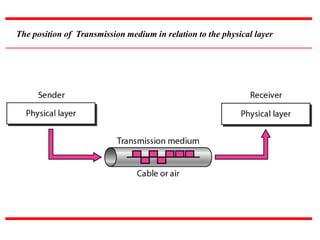
The position of Transmission medium in relation to the physical layer
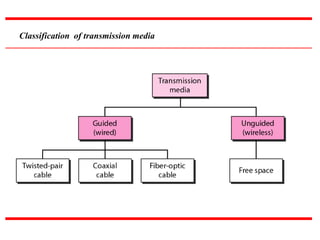
Classification of transmission media
GUIDED MEDIA
➢Guided media, in this type of media , a physical path
is established between source and destination .
➢The signal which is in the form of electromagnetic
waves utilizes the path for transmission
Guided media is of 3 types
➢ Twisted-Pair Cable
➢ Coaxial Cable
➢ Fiber - Optic Cable
Twisted-pair cable
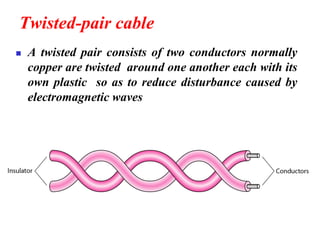
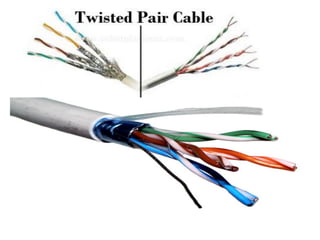
â—Ľ A twisted pair consists of two conductors normally
copper are twisted around one another each with its
own plastic so as to reduce disturbance caused by
electromagnetic waves
➢ One of the wires are used to carry signals to
the receiver and other is used as a ground
reference. The receiver uses the difference
between the two.
➢ In addition to the signal sent by the sender on
one of the wires, interference (noise) and cross
talk may effect both wires and create unwanted
signals.
➢ If the two wires are parallel, the effect of
these unwanted signals is not same in both
wires.
➢ Because they are at different locations
relative to noise or cross talk sources
➢ e.g. one is closer and one is farther
➢ This results in a difference at the receiver.
➢ By twisting the pairs, a balance is maintained.
➢ For example, suppose in one twist, one wire is closer
to the noise source and the other is farther; in the
next twist, the reverse is true.
➢ Twisting makes both the wires are equally affected
by external influences (noise or cross talk)
â—Ľ This means that the receiver which calculates the
difference between the two, receives no unwanted
signals. The unwanted signals are mostly cancelled
out
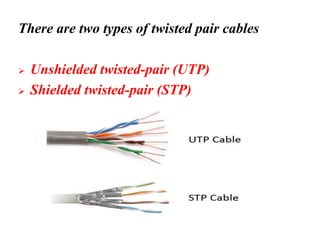
There are two types of twisted pair cables
➢ Unshielded twisted-pair (UTP)
➢ Shielded twisted-pair (STP)
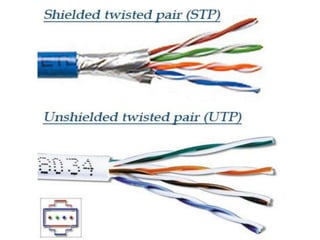
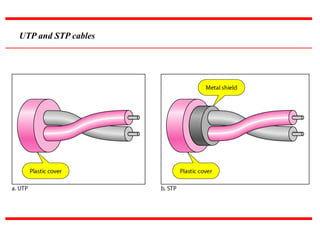
UTP and STP cables
Unshielded twisted-pair (UTP)
➢ In UTP there is no shielding around the twisted pair.
➢ UTP cables are used in telephone companies, computer
networking, Ethernet systems and also in token ring.
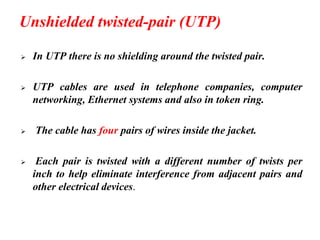
➢ The cable has four pairs of wires inside the jacket.
➢ Each pair is twisted with a different number of twists per
inch to help eliminate interference from adjacent pairs and
other electrical devices.
Categories of UTP
➢ The Electronic Industries Association (EIA)
has developed standards to classify unshielded
twisted-pair cable into seven categories.
➢ Categories are determined by cable quality,
with 1 as the lowest and 7 as the highest
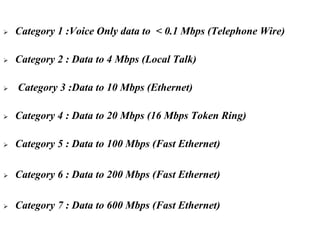
➢ Category 1 :Voice Only data to < 0.1 Mbps (Telephone Wire)
➢ Category 2 : Data to 4 Mbps (Local Talk)
➢ Category 3 :Data to 10 Mbps (Ethernet)
➢ Category 4 : Data to 20 Mbps (16 Mbps Token Ring)
➢ Category 5 : Data to 100 Mbps (Fast Ethernet)
➢ Category 6 : Data to 200 Mbps (Fast Ethernet)
➢ Category 7 : Data to 600 Mbps (Fast Ethernet)
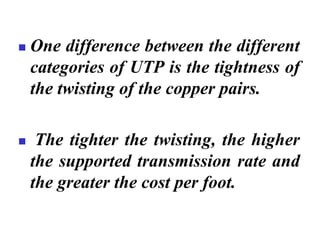
â—Ľ One difference between the different
categories of UTP is the tightness of
the twisting of the copper pairs.
â—Ľ The tighter the twisting, the higher
the supported transmission rate and
the greater the cost per foot.
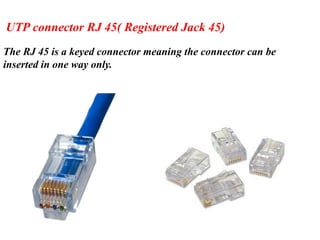
UTP connector RJ 45( Registered Jack 45)
The RJ 45 is a keyed connector meaning the connector can be
inserted in one way only.
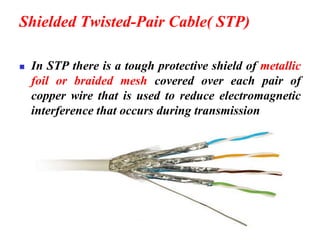
Shielded Twisted-Pair Cable( STP)
â—Ľ In STP there is a tough protective shield of metallic
foil or braided mesh covered over each pair of
copper wire that is used to reduce electromagnetic
interference that occurs during transmission
â—Ľ STP cabling often is used in Ethernet
networks, especially fast data rate Ethernets,
Telephone networks
â—Ľ The advantage of STP is it reduces external
interferences.
â—Ľ STP is expensive compared to UTP
Co-axial cable
➢ Coaxial cable (or coax) carries signals of
higher frequency ranges than those in twisted
pair cable
➢ Co axial cable is different from that of twisted
pair cable.
➢ Co axial cable comprise of two conductors.
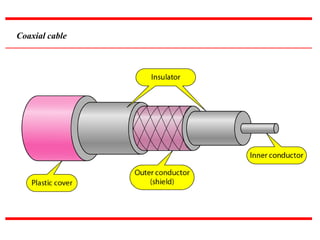
➢ Inner conductor( core conductor) enclosed
in an insulating sheath.
➢ Outer conductor of metal foil, braid, or a
combination of the two.
➢ This outer conductor is also enclosed in an
insulating sheath, and the whole cable is
protected by a plastic cover
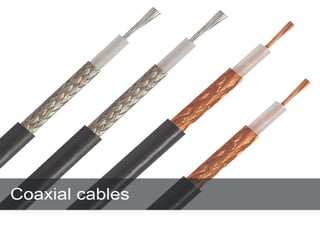
Coaxial cable
Usage of co axial cables
â—Ľ Coaxial cables can be used both for long
distance and short distance transmission.
â—Ľ Coaxial cable is sometimes used by telephone
companies from their central office to the
telephone poles near users.
â—Ľ Coaxial cables are used for connecting
television networks
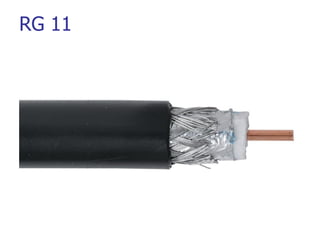
Categories of coaxial cables
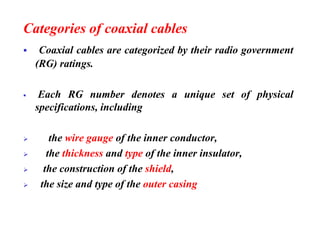
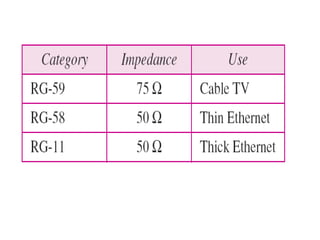
â–Ş Coaxial cables are categorized by their radio government
(RG) ratings.
â–Ş Each RG number denotes a unique set of physical
specifications, including
➢ the wire gauge of the inner conductor,
➢ the thickness and type of the inner insulator,
➢ the construction of the shield,
➢ the size and type of the outer casing
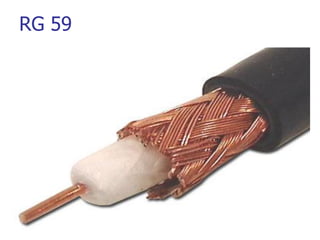
RG 59
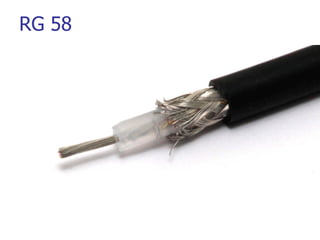
RG 58
RG 11
Coaxial Cable Connectors
â—Ľ To connect coaxial cable to devices, we need
coaxial connectors.
â—Ľ The most common type of connector used
today is the Bayone -Neill- Concelman
(BNC), connector
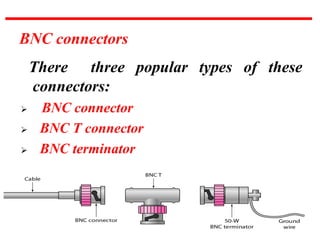
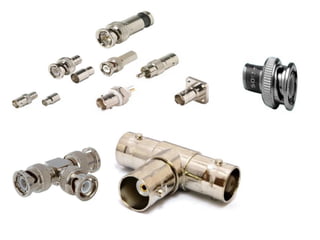
BNC connectors
There three popular types of these
connectors:
➢ BNC connector
➢ BNC T connector
➢ BNC terminator
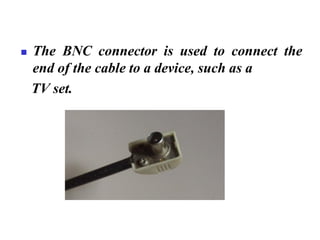
â—Ľ The BNC connector is used to connect the
end of the cable to a device, such as a
TV set.
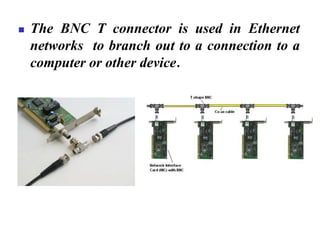
â—Ľ The BNC T connector is used in Ethernet
networks to branch out to a connection to a
computer or other device.
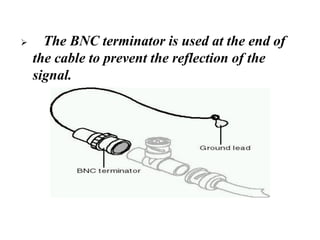
➢ The BNC terminator is used at the end of
the cable to prevent the reflection of the
signal.
Fiber optics cables
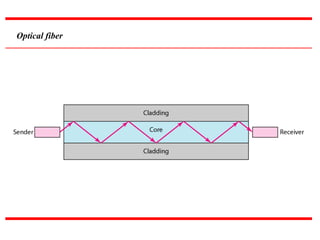
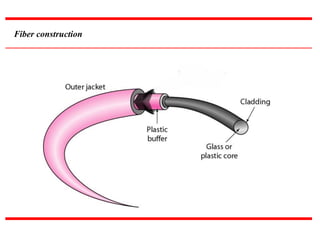
➢ A fiber-optic cable is made of glass or plastic
and transmits signals in the form of light.
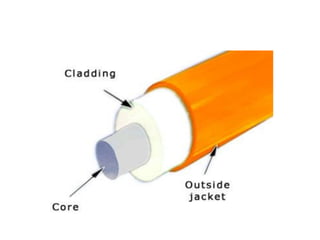
➢ Fiber optic cable consists of three layers.
➢ Core
➢ Cladding
➢ Jacket
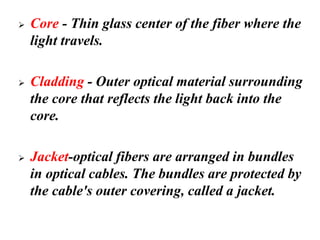
➢ Core - Thin glass center of the fiber where the
light travels.
➢ Cladding - Outer optical material surrounding
the core that reflects the light back into the
core.
➢ Jacket-optical fibers are arranged in bundles
in optical cables. The bundles are protected by
the cable's outer covering, called a jacket.
Optical fiber
Advantages of optical fiber
➢ Wider bandwidth( GHz)
➢ Immunity ( protection)
➢ Reduce transmission loss
➢ Improved security
➢ Durability (works longer time)
➢ Reliable
Disadvantages of optical fiber
➢ Cost
➢ Losses through bending
➢ Specialized tools equipment and training
➢ Less strength
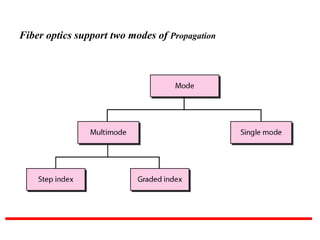
Fiber optics support two modes of Propagation
Multimode
➢ It allows multiple beams of light. This is more
suitable for short distance transmission.
➢ There are two types of multi modes.
➢ Step index multimode
➢ Graded-index multimode
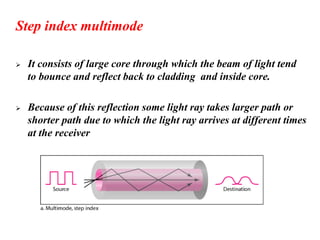
Step index multimode
➢ It consists of large core through which the beam of light tend
to bounce and reflect back to cladding and inside core.
➢ Because of this reflection some light ray takes larger path or
shorter path due to which the light ray arrives at different times
at the receiver
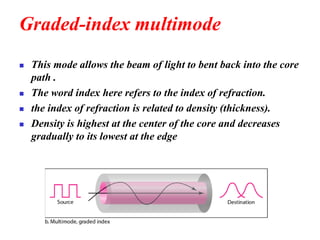
Graded-index multimode
â—Ľ This mode allows the beam of light to bent back into the core
path .
â—Ľ The word index here refers to the index of refraction.
â—Ľ the index of refraction is related to density (thickness).
â—Ľ Density is highest at the center of the core and decreases
gradually to its lowest at the edge
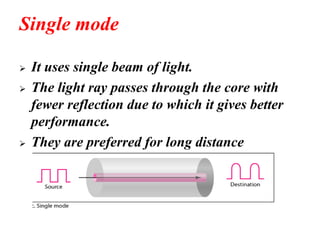
Single mode
➢ It uses single beam of light.
➢ The light ray passes through the core with
fewer reflection due to which it gives better
performance.
➢ They are preferred for long distance
Fiber construction
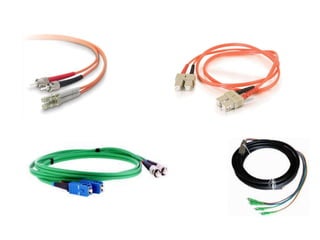
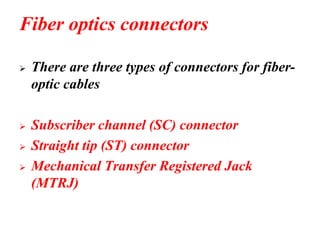
Fiber optics connectors
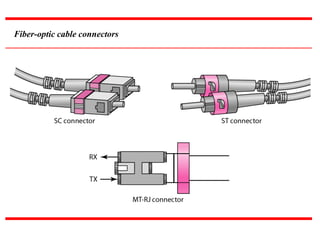
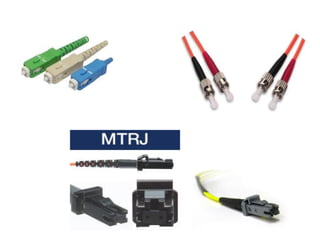
➢ There are three types of connectors for fiber-
optic cables
➢ Subscriber channel (SC) connector
➢ Straight tip (ST) connector
➢ Mechanical Transfer Registered Jack
(MTRJ)
Fiber-optic cable connectors
UNGUIDED MEDIA
(WIRELESS)
➢Unguided media transport electromagnetic waves
without using a physical path.
➢This type of communication is often referred to as
wireless communication which does not guide the
waves but provide methods or ways for transmitting
them.
➢Waves are propogated through air , vacuum and
seawater
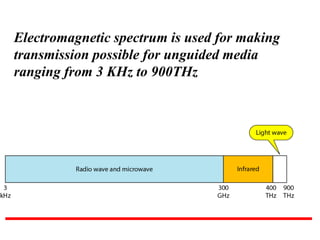
Electromagnetic spectrum is used for making
transmission possible for unguided media
ranging from 3 KHz to 900THz
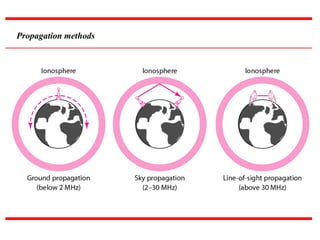
Propagation methods
â—Ľ Unguided signals can travel from source to
destination in several ways
➢ Ground propagation
➢ Sky propagation
➢ Line-of-sight propagation
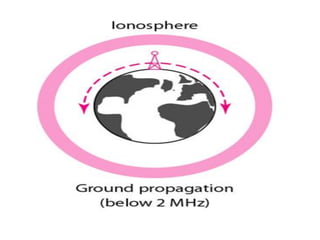
Ground propagation
➢ In this radio waves travel through lowest portion
of the atmosphere, hugging earth.
➢ The low frequency signals travel in all directions
from the transmitting antenna and follow the
curvature of the planet.
➢ Distance depends on the amount of power in the
signal: The greater the power, the greater the
distance.
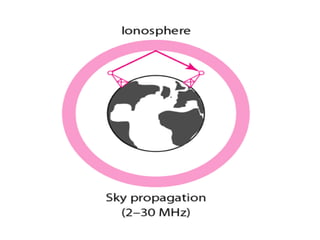
Sky propagation
➢ In sky propagation, higher-frequency radio
waves radiate upward (uplink frequency) into
the ionosphere where they are reflected back
(downlink frequency) to earth.
➢ This type of transmission allows for greater
distances with lower output power.
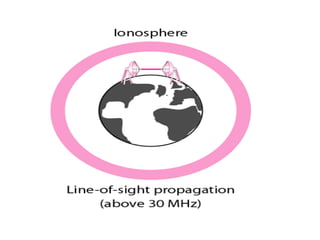
Line-of-sight propagation
â—Ľ In line-or-sight propagation, very high-
frequency signals are transmitted in straight
lines directly from antenna to antenna
â—Ľ Antennas must be directional, facing each
other and either tall enough or close enough
together not to be affected by the curvature of
the earth.
Propagation methods
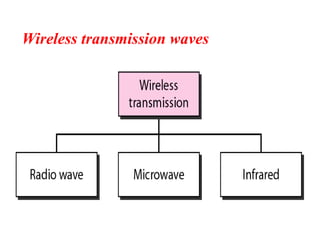
Wireless transmission waves
Radio waves
â—Ľ Electromagnetic waves ranging in frequencies between 3KHz
and 1GHz are normally called radio waves
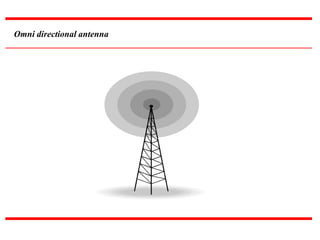
â—Ľ Radio waves, for the most part, are Omni directional.
â—Ľ When an antenna transmits radio waves, they are propagated
in all directions. A sending antenna sends waves that can
be received by any receiving antenna.
â—Ľ Radio waves, particularly those waves that propagate in the
sky mode, can travel long distances.
â—Ľ The radio wave band is relatively narrow, just
under 1 GHz, compared to the microwave
band. When this band is divided into sub
bands, the sub bands are also narrow, leading
to a low data rate for communications
â—Ľ Radio waves are used for multicast
communications, such as radio and
television, and paging systems. They can
penetrate through walls.
Omni directional antenna
Microwaves
â—Ľ Electromagnetic waves having frequencies between 1 and
300 GHz are called microwaves.
â—Ľ Microwaves are unidirectional.
â—Ľ When an antenna transmits microwave waves, they can be
narrowly focused. This means that the sending and receiving
antennas need to be aligned
Characteristics of microwave propagation
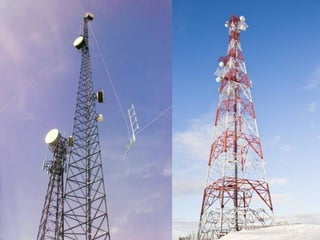
â—Ľ Microwave propagation is line-of-sight. The towers
with the mounted antennas need to be in direct sight
of each other, towers that are far apart need to be
very tall.
â—Ľ Repeaters are often needed for long distance
communication.
â—Ľ The microwave band is relatively wide, almost 299
GHz. Therefore high data rate is possible
Unidirectional Antenna
â—Ľ Microwaves need unidirectional antennas that send
out signals in one direction.
â—Ľ Two types of antennas are used for microwave
communications:
➢ Parabolic dish antenna
➢ Horn antenna
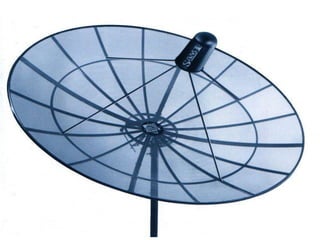
Parabolic dish antenna
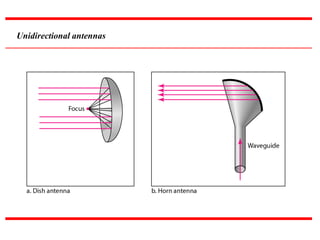
â—Ľ A parabolic dish antenna is based on the geometry
of a parabola.
â—Ľ Every line parallel to the line of symmetry (line of
sight) reflects off the curve at angles such that all
the lines intersect in a common point called the
focus.
â—Ľ The parabolic dish works as a catching a wide range
of waves and directing them to a common point.
Horn antenna
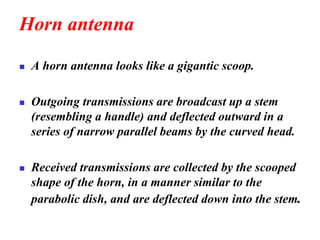
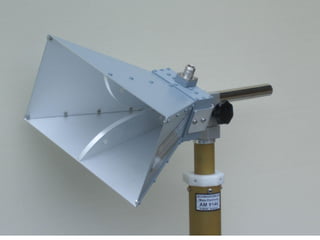
â—Ľ A horn antenna looks like a gigantic scoop.
â—Ľ Outgoing transmissions are broadcast up a stem
(resembling a handle) and deflected outward in a
series of narrow parallel beams by the curved head.
â—Ľ Received transmissions are collected by the scooped
shape of the horn, in a manner similar to the
parabolic dish, and are deflected down into the stem.
Unidirectional antennas
â—Ľ Microwaves are used for unicast
communication such as cellular
telephones, satellite networks, and
wireless LANs.
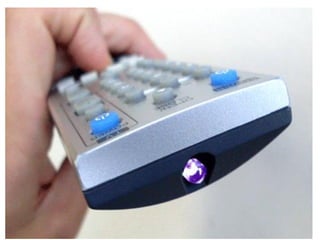
Infrared
â—Ľ Infrared waves, with frequencies from 300
GHz to 400 THz can be used for short-range
communication.
â—Ľ Infrared waves, having high frequencies,
cannot penetrate walls. This advantageous
characteristic prevents interference between
one system and another.
â—Ľ Infrared signals are useless for long-range
communication
â—Ľ we cannot use infrared waves outside a
building because the sun's rays contain
infrared waves that can interfere with the
communication.
â—Ľ Infrared signals can be used for short-range
communication in a closed area using line-
of-sight propagation.
Thank you

Transmission Media

  • 1.
    Transmission Media Dr RJegadeesan Prof-CSE Jyothishmathi Institute of Technology and Science, karimnagar
  • 2.
    â—Ľ Transmission mediais defined as any thing that carries information from a source to destination â—Ľ For example transmission media for two people having a dinner conversation is the air. â—Ľ For a written message , the transmission medium might be a mail carrier, a truck or an airplane
  • 3.
    The position ofTransmission medium in relation to the physical layer
  • 4.
  • 5.
  • 6.
    ➢Guided media, inthis type of media , a physical path is established between source and destination . ➢The signal which is in the form of electromagnetic waves utilizes the path for transmission Guided media is of 3 types ➢ Twisted-Pair Cable ➢ Coaxial Cable ➢ Fiber - Optic Cable
  • 7.
    Twisted-pair cable â—Ľ Atwisted pair consists of two conductors normally copper are twisted around one another each with its own plastic so as to reduce disturbance caused by electromagnetic waves
  • 9.
    ➢ One ofthe wires are used to carry signals to the receiver and other is used as a ground reference. The receiver uses the difference between the two. ➢ In addition to the signal sent by the sender on one of the wires, interference (noise) and cross talk may effect both wires and create unwanted signals.
  • 10.
    ➢ If thetwo wires are parallel, the effect of these unwanted signals is not same in both wires. ➢ Because they are at different locations relative to noise or cross talk sources ➢ e.g. one is closer and one is farther ➢ This results in a difference at the receiver.
  • 11.
    ➢ By twistingthe pairs, a balance is maintained. ➢ For example, suppose in one twist, one wire is closer to the noise source and the other is farther; in the next twist, the reverse is true. ➢ Twisting makes both the wires are equally affected by external influences (noise or cross talk) ◼ This means that the receiver which calculates the difference between the two, receives no unwanted signals. The unwanted signals are mostly cancelled out
  • 12.
    There are twotypes of twisted pair cables ➢ Unshielded twisted-pair (UTP) ➢ Shielded twisted-pair (STP)
  • 14.
  • 15.
    Unshielded twisted-pair (UTP) ➢In UTP there is no shielding around the twisted pair. ➢ UTP cables are used in telephone companies, computer networking, Ethernet systems and also in token ring. ➢ The cable has four pairs of wires inside the jacket. ➢ Each pair is twisted with a different number of twists per inch to help eliminate interference from adjacent pairs and other electrical devices.
  • 16.
    Categories of UTP ➢The Electronic Industries Association (EIA) has developed standards to classify unshielded twisted-pair cable into seven categories. ➢ Categories are determined by cable quality, with 1 as the lowest and 7 as the highest
  • 17.
    ➢ Category 1:Voice Only data to < 0.1 Mbps (Telephone Wire) ➢ Category 2 : Data to 4 Mbps (Local Talk) ➢ Category 3 :Data to 10 Mbps (Ethernet) ➢ Category 4 : Data to 20 Mbps (16 Mbps Token Ring) ➢ Category 5 : Data to 100 Mbps (Fast Ethernet) ➢ Category 6 : Data to 200 Mbps (Fast Ethernet) ➢ Category 7 : Data to 600 Mbps (Fast Ethernet)
  • 18.
    â—Ľ One differencebetween the different categories of UTP is the tightness of the twisting of the copper pairs. â—Ľ The tighter the twisting, the higher the supported transmission rate and the greater the cost per foot.
  • 19.
    UTP connector RJ45( Registered Jack 45) The RJ 45 is a keyed connector meaning the connector can be inserted in one way only.
  • 20.
    Shielded Twisted-Pair Cable(STP) â—Ľ In STP there is a tough protective shield of metallic foil or braided mesh covered over each pair of copper wire that is used to reduce electromagnetic interference that occurs during transmission
  • 21.
    â—Ľ STP cablingoften is used in Ethernet networks, especially fast data rate Ethernets, Telephone networks â—Ľ The advantage of STP is it reduces external interferences. â—Ľ STP is expensive compared to UTP
  • 22.
    Co-axial cable ➢ Coaxialcable (or coax) carries signals of higher frequency ranges than those in twisted pair cable ➢ Co axial cable is different from that of twisted pair cable. ➢ Co axial cable comprise of two conductors.
  • 23.
    ➢ Inner conductor(core conductor) enclosed in an insulating sheath. ➢ Outer conductor of metal foil, braid, or a combination of the two. ➢ This outer conductor is also enclosed in an insulating sheath, and the whole cable is protected by a plastic cover
  • 24.
  • 26.
    Usage of coaxial cables â—Ľ Coaxial cables can be used both for long distance and short distance transmission. â—Ľ Coaxial cable is sometimes used by telephone companies from their central office to the telephone poles near users. â—Ľ Coaxial cables are used for connecting television networks
  • 27.
    Categories of coaxialcables ▪ Coaxial cables are categorized by their radio government (RG) ratings. ▪ Each RG number denotes a unique set of physical specifications, including ➢ the wire gauge of the inner conductor, ➢ the thickness and type of the inner insulator, ➢ the construction of the shield, ➢ the size and type of the outer casing
  • 29.
  • 30.
  • 31.
  • 32.
    Coaxial Cable Connectors â—ĽTo connect coaxial cable to devices, we need coaxial connectors. â—Ľ The most common type of connector used today is the Bayone -Neill- Concelman (BNC), connector
  • 33.
    BNC connectors There threepopular types of these connectors: ➢ BNC connector ➢ BNC T connector ➢ BNC terminator
  • 35.
    â—Ľ The BNCconnector is used to connect the end of the cable to a device, such as a TV set.
  • 36.
    â—Ľ The BNCT connector is used in Ethernet networks to branch out to a connection to a computer or other device.
  • 37.
    ➢ The BNCterminator is used at the end of the cable to prevent the reflection of the signal.
  • 38.
    Fiber optics cables ➢A fiber-optic cable is made of glass or plastic and transmits signals in the form of light. ➢ Fiber optic cable consists of three layers. ➢ Core ➢ Cladding ➢ Jacket
  • 39.
    ➢ Core -Thin glass center of the fiber where the light travels. ➢ Cladding - Outer optical material surrounding the core that reflects the light back into the core. ➢ Jacket-optical fibers are arranged in bundles in optical cables. The bundles are protected by the cable's outer covering, called a jacket.
  • 40.
  • 42.
    Advantages of opticalfiber ➢ Wider bandwidth( GHz) ➢ Immunity ( protection) ➢ Reduce transmission loss ➢ Improved security ➢ Durability (works longer time) ➢ Reliable
  • 43.
    Disadvantages of opticalfiber ➢ Cost ➢ Losses through bending ➢ Specialized tools equipment and training ➢ Less strength
  • 44.
    Fiber optics supporttwo modes of Propagation
  • 45.
    Multimode ➢ It allowsmultiple beams of light. This is more suitable for short distance transmission. ➢ There are two types of multi modes. ➢ Step index multimode ➢ Graded-index multimode
  • 46.
    Step index multimode ➢It consists of large core through which the beam of light tend to bounce and reflect back to cladding and inside core. ➢ Because of this reflection some light ray takes larger path or shorter path due to which the light ray arrives at different times at the receiver
  • 47.
    Graded-index multimode â—Ľ Thismode allows the beam of light to bent back into the core path . â—Ľ The word index here refers to the index of refraction. â—Ľ the index of refraction is related to density (thickness). â—Ľ Density is highest at the center of the core and decreases gradually to its lowest at the edge
  • 48.
    Single mode ➢ Ituses single beam of light. ➢ The light ray passes through the core with fewer reflection due to which it gives better performance. ➢ They are preferred for long distance
  • 50.
  • 51.
    Fiber optics connectors ➢There are three types of connectors for fiber- optic cables ➢ Subscriber channel (SC) connector ➢ Straight tip (ST) connector ➢ Mechanical Transfer Registered Jack (MTRJ)
  • 52.
  • 54.
  • 55.
    ➢Unguided media transportelectromagnetic waves without using a physical path. ➢This type of communication is often referred to as wireless communication which does not guide the waves but provide methods or ways for transmitting them. ➢Waves are propogated through air , vacuum and seawater
  • 56.
    Electromagnetic spectrum isused for making transmission possible for unguided media ranging from 3 KHz to 900THz
  • 57.
    Propagation methods ◼ Unguidedsignals can travel from source to destination in several ways ➢ Ground propagation ➢ Sky propagation ➢ Line-of-sight propagation
  • 58.
    Ground propagation ➢ Inthis radio waves travel through lowest portion of the atmosphere, hugging earth. ➢ The low frequency signals travel in all directions from the transmitting antenna and follow the curvature of the planet. ➢ Distance depends on the amount of power in the signal: The greater the power, the greater the distance.
  • 60.
    Sky propagation ➢ Insky propagation, higher-frequency radio waves radiate upward (uplink frequency) into the ionosphere where they are reflected back (downlink frequency) to earth. ➢ This type of transmission allows for greater distances with lower output power.
  • 62.
    Line-of-sight propagation â—Ľ Inline-or-sight propagation, very high- frequency signals are transmitted in straight lines directly from antenna to antenna â—Ľ Antennas must be directional, facing each other and either tall enough or close enough together not to be affected by the curvature of the earth.
  • 64.
  • 65.
  • 66.
    Radio waves â—Ľ Electromagneticwaves ranging in frequencies between 3KHz and 1GHz are normally called radio waves â—Ľ Radio waves, for the most part, are Omni directional. â—Ľ When an antenna transmits radio waves, they are propagated in all directions. A sending antenna sends waves that can be received by any receiving antenna. â—Ľ Radio waves, particularly those waves that propagate in the sky mode, can travel long distances.
  • 67.
    â—Ľ The radiowave band is relatively narrow, just under 1 GHz, compared to the microwave band. When this band is divided into sub bands, the sub bands are also narrow, leading to a low data rate for communications â—Ľ Radio waves are used for multicast communications, such as radio and television, and paging systems. They can penetrate through walls.
  • 68.
  • 70.
    Microwaves â—Ľ Electromagnetic waveshaving frequencies between 1 and 300 GHz are called microwaves. â—Ľ Microwaves are unidirectional. â—Ľ When an antenna transmits microwave waves, they can be narrowly focused. This means that the sending and receiving antennas need to be aligned
  • 71.
    Characteristics of microwavepropagation â—Ľ Microwave propagation is line-of-sight. The towers with the mounted antennas need to be in direct sight of each other, towers that are far apart need to be very tall. â—Ľ Repeaters are often needed for long distance communication. â—Ľ The microwave band is relatively wide, almost 299 GHz. Therefore high data rate is possible
  • 72.
    Unidirectional Antenna ◼ Microwavesneed unidirectional antennas that send out signals in one direction. ◼ Two types of antennas are used for microwave communications: ➢ Parabolic dish antenna ➢ Horn antenna
  • 73.
    Parabolic dish antenna â—ĽA parabolic dish antenna is based on the geometry of a parabola. â—Ľ Every line parallel to the line of symmetry (line of sight) reflects off the curve at angles such that all the lines intersect in a common point called the focus. â—Ľ The parabolic dish works as a catching a wide range of waves and directing them to a common point.
  • 75.
    Horn antenna â—Ľ Ahorn antenna looks like a gigantic scoop. â—Ľ Outgoing transmissions are broadcast up a stem (resembling a handle) and deflected outward in a series of narrow parallel beams by the curved head. â—Ľ Received transmissions are collected by the scooped shape of the horn, in a manner similar to the parabolic dish, and are deflected down into the stem.
  • 77.
  • 78.
    â—Ľ Microwaves areused for unicast communication such as cellular telephones, satellite networks, and wireless LANs.
  • 79.
    Infrared â—Ľ Infrared waves,with frequencies from 300 GHz to 400 THz can be used for short-range communication. â—Ľ Infrared waves, having high frequencies, cannot penetrate walls. This advantageous characteristic prevents interference between one system and another. â—Ľ Infrared signals are useless for long-range communication
  • 80.
    â—Ľ we cannotuse infrared waves outside a building because the sun's rays contain infrared waves that can interfere with the communication. â—Ľ Infrared signals can be used for short-range communication in a closed area using line- of-sight propagation.
  • 82.