Transmission Media ( Guided and Wireless Transmission ) Pg 128
Overview Guided  – provide a physical path along which the signals are propagated Wire: Coaxial Cable, Optical Fiber, Twisted Pair Unguided  –employ an antenna for transmitting through air, vacuum or water. wireless Characteristics and quality determined by medium and signal For guided, the medium is more important For unguided, the bandwidth produced by the antenna is more important Key concerns are  data rate  and  distance Key Points
Design Factors Bandwidth Higher bandwidth gives higher data rate Transmission impairments Attenuation Interference Number of receivers In guided media More receivers (multi-point) introduce more attenuation
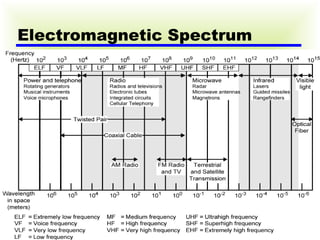
Electromagnetic Spectrum
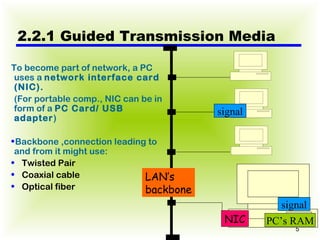
2.2.1 Guided Transmission Media To become part of network, a PC uses a  network interface card (NIC). (For portable comp., NIC can be in form of a  PC Card/ USB adapter ) Backbone ,connection leading to and from it might use: Twisted Pair Coaxial cable Optical fiber PC’s RAM NIC LAN’s  backbone signal signal
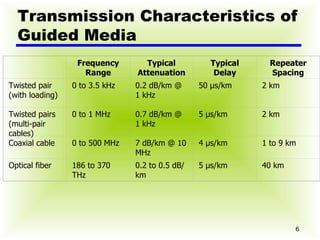
Transmission Characteristics of Guided Media      Frequency Range Typical Attenuation Typical Delay Repeater Spacing Twisted pair (with loading) 0 to 3.5 kHz 0.2 dB/km @ 1 kHz 50 µs/km 2 km Twisted pairs (multi-pair cables) 0 to 1 MHz 0.7 dB/km @ 1 kHz 5 µs/km 2 km Coaxial cable 0 to 500 MHz 7 dB/km @ 10 MHz 4 µs/km 1 to 9 km Optical fiber 186 to 370 THz 0.2 to 0.5 dB/km 5 µs/km 40 km
Twisted Pair –  Physical Description
Twisted Pair -  Applications Most common transmission medium for analog/digital signal Telephone network Between house and  local tel. exchange (subscriber loop) Com. within buildings To  private branch exchange (PBX) For local area networks (LAN) 10Mbps or 100Mbps
Twisted Pair -  Pros and Cons Pros Cheap Easy to work with Cons Low data rate Short range
Twisted Pair  -  Transmission Characteristics Analog  Amplifiers every 5km to 6km Digital Use either analog or digital signals repeater every 2km or 3km Limited distance Limited bandwidth (1MHz) Limited data rate (100MHz) Susceptible to interference and noise
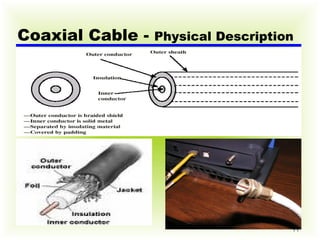
Coaxial Cable -  Physical Description
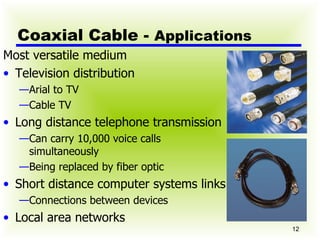
Coaxial Cable -  Applications Most versatile medium Television distribution Arial to TV Cable TV Long distance telephone transmission Can carry 10,000 voice calls simultaneously Being replaced by fiber optic Short distance computer systems links  Connections between devices Local area networks
Coaxial Cable - Benefits Less susceptible to interference and crosstalk** Longer distance** **(compared to twisted pair) Wide variety of application
Coaxial Cable  -  Transmission Characteristics Analog Amplifiers every few km Closer if higher frequency Up to 500MHz Digital Repeater every 1km Closer for higher data rates
Optical Fiber -  Physical Description
Optical Fiber -  Benefits Greater capacity Data rates of hundreds of Gbps Smaller size & weight Lower attenuation Electromagnetic isolation Not affected by external electromagnetic fields Greater repeater spacing 10s of km at least
Optical Fiber -  Applications Tel. network Long-haul trunks (laluan)  aver. 1500 km, 20k-60k voice channels Metropolitan trunks aver. 12 km, 100k voice channels Rural exchange trunks Links town-village 40-160 km Subscriber (Pelanggan)   loops Central exchange - subsciber LANs 100 Mbps to 1Gbps
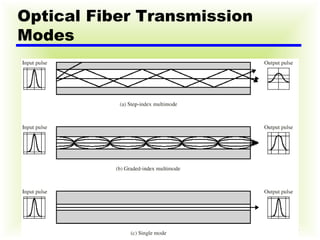
Optical Fiber Transmission Modes
Wireless Transmission Frequencies 2GHz to 40GHz Microwave frequencies Highly directional (one way) Point to point transmission Satellite 30MHz to 1GHz ( radio range ) Omnidirectional Broadcast radio 3 x 10 11  to 2 x 10 14  Hz Infrared
Antennas Electrical conductor (or system of conductor) used to radiate electromagnetic energy or collect electromagnetic energy Transmission of signal Radio-frequency electrical energy from transmitter Converted to electromagnetic energy By antenna Radiated into surrounding environment; atmosphere, space, water Reception of signal Electromagnetic energy impinging(melanggar) on antenna Converted to radio-frequency electrical energy Fed to receiver Same antenna often used for both
Terrestrial Microwave Parabolic dish Long haul telecommunications (application) alternative to coaxial cable or optical fiber. requires far fewer amplifiers/repeaters than coaxial cable over the same distance but requires LOS (line-of -sight) transmission. Higher frequencies give higher data rates common frequencies used for transmission are in the range 1 to 40GHz.
Satellite Microwave Satellite is relay station Satellite receives on one frequency (uplink), amplifies or repeats signal and transmits on another frequency (downlink) Applications Television Long distance telephone
Satellite Point to Point Link Uplink Downlink
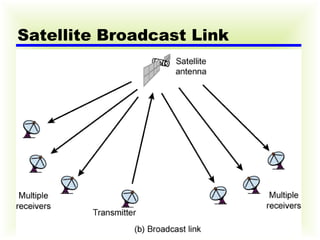
Satellite Broadcast Link
Broadcast Radio Omnidirectional FM radio UHF and VHF television Suffers from multipath interference Reflections
Infrared Achieved using transmitter/receivers (transceiver) that modulate non-coherent infrared light Transceivers must be within the line of sight of each other either directly or via reflection form a light-colored surface such as the ceiling of a room. Blocked by walls e.g. TV remote control
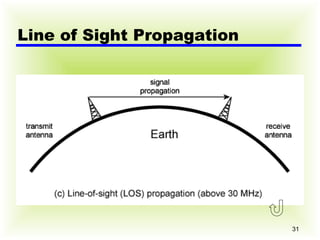
Wireless Propagation Signal travels along three routes Ground wave Follows contour of earth Up to 2MHz Best-known example of ground wave communication is AM radio Sky wave Used for amateur radio, BBC world service, Voice of America A signal from an earth-based antenna is reflected from ionosphere layer of upper atmosphere back down to earth. Line of sight (LOS) Above 30Mhz, neither ground wave or sky wave propagation modes operate, and communication must be by LOS.
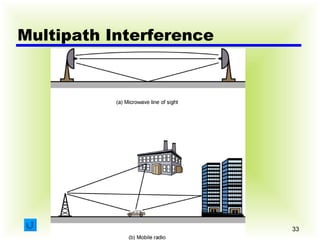
Line of Sight Transmission’s Impairment Free space loss Signal disperses with distance (signal spread over a larger and larger area) Atmospheric Absorption Water vapour and oxygen absorb radio signals Water greatest at 22GHz, less below 15GHz Oxygen greater at 60GHz, less below 30GHz Rain and fog scatter radio waves that results in attenuation. Multipath Better to get line of sight if possible Signal can be reflected causing multiple copies to be received May be no direct signal at all May reinforce or cancel direct signal Refraction May result in partial or total loss of signal at receiver END!!
Ground Wave Propagation
Sky Wave Propagation
Line of Sight Propagation
Free Space Loss
Multipath Interference
Key Points Transmission media – guided and unguided For guided transmission: Twisted pair has been the workhorse for com. of all sorts. Higher data rates over longer distances can be achieved with coaxial cable, so coaxial cable has been often been used for high-speed LAN and for high-capacity long-distance trunk applications.
Key Points(2) However, tremendous capacity of optical fiber has made that medium more attractive than coaxial cable, and thus optical fiber has taken over much of the market for high-speed LANs and for long-distance applications. For unguided transmission: Commonly used for info. com. including broadcast radio, terrestrial  ( daratan )  microwave, and satellite. Infrared transmission is used in some LAN applications.
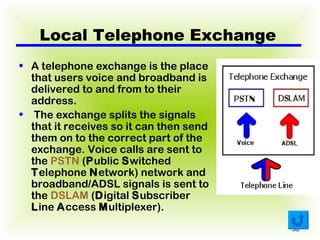
Local Telephone Exchange A telephone exchange is the place that users voice and broadband is delivered to and from to their address. The exchange splits the signals that it receives so it can then send them on to the correct part of the exchange. Voice calls are sent to the  PSTN  ( P ublic  S witched  T elephone  N etwork) network and broadband/ADSL signals is sent to the  DSLAM  ( D igital  S ubscriber  L ine  A ccess  M ultiplexer).
private branch exchange A PBX (private branch exchange) is a telephone system within an  enterprise  that switches calls between enterprise users on local lines while allowing all users to share a certain number of external phone lines. The main purpose of a PBX is to save the cost of requiring a line for each user to the telephone company's central office.

3. transmission media

  • 1.
    Transmission Media (Guided and Wireless Transmission ) Pg 128
  • 2.
    Overview Guided – provide a physical path along which the signals are propagated Wire: Coaxial Cable, Optical Fiber, Twisted Pair Unguided –employ an antenna for transmitting through air, vacuum or water. wireless Characteristics and quality determined by medium and signal For guided, the medium is more important For unguided, the bandwidth produced by the antenna is more important Key concerns are data rate and distance Key Points
  • 3.
    Design Factors BandwidthHigher bandwidth gives higher data rate Transmission impairments Attenuation Interference Number of receivers In guided media More receivers (multi-point) introduce more attenuation
  • 4.
  • 5.
    2.2.1 Guided TransmissionMedia To become part of network, a PC uses a network interface card (NIC). (For portable comp., NIC can be in form of a PC Card/ USB adapter ) Backbone ,connection leading to and from it might use: Twisted Pair Coaxial cable Optical fiber PC’s RAM NIC LAN’s backbone signal signal
  • 6.
    Transmission Characteristics ofGuided Media     Frequency Range Typical Attenuation Typical Delay Repeater Spacing Twisted pair (with loading) 0 to 3.5 kHz 0.2 dB/km @ 1 kHz 50 µs/km 2 km Twisted pairs (multi-pair cables) 0 to 1 MHz 0.7 dB/km @ 1 kHz 5 µs/km 2 km Coaxial cable 0 to 500 MHz 7 dB/km @ 10 MHz 4 µs/km 1 to 9 km Optical fiber 186 to 370 THz 0.2 to 0.5 dB/km 5 µs/km 40 km
  • 7.
    Twisted Pair – Physical Description
  • 8.
    Twisted Pair - Applications Most common transmission medium for analog/digital signal Telephone network Between house and local tel. exchange (subscriber loop) Com. within buildings To private branch exchange (PBX) For local area networks (LAN) 10Mbps or 100Mbps
  • 9.
    Twisted Pair - Pros and Cons Pros Cheap Easy to work with Cons Low data rate Short range
  • 10.
    Twisted Pair - Transmission Characteristics Analog Amplifiers every 5km to 6km Digital Use either analog or digital signals repeater every 2km or 3km Limited distance Limited bandwidth (1MHz) Limited data rate (100MHz) Susceptible to interference and noise
  • 11.
    Coaxial Cable - Physical Description
  • 12.
    Coaxial Cable - Applications Most versatile medium Television distribution Arial to TV Cable TV Long distance telephone transmission Can carry 10,000 voice calls simultaneously Being replaced by fiber optic Short distance computer systems links Connections between devices Local area networks
  • 13.
    Coaxial Cable -Benefits Less susceptible to interference and crosstalk** Longer distance** **(compared to twisted pair) Wide variety of application
  • 14.
    Coaxial Cable - Transmission Characteristics Analog Amplifiers every few km Closer if higher frequency Up to 500MHz Digital Repeater every 1km Closer for higher data rates
  • 15.
    Optical Fiber - Physical Description
  • 16.
    Optical Fiber - Benefits Greater capacity Data rates of hundreds of Gbps Smaller size & weight Lower attenuation Electromagnetic isolation Not affected by external electromagnetic fields Greater repeater spacing 10s of km at least
  • 17.
    Optical Fiber - Applications Tel. network Long-haul trunks (laluan) aver. 1500 km, 20k-60k voice channels Metropolitan trunks aver. 12 km, 100k voice channels Rural exchange trunks Links town-village 40-160 km Subscriber (Pelanggan) loops Central exchange - subsciber LANs 100 Mbps to 1Gbps
  • 18.
  • 19.
    Wireless Transmission Frequencies2GHz to 40GHz Microwave frequencies Highly directional (one way) Point to point transmission Satellite 30MHz to 1GHz ( radio range ) Omnidirectional Broadcast radio 3 x 10 11 to 2 x 10 14 Hz Infrared
  • 20.
    Antennas Electrical conductor(or system of conductor) used to radiate electromagnetic energy or collect electromagnetic energy Transmission of signal Radio-frequency electrical energy from transmitter Converted to electromagnetic energy By antenna Radiated into surrounding environment; atmosphere, space, water Reception of signal Electromagnetic energy impinging(melanggar) on antenna Converted to radio-frequency electrical energy Fed to receiver Same antenna often used for both
  • 21.
    Terrestrial Microwave Parabolicdish Long haul telecommunications (application) alternative to coaxial cable or optical fiber. requires far fewer amplifiers/repeaters than coaxial cable over the same distance but requires LOS (line-of -sight) transmission. Higher frequencies give higher data rates common frequencies used for transmission are in the range 1 to 40GHz.
  • 22.
    Satellite Microwave Satelliteis relay station Satellite receives on one frequency (uplink), amplifies or repeats signal and transmits on another frequency (downlink) Applications Television Long distance telephone
  • 23.
    Satellite Point toPoint Link Uplink Downlink
  • 24.
  • 25.
    Broadcast Radio OmnidirectionalFM radio UHF and VHF television Suffers from multipath interference Reflections
  • 26.
    Infrared Achieved usingtransmitter/receivers (transceiver) that modulate non-coherent infrared light Transceivers must be within the line of sight of each other either directly or via reflection form a light-colored surface such as the ceiling of a room. Blocked by walls e.g. TV remote control
  • 27.
    Wireless Propagation Signaltravels along three routes Ground wave Follows contour of earth Up to 2MHz Best-known example of ground wave communication is AM radio Sky wave Used for amateur radio, BBC world service, Voice of America A signal from an earth-based antenna is reflected from ionosphere layer of upper atmosphere back down to earth. Line of sight (LOS) Above 30Mhz, neither ground wave or sky wave propagation modes operate, and communication must be by LOS.
  • 28.
    Line of SightTransmission’s Impairment Free space loss Signal disperses with distance (signal spread over a larger and larger area) Atmospheric Absorption Water vapour and oxygen absorb radio signals Water greatest at 22GHz, less below 15GHz Oxygen greater at 60GHz, less below 30GHz Rain and fog scatter radio waves that results in attenuation. Multipath Better to get line of sight if possible Signal can be reflected causing multiple copies to be received May be no direct signal at all May reinforce or cancel direct signal Refraction May result in partial or total loss of signal at receiver END!!
  • 29.
  • 30.
  • 31.
    Line of SightPropagation
  • 32.
  • 33.
  • 34.
    Key Points Transmissionmedia – guided and unguided For guided transmission: Twisted pair has been the workhorse for com. of all sorts. Higher data rates over longer distances can be achieved with coaxial cable, so coaxial cable has been often been used for high-speed LAN and for high-capacity long-distance trunk applications.
  • 35.
    Key Points(2) However,tremendous capacity of optical fiber has made that medium more attractive than coaxial cable, and thus optical fiber has taken over much of the market for high-speed LANs and for long-distance applications. For unguided transmission: Commonly used for info. com. including broadcast radio, terrestrial ( daratan ) microwave, and satellite. Infrared transmission is used in some LAN applications.
  • 36.
    Local Telephone ExchangeA telephone exchange is the place that users voice and broadband is delivered to and from to their address. The exchange splits the signals that it receives so it can then send them on to the correct part of the exchange. Voice calls are sent to the PSTN ( P ublic S witched T elephone N etwork) network and broadband/ADSL signals is sent to the DSLAM ( D igital S ubscriber L ine A ccess M ultiplexer).
  • 37.
    private branch exchangeA PBX (private branch exchange) is a telephone system within an enterprise that switches calls between enterprise users on local lines while allowing all users to share a certain number of external phone lines. The main purpose of a PBX is to save the cost of requiring a line for each user to the telephone company's central office.