Introduction of transmission media.
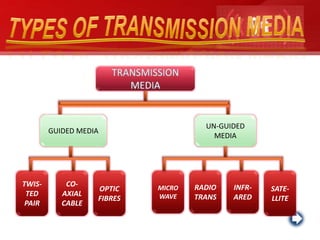
Types of transmission media
• Guidedbounded media
• Unguidedunbounded media
Guided wired transmission
• Twisted pair cable
• Coaxial cable
• Optical fiber cable
Unguided wireless transmission
• Radio transmission
• Microwave transmission
• Satellite transmission
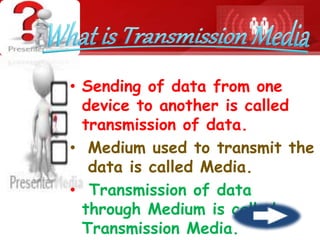
• Sending of data from one
device to another is called
transmission of data.
• Medium used to transmit the
data is called Media.
• Transmission of data
through Medium is called
Transmission Media.
UN-GUIDED
MEDIA
GUIDED MEDIA
TWIS-
TED
PAIR
CO-
AXIAL
CABLE
OPTIC
FIBRES
MICRO
WAVE
RADIO
TRANS
INFR-
ARED
SATE-
LLITE
• Guided or bounded media
transmission system
employ physical media
which are tangible.
• Also known as
conducted system .
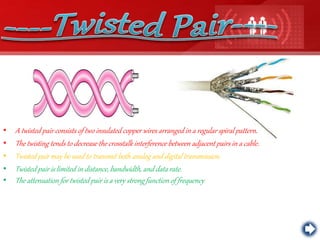
• A twisted pair consists of two insulated copper wires arranged in a regular spiral pattern.
• The twisting tends to decrease the crosstalk interference between adjacent pairs in a cable.
• Twisted pair may be used to transmit both analog and digital transmission.
• Twisted pair is limited in distance, bandwidth, and data rate.
• The attenuation for twisted pair is a very strong function of frequency
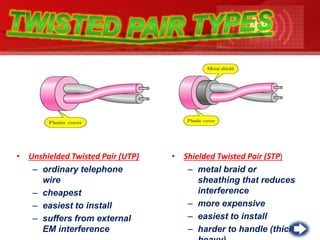
• Unshielded Twisted Pair (UTP)
– ordinary telephone
wire
– cheapest
– easiest to install
– suffers from external
EM interference
• Shielded Twisted Pair (STP)
– metal braid or
sheathing that reduces
interference
– more expensive
– easiest to install
– harder to handle (thick,
DISADVANTAGE
ADVANTAGESIt is less costly transmission medium for short distance.
Man p0wer needed to repair and service can be easily applied.
Can be used for voice transmission very effectively.
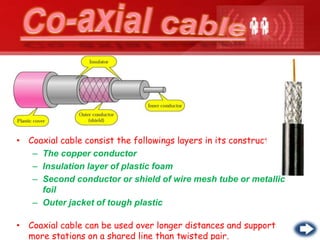
• Coaxial cable consist the followings layers in its construction
– The copper conductor
– Insulation layer of plastic foam
– Second conductor or shield of wire mesh tube or metallic
foil
– Outer jacket of tough plastic
• Coaxial cable can be used over longer distances and support
more stations on a shared line than twisted pair.
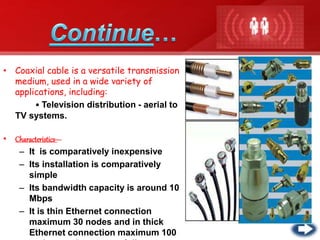
• Coaxial cable is a versatile transmission
medium, used in a wide variety of
applications, including:
• Television distribution - aerial to
TV systems.
• Characteristics---
– It is comparatively inexpensive
– Its installation is comparatively
simple
– Its bandwidth capacity is around 10
Mbps
– It is thin Ethernet connection
maximum 30 nodes and in thick
Ethernet connection maximum 100
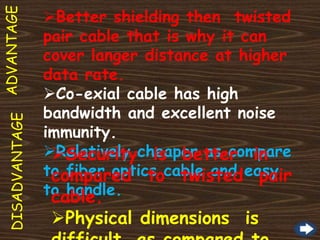
ADVANTAGEDISADVANTAGE Better shielding then twisted
pair cable that is why it can
cover langer distance at higher
data rate.
Co-exial cable has high
bandwidth and excellent noise
immunity.
Relatively cheaper as compare
to fiber optics cable and easy
to handle.
Security is better in
compared to twisted pair
cable.
Physical dimensions is
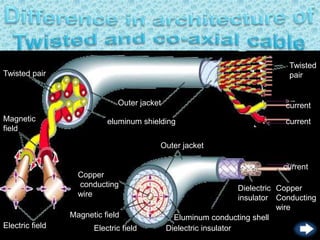
Twisted pair
Outer jacket
eluminum shielding
Outer jacket
Twisted
pair
current
current
current
Copper
Conducting
wire
Dielectric
insulator
Eluminum conducting shell
Dielectric insulatorElectric field
Magnetic field
Copper
conducting
wire
Electric field
Magnetic
field
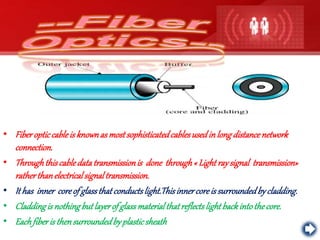
• Fiberopticcableis knownas mostsophisticatedcablesusedinlongdistancenetwork
connection.
• Throughthiscabledatatransmissionis done through« Lightraysignal transmission»
ratherthanelectricalsignaltransmission.
• It has inner coreof glassthatconductslight.Thisinnercoreis surroundedbycladding.
• Claddingis nothingbutlayerof glassmaterialthatreflectslightbackintothecore.
• Eachfiberis thensurroundedbyplasticsheath
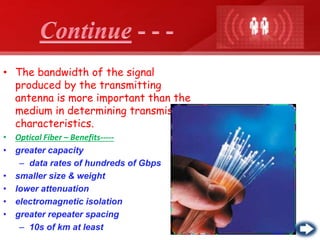
• The bandwidth of the signal
produced by the transmitting
antenna is more important than the
medium in determining transmission
characteristics.
• Optical Fiber – Benefits-----
• greater capacity
– data rates of hundreds of Gbps
• smaller size & weight
• lower attenuation
• electromagnetic isolation
• greater repeater spacing
– 10s of km at least
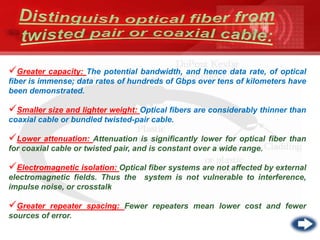
Greater capacity: The potential bandwidth, and hence data rate, of optical
fiber is immense; data rates of hundreds of Gbps over tens of kilometers have
been demonstrated.
Smaller size and lighter weight: Optical fibers are considerably thinner than
coaxial cable or bundled twisted-pair cable.
Lower attenuation: Attenuation is significantly lower for optical fiber than
for coaxial cable or twisted pair, and is constant over a wide range.
Electromagnetic isolation: Optical fiber systems are not affected by external
electromagnetic fields. Thus the system is not vulnerable to interference,
impulse noise, or crosstalk
Greater repeater spacing: Fewer repeaters mean lower cost and fewer
sources of error.
Wireless transmission
systems do not make use of
a physical conductor ,or
guide ,to bind the signal .
Data is transmitted using
electromagnetic
waves.
Such system employ
Omnidirectional antenna
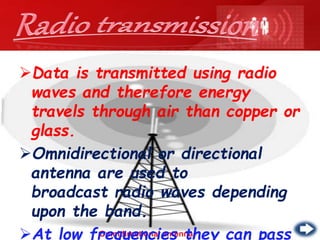
Data is transmitted using radio
waves and therefore energy
travels through air than copper or
glass.
Omnidirectional or directional
antenna are used to
broadcast radio waves depending
upon the band.
At low frequencies they can pass
It is a form of radio transmission that uses
ultra-high frequencies.
Its bandwidth are in the Giga Hertz(GHz) range
and the
wavelength in the millimeter range .
It uses repeater for maintain his frequency.
Repeater are placed at the interval of about 25
to 30 km in between
of transmitter and receiving .
It is a point-to-point ,rather than broadcast
transmission system.
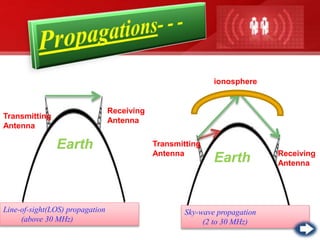
Each antenna should be in the line-of-sight of
Earth
Transmitting
Antenna
Receiving
Antenna
Transmitting
Antenna Receiving
AntennaEarth
Line-of-sight(LOS) propagation
(above 30 MHz)
Sky-wave propagation
(2 to 30 MHz)
ionosphere
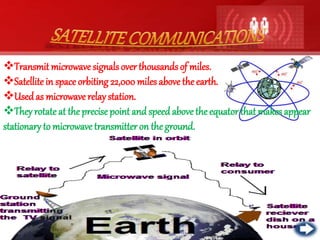
Transmit microwave signals overthousands of miles.
Satellite in space orbiting 22,000 miles above the earth.
Used as microwave relaystation.
They rotateat the precise point and speedabove the equator that makes appear
stationary to microwave transmitter on theground.
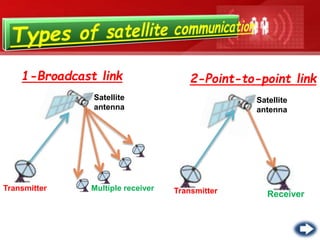
Transmitter Multiple receiver Transmitter
2-Point-to-point link1-Broadcast link
Receiver
Satellite
antenna
Satellite
antenna
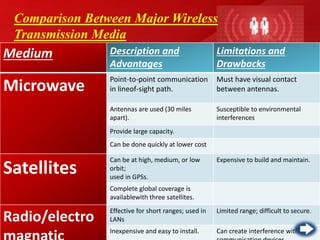
Medium Description and
Advantages
Limitations and
Drawbacks
Microwave
Point-to-point communication
in lineof-sight path.
Must have visual contact
between antennas.
Antennas are used (30 miles
apart).
Susceptible to environmental
interferences
Provide large capacity.
Can be done quickly at lower cost
Satellites
Can be at high, medium, or low
orbit;
used in GPSs.
Expensive to build and maintain.
Complete global coverage is
availablewith three satellites.
Radio/electro
Effective for short ranges; used in
LANs
Limited range; difficult to secure.
Inexpensive and easy to install. Can create interference with
Comparison Between Major Wireless
Transmission Media
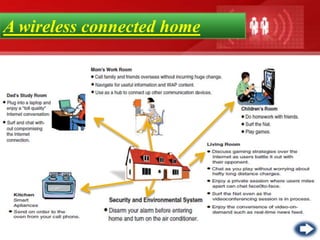
A wireless connected home
Computer network

Computer network

  • 1.
    Introduction of transmissionmedia. Types of transmission media • Guidedbounded media • Unguidedunbounded media Guided wired transmission • Twisted pair cable • Coaxial cable • Optical fiber cable Unguided wireless transmission • Radio transmission • Microwave transmission • Satellite transmission
  • 2.
    • Sending ofdata from one device to another is called transmission of data. • Medium used to transmit the data is called Media. • Transmission of data through Medium is called Transmission Media.
  • 3.
  • 4.
    • Guided orbounded media transmission system employ physical media which are tangible. • Also known as conducted system .
  • 5.
    • A twistedpair consists of two insulated copper wires arranged in a regular spiral pattern. • The twisting tends to decrease the crosstalk interference between adjacent pairs in a cable. • Twisted pair may be used to transmit both analog and digital transmission. • Twisted pair is limited in distance, bandwidth, and data rate. • The attenuation for twisted pair is a very strong function of frequency
  • 6.
    • Unshielded TwistedPair (UTP) – ordinary telephone wire – cheapest – easiest to install – suffers from external EM interference • Shielded Twisted Pair (STP) – metal braid or sheathing that reduces interference – more expensive – easiest to install – harder to handle (thick,
  • 7.
    DISADVANTAGE ADVANTAGESIt is lesscostly transmission medium for short distance. Man p0wer needed to repair and service can be easily applied. Can be used for voice transmission very effectively.
  • 8.
    • Coaxial cableconsist the followings layers in its construction – The copper conductor – Insulation layer of plastic foam – Second conductor or shield of wire mesh tube or metallic foil – Outer jacket of tough plastic • Coaxial cable can be used over longer distances and support more stations on a shared line than twisted pair.
  • 9.
    • Coaxial cableis a versatile transmission medium, used in a wide variety of applications, including: • Television distribution - aerial to TV systems. • Characteristics--- – It is comparatively inexpensive – Its installation is comparatively simple – Its bandwidth capacity is around 10 Mbps – It is thin Ethernet connection maximum 30 nodes and in thick Ethernet connection maximum 100
  • 10.
    ADVANTAGEDISADVANTAGE Better shieldingthen twisted pair cable that is why it can cover langer distance at higher data rate. Co-exial cable has high bandwidth and excellent noise immunity. Relatively cheaper as compare to fiber optics cable and easy to handle. Security is better in compared to twisted pair cable. Physical dimensions is
  • 11.
    Twisted pair Outer jacket eluminumshielding Outer jacket Twisted pair current current current Copper Conducting wire Dielectric insulator Eluminum conducting shell Dielectric insulatorElectric field Magnetic field Copper conducting wire Electric field Magnetic field
  • 12.
    • Fiberopticcableis knownasmostsophisticatedcablesusedinlongdistancenetwork connection. • Throughthiscabledatatransmissionis done through« Lightraysignal transmission» ratherthanelectricalsignaltransmission. • It has inner coreof glassthatconductslight.Thisinnercoreis surroundedbycladding. • Claddingis nothingbutlayerof glassmaterialthatreflectslightbackintothecore. • Eachfiberis thensurroundedbyplasticsheath
  • 13.
    • The bandwidthof the signal produced by the transmitting antenna is more important than the medium in determining transmission characteristics. • Optical Fiber – Benefits----- • greater capacity – data rates of hundreds of Gbps • smaller size & weight • lower attenuation • electromagnetic isolation • greater repeater spacing – 10s of km at least
  • 16.
    Greater capacity: Thepotential bandwidth, and hence data rate, of optical fiber is immense; data rates of hundreds of Gbps over tens of kilometers have been demonstrated. Smaller size and lighter weight: Optical fibers are considerably thinner than coaxial cable or bundled twisted-pair cable. Lower attenuation: Attenuation is significantly lower for optical fiber than for coaxial cable or twisted pair, and is constant over a wide range. Electromagnetic isolation: Optical fiber systems are not affected by external electromagnetic fields. Thus the system is not vulnerable to interference, impulse noise, or crosstalk Greater repeater spacing: Fewer repeaters mean lower cost and fewer sources of error.
  • 17.
    Wireless transmission systems donot make use of a physical conductor ,or guide ,to bind the signal . Data is transmitted using electromagnetic waves. Such system employ
  • 18.
    Omnidirectional antenna Data istransmitted using radio waves and therefore energy travels through air than copper or glass. Omnidirectional or directional antenna are used to broadcast radio waves depending upon the band. At low frequencies they can pass
  • 19.
    It is aform of radio transmission that uses ultra-high frequencies. Its bandwidth are in the Giga Hertz(GHz) range and the wavelength in the millimeter range . It uses repeater for maintain his frequency. Repeater are placed at the interval of about 25 to 30 km in between of transmitter and receiving . It is a point-to-point ,rather than broadcast transmission system. Each antenna should be in the line-of-sight of
  • 20.
  • 21.
    Transmit microwave signalsoverthousands of miles. Satellite in space orbiting 22,000 miles above the earth. Used as microwave relaystation. They rotateat the precise point and speedabove the equator that makes appear stationary to microwave transmitter on theground.
  • 22.
    Transmitter Multiple receiverTransmitter 2-Point-to-point link1-Broadcast link Receiver Satellite antenna Satellite antenna
  • 23.
    Medium Description and Advantages Limitationsand Drawbacks Microwave Point-to-point communication in lineof-sight path. Must have visual contact between antennas. Antennas are used (30 miles apart). Susceptible to environmental interferences Provide large capacity. Can be done quickly at lower cost Satellites Can be at high, medium, or low orbit; used in GPSs. Expensive to build and maintain. Complete global coverage is availablewith three satellites. Radio/electro Effective for short ranges; used in LANs Limited range; difficult to secure. Inexpensive and easy to install. Can create interference with Comparison Between Major Wireless Transmission Media
  • 24.