By :- Sudhanshu Kumar Shivam Dubey Vinay Das Prashant
Contents Introduction Characteristics Factors affecting data communication distance of a medium Reasons for transmission Impairence Types of transmission media Guided Media Twisted Pair Cables ILLUMINATI
Coaxial Cables Optical Fiber Cables Basic Differences Comparision Unguided Medium Radio waves Microwaves Infrared waves Conclusion ILLUMINATI
On any network, the various entities must communicate through some form of media. Just as humans can communicate through telephone wires or sound waves in the air, computers can communicate through cables, light, and radio waves. Transmission media enables computers to send and receive messages but do not guarantee that the messages will be understood. Introduction
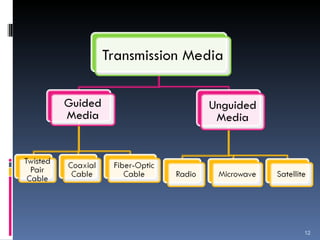
Communication is possible only if information is encoded in a signal, and the signal is carried on a transmission the characteristics of the signal and of the medium both determine the quality of the communication medium. There are two main groups of transmission media, namely the guided medium and the wireless medium.
For the guided medium, there is a physical path (such as a cable) for electromagnetic wave propagation. For the wireless medium, however, the electromagnetic wave is transmitted through air, water, or vacuum.  A wireless medium is also called an unguided medium.
Characteristics A good transmission medium should provide communication with good quality at long distance. For voice communication, quality of communication is determined by the voice quality. For data communication, however, the quality of communication is mainly determined by the effective data rate of communication.
F actors  Affecting Data Communication of a Medium Communication bandwidth of the medium Interference  The transmission impairments
The bandwidth of a medium determines the signal frequencies that can be carried in the medium. A wide bandwidth, or broadband, usually allows communication at a higher data rate.
Reasons  For Transmission  Impairence Attenuation Distortion during signal propagation Noises
TYPES  of     TRANSMISSION  MEDIA
Guided Media Guided media includes everything that ‘guides’ the transmission. That usually takes the form of some sort of a wire. Usually copper, but can also be an optical fiber.
Twisted Pair Cable
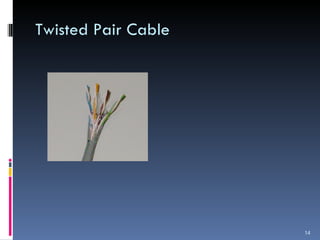
Twisted Pair Cable A transmission medium consisting of pairs  of twisted copper wires. We can transmit 1 Mbps over short distances (less than 100m). They are mainly used to transmit analog signals, but they can be used for digital signals.
Performance One way to measure the performance  of twisted pair cable is to compare attenuation versus frequency and distance.Gauge is a measure of the thickness of the wire.
Applications They are used in telephone lines to provide voice and data channels. Local area networks , such as 10 Base-T and 100 Base-T also use twisted-pair cables.
Coaxial Cable
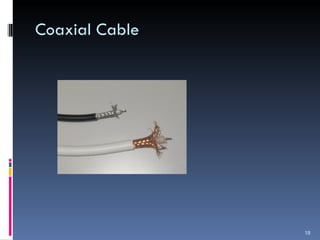
Coaxial Cable In its simplest form, coaxial consists of a core made of solid copper surrounded by insulation, a braided metal shielding, and an outer cover. A transmission medium consisting of thickly insulated copper wire, which can transmit a large volume of data than twisted wire.
Performance The performance is same as the twisted pair cable. The only difference is that the attenuation is much higher in co-axial cable than in twisted pair cable.
Applications It is used in cable TV networks It is used in traditional ethernet LANs.
Optical Fiber
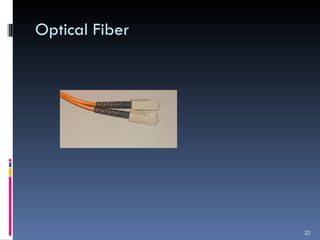
Optical Fiber Optical fiber consists of a glass core, surrounded by a glass cladding with slightly lower refractive index. In most networks fiber-optic cable is used as the high-speed backbone, and twisted wire and coaxial cable are used to connect the backbone to individual devices.
Performance The performance can be measured by plot of attenuation versus wavelength. Attenuation is flatter than in case of twisted pair cable and co-axial cable.
Applications The fiber optic cable is often found in backbone networks because its bandwidth is cost effective. Used in TV companies. LAN such as 100 Base-FX  Network
 
Twisted Wire It is inexpensive and already is in use. Twisted wires are slow, high-speed transmission causes interference (crosstalk). Limiting factors: skin effect & radiation effect.
Coaxial Cable It is often used in place of twisted wire for important links in a network because it is a faster. More interference-free transmission medium (speed: 200 megabits per second). Coaxial cable is thick, is hard to wire in many buildings. It does not support analog conversations.
Optical Fiber Optical fibers are faster, lighter, and suitable for  transferring  large amount of data. Fiber-optic cable is more difficult to work with, more expensive. Its difficult to install them.
Comparison Optical fiber cable differs from both these  transmission media in that it carries the transmitted information in the form of a fluctuating beam of light in a glass fiber.  Light transmission has much wider bandwidth, thus enabling the transmission rate of hundreds of megabits per second.
Optical transmission is immune to electromagnetic interference and crosstalk. While  others are immune to interference. Optical fibers have less loss of signal strength than copper, after every 30 miles we need to use a repeater, whereas in copper, we should insert repeaters at an interval of 2.8 miles .  Optical fiber is more secure, no easy tapping on the cable, like in copper.  But optical fibers are more expensive than other two cables.
Unguided Media Unguided media is still ‘media’ (stuff that signal travels though). The trick is that the media is usually not directional, like air, space, etc. Because the effect is usually much wider than with guided media, there have been a lot of regulation, licensing, and standardization of transmissions via unguided media.
Wireless Transmission Wireless  transmission that sends signals through air or space without any physical wire. Common uses of wireless data transmission include pagers, cellular telephones, microwave transmissions, communication satellites, mobile data networks, personal digital assistants, television remote controls.
Radio Waves Although  there is no clear cut demarcation between radio waves and microwaves , electromagnetic waves ranging in frequencies between  3KHz and 1GHz normally called radio waves. Radio waves are omnidirectional. Radio waves particularly those waves that  propagate in the sky mode , can travel long distances .This makes Radio waves a good candidate for long distance broadcasting  such as AM Radio
Applications The omnidirectional characteristics of Radio waves make them useful for multicasting, in which there is one sender but many receivers. AM  and  FM  Radio, television ,maritime radio , cordless phone , and paging are examples of multicasting.
Microwaves Electromagnetic waves having frequency  between 1 and 300 GHz are called as Micro waves. Micro waves are unidirectional. Microwave propagation is line of sight. Very high frequency Micro waves can not penetrate walls. The microwave band is relatively wide, almost 299 GHz
Applications Microwaves due to there unidirectional properties  are very useful when unicast (one to one ) communication is needed between the sender and the receiver. They are used in Cellular phones. They are used in satellite networks. They are used in wireless LANs.
Infrared Waves Infrared  waves , with frequencies from 300GHz-400THz can be used for short range communication . Infrared waves having high frequencies can not penetrate walls. When we use our Infrared control , we do not interfere with use of the remote by our neighbours. We cannot use Infrared waves outside a building because the suns rays Contain Infrared waves that can interfere with communication.
Applications The infrared band almost 400 THz has an excellent potential for data  transmission. Such a wide bandwidth can be used to transmit digital data with a very high data rate. Infrared waves is used in communication between devices such as Keyboard, PCs and Printers.
KEY Terms Bandwidth :  The difference between the lowest and highest frequency signals that can be transmitted across a transmission line or communication system. Interference :  The distortion on the signal in transmission due to unwanted signals from outside sources.
Transmission Impairments :  Attenuation, distortion, or noises that will degrade the signal quality during transmission. Attenuation :   The loss of a signal’s energy when the signal is transmitted across a medium. Signal Distortion :  Any change in a signal during signal transmission.
Noises :  Random signals that can be picked up during signal transmission and result in degradation or distortion of data. Trunk  Circuits :  The communication circuits between two switching offices.
Conclusion In summary, transmission media are essential for  communication  systems. Signals that carry information can be transmitted on a transmission medium for communication purposes.Thetransmission characteristics of the medium in use are important because they directly affect the communication quality. Since different types of transmission media have different transmission characteristics and costs, they are used in different (and the most suited) applications.

Transmission Media

  • 1.
    By :- SudhanshuKumar Shivam Dubey Vinay Das Prashant
  • 2.
    Contents Introduction CharacteristicsFactors affecting data communication distance of a medium Reasons for transmission Impairence Types of transmission media Guided Media Twisted Pair Cables ILLUMINATI
  • 3.
    Coaxial Cables OpticalFiber Cables Basic Differences Comparision Unguided Medium Radio waves Microwaves Infrared waves Conclusion ILLUMINATI
  • 4.
    On any network,the various entities must communicate through some form of media. Just as humans can communicate through telephone wires or sound waves in the air, computers can communicate through cables, light, and radio waves. Transmission media enables computers to send and receive messages but do not guarantee that the messages will be understood. Introduction
  • 5.
    Communication is possibleonly if information is encoded in a signal, and the signal is carried on a transmission the characteristics of the signal and of the medium both determine the quality of the communication medium. There are two main groups of transmission media, namely the guided medium and the wireless medium.
  • 6.
    For the guidedmedium, there is a physical path (such as a cable) for electromagnetic wave propagation. For the wireless medium, however, the electromagnetic wave is transmitted through air, water, or vacuum. A wireless medium is also called an unguided medium.
  • 7.
    Characteristics A goodtransmission medium should provide communication with good quality at long distance. For voice communication, quality of communication is determined by the voice quality. For data communication, however, the quality of communication is mainly determined by the effective data rate of communication.
  • 8.
    F actors Affecting Data Communication of a Medium Communication bandwidth of the medium Interference The transmission impairments
  • 9.
    The bandwidth ofa medium determines the signal frequencies that can be carried in the medium. A wide bandwidth, or broadband, usually allows communication at a higher data rate.
  • 10.
    Reasons ForTransmission Impairence Attenuation Distortion during signal propagation Noises
  • 11.
    TYPES of TRANSMISSION MEDIA
  • 13.
    Guided Media Guidedmedia includes everything that ‘guides’ the transmission. That usually takes the form of some sort of a wire. Usually copper, but can also be an optical fiber.
  • 14.
  • 15.
    Twisted Pair CableA transmission medium consisting of pairs of twisted copper wires. We can transmit 1 Mbps over short distances (less than 100m). They are mainly used to transmit analog signals, but they can be used for digital signals.
  • 16.
    Performance One wayto measure the performance of twisted pair cable is to compare attenuation versus frequency and distance.Gauge is a measure of the thickness of the wire.
  • 17.
    Applications They areused in telephone lines to provide voice and data channels. Local area networks , such as 10 Base-T and 100 Base-T also use twisted-pair cables.
  • 18.
  • 19.
    Coaxial Cable Inits simplest form, coaxial consists of a core made of solid copper surrounded by insulation, a braided metal shielding, and an outer cover. A transmission medium consisting of thickly insulated copper wire, which can transmit a large volume of data than twisted wire.
  • 20.
    Performance The performanceis same as the twisted pair cable. The only difference is that the attenuation is much higher in co-axial cable than in twisted pair cable.
  • 21.
    Applications It isused in cable TV networks It is used in traditional ethernet LANs.
  • 22.
  • 23.
    Optical Fiber Opticalfiber consists of a glass core, surrounded by a glass cladding with slightly lower refractive index. In most networks fiber-optic cable is used as the high-speed backbone, and twisted wire and coaxial cable are used to connect the backbone to individual devices.
  • 24.
    Performance The performancecan be measured by plot of attenuation versus wavelength. Attenuation is flatter than in case of twisted pair cable and co-axial cable.
  • 25.
    Applications The fiberoptic cable is often found in backbone networks because its bandwidth is cost effective. Used in TV companies. LAN such as 100 Base-FX Network
  • 26.
  • 27.
    Twisted Wire Itis inexpensive and already is in use. Twisted wires are slow, high-speed transmission causes interference (crosstalk). Limiting factors: skin effect & radiation effect.
  • 28.
    Coaxial Cable Itis often used in place of twisted wire for important links in a network because it is a faster. More interference-free transmission medium (speed: 200 megabits per second). Coaxial cable is thick, is hard to wire in many buildings. It does not support analog conversations.
  • 29.
    Optical Fiber Opticalfibers are faster, lighter, and suitable for transferring large amount of data. Fiber-optic cable is more difficult to work with, more expensive. Its difficult to install them.
  • 30.
    Comparison Optical fibercable differs from both these transmission media in that it carries the transmitted information in the form of a fluctuating beam of light in a glass fiber. Light transmission has much wider bandwidth, thus enabling the transmission rate of hundreds of megabits per second.
  • 31.
    Optical transmission isimmune to electromagnetic interference and crosstalk. While others are immune to interference. Optical fibers have less loss of signal strength than copper, after every 30 miles we need to use a repeater, whereas in copper, we should insert repeaters at an interval of 2.8 miles . Optical fiber is more secure, no easy tapping on the cable, like in copper. But optical fibers are more expensive than other two cables.
  • 32.
    Unguided Media Unguidedmedia is still ‘media’ (stuff that signal travels though). The trick is that the media is usually not directional, like air, space, etc. Because the effect is usually much wider than with guided media, there have been a lot of regulation, licensing, and standardization of transmissions via unguided media.
  • 33.
    Wireless Transmission Wireless transmission that sends signals through air or space without any physical wire. Common uses of wireless data transmission include pagers, cellular telephones, microwave transmissions, communication satellites, mobile data networks, personal digital assistants, television remote controls.
  • 34.
    Radio Waves Although there is no clear cut demarcation between radio waves and microwaves , electromagnetic waves ranging in frequencies between 3KHz and 1GHz normally called radio waves. Radio waves are omnidirectional. Radio waves particularly those waves that propagate in the sky mode , can travel long distances .This makes Radio waves a good candidate for long distance broadcasting such as AM Radio
  • 35.
    Applications The omnidirectionalcharacteristics of Radio waves make them useful for multicasting, in which there is one sender but many receivers. AM and FM Radio, television ,maritime radio , cordless phone , and paging are examples of multicasting.
  • 36.
    Microwaves Electromagnetic waveshaving frequency between 1 and 300 GHz are called as Micro waves. Micro waves are unidirectional. Microwave propagation is line of sight. Very high frequency Micro waves can not penetrate walls. The microwave band is relatively wide, almost 299 GHz
  • 37.
    Applications Microwaves dueto there unidirectional properties are very useful when unicast (one to one ) communication is needed between the sender and the receiver. They are used in Cellular phones. They are used in satellite networks. They are used in wireless LANs.
  • 38.
    Infrared Waves Infrared waves , with frequencies from 300GHz-400THz can be used for short range communication . Infrared waves having high frequencies can not penetrate walls. When we use our Infrared control , we do not interfere with use of the remote by our neighbours. We cannot use Infrared waves outside a building because the suns rays Contain Infrared waves that can interfere with communication.
  • 39.
    Applications The infraredband almost 400 THz has an excellent potential for data transmission. Such a wide bandwidth can be used to transmit digital data with a very high data rate. Infrared waves is used in communication between devices such as Keyboard, PCs and Printers.
  • 40.
    KEY Terms Bandwidth: The difference between the lowest and highest frequency signals that can be transmitted across a transmission line or communication system. Interference : The distortion on the signal in transmission due to unwanted signals from outside sources.
  • 41.
    Transmission Impairments : Attenuation, distortion, or noises that will degrade the signal quality during transmission. Attenuation : The loss of a signal’s energy when the signal is transmitted across a medium. Signal Distortion : Any change in a signal during signal transmission.
  • 42.
    Noises : Random signals that can be picked up during signal transmission and result in degradation or distortion of data. Trunk Circuits : The communication circuits between two switching offices.
  • 43.
    Conclusion In summary,transmission media are essential for communication systems. Signals that carry information can be transmitted on a transmission medium for communication purposes.Thetransmission characteristics of the medium in use are important because they directly affect the communication quality. Since different types of transmission media have different transmission characteristics and costs, they are used in different (and the most suited) applications.