GUIDED MEDIA
Presented by
Shakhawat Amin
Reg. : 2012331009
Dept : Computer Science and Engineering, SUST
Acknowledgement
Mrs. Sadia Sultana
Assistant professor, CSE, SUST
Mr. Refat Kibria
Assistant professor, CSE, SUST
What is a transmission media ?
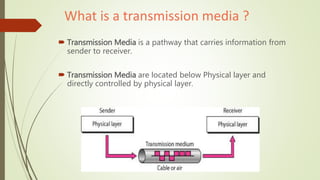
 Transmission Media is a pathway that carries information from
sender to receiver.
 Transmission Media are located below Physical layer and
directly controlled by physical layer.
Classification
Data is normally transmitted through electrical or electromagnetic
signals through transmission medium.
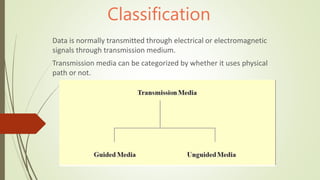
Transmission media can be categorized by whether it uses physical
path or not.
GUIDED MEDIA
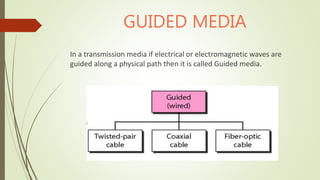
In a transmission media if electrical or electromagnetic waves are
guided along a physical path then it is called Guided media.
Twisted pair Cable
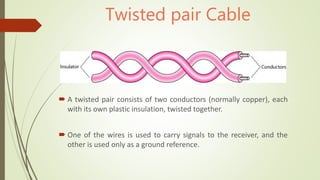
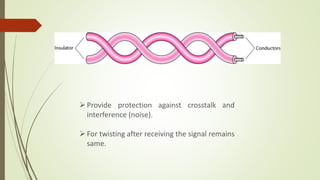
 A twisted pair consists of two conductors (normally copper), each
with its own plastic insulation, twisted together.
 One of the wires is used to carry signals to the receiver, and the
other is used only as a ground reference.
Provide protection against crosstalk and
interference (noise).
For twisting after receiving the signal remains
same.
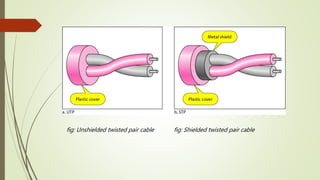
fig: Unshielded twisted pair cable fig: Shielded twisted pair cable
Coaxial Cable
Coaxial cable (or coax) carries signals of higher frequency
ranges than those in twisted pair cable. Instead of having two
wires, coax has a central core conductor of solid or stranded
wire.
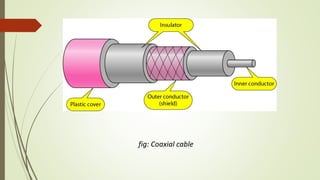
The outer metallic wrapping serves both as a shield against
noise and as the second conductor, which completes the
circuit.
fig: Coaxial cable
To connect coaxial cable to devices, we need coaxial
connectors.
The most common type of connector used today is the
Bayone – Neill - Concelman (BNC) connector.
Coaxial Cable
Connectors
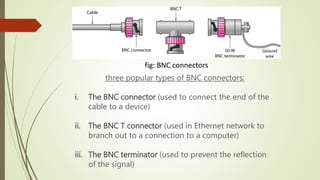
fig: BNC connectors
three popular types of BNC connectors:
i. The BNC connector (used to connect the end of the
cable to a device)
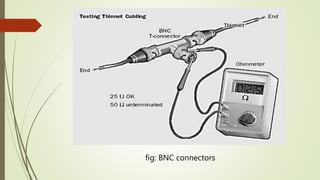
ii. The BNC T connector (used in Ethernet network to
branch out to a connection to a computer)
iii. The BNC terminator (used to prevent the reflection
of the signal)
fig: BNC connectors
Fiber-Optic Cable
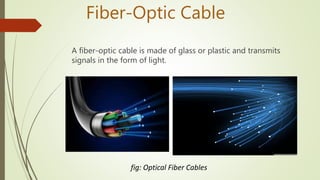
A fiber-optic cable is made of glass or plastic and transmits
signals in the form of light.
fig: Optical Fiber Cables
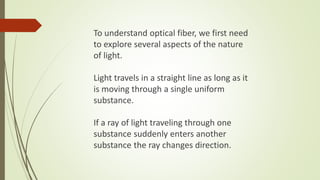
To understand optical fiber, we first need
to explore several aspects of the nature
of light.
Light travels in a straight line as long as it
is moving through a single uniform
substance.
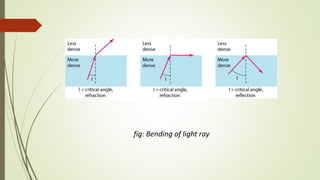
If a ray of light traveling through one
substance suddenly enters another
substance the ray changes direction.
fig: Bending of light ray
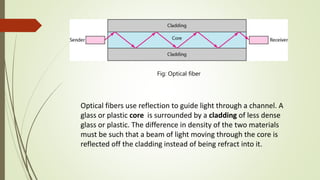
Fig: Optical fiber
Optical fibers use reflection to guide light through a channel. A
glass or plastic core is surrounded by a cladding of less dense
glass or plastic. The difference in density of the two materials
must be such that a beam of light moving through the core is
reflected off the cladding instead of being refract into it.
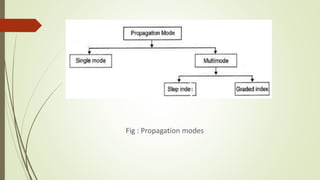
Two modes (multimode and single mode) for
propagating light along optical channels, each
requiring fiber with different physical characteristics.
Multimode can be implemented in two forms:
 step-index fiber &
 graded-index.
PROPAGATION MODES
Fig : Propagation modes
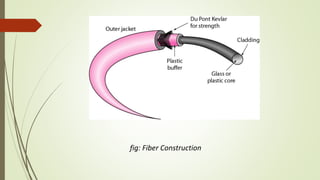
fig: Fiber Construction
THE END

Guided Media

  • 1.
    GUIDED MEDIA Presented by ShakhawatAmin Reg. : 2012331009 Dept : Computer Science and Engineering, SUST Acknowledgement Mrs. Sadia Sultana Assistant professor, CSE, SUST Mr. Refat Kibria Assistant professor, CSE, SUST
  • 2.
    What is atransmission media ?  Transmission Media is a pathway that carries information from sender to receiver.  Transmission Media are located below Physical layer and directly controlled by physical layer.
  • 3.
    Classification Data is normallytransmitted through electrical or electromagnetic signals through transmission medium. Transmission media can be categorized by whether it uses physical path or not.
  • 4.
    GUIDED MEDIA In atransmission media if electrical or electromagnetic waves are guided along a physical path then it is called Guided media.
  • 5.
    Twisted pair Cable A twisted pair consists of two conductors (normally copper), each with its own plastic insulation, twisted together.  One of the wires is used to carry signals to the receiver, and the other is used only as a ground reference.
  • 6.
    Provide protection againstcrosstalk and interference (noise). For twisting after receiving the signal remains same.
  • 7.
    fig: Unshielded twistedpair cable fig: Shielded twisted pair cable
  • 8.
    Coaxial Cable Coaxial cable(or coax) carries signals of higher frequency ranges than those in twisted pair cable. Instead of having two wires, coax has a central core conductor of solid or stranded wire. The outer metallic wrapping serves both as a shield against noise and as the second conductor, which completes the circuit.
  • 9.
  • 10.
    To connect coaxialcable to devices, we need coaxial connectors. The most common type of connector used today is the Bayone – Neill - Concelman (BNC) connector. Coaxial Cable Connectors
  • 11.
    fig: BNC connectors threepopular types of BNC connectors: i. The BNC connector (used to connect the end of the cable to a device) ii. The BNC T connector (used in Ethernet network to branch out to a connection to a computer) iii. The BNC terminator (used to prevent the reflection of the signal)
  • 12.
  • 13.
    Fiber-Optic Cable A fiber-opticcable is made of glass or plastic and transmits signals in the form of light. fig: Optical Fiber Cables
  • 14.
    To understand opticalfiber, we first need to explore several aspects of the nature of light. Light travels in a straight line as long as it is moving through a single uniform substance. If a ray of light traveling through one substance suddenly enters another substance the ray changes direction.
  • 15.
    fig: Bending oflight ray
  • 16.
    Fig: Optical fiber Opticalfibers use reflection to guide light through a channel. A glass or plastic core is surrounded by a cladding of less dense glass or plastic. The difference in density of the two materials must be such that a beam of light moving through the core is reflected off the cladding instead of being refract into it.
  • 17.
    Two modes (multimodeand single mode) for propagating light along optical channels, each requiring fiber with different physical characteristics. Multimode can be implemented in two forms:  step-index fiber &  graded-index. PROPAGATION MODES
  • 18.
  • 19.
  • 20.