Optical Signal Property Synthesis at
Runtime
Andy Doberstein
Keysight, Germany
May 2015
A new Approach for Coherent Transmission Stress Testing
PageOutline
1. Test strategies for coherent optical receivers
• Requirements and challenges of next generation optical transmission
networks
• Optical receiver stress testing and current limitations
2. Introducing DSP processing into AWG based optical signal synthesizer
• Overview of real-time processing architecture
• Clean signal generation / Generation of optical signal properties
3. Summary
5/27/2015
Optical Signal
Synthesis at
Runtime 2
Page
Test strategies for coherent optical
receivers
Optical Signal
Synthesis at
Runtime 3
5/27/2015
Page
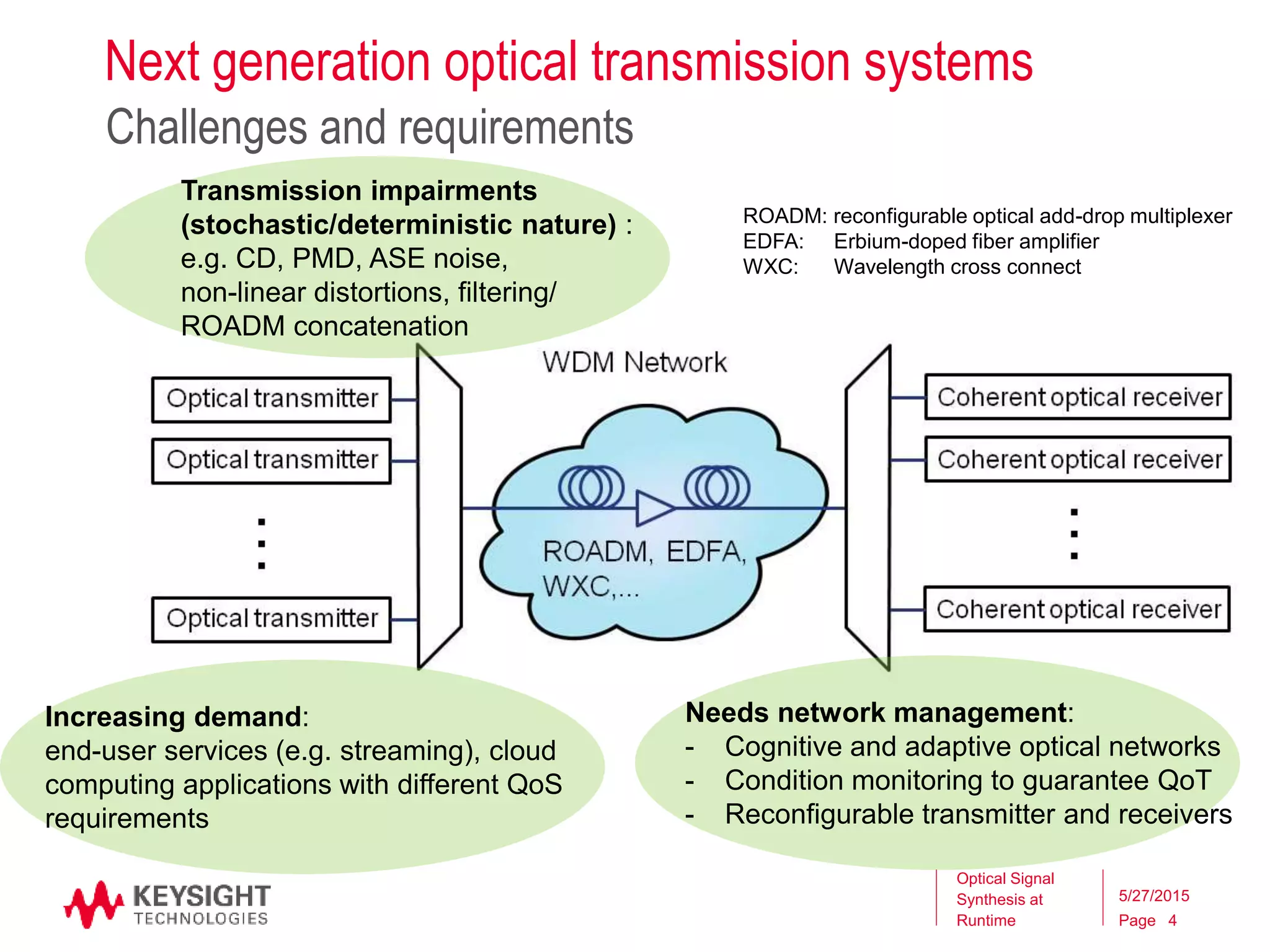
Next generation optical transmission systems
Challenges and requirements
5/27/2015
Optical Signal
Synthesis at
Runtime
ROADM: reconfigurable optical add-drop multiplexer
EDFA: Erbium-doped fiber amplifier
WXC: Wavelength cross connect
4
Increasing demand:
end-user services (e.g. streaming), cloud
computing applications with different QoS
requirements
Transmission impairments
(stochastic/deterministic nature) :
e.g. CD, PMD, ASE noise,
non-linear distortions, filtering/
ROADM concatenation
Needs network management:
- Cognitive and adaptive optical networks
- Condition monitoring to guarantee QoT
- Reconfigurable transmitter and receivers
Page
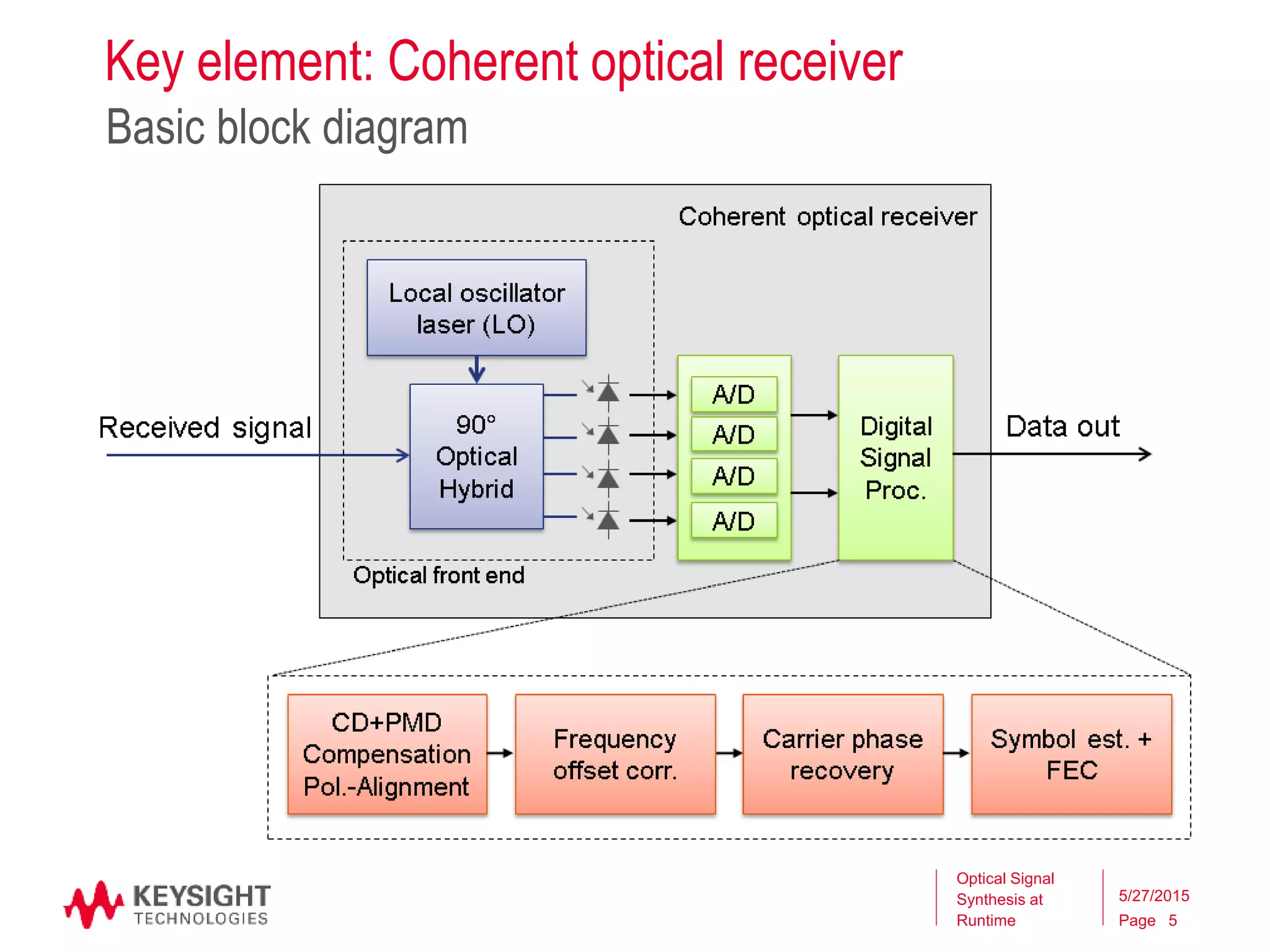
Key element: Coherent optical receiver
Basic block diagram
5/27/2015
Optical Signal
Synthesis at
Runtime 5
Page
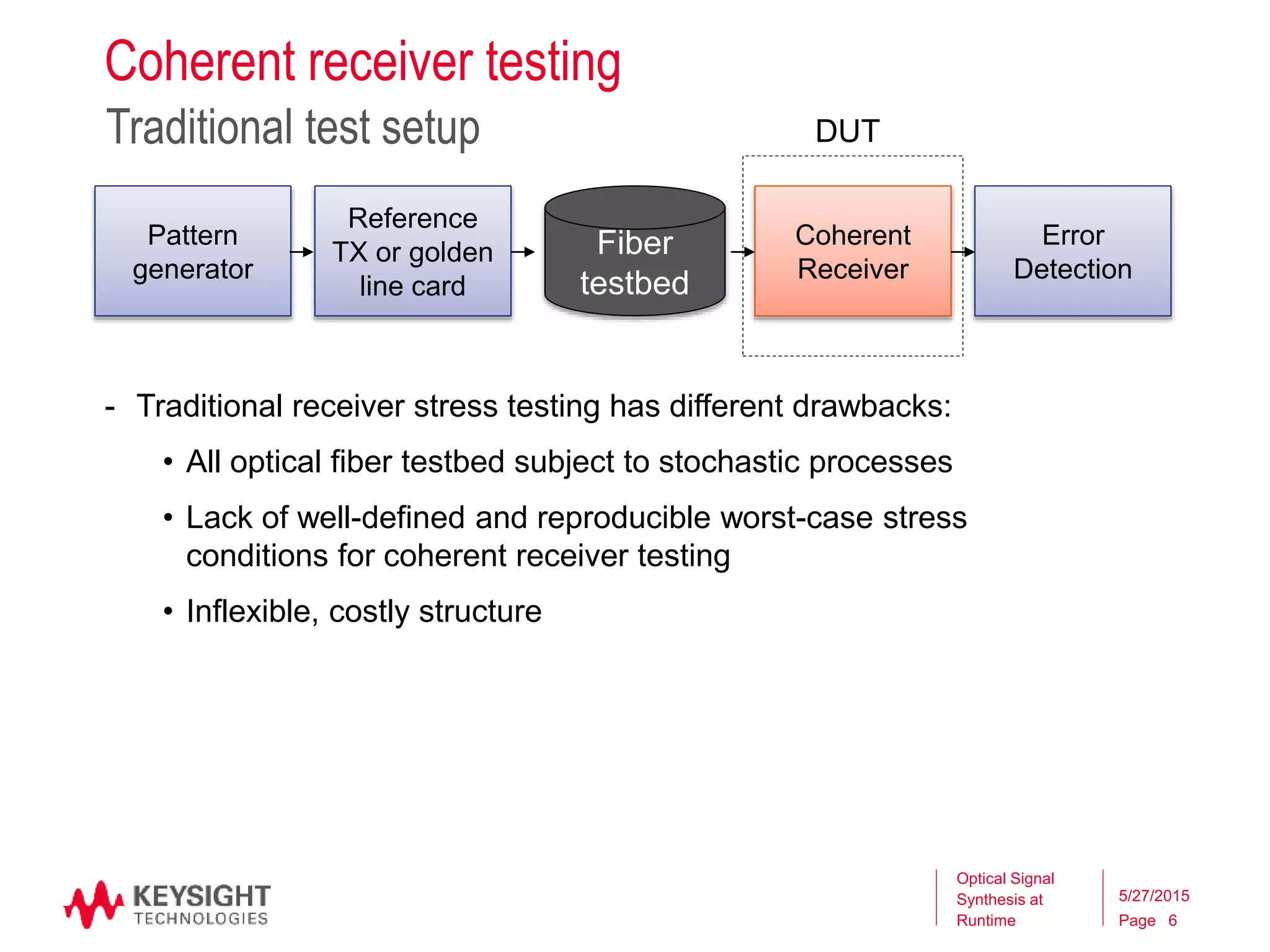
- Traditional receiver stress testing has different drawbacks:
• All optical fiber testbed subject to stochastic processes
• Lack of well-defined and reproducible worst-case stress
conditions for coherent receiver testing
• Inflexible, costly structure
Coherent receiver testing
Traditional test setup
Optical Signal
Synthesis at
Runtime
5/27/2015
6
Reference
TX or golden
line card
Pattern
generator
Fiber
testbed
Coherent
Receiver
Error
Detection
DUT
Page
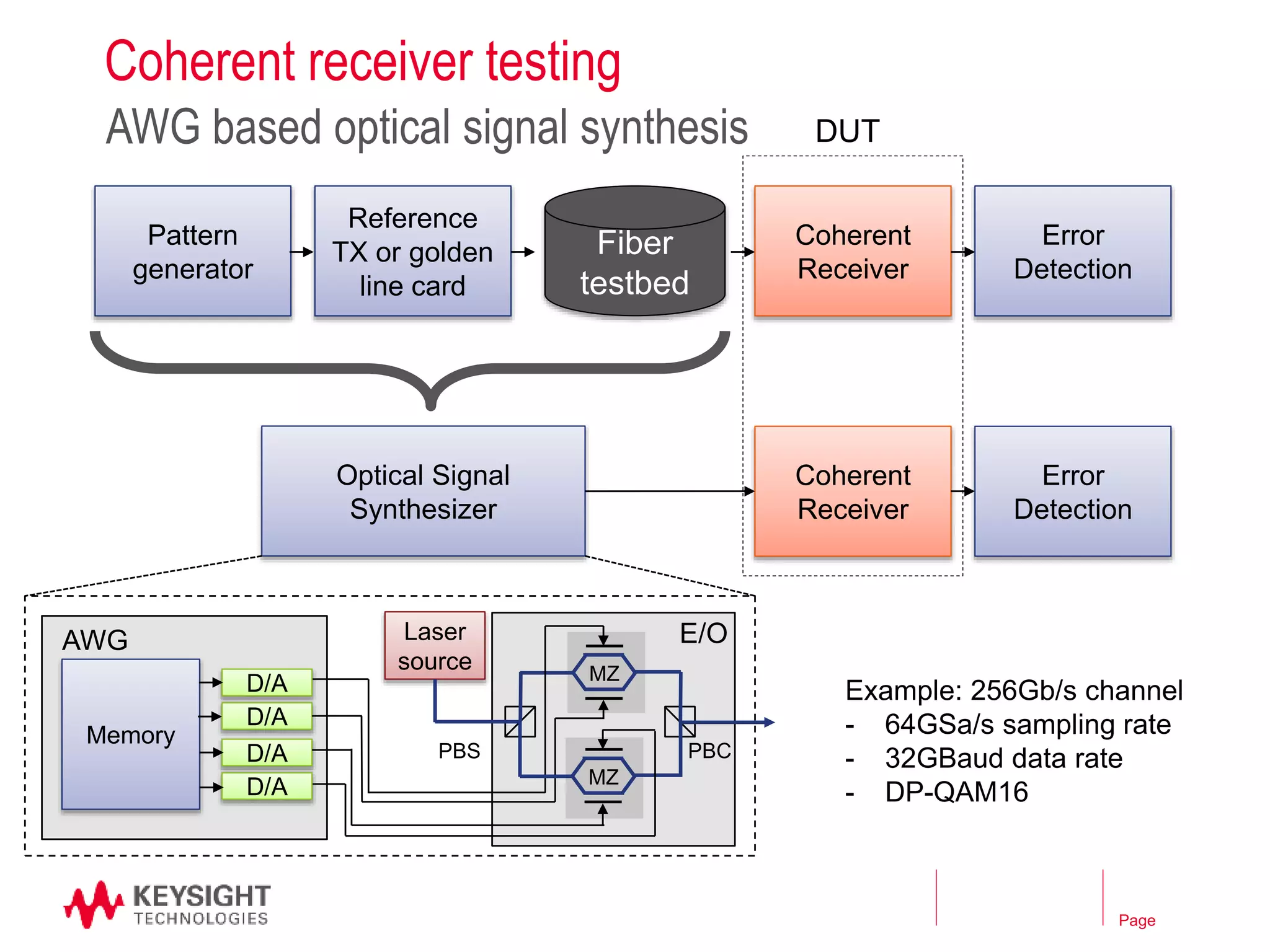
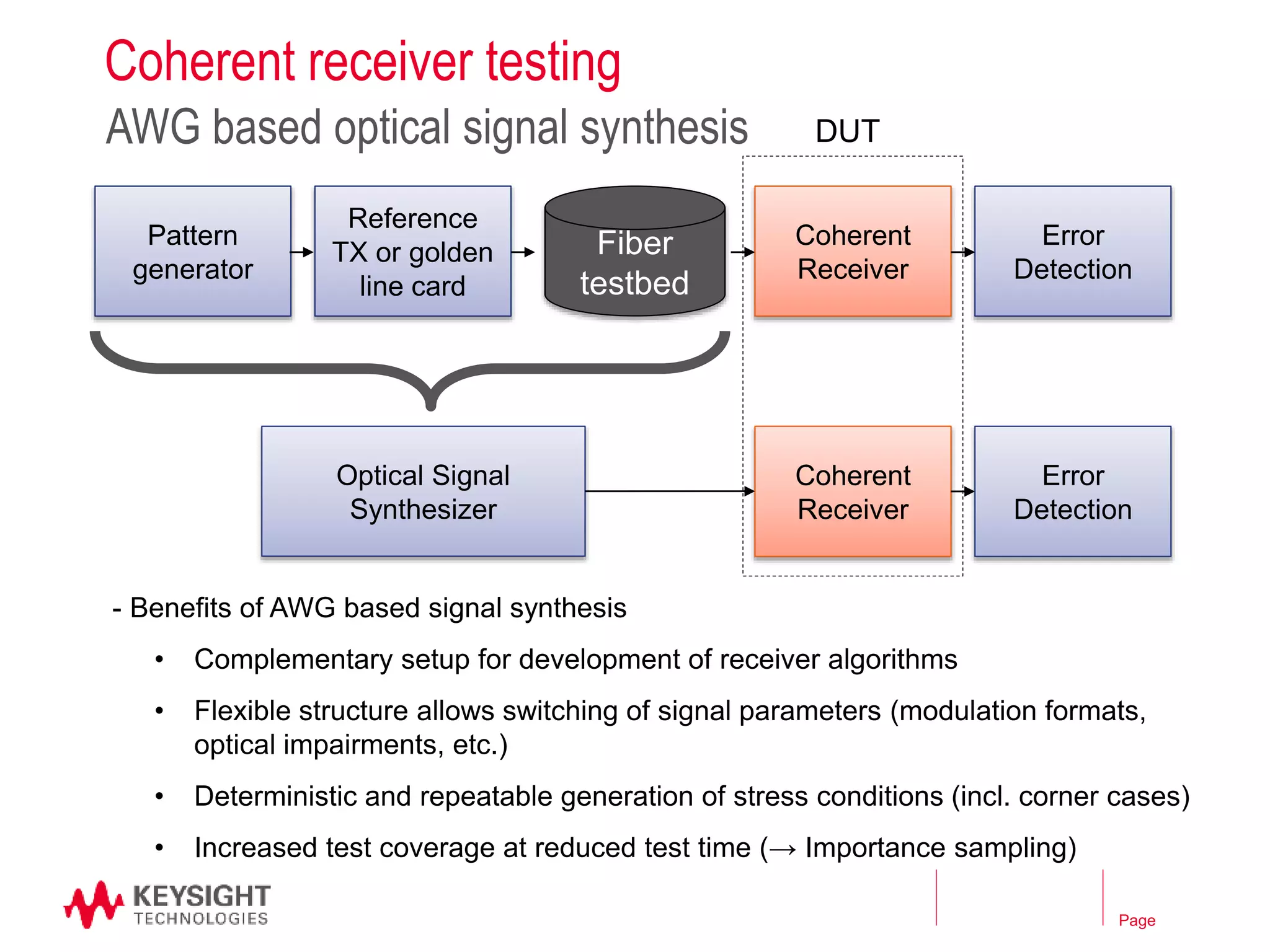
Coherent receiver testing
AWG based optical signal synthesis
Reference
TX or golden
line card
Pattern
generator
Fiber
testbed
Coherent
Receiver
Error
Detection
Optical Signal
Synthesizer
Coherent
Receiver
Error
Detection
DUT
Laser
source MZ
MZ
PBS PBC
E/O
Memory
D/A
D/A
D/A
D/A
AWG
Example: 256Gb/s channel
- 64GSa/s sampling rate
- 32GBaud data rate
- DP-QAM16
Page
Coherent receiver testing
AWG based optical signal synthesis
Reference
TX or golden
line card
Pattern
generator
Fiber
testbed
Coherent
Receiver
Error
Detection
Optical Signal
Synthesizer
Coherent
Receiver
Error
Detection
DUT
- Benefits of AWG based signal synthesis
• Complementary setup for development of receiver algorithms
• Flexible structure allows switching of signal parameters (modulation formats,
optical impairments, etc.)
• Deterministic and repeatable generation of stress conditions (incl. corner cases)
• Increased test coverage at reduced test time (→ Importance sampling)
Page
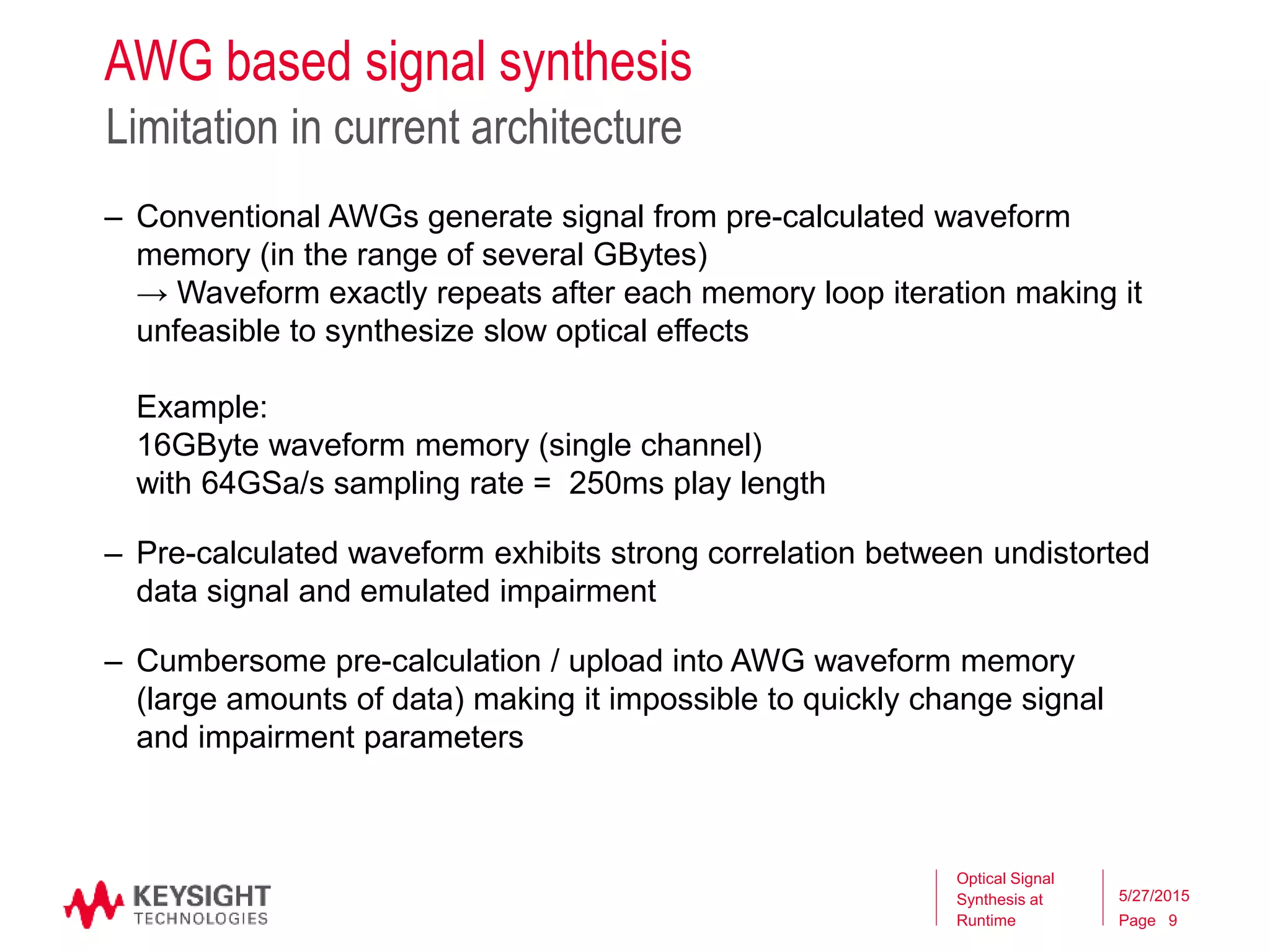
AWG based signal synthesis
Limitation in current architecture
5/27/2015
Optical Signal
Synthesis at
Runtime
– Conventional AWGs generate signal from pre-calculated waveform
memory (in the range of several GBytes)
→ Waveform exactly repeats after each memory loop iteration making it
unfeasible to synthesize slow optical effects
Example:
16GByte waveform memory (single channel)
with 64GSa/s sampling rate = 250ms play length
– Pre-calculated waveform exhibits strong correlation between undistorted
data signal and emulated impairment
– Cumbersome pre-calculation / upload into AWG waveform memory
(large amounts of data) making it impossible to quickly change signal
and impairment parameters
9
Page
Introducing DSP processing into AWG
based optical signal synthesizer
Optical Signal
Synthesis at
Runtime 10
5/27/2015
Page
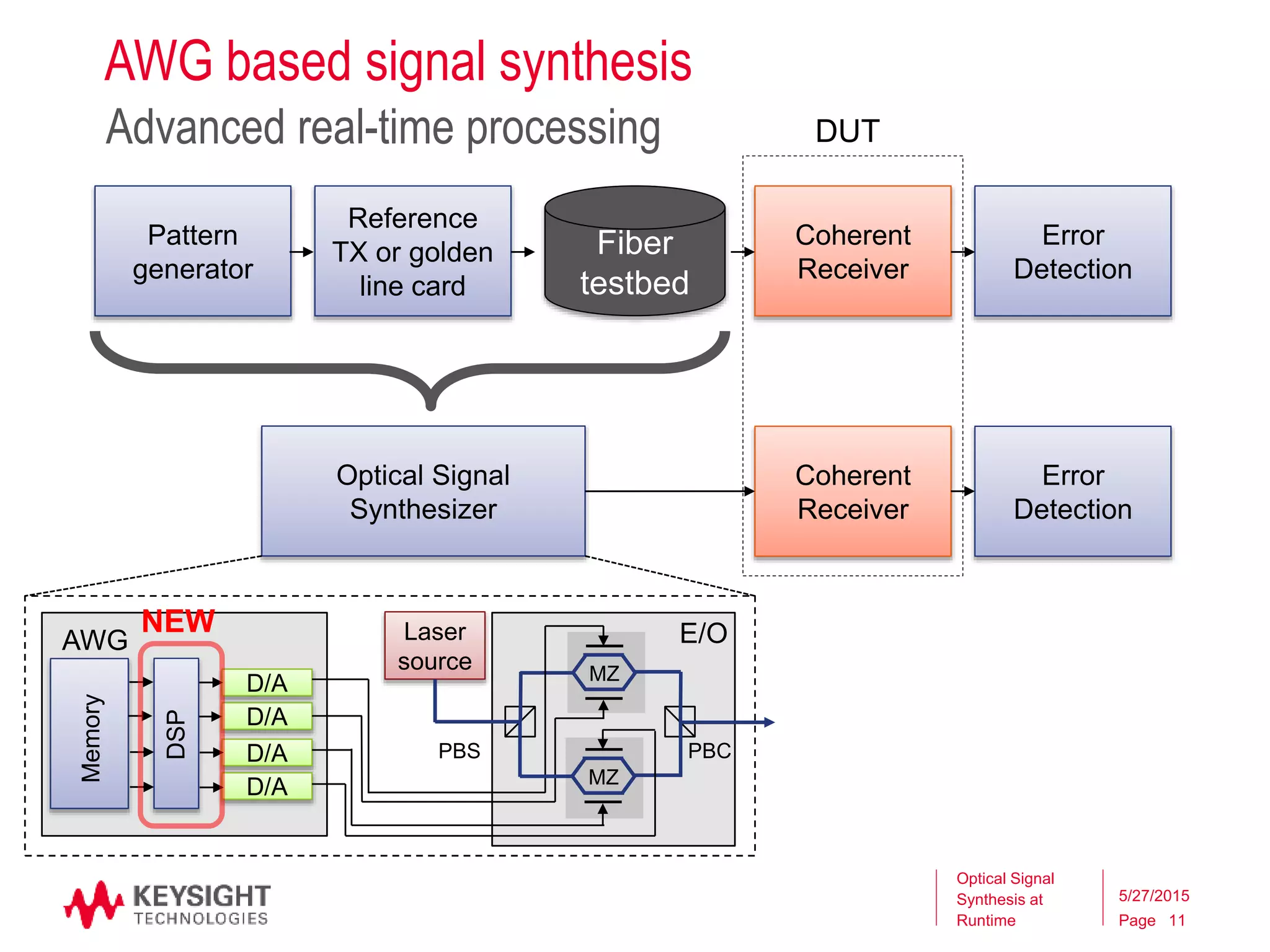
AWG based signal synthesis
Advanced real-time processing
Optical Signal
Synthesis at
Runtime
5/27/2015
11
Reference
TX or golden
line card
Pattern
generator
Fiber
testbed
Coherent
Receiver
Error
Detection
Optical Signal
Synthesizer
Coherent
Receiver
Error
Detection
DUT
D/A
D/A
D/A
D/A
AWG Laser
source MZ
MZ
PBS PBC
E/O
DSP
Memory
NEW
Page
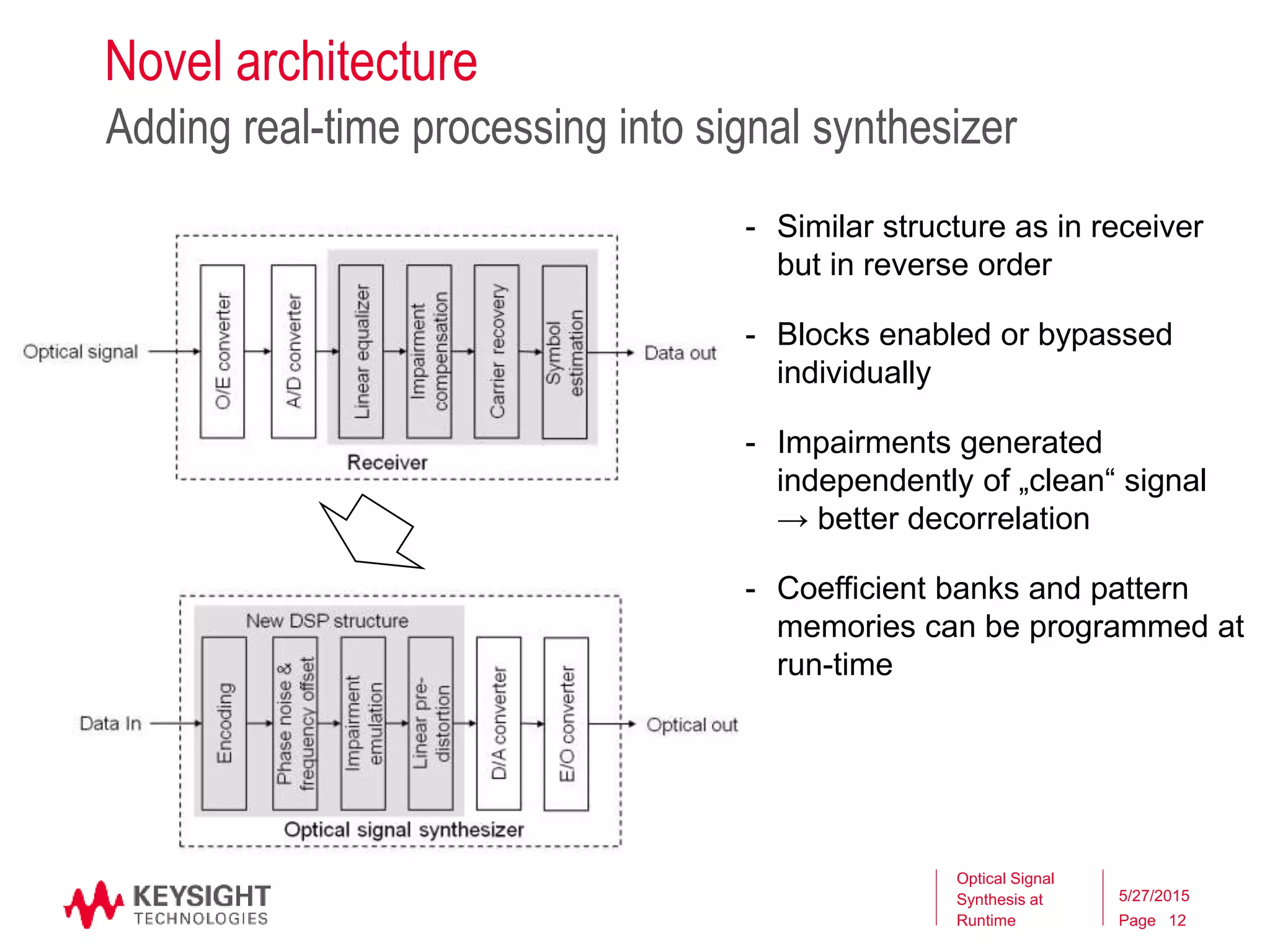
- Similar structure as in receiver
but in reverse order
- Blocks enabled or bypassed
individually
- Impairments generated
independently of „clean“ signal
→ better decorrelation
- Coefficient banks and pattern
memories can be programmed at
run-time
Novel architecture
Adding real-time processing into signal synthesizer
Optical Signal
Synthesis at
Runtime
5/27/2015
12
Page
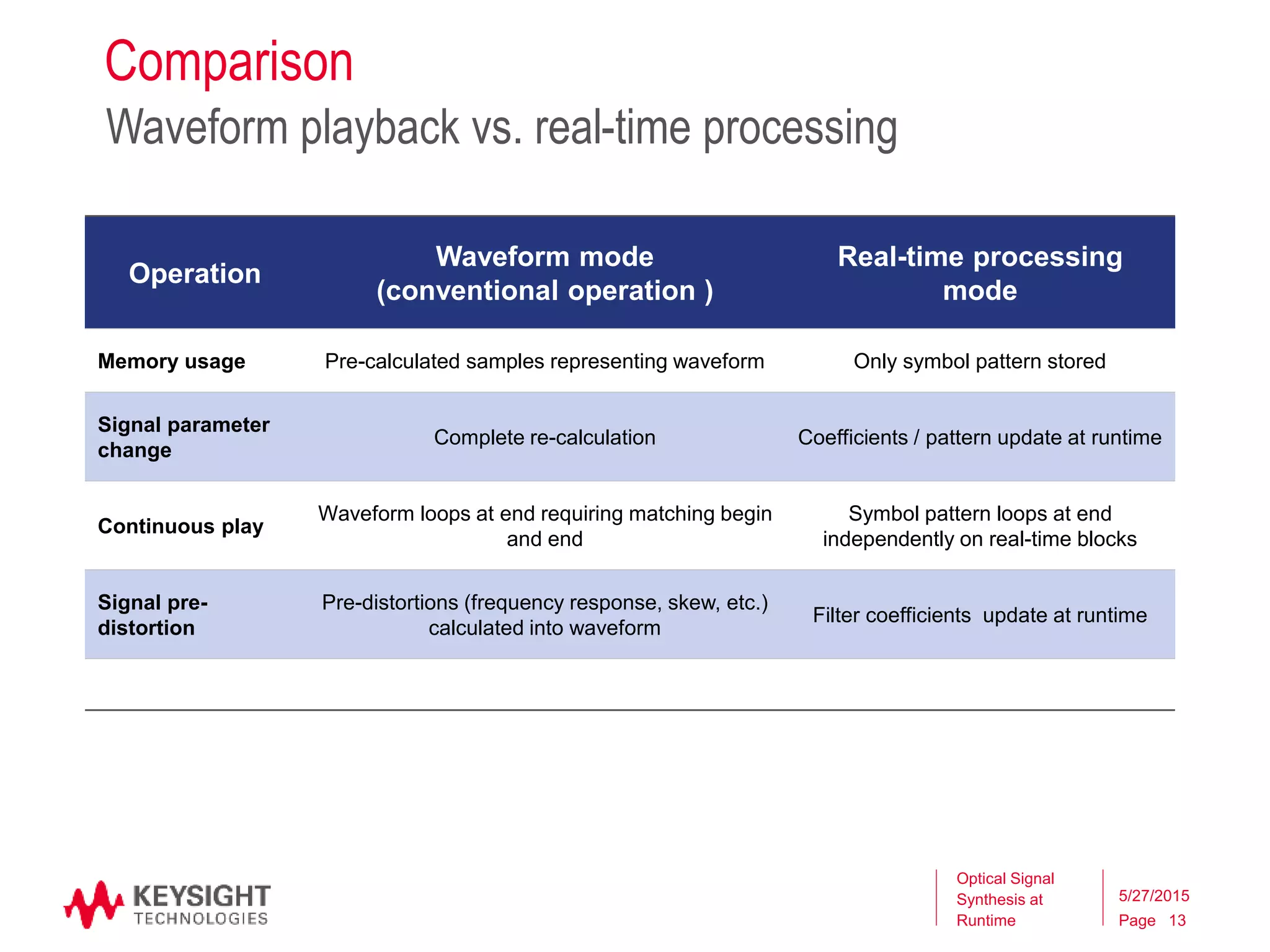
Comparison
Waveform playback vs. real-time processing
Optical Signal
Synthesis at
Runtime
5/27/2015
13
Operation
Waveform mode
(conventional operation )
Real-time processing
mode
Memory usage Pre-calculated samples representing waveform Only symbol pattern stored
Signal parameter
change
Complete re-calculation Coefficients / pattern update at runtime
Continuous play
Waveform loops at end requiring matching begin
and end
Symbol pattern loops at end
independently on real-time blocks
Signal pre-
distortion
Pre-distortions (frequency response, skew, etc.)
calculated into waveform
Filter coefficients update at runtime
Page
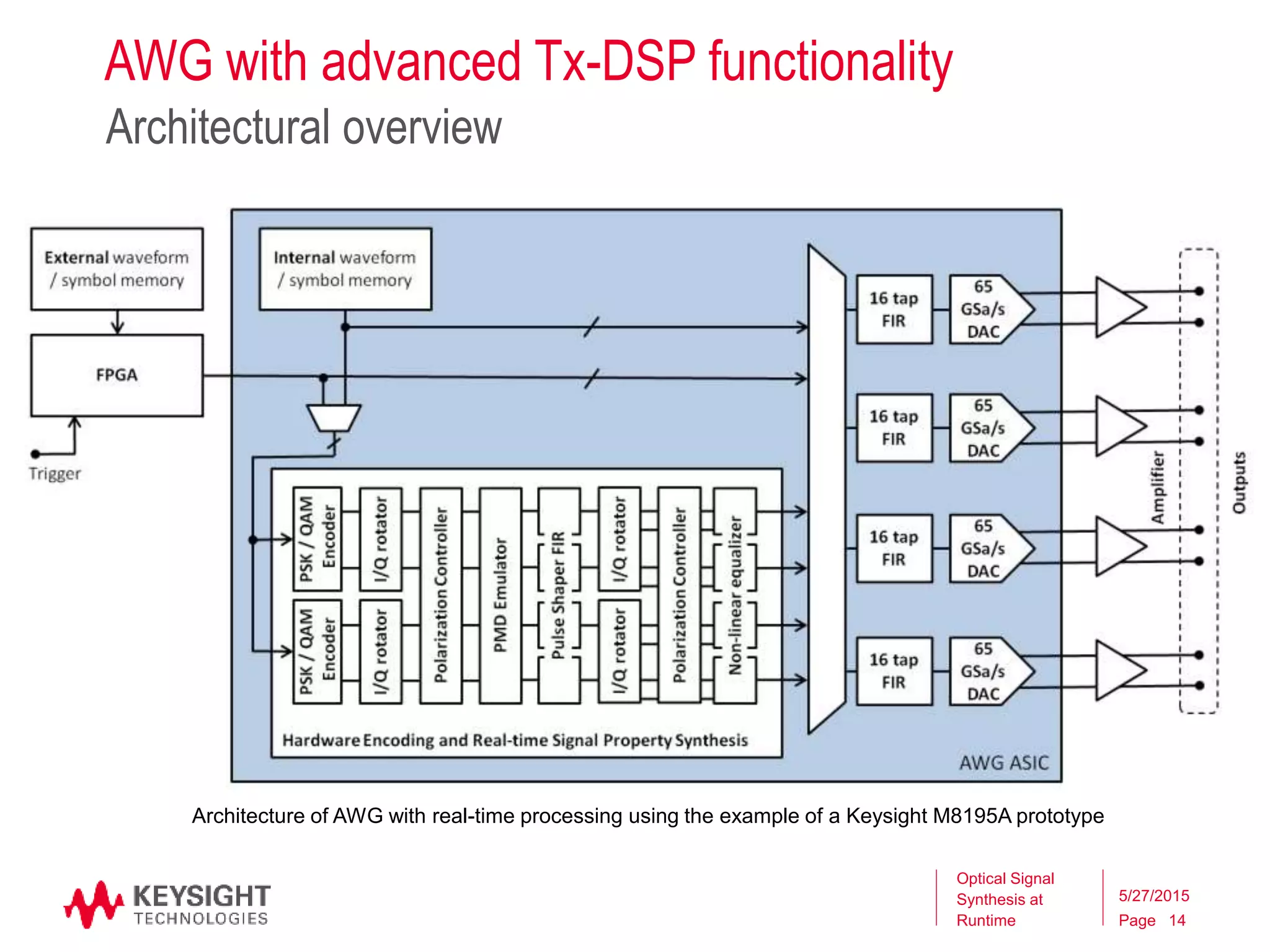
AWG with advanced Tx-DSP functionality
Architectural overview
Optical Signal
Synthesis at
Runtime
5/27/2015
14
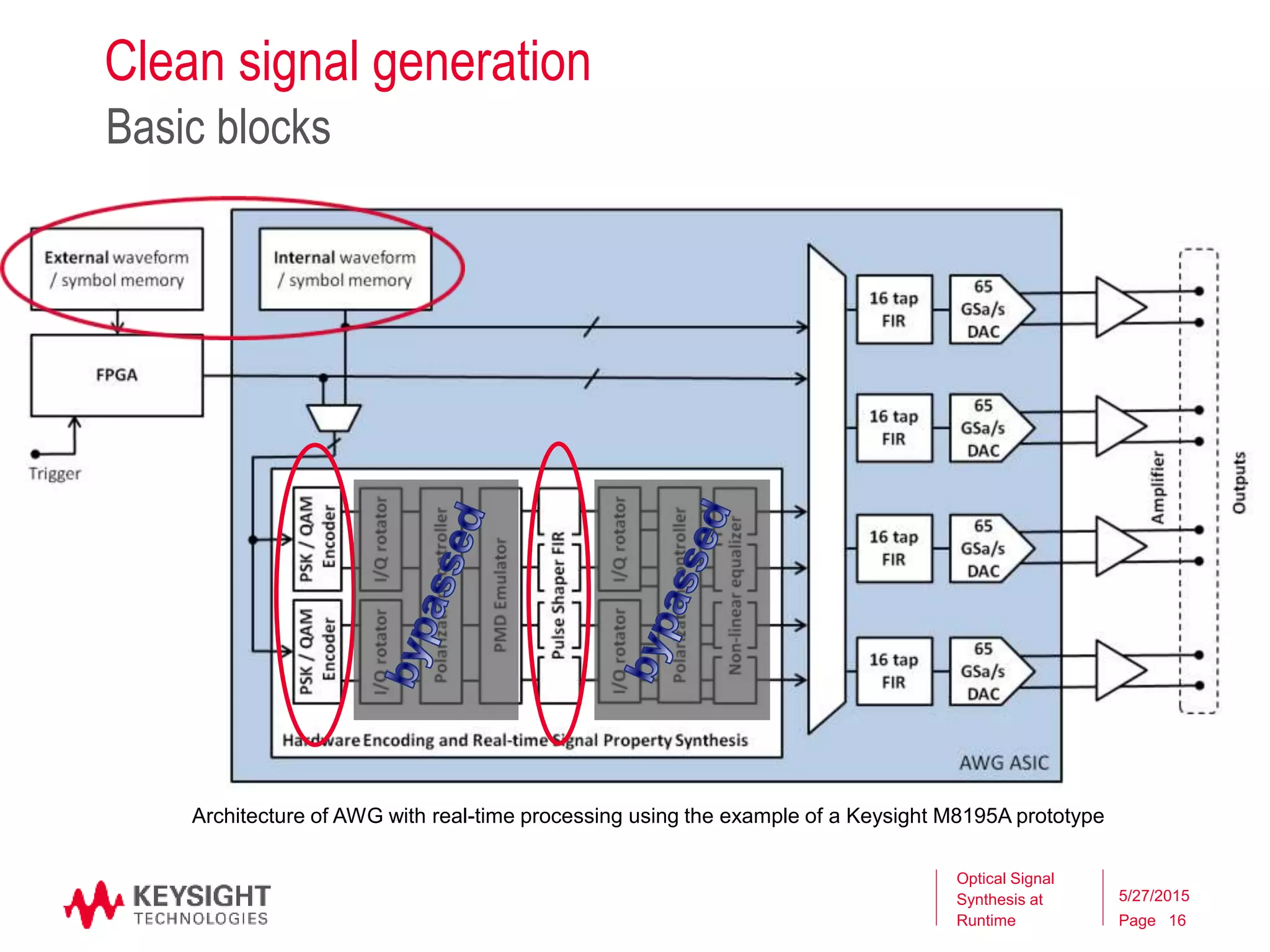
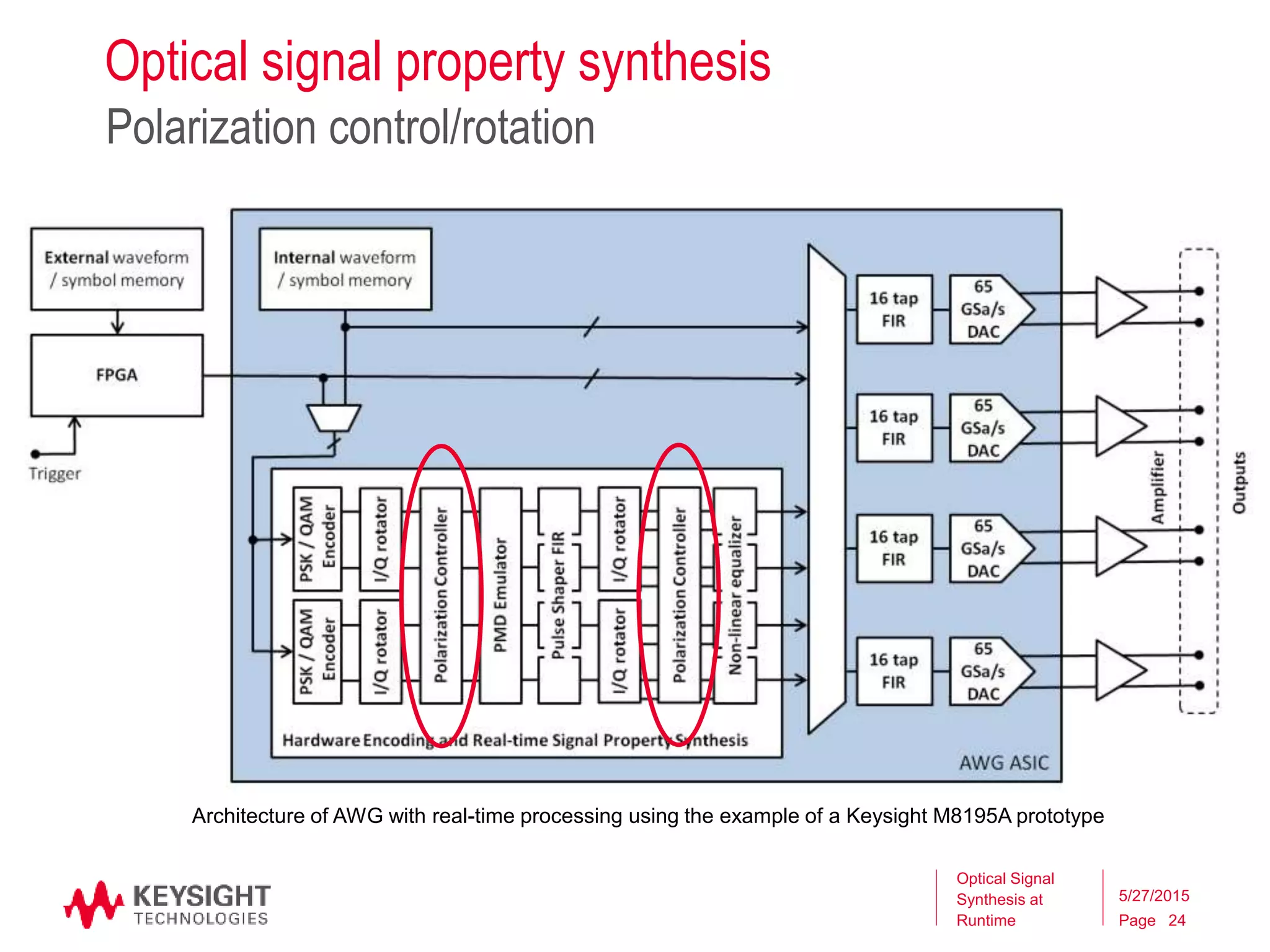
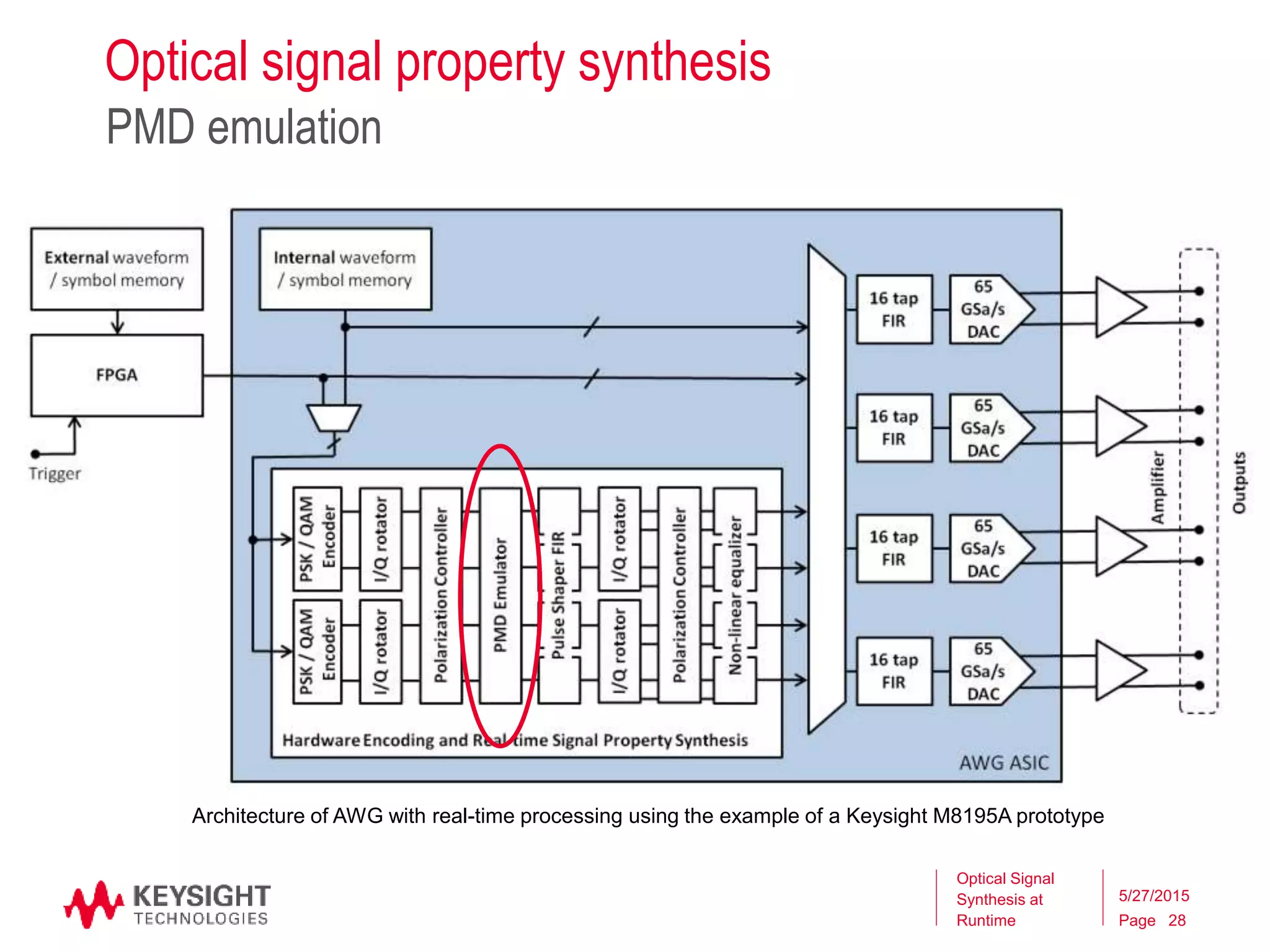
Architecture of AWG with real-time processing using the example of a Keysight M8195A prototype
Page
Clean signal generation
Optical Signal
Synthesis at
Runtime 15
5/27/2015
Page
Clean signal generation
Basic blocks
Optical Signal
Synthesis at
Runtime
5/27/2015
16
Architecture of AWG with real-time processing using the example of a Keysight M8195A prototype
Page
Clean signal generation
Basic blocks
Optical Signal
Synthesis at
Runtime
5/27/2015
17
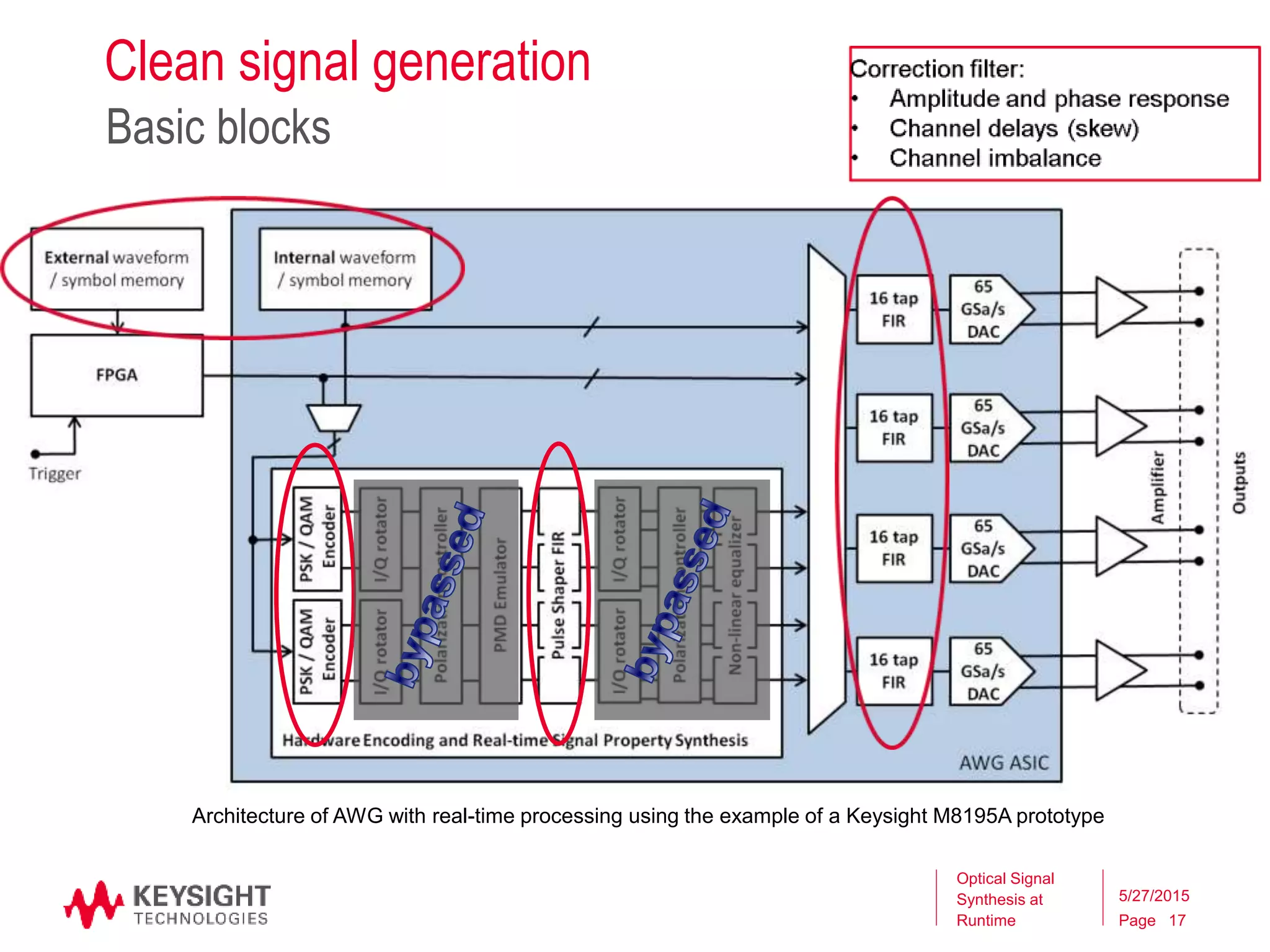
Architecture of AWG with real-time processing using the example of a Keysight M8195A prototype
Page
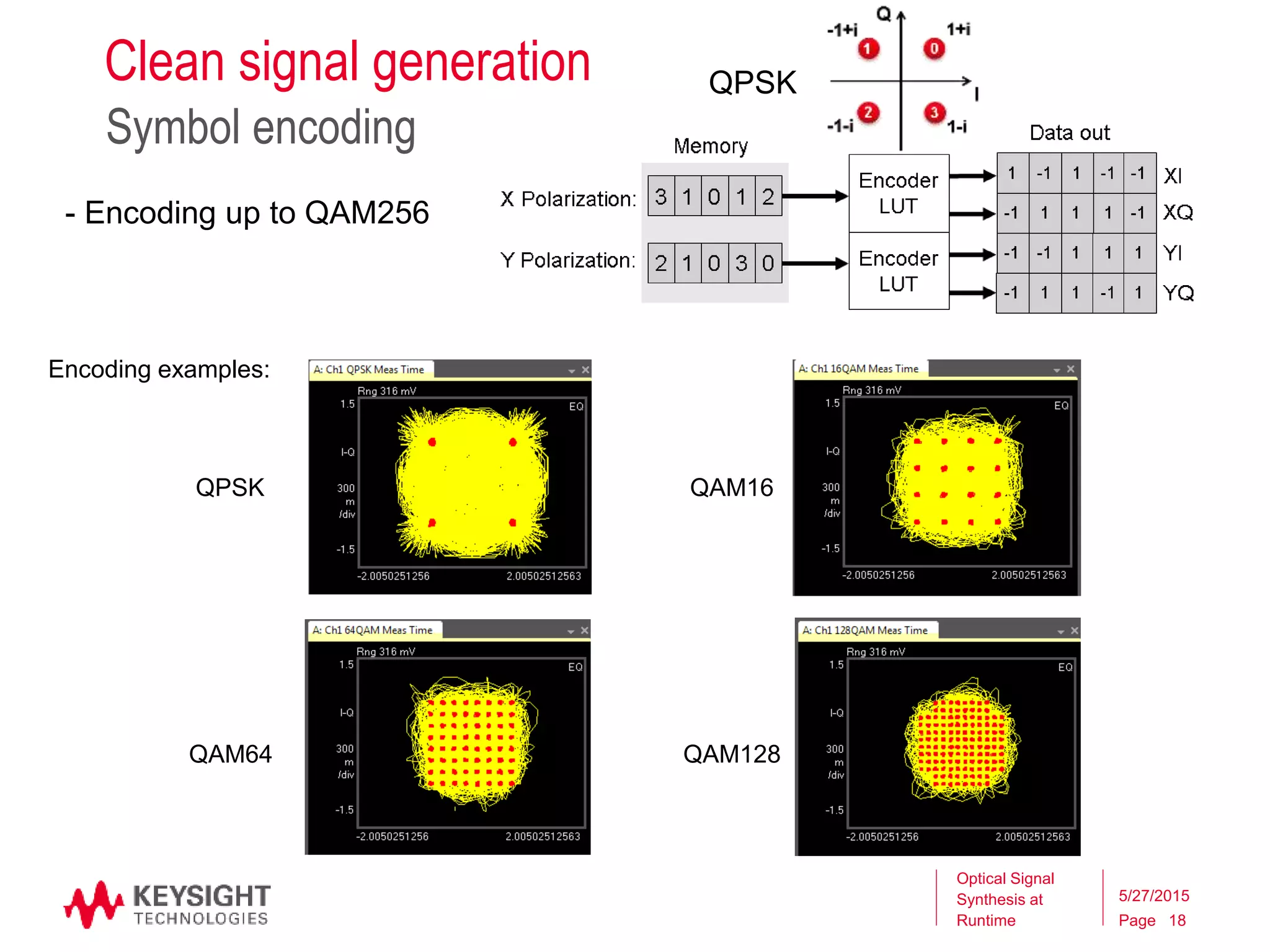
Encoding examples:
QPSK QAM16 QAM16
QAM64 QAM128
Clean signal generation
Symbol encoding
Optical Signal
Synthesis at
Runtime
5/27/2015
18
- Encoding up to QAM256
QPSK
Page
Clean signal generation
Pulse shaping (interpolation filter)
Optical Signal
Synthesis at
Runtime
5/27/2015
19
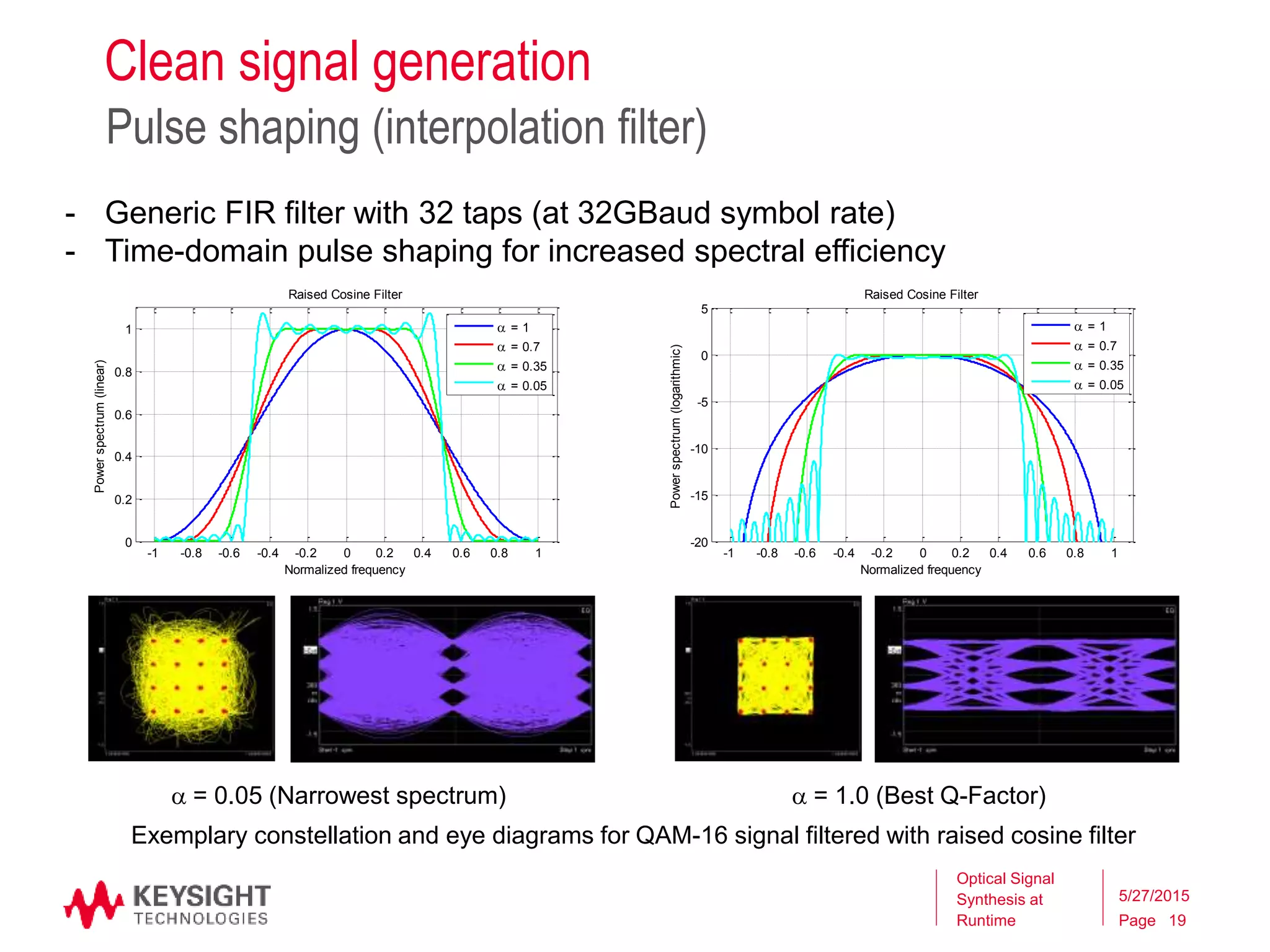
- Generic FIR filter with 32 taps (at 32GBaud symbol rate)
- Time-domain pulse shaping for increased spectral efficiency
Exemplary constellation and eye diagrams for QAM-16 signal filtered with raised cosine filter
a = 0.05 (Narrowest spectrum) a = 1.0 (Best Q-Factor)
-1 -0.8 -0.6 -0.4 -0.2 0 0.2 0.4 0.6 0.8 1
0
0.2
0.4
0.6
0.8
1
Normalized frequency
Powerspectrum(linear)
Raised Cosine Filter
a = 1
a = 0.7
a = 0.35
a = 0.05
-1 -0.8 -0.6 -0.4 -0.2 0 0.2 0.4 0.6 0.8 1
-20
-15
-10
-5
0
5
Normalized frequency
Powerspectrum(logarithmic)
Raised Cosine Filter
a = 1
a = 0.7
a = 0.35
a = 0.05
Page
Generation of optical signal properties
and impairments
Optical Signal
Synthesis at
Runtime 20
5/27/2015
Page
Optical signal property synthesis
Phase noise & carrier frequency offset
Optical Signal
Synthesis at
Runtime
5/27/2015
21
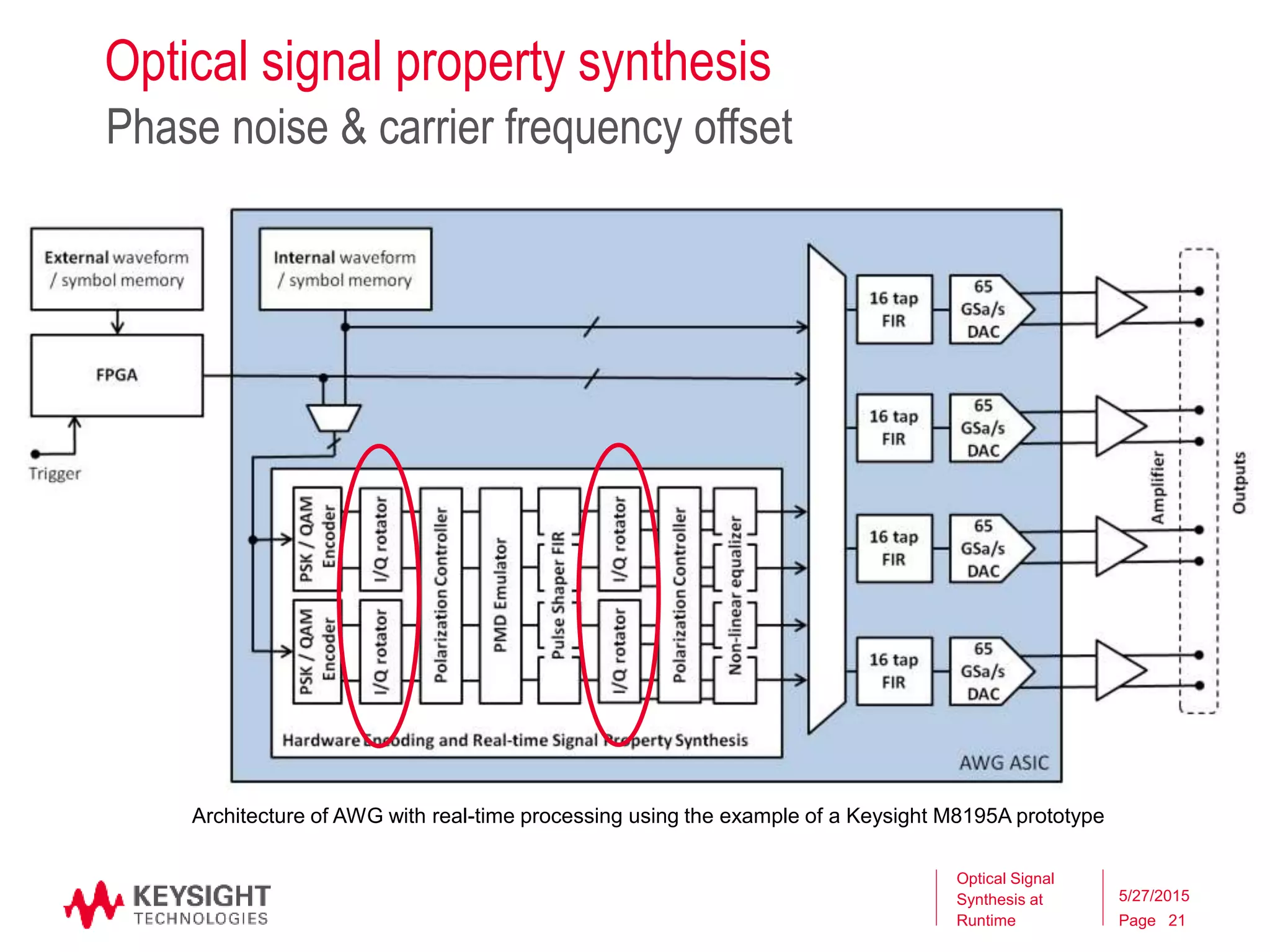
Architecture of AWG with real-time processing using the example of a Keysight M8195A prototype
Page
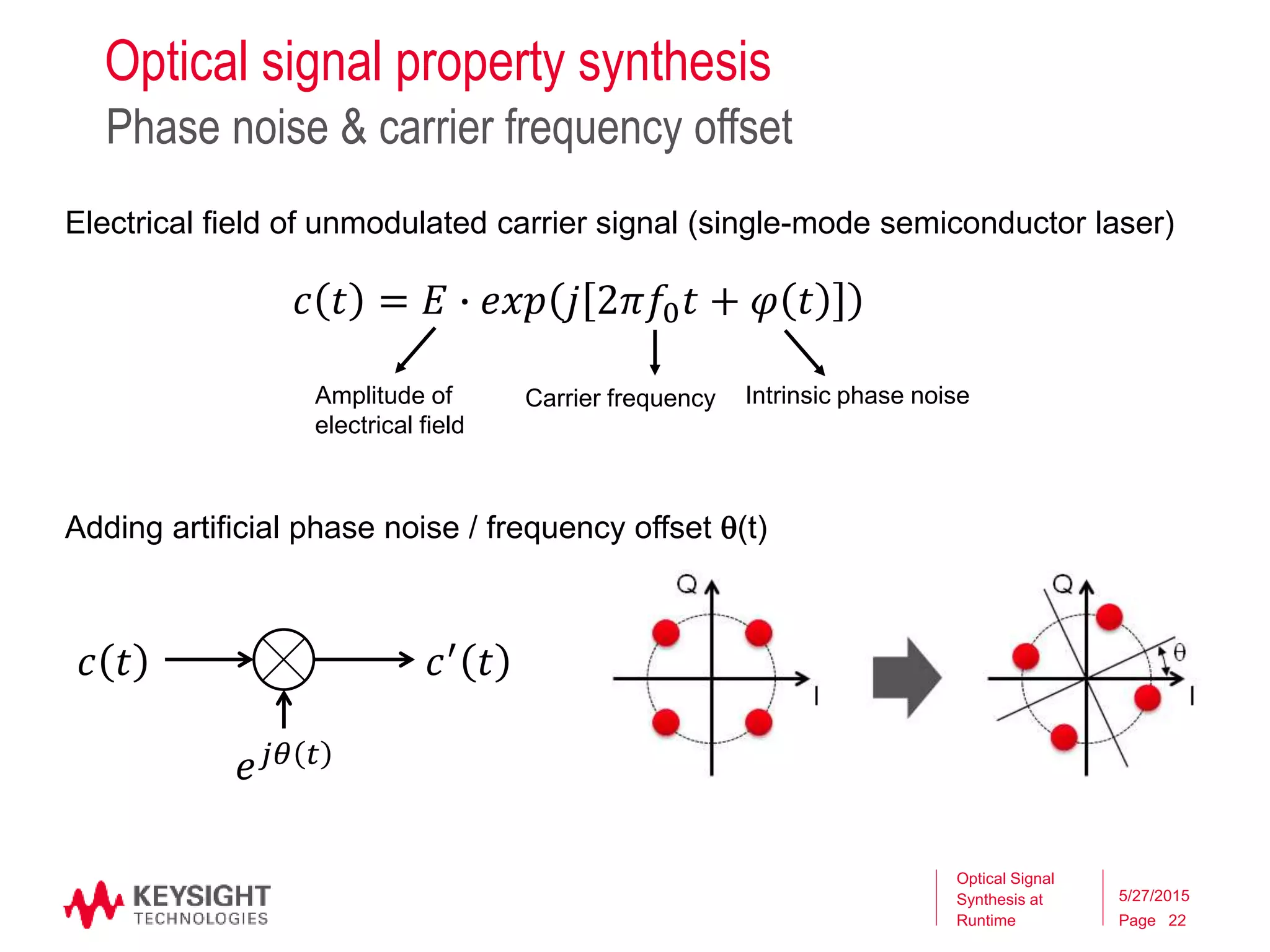
Electrical field of unmodulated carrier signal (single-mode semiconductor laser)
Adding artificial phase noise / frequency offset (t)
Optical signal property synthesis
Phase noise & carrier frequency offset
Optical Signal
Synthesis at
Runtime
5/27/2015
22
𝑐 𝑡 = 𝐸 ∙ 𝑒𝑥𝑝 𝑗 2𝜋𝑓0 𝑡 + 𝜑 𝑡
Amplitude of
electrical field
Carrier frequency Intrinsic phase noise
𝑐 𝑡
𝑒 𝑗𝜃 𝑡
𝑐′ 𝑡
Page
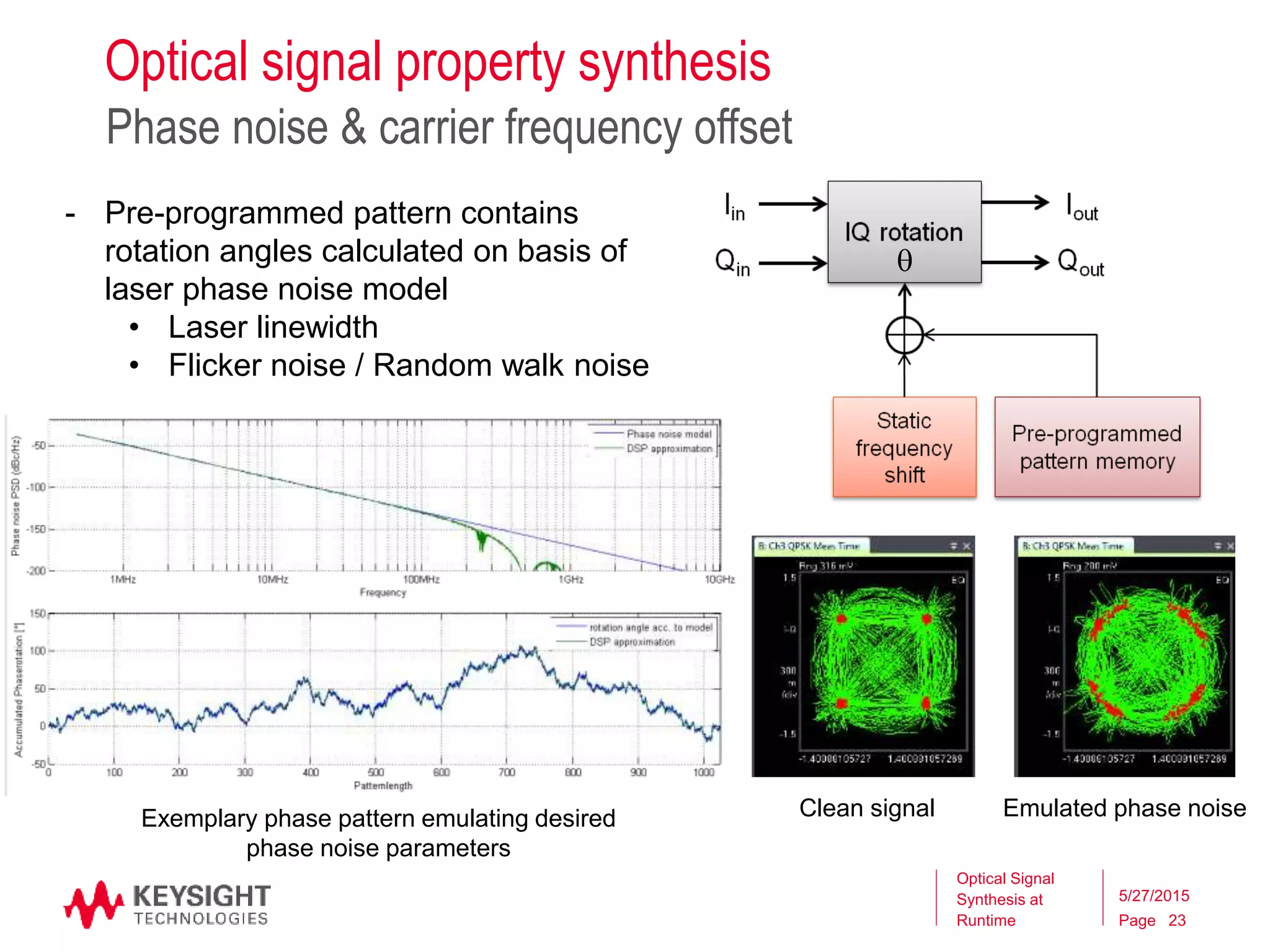
- Pre-programmed pattern contains
rotation angles calculated on basis of
laser phase noise model
• Laser linewidth
• Flicker noise / Random walk noise
Optical signal property synthesis
Phase noise & carrier frequency offset
Optical Signal
Synthesis at
Runtime
5/27/2015
23
Clean signal Emulated phase noiseExemplary phase pattern emulating desired
phase noise parameters

Page
Optical signal property synthesis
Polarization control/rotation
Optical Signal
Synthesis at
Runtime
5/27/2015
24
Architecture of AWG with real-time processing using the example of a Keysight M8195A prototype
Page
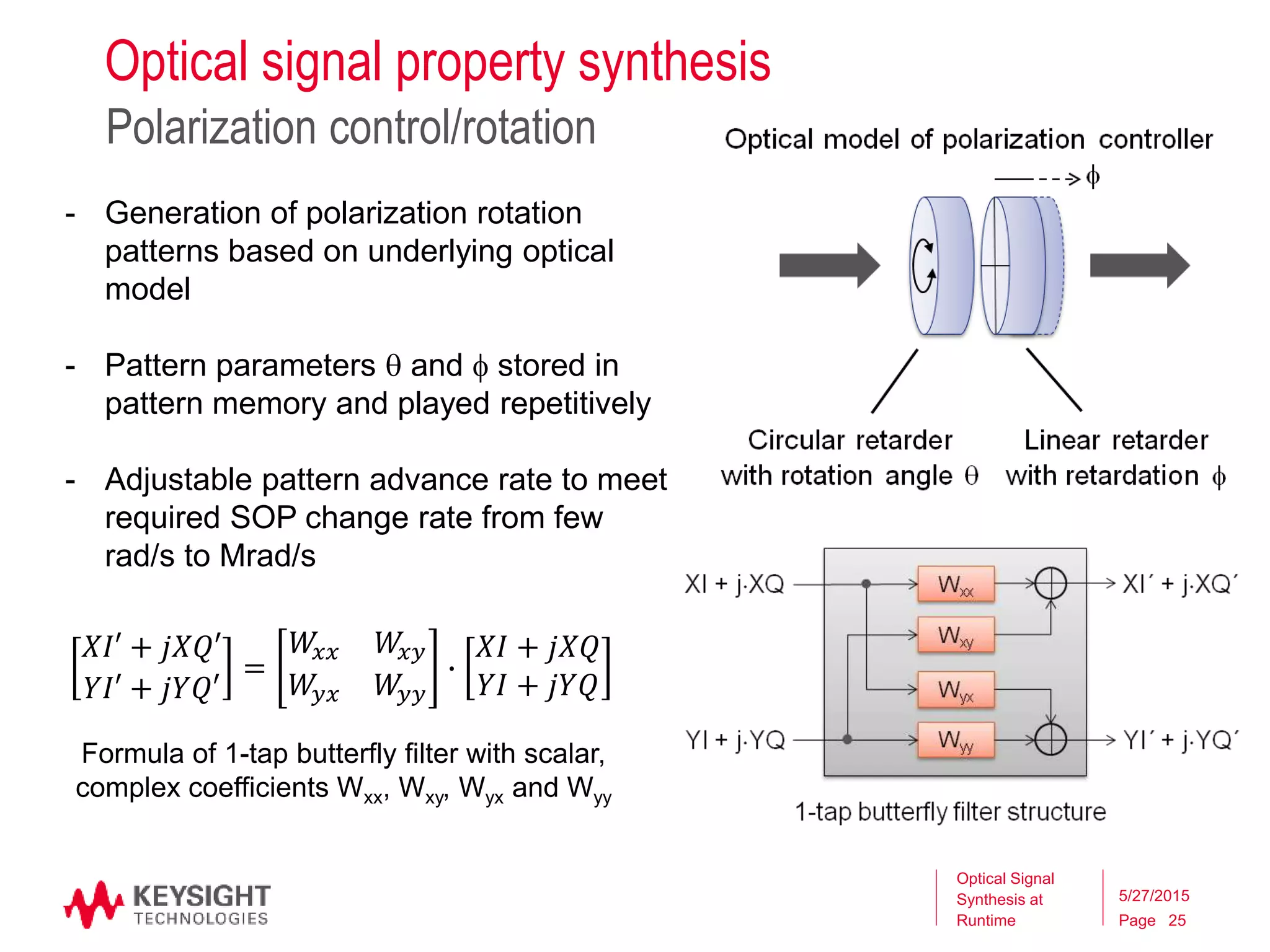
- Generation of polarization rotation
patterns based on underlying optical
model
- Pattern parameters  and  stored in
pattern memory and played repetitively
- Adjustable pattern advance rate to meet
required SOP change rate from few
rad/s to Mrad/s
Optical signal property synthesis
Polarization control/rotation
Optical Signal
Synthesis at
Runtime
5/27/2015
25
𝑋𝐼′ + 𝑗𝑋𝑄′
𝑌𝐼′ + 𝑗𝑌𝑄′
=
𝑊𝑥𝑥 𝑊𝑥𝑦
𝑊𝑦𝑥 𝑊𝑦𝑦
∙
𝑋𝐼 + 𝑗𝑋𝑄
𝑌𝐼 + 𝑗𝑌𝑄
Formula of 1-tap butterfly filter with scalar,
complex coefficients Wxx, Wxy, Wyx and Wyy
Page
Optical signal property synthesis
Polarization control/rotation
Optical Signal
Synthesis at
Runtime
5/27/2015
26
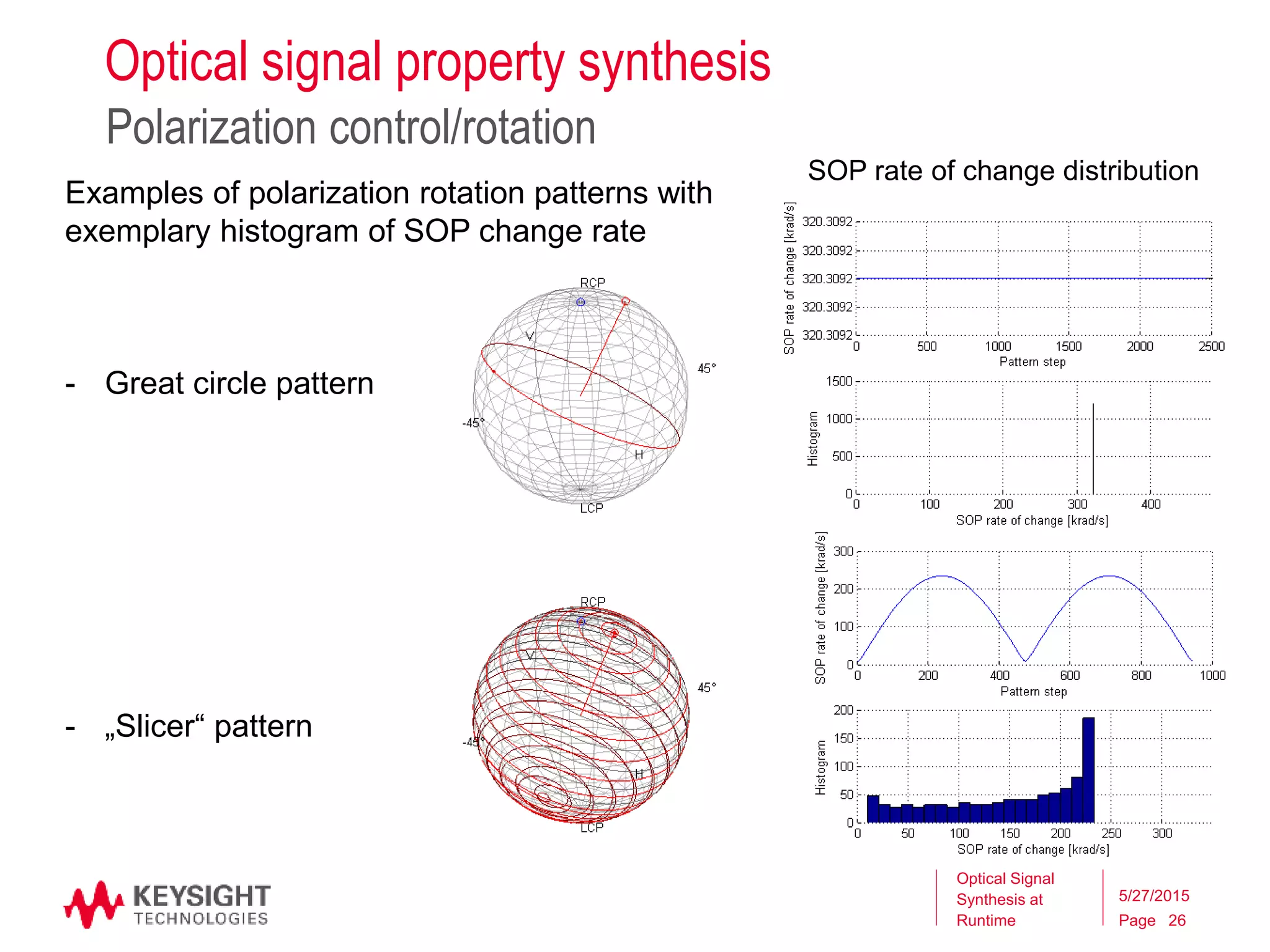
Examples of polarization rotation patterns with
exemplary histogram of SOP change rate
- Great circle pattern
- „Slicer“ pattern
SOP rate of change distribution
Page
Optical signal property synthesis
Polarization control/rotation
Optical Signal
Synthesis at
Runtime
5/27/2015
27
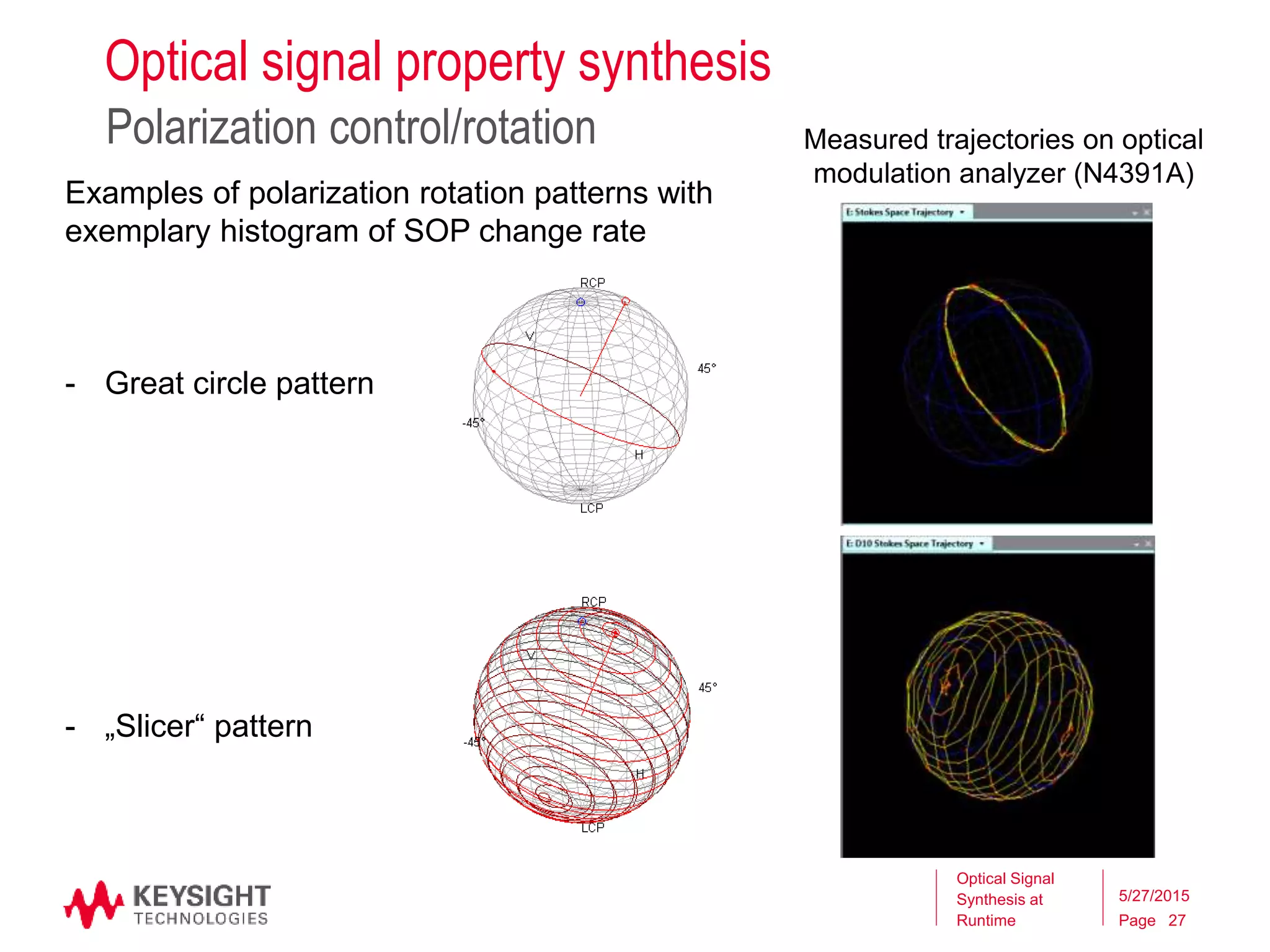
Examples of polarization rotation patterns with
exemplary histogram of SOP change rate
- Great circle pattern
- „Slicer“ pattern
Measured trajectories on optical
modulation analyzer (N4391A)
Page
Optical signal property synthesis
PMD emulation
Optical Signal
Synthesis at
Runtime
5/27/2015
28
Architecture of AWG with real-time processing using the example of a Keysight M8195A prototype
Page
Optical signal property synthesis
PMD emulation
Optical Signal
Synthesis at
Runtime
5/27/2015
29
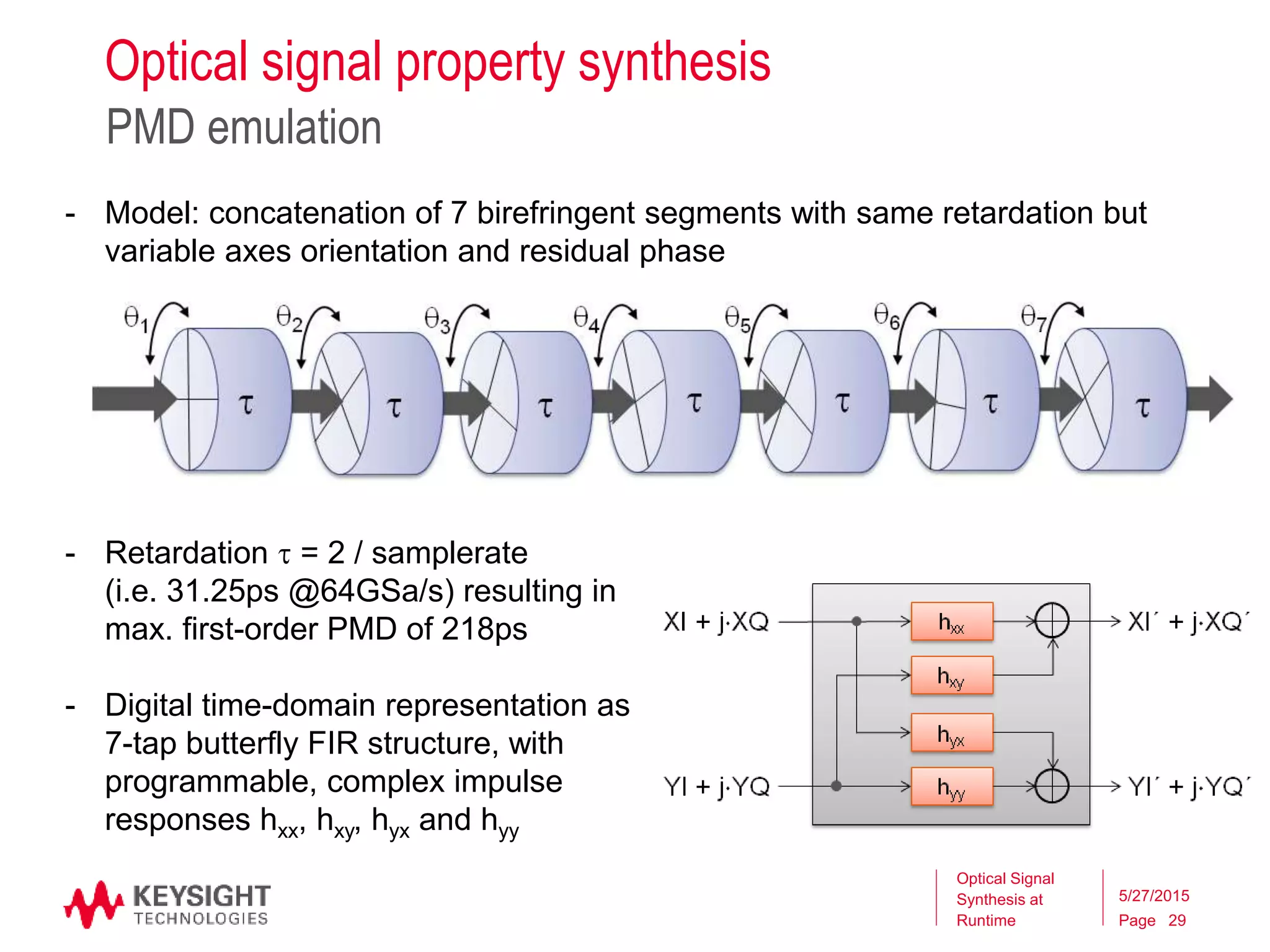
- Model: concatenation of 7 birefringent segments with same retardation but
variable axes orientation and residual phase
- Retardation  = 2 / samplerate
(i.e. 31.25ps @64GSa/s) resulting in
max. first-order PMD of 218ps
- Digital time-domain representation as
7-tap butterfly FIR structure, with
programmable, complex impulse
responses hxx, hxy, hyx and hyy
Page
Optical signal property synthesis
PMD emulation
Optical Signal
Synthesis at
Runtime
5/27/2015
30
Addressable PMD space with shown model
at 64GSa/s sampling rate:
• First order PMD: up to 218ps
• Second order PMD: up to 11500ps2
Addressable PMD space
0 20 40 60 80 100 120 140 160 180 200 220
0
2000
4000
6000
8000
10000
12000
First-order PMD [ps]
Second.orderPMD[ps2]
-50 -40 -30 -20 -10 0 10 20 30 40 50
0
50
100
150
200
DGD(ps)
-50 -40 -30 -20 -10 0 10 20 30 40 50
0
5000
10000
SOPMD(ps2)
-50 -40 -30 -20 -10 0 10 20 30 40 50
-4000
-2000
0
2000
4000
Relative frequency (GHz)
PDCD(ps2)
PMD spectra (exemplary settings)
32G channel spectrum
- Red dots: selected states from
7 segment model
- Green dots: selected states
from 6 segment model
- Blue dots: simulated random
states
Page
Summary
Optical Signal
Synthesis at
Runtime
5/27/2015
31
- Next generation optical transmission systems require cognitive networks and
network condition monitoring to meet demanded quality of service (QoS) for
future applications.
- Powerful DSP algorithms in coherent receivers are one key element for
mitigating optical signal impairments occurring in transmission path and
ensuring required quality of transmission (QoT).
- Real-time processing features in enable deterministic and repeatable stress
conditions for development and tolerance testing of coherent receivers, thus
increasing test coverage at reduced test time.
Page
Question & Answers
Optical Signal
Synthesis at
Runtime
5/27/2015
32

Optical Signal Property Synthesis at Runtime – An new approach for coherent transmission stress testing

  • 1.
    Optical Signal PropertySynthesis at Runtime Andy Doberstein Keysight, Germany May 2015 A new Approach for Coherent Transmission Stress Testing
  • 2.
    PageOutline 1. Test strategiesfor coherent optical receivers • Requirements and challenges of next generation optical transmission networks • Optical receiver stress testing and current limitations 2. Introducing DSP processing into AWG based optical signal synthesizer • Overview of real-time processing architecture • Clean signal generation / Generation of optical signal properties 3. Summary 5/27/2015 Optical Signal Synthesis at Runtime 2
  • 3.
    Page Test strategies forcoherent optical receivers Optical Signal Synthesis at Runtime 3 5/27/2015
  • 4.
    Page Next generation opticaltransmission systems Challenges and requirements 5/27/2015 Optical Signal Synthesis at Runtime ROADM: reconfigurable optical add-drop multiplexer EDFA: Erbium-doped fiber amplifier WXC: Wavelength cross connect 4 Increasing demand: end-user services (e.g. streaming), cloud computing applications with different QoS requirements Transmission impairments (stochastic/deterministic nature) : e.g. CD, PMD, ASE noise, non-linear distortions, filtering/ ROADM concatenation Needs network management: - Cognitive and adaptive optical networks - Condition monitoring to guarantee QoT - Reconfigurable transmitter and receivers
  • 5.
    Page Key element: Coherentoptical receiver Basic block diagram 5/27/2015 Optical Signal Synthesis at Runtime 5
  • 6.
    Page - Traditional receiverstress testing has different drawbacks: • All optical fiber testbed subject to stochastic processes • Lack of well-defined and reproducible worst-case stress conditions for coherent receiver testing • Inflexible, costly structure Coherent receiver testing Traditional test setup Optical Signal Synthesis at Runtime 5/27/2015 6 Reference TX or golden line card Pattern generator Fiber testbed Coherent Receiver Error Detection DUT
  • 7.
    Page Coherent receiver testing AWGbased optical signal synthesis Reference TX or golden line card Pattern generator Fiber testbed Coherent Receiver Error Detection Optical Signal Synthesizer Coherent Receiver Error Detection DUT Laser source MZ MZ PBS PBC E/O Memory D/A D/A D/A D/A AWG Example: 256Gb/s channel - 64GSa/s sampling rate - 32GBaud data rate - DP-QAM16
  • 8.
    Page Coherent receiver testing AWGbased optical signal synthesis Reference TX or golden line card Pattern generator Fiber testbed Coherent Receiver Error Detection Optical Signal Synthesizer Coherent Receiver Error Detection DUT - Benefits of AWG based signal synthesis • Complementary setup for development of receiver algorithms • Flexible structure allows switching of signal parameters (modulation formats, optical impairments, etc.) • Deterministic and repeatable generation of stress conditions (incl. corner cases) • Increased test coverage at reduced test time (→ Importance sampling)
  • 9.
    Page AWG based signalsynthesis Limitation in current architecture 5/27/2015 Optical Signal Synthesis at Runtime – Conventional AWGs generate signal from pre-calculated waveform memory (in the range of several GBytes) → Waveform exactly repeats after each memory loop iteration making it unfeasible to synthesize slow optical effects Example: 16GByte waveform memory (single channel) with 64GSa/s sampling rate = 250ms play length – Pre-calculated waveform exhibits strong correlation between undistorted data signal and emulated impairment – Cumbersome pre-calculation / upload into AWG waveform memory (large amounts of data) making it impossible to quickly change signal and impairment parameters 9
  • 10.
    Page Introducing DSP processinginto AWG based optical signal synthesizer Optical Signal Synthesis at Runtime 10 5/27/2015
  • 11.
    Page AWG based signalsynthesis Advanced real-time processing Optical Signal Synthesis at Runtime 5/27/2015 11 Reference TX or golden line card Pattern generator Fiber testbed Coherent Receiver Error Detection Optical Signal Synthesizer Coherent Receiver Error Detection DUT D/A D/A D/A D/A AWG Laser source MZ MZ PBS PBC E/O DSP Memory NEW
  • 12.
    Page - Similar structureas in receiver but in reverse order - Blocks enabled or bypassed individually - Impairments generated independently of „clean“ signal → better decorrelation - Coefficient banks and pattern memories can be programmed at run-time Novel architecture Adding real-time processing into signal synthesizer Optical Signal Synthesis at Runtime 5/27/2015 12
  • 13.
    Page Comparison Waveform playback vs.real-time processing Optical Signal Synthesis at Runtime 5/27/2015 13 Operation Waveform mode (conventional operation ) Real-time processing mode Memory usage Pre-calculated samples representing waveform Only symbol pattern stored Signal parameter change Complete re-calculation Coefficients / pattern update at runtime Continuous play Waveform loops at end requiring matching begin and end Symbol pattern loops at end independently on real-time blocks Signal pre- distortion Pre-distortions (frequency response, skew, etc.) calculated into waveform Filter coefficients update at runtime
  • 14.
    Page AWG with advancedTx-DSP functionality Architectural overview Optical Signal Synthesis at Runtime 5/27/2015 14 Architecture of AWG with real-time processing using the example of a Keysight M8195A prototype
  • 15.
    Page Clean signal generation OpticalSignal Synthesis at Runtime 15 5/27/2015
  • 16.
    Page Clean signal generation Basicblocks Optical Signal Synthesis at Runtime 5/27/2015 16 Architecture of AWG with real-time processing using the example of a Keysight M8195A prototype
  • 17.
    Page Clean signal generation Basicblocks Optical Signal Synthesis at Runtime 5/27/2015 17 Architecture of AWG with real-time processing using the example of a Keysight M8195A prototype
  • 18.
    Page Encoding examples: QPSK QAM16QAM16 QAM64 QAM128 Clean signal generation Symbol encoding Optical Signal Synthesis at Runtime 5/27/2015 18 - Encoding up to QAM256 QPSK
  • 19.
    Page Clean signal generation Pulseshaping (interpolation filter) Optical Signal Synthesis at Runtime 5/27/2015 19 - Generic FIR filter with 32 taps (at 32GBaud symbol rate) - Time-domain pulse shaping for increased spectral efficiency Exemplary constellation and eye diagrams for QAM-16 signal filtered with raised cosine filter a = 0.05 (Narrowest spectrum) a = 1.0 (Best Q-Factor) -1 -0.8 -0.6 -0.4 -0.2 0 0.2 0.4 0.6 0.8 1 0 0.2 0.4 0.6 0.8 1 Normalized frequency Powerspectrum(linear) Raised Cosine Filter a = 1 a = 0.7 a = 0.35 a = 0.05 -1 -0.8 -0.6 -0.4 -0.2 0 0.2 0.4 0.6 0.8 1 -20 -15 -10 -5 0 5 Normalized frequency Powerspectrum(logarithmic) Raised Cosine Filter a = 1 a = 0.7 a = 0.35 a = 0.05
  • 20.
    Page Generation of opticalsignal properties and impairments Optical Signal Synthesis at Runtime 20 5/27/2015
  • 21.
    Page Optical signal propertysynthesis Phase noise & carrier frequency offset Optical Signal Synthesis at Runtime 5/27/2015 21 Architecture of AWG with real-time processing using the example of a Keysight M8195A prototype
  • 22.
    Page Electrical field ofunmodulated carrier signal (single-mode semiconductor laser) Adding artificial phase noise / frequency offset (t) Optical signal property synthesis Phase noise & carrier frequency offset Optical Signal Synthesis at Runtime 5/27/2015 22 𝑐 𝑡 = 𝐸 ∙ 𝑒𝑥𝑝 𝑗 2𝜋𝑓0 𝑡 + 𝜑 𝑡 Amplitude of electrical field Carrier frequency Intrinsic phase noise 𝑐 𝑡 𝑒 𝑗𝜃 𝑡 𝑐′ 𝑡
  • 23.
    Page - Pre-programmed patterncontains rotation angles calculated on basis of laser phase noise model • Laser linewidth • Flicker noise / Random walk noise Optical signal property synthesis Phase noise & carrier frequency offset Optical Signal Synthesis at Runtime 5/27/2015 23 Clean signal Emulated phase noiseExemplary phase pattern emulating desired phase noise parameters 
  • 24.
    Page Optical signal propertysynthesis Polarization control/rotation Optical Signal Synthesis at Runtime 5/27/2015 24 Architecture of AWG with real-time processing using the example of a Keysight M8195A prototype
  • 25.
    Page - Generation ofpolarization rotation patterns based on underlying optical model - Pattern parameters  and  stored in pattern memory and played repetitively - Adjustable pattern advance rate to meet required SOP change rate from few rad/s to Mrad/s Optical signal property synthesis Polarization control/rotation Optical Signal Synthesis at Runtime 5/27/2015 25 𝑋𝐼′ + 𝑗𝑋𝑄′ 𝑌𝐼′ + 𝑗𝑌𝑄′ = 𝑊𝑥𝑥 𝑊𝑥𝑦 𝑊𝑦𝑥 𝑊𝑦𝑦 ∙ 𝑋𝐼 + 𝑗𝑋𝑄 𝑌𝐼 + 𝑗𝑌𝑄 Formula of 1-tap butterfly filter with scalar, complex coefficients Wxx, Wxy, Wyx and Wyy
  • 26.
    Page Optical signal propertysynthesis Polarization control/rotation Optical Signal Synthesis at Runtime 5/27/2015 26 Examples of polarization rotation patterns with exemplary histogram of SOP change rate - Great circle pattern - „Slicer“ pattern SOP rate of change distribution
  • 27.
    Page Optical signal propertysynthesis Polarization control/rotation Optical Signal Synthesis at Runtime 5/27/2015 27 Examples of polarization rotation patterns with exemplary histogram of SOP change rate - Great circle pattern - „Slicer“ pattern Measured trajectories on optical modulation analyzer (N4391A)
  • 28.
    Page Optical signal propertysynthesis PMD emulation Optical Signal Synthesis at Runtime 5/27/2015 28 Architecture of AWG with real-time processing using the example of a Keysight M8195A prototype
  • 29.
    Page Optical signal propertysynthesis PMD emulation Optical Signal Synthesis at Runtime 5/27/2015 29 - Model: concatenation of 7 birefringent segments with same retardation but variable axes orientation and residual phase - Retardation  = 2 / samplerate (i.e. 31.25ps @64GSa/s) resulting in max. first-order PMD of 218ps - Digital time-domain representation as 7-tap butterfly FIR structure, with programmable, complex impulse responses hxx, hxy, hyx and hyy
  • 30.
    Page Optical signal propertysynthesis PMD emulation Optical Signal Synthesis at Runtime 5/27/2015 30 Addressable PMD space with shown model at 64GSa/s sampling rate: • First order PMD: up to 218ps • Second order PMD: up to 11500ps2 Addressable PMD space 0 20 40 60 80 100 120 140 160 180 200 220 0 2000 4000 6000 8000 10000 12000 First-order PMD [ps] Second.orderPMD[ps2] -50 -40 -30 -20 -10 0 10 20 30 40 50 0 50 100 150 200 DGD(ps) -50 -40 -30 -20 -10 0 10 20 30 40 50 0 5000 10000 SOPMD(ps2) -50 -40 -30 -20 -10 0 10 20 30 40 50 -4000 -2000 0 2000 4000 Relative frequency (GHz) PDCD(ps2) PMD spectra (exemplary settings) 32G channel spectrum - Red dots: selected states from 7 segment model - Green dots: selected states from 6 segment model - Blue dots: simulated random states
  • 31.
    Page Summary Optical Signal Synthesis at Runtime 5/27/2015 31 -Next generation optical transmission systems require cognitive networks and network condition monitoring to meet demanded quality of service (QoS) for future applications. - Powerful DSP algorithms in coherent receivers are one key element for mitigating optical signal impairments occurring in transmission path and ensuring required quality of transmission (QoT). - Real-time processing features in enable deterministic and repeatable stress conditions for development and tolerance testing of coherent receivers, thus increasing test coverage at reduced test time.
  • 32.
    Page Question & Answers OpticalSignal Synthesis at Runtime 5/27/2015 32