Transmission  Media  ROTHMAN Amit kumar Gunjan Kumar Mayank Sinha
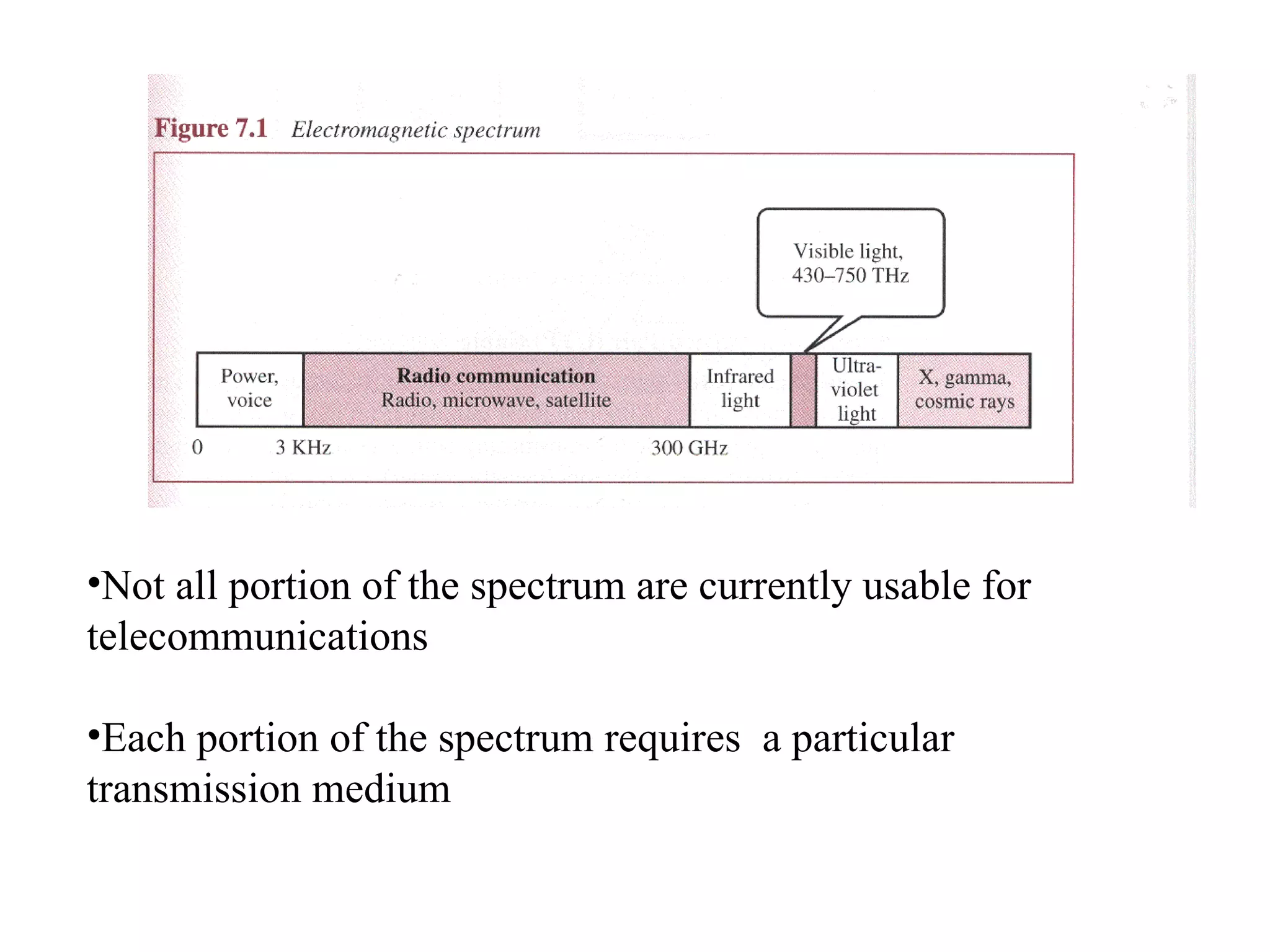
Transmission Media The transmission medium is the physical path by which a message travels from sender to receiver. Computers and telecommunication devices use signals to represent data. These signals are transmitted from a device to another in the  form of electromagnetic energy. Examples  of Electromagnetic energy include power, radio waves, infrared light, visible light, ultraviolet light, and X and gamma rays.  All  these electromagnetic signals constitute  the  electromagnetic spectrum
Not all portion of the spectrum are currently usable for  telecommunications Each portion of the spectrum requires  a particular transmission medium
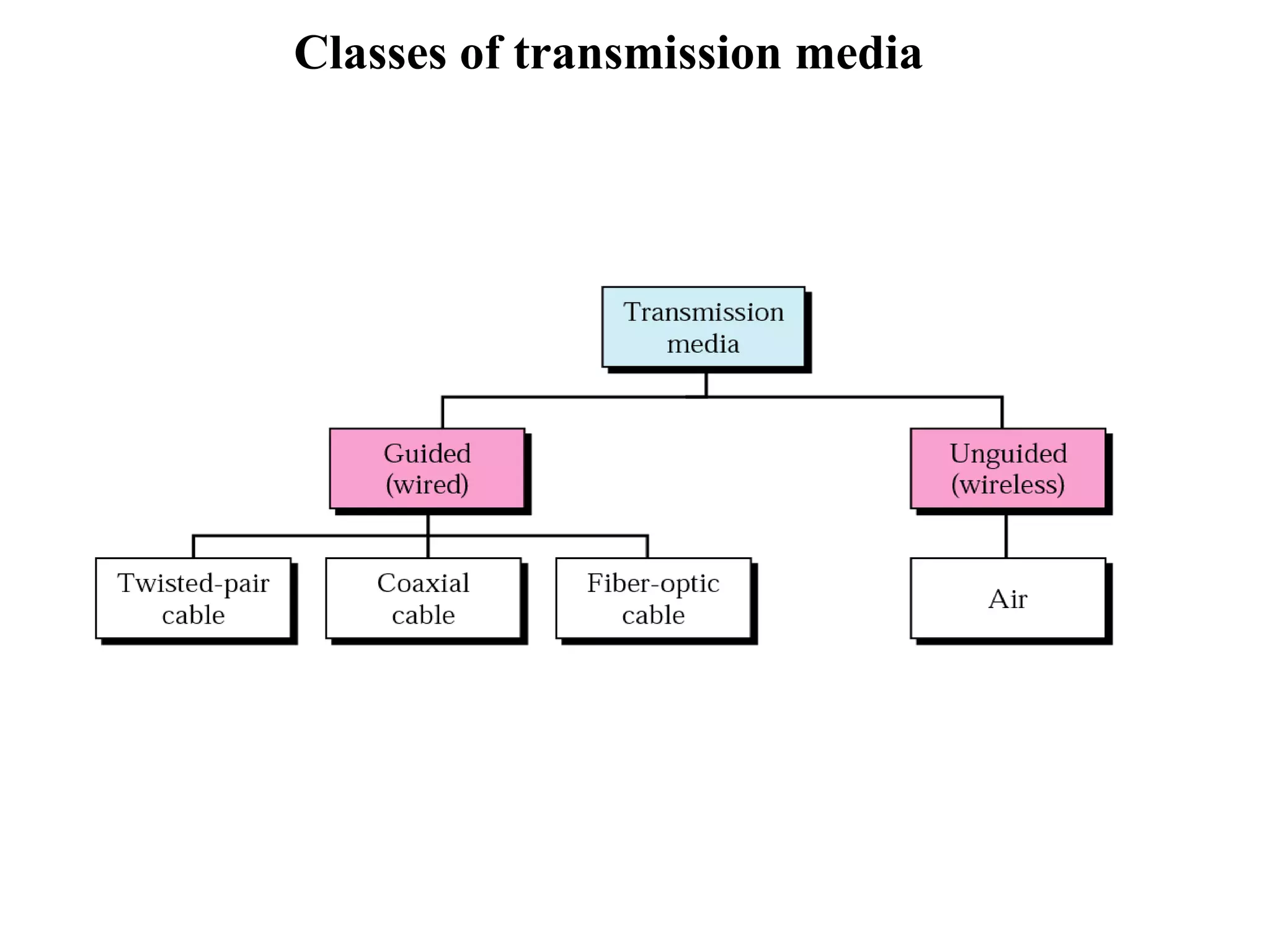
Classes of transmission media
Transmission Media Guided  media,  which are those that provide  a conduit from one device to another. Examples: twisted-pair, coaxial cable, optical fiber. Unguided media (or wireless communication)  transport electromagnetic waves without using a physical conductor. Instead, signals are broadcast through air (or, in a few cases, water), and thus are available  to anyone who has a device capable of receiving them.
Guided Media There are three categories of  guided  media: Twisted-pair cable Coaxial cable Fiber-optic cable
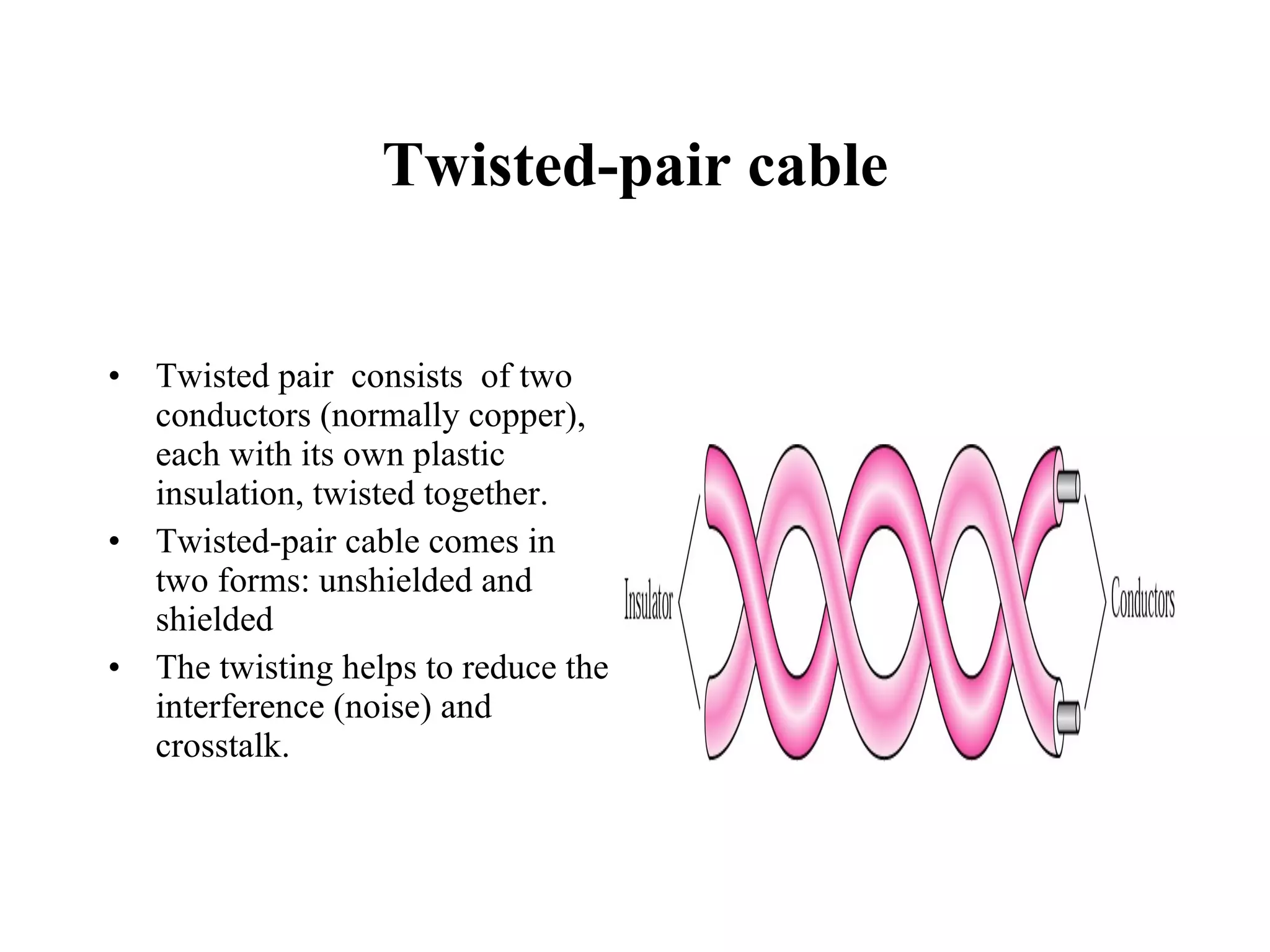
Twisted-pair cable Twisted pair  consists  of two conductors (normally copper), each with its own plastic insulation, twisted together. Twisted-pair cable comes in two forms: unshielded and shielded The twisting helps to reduce the interference (noise) and crosstalk.
 
UTP and STP
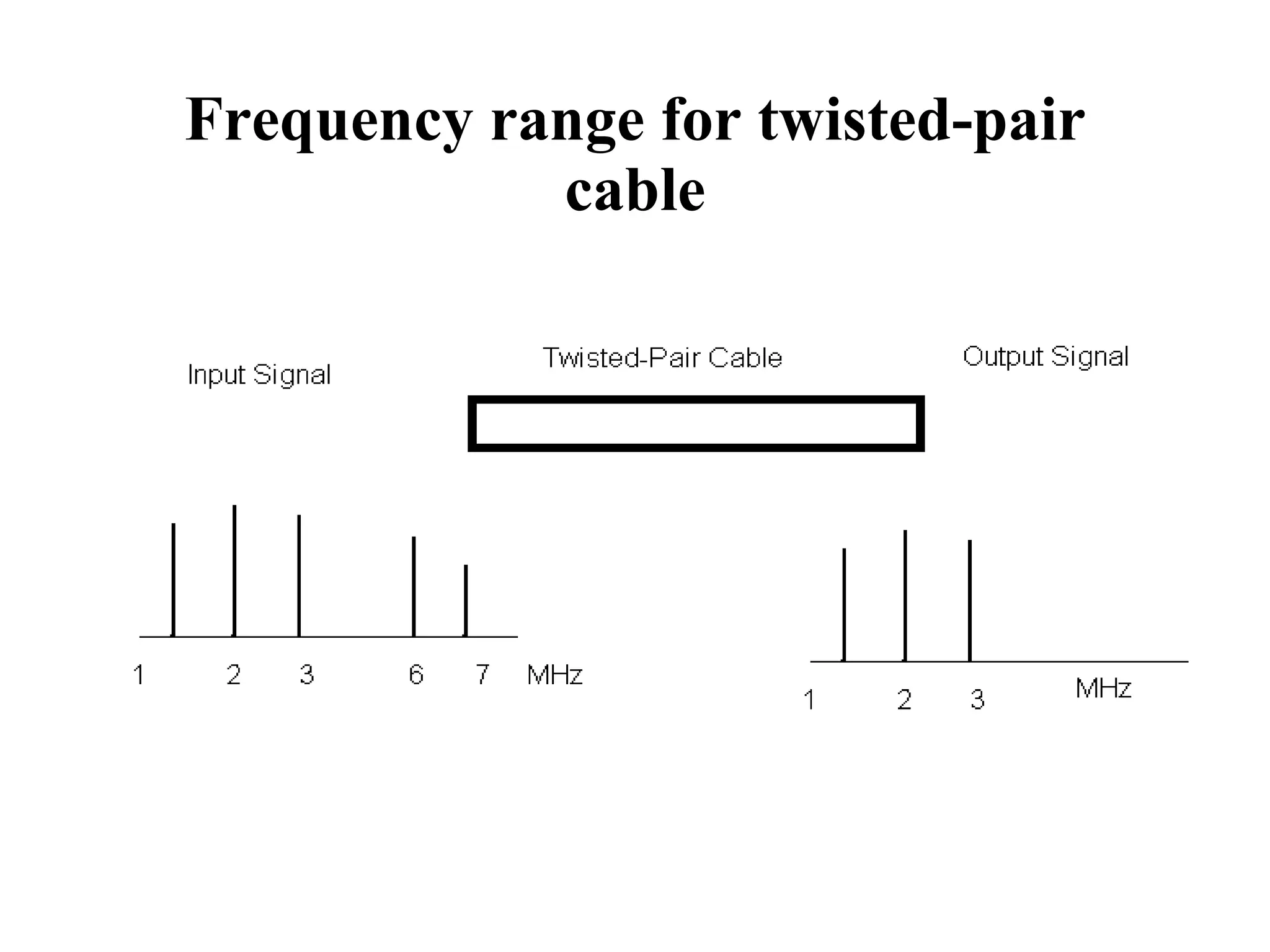
Frequency range for twisted-pair cable
Unshielded Twisted-pair (UTP) cable Any medium can transmit only a fixed range of frequencies! UTP cable is the most common type of telecommunication medium in use today. The range  is suitable for transmitting both data and video. Advantages of UTP  are its cost and ease of use. UTP is cheap, flexible, and easy to install.
Shielded Twisted (STP) Cable STP cable has a metal foil  or braided-mesh covering that enhances each pair of insulated conductors. The metal casing prevents the penetration of electromagnetic noise. Materials and manufacturing requirements make STP more expensive than UTP but less susceptible to noise.
Applications Twisted-pair cables are used in telephones lines to provide voice and data channels. The DSL lines that are used by the telephone companies to provide high data rate connections also use the high-bandwidth capability of unshielded twisted-pair cables. Local area networks, such as 10Base-T and 100Base-T, also used UTP cables.
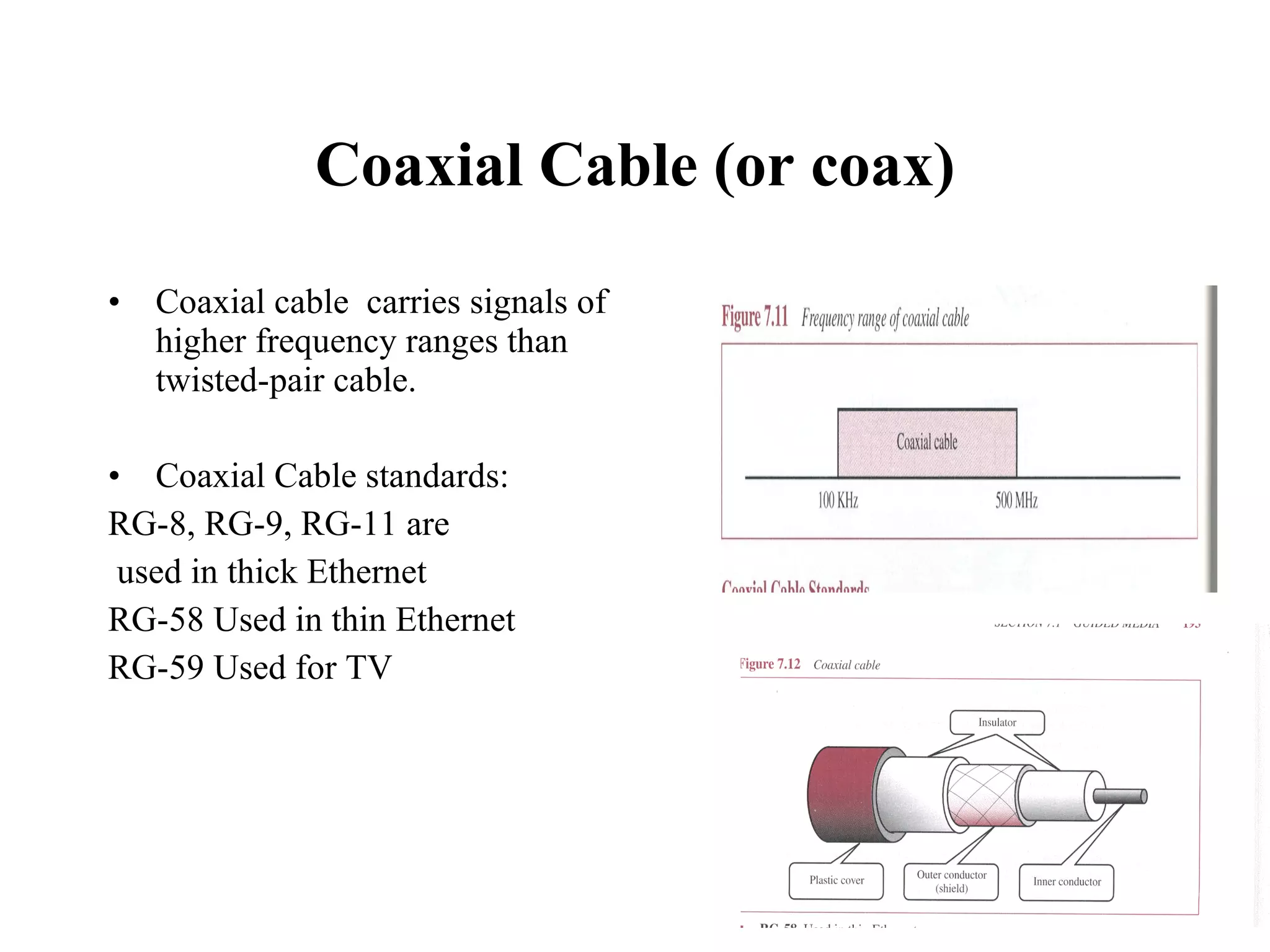
Coaxial Cable (or coax) Coaxial cable  carries signals of higher frequency ranges than twisted-pair cable. Coaxial Cable standards: RG-8, RG-9, RG-11 are  used in thick Ethernet RG-58 Used in thin Ethernet RG-59 Used for TV
Optical Fiber Metal  cables transmit signals in the form of  electric current. Optical fiber is made of glass or plastic and transmits signals in the form of  light . Light, a  form of electromagnetic energy,  travels at 300,000 Kilometers/second ( 186,000 miles/second), in a vacuum. The speed of the light depends on the density of the medium through which  it is traveling ( the higher density, the slower the speed).
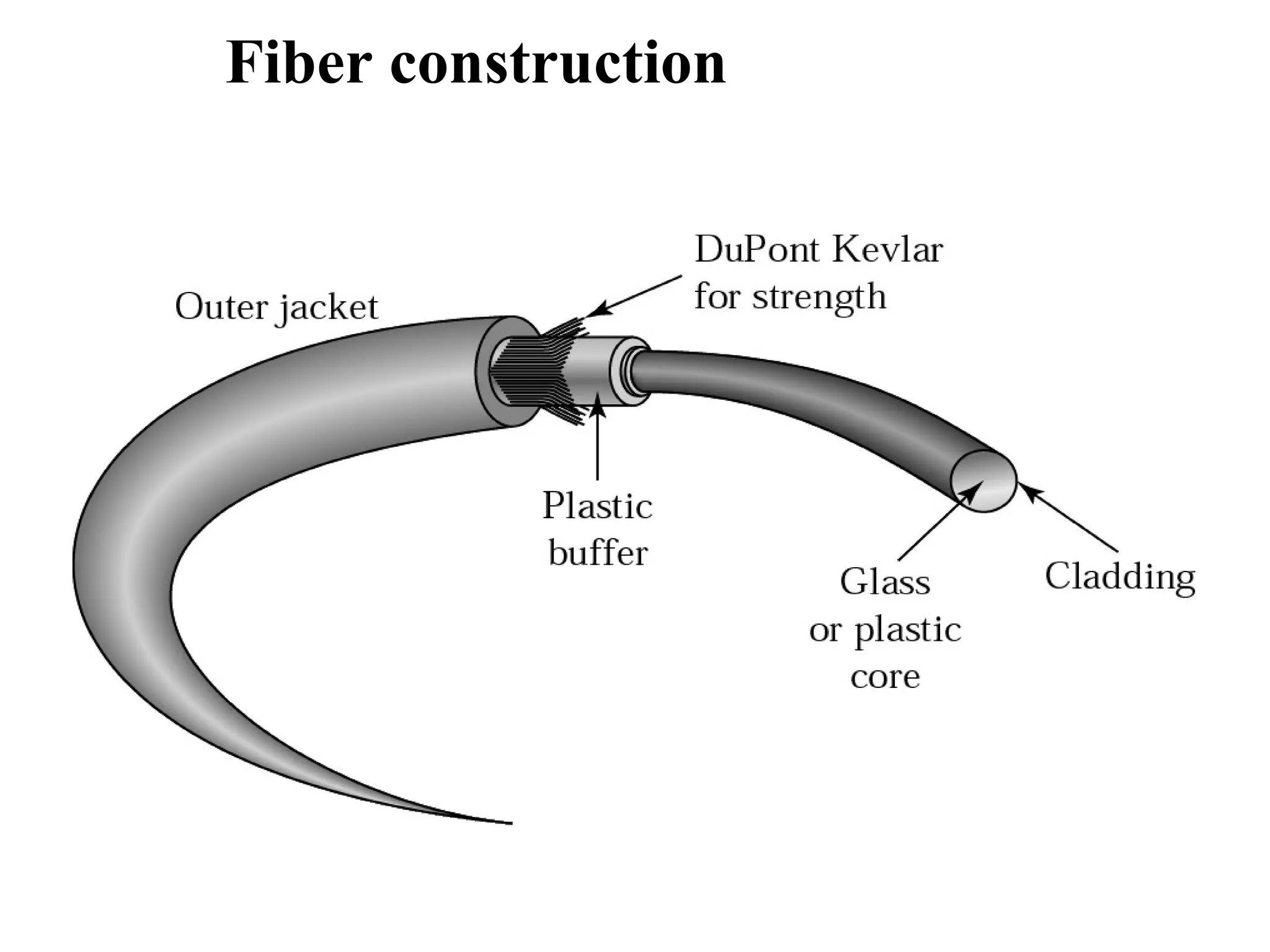
Optical fibers use reflection to guide light through a channel. A glass or core is surrounded  by a cladding of less dense glass or plastic. The  difference in density  of the two materials must be such  that a beam of light moving through the core is reflected off  the cladding instead of being  into it. Information is encoded onto a beam of light as a series of on-off flashes that represent 1 and 0 bits.
Fiber construction
Types of Optical Fiber   There are two basic types of fiber: multimode fiber and single-mode fiber.  Multimode fiber is best designed for short transmission distances, and is suited for use in LAN systems and video surveillance.   Single-mode fiber is best designed for longer transmission distances, making it suitable for long-distance telephony and multichannel television broadcast systems.
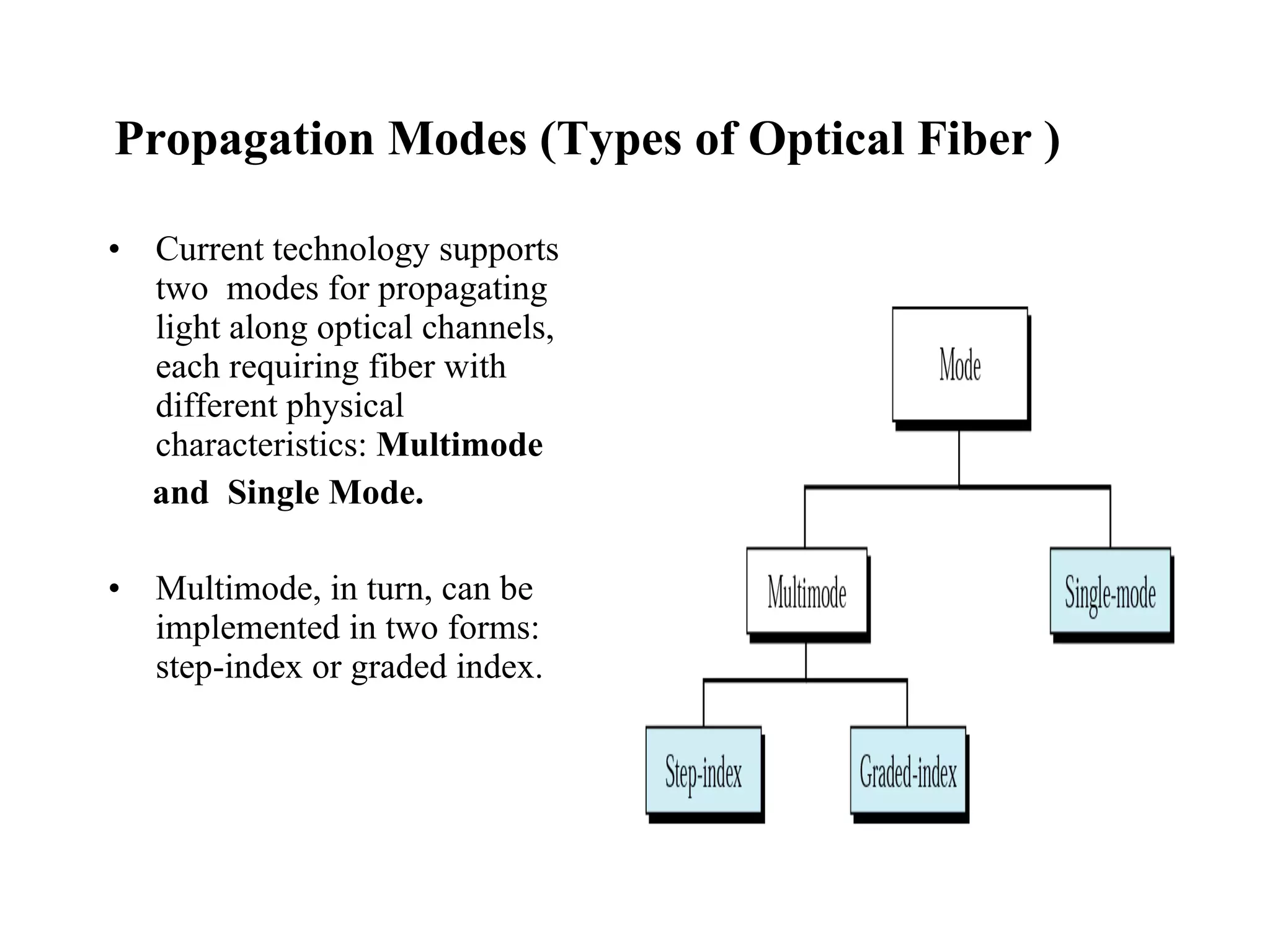
Propagation Modes (Types of Optical Fiber ) Current technology supports two  modes for propagating light along optical channels, each requiring fiber with  different physical characteristics:  Multimode  and  Single Mode. Multimode, in turn, can be implemented in two forms: step-index or graded index.
Multimode : In this  case multiple beams from a light source move through the core in different paths. In  multimode step-index fiber , the density of the core remains constant from the center to the edges. A beam of light moves through this constant density in a straight line until it reaches the interface of the core and cladding. At the interface there is an abrupt change to a lower density that alters  the angle of the beam’s motion. In a  multimode graded-index fiber  the density is highest at the center of the core and decreases gradually to its lowest at the edge.
Propagation Modes
Single mode  uses step-index fiber and a highly focused source of light that limits beams to a small range of angles, all close to the horizontal. Fiber Sizes Optical fibers are defined by the ratio of the diameter of their  core to the diameter of their cladding, both expressed in microns  (micrometers) Type Core Cladding Mode 50/125 50 125 Multimode, graded-index 62.5/125 62.5 125 Multimode, graded-index 100/125 100 125 Multimode, graded-index 7/125 7 125 Single-mode
Light sources for optical fibers The purpose of fiber-optic cable is to contain and direct a beam of light from source to target. The sending device must be equipped with a light source and the receiving device with photosensitive cell (called a photodiode) capable of translating  the received light into  an electrical signal. The light source can be either a light-emitting diode (LED) or an injection laser diode.
Fiber-optic cable connectors The subscriber channel (SC) connector is used in cable TV. It uses a push/pull locking system. The straight-tip (ST) connector is used for connecting cable  to networking devices. MT-RJ is a new connector with the same size as  RJ45.
Advantages of Optical Fiber The major advantages offered by fiber-optic cable over twisted-pair and coaxial cable are  noise resistance, less signal attenuation, and higher bandwidth . Noise Resistance : Because fiber-optic transmission uses light rather than electricity, noise is not a factor. External light, the only possible interference, is blocked  from the channel by the outer jacket.
Advantages of Optical Fiber Less signal attenuation Fiber-optic transmission  distance is significantly greater than that of other guided media. A signal can run for miles without requiring regeneration. Higher bandwidth Currently, data rates and bandwidth utilization over fiber-optic cable are limited not by the medium but by the signal generation and reception technology available.
Disadvantages of Optical Fiber The main disadvantages of fiber optics are  cost, installation/maintenance, and fragility . Cost.  Fiber-optic cable is expensive. Also, a laser light source can cost thousands of dollars, compared to hundreds of dollars for electrical signal generators. Installation/maintenance Fragility. Glass fiber is more easily broken than wire, making it less useful for applications  where hardware portability is required.
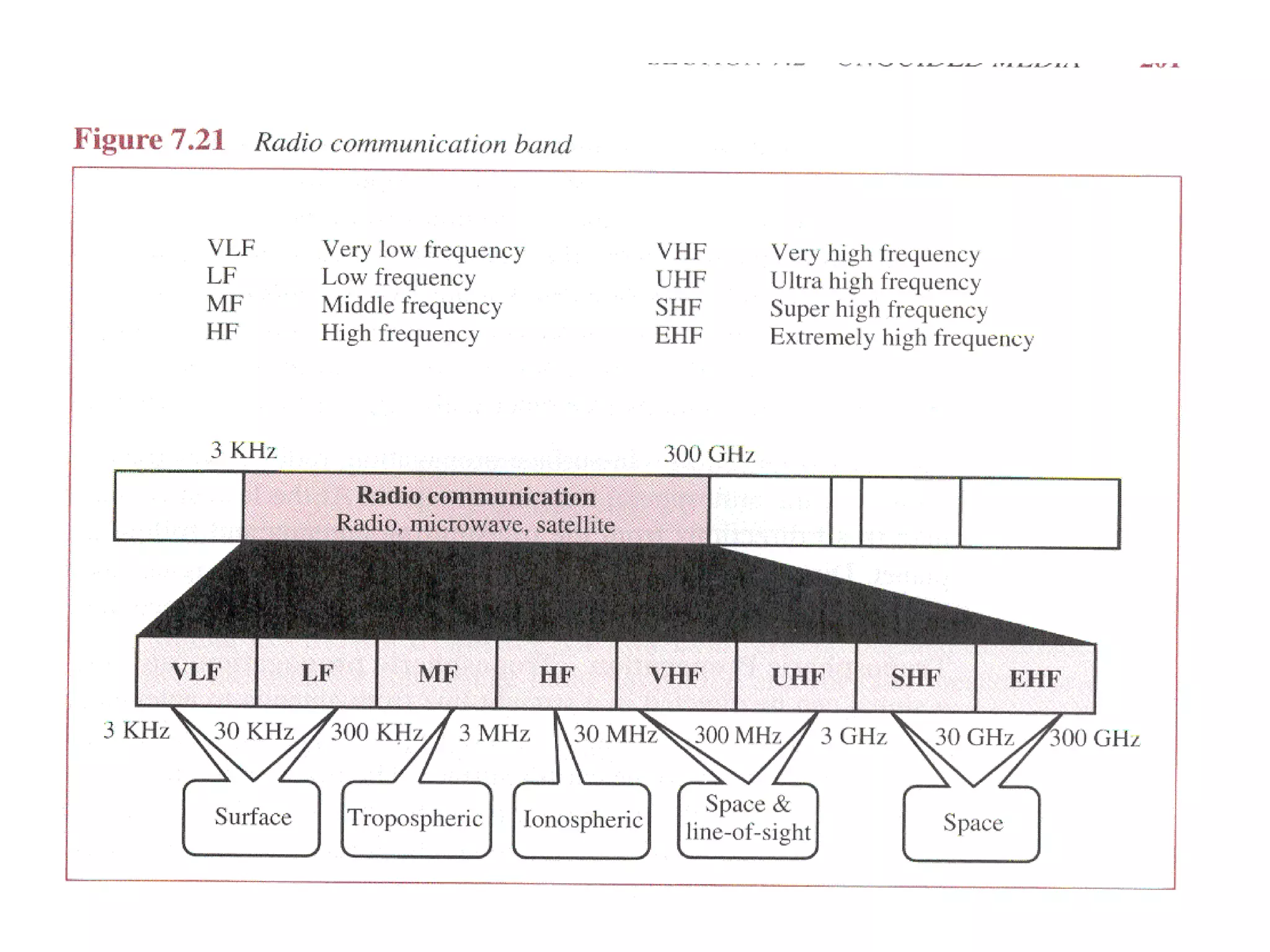
Unguided Media Unguided media, or wireless communication, transport electromagnetic waves without using a physical conductor. Instead the signals are broadcast though air or water, and thus are available  to anyone who has a device capable of receiving them. The section of the electromagnetic spectrum  defined as radio communication is divided into eight ranges, called  bands,  each regulated by government authorities.
 
Propagation of Radio Waves Radio technology considers the earth as surrounded by two layers of atmosphere: the  troposphere  and  the  ionosphere . The troposphere  is the portion of  the atmosphere extending outward approximately 30 miles from the earth's surface. The troposphere contains what we generally  think of as air. Clouds, wind, temperature variations, and weather in general occur in the troposphere. The ionosphere is the layer of the atmosphere  above the troposphere but below space.
Propagation methods
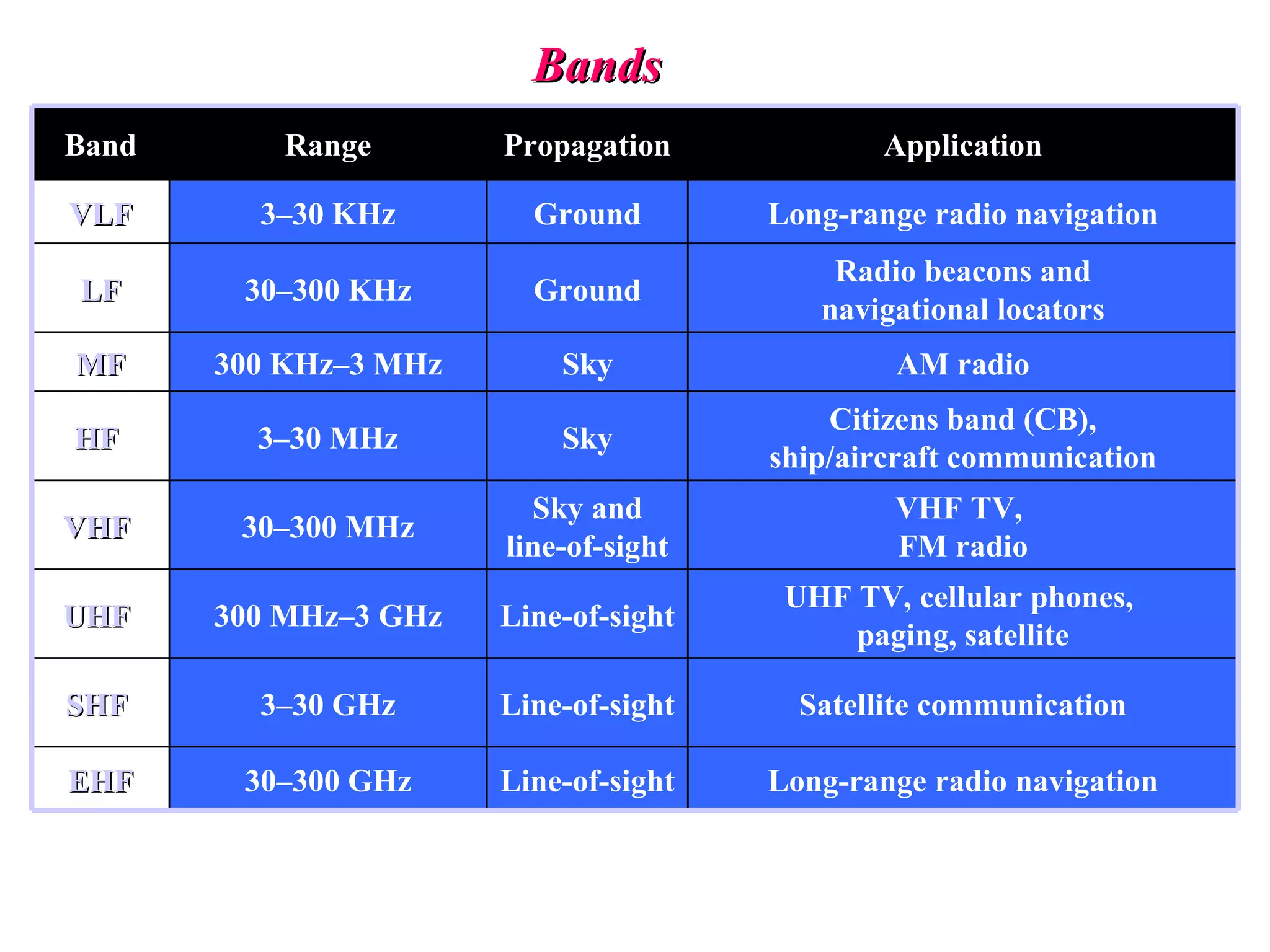
Ground propagation . In ground propagation, radio waves travel through the lowest portion of the atmosphere, hugging the earth.  These low-frequency signals emanate in all directions from the transmitting antenna and follow the curvature of the planet. The distance depends on the power in the signal. In  Sky propagation , higher-frequency radio waves  radiate upward into  the ionosphere where they are reflected back to earth.  This type of transmission allows  for greater distances with lower power output. In  Line-of-Sight Propagation , very high frequency signals are transmitted in straight lines directly from antenna to antenna.
Bands Band Range Propagation Application VLF 3–30 KHz Ground Long-range radio navigation LF 30–300 KHz Ground Radio beacons and navigational locators MF 300 KHz–3 MHz Sky AM radio HF  3–30 MHz Sky Citizens band (CB), ship/aircraft communication VHF  30–300 MHz Sky and line-of-sight VHF TV,  FM radio UHF  300 MHz–3 GHz Line-of-sight UHF TV, cellular phones,  paging, satellite SHF  3–30 GHz Line-of-sight Satellite communication EHF 30–300 GHz Line-of-sight Long-range radio navigation

Rothmans

  • 1.
    Transmission Media ROTHMAN Amit kumar Gunjan Kumar Mayank Sinha
  • 2.
    Transmission Media Thetransmission medium is the physical path by which a message travels from sender to receiver. Computers and telecommunication devices use signals to represent data. These signals are transmitted from a device to another in the form of electromagnetic energy. Examples of Electromagnetic energy include power, radio waves, infrared light, visible light, ultraviolet light, and X and gamma rays. All these electromagnetic signals constitute the electromagnetic spectrum
  • 3.
    Not all portionof the spectrum are currently usable for telecommunications Each portion of the spectrum requires a particular transmission medium
  • 4.
  • 5.
    Transmission Media Guided media, which are those that provide a conduit from one device to another. Examples: twisted-pair, coaxial cable, optical fiber. Unguided media (or wireless communication) transport electromagnetic waves without using a physical conductor. Instead, signals are broadcast through air (or, in a few cases, water), and thus are available to anyone who has a device capable of receiving them.
  • 6.
    Guided Media Thereare three categories of guided media: Twisted-pair cable Coaxial cable Fiber-optic cable
  • 7.
    Twisted-pair cable Twistedpair consists of two conductors (normally copper), each with its own plastic insulation, twisted together. Twisted-pair cable comes in two forms: unshielded and shielded The twisting helps to reduce the interference (noise) and crosstalk.
  • 8.
  • 9.
  • 10.
    Frequency range fortwisted-pair cable
  • 11.
    Unshielded Twisted-pair (UTP)cable Any medium can transmit only a fixed range of frequencies! UTP cable is the most common type of telecommunication medium in use today. The range is suitable for transmitting both data and video. Advantages of UTP are its cost and ease of use. UTP is cheap, flexible, and easy to install.
  • 12.
    Shielded Twisted (STP)Cable STP cable has a metal foil or braided-mesh covering that enhances each pair of insulated conductors. The metal casing prevents the penetration of electromagnetic noise. Materials and manufacturing requirements make STP more expensive than UTP but less susceptible to noise.
  • 13.
    Applications Twisted-pair cablesare used in telephones lines to provide voice and data channels. The DSL lines that are used by the telephone companies to provide high data rate connections also use the high-bandwidth capability of unshielded twisted-pair cables. Local area networks, such as 10Base-T and 100Base-T, also used UTP cables.
  • 14.
    Coaxial Cable (orcoax) Coaxial cable carries signals of higher frequency ranges than twisted-pair cable. Coaxial Cable standards: RG-8, RG-9, RG-11 are used in thick Ethernet RG-58 Used in thin Ethernet RG-59 Used for TV
  • 15.
    Optical Fiber Metal cables transmit signals in the form of electric current. Optical fiber is made of glass or plastic and transmits signals in the form of light . Light, a form of electromagnetic energy, travels at 300,000 Kilometers/second ( 186,000 miles/second), in a vacuum. The speed of the light depends on the density of the medium through which it is traveling ( the higher density, the slower the speed).
  • 16.
    Optical fibers usereflection to guide light through a channel. A glass or core is surrounded by a cladding of less dense glass or plastic. The difference in density of the two materials must be such that a beam of light moving through the core is reflected off the cladding instead of being into it. Information is encoded onto a beam of light as a series of on-off flashes that represent 1 and 0 bits.
  • 17.
  • 18.
    Types of OpticalFiber There are two basic types of fiber: multimode fiber and single-mode fiber. Multimode fiber is best designed for short transmission distances, and is suited for use in LAN systems and video surveillance.  Single-mode fiber is best designed for longer transmission distances, making it suitable for long-distance telephony and multichannel television broadcast systems.
  • 19.
    Propagation Modes (Typesof Optical Fiber ) Current technology supports two modes for propagating light along optical channels, each requiring fiber with different physical characteristics: Multimode and Single Mode. Multimode, in turn, can be implemented in two forms: step-index or graded index.
  • 20.
    Multimode : Inthis case multiple beams from a light source move through the core in different paths. In multimode step-index fiber , the density of the core remains constant from the center to the edges. A beam of light moves through this constant density in a straight line until it reaches the interface of the core and cladding. At the interface there is an abrupt change to a lower density that alters the angle of the beam’s motion. In a multimode graded-index fiber the density is highest at the center of the core and decreases gradually to its lowest at the edge.
  • 21.
  • 22.
    Single mode uses step-index fiber and a highly focused source of light that limits beams to a small range of angles, all close to the horizontal. Fiber Sizes Optical fibers are defined by the ratio of the diameter of their core to the diameter of their cladding, both expressed in microns (micrometers) Type Core Cladding Mode 50/125 50 125 Multimode, graded-index 62.5/125 62.5 125 Multimode, graded-index 100/125 100 125 Multimode, graded-index 7/125 7 125 Single-mode
  • 23.
    Light sources foroptical fibers The purpose of fiber-optic cable is to contain and direct a beam of light from source to target. The sending device must be equipped with a light source and the receiving device with photosensitive cell (called a photodiode) capable of translating the received light into an electrical signal. The light source can be either a light-emitting diode (LED) or an injection laser diode.
  • 24.
    Fiber-optic cable connectorsThe subscriber channel (SC) connector is used in cable TV. It uses a push/pull locking system. The straight-tip (ST) connector is used for connecting cable to networking devices. MT-RJ is a new connector with the same size as RJ45.
  • 25.
    Advantages of OpticalFiber The major advantages offered by fiber-optic cable over twisted-pair and coaxial cable are noise resistance, less signal attenuation, and higher bandwidth . Noise Resistance : Because fiber-optic transmission uses light rather than electricity, noise is not a factor. External light, the only possible interference, is blocked from the channel by the outer jacket.
  • 26.
    Advantages of OpticalFiber Less signal attenuation Fiber-optic transmission distance is significantly greater than that of other guided media. A signal can run for miles without requiring regeneration. Higher bandwidth Currently, data rates and bandwidth utilization over fiber-optic cable are limited not by the medium but by the signal generation and reception technology available.
  • 27.
    Disadvantages of OpticalFiber The main disadvantages of fiber optics are cost, installation/maintenance, and fragility . Cost. Fiber-optic cable is expensive. Also, a laser light source can cost thousands of dollars, compared to hundreds of dollars for electrical signal generators. Installation/maintenance Fragility. Glass fiber is more easily broken than wire, making it less useful for applications where hardware portability is required.
  • 28.
    Unguided Media Unguidedmedia, or wireless communication, transport electromagnetic waves without using a physical conductor. Instead the signals are broadcast though air or water, and thus are available to anyone who has a device capable of receiving them. The section of the electromagnetic spectrum defined as radio communication is divided into eight ranges, called bands, each regulated by government authorities.
  • 29.
  • 30.
    Propagation of RadioWaves Radio technology considers the earth as surrounded by two layers of atmosphere: the troposphere and the ionosphere . The troposphere is the portion of the atmosphere extending outward approximately 30 miles from the earth's surface. The troposphere contains what we generally think of as air. Clouds, wind, temperature variations, and weather in general occur in the troposphere. The ionosphere is the layer of the atmosphere above the troposphere but below space.
  • 31.
  • 32.
    Ground propagation .In ground propagation, radio waves travel through the lowest portion of the atmosphere, hugging the earth. These low-frequency signals emanate in all directions from the transmitting antenna and follow the curvature of the planet. The distance depends on the power in the signal. In Sky propagation , higher-frequency radio waves radiate upward into the ionosphere where they are reflected back to earth. This type of transmission allows for greater distances with lower power output. In Line-of-Sight Propagation , very high frequency signals are transmitted in straight lines directly from antenna to antenna.
  • 33.
    Bands Band RangePropagation Application VLF 3–30 KHz Ground Long-range radio navigation LF 30–300 KHz Ground Radio beacons and navigational locators MF 300 KHz–3 MHz Sky AM radio HF 3–30 MHz Sky Citizens band (CB), ship/aircraft communication VHF 30–300 MHz Sky and line-of-sight VHF TV, FM radio UHF 300 MHz–3 GHz Line-of-sight UHF TV, cellular phones, paging, satellite SHF 3–30 GHz Line-of-sight Satellite communication EHF 30–300 GHz Line-of-sight Long-range radio navigation