Submitted by-
CHANDNI VIJAYVARGIYA
HARSHITA YADAV
HIMANSHI CHARAN
SALONI LADDHA
SHIVANI JHANWAR
SHWETA LALANI
• Switching is a process moving data from one interface
and delivering it through another interface, selecting the
best paths between machines that stores messages.
• The fundamental purpose of a communication system is
to exchange information between two or more devices.
• A switched network consists of a service of interlinked
nodes called switches, switches are hardware and
software device capable of creating temporary
connections b/w two or more devices linked to a switch
but not to each other.
• CIRCUIT SWITCHING
• PACKET SWITCHING
• MESSAGE SWITCHING
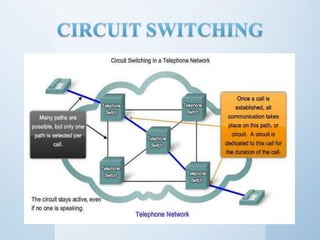
• Circuit switching is the dominant technology for both
voice and data communication.
• Communication via circuit switching in data
communication networks implies that there is
dedicated electrical, communication path between two
ports or hosts.
• The electrical path may be realized by physical wires
or co axial cables or radio or satellite communication.
• EX:-
Telephone network connection.
• Packet-switched describes the type of network in which
relatively small units of data called packets are routed through
a network based on the destination address contained within
each packet.
• Breaking communication down into packets allows the same
data path to be shared among many users in the network.
• This type of communication between sender and receiver is
known as connectionless .
• The control information should at least contain:
– Destination Address
– Source Address
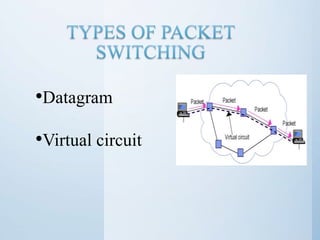
•Datagram
•Virtual circuit
• In Datagram packet switching each packet is a self- contained unit
with complete addressing information attached.
• This fact allows packets to take a variety of possible paths
through the network.
• So the packets, each with the same destination address, do not
follow the same route, and they may arrive out of sequence at
the exit point node (or the destination).
• Reordering is done at the destination point based on the
sequence number of the packets.
•In the Virtual Circuit approach a pre-planned route is established
before any packet are sent.
•There is a call set up before the exchange of data.
•All packets follow the same route and therefore arrive in
sequence.
•Each packet contains a virtual circuit identifier instead of
destination address
•More set up time
•No routing decisions required for each packet - Less routing or
processing time
•Susceptible to data loss in the face of link or node failure
•Clear request to drop circuit
•Not a dedicated path
• A message is a logical unit of information and can be of
any length.
• In message switching, if a station wishes to send a
message to another station, it first adds the destination
address to the message.
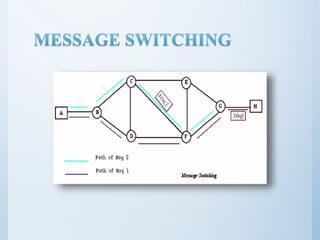
• Message switching does not establish a dedicated path
between the two communicating devices i.e. no direct link
is established between sender and receiver.
• Each message is treated as an independent unit.
SUBMITTED TO –
KAVITA ROY MA’AM

switching techniques in data communication and networking

  • 1.
    Submitted by- CHANDNI VIJAYVARGIYA HARSHITAYADAV HIMANSHI CHARAN SALONI LADDHA SHIVANI JHANWAR SHWETA LALANI
  • 2.
    • Switching isa process moving data from one interface and delivering it through another interface, selecting the best paths between machines that stores messages. • The fundamental purpose of a communication system is to exchange information between two or more devices. • A switched network consists of a service of interlinked nodes called switches, switches are hardware and software device capable of creating temporary connections b/w two or more devices linked to a switch but not to each other.
  • 3.
    • CIRCUIT SWITCHING •PACKET SWITCHING • MESSAGE SWITCHING
  • 4.
    • Circuit switchingis the dominant technology for both voice and data communication. • Communication via circuit switching in data communication networks implies that there is dedicated electrical, communication path between two ports or hosts. • The electrical path may be realized by physical wires or co axial cables or radio or satellite communication. • EX:- Telephone network connection.
  • 6.
    • Packet-switched describesthe type of network in which relatively small units of data called packets are routed through a network based on the destination address contained within each packet. • Breaking communication down into packets allows the same data path to be shared among many users in the network. • This type of communication between sender and receiver is known as connectionless . • The control information should at least contain: – Destination Address – Source Address
  • 7.
  • 8.
    • In Datagrampacket switching each packet is a self- contained unit with complete addressing information attached. • This fact allows packets to take a variety of possible paths through the network. • So the packets, each with the same destination address, do not follow the same route, and they may arrive out of sequence at the exit point node (or the destination). • Reordering is done at the destination point based on the sequence number of the packets.
  • 9.
    •In the VirtualCircuit approach a pre-planned route is established before any packet are sent. •There is a call set up before the exchange of data. •All packets follow the same route and therefore arrive in sequence. •Each packet contains a virtual circuit identifier instead of destination address •More set up time •No routing decisions required for each packet - Less routing or processing time •Susceptible to data loss in the face of link or node failure •Clear request to drop circuit •Not a dedicated path
  • 10.
    • A messageis a logical unit of information and can be of any length. • In message switching, if a station wishes to send a message to another station, it first adds the destination address to the message. • Message switching does not establish a dedicated path between the two communicating devices i.e. no direct link is established between sender and receiver. • Each message is treated as an independent unit.
  • 12.