Victoria Thompson
       SP2H
   Sixth Period
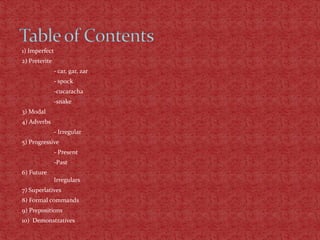
1) Imperfect
2) Preterite
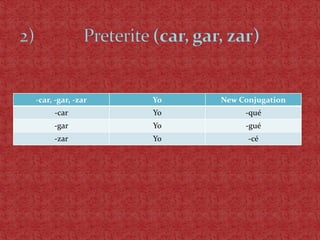
               - car, gar, zar
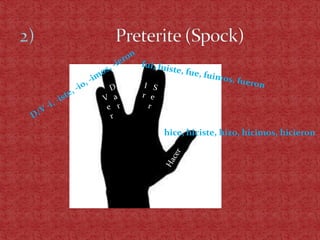
               - spock
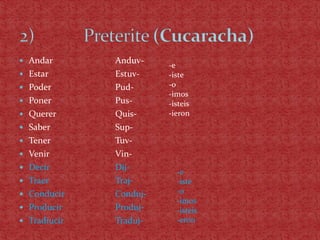
               -cucaracha
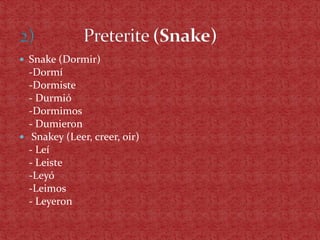
               -snake
3) Modal
4) Adverbs
               - Irregular
5) Progressive
               - Present
               -Past
6) Future
               Irregulars
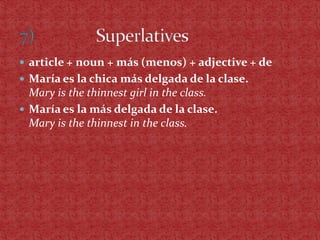
7) Superlatives
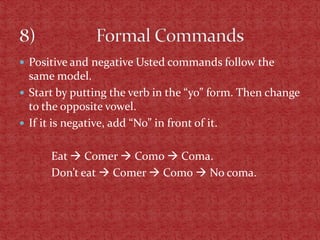
8) Formal commands
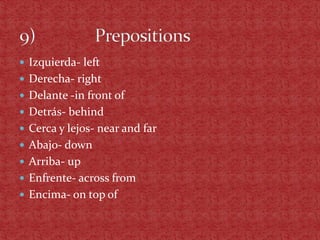
9) Prepositions
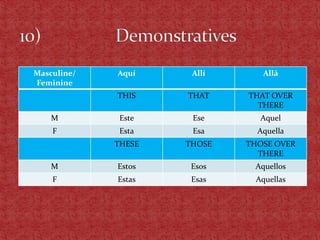
10) Demonstratives
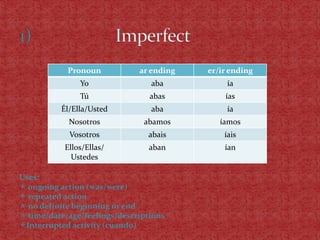
Pronoun           ar ending   er/ir ending
               Yo                aba           ía
               Tú                abas         ías
          Él/Ella/Usted          aba           ía
            Nosotros           abamos        íamos
            Vosotros            abais         íais
           Ellos/Ellas/          aban         ían
             Ustedes

Uses:
 ongoing action (was/were)
 repeated action
 no definite beginning or end
 time/date/age/feelings/descriptions
Interrupted activity (cuando)
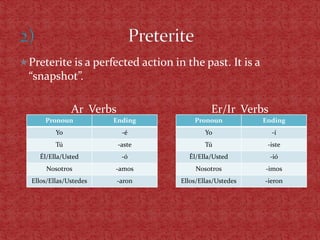
 Preterite is a perfected action in the past. It is a
  “snapshot”.

               Ar Verbs                       Er/Ir Verbs
      Pronoun           Ending          Pronoun           Ending
          Yo               -é               Yo              -í
          Tú              -aste             Tú             -iste
    Él/Ella/Usted          -ó         Él/Ella/Usted         -ió
       Nosotros         -amos            Nosotros         -imos
  Ellos/Ellas/Ustedes     -aron     Ellos/Ellas/Ustedes   -ieron
-car, -gar, -zar   Yo   New Conjugation
     -car          Yo        -qué
     -gar          Yo        -gué
     -zar          Yo         -cé
hice, hiciste, hizo, hicimos, hicieron
 Andar       Anduv-
                        -e
 Estar       Estuv-    -iste
 Poder       Pud-      -o
                        -imos
 Poner       Pus-      -isteis
 Querer      Quis-     -ieron
 Saber       Sup-
 Tener       Tuv-
 Venir       Vin-
 Decir       Dij-
                          -e
 Traer       Traj-       -iste
 Conducir    Conduj-     -o
                          -imos
 Producir    Produj-     -isteis
 Tradiucir   Traduj-     -eron
 Snake (Dormir)
  -Dormí
  -Dormiste
  - Durmió
  -Dormimos
  - Dumieron
 Snakey (Leer, creer, oir)
  - Leí
  - Leiste
  -Leyó
  -Leimos
  - Leyeron
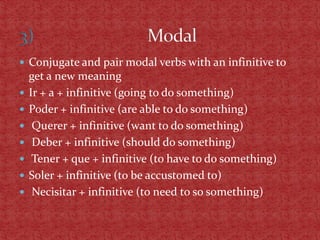
 Conjugate and pair modal verbs with an infinitive to
    get a new meaning
   Ir + a + infinitive (going to do something)
   Poder + infinitive (are able to do something)
    Querer + infinitive (want to do something)
    Deber + infinitive (should do something)
    Tener + que + infinitive (to have to do something)
   Soler + infinitive (to be accustomed to)
    Necisitar + infinitive (to need to so something)
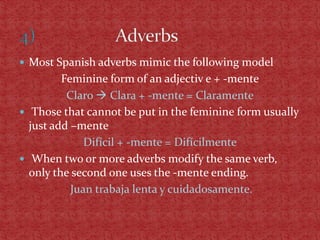
 Most Spanish adverbs mimic the following model
         Feminine form of an adjectiv e + -mente
          Claro  Clara + -mente = Claramente
 Those that cannot be put in the feminine form usually
  just add –mente
              Difícil + -mente = Difícilmente
 When two or more adverbs modify the same verb,
  only the second one uses the -mente ending.
           Juan trabaja lenta y cuidadosamente.
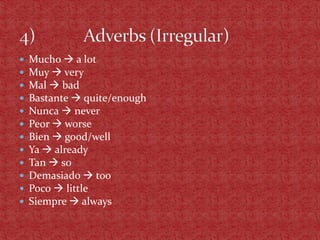
   Mucho  a lot
   Muy  very
   Mal  bad
   Bastante  quite/enough
   Nunca  never
   Peor  worse
   Bien  good/well
   Ya  already
   Tan  so
   Demasiado  too
   Poco  little
   Siempre  always
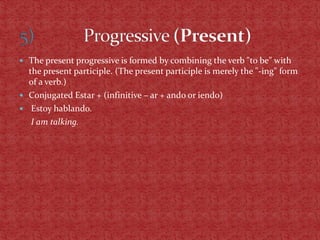
 The present progressive is formed by combining the verb "to be" with
  the present participle. (The present participle is merely the "-ing" form
  of a verb.)
 Conjugated Estar + (infinitive – ar + ando or iendo)
 Estoy hablando.
   I am talking.
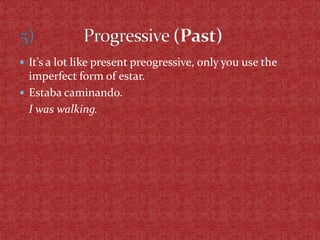
 It’s a lot like present preogressive, only you use the
  imperfect form of estar.
 Estaba caminando.
  I was walking.
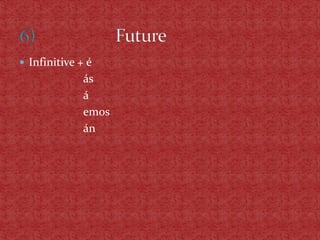
 Infinitive + é
              ás
              á
              emos
              án
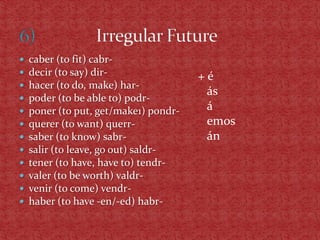
   caber (to fit) cabr-
   decir (to say) dir-                +é
   hacer (to do, make) har-
                                        ás
   poder (to be able to) podr-
   poner (to put, get/make1) pondr-    á
   querer (to want) querr-             emos
   saber (to know) sabr-               án
   salir (to leave, go out) saldr-
   tener (to have, have to) tendr-
   valer (to be worth) valdr-
   venir (to come) vendr-
   haber (to have -en/-ed) habr-
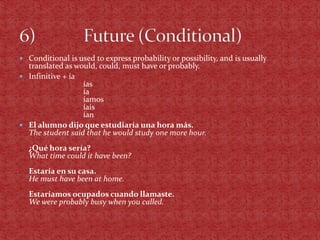
 Conditional is used to express probability or possibility, and is usually
  translated as would, could, must have or probably.
 Infinitive + ía
                  ías
                  ía
                  íamos
                  íais
                  ían
 El alumno dijo que estudiaría una hora más.
  The student said that he would study one more hour.
  ¿Qué hora sería?
  What time could it have been?
  Estaría en su casa.
  He must have been at home.
  Estaríamos ocupados cuando llamaste.
  We were probably busy when you called.
 article + noun + más (menos) + adjective + de
 María es la chica más delgada de la clase.
  Mary is the thinnest girl in the class.
 María es la más delgada de la clase.
  Mary is the thinnest in the class.
 Positive and negative Usted commands follow the
  same model.
 Start by putting the verb in the “yo” form. Then change
  to the opposite vowel.
 If it is negative, add “No” in front of it.


      Eat  Comer  Como  Coma.
      Don’t eat  Comer  Como  No coma.
 Izquierda- left
 Derecha- right
 Delante -in front of
 Detrás- behind
 Cerca y lejos- near and far
 Abajo- down
 Arriba- up
 Enfrente- across from
 Encima- on top of
Masculine/   Aquí     Allí      Allá
Feminine
             THIS    THAT    THAT OVER
                               THERE
    M         Este    Ese       Aquel
    F         Esta    Esa      Aquella
             THESE   THOSE   THOSE OVER
                               THERE
    M        Estos    Esos    Aquellos
    F        Estas    Esas     Aquellas

Grammar book 2

  • 1.
    Victoria Thompson SP2H Sixth Period
  • 2.
    1) Imperfect 2) Preterite - car, gar, zar - spock -cucaracha -snake 3) Modal 4) Adverbs - Irregular 5) Progressive - Present -Past 6) Future Irregulars 7) Superlatives 8) Formal commands 9) Prepositions 10) Demonstratives
  • 3.
    Pronoun ar ending er/ir ending Yo aba ía Tú abas ías Él/Ella/Usted aba ía Nosotros abamos íamos Vosotros abais íais Ellos/Ellas/ aban ían Ustedes Uses:  ongoing action (was/were)  repeated action  no definite beginning or end  time/date/age/feelings/descriptions Interrupted activity (cuando)
  • 4.
     Preterite isa perfected action in the past. It is a “snapshot”. Ar Verbs Er/Ir Verbs Pronoun Ending Pronoun Ending Yo -é Yo -í Tú -aste Tú -iste Él/Ella/Usted -ó Él/Ella/Usted -ió Nosotros -amos Nosotros -imos Ellos/Ellas/Ustedes -aron Ellos/Ellas/Ustedes -ieron
  • 5.
    -car, -gar, -zar Yo New Conjugation -car Yo -qué -gar Yo -gué -zar Yo -cé
  • 6.
    hice, hiciste, hizo,hicimos, hicieron
  • 7.
     Andar Anduv- -e  Estar Estuv- -iste  Poder Pud- -o -imos  Poner Pus- -isteis  Querer Quis- -ieron  Saber Sup-  Tener Tuv-  Venir Vin-  Decir Dij- -e  Traer Traj- -iste  Conducir Conduj- -o -imos  Producir Produj- -isteis  Tradiucir Traduj- -eron
  • 8.
     Snake (Dormir) -Dormí -Dormiste - Durmió -Dormimos - Dumieron  Snakey (Leer, creer, oir) - Leí - Leiste -Leyó -Leimos - Leyeron
  • 9.
     Conjugate andpair modal verbs with an infinitive to get a new meaning  Ir + a + infinitive (going to do something)  Poder + infinitive (are able to do something)  Querer + infinitive (want to do something)  Deber + infinitive (should do something)  Tener + que + infinitive (to have to do something)  Soler + infinitive (to be accustomed to)  Necisitar + infinitive (to need to so something)
  • 10.
     Most Spanishadverbs mimic the following model Feminine form of an adjectiv e + -mente Claro  Clara + -mente = Claramente  Those that cannot be put in the feminine form usually just add –mente Difícil + -mente = Difícilmente  When two or more adverbs modify the same verb, only the second one uses the -mente ending. Juan trabaja lenta y cuidadosamente.
  • 11.
    Mucho  a lot  Muy  very  Mal  bad  Bastante  quite/enough  Nunca  never  Peor  worse  Bien  good/well  Ya  already  Tan  so  Demasiado  too  Poco  little  Siempre  always
  • 12.
     The presentprogressive is formed by combining the verb "to be" with the present participle. (The present participle is merely the "-ing" form of a verb.)  Conjugated Estar + (infinitive – ar + ando or iendo)  Estoy hablando. I am talking.
  • 13.
     It’s alot like present preogressive, only you use the imperfect form of estar.  Estaba caminando. I was walking.
  • 14.
     Infinitive +é ás á emos án
  • 15.
    caber (to fit) cabr-  decir (to say) dir- +é  hacer (to do, make) har- ás  poder (to be able to) podr-  poner (to put, get/make1) pondr- á  querer (to want) querr- emos  saber (to know) sabr- án  salir (to leave, go out) saldr-  tener (to have, have to) tendr-  valer (to be worth) valdr-  venir (to come) vendr-  haber (to have -en/-ed) habr-
  • 16.
     Conditional isused to express probability or possibility, and is usually translated as would, could, must have or probably.  Infinitive + ía ías ía íamos íais ían  El alumno dijo que estudiaría una hora más. The student said that he would study one more hour. ¿Qué hora sería? What time could it have been? Estaría en su casa. He must have been at home. Estaríamos ocupados cuando llamaste. We were probably busy when you called.
  • 17.
     article +noun + más (menos) + adjective + de  María es la chica más delgada de la clase. Mary is the thinnest girl in the class.  María es la más delgada de la clase. Mary is the thinnest in the class.
  • 18.
     Positive andnegative Usted commands follow the same model.  Start by putting the verb in the “yo” form. Then change to the opposite vowel.  If it is negative, add “No” in front of it. Eat  Comer  Como  Coma. Don’t eat  Comer  Como  No coma.
  • 19.
     Izquierda- left Derecha- right  Delante -in front of  Detrás- behind  Cerca y lejos- near and far  Abajo- down  Arriba- up  Enfrente- across from  Encima- on top of
  • 20.
    Masculine/ Aquí Allí Allá Feminine THIS THAT THAT OVER THERE M Este Ese Aquel F Esta Esa Aquella THESE THOSE THOSE OVER THERE M Estos Esos Aquellos F Estas Esas Aquellas