Carlos Reeve, 6 th Sp.2H
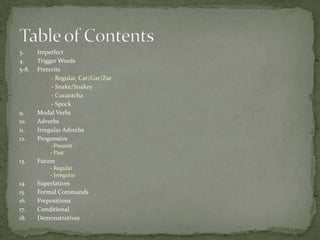
3.     Imperfect
4.     Trigger Words
5-8.   Preterite
            - Regular, Car/Gar/Zar
            - Snake/Snakey
            - Cucaracha
            - Spock
9.     Modal Verbs
10.    Adverbs
11.    Irregular Adverbs
12.    Progressive
           - Present
           - Past
13.    Future
           - Regular
           - Irregular
14.    Superlatives
15.    Formal Commands
16.    Prepositions
17.    Conditional
18.    Demonstratives
 Uses:
    Ongoing action [Was/Were]
    Repeated action [Used to]
    No definite beginning or end
    Time/Date/Age/Feelings/Description
    Interrupted Activity [Cuando]
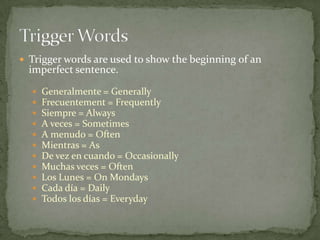
 Trigger words are used to show the beginning of an
  imperfect sentence.

     Generalmente = Generally
     Frecuentement = Frequently
     Siempre = Always
     A veces = Sometimes
     A menudo = Often
     Mientras = As
     De vez en cuando = Occasionally
     Muchas veces = Often
     Los Lunes = On Mondays
     Cada día = Daily
     Todos los días = Everyday
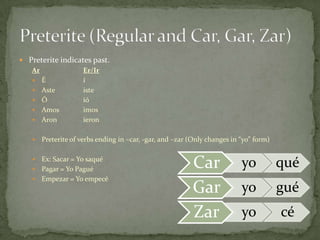
 Preterite indicates past.
   Ar              Er/Ir
    É             í
    Aste          iste
    Ó             ió
    Amos          imos
    Aron          ieron

      Preterite of verbs ending in –car, -gar, and –zar (Only changes in “yo” form)

    Ex: Sacar = Yo saqué
    Pagar = Yo Pagué
                                                          Car             yo           qué
    Empezar = Yo empecé
                                                          Gar             yo           gué
                                                          Zar             yo           cé
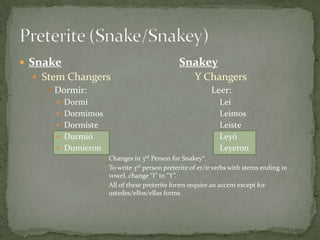
 Snake                                       Snakey
   Stem Changers                                   Y Changers
      Dormir:                                            Leer:
       Dormí                                                Leí
       Dormimos                                             Leimos
       Dormiste                                             Leiste
       Durmió                                               Leyó
       Dumieron                                             Leyeron
                    Changes in 3rd Person for Snakey*.
                    To write 3rd person preterite of er/ir verbs with stems ending in
                     vowel, change “I” to “Y”.
                    All of these preterite forms require an accent except for
                     ustedes/ellos/ellas forms.
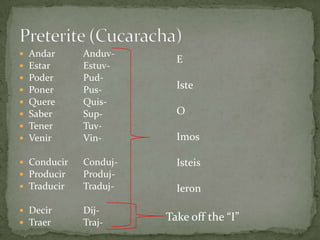
   Andar    Anduv-
                         E
   Estar    Estuv-
   Poder    Pud-
   Poner    Pus-        Iste
   Quere    Quis-
   Saber    Sup-        O
   Tener    Tuv-
   Venir    Vin-        Imos

 Conducir   Conduj-     Isteis
 Producir   Produj-
 Traducir   Traduj-     Ieron

 Decir      Dij-
 Traer      Traj-
                       Take off the “I”
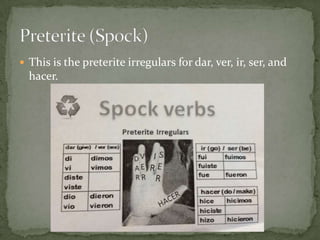
 This is the preterite irregulars for dar, ver, ir, ser, and
  hacer.
 Conjugate and pair the modal verbs with an infinitive
 to get a new meaning.

   Ir + a + infinitive [Going to do something]
   Poder + infinitive [Are able to do something]
   Querer + infinitive [Want to do something]
   Deber + infinitive [Should do something]
   Tener que + infitive [To have to do something]
   Soler + infinitive [To be accustomed to]
   Necesitar + infinitive [Need to do something]
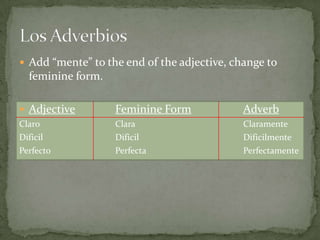
 Add “mente” to the end of the adjective, change to
  feminine form.

 Adjective        Feminine Form             Adverb
Claro              Clara                     Claramente
Dificil            Dificil                   Dificilmente
Perfecto           Perfecta                  Perfectamente
 Mucho [A lot]
 Mal [Bad]
 Ya [Already]
 Siempre [Always]
 Peor [Worse]
 Poco [Little]
 Bastante [Quite/Enough]
 Muy [Very]
 Tan [So]
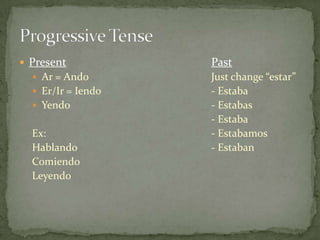
 Present           Past
   Ar = Ando       Just change “estar”
   Er/Ir = Iendo   - Estaba
   Yendo           - Estabas
                    - Estaba
  Ex:               - Estabamos
  Hablando          - Estaban
  Comiendo
  Leyendo
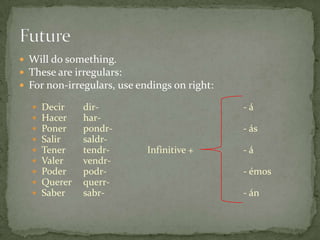
 Will do something.
 These are irregulars:
 For non-irregulars, use endings on right:

     Decir    dir-                           -á
     Hacer    har-
     Poner    pondr-                         - ás
     Salir    saldr-
     Tener    tendr-       Infinitive +      -á
     Valer    vendr-
     Poder    podr-                          - émos
     Querer   querr-
     Saber    sabr-                          - án
 Used when saying something has the “most” or least”
 of something, such as an adjective.

 Más + Adjective
   [The most]
 Menos + Adjective
   [The least…]

      Ex: Carlos es el más alto. = Carlos is the tallest.
      Tito es la menos alto. = Tito is the shortest.
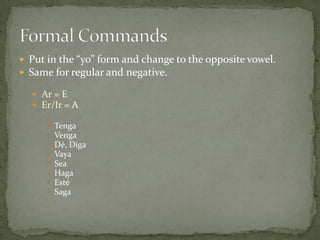
 Put in the “yo” form and change to the opposite vowel.
 Same for regular and negative.

   Ar = E
   Er/Ir = A

        Tenga
        Venga
        Dé, Diga
        Vaya
        Sea
        Haga
        Esté
        Saga
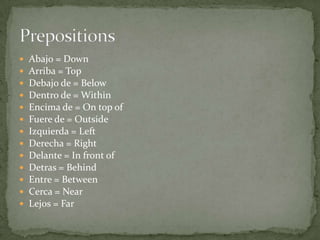
   Abajo = Down
   Arriba = Top
   Debajo de = Below
   Dentro de = Within
   Encima de = On top of
   Fuere de = Outside
   Izquierda = Left
   Derecha = Right
   Delante = In front of
   Detras = Behind
   Entre = Between
   Cerca = Near
   Lejos = Far
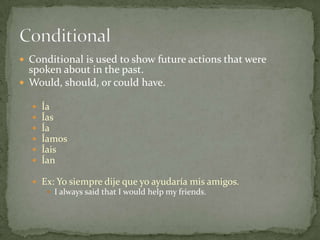
 Conditional is used to show future actions that were
  spoken about in the past.
 Would, should, or could have.

     Ía
     Ías
     Ía
     Íamos
     Íais
     Ían

   Ex: Yo siempre dije que yo ayudaría mis amigos.
      I always said that I would help my friends.
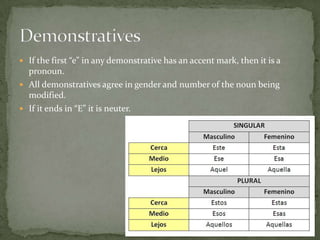
 If the first “e” in any demonstrative has an accent mark, then it is a
  pronoun.
 All demonstratives agree in gender and number of the noun being
  modified.
 If it ends in “E” it is neuter.

Grammar book [2]

  • 1.
  • 2.
    3. Imperfect 4. Trigger Words 5-8. Preterite - Regular, Car/Gar/Zar - Snake/Snakey - Cucaracha - Spock 9. Modal Verbs 10. Adverbs 11. Irregular Adverbs 12. Progressive - Present - Past 13. Future - Regular - Irregular 14. Superlatives 15. Formal Commands 16. Prepositions 17. Conditional 18. Demonstratives
  • 3.
     Uses:  Ongoing action [Was/Were]  Repeated action [Used to]  No definite beginning or end  Time/Date/Age/Feelings/Description  Interrupted Activity [Cuando]
  • 4.
     Trigger wordsare used to show the beginning of an imperfect sentence.  Generalmente = Generally  Frecuentement = Frequently  Siempre = Always  A veces = Sometimes  A menudo = Often  Mientras = As  De vez en cuando = Occasionally  Muchas veces = Often  Los Lunes = On Mondays  Cada día = Daily  Todos los días = Everyday
  • 5.
     Preterite indicatespast. Ar Er/Ir  É í  Aste iste  Ó ió  Amos imos  Aron ieron  Preterite of verbs ending in –car, -gar, and –zar (Only changes in “yo” form)  Ex: Sacar = Yo saqué  Pagar = Yo Pagué Car yo qué  Empezar = Yo empecé Gar yo gué Zar yo cé
  • 6.
     Snake Snakey  Stem Changers Y Changers  Dormir: Leer:  Dormí Leí  Dormimos Leimos  Dormiste Leiste  Durmió Leyó  Dumieron Leyeron  Changes in 3rd Person for Snakey*.  To write 3rd person preterite of er/ir verbs with stems ending in vowel, change “I” to “Y”.  All of these preterite forms require an accent except for ustedes/ellos/ellas forms.
  • 7.
    Andar Anduv- E  Estar Estuv-  Poder Pud-  Poner Pus- Iste  Quere Quis-  Saber Sup- O  Tener Tuv-  Venir Vin- Imos  Conducir Conduj- Isteis  Producir Produj-  Traducir Traduj- Ieron  Decir Dij-  Traer Traj- Take off the “I”
  • 8.
     This isthe preterite irregulars for dar, ver, ir, ser, and hacer.
  • 9.
     Conjugate andpair the modal verbs with an infinitive to get a new meaning.  Ir + a + infinitive [Going to do something]  Poder + infinitive [Are able to do something]  Querer + infinitive [Want to do something]  Deber + infinitive [Should do something]  Tener que + infitive [To have to do something]  Soler + infinitive [To be accustomed to]  Necesitar + infinitive [Need to do something]
  • 10.
     Add “mente”to the end of the adjective, change to feminine form.  Adjective Feminine Form Adverb Claro Clara Claramente Dificil Dificil Dificilmente Perfecto Perfecta Perfectamente
  • 11.
     Mucho [Alot]  Mal [Bad]  Ya [Already]  Siempre [Always]  Peor [Worse]  Poco [Little]  Bastante [Quite/Enough]  Muy [Very]  Tan [So]
  • 12.
     Present Past  Ar = Ando Just change “estar”  Er/Ir = Iendo - Estaba  Yendo - Estabas - Estaba Ex: - Estabamos Hablando - Estaban Comiendo Leyendo
  • 13.
     Will dosomething.  These are irregulars:  For non-irregulars, use endings on right:  Decir dir- -á  Hacer har-  Poner pondr- - ás  Salir saldr-  Tener tendr- Infinitive + -á  Valer vendr-  Poder podr- - émos  Querer querr-  Saber sabr- - án
  • 14.
     Used whensaying something has the “most” or least” of something, such as an adjective.  Más + Adjective  [The most]  Menos + Adjective  [The least…]  Ex: Carlos es el más alto. = Carlos is the tallest.  Tito es la menos alto. = Tito is the shortest.
  • 15.
     Put inthe “yo” form and change to the opposite vowel.  Same for regular and negative.  Ar = E  Er/Ir = A  Tenga  Venga  Dé, Diga  Vaya  Sea  Haga  Esté  Saga
  • 16.
    Abajo = Down  Arriba = Top  Debajo de = Below  Dentro de = Within  Encima de = On top of  Fuere de = Outside  Izquierda = Left  Derecha = Right  Delante = In front of  Detras = Behind  Entre = Between  Cerca = Near  Lejos = Far
  • 17.
     Conditional isused to show future actions that were spoken about in the past.  Would, should, or could have.  Ía  Ías  Ía  Íamos  Íais  Ían  Ex: Yo siempre dije que yo ayudaría mis amigos.  I always said that I would help my friends.
  • 18.
     If thefirst “e” in any demonstrative has an accent mark, then it is a pronoun.  All demonstratives agree in gender and number of the noun being modified.  If it ends in “E” it is neuter.