Grammar book

 Gerardo Metropol
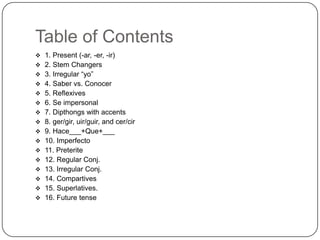
Table of Contents
 1. Present (-ar, -er, -ir)
 2. Stem Changers
 3. Irregular “yo”
 4. Saber vs. Conocer
 5. Reflexives
 6. Se impersonal
 7. Dipthongs with accents
 8. ger/gir, uir/guir, and cer/cir
 9. Hace___+Que+___
 10. Imperfecto
 11. Preterite
 12. Regular Conj.
 13. Irregular Conj.
 14. Compartives
 15. Superlatives.
 16. Future tense
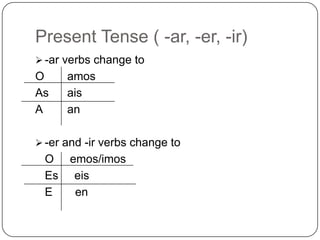
Present Tense ( -ar, -er, -ir)
 -ar verbs change to
O     amos
As    ais
A     an

 -er and -ir verbs change to
 O    emos/imos
 Es    eis
 E     en
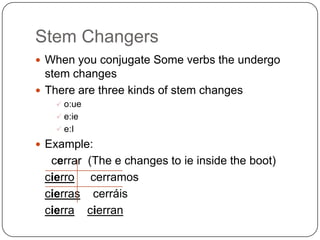
Stem Changers
 When you conjugate Some verbs the undergo
  stem changes
 There are three kinds of stem changes
    o:ue
    e:ie
    e:I

 Example:
  cerrar    (The e changes to ie inside the boot)
 cierro      cerramos
 cierras     cerráis
 cierra     cierran
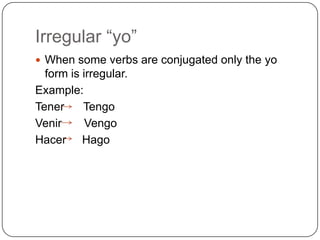
Irregular “yo”
 When some verbs are conjugated only the yo
  form is irregular.
Example:
Tener     Tengo
Venir      Vengo
Hacer Hago
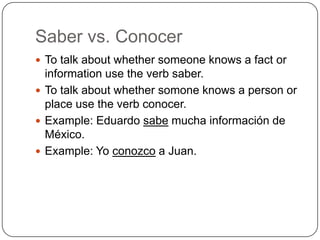
Saber vs. Conocer
 To talk about whether someone knows a fact or
  information use the verb saber.
 To talk about whether somone knows a person or
  place use the verb conocer.
 Example: Eduardo sabe mucha información de
  México.
 Example: Yo conozco a Juan.
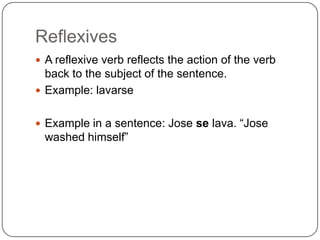
Reflexives
 A reflexive verb reflects the action of the verb
  back to the subject of the sentence.
 Example: lavarse


 Example in a sentence: Jose se lava. “Jose
 washed himself”
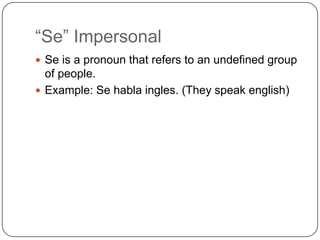
“Se” Impersonal
 Se is a pronoun that refers to an undefined group
  of people.
 Example: Se habla ingles. (They speak english)
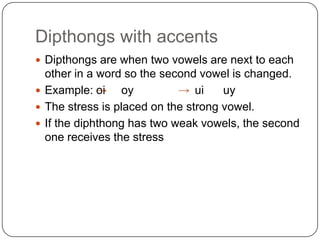
Dipthongs with accents
 Dipthongs are when two vowels are next to each
  other in a word so the second vowel is changed.
 Example: oi     oy            ui   uy
 The stress is placed on the strong vowel.
 If the diphthong has two weak vowels, the second
  one receives the stress
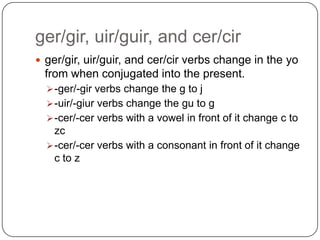
ger/gir, uir/guir, and cer/cir
 ger/gir, uir/guir, and cer/cir verbs change in the yo
  from when conjugated into the present.
   -ger/-gir verbs change the g to j
   -uir/-giur verbs change the gu to g
   -cer/-cer verbs with a vowel in front of it change c to
    zc
   -cer/-cer verbs with a consonant in front of it change
    c to z
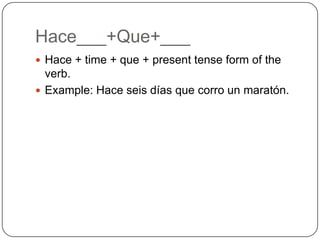
Hace___+Que+___
 Hace + time + que + present tense form of the
  verb.
 Example: Hace seis días que corro un maratón.
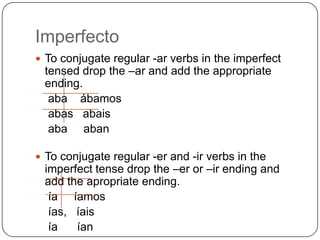
Imperfecto
 To conjugate regular -ar verbs in the imperfect
 tensed drop the –ar and add the appropriate
 ending.
  aba ábamos
  abas abais
  aba aban

 To conjugate regular -er and -ir verbs in the
 imperfect tense drop the –er or –ir ending and
 add the apropriate ending.
  ía íamos
  ías, íais
  ía   ían
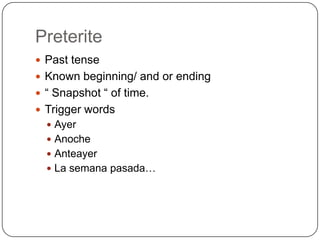
Preterite
 Past tense
 Known beginning/ and or ending
 “ Snapshot “ of time.
 Trigger words
   Ayer
   Anoche
   Anteayer
   La semana pasada…
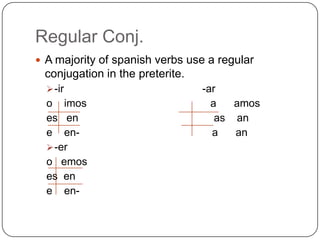
Regular Conj.
 A majority of spanish verbs use a regular
 conjugation in the preterite.
   -ir                          -ar
  o imos                           a   amos
  es en                             as an
  e en-                            a   an
   -er
  o emos
  es en
  e en-
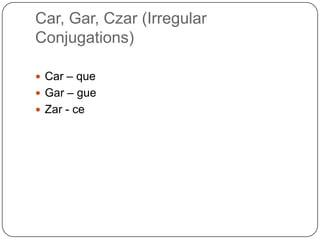
Car, Gar, Czar (Irregular
Conjugations)

 Car – que
 Gar – gue
 Zar - ce
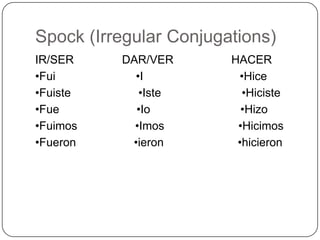
Spock (Irregular Conjugations)
IR/SER    DAR/VER       HACER
•Fui        •I           •Hice
•Fuiste      •Iste        •Hiciste
•Fue        •Io           •Hizo
•Fuimos     •Imos        •Hicimos
•Fueron    •ieron        •hicieron
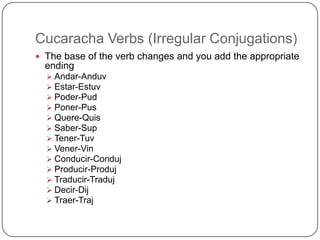
Cucaracha Verbs (Irregular Conjugations)
 The base of the verb changes and you add the appropriate
  ending
   Andar-Anduv
   Estar-Estuv
   Poder-Pud
   Poner-Pus
   Quere-Quis
   Saber-Sup
   Tener-Tuv
   Vener-Vin
   Conducir-Conduj
   Producir-Produj
   Traducir-Traduj
   Decir-Dij
   Traer-Traj
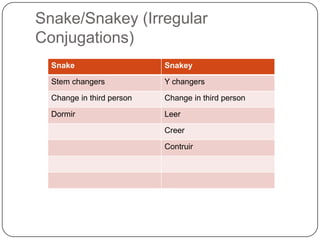
Snake/Snakey (Irregular
Conjugations)
  Snake                    Snakey

  Stem changers            Y changers

  Change in third person   Change in third person

  Dormir                   Leer

                           Creer

                           Contruir
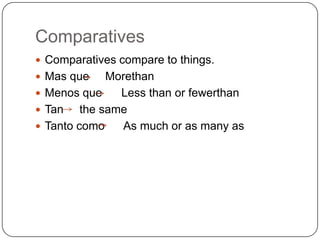
Comparatives
 Comparatives compare to things.
 Mas que     Morethan
 Menos que     Less than or fewerthan
 Tan    the same
 Tanto como     As much or as many as
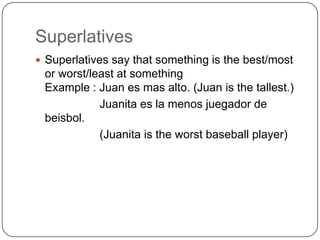
Superlatives
 Superlatives say that something is the best/most
 or worst/least at something
 Example : Juan es mas alto. (Juan is the tallest.)
            Juanita es la menos juegador de
 beisbol.
            (Juanita is the worst baseball player)
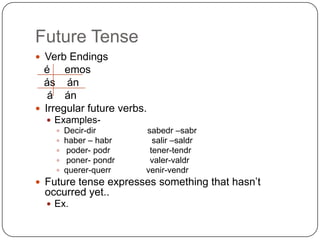
Future Tense
 Verb Endings
  é emos
  ás án
   á án
 Irregular future verbs.
   Examples-
     Decir-dir         sabedr –sabr
     haber – habr        salir –saldr
     poder- podr        tener-tendr
     poner- pondr       valer-valdr
     querer-querr      venir-vendr
 Future tense expresses something that hasn’t
  occurred yet..
   Ex.

Grammar Book

  • 1.
  • 2.
    Table of Contents 1. Present (-ar, -er, -ir)  2. Stem Changers  3. Irregular “yo”  4. Saber vs. Conocer  5. Reflexives  6. Se impersonal  7. Dipthongs with accents  8. ger/gir, uir/guir, and cer/cir  9. Hace___+Que+___  10. Imperfecto  11. Preterite  12. Regular Conj.  13. Irregular Conj.  14. Compartives  15. Superlatives.  16. Future tense
  • 3.
    Present Tense (-ar, -er, -ir)  -ar verbs change to O amos As ais A an  -er and -ir verbs change to O emos/imos Es eis E en
  • 4.
    Stem Changers  Whenyou conjugate Some verbs the undergo stem changes  There are three kinds of stem changes  o:ue  e:ie  e:I  Example: cerrar (The e changes to ie inside the boot) cierro cerramos cierras cerráis cierra cierran
  • 5.
    Irregular “yo”  Whensome verbs are conjugated only the yo form is irregular. Example: Tener Tengo Venir Vengo Hacer Hago
  • 6.
    Saber vs. Conocer To talk about whether someone knows a fact or information use the verb saber.  To talk about whether somone knows a person or place use the verb conocer.  Example: Eduardo sabe mucha información de México.  Example: Yo conozco a Juan.
  • 7.
    Reflexives  A reflexiveverb reflects the action of the verb back to the subject of the sentence.  Example: lavarse  Example in a sentence: Jose se lava. “Jose washed himself”
  • 8.
    “Se” Impersonal  Seis a pronoun that refers to an undefined group of people.  Example: Se habla ingles. (They speak english)
  • 9.
    Dipthongs with accents Dipthongs are when two vowels are next to each other in a word so the second vowel is changed.  Example: oi oy ui uy  The stress is placed on the strong vowel.  If the diphthong has two weak vowels, the second one receives the stress
  • 10.
    ger/gir, uir/guir, andcer/cir  ger/gir, uir/guir, and cer/cir verbs change in the yo from when conjugated into the present.  -ger/-gir verbs change the g to j  -uir/-giur verbs change the gu to g  -cer/-cer verbs with a vowel in front of it change c to zc  -cer/-cer verbs with a consonant in front of it change c to z
  • 11.
    Hace___+Que+___  Hace +time + que + present tense form of the verb.  Example: Hace seis días que corro un maratón.
  • 12.
    Imperfecto  To conjugateregular -ar verbs in the imperfect tensed drop the –ar and add the appropriate ending. aba ábamos abas abais aba aban  To conjugate regular -er and -ir verbs in the imperfect tense drop the –er or –ir ending and add the apropriate ending. ía íamos ías, íais ía ían
  • 13.
    Preterite  Past tense Known beginning/ and or ending  “ Snapshot “ of time.  Trigger words  Ayer  Anoche  Anteayer  La semana pasada…
  • 14.
    Regular Conj.  Amajority of spanish verbs use a regular conjugation in the preterite.  -ir -ar o imos a amos es en as an e en- a an  -er o emos es en e en-
  • 15.
    Car, Gar, Czar(Irregular Conjugations)  Car – que  Gar – gue  Zar - ce
  • 16.
    Spock (Irregular Conjugations) IR/SER DAR/VER HACER •Fui •I •Hice •Fuiste •Iste •Hiciste •Fue •Io •Hizo •Fuimos •Imos •Hicimos •Fueron •ieron •hicieron
  • 17.
    Cucaracha Verbs (IrregularConjugations)  The base of the verb changes and you add the appropriate ending  Andar-Anduv  Estar-Estuv  Poder-Pud  Poner-Pus  Quere-Quis  Saber-Sup  Tener-Tuv  Vener-Vin  Conducir-Conduj  Producir-Produj  Traducir-Traduj  Decir-Dij  Traer-Traj
  • 18.
    Snake/Snakey (Irregular Conjugations) Snake Snakey Stem changers Y changers Change in third person Change in third person Dormir Leer Creer Contruir
  • 19.
    Comparatives  Comparatives compareto things.  Mas que Morethan  Menos que Less than or fewerthan  Tan the same  Tanto como As much or as many as
  • 20.
    Superlatives  Superlatives saythat something is the best/most or worst/least at something Example : Juan es mas alto. (Juan is the tallest.) Juanita es la menos juegador de beisbol. (Juanita is the worst baseball player)
  • 21.
    Future Tense  VerbEndings é emos ás án á án  Irregular future verbs.  Examples-  Decir-dir sabedr –sabr  haber – habr salir –saldr  poder- podr tener-tendr  poner- pondr valer-valdr  querer-querr venir-vendr  Future tense expresses something that hasn’t occurred yet..  Ex.