Le passé composé

  (the perfect tense)
The perfect tense – Le passé
             composé
•    In French you use the perfect tense (le
  passé composé) to say what you have
  done in the past.
• The passé composé is usually formed by
  using the present tense of
• avoir and the
• past participle of the verb, just as in
  English
Par exemple:
•   J’ai joué =
•   I have played
•   Nous avons gagné =
•   We have won
•   Elle a dormi =
•   She has slept
•   Tu as répondu =
•   You have replied
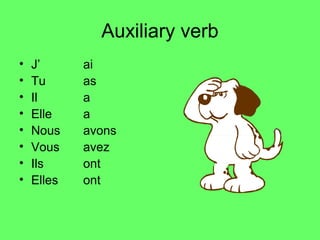
Auxiliary verb
•   J’      ai
•   Tu      as
•   Il      a
•   Elle    a
•   Nous    avons
•   Vous    avez
•   Ils     ont
•   Elles   ont
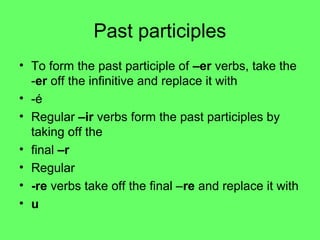
Past participles
• To form the past participle of –er verbs, take the
  -er off the infinitive and replace it with
• -é
• Regular –ir verbs form the past participles by
  taking off the
• final –r
• Regular
• -re verbs take off the final –re and replace it with
• u
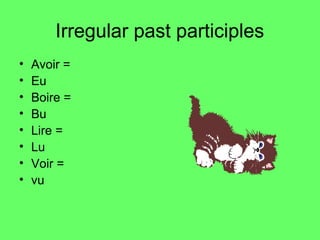
Irregular past participles
•   Avoir =
•   Eu
•   Boire =
•   Bu
•   Lire =
•   Lu
•   Voir =
•   vu
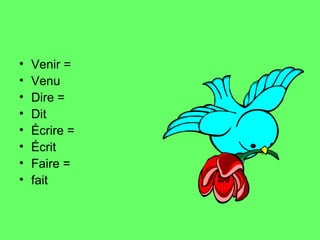
•   Venir =
•   Venu
•   Dire =
•   Dit
•   Écrire =
•   Écrit
•   Faire =
•   fait
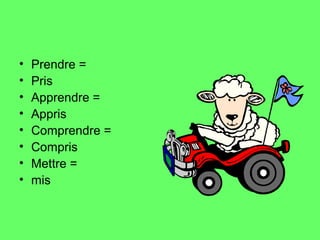
•   Prendre =
•   Pris
•   Apprendre =
•   Appris
•   Comprendre =
•   Compris
•   Mettre =
•   mis
Part 2 Next
• In the perfect tense most verbs take the
  auxiliary verb
• Avoir
• But some take
• Être
• To help you learn which verbs take être
  you can memorise the mnemonic
• MR DAMP’S TAVERN
MR DAMPS TAVERN
•   Mourir
•   Retourner
•   Descendre
•   Aller
•   Monter
•   Partir
•   Sortir
•   Tomber
•   Arriver
•   Venir
•   Entrer
•   Rester
•   Naitre
Agreement
• Notice that with verbs that take être as the
  auxiliary verb, the past
• participle agrees with the subject (the
  person or thing doing the action). If the
  subject is feminine you must add an extra
• -e and if the subject is plural you must add
  an extra
• -s. If it is plural and feminine you must add
• -es!

Passé composé revision

  • 1.
    Le passé composé (the perfect tense)
  • 2.
    The perfect tense– Le passé composé • In French you use the perfect tense (le passé composé) to say what you have done in the past. • The passé composé is usually formed by using the present tense of • avoir and the • past participle of the verb, just as in English
  • 3.
    Par exemple: • J’ai joué = • I have played • Nous avons gagné = • We have won • Elle a dormi = • She has slept • Tu as répondu = • You have replied
  • 4.
    Auxiliary verb • J’ ai • Tu as • Il a • Elle a • Nous avons • Vous avez • Ils ont • Elles ont
  • 5.
    Past participles • Toform the past participle of –er verbs, take the -er off the infinitive and replace it with • -é • Regular –ir verbs form the past participles by taking off the • final –r • Regular • -re verbs take off the final –re and replace it with • u
  • 6.
    Irregular past participles • Avoir = • Eu • Boire = • Bu • Lire = • Lu • Voir = • vu
  • 7.
    Venir = • Venu • Dire = • Dit • Écrire = • Écrit • Faire = • fait
  • 8.
    Prendre = • Pris • Apprendre = • Appris • Comprendre = • Compris • Mettre = • mis
  • 9.
  • 10.
    • In theperfect tense most verbs take the auxiliary verb • Avoir • But some take • Être • To help you learn which verbs take être you can memorise the mnemonic • MR DAMP’S TAVERN
  • 11.
    MR DAMPS TAVERN • Mourir • Retourner • Descendre • Aller • Monter • Partir • Sortir
  • 12.
    Tomber • Arriver • Venir • Entrer • Rester • Naitre
  • 13.
    Agreement • Notice thatwith verbs that take être as the auxiliary verb, the past • participle agrees with the subject (the person or thing doing the action). If the subject is feminine you must add an extra • -e and if the subject is plural you must add an extra • -s. If it is plural and feminine you must add • -es!