Libro de Gramatica
             (Spanish Grammar Book)


Joya Burns
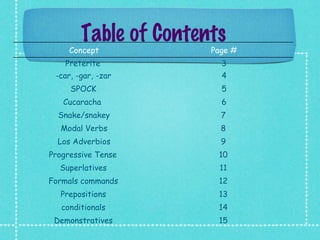
Table of Contents
     Concept           Page #
    Preterite            3
 -car, -gar, -zar        4
     SPOCK               5
   Cucaracha             6
  Snake/snakey           7
  Modal Verbs            8
  Los Adverbios          9
Progressive Tense       10
  Superlatives          11
Formals commands        12
  Prepositions          13
   conditionals         14
 Demonstratives         15
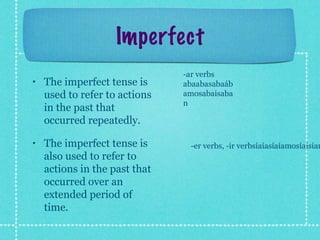
Imperfect
                               -ar verbs
•   The imperfect tense is     abaabasabaáb
    used to refer to actions   amosabaisaba
                               n
    in the past that
    occurred repeatedly.

•   The imperfect tense is      -er verbs, -ir verbsíaíasíaíamosíaisían
    also used to refer to
    actions in the past that
    occurred over an
    extended period of
    time.
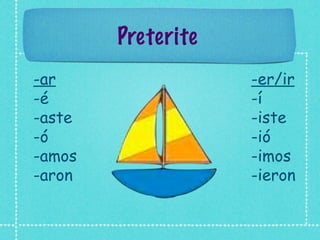
Preterite
-ar                 -er/ir
-é                  -í
-aste               -iste
-ó                  -ió
-amos               -imos
-aron               -ieron
Preterite
 Irregulares
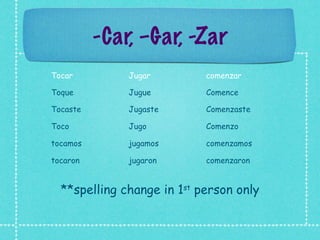
-Car, –Gar, -Zar
Tocar         Jugar         comenzar

Toque         Jugue         Comence

Tocaste       Jugaste       Comenzaste

Toco          Jugo          Comenzo

tocamos       jugamos       comenzamos

tocaron       jugaron       comenzaron


  **spelling change in 1st person only
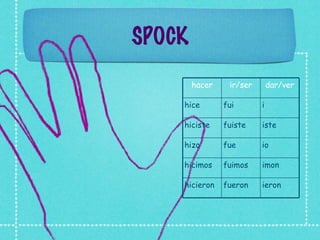
SPOCK
        hacer    ir/ser       dar/ver

    hice        fui       i

    hiciste     fuiste    iste

    hizo        fue       io

    hicimos     fuimos    imon

    hicieron    fueron    ieron
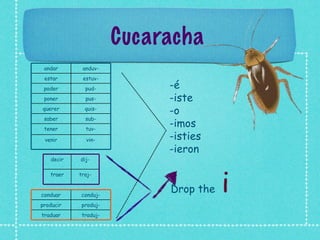
Cucaracha
 andar      anduv-
 estar      estuv-
 poder       pud-          -é
 poner       pus-          -iste
querer       quis-
                           -o
 saber       sub-
 tener       tuv-
                           -imos
 venir       vin-          -isties
                           -ieron
   decir   dij-


                                      i
   traer   traj-


conduar     conduj-
                           Drop the
producir    produj-
traduar     traduj-
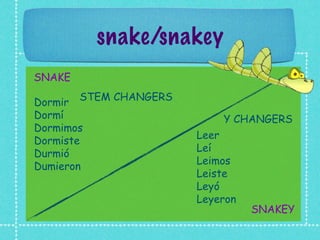
snake/snakey
SNAKE

Dormir STEM CHANGERS
Dormí                      Y CHANGERS
Dormimos
                       Leer
Dormiste
                       Leí
Durmió
                       Leimos
Dumieron
                       Leiste
                       Leyó
                       Leyeron
                                 SNAKEY
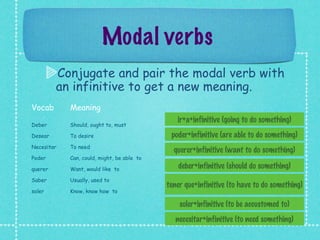
Modal verbs
         Conjugate and pair the modal verb with
         an infinitive to get a new meaning.
Vocab       Meaning
                                               ir+a+infinitive (going to do something)
Deber       Should, ought to, must

Desear      To desire                        poder+infinitive (are able to do something)
Necesitar   To need
                                              querer+infinitive (want to do something)
Poder       Can, could, might, be able to

querer      Want, would like to                 deber+infinitive (should do something)
Saber       Usually, used to
                                            tener que+infinitive (to have to do something)
soler       Know, know how to

                                                soler+infinitive (to be accustomed to)
                                               necesitar+infinitive (to need something)
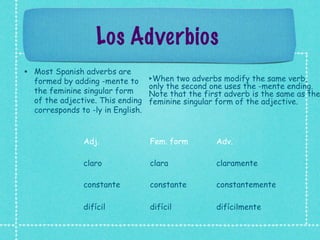
Los Adverbios
• Most Spanish adverbs are
  formed by adding -mente to ‣When two adverbs modify the same verb,
                                 only the second one uses the -mente ending.
  the feminine singular form     Note that the first adverb is the same as the
  of the adjective. This ending feminine singular form of the adjective.
  corresponds to -ly in English.


               Adj.             Fem. form         Adv.

               claro            clara             claramente

               constante        constante         constantemente

               difícil          difícil           difícilmente
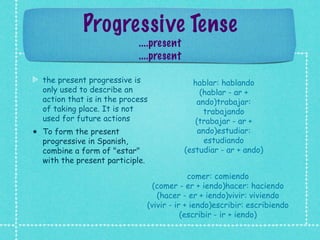
Progressive Tense
                              ....present
                              ....present

    the present progressive is                 hablar: hablando
    only used to describe an                      (hablar - ar +
    action that is in the process               ando)trabajar:
    of taking place. It is not                     trabajando
    used for future actions                     (trabajar - ar +
•   To form the present                          ando)estudiar:
    progressive in Spanish,                        estudiando
    combine a form of "estar"                (estudiar - ar + ando)
    with the present participle.
                                                comer: comiendo
                                    (comer - er + iendo)hacer: haciendo
                                      (hacer - er + iendo)vivir: viviendo
                                   (vivir - ir + iendo)escribir: escribiendo
                                              (escribir - ir + iendo)
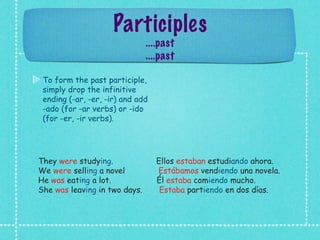
Participles
                               ....past
                               ....past

 To form the past participle,
 simply drop the infinitive
 ending (-ar, -er, -ir) and add
 -ado (for -ar verbs) or -ido
 (for -er, -ir verbs).


They were studying.               Ellos estaban estudiando ahora.
We were selling a novel           Estábamos vendiendo una novela.
He was eating a lot.              Él estaba comiendo mucho.
She was leaving in two days.       Estaba partiendo en dos días.
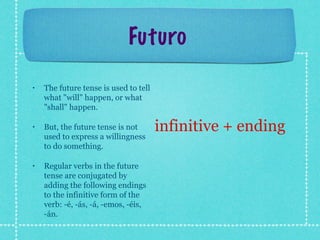
Futuro

•   The future tense is used to tell
    what "will" happen, or what
    "shall" happen.

•   But, the future tense is not       infinitive + ending
    used to express a willingness
    to do something.

•   Regular verbs in the future
    tense are conjugated by
    adding the following endings
    to the infinitive form of the
    verb: -é, -ás, -á, -emos, -éis,
    -án.
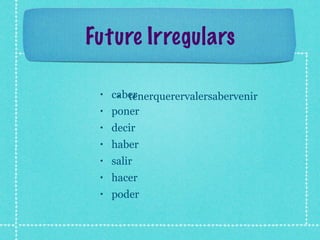
Future Irregulars

 •   caber
      • tenerquerervalersabervenir
 •   poner
 •   decir
 •   haber
 •   salir
 •   hacer
 •   poder
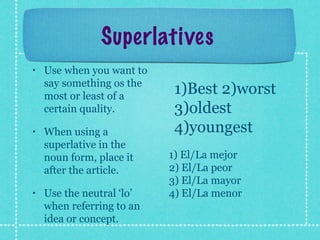
Superlatives
•   Use when you want to
    say something os the
    most or least of a
                            1)Best 2)worst
    certain quality.        3)oldest
•   When using a            4)youngest
    superlative in the
    noun form, place it    1) El/La mejor
    after the article.     2) El/La peor
                           3) El/La mayor
•   Use the neutral ‘lo’   4) El/La menor
    when referring to an
    idea or concept.
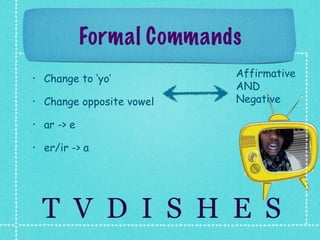
Formal Commands
•   Change to ‘yo’          Affirmative
                            AND
•   Change opposite vowel   Negative

•   ar -> e

•   er/ir -> a


    T V D I S H E S
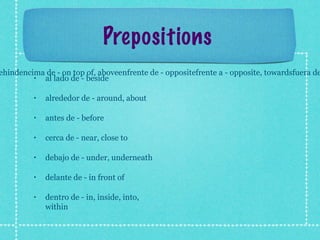
Prepositions
ehindencima de - on top of, aboveenfrente de - oppositefrente a - opposite, towardsfuera de
         • al lado de - beside

         •   alrededor de - around, about

         •   antes de - before

         •   cerca de - near, close to

         •   debajo de - under, underneath

         •   delante de - in front of

         •   dentro de - in, inside, into,
             within
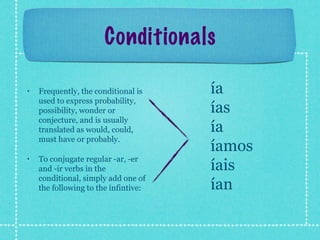
Conditionals

•   Frequently, the conditional is    ía
    used to express probability,
    possibility, wonder or            ías
    conjecture, and is usually
    translated as would, could,       ía
    must have or probably.
                                      íamos
•   To conjugate regular -ar, -er
    and -ir verbs in the              íais
    conditional, simply add one of
    the following to the infintive:   ían
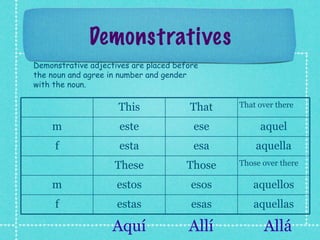
Demonstratives
Demonstrative adjectives are placed before
the noun and agree in number and gender
with the noun.

                     This              That    That over there

    m                este               ese         aquel
     f               esta               esa        aquella
                    These              Those   Those over there

    m                estos              esos      aquellos
     f               estas              esas      aquellas

                    Aquí               Allí          Allá

Grammar book part 2

  • 1.
    Libro de Gramatica (Spanish Grammar Book) Joya Burns
  • 2.
    Table of Contents Concept Page # Preterite 3 -car, -gar, -zar 4 SPOCK 5 Cucaracha 6 Snake/snakey 7 Modal Verbs 8 Los Adverbios 9 Progressive Tense 10 Superlatives 11 Formals commands 12 Prepositions 13 conditionals 14 Demonstratives 15
  • 3.
    Imperfect -ar verbs • The imperfect tense is abaabasabaáb used to refer to actions amosabaisaba n in the past that occurred repeatedly. • The imperfect tense is -er verbs, -ir verbsíaíasíaíamosíaisían also used to refer to actions in the past that occurred over an extended period of time.
  • 4.
    Preterite -ar -er/ir -é -í -aste -iste -ó -ió -amos -imos -aron -ieron
  • 5.
  • 6.
    -Car, –Gar, -Zar Tocar Jugar comenzar Toque Jugue Comence Tocaste Jugaste Comenzaste Toco Jugo Comenzo tocamos jugamos comenzamos tocaron jugaron comenzaron **spelling change in 1st person only
  • 7.
    SPOCK hacer ir/ser dar/ver hice fui i hiciste fuiste iste hizo fue io hicimos fuimos imon hicieron fueron ieron
  • 8.
    Cucaracha andar anduv- estar estuv- poder pud- -é poner pus- -iste querer quis- -o saber sub- tener tuv- -imos venir vin- -isties -ieron decir dij- i traer traj- conduar conduj- Drop the producir produj- traduar traduj-
  • 9.
    snake/snakey SNAKE Dormir STEM CHANGERS Dormí Y CHANGERS Dormimos Leer Dormiste Leí Durmió Leimos Dumieron Leiste Leyó Leyeron SNAKEY
  • 10.
    Modal verbs Conjugate and pair the modal verb with an infinitive to get a new meaning. Vocab Meaning ir+a+infinitive (going to do something) Deber Should, ought to, must Desear To desire poder+infinitive (are able to do something) Necesitar To need querer+infinitive (want to do something) Poder Can, could, might, be able to querer Want, would like to deber+infinitive (should do something) Saber Usually, used to tener que+infinitive (to have to do something) soler Know, know how to soler+infinitive (to be accustomed to) necesitar+infinitive (to need something)
  • 11.
    Los Adverbios • MostSpanish adverbs are formed by adding -mente to ‣When two adverbs modify the same verb, only the second one uses the -mente ending. the feminine singular form Note that the first adverb is the same as the of the adjective. This ending feminine singular form of the adjective. corresponds to -ly in English. Adj. Fem. form Adv. claro clara claramente constante constante constantemente difícil difícil difícilmente
  • 12.
    Progressive Tense ....present ....present the present progressive is hablar: hablando only used to describe an (hablar - ar + action that is in the process ando)trabajar: of taking place. It is not trabajando used for future actions (trabajar - ar + • To form the present ando)estudiar: progressive in Spanish, estudiando combine a form of "estar" (estudiar - ar + ando) with the present participle. comer: comiendo (comer - er + iendo)hacer: haciendo (hacer - er + iendo)vivir: viviendo (vivir - ir + iendo)escribir: escribiendo (escribir - ir + iendo)
  • 13.
    Participles ....past ....past To form the past participle, simply drop the infinitive ending (-ar, -er, -ir) and add -ado (for -ar verbs) or -ido (for -er, -ir verbs). They were studying. Ellos estaban estudiando ahora. We were selling a novel Estábamos vendiendo una novela. He was eating a lot. Él estaba comiendo mucho. She was leaving in two days. Estaba partiendo en dos días.
  • 14.
    Futuro • The future tense is used to tell what "will" happen, or what "shall" happen. • But, the future tense is not infinitive + ending used to express a willingness to do something. • Regular verbs in the future tense are conjugated by adding the following endings to the infinitive form of the verb: -é, -ás, -á, -emos, -éis, -án.
  • 15.
    Future Irregulars • caber • tenerquerervalersabervenir • poner • decir • haber • salir • hacer • poder
  • 16.
    Superlatives • Use when you want to say something os the most or least of a 1)Best 2)worst certain quality. 3)oldest • When using a 4)youngest superlative in the noun form, place it 1) El/La mejor after the article. 2) El/La peor 3) El/La mayor • Use the neutral ‘lo’ 4) El/La menor when referring to an idea or concept.
  • 17.
    Formal Commands • Change to ‘yo’ Affirmative AND • Change opposite vowel Negative • ar -> e • er/ir -> a T V D I S H E S
  • 18.
    Prepositions ehindencima de -on top of, aboveenfrente de - oppositefrente a - opposite, towardsfuera de • al lado de - beside • alrededor de - around, about • antes de - before • cerca de - near, close to • debajo de - under, underneath • delante de - in front of • dentro de - in, inside, into, within
  • 19.
    Conditionals • Frequently, the conditional is ía used to express probability, possibility, wonder or ías conjecture, and is usually translated as would, could, ía must have or probably. íamos • To conjugate regular -ar, -er and -ir verbs in the íais conditional, simply add one of the following to the infintive: ían
  • 20.
    Demonstratives Demonstrative adjectives areplaced before the noun and agree in number and gender with the noun. This That That over there m este ese aquel f esta esa aquella These Those Those over there m estos esos aquellos f estas esas aquellas Aquí Allí Allá