GRAMMAR BOOK (SECOND
SEMESTER)
By: Catalina Taylor
TABLE OF CONTENTS
   1. Pretèrito
   2. –car, -gar, -zar
   3. Spock
   4. Cucaracha
   5. Snake/Snakey
   6. Modal Verbs
   7. Adverbs
   8. Progressive- Past and Present
   9. Future
   10. Future- Irregulars
   11. Future- Conditional
   12. Superlatives
   13. Formal Commands
   14. Prepositions
   15. Demonstratives
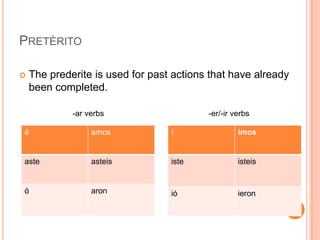
PRETÈRITO

   The prederite is used for past actions that have already
    been completed.

             -ar verbs                    -er/-ir verbs

é                 amos            í                imos


aste              asteis          iste             isteis


ó                 aron            ió               ieron
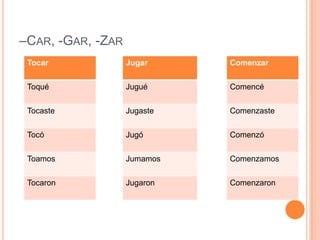
–CAR, -GAR, -ZAR
 Tocar             Jugar     Comenzar


 Toqué             Jugué     Comencé


 Tocaste           Jugaste   Comenzaste


 Tocó              Jugó      Comenzó

 Toamos            Jumamos   Comenzamos


 Tocaron           Jugaron   Comenzaron
SPOCK

                               I
                               Iste


           dar
                       D-/v-   Io


                 ver
                               Imos
                               ieron
-Fui
-Fuiste
-Fue
-Fuimos
-Fueron

Hice
Hiciste
Hizo
Hicimos
Hicieron
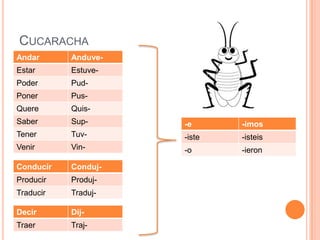
CUCARACHA
Andar      Anduve-
Estar      Estuve-
Poder      Pud-
Poner      Pus-
Quere      Quis-
Saber      Sup-      -e      -imos
Tener      Tuv-      -iste   -isteis
Venir      Vin-      -o      -ieron

Conducir   Conduj-
Producir   Produj-
Traducir   Traduj-

Decir      Dij-
Traer      Traj-
SNAKE/SNAKEY
                                Stem Changers

         Dormí                            Dormimos
Dormir   Dormiste
         Durmió                           Durmieron

               *The “o” changes to a “u” in the third person.


                                 “Y” Changers
         Leí                              Leimos
Leer     Leiste
         Leyó                             Leyeron

               *The “i” changes to a “y” in the third person.
MODAL VERBS
 Conjugate   and pair the model verb with an
 infinitive to create a new meaning.
   Ir + a + infinitive(going to do something)
   Poder + infinitive(are able to do something)
   Querer + infinitive(want to do something)
   Deber + infinitive(should do something)
   Tener que + infinitive(to have to do
    something)
   Soler + infinitive (to be accustomed to…)
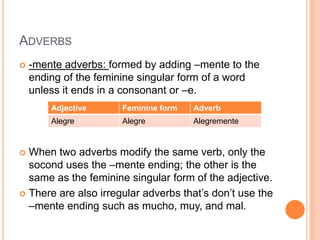
ADVERBS
   -mente adverbs: formed by adding –mente to the
    ending of the feminine singular form of a word
    unless it ends in a consonant or –e.
        Adjective     Feminine form   Adverb
        Alegre        Alegre          Alegremente


 When two adverbs modify the same verb, only the
  socond uses the –mente ending; the other is the
  same as the feminine singular form of the adjective.
 There are also irregular adverbs that’s don’t use the
  –mente ending such as mucho, muy, and mal.
PREGRESSIVE TENSE- PRESENT AND PAST
   Past Progressive: Conjugate estar to the imperfect
    tense, drop the –ar, -er, -ir of the infinitie, and attach
    the progressive tense.
     ESTAR + -ando/-iendo/-yendo
     Example: Estaba hablando a ti.(I was talking to you.)


   Pressent Progressive: formed by combining the
    verb “to be” with the present participle.
     ESTAR + -ando/-iendo/-yendo
     Example: Estoy hablando a ti.(I am talking to you.)
FUTURE “WILL”
   The future tense describes what will occur in the
    future.
       Example: I will eat.  Yo comè.


                               È
                               Ás
            Infinitive +       Á
                               Emos
                               Án
FUTURE- IRREGULARS
 Decir  Dir-
 Hacer  Har-

 Poner  Pondr-     È
 Salir  Saldr-     Ás
 Tener  Tendr-
                     Á
                     Emos
 Valer  Vendr-
                     Án
 Ponder  Podr

 Querer  Querr

 Saber  Sabr
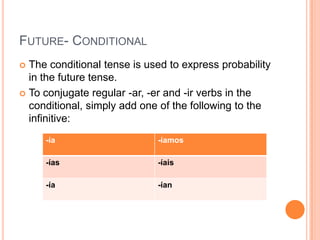
FUTURE- CONDITIONAL
 The conditional tense is used to express probability
  in the future tense.
 To conjugate regular -ar, -er and -ir verbs in the
  conditional, simply add one of the following to the
  infinitive:
     -ía                     -íamos

     -ías                    -íais

     -ía                     -ían
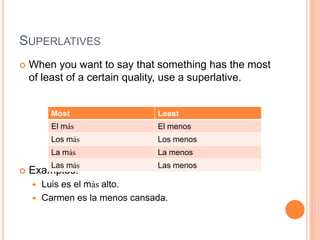
SUPERLATIVES
   When you want to say that something has the most
    of least of a certain quality, use a superlative.


        Most                  Least
        El más                El menos
        Los más               Los menos
        La más                La menos
        Las más               Las menos
   Examples:
     Luis es el más alto.
     Carmen es la menos cansada.
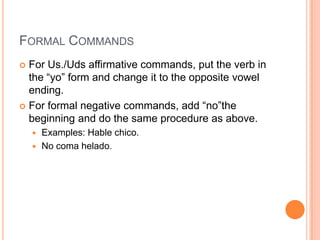
FORMAL COMMANDS
 For Us./Uds affirmative commands, put the verb in
  the “yo” form and change it to the opposite vowel
  ending.
 For formal negative commands, add “no”the
  beginning and do the same procedure as above.
     Examples: Hable chico.
     No coma helado.
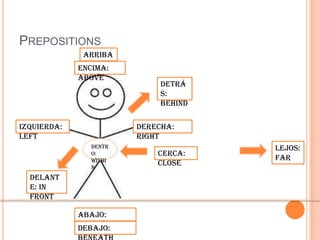
PREPOSITIONS
              Arriba
              : up
             Encima:
             above
                            Detrá
                            s:
                            behind

Izquierda:             Derecha:
left                   right
               Dentr                 Lejos:
               o:          Cerca:
               withi                 far
               n
                           close
  Delant
  e: in
  front

             Abajo:
             below
             Debajo:
DEMONSTRATIVES

                                • Este/ Esta (this)- aquí
                                • Ese/Esa (that)- allí
         Singular               • Aquel/Aquella (that over
                                  there)- allá


                                • Estos/Estas (these)-
                                  aquí
                                • Esos/Esas (those)-allí
            Plural              • Aquellos/Aquellas
                                  (those over there)- allá


*adding an accent over the “e” turns it into a pronoun

Grammar Book

  • 1.
  • 2.
    TABLE OF CONTENTS  1. Pretèrito  2. –car, -gar, -zar  3. Spock  4. Cucaracha  5. Snake/Snakey  6. Modal Verbs  7. Adverbs  8. Progressive- Past and Present  9. Future  10. Future- Irregulars  11. Future- Conditional  12. Superlatives  13. Formal Commands  14. Prepositions  15. Demonstratives
  • 3.
    PRETÈRITO  The prederite is used for past actions that have already been completed. -ar verbs -er/-ir verbs é amos í imos aste asteis iste isteis ó aron ió ieron
  • 4.
    –CAR, -GAR, -ZAR Tocar Jugar Comenzar Toqué Jugué Comencé Tocaste Jugaste Comenzaste Tocó Jugó Comenzó Toamos Jumamos Comenzamos Tocaron Jugaron Comenzaron
  • 5.
    SPOCK I Iste dar D-/v- Io ver Imos ieron -Fui -Fuiste -Fue -Fuimos -Fueron Hice Hiciste Hizo Hicimos Hicieron
  • 6.
    CUCARACHA Andar Anduve- Estar Estuve- Poder Pud- Poner Pus- Quere Quis- Saber Sup- -e -imos Tener Tuv- -iste -isteis Venir Vin- -o -ieron Conducir Conduj- Producir Produj- Traducir Traduj- Decir Dij- Traer Traj-
  • 7.
    SNAKE/SNAKEY Stem Changers Dormí Dormimos Dormir Dormiste Durmió Durmieron *The “o” changes to a “u” in the third person. “Y” Changers Leí Leimos Leer Leiste Leyó Leyeron *The “i” changes to a “y” in the third person.
  • 8.
    MODAL VERBS  Conjugate and pair the model verb with an infinitive to create a new meaning.  Ir + a + infinitive(going to do something)  Poder + infinitive(are able to do something)  Querer + infinitive(want to do something)  Deber + infinitive(should do something)  Tener que + infinitive(to have to do something)  Soler + infinitive (to be accustomed to…)
  • 9.
    ADVERBS  -mente adverbs: formed by adding –mente to the ending of the feminine singular form of a word unless it ends in a consonant or –e. Adjective Feminine form Adverb Alegre Alegre Alegremente  When two adverbs modify the same verb, only the socond uses the –mente ending; the other is the same as the feminine singular form of the adjective.  There are also irregular adverbs that’s don’t use the –mente ending such as mucho, muy, and mal.
  • 10.
    PREGRESSIVE TENSE- PRESENTAND PAST  Past Progressive: Conjugate estar to the imperfect tense, drop the –ar, -er, -ir of the infinitie, and attach the progressive tense.  ESTAR + -ando/-iendo/-yendo  Example: Estaba hablando a ti.(I was talking to you.)  Pressent Progressive: formed by combining the verb “to be” with the present participle.  ESTAR + -ando/-iendo/-yendo  Example: Estoy hablando a ti.(I am talking to you.)
  • 11.
    FUTURE “WILL”  The future tense describes what will occur in the future.  Example: I will eat.  Yo comè. È Ás Infinitive + Á Emos Án
  • 12.
    FUTURE- IRREGULARS  Decir Dir-  Hacer  Har-  Poner  Pondr- È  Salir  Saldr- Ás  Tener  Tendr- Á Emos  Valer  Vendr- Án  Ponder  Podr  Querer  Querr  Saber  Sabr
  • 13.
    FUTURE- CONDITIONAL  Theconditional tense is used to express probability in the future tense.  To conjugate regular -ar, -er and -ir verbs in the conditional, simply add one of the following to the infinitive: -ía -íamos -ías -íais -ía -ían
  • 14.
    SUPERLATIVES  When you want to say that something has the most of least of a certain quality, use a superlative. Most Least El más El menos Los más Los menos La más La menos Las más Las menos  Examples:  Luis es el más alto.  Carmen es la menos cansada.
  • 15.
    FORMAL COMMANDS  ForUs./Uds affirmative commands, put the verb in the “yo” form and change it to the opposite vowel ending.  For formal negative commands, add “no”the beginning and do the same procedure as above.  Examples: Hable chico.  No coma helado.
  • 16.
    PREPOSITIONS Arriba : up Encima: above Detrá s: behind Izquierda: Derecha: left right Dentr Lejos: o: Cerca: withi far n close Delant e: in front Abajo: below Debajo:
  • 17.
    DEMONSTRATIVES • Este/ Esta (this)- aquí • Ese/Esa (that)- allí Singular • Aquel/Aquella (that over there)- allá • Estos/Estas (these)- aquí • Esos/Esas (those)-allí Plural • Aquellos/Aquellas (those over there)- allá *adding an accent over the “e” turns it into a pronoun