

1.Introduction to Nano-Technology
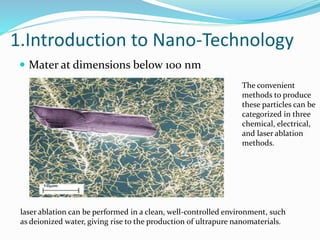
 Mater at dimensions below 100 nm
The convenient
methods to produce
these particles can be
categorized in three
chemical, electrical,
and laser ablation
methods.
laser ablation can be performed in a clean, well-controlled environment, such
as deionized water, giving rise to the production of ultrapure nanomaterials.
Applications of nanotechnology
Noble metals and base metals
Noble metals (Precious metals) base metals
The noble metals are a group of metals
that resist oxidation and corrosion in
moist air.
 ruthenium
 rhodium
 palladium
 silver
 osmium
 iridium
 platinum
 gold
They are the opposite of the base
metals, which more readily oxidize and
corrode.
 Copper
 aluminum
 zinc
 nickel, etc
Gold Nanoparticles
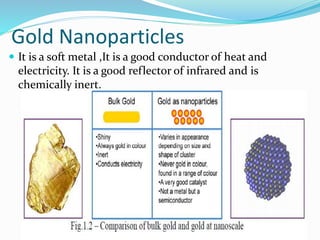
 It is a soft metal ,It is a good conductor of heat and
electricity. It is a good reflector of infrared and is
chemically inert.
Applications of Gold NPs
 gold ion or metallic gold as well as gold NPs can be
exploited in medicine for
 burn treatment
 dental materials
 coating stainless steel materials
 textile fabrics
 Electronic instruments
 it posses low toxicity to human cells, high thermal
stability
 Sensory probes in TEM
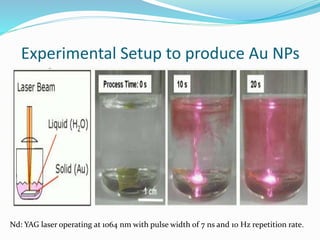
Experimental Setup to produce Au NPs
Nd: YAG laser operating at 1064 nm with pulse width of 7 ns and 10 Hz repetition rate.
Results
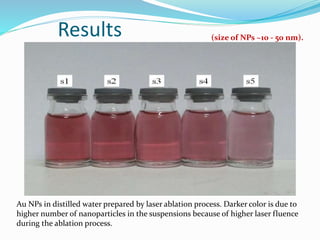
Au NPs in distilled water prepared by laser ablation process. Darker color is due to
higher number of nanoparticles in the suspensions because of higher laser fluence
during the ablation process.
(size of NPs ~10 - 50 nm).
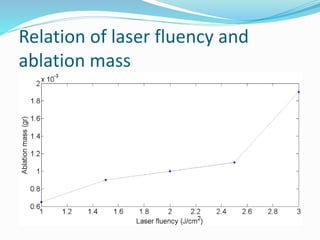
Relation of laser fluency and
ablation mass
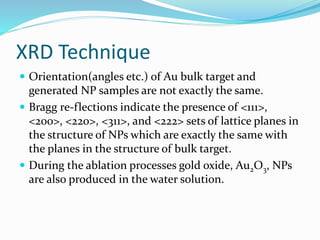
XRD Technique
 Orientation(angles etc.) of Au bulk target and
generated NP samples are not exactly the same.
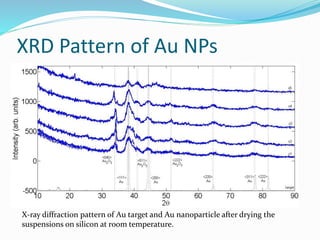
 Bragg re-flections indicate the presence of <111>,
<200>, <220>, <311>, and <222> sets of lattice planes in
the structure of NPs which are exactly the same with
the planes in the structure of bulk target.
 During the ablation processes gold oxide, Au2O3, NPs
are also produced in the water solution.
XRD Pattern of Au NPs
X-ray diffraction pattern of Au target and Au nanoparticle after drying the
suspensions on silicon at room temperature.
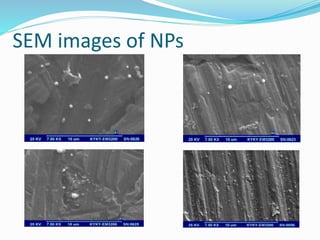
SEM images of NPs
Cont…
 The morphology of nanoparticles is strongly depends
on the energy and wavelength of laser pulse
 From s1 to s3, with increasing the laser pulse energy
number of small particles in the samples is increased.
 while from sample 3 to 5 more large NPs in the
samples can be observed.
Conclusions
 laser fluence is a powerful tool to control the
morphology and size of NPs.
 Size and morphology of nanoparticles depends upon
magnitude of laser energy which touches the target
surface through liquid medium.
 increasing the laser fluence size of produced gold
nanoparticles will decrease.
 there is threshold for the laser fluence at which the
absorption of the laser energy by the liquid
environment enhances sharply.
 In this experimental condition produced
nanoparticles are formed from the nucleation of
ablated gold atoms so the lattice structure of
nanoparticles is independent of the lattice structure of
target.
Gold nano particles and laser

Gold nano particles and laser

  • 2.
    1.Introduction to Nano-Technology Mater at dimensions below 100 nm The convenient methods to produce these particles can be categorized in three chemical, electrical, and laser ablation methods. laser ablation can be performed in a clean, well-controlled environment, such as deionized water, giving rise to the production of ultrapure nanomaterials.
  • 3.
  • 4.
    Noble metals andbase metals Noble metals (Precious metals) base metals The noble metals are a group of metals that resist oxidation and corrosion in moist air.  ruthenium  rhodium  palladium  silver  osmium  iridium  platinum  gold They are the opposite of the base metals, which more readily oxidize and corrode.  Copper  aluminum  zinc  nickel, etc
  • 5.
    Gold Nanoparticles  Itis a soft metal ,It is a good conductor of heat and electricity. It is a good reflector of infrared and is chemically inert.
  • 6.
    Applications of GoldNPs  gold ion or metallic gold as well as gold NPs can be exploited in medicine for  burn treatment  dental materials  coating stainless steel materials  textile fabrics  Electronic instruments  it posses low toxicity to human cells, high thermal stability  Sensory probes in TEM
  • 7.
    Experimental Setup toproduce Au NPs Nd: YAG laser operating at 1064 nm with pulse width of 7 ns and 10 Hz repetition rate.
  • 8.
    Results Au NPs indistilled water prepared by laser ablation process. Darker color is due to higher number of nanoparticles in the suspensions because of higher laser fluence during the ablation process. (size of NPs ~10 - 50 nm).
  • 9.
    Relation of laserfluency and ablation mass
  • 10.
    XRD Technique  Orientation(anglesetc.) of Au bulk target and generated NP samples are not exactly the same.  Bragg re-flections indicate the presence of <111>, <200>, <220>, <311>, and <222> sets of lattice planes in the structure of NPs which are exactly the same with the planes in the structure of bulk target.  During the ablation processes gold oxide, Au2O3, NPs are also produced in the water solution.
  • 11.
    XRD Pattern ofAu NPs X-ray diffraction pattern of Au target and Au nanoparticle after drying the suspensions on silicon at room temperature.
  • 12.
  • 13.
    Cont…  The morphologyof nanoparticles is strongly depends on the energy and wavelength of laser pulse  From s1 to s3, with increasing the laser pulse energy number of small particles in the samples is increased.  while from sample 3 to 5 more large NPs in the samples can be observed.
  • 14.
    Conclusions  laser fluenceis a powerful tool to control the morphology and size of NPs.  Size and morphology of nanoparticles depends upon magnitude of laser energy which touches the target surface through liquid medium.  increasing the laser fluence size of produced gold nanoparticles will decrease.  there is threshold for the laser fluence at which the absorption of the laser energy by the liquid environment enhances sharply.
  • 15.
     In thisexperimental condition produced nanoparticles are formed from the nucleation of ablated gold atoms so the lattice structure of nanoparticles is independent of the lattice structure of target.