Graphene
Graphene physically acts as a 2-Dimensional material. This
leads to many properties that are electrially beneficial, such
as high electron moblity and lowered power usage.
Graphene is currently in its infant stages and is undergoing
many applications and studies.
• It was discovered at Manchester University by
Russian born scientists ANDRE GEIM and
KOSTYA NOVOSELOV in 2004.
• They won Nobel prize in 2010 for their discovery.
• It is a layer of carbon a single atom thick,
stronger than diamond but stretches like rubber
and conducts electricity much more times than
copper
Introduction
• What is Graphene
• Discovery
• Methods of preparation
• Electrical Properties
• Mechanical Strength
• Optical Properties
• Applications
• Devices
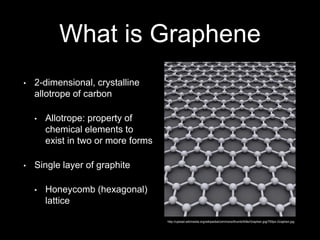
What is Graphene
• 2-dimensional, crystalline
allotrope of carbon
• Allotrope: property of
chemical elements to
exist in two or more forms
• Single layer of graphite
• Honeycomb (hexagonal)
lattice
http://upload.wikimedia.org/wikipedia/commons/thumb/9/9e/Graphen.jpg/750px-Graphen.jpg
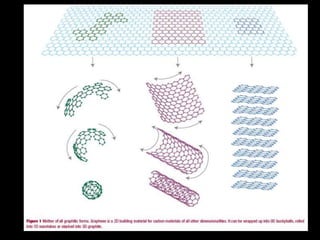
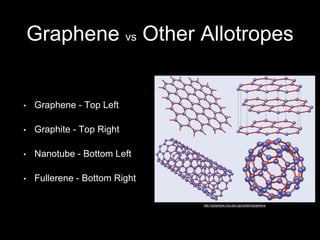
Graphene vs Other Allotropes
• Graphene - Top Left
• Graphite - Top Right
• Nanotube - Bottom Left
• Fullerene - Bottom Right
http://graphene.nus.edu.sg/content/graphene
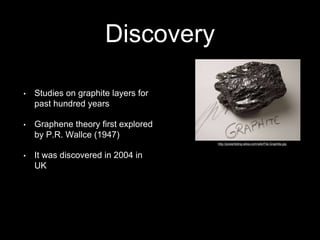
Discovery
• Studies on graphite layers for
past hundred years
• Graphene theory first explored
by P.R. Wallce (1947)
• It was discovered in 2004 in
UK
http://powerlisting.wikia.com/wiki/File:Graphite.jpg
Methods of preparation
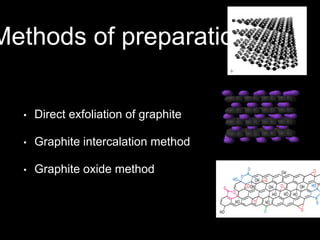
• Direct exfoliation of graphite
• Graphite intercalation method
• Graphite oxide method
Electrical Properties
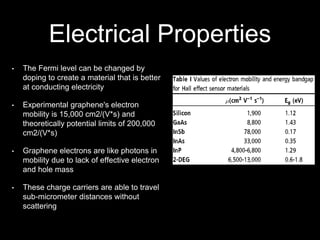
• The Fermi level can be changed by
doping to create a material that is better
at conducting electricity
• Experimental graphene's electron
mobility is 15,000 cm2/(V*s) and
theoretically potential limits of 200,000
cm2/(V*s)
• Graphene electrons are like photons in
mobility due to lack of effective electron
and hole mass
• These charge carriers are able to travel
sub-micrometer distances without
scattering
Mechanical Strengths
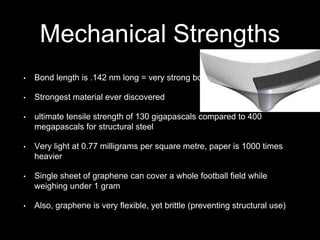
• Bond length is .142 nm long = very strong bond
• Strongest material ever discovered
• ultimate tensile strength of 130 gigapascals compared to 400
megapascals for structural steel
• Very light at 0.77 milligrams per square metre, paper is 1000 times
heavier
• Single sheet of graphene can cover a whole football field while
weighing under 1 gram
• Also, graphene is very flexible, yet brittle (preventing structural use)
Optical Properties
• Absorbs 2.3% white light
• Optical electronics absorb
<10% white light
• Highly conductive
• Strong and flexible
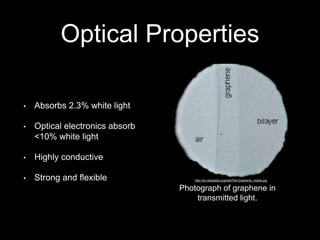
Photograph of graphene in
transmitted light.
http://en.wikipedia.org/wiki/File:Graphene_visible.jpg
Other Applications
• OLED Techonologies
• Body Armour
• Lightweight Aircraft/vehicles
• Photovoltaics
• Superconductor
• Filtration
• Biological Engineering
• Optical Electronics (touch screen, LTD, OLED)
• Composites
• Energy storage
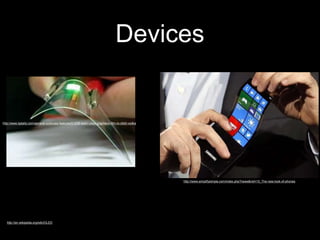
Devices
http://www.tgdaily.com/general-sciences-features/61058-team-uses-graphene-film-to-distil-vodka
http://en.wikipedia.org/wiki/OLED
http://www.simplifysimple.com/index.php?news&nid=15_The-new-look-of-phones
Summary
Graphene, a singular layer of graphite, has been
discovered to have unique properties. The high
mobility and ability to travel short distances
without scattering makes it one of the best
materials for electrical applications. Graphene's
mechanical and optical properties also allow its
use to go beyond electrical applications.
Conclusion
• Graphite had been studied for over a hundred years but Geim
and Novoselov found how to isolate it to be graphene and some
applications for its use
• The reason graphene is such a beneficial material is due to its 2D
like nature and short/strong bonds
• It has a super high conductivity and an electron mobility of
15,000 cm2/(V*s)
• It is the strongest material ever discovered, however its brittle
nature cannot be used structurally (only to help reinforce)
• One of the most common current uses of graphene is in OLEDs
Thank you

Graphene

  • 1.
    Graphene Graphene physically actsas a 2-Dimensional material. This leads to many properties that are electrially beneficial, such as high electron moblity and lowered power usage. Graphene is currently in its infant stages and is undergoing many applications and studies.
  • 2.
    • It wasdiscovered at Manchester University by Russian born scientists ANDRE GEIM and KOSTYA NOVOSELOV in 2004. • They won Nobel prize in 2010 for their discovery. • It is a layer of carbon a single atom thick, stronger than diamond but stretches like rubber and conducts electricity much more times than copper
  • 4.
    Introduction • What isGraphene • Discovery • Methods of preparation • Electrical Properties • Mechanical Strength • Optical Properties • Applications • Devices
  • 5.
    What is Graphene •2-dimensional, crystalline allotrope of carbon • Allotrope: property of chemical elements to exist in two or more forms • Single layer of graphite • Honeycomb (hexagonal) lattice http://upload.wikimedia.org/wikipedia/commons/thumb/9/9e/Graphen.jpg/750px-Graphen.jpg
  • 6.
    Graphene vs OtherAllotropes • Graphene - Top Left • Graphite - Top Right • Nanotube - Bottom Left • Fullerene - Bottom Right http://graphene.nus.edu.sg/content/graphene
  • 7.
    Discovery • Studies ongraphite layers for past hundred years • Graphene theory first explored by P.R. Wallce (1947) • It was discovered in 2004 in UK http://powerlisting.wikia.com/wiki/File:Graphite.jpg
  • 8.
    Methods of preparation •Direct exfoliation of graphite • Graphite intercalation method • Graphite oxide method
  • 9.
    Electrical Properties • TheFermi level can be changed by doping to create a material that is better at conducting electricity • Experimental graphene's electron mobility is 15,000 cm2/(V*s) and theoretically potential limits of 200,000 cm2/(V*s) • Graphene electrons are like photons in mobility due to lack of effective electron and hole mass • These charge carriers are able to travel sub-micrometer distances without scattering
  • 10.
    Mechanical Strengths • Bondlength is .142 nm long = very strong bond • Strongest material ever discovered • ultimate tensile strength of 130 gigapascals compared to 400 megapascals for structural steel • Very light at 0.77 milligrams per square metre, paper is 1000 times heavier • Single sheet of graphene can cover a whole football field while weighing under 1 gram • Also, graphene is very flexible, yet brittle (preventing structural use)
  • 11.
    Optical Properties • Absorbs2.3% white light • Optical electronics absorb <10% white light • Highly conductive • Strong and flexible Photograph of graphene in transmitted light. http://en.wikipedia.org/wiki/File:Graphene_visible.jpg
  • 12.
    Other Applications • OLEDTechonologies • Body Armour • Lightweight Aircraft/vehicles • Photovoltaics • Superconductor • Filtration • Biological Engineering
  • 13.
    • Optical Electronics(touch screen, LTD, OLED) • Composites • Energy storage
  • 14.
  • 15.
    Summary Graphene, a singularlayer of graphite, has been discovered to have unique properties. The high mobility and ability to travel short distances without scattering makes it one of the best materials for electrical applications. Graphene's mechanical and optical properties also allow its use to go beyond electrical applications.
  • 16.
    Conclusion • Graphite hadbeen studied for over a hundred years but Geim and Novoselov found how to isolate it to be graphene and some applications for its use • The reason graphene is such a beneficial material is due to its 2D like nature and short/strong bonds • It has a super high conductivity and an electron mobility of 15,000 cm2/(V*s) • It is the strongest material ever discovered, however its brittle nature cannot be used structurally (only to help reinforce) • One of the most common current uses of graphene is in OLEDs
  • 17.