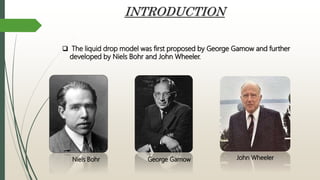
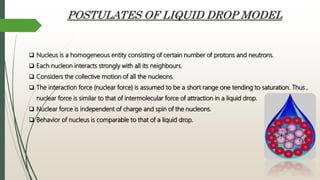
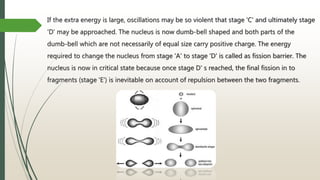
The liquid drop model, developed by George Gamow and Niels Bohr, describes the nucleus as a homogeneous entity of protons and neutrons interacting through a short-range nuclear force, akin to intermolecular forces in liquids. It explains nuclear fission through the Bohr-Wheeler theory, demonstrating how a captured neutron can cause the nucleus to oscillate and eventually split into fragments. While the model successfully accounts for several nuclear phenomena, it has limitations, such as not explaining magic numbers or the stability of heavy nuclides.