


ASHOK KUMAR  DIVYA BISHT KAVITA TIWARI NANOTECHNOLOGY
CONTENTS Introduction Origin and the history of the nanotechnology Theory Vision  Applications Health and Environment  The Future of Nanotechnology  NANOTECHNOLOGY
INTRODUCTION Nanotechnology refers to a field of applied science that deals with structures devices100 nanometers or smaller in size. To give you an idea of how small that is, it would take eight hundred 100 nanometer particles side by side to match the width of a human hair.  1 nanometer (nm) =10 -9  meter  (m). NANOTECHNOLOGY
Origin And The History Of The Nanotechnology The first use of the concepts in 'nano-technology' (but predating use of that name) was in "There's Plenty of Room at the Bottom," a talk given by physicist Richard Feynman at an American Physical Society meeting at Caltech on December 29, 1959  .  The term "nanotechnology" was defined by Tokyo Science University Professor Norio Taniguchi  in1974. Cont... NANOTECHNOLOGY
Dr. K. Eric Drexler promoted the technological significance of nano-scale phenomena and devices through speeches and the books Engines of Creation:The Coming Era of Nanotechnology in 1986. NANOTECHNOLOGY
NANOTUBE A  nanotube  is a nanometer-scale tube-like structure. It may refer to: Carbon  nanotube Inorganic nanotube  DNA nanotube Membrane nanotube NANOTECHNOLOGY
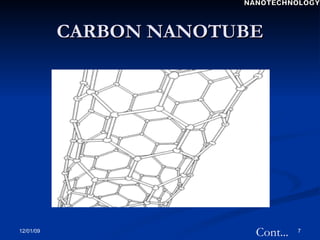
CARBON NANOTUBE Cont... NANOTECHNOLOGY
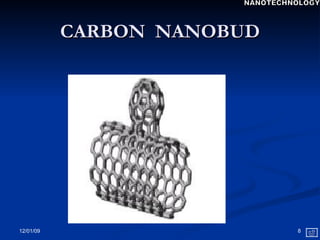
CARBON  NANOBUD NANOTECHNOLOGY
DNA NANOTUBE The first layered nanotubes composed almost entirely of DNA have been created. Layers of DNA in the nanotubes are held together by hybridization of a series of DNA strands. The nanotubes fall apart when heated, releasing single-stranded DNA.  NANOTECHNOLOGY
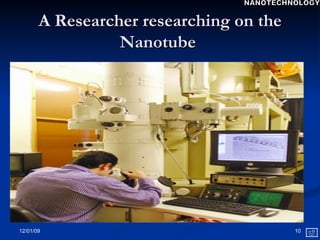
A Researcher researching on the Nanotube  NANOTECHNOLOGY
VISION There are two types of approaches used in nanotechnology: TOP DOWN BOTTOM UP Cont... NANOTECHNOLOGY
TOP-DOWN APPROACH These seek to create smaller devices by using larger ones to direct their assembly. Many technologies descended from conventional  solid-state silicon methods  for fabricating microprocessors  are now capable of creating features smaller than 100 nm, falling under the definition of nanotechnology. Giant magnetoresistance -based hard drives already on the market fit this description, as do atomic layer deposition (ALD) techniques.  Solid-state techniques can also be used to create devices known as  nanoelectromechanical systems  or NEMS, which are related to microelectromechanical systems  or MEMS.  Atomic force microscope  tips can be used as a nanoscale "write head" to deposit a chemical upon a surface in a desired pattern in a process called  dip pen nanolithography . This fits into the larger subfield of nanolithography. Cont... NANOTECHNOLOGY
BOTTOM-UP APPROACH These seek to arrange smaller components into more complex assemblies. DNA nanotechnology  utilizes the specificity of Watson-Crick basepairing to construct well-defined structures out of DNA  and other nucleic acids .  Approaches from the field of "classical" chemical synthesis also aim at designing molecules with well-defined shape (e.g. bis-peptides.  More generally,  molecular self-assembly  seeks to use concepts of supramolecular chemistry, and molecular recognition in particular, to cause single-molecule components to automatically arrange themselves into some useful conformation.  NANOTECHNOLOGY
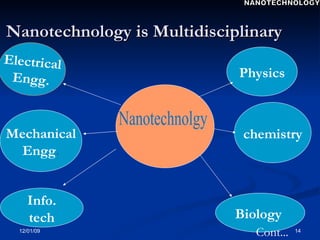
Nanotechnology is Multidisciplinary Electrical Engg. Info. tech Mechanical Engg . chemistry Physics Biology  Nanotechnolgy Cont... NANOTECHNOLOGY
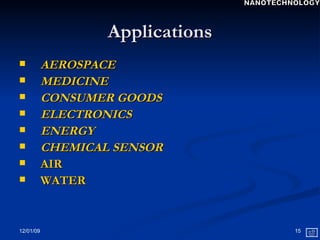
Applications AEROSPACE MEDICINE CONSUMER GOODS ELECTRONICS ENERGY CHEMICAL SENSOR AIR WATER NANOTECHNOLOGY
Health & Environment Concerns Silver nanoparticles, which are bacteriostatic, may then destroy beneficial bacteria which are important for breaking down organic matter in waste treatment. It could be as harmful as asbestos if inhaled in sufficient quantities.  NANOTECHNOLOGY
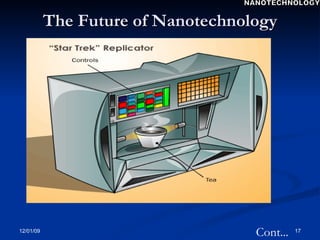
The Future of Nanotechnology NANOTECHNOLOGY Cont...
Bibliography From Wikipedia, the free encyclopedia www.understanding nano .com How stuff works . www. Nanotech-now.com NANOTECHNOLOGY
MEDICINE Diagnostics Drug delivery  :Iron nanoparticles are used in  cancer treatment,nanomedicine also  greatly reduce the damage treatment such as chemotherapy does to a patient's healthy cells. Tissue engineering   NANOTECHNOLOGY
ELECTRONICS Applications under development:- Improving display screens on electronics devices.  Increasing the density of memory chips. Reducing the size of transistors used in integrated circuits. NANOTECHNOLOGY
Membrane Nanotubes Membrane nanotubes  are long and thin tubes formed from the plasma membrane that connect different cells over long distances. NANOTECHNOLOGY
Inorganic Nanotube An  inorganic nanotube  is a cylindrical molecule often composed of metal oxides, and morphologically similar to a carbon nanotube. Inorganic nanotubes have been observed to occur naturally in some mineral deposits. Inorganic nanotubes are heavier than carbon nanotubes and not as strong under tensile stress, but they are particularly strong under compression, leading to potential applications in impact resistant applications such as bullet proof vests. NANOTECHNOLOGY
Space Advancements in nanomaterials make lightweight solar sails.  Nanotechnology helps to reduce the size of equipments used  . NANOTECHNOLOGY
Food Nanotechnology can be applied in the production, processing, safety and packaging of food. Nanomaterials can improves the taste of food. Nanocomposite coating can improve food packaging. Nanomaterials can improve health benefits that food delivers.  Cont... NANOTECHNOLOGY
Textile Nanofibers makes clothes water- and stain-repellent or wrinkle-free.  Textiles with a nanotechnological finish can be washed less frequently and at lower temperatures.   Cont... NANOTECHNOLOGY
Optics For optics, nanotechnology also offers scratch resistant surface coatings. Nano-optics could allow for an increase in precision of pupil repair and other types of laser eye surgery. NANOTECHNOLOGY
Solar Cells Companies have developed nanotech solar cells that can be manufactured at significantly lower cost than conventional solar cells. Commercially available solar cells have much lower efficiencies (15-20%). Nanotechnology could help increase the efficiency to around 40 percent. Cont... NANOTECHNOLOGY
FUEL CELLS Nanotechnology is used to reduce the cost of catalysts used in fuel cells. Cont... NANOTECHNOLOGY
Nanobatteries   Nanobatteries are the rechargeable batteries with higher rate of recharging using nanomaterials could be helpful for the battery disposal problem.   NANOTECHNOLOGY
Better Air Quality Nanotechnology can improve the performance of catalysts used to transform vapors escaping from cars or industrial plants into harmless gasses.  NANOTECHNOLOGY
Cleaner Water Nanotechnology is used to develop solution of problems in water quality: It helps in the removal of industrial wastes from water. Nanoparticles can be used to convert the contaminating chemical through a chemical reaction to make it harmless. NANOTECHNOLOGY
Chemical Sensors Nanotechnology can enable sensors to detect very small amounts of chemical vapors. Various types of detecting elements, such as carbon nanotubes, zinc oxide nanowires or palladium nanoparticles can be used in nanotechnology-based sensors. NANOTECHNOLOGY

nano science and nano technology

  • 1.
    ASHOK KUMAR DIVYA BISHT KAVITA TIWARI NANOTECHNOLOGY
  • 2.
    CONTENTS Introduction Originand the history of the nanotechnology Theory Vision Applications Health and Environment The Future of Nanotechnology NANOTECHNOLOGY
  • 3.
    INTRODUCTION Nanotechnology refersto a field of applied science that deals with structures devices100 nanometers or smaller in size. To give you an idea of how small that is, it would take eight hundred 100 nanometer particles side by side to match the width of a human hair. 1 nanometer (nm) =10 -9 meter (m). NANOTECHNOLOGY
  • 4.
    Origin And TheHistory Of The Nanotechnology The first use of the concepts in 'nano-technology' (but predating use of that name) was in "There's Plenty of Room at the Bottom," a talk given by physicist Richard Feynman at an American Physical Society meeting at Caltech on December 29, 1959 . The term "nanotechnology" was defined by Tokyo Science University Professor Norio Taniguchi in1974. Cont... NANOTECHNOLOGY
  • 5.
    Dr. K. EricDrexler promoted the technological significance of nano-scale phenomena and devices through speeches and the books Engines of Creation:The Coming Era of Nanotechnology in 1986. NANOTECHNOLOGY
  • 6.
    NANOTUBE A nanotube is a nanometer-scale tube-like structure. It may refer to: Carbon nanotube Inorganic nanotube DNA nanotube Membrane nanotube NANOTECHNOLOGY
  • 7.
  • 8.
    CARBON NANOBUDNANOTECHNOLOGY
  • 9.
    DNA NANOTUBE Thefirst layered nanotubes composed almost entirely of DNA have been created. Layers of DNA in the nanotubes are held together by hybridization of a series of DNA strands. The nanotubes fall apart when heated, releasing single-stranded DNA. NANOTECHNOLOGY
  • 10.
    A Researcher researchingon the Nanotube NANOTECHNOLOGY
  • 11.
    VISION There aretwo types of approaches used in nanotechnology: TOP DOWN BOTTOM UP Cont... NANOTECHNOLOGY
  • 12.
    TOP-DOWN APPROACH Theseseek to create smaller devices by using larger ones to direct their assembly. Many technologies descended from conventional solid-state silicon methods for fabricating microprocessors are now capable of creating features smaller than 100 nm, falling under the definition of nanotechnology. Giant magnetoresistance -based hard drives already on the market fit this description, as do atomic layer deposition (ALD) techniques. Solid-state techniques can also be used to create devices known as nanoelectromechanical systems or NEMS, which are related to microelectromechanical systems or MEMS. Atomic force microscope tips can be used as a nanoscale "write head" to deposit a chemical upon a surface in a desired pattern in a process called dip pen nanolithography . This fits into the larger subfield of nanolithography. Cont... NANOTECHNOLOGY
  • 13.
    BOTTOM-UP APPROACH Theseseek to arrange smaller components into more complex assemblies. DNA nanotechnology utilizes the specificity of Watson-Crick basepairing to construct well-defined structures out of DNA and other nucleic acids . Approaches from the field of "classical" chemical synthesis also aim at designing molecules with well-defined shape (e.g. bis-peptides. More generally, molecular self-assembly seeks to use concepts of supramolecular chemistry, and molecular recognition in particular, to cause single-molecule components to automatically arrange themselves into some useful conformation. NANOTECHNOLOGY
  • 14.
    Nanotechnology is MultidisciplinaryElectrical Engg. Info. tech Mechanical Engg . chemistry Physics Biology Nanotechnolgy Cont... NANOTECHNOLOGY
  • 15.
    Applications AEROSPACE MEDICINECONSUMER GOODS ELECTRONICS ENERGY CHEMICAL SENSOR AIR WATER NANOTECHNOLOGY
  • 16.
    Health & EnvironmentConcerns Silver nanoparticles, which are bacteriostatic, may then destroy beneficial bacteria which are important for breaking down organic matter in waste treatment. It could be as harmful as asbestos if inhaled in sufficient quantities. NANOTECHNOLOGY
  • 17.
    The Future ofNanotechnology NANOTECHNOLOGY Cont...
  • 18.
    Bibliography From Wikipedia,the free encyclopedia www.understanding nano .com How stuff works . www. Nanotech-now.com NANOTECHNOLOGY
  • 19.
    MEDICINE Diagnostics Drugdelivery :Iron nanoparticles are used in cancer treatment,nanomedicine also greatly reduce the damage treatment such as chemotherapy does to a patient's healthy cells. Tissue engineering NANOTECHNOLOGY
  • 20.
    ELECTRONICS Applications underdevelopment:- Improving display screens on electronics devices. Increasing the density of memory chips. Reducing the size of transistors used in integrated circuits. NANOTECHNOLOGY
  • 21.
    Membrane Nanotubes Membranenanotubes are long and thin tubes formed from the plasma membrane that connect different cells over long distances. NANOTECHNOLOGY
  • 22.
    Inorganic Nanotube An inorganic nanotube is a cylindrical molecule often composed of metal oxides, and morphologically similar to a carbon nanotube. Inorganic nanotubes have been observed to occur naturally in some mineral deposits. Inorganic nanotubes are heavier than carbon nanotubes and not as strong under tensile stress, but they are particularly strong under compression, leading to potential applications in impact resistant applications such as bullet proof vests. NANOTECHNOLOGY
  • 23.
    Space Advancements innanomaterials make lightweight solar sails. Nanotechnology helps to reduce the size of equipments used . NANOTECHNOLOGY
  • 24.
    Food Nanotechnology canbe applied in the production, processing, safety and packaging of food. Nanomaterials can improves the taste of food. Nanocomposite coating can improve food packaging. Nanomaterials can improve health benefits that food delivers. Cont... NANOTECHNOLOGY
  • 25.
    Textile Nanofibers makesclothes water- and stain-repellent or wrinkle-free. Textiles with a nanotechnological finish can be washed less frequently and at lower temperatures. Cont... NANOTECHNOLOGY
  • 26.
    Optics For optics,nanotechnology also offers scratch resistant surface coatings. Nano-optics could allow for an increase in precision of pupil repair and other types of laser eye surgery. NANOTECHNOLOGY
  • 27.
    Solar Cells Companieshave developed nanotech solar cells that can be manufactured at significantly lower cost than conventional solar cells. Commercially available solar cells have much lower efficiencies (15-20%). Nanotechnology could help increase the efficiency to around 40 percent. Cont... NANOTECHNOLOGY
  • 28.
    FUEL CELLS Nanotechnologyis used to reduce the cost of catalysts used in fuel cells. Cont... NANOTECHNOLOGY
  • 29.
    Nanobatteries Nanobatteries are the rechargeable batteries with higher rate of recharging using nanomaterials could be helpful for the battery disposal problem. NANOTECHNOLOGY
  • 30.
    Better Air QualityNanotechnology can improve the performance of catalysts used to transform vapors escaping from cars or industrial plants into harmless gasses. NANOTECHNOLOGY
  • 31.
    Cleaner Water Nanotechnologyis used to develop solution of problems in water quality: It helps in the removal of industrial wastes from water. Nanoparticles can be used to convert the contaminating chemical through a chemical reaction to make it harmless. NANOTECHNOLOGY
  • 32.
    Chemical Sensors Nanotechnologycan enable sensors to detect very small amounts of chemical vapors. Various types of detecting elements, such as carbon nanotubes, zinc oxide nanowires or palladium nanoparticles can be used in nanotechnology-based sensors. NANOTECHNOLOGY