Subject Name And Code : Physics(2110005) 
Active Learning Assignment 
Topic : Nanotechnology 
Guided by : Sanket sir 
Branch : Electrical 
Division : F2 Sem : 1st 
Academic Year : 2014(odd)
What is Nanotechnology ? 
 The branch of technology that deals with dimensions and tolerances of less 
than 100 nanometres, especially the manipulation of individual atoms and 
molecules. 
 Nanotechnology is the technique of design , production of devices and system 
by controlling the shape and size at the nanometre scale.
Nanomaterial 
 Nanomaterials are the materials containing nanocrystals, i.e. 
their grain size is in the 1 to 100 nanometre range. The 
material may be metals, alloys, intermetallic and ceramics . 
 In commercial products they are used for a electronic 
devices, sporting goods, cosmetics, textiles, sunscreens, 
tyres , paint, vanishings etc. In medical field, they are used 
for the purpose of imaging, targeted drug delivery, diagnosis 
etc.
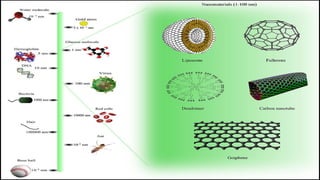
Nanoscale 
 The nanoscopic scale (or nanoscale) usually refers to structures with a 
length scale applicable to nanotechnology, usually cited as 1–100 nanometres.[ 
1] A nanometre is a billionth of a meter. The nanoscopic scale is (roughly 
speaking) a lower bound to the mesoscopic scale for most solids. 
 For technical purposes, the nanoscopic scale is the size at which fluctuations in 
the averaged properties (due to the motion and behavior of individual 
particles) begin to have a significant effect (often a few percent) on the 
behavior of a system, and must be taken into account in its analysis. 
 The nanoscopic scale is sometimes marked as the point where the properties of 
a material change; above this point, the properties of a material are caused by 
'bulk' or 'volume' effects, namely which atoms are present, how they are 
bonded, and in what ratios. Below this point, the properties of a material 
change, and while the type of atoms present and their relative orientations are 
still important, 'surface area effects' (also referred to as quantum effects) 
become more apparent – these effects are due to the geometry of the material 
(how thick it is, how wide it is, etc.), which, at these low dimensions, can have 
a drastic effect on quantized states, and thus the properties of a material.
Surface Area To Volume Ratio 
 The surface-area-to-volume ratio, also called the surface-to-volume 
ratio and variously denoted sa/vol or SA:V, is the amount of surface area per 
unit volume of an object or collection of objects. The surface-area-to-volume 
ratio is measured in units of inverse distance. 
 SA:V is a great way to measure the efficiency of nanotechnology. 
 SA:V In a nanoparticle have a significant effect on nanoparticle properties. 
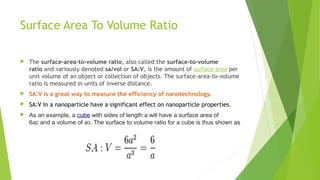
 As an example, a cube with sides of length a will have a surface area of 
6a2 and a volume of a3. The surface to volume ratio for a cube is thus shown as
What is a Carbon Nanotube? 
• Nanotubes have been constructed with length-to-diameter 
ratio of up to 132,000,000. 
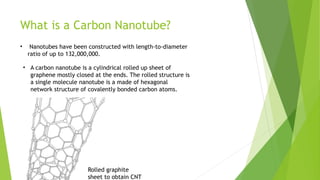
• A carbon nanotube is a cylindrical rolled up sheet of 
graphene mostly closed at the ends. The rolled structure is 
a single molecule nanotube is a made of hexagonal 
network structure of covalently bonded carbon atoms. 
Rolled graphite 
sheet to obtain CNT
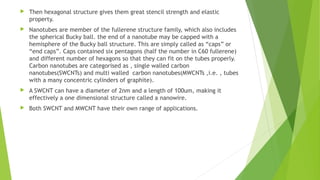
 Then hexagonal structure gives them great stencil strength and elastic 
property. 
 Nanotubes are member of the fullerene structure family, which also includes 
the spherical Bucky ball. the end of a nanotube may be capped with a 
hemisphere of the Bucky ball structure. This are simply called as “caps” or 
“end caps”. Caps contained six pentagons (half the number in C60 fullerene) 
and different number of hexagons so that they can fit on the tubes properly. 
Carbon nanotubes are categorised as , single walled carbon 
nanotubes(SWCNTs) and multi walled carbon nanotubes(MWCNTs ,i.e. , tubes 
with a many concentric cylinders of graphite). 
 A SWCNT can have a diameter of 2nm and a length of 100um, making it 
effectively a one dimensional structure called a nanowire. 
 Both SWCNT and MWCNT have their own range of applications.
STRUCTURE OF CARBON NANOTUBES 
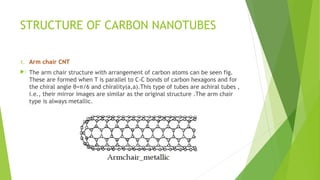
1. Arm chair CNT 
. The arm chair structure with arrangement of carbon atoms can be seen fig. 
These are formed when T is parallel to C-C bonds of carbon hexagons and for 
the chiral angle θ=π/6 and chirality(a,a).This type of tubes are achiral tubes , 
i.e., their mirror images are similar as the original structure .The arm chair 
type is always metallic.
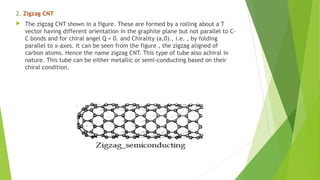
2. Zigzag CNT 
 The zigzag CNT shown in a figure. These are formed by a rolling about a T 
vector having different orientation in the graphite plane but not parallel to C-C 
bonds and for chiral angel Q = 0. and Chirality (a,0)., i.e. , by folding 
parallel to x-axes. It can be seen from the figure , the zigzag aligned of 
carbon atoms. Hence the name zigzag CNT. This type of tube also achiral in 
nature. This tube can be either metallic or semi-conducting based on their 
chiral condition.
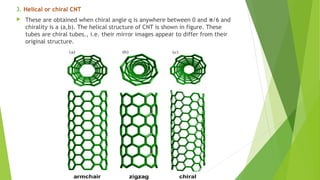
3. Helical or chiral CNT 
 These are obtained when chiral angle q is anywhere between 0 and π/6 and 
chirality is a (a,b). The helical structure of CNT is shown in figure. These 
tubes are chiral tubes., i.e. their mirror images appear to differ from their 
original structure.
Why Now ? 
Richard Feynman’s famous presentation “There’s Plenty of Room at 
the Bottom” was in the 1959 at the American Physical Society. 
Here he asked: 
Why can’t we manipulate materials atom by atom? 
 Why can’t we control the synthesis of individual molecules? 
Why can’t we write all of human knowledge on the head of a pin? 
Why can’t we build machines to accomplish these things? 
 New tools for atomic-scale characterization 
 New capabilities for single atom/molecule manipulation 
 Computational access to large systems of atoms and long time 
scales 
 Convergence of scientific-disciplines at the nanoscale
Benefits of Nanotechnology 
 “The power of nanotechnology is rooted in its potential to 
transform and revolutionize multiple technology and industry 
sectors, including aerospace, agriculture, biotechnology, 
homeland security and national defense, energy, environmental 
improvement, information technology, medicine, and 
transportation. Discovery in some of these areas has advanced to 
the point where it is now possible to identify applications that 
will impact the world we live in.”
Importance of Nanotechnology 
 Various properties of materials such as electronics, thermal, mechanical, 
optical and chemical have been vastly improved at the nanoscale. 
 Therefore it is possible to achieve exceptional performance in components 
and devices.
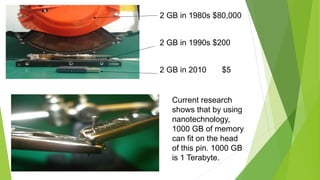
2 GB in 1980s $80,000 
2 GB in 1990s $200 
2 GB in 2010 $5 
Current research 
shows that by using 
nanotechnology, 
1000 GB of memory 
can fit on the head 
of this pin. 1000 GB 
is 1 Terabyte.
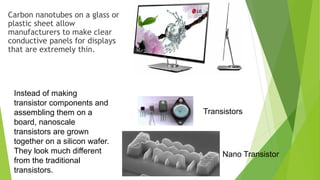
Carbon nanotubes on a glass or 
plastic sheet allow 
manufacturers to make clear 
conductive panels for displays 
that are extremely thin. 
Instead of making 
transistor components and 
assembling them on a 
board, nanoscale 
transistors are grown 
together on a silicon wafer. 
They look much different 
from the traditional 
transistors. 
Transistors 
Nano Transistor
Disadvantages of Nanotechnology 
 Atomic weapons can now be more accessible and made to be 
more powerful and more destructive. These can also become 
more accessible with nanotechnology. 
 Presently, nanotechnology is very expensive and developing it can 
cost you a lot of money. It is also pretty difficult to manufacture, 
which is probably why products made with nanotechnology are 
more expensive. 
 Nanotechnology has increased risk to the health also , 
nanoparticles due to there their small size can cause inhalation 
problem and many other fatal diseases. by just inhaling for 60 
seconds in the air contain nano particles can damage lungs easily. 
 The engineered robots will perform jobs instead of people which 
will result in a loss of jobs 
 If any damage is done at the molecular level then it is not possible 
to revert it.
Future Challenges Using Nanotechnology 
 Environmental problems can be solved. 
 Efficiency of renewable sources can be greatly improved. 
 It may help to grow life in order space/planet. 
 It helps in sustaining the planet for future generation.
Reference by:

Presentation on nano technology

  • 1.
    Subject Name AndCode : Physics(2110005) Active Learning Assignment Topic : Nanotechnology Guided by : Sanket sir Branch : Electrical Division : F2 Sem : 1st Academic Year : 2014(odd)
  • 3.
    What is Nanotechnology?  The branch of technology that deals with dimensions and tolerances of less than 100 nanometres, especially the manipulation of individual atoms and molecules.  Nanotechnology is the technique of design , production of devices and system by controlling the shape and size at the nanometre scale.
  • 4.
    Nanomaterial  Nanomaterialsare the materials containing nanocrystals, i.e. their grain size is in the 1 to 100 nanometre range. The material may be metals, alloys, intermetallic and ceramics .  In commercial products they are used for a electronic devices, sporting goods, cosmetics, textiles, sunscreens, tyres , paint, vanishings etc. In medical field, they are used for the purpose of imaging, targeted drug delivery, diagnosis etc.
  • 5.
    Nanoscale  Thenanoscopic scale (or nanoscale) usually refers to structures with a length scale applicable to nanotechnology, usually cited as 1–100 nanometres.[ 1] A nanometre is a billionth of a meter. The nanoscopic scale is (roughly speaking) a lower bound to the mesoscopic scale for most solids.  For technical purposes, the nanoscopic scale is the size at which fluctuations in the averaged properties (due to the motion and behavior of individual particles) begin to have a significant effect (often a few percent) on the behavior of a system, and must be taken into account in its analysis.  The nanoscopic scale is sometimes marked as the point where the properties of a material change; above this point, the properties of a material are caused by 'bulk' or 'volume' effects, namely which atoms are present, how they are bonded, and in what ratios. Below this point, the properties of a material change, and while the type of atoms present and their relative orientations are still important, 'surface area effects' (also referred to as quantum effects) become more apparent – these effects are due to the geometry of the material (how thick it is, how wide it is, etc.), which, at these low dimensions, can have a drastic effect on quantized states, and thus the properties of a material.
  • 7.
    Surface Area ToVolume Ratio  The surface-area-to-volume ratio, also called the surface-to-volume ratio and variously denoted sa/vol or SA:V, is the amount of surface area per unit volume of an object or collection of objects. The surface-area-to-volume ratio is measured in units of inverse distance.  SA:V is a great way to measure the efficiency of nanotechnology.  SA:V In a nanoparticle have a significant effect on nanoparticle properties.  As an example, a cube with sides of length a will have a surface area of 6a2 and a volume of a3. The surface to volume ratio for a cube is thus shown as
  • 8.
    What is aCarbon Nanotube? • Nanotubes have been constructed with length-to-diameter ratio of up to 132,000,000. • A carbon nanotube is a cylindrical rolled up sheet of graphene mostly closed at the ends. The rolled structure is a single molecule nanotube is a made of hexagonal network structure of covalently bonded carbon atoms. Rolled graphite sheet to obtain CNT
  • 9.
     Then hexagonalstructure gives them great stencil strength and elastic property.  Nanotubes are member of the fullerene structure family, which also includes the spherical Bucky ball. the end of a nanotube may be capped with a hemisphere of the Bucky ball structure. This are simply called as “caps” or “end caps”. Caps contained six pentagons (half the number in C60 fullerene) and different number of hexagons so that they can fit on the tubes properly. Carbon nanotubes are categorised as , single walled carbon nanotubes(SWCNTs) and multi walled carbon nanotubes(MWCNTs ,i.e. , tubes with a many concentric cylinders of graphite).  A SWCNT can have a diameter of 2nm and a length of 100um, making it effectively a one dimensional structure called a nanowire.  Both SWCNT and MWCNT have their own range of applications.
  • 10.
    STRUCTURE OF CARBONNANOTUBES 1. Arm chair CNT . The arm chair structure with arrangement of carbon atoms can be seen fig. These are formed when T is parallel to C-C bonds of carbon hexagons and for the chiral angle θ=π/6 and chirality(a,a).This type of tubes are achiral tubes , i.e., their mirror images are similar as the original structure .The arm chair type is always metallic.
  • 11.
    2. Zigzag CNT  The zigzag CNT shown in a figure. These are formed by a rolling about a T vector having different orientation in the graphite plane but not parallel to C-C bonds and for chiral angel Q = 0. and Chirality (a,0)., i.e. , by folding parallel to x-axes. It can be seen from the figure , the zigzag aligned of carbon atoms. Hence the name zigzag CNT. This type of tube also achiral in nature. This tube can be either metallic or semi-conducting based on their chiral condition.
  • 12.
    3. Helical orchiral CNT  These are obtained when chiral angle q is anywhere between 0 and π/6 and chirality is a (a,b). The helical structure of CNT is shown in figure. These tubes are chiral tubes., i.e. their mirror images appear to differ from their original structure.
  • 13.
    Why Now ? Richard Feynman’s famous presentation “There’s Plenty of Room at the Bottom” was in the 1959 at the American Physical Society. Here he asked: Why can’t we manipulate materials atom by atom?  Why can’t we control the synthesis of individual molecules? Why can’t we write all of human knowledge on the head of a pin? Why can’t we build machines to accomplish these things?  New tools for atomic-scale characterization  New capabilities for single atom/molecule manipulation  Computational access to large systems of atoms and long time scales  Convergence of scientific-disciplines at the nanoscale
  • 14.
    Benefits of Nanotechnology  “The power of nanotechnology is rooted in its potential to transform and revolutionize multiple technology and industry sectors, including aerospace, agriculture, biotechnology, homeland security and national defense, energy, environmental improvement, information technology, medicine, and transportation. Discovery in some of these areas has advanced to the point where it is now possible to identify applications that will impact the world we live in.”
  • 15.
    Importance of Nanotechnology  Various properties of materials such as electronics, thermal, mechanical, optical and chemical have been vastly improved at the nanoscale.  Therefore it is possible to achieve exceptional performance in components and devices.
  • 16.
    2 GB in1980s $80,000 2 GB in 1990s $200 2 GB in 2010 $5 Current research shows that by using nanotechnology, 1000 GB of memory can fit on the head of this pin. 1000 GB is 1 Terabyte.
  • 17.
    Carbon nanotubes ona glass or plastic sheet allow manufacturers to make clear conductive panels for displays that are extremely thin. Instead of making transistor components and assembling them on a board, nanoscale transistors are grown together on a silicon wafer. They look much different from the traditional transistors. Transistors Nano Transistor
  • 18.
    Disadvantages of Nanotechnology  Atomic weapons can now be more accessible and made to be more powerful and more destructive. These can also become more accessible with nanotechnology.  Presently, nanotechnology is very expensive and developing it can cost you a lot of money. It is also pretty difficult to manufacture, which is probably why products made with nanotechnology are more expensive.  Nanotechnology has increased risk to the health also , nanoparticles due to there their small size can cause inhalation problem and many other fatal diseases. by just inhaling for 60 seconds in the air contain nano particles can damage lungs easily.  The engineered robots will perform jobs instead of people which will result in a loss of jobs  If any damage is done at the molecular level then it is not possible to revert it.
  • 19.
    Future Challenges UsingNanotechnology  Environmental problems can be solved.  Efficiency of renewable sources can be greatly improved.  It may help to grow life in order space/planet.  It helps in sustaining the planet for future generation.
  • 21.