1
Introduction of MNPs
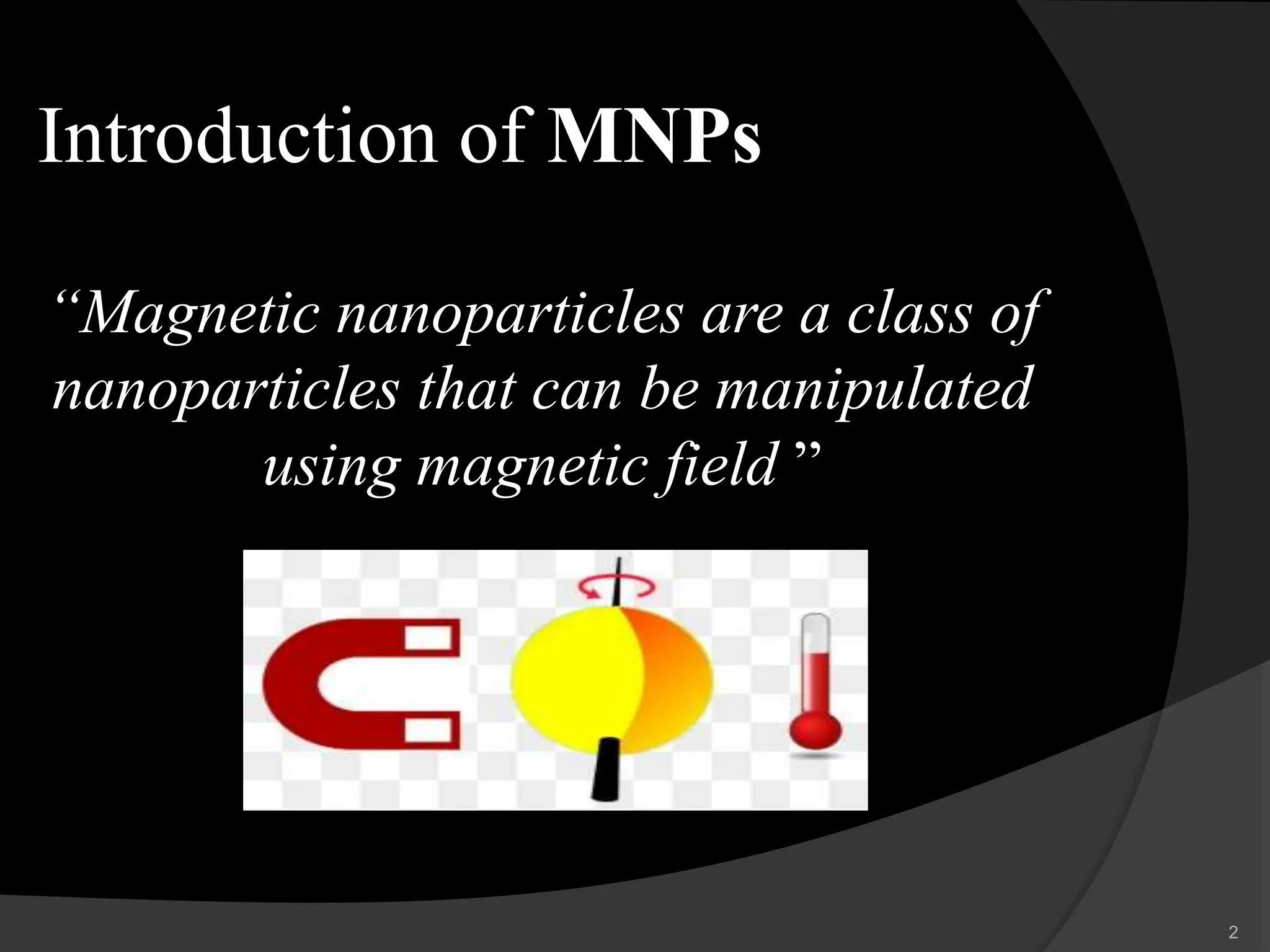
“Magnetic nanoparticles are a class of
nanoparticles that can be manipulated
using magnetic field ”
2
 Commonly consists of magnetic
elements such as Fe, Ni, & Co, and
their oxides.
 Iron oxide nanoparticles are common
magnetic nanoparticles used due to
high electrical resistivity, chemical
stability, mechanical hardness,
magnetic properties in radiofrequency
region.
3
Properties
 The properties of magnetic nanoparticles
depend on the synthesis method and chemical
structure. In most cases, the magnetic
nanoparticles range from 1 to 100 nm in size
and can display superparamagnetism.
4
Types of MNPs
 Ferrites
 Ferrites with a shell
 Metallic
 Metallic with a shell
5
Ferrite MNPs
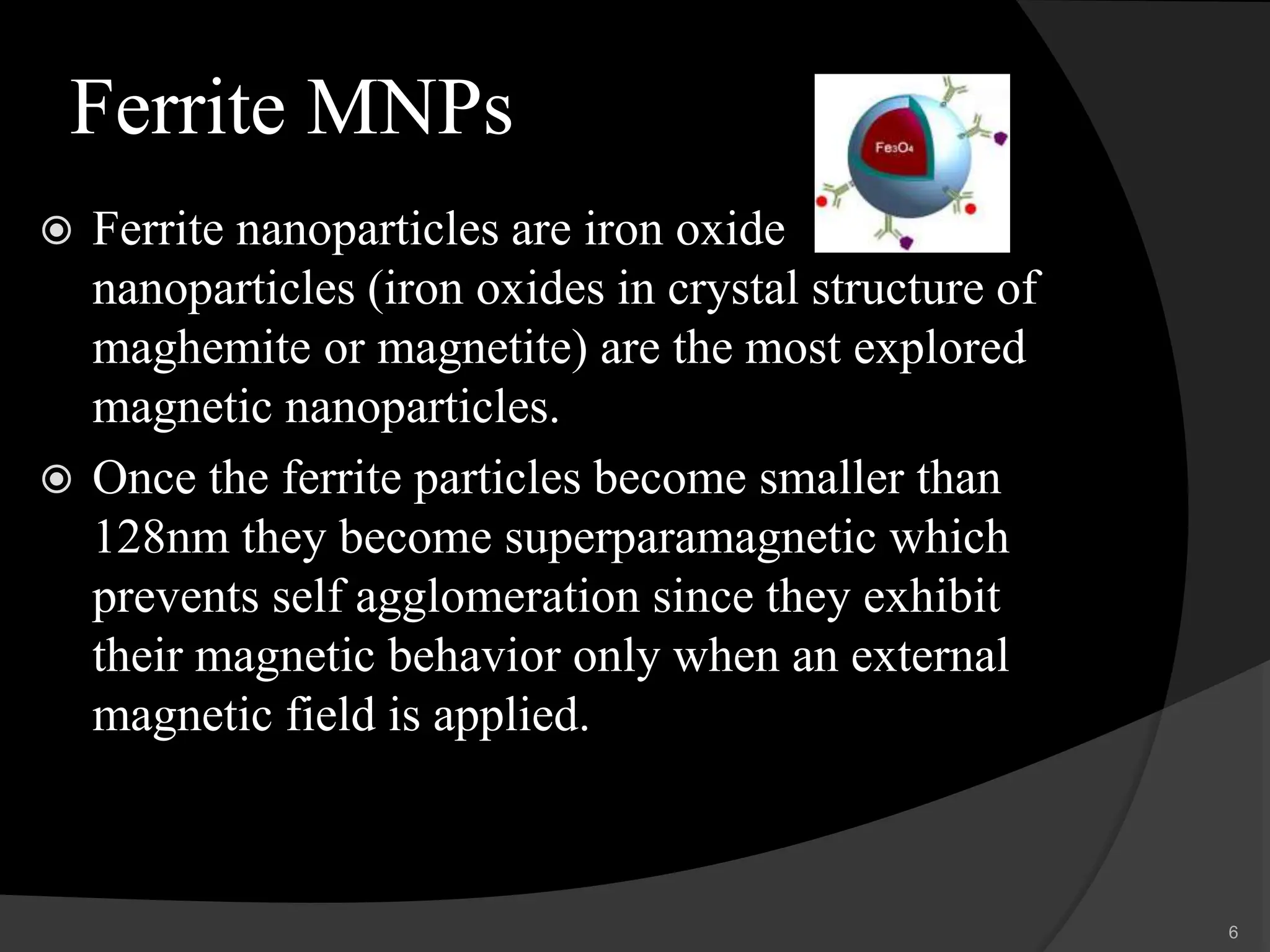
 Ferrite nanoparticles are iron oxide
nanoparticles (iron oxides in crystal structure of
maghemite or magnetite) are the most explored
magnetic nanoparticles.
 Once the ferrite particles become smaller than
128nm they become superparamagnetic which
prevents self agglomeration since they exhibit
their magnetic behavior only when an external
magnetic field is applied.
6
Continued:
 The surface of ferrite nanoparticles is
often modified by surfactants, silica,
silicones or phosphoric acid derivatives to
increase their stability in solution.
7
Ferrites with a shell
 The surface of a maghemite or magnetite
magnetic nanoparticles are inert. The reactivity
of the magnetic nanoparticles can be improved
by coating a layer of silica onto their surface.
 Ferrite nanoparticles clusters
with narrow size distribution
consisting of superparamagnetic
oxide nanoparticles coated with
a silica shell have several advantages:
8
Continued:
 High chemical stability
 Narrow size distribution
 Magnetic moment can be tuned with the
nanoparticle cluster size
 Higher colloidal stability
9
Metallic MNPs
 Metallic nanoparticles may be beneficial for
some technical applications due to their
higher magnetic moment whereas oxides
(maghemite, magnetite) would be beneficial
for biomedical applications.
 Metallic nanoparticles have the great
disadvantage of being pyrophoric and
reactive to oxidizing agents.
10
Metallic with a shell
 The metallic core of magnetic nanoparticles
may be passivated by oxidation, surfactants or
metals.
 Nanoparticles with a magnetic core consisting
either of elementary Iron or Cobalt with a shell
made of graphene or other metal like Au.
 Advantages:
Higher magnetization
Higher stability
11
Synthesis of MNPs
Several methods exist for preparing magnetic
nanoparticles:
 Co-precipitation
 Microemulsion
 Thermal decomposition
 Hydrothermal
12
Co-precipitation
 Co-precipitation is the most useful & proper
method for controlled sizes Magnetic
Nanoparticles synthesis method.
 It is extensively used in the biomedical
applications because of the ease of application
& harmless procedure.
 In this method, MNPs are prepared from
aqueous salt solutions, by the addition of a base
under an inert atmosphere at room temperatures
or at high temperature.
13
Continued:
 The trouble with the synthesis of
nanoparticles by this method is the tendency
of particles to agglomerate because of the
extremely small size which have high
surface area and surface energy.
14
Microemulsion
 Microemulsion is the thermodynamically stable
isotropic dispersal of two immiscible water and oil
phases in the presence of a surfactant.
 The surfactant molecules can from a monolayer at the
interface between the oil and water, with the
hydrophilic head groups in the aqueous phase and the
hydrophobic tails of surfactant molecules dissolved in
the oil phase.
 This method has series of advantages over other
methods namely use of simple equipment, controlled
sized nanoparticles synthesis, particle with crystalline
15
Continued:
structure & high surface area and simple
experiment conditions.
 Particles produced by the microemulsion
method are smaller in size and are higher in
saturation magnetization.
 The properties of NPs prepared by the
microemulsion method depend on the type
and structure of the surfactant.
16
Thermal decomposition
 The decomposition of metal precursors in the
presence of hot organic surfactants has yielded
improved samples with good size control,
narrow size distribution, good crystallinity of
individual and dispersible nanoparticles.
 Nanoparticles with high level monodispersity
and size controlled particles can be produced by
high temperature decomposition of organic
surfactants.
17
Continued:
 The nanoparticles produced by this
method are crystalline in nature and can
be dispersed in organic solvents.
 The size of the nanoparticles produced in
this method varied with reaction
temperature and time.
18
Hydrothermal
 This method is also known as solvothermal
method. This technique is one the most
successful ways to grow crystals of many
different materials.
 The hydrothermal method contains various
wet-chemical technologies of crystallizing
material in a sealed container, from aqueous
solution at the high temperature and at high
vapor pressure.
19
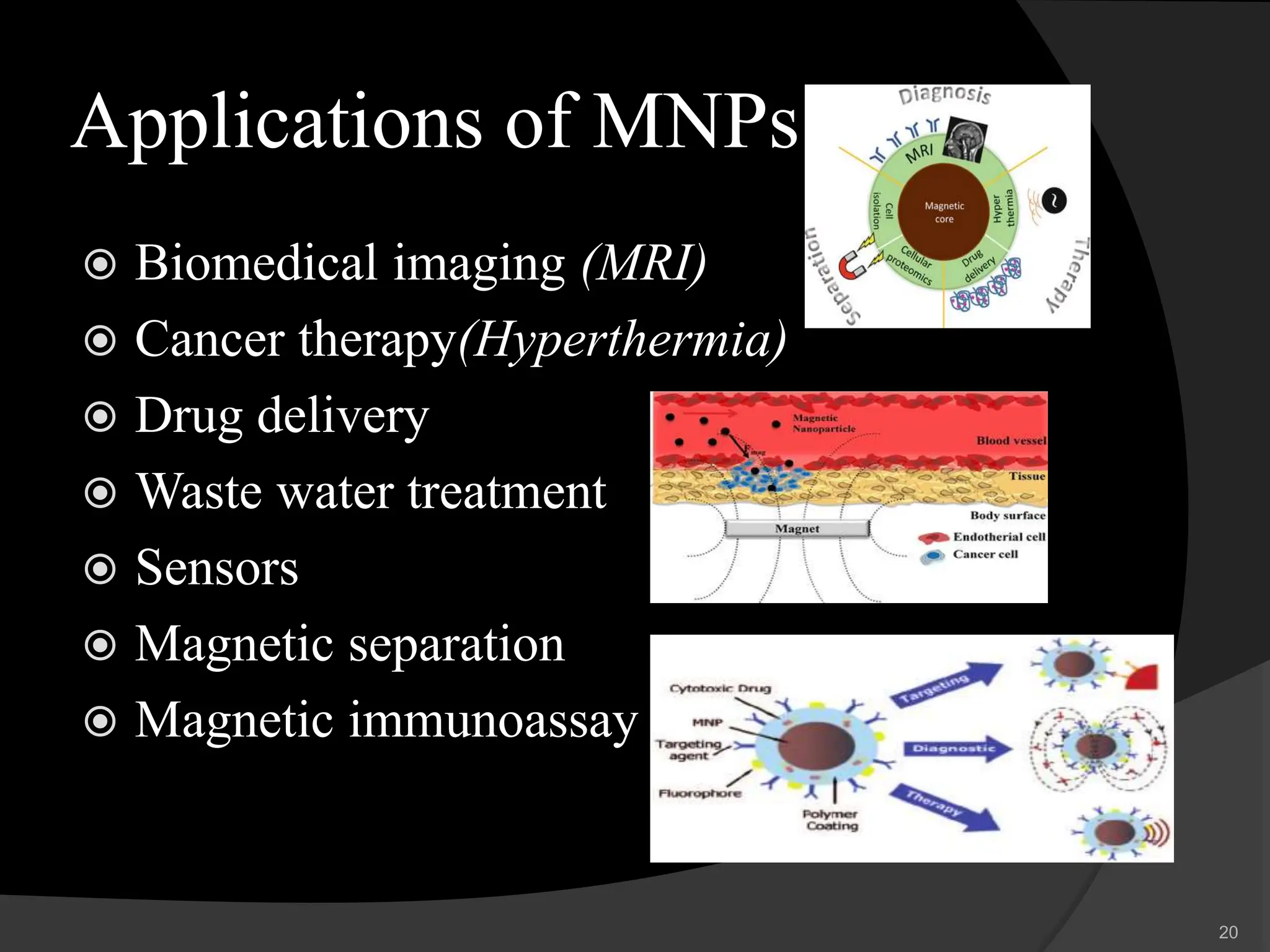
Applications of MNPs
 Biomedical imaging (MRI)
 Cancer therapy(Hyperthermia)
 Drug delivery
 Waste water treatment
 Sensors
 Magnetic separation
 Magnetic immunoassay
20
Conclusions
 Magnetic nanoparticles can be directed with
a magnetic field, for example, delivery of
drug to a tumor.
 Magnetic nanoparticles also can improve the
sensitivity of medical imaging techniques
that use magnetic signals.
 Magnetic nanoparticles applications is the
ability to manipulate the particles using an
external magnetic field.
21
References
 Tadic, Marin; Kralj, Slavko; Jagodic, Marko; Hanzel, Darko; Makovec,
Darko (December 2014). "Magnetic properties of novel
superparamagnetic iron oxide nanoclusters and their peculiarity under
annealing treatment". Applied Surface Science. 322: 255–264.
 A.-H. Lu; E. L. Salabas; F. Schüth (2007). "Magnetic Nanoparticles:
Synthesis, Protection, Functionalization, and Application". Angew. Chem.
Int. Ed. 46(8): 1222–1244.
 Kralj, Slavko; Makovec, Darko; Čampelj, Stanislav; Drofenik, Miha (July
2010). "Producing ultra-thin silica coatings on iron-oxide nanoparticles to
improve their surface reactivity". Journal of Magnetism and Magnetic
Materials. 322 (13): 1847–1853.
 Magnetic nanomaterial's by Hemanth kumar.
 http://www.understandingnano.com/nanoparticles-magnetic.html
 Biomedical applications for magnetic nanoparticles by
glawes@wayne.edu
22

Magnetic Nanoparticles.pptx

  • 1.
  • 2.
    Introduction of MNPs “Magneticnanoparticles are a class of nanoparticles that can be manipulated using magnetic field ” 2
  • 3.
     Commonly consistsof magnetic elements such as Fe, Ni, & Co, and their oxides.  Iron oxide nanoparticles are common magnetic nanoparticles used due to high electrical resistivity, chemical stability, mechanical hardness, magnetic properties in radiofrequency region. 3
  • 4.
    Properties  The propertiesof magnetic nanoparticles depend on the synthesis method and chemical structure. In most cases, the magnetic nanoparticles range from 1 to 100 nm in size and can display superparamagnetism. 4
  • 5.
    Types of MNPs Ferrites  Ferrites with a shell  Metallic  Metallic with a shell 5
  • 6.
    Ferrite MNPs  Ferritenanoparticles are iron oxide nanoparticles (iron oxides in crystal structure of maghemite or magnetite) are the most explored magnetic nanoparticles.  Once the ferrite particles become smaller than 128nm they become superparamagnetic which prevents self agglomeration since they exhibit their magnetic behavior only when an external magnetic field is applied. 6
  • 7.
    Continued:  The surfaceof ferrite nanoparticles is often modified by surfactants, silica, silicones or phosphoric acid derivatives to increase their stability in solution. 7
  • 8.
    Ferrites with ashell  The surface of a maghemite or magnetite magnetic nanoparticles are inert. The reactivity of the magnetic nanoparticles can be improved by coating a layer of silica onto their surface.  Ferrite nanoparticles clusters with narrow size distribution consisting of superparamagnetic oxide nanoparticles coated with a silica shell have several advantages: 8
  • 9.
    Continued:  High chemicalstability  Narrow size distribution  Magnetic moment can be tuned with the nanoparticle cluster size  Higher colloidal stability 9
  • 10.
    Metallic MNPs  Metallicnanoparticles may be beneficial for some technical applications due to their higher magnetic moment whereas oxides (maghemite, magnetite) would be beneficial for biomedical applications.  Metallic nanoparticles have the great disadvantage of being pyrophoric and reactive to oxidizing agents. 10
  • 11.
    Metallic with ashell  The metallic core of magnetic nanoparticles may be passivated by oxidation, surfactants or metals.  Nanoparticles with a magnetic core consisting either of elementary Iron or Cobalt with a shell made of graphene or other metal like Au.  Advantages: Higher magnetization Higher stability 11
  • 12.
    Synthesis of MNPs Severalmethods exist for preparing magnetic nanoparticles:  Co-precipitation  Microemulsion  Thermal decomposition  Hydrothermal 12
  • 13.
    Co-precipitation  Co-precipitation isthe most useful & proper method for controlled sizes Magnetic Nanoparticles synthesis method.  It is extensively used in the biomedical applications because of the ease of application & harmless procedure.  In this method, MNPs are prepared from aqueous salt solutions, by the addition of a base under an inert atmosphere at room temperatures or at high temperature. 13
  • 14.
    Continued:  The troublewith the synthesis of nanoparticles by this method is the tendency of particles to agglomerate because of the extremely small size which have high surface area and surface energy. 14
  • 15.
    Microemulsion  Microemulsion isthe thermodynamically stable isotropic dispersal of two immiscible water and oil phases in the presence of a surfactant.  The surfactant molecules can from a monolayer at the interface between the oil and water, with the hydrophilic head groups in the aqueous phase and the hydrophobic tails of surfactant molecules dissolved in the oil phase.  This method has series of advantages over other methods namely use of simple equipment, controlled sized nanoparticles synthesis, particle with crystalline 15
  • 16.
    Continued: structure & highsurface area and simple experiment conditions.  Particles produced by the microemulsion method are smaller in size and are higher in saturation magnetization.  The properties of NPs prepared by the microemulsion method depend on the type and structure of the surfactant. 16
  • 17.
    Thermal decomposition  Thedecomposition of metal precursors in the presence of hot organic surfactants has yielded improved samples with good size control, narrow size distribution, good crystallinity of individual and dispersible nanoparticles.  Nanoparticles with high level monodispersity and size controlled particles can be produced by high temperature decomposition of organic surfactants. 17
  • 18.
    Continued:  The nanoparticlesproduced by this method are crystalline in nature and can be dispersed in organic solvents.  The size of the nanoparticles produced in this method varied with reaction temperature and time. 18
  • 19.
    Hydrothermal  This methodis also known as solvothermal method. This technique is one the most successful ways to grow crystals of many different materials.  The hydrothermal method contains various wet-chemical technologies of crystallizing material in a sealed container, from aqueous solution at the high temperature and at high vapor pressure. 19
  • 20.
    Applications of MNPs Biomedical imaging (MRI)  Cancer therapy(Hyperthermia)  Drug delivery  Waste water treatment  Sensors  Magnetic separation  Magnetic immunoassay 20
  • 21.
    Conclusions  Magnetic nanoparticlescan be directed with a magnetic field, for example, delivery of drug to a tumor.  Magnetic nanoparticles also can improve the sensitivity of medical imaging techniques that use magnetic signals.  Magnetic nanoparticles applications is the ability to manipulate the particles using an external magnetic field. 21
  • 22.
    References  Tadic, Marin;Kralj, Slavko; Jagodic, Marko; Hanzel, Darko; Makovec, Darko (December 2014). "Magnetic properties of novel superparamagnetic iron oxide nanoclusters and their peculiarity under annealing treatment". Applied Surface Science. 322: 255–264.  A.-H. Lu; E. L. Salabas; F. Schüth (2007). "Magnetic Nanoparticles: Synthesis, Protection, Functionalization, and Application". Angew. Chem. Int. Ed. 46(8): 1222–1244.  Kralj, Slavko; Makovec, Darko; Čampelj, Stanislav; Drofenik, Miha (July 2010). "Producing ultra-thin silica coatings on iron-oxide nanoparticles to improve their surface reactivity". Journal of Magnetism and Magnetic Materials. 322 (13): 1847–1853.  Magnetic nanomaterial's by Hemanth kumar.  http://www.understandingnano.com/nanoparticles-magnetic.html  Biomedical applications for magnetic nanoparticles by glawes@wayne.edu 22