Seminar on
COMSOL MULTIPHYSICS
Presented By-
Manish Kumar Shaw
Department of Mechanical Engineering
National Institute of Technology Durgapur
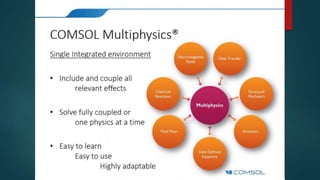
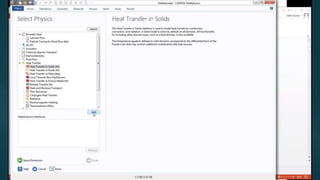
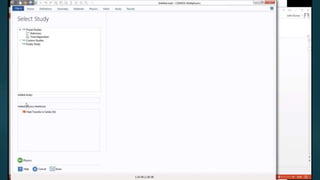
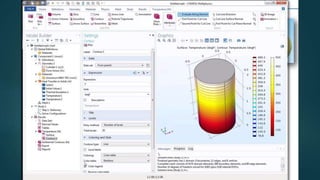
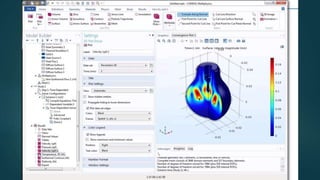
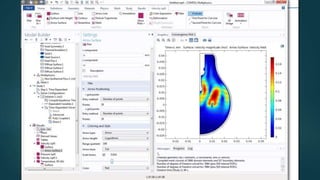
 COMSOL Multiphysics is a finite element analysis, solver
and simulation software / FEA software package for various
physics and engineering applications, especially coupled
phenomena, or Multiphysics.
 The package is cross-platform (Windows, Mac, Linux). In
addition to conventional physics-based user interfaces, COMSOL
Multiphysics also allows entering coupled systems
of partial differential equations (PDEs).
 The PDEs can be entered directly or using the so-called
weak form.
 Since version 5.0 (2014), COMSOL Multiphysics is also
used for creating physics-based apps. These apps can
be run with a regular COMSOL Multiphysics license
but also with a COMSOL Server license. An early version (before
2005) of COMSOL Multiphysics was called
FEMLAB
 COMSOL was started in 1986 by Svante Littmarck
And Farhad Saeidi (graduate students of Germund
Dahlquist)based on code developed for a graduate course at the
Royal Institute of Technology (KTH) in Stockholm, Sweden.
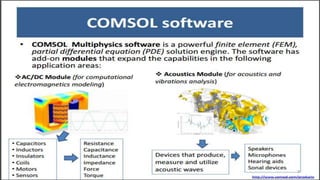
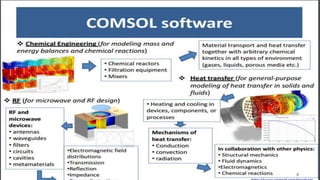
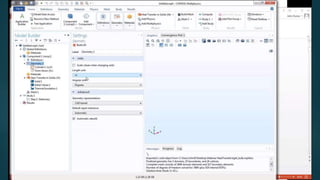
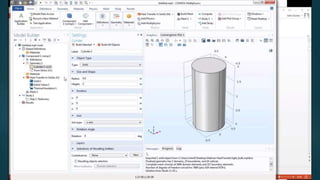
 The main product is COMSOL Desktop which is an
integrated user interface environment designed for cross
disciplinary product development with a unified workflow for
electrical, mechanical, fluid, and chemical applications.
 The add-on modules blend into COMSOL Desktop, and
the way of operation of the software remains the
same no matter which add-on products are engaged.
 COMSOL Multiphysics also provides application programming
interfaces (APIs).
 Live Link for MATLAB provides the ability to work with
 COMSOL Multiphysics in combination with MATLAB.
 The Physics Builder, which is included in COMSOL Desktop,
makes it possible to create custom made physics interfaces
accessible from the COMSOL Desktop with the same look-and-feel
as the built-in physics interfaces.
 In the case of the Physics Builder, no programming is
needed as it works in the COMSOL Desktop from the
Physics Builder Tree.
 The newer Application Builder has largely replaced the
Physics Builder as a tool for creating customuser interfaces for
specific needs.
 COMSOL Server is the software and engine for running
simulation apps and the platform for controlling their
deployment and distribution.
 The apps can be run in COMSOL Server through web
browsers or a Windows installed client.
 COMSOL Server was released with version 5.0.1 in
December 2014.
 The COMSOL Server license is world-wide and allows for
third-party access to simulation apps.
 A COMSOL Server installation also be used to present
simulation apps to users who rent time for access.
 The latest version released is COMSOL MULTIPHYSICS 5.2a
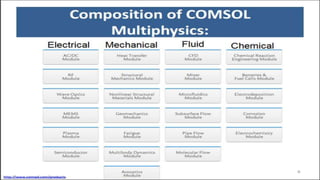
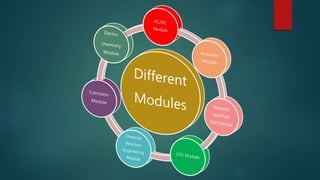
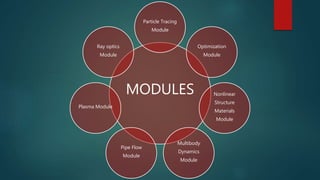
Several add-on products are available for COMSOL
Multiphysics.
These have been categorized according
to the applications areas, namely Electrical, Mechanical,
Fluid, Chemical, Multipurpose, and Interfacing.
Also these add-ons are of two types: one with COMSOL
Multiphysics, and one with COMSOL Server.
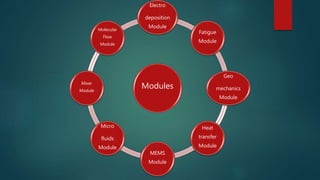
Modules
Electro
deposition
Module
Fatigue
Module
Geo
mechanics
Module
Heat
transfer
Module
MEMS
Module
Micro
fluids
Module
Mixer
Module
Molecular
Flow
Module
MODULES
Particle Tracing
Module
Optimization
Module
Nonlinear
Structure
Materials
Module
Multibody
Dynamics
Module
Pipe Flow
Module
Plasma Module
Ray optics
Module
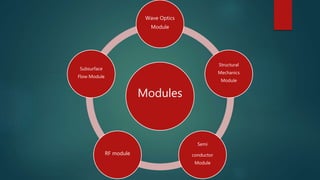
Modules
Wave Optics
Module
Structural
Mechanics
Module
Semi
conductor
Module
RF module
Subsurface
Flow Module
LIVELINKS
Livelink for
MATLAB
Livelink for
AutoCad
Livelink for
Excel
Livelink for
INVENTOR
Livelink for
PTC Creo
Parametric
Livelink for
PTC
ProEngineer
Livelink for
Solid Edge
Livelink for
SOLIDWORKS
3D Printing Today:
Advantages and Limitations
With the release of COMSOL Multiphysics 4.3b in 2013, it is now possible to export
geometries, meshes, and surface plots in the STL format for printing in 3D. This means
one can conceive, design, optimize, and prototype a product using only COMSOL
Multiphysics (and/or one of the LiveLink™ products) and a 3D printer. The quality and
speed at which objects can be printed depends, of course, on the printer.
Low-end printers take several hours to print objects the size of a baseball, while high-end
printers can maybe print two per hour. This is rather slow for mass-scale manufacturing,
but quite alright for prototyping. There is no need to outsource the creation of parts to a
machine shop. Printer resolution is currently around 150-200µm in the vertical direction
but some high-end machines can print much finer resolutions. Although this sounds
impressive, it is still not accurate enough for printing microfluidic devices whose intricate
flow channels require an even finer resolution. Models analysed in COMSOL
Multiphysics typically consist of multiple materials, often some combination of metals and
plastics. This places a lot of restrictions on exactly what type of devices can be printed
from a practical stand-point. Metal 3D printers are starting to become available, but
printing combinations of metals and plastics remains a significant challenge.
Looking into the Future of Additive Manufacturing and COMSOL Multiphysics
Windows 8.1 and above version has native for supporting 3D printing, which allow for
3D printing without having to first export the geometry and then import it into software
that comes with the printer. The list of available printing materials also keeps growing,
and printers continually become faster, more accurate, and cheaper. On the simulation
side, we are constantly adding new machinery to characterize and optimize physical
systems, and our software’s simulation capabilities will allow you to gain an advantage
over competitors. Anyone can design and prototype something, but only true
Multiphysics software will allow one to optimize and perfect the design based on the
underlying physics.
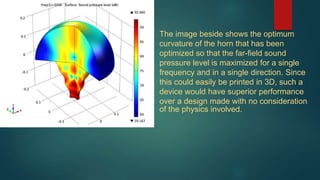
Considering a simple acoustic horn, for example. The performance of the horn depends
very strongly on the shape of the horn surface. By changing the curvature of this
surface, the directivity and impedance can be changed.
The image beside shows the optimum
curvature of the horn that has been
optimized so that the far-field sound
pressure level is maximized for a single
frequency and in a single direction. Since
this could easily be printed in 3D, such a
device would have superior performance
over a design made with no consideration
of the physics involved.
END OF THE PRESENTATION
THANK YOU!!

Comsol Multiphysics Presentation

  • 1.
    Seminar on COMSOL MULTIPHYSICS PresentedBy- Manish Kumar Shaw Department of Mechanical Engineering National Institute of Technology Durgapur
  • 4.
     COMSOL Multiphysicsis a finite element analysis, solver and simulation software / FEA software package for various physics and engineering applications, especially coupled phenomena, or Multiphysics.  The package is cross-platform (Windows, Mac, Linux). In addition to conventional physics-based user interfaces, COMSOL Multiphysics also allows entering coupled systems of partial differential equations (PDEs).  The PDEs can be entered directly or using the so-called weak form.  Since version 5.0 (2014), COMSOL Multiphysics is also used for creating physics-based apps. These apps can be run with a regular COMSOL Multiphysics license but also with a COMSOL Server license. An early version (before 2005) of COMSOL Multiphysics was called FEMLAB
  • 5.
     COMSOL wasstarted in 1986 by Svante Littmarck And Farhad Saeidi (graduate students of Germund Dahlquist)based on code developed for a graduate course at the Royal Institute of Technology (KTH) in Stockholm, Sweden.  The main product is COMSOL Desktop which is an integrated user interface environment designed for cross disciplinary product development with a unified workflow for electrical, mechanical, fluid, and chemical applications.  The add-on modules blend into COMSOL Desktop, and the way of operation of the software remains the same no matter which add-on products are engaged.
  • 6.
     COMSOL Multiphysicsalso provides application programming interfaces (APIs).  Live Link for MATLAB provides the ability to work with  COMSOL Multiphysics in combination with MATLAB.  The Physics Builder, which is included in COMSOL Desktop, makes it possible to create custom made physics interfaces accessible from the COMSOL Desktop with the same look-and-feel as the built-in physics interfaces.  In the case of the Physics Builder, no programming is needed as it works in the COMSOL Desktop from the Physics Builder Tree.  The newer Application Builder has largely replaced the Physics Builder as a tool for creating customuser interfaces for specific needs.
  • 7.
     COMSOL Serveris the software and engine for running simulation apps and the platform for controlling their deployment and distribution.  The apps can be run in COMSOL Server through web browsers or a Windows installed client.  COMSOL Server was released with version 5.0.1 in December 2014.  The COMSOL Server license is world-wide and allows for third-party access to simulation apps.  A COMSOL Server installation also be used to present simulation apps to users who rent time for access.  The latest version released is COMSOL MULTIPHYSICS 5.2a
  • 8.
    Several add-on productsare available for COMSOL Multiphysics. These have been categorized according to the applications areas, namely Electrical, Mechanical, Fluid, Chemical, Multipurpose, and Interfacing. Also these add-ons are of two types: one with COMSOL Multiphysics, and one with COMSOL Server.
  • 10.
  • 11.
  • 12.
  • 13.
    LIVELINKS Livelink for MATLAB Livelink for AutoCad Livelinkfor Excel Livelink for INVENTOR Livelink for PTC Creo Parametric Livelink for PTC ProEngineer Livelink for Solid Edge Livelink for SOLIDWORKS
  • 72.
    3D Printing Today: Advantagesand Limitations With the release of COMSOL Multiphysics 4.3b in 2013, it is now possible to export geometries, meshes, and surface plots in the STL format for printing in 3D. This means one can conceive, design, optimize, and prototype a product using only COMSOL Multiphysics (and/or one of the LiveLink™ products) and a 3D printer. The quality and speed at which objects can be printed depends, of course, on the printer. Low-end printers take several hours to print objects the size of a baseball, while high-end printers can maybe print two per hour. This is rather slow for mass-scale manufacturing, but quite alright for prototyping. There is no need to outsource the creation of parts to a machine shop. Printer resolution is currently around 150-200µm in the vertical direction but some high-end machines can print much finer resolutions. Although this sounds impressive, it is still not accurate enough for printing microfluidic devices whose intricate flow channels require an even finer resolution. Models analysed in COMSOL Multiphysics typically consist of multiple materials, often some combination of metals and plastics. This places a lot of restrictions on exactly what type of devices can be printed from a practical stand-point. Metal 3D printers are starting to become available, but printing combinations of metals and plastics remains a significant challenge.
  • 73.
    Looking into theFuture of Additive Manufacturing and COMSOL Multiphysics Windows 8.1 and above version has native for supporting 3D printing, which allow for 3D printing without having to first export the geometry and then import it into software that comes with the printer. The list of available printing materials also keeps growing, and printers continually become faster, more accurate, and cheaper. On the simulation side, we are constantly adding new machinery to characterize and optimize physical systems, and our software’s simulation capabilities will allow you to gain an advantage over competitors. Anyone can design and prototype something, but only true Multiphysics software will allow one to optimize and perfect the design based on the underlying physics. Considering a simple acoustic horn, for example. The performance of the horn depends very strongly on the shape of the horn surface. By changing the curvature of this surface, the directivity and impedance can be changed.
  • 74.
    The image besideshows the optimum curvature of the horn that has been optimized so that the far-field sound pressure level is maximized for a single frequency and in a single direction. Since this could easily be printed in 3D, such a device would have superior performance over a design made with no consideration of the physics involved.
  • 75.
    END OF THEPRESENTATION THANK YOU!!