LD COLLEGE OF ENGINEERING
SUBJECT : IRRIGATION ENGINEERING
TOPIC : DUTY OF WATER AND DELTA
PREPARED BY : MAKWANA TULSI 130280106052
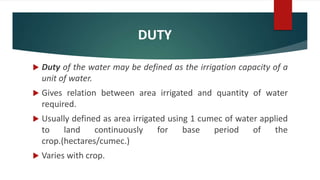
DUTY
 Duty of the water may be defined as the irrigation capacity of a
unit of water.
 Gives relation between area irrigated and quantity of water
required.
 Usually defined as area irrigated using 1 cumec of water applied
to land continuously for base period of the
crop.(hectares/cumec.)
 Varies with crop.
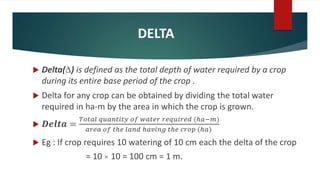
DELTA
 Delta(∆) is defined as the total depth of water required by a crop
during its entire base period of the crop .
 Delta for any crop can be obtained by dividing the total water
required in ha-m by the area in which the crop is grown.
 𝑫𝒆𝒍𝒕𝒂 =
𝑇𝑜𝑡𝑎𝑙 𝑞𝑢𝑎𝑛𝑡𝑖𝑡𝑦 𝑜𝑓 𝑤𝑎𝑡𝑒𝑟 𝑟𝑒𝑞𝑢𝑖𝑟𝑒𝑑 (ℎ𝑎−𝑚)
𝑎𝑟𝑒𝑎 𝑜𝑓 𝑡ℎ𝑒 𝑙𝑎𝑛𝑑 ℎ𝑎𝑣𝑖𝑛𝑔 𝑡ℎ𝑒 𝑐𝑟𝑜𝑝 (ℎ𝑎)
 Eg : If crop requires 10 watering of 10 cm each the delta of the crop
= 10 × 10 = 100 cm = 1 m.
METHODS OF RECKONING DUTY
 Number of hectares that can be irrigated by 1 cumec of water.
 Total depth of water.(delta)
 Number of hectares that can be irrigated using the water stored.
Generally used for tank irrigation.
 Number of hectares-metres expended per hectare. Generally used
for tank irrigation.
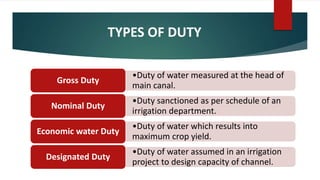
TYPES OF DUTY
•Duty of water measured at the head of
main canal.
Gross Duty
•Duty sanctioned as per schedule of an
irrigation department.
Nominal Duty
•Duty of water which results into
maximum crop yield.
Economic water Duty
•Duty of water assumed in an irrigation
project to design capacity of channel.
Designated Duty
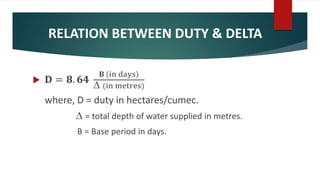
RELATION BETWEEN DUTY & DELTA
 𝐃 = 𝟖. 𝟔𝟒
𝐁 (in days)
∆ (in metres)
where, D = duty in hectares/cumec.
∆ = total depth of water supplied in metres.
B = Base period in days.
Question:
The transplantation of rice
requires 10 days and total
depth of water required during
transplantation is 48 cm. During
transplantation, there is an
effective rainfall of 8 cm.
The duty of irrigation water (in
ha/cumec) is ?
Answer:
 D = 8.64
B (in days)
∆ (in metres)
 Here B=10 days
 Total depth required = 48 cm.
 Rainfall = 8 cm
 Actual depth = total - rainfall
= 48 – 8
= 40 cm
 D = 8.64
𝟏𝟎
0.4
= 216 hectares/cumec
FACTORS AFFECTING DUTY OF WATER
1) Method of irrigation:
• Affects the duty because the water application efficiency is
different.
• Drip has the maximum duty,sprinkler also has high duty.
• In case of surface irrigation the duty is low.
2) Type of crop:
• Duty varies because different crops require varying quatities
of water.Duty is low for crops requiring high quantity of water.
Continued…
3) Method of cultivation:
• If land is properly ploughed and loose before irrigation then the
duty increases.
• Modern methods give higher duty than the old ones.
4) Base period of crop:
• When the base period is long then more water required and
hence low duty.
5) Climatic conditions:
• Temperature,wind,humidity and rainfall affect the duty.
• High temperature and leads to high evaporation hence duty will
be less where as high humidity and rainfall increases the duty.
6) Times of irrigation and frequency of cultivation:
• Initially not proper level land so more water is required so duty is
less and the duty increases with time.
• Frequent cultivation reduces loss of moisture and hence duty is high.
Continued…
7) Quality of water:
• if the water contains salts and alkalies more water has to be
applied and the duty is reduced.
8) Methods of assessment of irrigation water:
• if the assessment is on volume base then the farmer use water
carefully and so the wastage is less,high duty.
• if flat based the duty is low.
Continued…
9) Type of soil and sub-soil of the canal:
• In an unlined canal with coarse grained and permeable soils the
seepage losses will be more,duty is low and vice versa.
10)Type of soil and sub-soil of the field:
• If the soil in the field is coarse grained percolation losses are high,duty
is low.
• If there is hard and Impervious soil the percolation losses will be
low, duty is high.
Continued…
11)System of irrigation:
• In perennial irrigation system, duty is high because the soil is kept
moist and less water is required for initial saturation.
• In inundation system the wastage is more so duty is low.
• In case of tank and well(lift) irrigation the transmission losses are
less, duty is high.
Continued…
12)Canal condition:
• in earthen canal the seepage and percolation losses are more
duty is low and for lined canal duty is high.
• Canal with good maintenance have high duty.
• If the area to be irrigated is concentrated along the canal the
duty is high.
Continued…
METHODS OF IMPROVING DUTY OF WATER
 Land should be properly ploughed to the required depth and
levelled before sowing the crops.
 Suitable method of applying water/irrigation system.
 Frequent cultivation of land,this reduces the loss of moisture from
soil.
 Crop rotation must be done.
 Canals should be lined and well maintained to reduce the seepage
and percolation losses.
METHODS OF IMPROVING DUTY OF WATER
 The canal should be so aligned that the area to be irrigated is
concentrated along it.
 Length of the canal should be reduced to minimum.
 Efficient methods of irrigation should be used such as
drip,sprinkler and furrow.
 Volumetric assessment should be used.
 Quality of water should be good.
METHODS OF IMPROVING DUTY OF WATER
 The farmers should be trained such that they can know how much
and when to provide water.
 Alignment should be avoided in sandy or coarse grained soils.
 Modern methods of cultivation must be adopted.
 The canal administrative are well trained so that they well aware
of economic use of water.
THANK YOU

Irrigation

  • 1.
    LD COLLEGE OFENGINEERING SUBJECT : IRRIGATION ENGINEERING TOPIC : DUTY OF WATER AND DELTA PREPARED BY : MAKWANA TULSI 130280106052
  • 2.
    DUTY  Duty ofthe water may be defined as the irrigation capacity of a unit of water.  Gives relation between area irrigated and quantity of water required.  Usually defined as area irrigated using 1 cumec of water applied to land continuously for base period of the crop.(hectares/cumec.)  Varies with crop.
  • 3.
    DELTA  Delta(∆) isdefined as the total depth of water required by a crop during its entire base period of the crop .  Delta for any crop can be obtained by dividing the total water required in ha-m by the area in which the crop is grown.  𝑫𝒆𝒍𝒕𝒂 = 𝑇𝑜𝑡𝑎𝑙 𝑞𝑢𝑎𝑛𝑡𝑖𝑡𝑦 𝑜𝑓 𝑤𝑎𝑡𝑒𝑟 𝑟𝑒𝑞𝑢𝑖𝑟𝑒𝑑 (ℎ𝑎−𝑚) 𝑎𝑟𝑒𝑎 𝑜𝑓 𝑡ℎ𝑒 𝑙𝑎𝑛𝑑 ℎ𝑎𝑣𝑖𝑛𝑔 𝑡ℎ𝑒 𝑐𝑟𝑜𝑝 (ℎ𝑎)  Eg : If crop requires 10 watering of 10 cm each the delta of the crop = 10 × 10 = 100 cm = 1 m.
  • 4.
    METHODS OF RECKONINGDUTY  Number of hectares that can be irrigated by 1 cumec of water.  Total depth of water.(delta)  Number of hectares that can be irrigated using the water stored. Generally used for tank irrigation.  Number of hectares-metres expended per hectare. Generally used for tank irrigation.
  • 5.
    TYPES OF DUTY •Dutyof water measured at the head of main canal. Gross Duty •Duty sanctioned as per schedule of an irrigation department. Nominal Duty •Duty of water which results into maximum crop yield. Economic water Duty •Duty of water assumed in an irrigation project to design capacity of channel. Designated Duty
  • 6.
    RELATION BETWEEN DUTY& DELTA  𝐃 = 𝟖. 𝟔𝟒 𝐁 (in days) ∆ (in metres) where, D = duty in hectares/cumec. ∆ = total depth of water supplied in metres. B = Base period in days.
  • 7.
    Question: The transplantation ofrice requires 10 days and total depth of water required during transplantation is 48 cm. During transplantation, there is an effective rainfall of 8 cm. The duty of irrigation water (in ha/cumec) is ? Answer:  D = 8.64 B (in days) ∆ (in metres)  Here B=10 days  Total depth required = 48 cm.  Rainfall = 8 cm  Actual depth = total - rainfall = 48 – 8 = 40 cm  D = 8.64 𝟏𝟎 0.4 = 216 hectares/cumec
  • 8.
    FACTORS AFFECTING DUTYOF WATER 1) Method of irrigation: • Affects the duty because the water application efficiency is different. • Drip has the maximum duty,sprinkler also has high duty. • In case of surface irrigation the duty is low. 2) Type of crop: • Duty varies because different crops require varying quatities of water.Duty is low for crops requiring high quantity of water.
  • 9.
    Continued… 3) Method ofcultivation: • If land is properly ploughed and loose before irrigation then the duty increases. • Modern methods give higher duty than the old ones. 4) Base period of crop: • When the base period is long then more water required and hence low duty.
  • 10.
    5) Climatic conditions: •Temperature,wind,humidity and rainfall affect the duty. • High temperature and leads to high evaporation hence duty will be less where as high humidity and rainfall increases the duty. 6) Times of irrigation and frequency of cultivation: • Initially not proper level land so more water is required so duty is less and the duty increases with time. • Frequent cultivation reduces loss of moisture and hence duty is high. Continued…
  • 11.
    7) Quality ofwater: • if the water contains salts and alkalies more water has to be applied and the duty is reduced. 8) Methods of assessment of irrigation water: • if the assessment is on volume base then the farmer use water carefully and so the wastage is less,high duty. • if flat based the duty is low. Continued…
  • 12.
    9) Type ofsoil and sub-soil of the canal: • In an unlined canal with coarse grained and permeable soils the seepage losses will be more,duty is low and vice versa. 10)Type of soil and sub-soil of the field: • If the soil in the field is coarse grained percolation losses are high,duty is low. • If there is hard and Impervious soil the percolation losses will be low, duty is high. Continued…
  • 13.
    11)System of irrigation: •In perennial irrigation system, duty is high because the soil is kept moist and less water is required for initial saturation. • In inundation system the wastage is more so duty is low. • In case of tank and well(lift) irrigation the transmission losses are less, duty is high. Continued…
  • 14.
    12)Canal condition: • inearthen canal the seepage and percolation losses are more duty is low and for lined canal duty is high. • Canal with good maintenance have high duty. • If the area to be irrigated is concentrated along the canal the duty is high. Continued…
  • 15.
    METHODS OF IMPROVINGDUTY OF WATER  Land should be properly ploughed to the required depth and levelled before sowing the crops.  Suitable method of applying water/irrigation system.  Frequent cultivation of land,this reduces the loss of moisture from soil.  Crop rotation must be done.  Canals should be lined and well maintained to reduce the seepage and percolation losses.
  • 16.
    METHODS OF IMPROVINGDUTY OF WATER  The canal should be so aligned that the area to be irrigated is concentrated along it.  Length of the canal should be reduced to minimum.  Efficient methods of irrigation should be used such as drip,sprinkler and furrow.  Volumetric assessment should be used.  Quality of water should be good.
  • 17.
    METHODS OF IMPROVINGDUTY OF WATER  The farmers should be trained such that they can know how much and when to provide water.  Alignment should be avoided in sandy or coarse grained soils.  Modern methods of cultivation must be adopted.  The canal administrative are well trained so that they well aware of economic use of water.
  • 18.