Jimma University
Department of Civil Engineering
Foundation Engineering-I
(CENG-3056)
By: Tahir K.
Email: tahrist@gmail.com
1
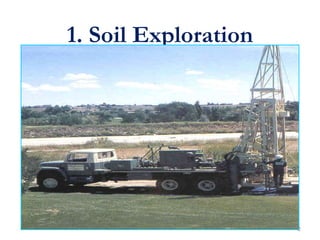
1. Soil Exploration
2
Purpose of exploration
The primary objective is to analyze the nature of the soil in
all aspects, basically is to find out strength characteristics of
the sub-soil over which the structure has to be built.
Soil exploration includes:
 Selection of alternative construction sites or the choice of
the most economical sites,
 Selection of alternative types or depth of foundation,
 Selection of alternative methods of construction,
 Evaluation of the safety of existing structure,
 Location and selection of construction materials.
3
The soil exploration should provide the following
data:
 Soil parameters and properties of different layers (e.g. for
classification, bearing capacity or settlement calculation),
 Thickness of soil layers and depth to bedrock
(stratification of soil),
 Location of ground water level and important groundwater
related issues,
 Special problems and concerns.
4
Planning an exploration program
• The planning of a program for soil exploration
depends upon:
– The nature of sub-soil
– The type of structure
– The importance of structure
• The actual planning of a subsurface exploration
program includes some or all of the following
steps:
i. Desk-study:
Assembly of all available information on type and use of
the structure, and also of the general topographic and
geological character of the site.
5
ii. Reconnaissance of the area: Consists of
walking the site and visually assessing the local
condition, inspection of behavior of adjacent
structures, rock outcrops, cuts, etc.
Reconnaissance includes the assessment of;
 Any previous development on site,
 Any previous grading on site,
 Any potential landslide or other stability problems,
 Condition of nearby structure
6
iii. A preliminary site investigation:
This is usually in the form of a few borings or a test pit to
establish the types of materials, Stratification (vertical
profile) of the soil, and possibly the location of the
ground water level.
 For small projects this step may be sufficient to
establish foundation criteria, in which case the
exploration program is finished.
iv. A detailed site investigation:
For complex projects or where the soil is of poor
quality and/or erratic, a more detailed investigation
may be undertaken. This may involve sinking several
boreholes, taking soil samples for laboratory
investigations, conducting sounding and other field
tests.
7
Methods of exploration
It is important to investigate the surface condition, but we
basically rely on subsurface exploration soil and rock
samples obtained by drilling vertical holes known as Borings
or by digging exploratory trenches or test pits.
Methods of determining the stratification and engineering
characteristics of sub-surface are
 Test pits
 Boring and sampling
 Field tests
 Geophysical methods
 Laboratory tests
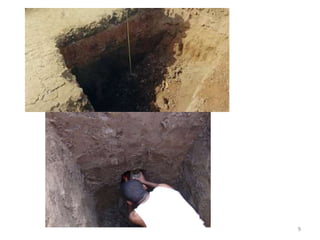
Test Pits
• The simplest and cheapest method of shallow soil exploration is to sink
test pit to depths of 3 to 4 m.
• Test pits enable the in-situ soil conditions to be examined visually.
• It is relatively easy to obtain disturbed or undisturbed soil samples:
8
9
Soil Boring and Sampling
Soil Boring:
• This is the most widely used method.
• It provides samples from shallow to deeper depths for
visual inspection as well as laboratory tests.
• The most commonly used methods of boring are:
» Auger boring
» Wash boring
» Percussion drilling
» Rotary drilling
10
Auger boring:
Operated by hand or by power.
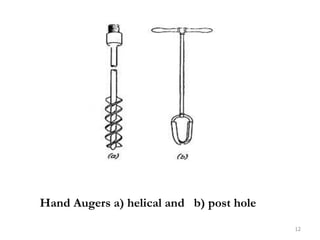
• Hand operated augers, = 15 to 20cm, are of two types.
• Post-hole and helical augers
• This boring method provides highly disturbed soil samples.
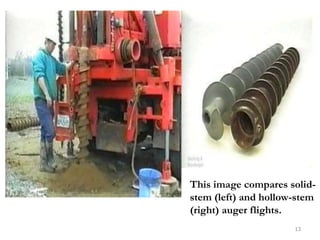
• Power operated augers (helical) can be used to great
depths, even to 30m, and used in almost all types of soils
above water table.
11
Hand Augers a) helical and b) post hole
12
This image compares solid-
stem (left) and hollow-stem
(right) auger flights.
13
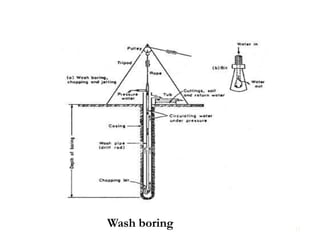
Wash boring:
Power operated.
Hole is advanced by chopping, twisting action of a light
chopping bit and jetting action of drilling fluid, usually water,
under pressure.
 Loosened soil particles rise as suspended particles through the
annular space between casing and drill rod.
This method best suits in sandy and clayey soils and not in very
hard soil strata (i.e. boulders) and rocks.
 Depth of boring could be up to 60m or more.
Changes in soil strata are indicated by changes in the rate of
progress of boring, examination of out coming slurry and
cutting in the slurry.
Undisturbed samples whenever needed can be obtained by use
of proper samplers.
14
Wash boring 15
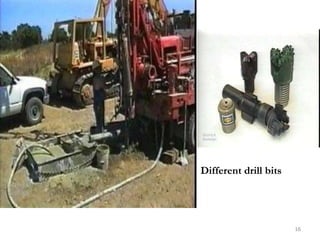
Different drill bits
16
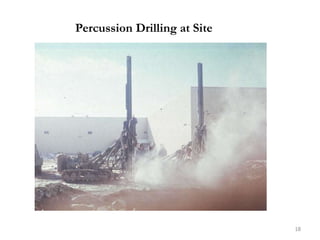
Percussion drilling:
• Power operated.
• Hole is advanced by repeated blows of a heavy chisel into
the bottom of the hole.
• The resulting slurry formed at bottom of borehole is
removed by bailer or sand pump.
• Because of the deep disturbance of the soil this method
of boring is not favored. Casing is generally required.
• Maximum depth of boring is 60m.
17
18
Percussion Drilling at Site
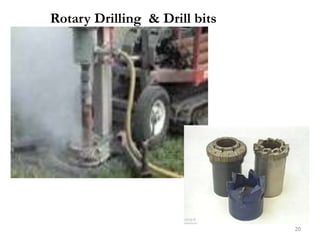
Rotary drilling:
• Power operated.
• Hole is advanced by a rapidly rotating bit.
• This is the most rapid method for penetrating highly
resistant materials (e.g. bed rock).
• In this method undisturbed samples can be obtained
at desired depths by using suitable samplers.
• Maximum depth of drilling is 80 to 150m.
19
20
Rotary Drilling & Drill bits
Drilling in soils prone to caving or squeezing
• Open hole methods encounter problems in soils prone to
caving (i.e., the sides of the boring fall in) or squeezing
(the soil moves inwards, reducing the boring diameter).
• Caving is most likely in loose sands and gravels, especially
below the groundwater table, while squeezing is likely in
soft saturated silts and clays.
• In such cases, it becomes necessary to provide some type
of lateral support inside the hole during drilling.
21
Drilling in soils prone to caving or squeezing
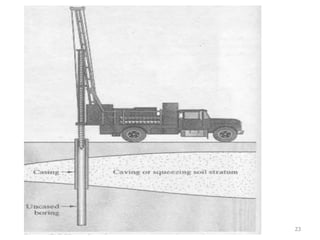
• One method of supporting the hole is to install casing (see
Figure ), which is temporary lining made of steel pipe.
This method is especially useful if only the upper soil are
prone to caving, because the casing does not need to
extend for the entire depth of the boring.
• The other method is to fill the boring with drilling mud or
slurry, which is a mixture of bentonite or attapulgite clay
and water. This material provides a hydrostatic pressure on
the walls of the boring, thus preventing caving or
squeezing.
22
23
Soil Sampling
• Laboratory test results are mainly dependent on the
quality of soil samples.
• There are two main types of soil samples which can be
recovered from bore holes or trial pits.
Disturbed and
Undisturbed samples
24
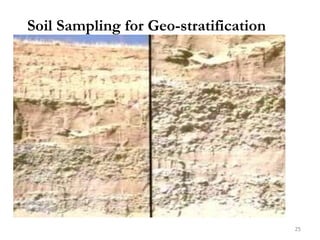
Soil Sampling for Geo-stratification
25
Disturbed Samples
• These are samples where the structure of the natural
soil has been disturbed to a considerable degree by the
action of the boring tolls or excavation equipment.
• However, these samples represent the composition and
the mineral content of the soil.
• Disturbed samples are satisfactory for performing
classification tests such as, sieve analysis, Atterberg
limits etc.
26
Undisturbed Samples
• These are samples, which represent as closely as is
practicable, the true in-situ structure and water content of
the soil.
• Undisturbed samples are required for determining reliable
information on the shearing resistance and stress-
deformation characteristics of a deposit.
• It is virtually impossible to obtain totally undisturbed
samples.
This is due to that:
The process of boring, driving the coring tool,
raising and withdrawing the coring tool and
extruding the sample from the coring tool, all
conspire to cause some disturbance.
In addition, samples taken from holes may tend
to swell as a result of stress relief.
27
• Samples should be taken only from a newly- drilled or newly
extended hole, with care being taken to avoid contact with
water.
• As soon as they are brought to the surface:
Core tubes ends should be sealed with wax and
capped to preserve the loss of moisture content.
Core tubes should properly be labeled to indicate
the number of bore holes and the depth at which
they are taken and then stored away from extremes
of heat or cold and vibration.
28
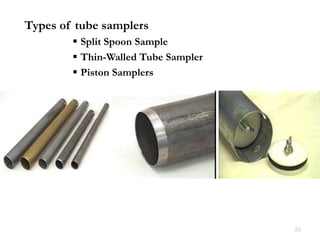
Types of tube samplers
 Split Spoon Sample
 Thin-Walled Tube Sampler
 Piston Samplers
29
Field [in-situ] tests
• These tests are valuable means of determining the
relative densities; shear strengths and bearing
capacities of soils directly without disturbing effects
of boring and sampling.
• The most commonly used field tests are:
»Penetration or sounding tests
»Vane shear test
»Plate loading test
»Pile loading test
30
Penetration Tests
• They are conducted mainly to get information on the
relative density of soils with little or no cohesion.
• The tests are based on the fact that the relative density
of a soil stratum is directly proportional to the
resistance of the soil against the penetration of the
drive point.
• From this, correlations between values of penetration
resistance versus angle of internal friction (Φ), bearing
pressure, density and modulus of compressibility have
been developed.
• Penetration tests are classified as: Static and
dynamic penetration tests.
31
Static Penetration Tests
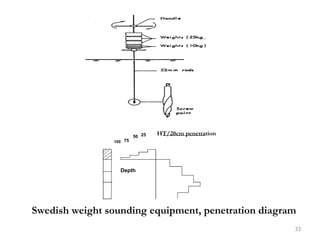
1) Swedish Weight Sounding Test:
• This method of testing is widely used in Scandinavia and
here in Ethiopia.
• The depth of penetration is measured for each loading
after which the number of half-turns is counted by 100kg
load; the penetration depth is then measured after 25 half-
turns.
• If the penetration after 25 half-turns is less than 5cm the
rod is unloaded and driven down by a 5 to 6kg hammer.
32
100 75
50 25 HT/20cm penetration
Depth
Swedish weight sounding equipment, penetration diagram
33
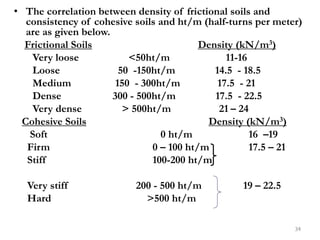
• The correlation between density of frictional soils and
consistency of cohesive soils and ht/m (half-turns per meter)
are as given below.
Frictional Soils Density (kN/m3)
Very loose <50ht/m 11-16
Loose 50 -150ht/m 14.5 - 18.5
Medium 150 - 300ht/m 17.5 - 21
Dense 300 - 500ht/m 17.5 - 22.5
Very dense > 500ht/m 21 – 24
Cohesive Soils Density (kN/m3)
Soft 0 ht/m 16 –19
Firm 0 – 100 ht/m 17.5 – 21
Stiff 100-200 ht/m
Very stiff 200 - 500 ht/m 19 – 22.5
Hard >500 ht/m
34
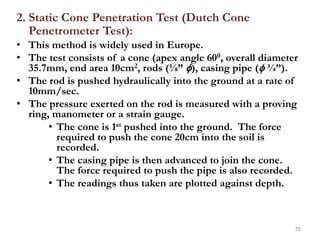
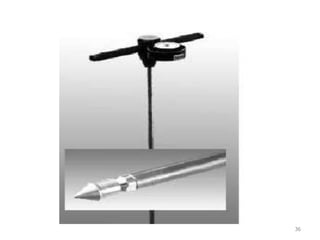
2. Static Cone Penetration Test (Dutch Cone
Penetrometer Test):
• This method is widely used in Europe.
• The test consists of a cone (apex angle 600, overall diameter
35.7mm, end area 10cm2, rods (⅝” ), casing pipe ( ¾”).
• The rod is pushed hydraulically into the ground at a rate of
10mm/sec.
• The pressure exerted on the rod is measured with a proving
ring, manometer or a strain gauge.
• The cone is 1st pushed into the ground. The force
required to push the cone 20cm into the soil is
recorded.
• The casing pipe is then advanced to join the cone.
The force required to push the pipe is also recorded.
• The readings thus taken are plotted against depth.
35
36
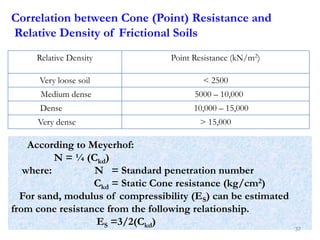
Correlation between Cone (Point) Resistance and
Relative Density of Frictional Soils
Relative Density Point Resistance (kN/m2)
Very loose soil < 2500
Medium dense 5000 – 10,000
Dense 10,000 – 15,000
Very dense > 15,000
According to Meyerhof:
N = ¼ (Ckd)
where: N = Standard penetration number
Ckd = Static Cone resistance (kg/cm2)
For sand, modulus of compressibility (ES) can be estimated
from cone resistance from the following relationship.
ES =3/2(Ckd)
37
Dynamic Penetration Tests
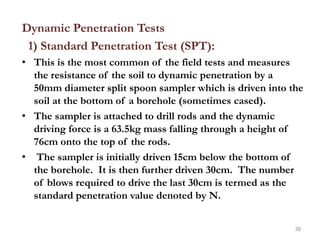
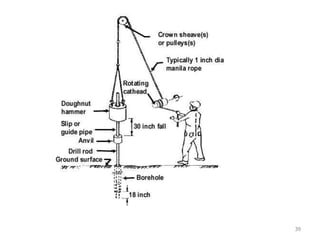
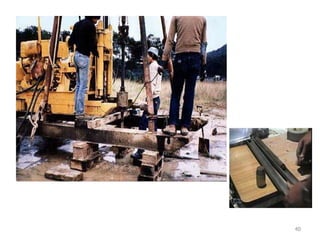
1) Standard Penetration Test (SPT):
• This is the most common of the field tests and measures
the resistance of the soil to dynamic penetration by a
50mm diameter split spoon sampler which is driven into the
soil at the bottom of a borehole (sometimes cased).
• The sampler is attached to drill rods and the dynamic
driving force is a 63.5kg mass falling through a height of
76cm onto the top of the rods.
• The sampler is initially driven 15cm below the bottom of
the borehole. It is then further driven 30cm. The number
of blows required to drive the last 30cm is termed as the
standard penetration value denoted by N.
38
39
40
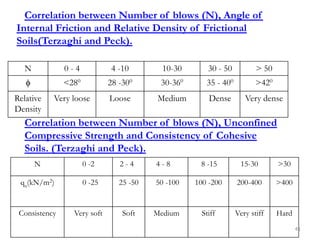
Correlation between Number of blows (N), Angle of
Internal Friction and Relative Density of Frictional
Soils(Terzaghi and Peck).
N 0 - 4 4 -10 10-30 30 - 50 > 50
 <280 28 -300 30-360 35 - 400 >420
Relative
Density
Very loose Loose Medium Dense Very dense
Correlation between Number of blows (N), Unconfined
Compressive Strength and Consistency of Cohesive
Soils. (Terzaghi and Peck).
N 0 -2 2 - 4 4 - 8 8 -15 15-30 >30
qu(kN/m2) 0 -25 25 -50 50 -100 100 -200 200-400 >400
Consistency Very soft Soft Medium Stiff Very stiff Hard
41
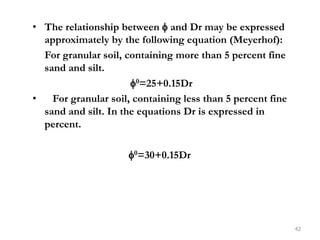
• The relationship between  and Dr may be expressed
approximately by the following equation (Meyerhof):
For granular soil, containing more than 5 percent fine
sand and silt.
0=25+0.15Dr
• For granular soil, containing less than 5 percent fine
sand and silt. In the equations Dr is expressed in
percent.
0=30+0.15Dr
42
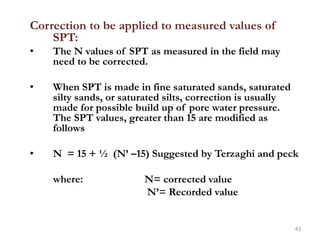
Correction to be applied to measured values of
SPT:
• The N values of SPT as measured in the field may
need to be corrected.
• When SPT is made in fine saturated sands, saturated
silty sands, or saturated silts, correction is usually
made for possible build up of pore water pressure.
The SPT values, greater than 15 are modified as
follows
• N = 15 + ½ (N’ –15) Suggested by Terzaghi and peck
where: N= corrected value
N’= Recorded value
43
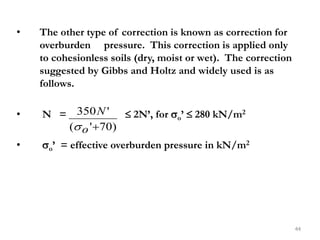
• The other type of correction is known as correction for
overburden pressure. This correction is applied only
to cohesionless soils (dry, moist or wet). The correction
suggested by Gibbs and Holtz and widely used is as
follows.
• N =  2N’, for o’  280 kN/m2
• o’ = effective overburden pressure in kN/m2
44
)
70
'
(
'
350

o
N

2) Dynamic Cone Penetration Test:
• This is another useful test, which is normally used to
determine the relative resistance offered by the different
soil layers.
• The cone is fixed to the bottom of a rod and driven into
the ground in the same way as a SPT is performed. The
number of blows required to penetrate 30cms depth is
called as Nc value.
• In the case of dynamic cone penetration test no borehole
is used.
45
• Experiments carried out indicate that beyond about 6m
depth, frictional resistance on the rod increases which gives
erroneous results for Nc value. The maximum depth
suggested for this test is about 6 m.
• If the test has to be conducted beyond 6 m depth, one has to
use drilling mud (bentonite slurry) under pressure forced
through the pipe and the cone.
• The mud solution coming out of the cone rises above along
the drill rod eliminating thereby the frictional resistance
offered by the soil for penetration. The former method is
called as dry method and the latter wet method.
46
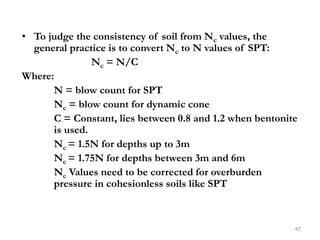
• To judge the consistency of soil from Nc values, the
general practice is to convert Nc to N values of SPT:
Nc = N/C
Where:
N = blow count for SPT
Nc = blow count for dynamic cone
C = Constant, lies between 0.8 and 1.2 when bentonite
is used.
Nc = 1.5N for depths up to 3m
Nc = 1.75N for depths between 3m and 6m
Nc Values need to be corrected for overburden
pressure in cohesionless soils like SPT
47
Vane Shear Test
• It is used to determine the undrained shear strength of
soft clays soils.
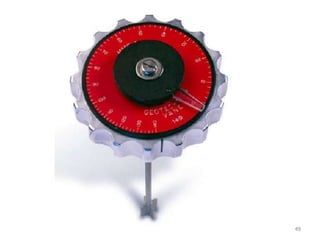
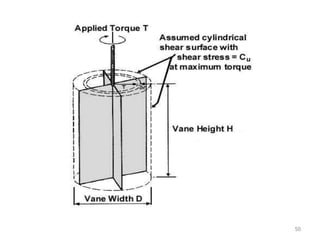
• The apparatus consists of a vertical steel rod having four
thin stainless steel blades (vanes) fixed at its bottom ends.
• Vane head (torsion head), complete with pointer, stop pin,
circumferential graduated scale, calibrated torsion spring.
48
49
50
• In most cases a hole is drilled to the desired depth,
where the vane shear test is planned to be performed
and the vane is carefully pushed into the soil.
• A torque necessary to shear the cylinder of soil defined
by the blades of the vane is applied by rotating the arm
of the apparatus with a constant speed of 0.5
degree/sec.
• The maximum torque is then measured from which the
shearing strength is determined.
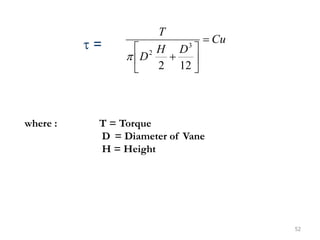
• From the measured maximum torque one may estimate
the shearing resistance of the tested clay from the
following formula.
51
Cu
D
H
D
T








12
2
3
2

52
 =
where : T = Torque
D = Diameter of Vane
H = Height
Plate Loading Test
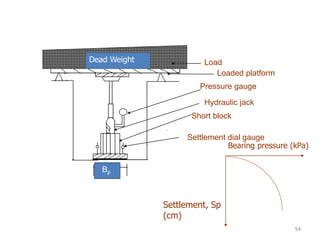
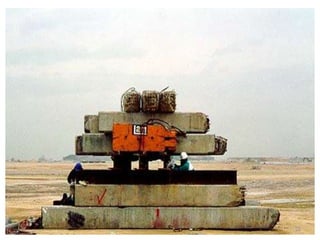
• In this test a gradually increasing static load is applied to
the soil through a steel plate, and readings of the
settlement and applied load are recorded, from which a
relationship between bearing pressure and settlement for
the soil can be obtained.
The test procedure:
1. Pit for the test must be at least 5 times the size of the
plate.
2. The plate should be properly placed in the soil. In the
case of cohesionless soil (to prevent early displacement
of soil under the edges of the plate), the plate must be
positioned in cast in-situ concrete.
3. Loading platform should be properly erected.
53
Load
Loaded platform
Pressure gauge
Short block
Settlement dial gauge
Bp
Hydraulic jack
Dead Weight
Settlement, Sp
(cm)
Bearing pressure (kPa)
54
55
4. Loading of the soil is conducted in steps (loading
increment is kept constant).
5. Once completion of the test, the plate is unloaded in the
same incremental steps (to draw the expansion curve).
• Bearing capacity of non-cohesive soil is determined from
settlement consideration.
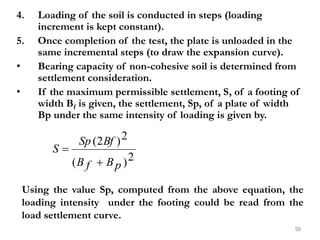
• If the maximum permissible settlement, S, of a footing of
width Bf is given, the settlement, Sp, of a plate of width
Bp under the same intensity of loading is given by.
56
2
)
(
2
)
2
(
p
B
f
B
Bf
Sp
S


Using the value Sp, computed from the above equation, the
loading intensity under the footing could be read from the
load settlement curve.
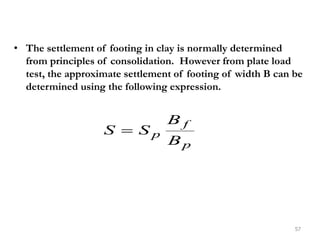
• The settlement of footing in clay is normally determined
from principles of consolidation. However from plate load
test, the approximate settlement of footing of width B can be
determined using the following expression.
57
p
f
p
B
B
S
S 
Limitation of Plate Loading Test:
• Plate loading test is of short duration. Hence
consolidation settlement does not fully occur during the
test.
• For settlement consideration, its use is restricted to sandy
soils, and to partially saturated or rather unsaturated
clayey soils.
• Plate loading test can give very misleading information of
the soil is not homogeneous within the effective depth
(depth of stress influence) of the prototype foundation.
• Plate loading test should not be recommended in soils
which are not homogeneous at least to depth of 1½ to 2
times the width of the prototype foundation.
58
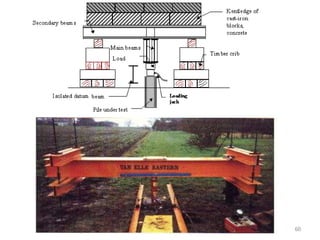
Pile Loading Test:
• This is the most reliable means for determining the
load carrying capacity of a pile.
• The load arrangement and testing procedure are more
or less similar to the plate-loading test.
• From the results of this test, the allowable bearing
capacity and load- settlement relationship of a group
of friction piles can be estimated.
59
60
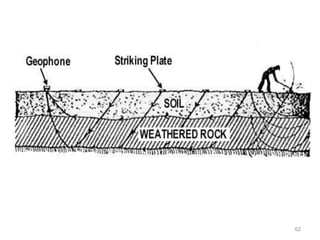
Geophysical methods:
• These comprise the seismic and resistivity methods.
Seismic Refraction Method:
• In this method shock or seismic are created by detonating
small charges or by striking a rod or a plate near the
surface. The radiating waves are picked up and time of
travel from source recorded by detectors known as
geophones or seismometers.
• Seismic method is based on the fact that sound waves
travel faster through rocks than through soils.
61
62
Electrical Resistivity:
• In this method four metallic spikes to serve as
electrodes are driven in to the ground at equal intervals
along a line. A known potential is then applied between
the outermost electrodes and potential drop is
measured between the innermost electrodes.
• The resistivity method makes use of the fact some soils
(e.g. soft clays) have low electrical resistivity than others
(e.g. sand or gravel).
• Seismic and resistivity methods are normally employed
as preliminary or supplementary to other methods of
exploration.
63
Laboratory tests
The common laboratory tests that concern the foundation
engineers are
– Grain size analysis
– Atterberg limits
– Natural moisture content
– Unit weight
– Unconfined compression test
– Direct shear test
– Triaxial compression test
– Consolidation test
– Compaction test
– Chemical analysis
64
Ground Water Measurement
• Ground water affects many elements of foundation
design and construction.
• Because of this its location should be determined in
each job with reasonable accuracy.
• The depth of water table is measured by lowering a
chalk-coated steel tape in the borehole.
• The depth can also be measured by lowering the leads of
an electrical circuit. As soon as the open ends of the leads
touch the water in the borehole, the circuit is completed.
It is indicated by glow of the indicator lamp.
65
Depth and number of borings
Depth of Boring
The depth to which boreholes should be sunk is
governed by the depth of soil affected by foundation
bearing pressures.
According to Tomlinson the following depths of
boreholes for various foundation conditions may be
used.
1. For widely spaced strip of pad foundations, boring
depth should be deeper than 1.5 times the width of the
foundation.
2. For raft foundations, boring depth deeper than 1.5 times
width of raft should be used.
66
3. For closely spaced strip or pad foundations where there
is overlapping of the zones of pressure, boring depth
deeper than 1.5 times width of building should be used.
4. For group of piled foundation on soil, boring depth
should be deeper than 1.5 times width of pile group, the
depth being measured from a depth of two- thirds of the
length of the piles.
5. For piled foundation on rock, boring depth should be
deeper than 3.0m inside bedrock.
6. According to Teng, for high ways and airfields minimum
depth of boring is 1.5m, but should be extended below
organic soil, fill or compressible layers such as soft clays
and silts.
67
Project Distance between boring (m) Minimum
number of
boring for each
structure
Horizontal stratification of soil
Uniform Average Erratic
Multi-story building 45 30 15 4
One or two story
building
60 30 15 3
Bridge piers,
abutments, television
towers, etc
- 30 75 1-2 for each
foundation unit
Highways 300 150 30
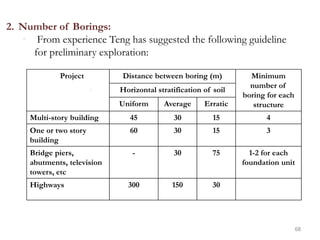
2. Number of Borings:
• From experience Teng has suggested the following guideline
for preliminary exploration:
68
Data presentation
• The results of borings, samplings, penetration tests and
laboratory tests of a site are usually plotted graphically on
a sheet of drawing paper.
• The graphical presentation should include.
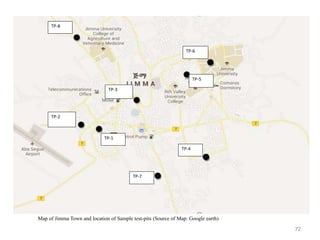
1. A plot plan, showing the location of all boreholes, test pits,
etc and their identification number.
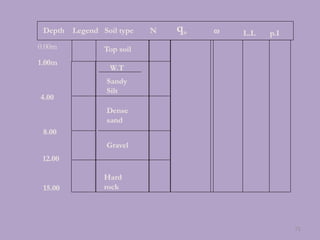
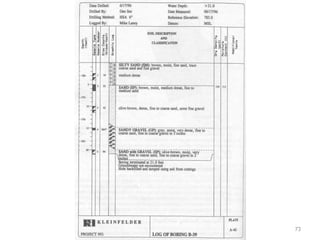
2. A separate plot, showing the soil profile as established from
the drillings or test pits records.
3. Soil profiles along given lines in the ground surface,
showing the boundaries between identifiable soil layers,
variation of thickness of firm bottom layer, thickness of
soft clay layers etc.
69
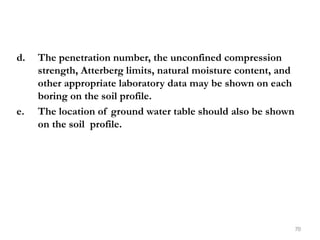
d. The penetration number, the unconfined compression
strength, Atterberg limits, natural moisture content, and
other appropriate laboratory data may be shown on each
boring on the soil profile.
e. The location of ground water table should also be shown
on the soil profile.
70
Top soil
Sandy
Silt
Dense
sand
Gravel
Hard
rock
0.00m
12.00
8.00
15.00
1.00m
4.00
Depth Legend Soil type N qu
W.T
 L.L p.I
71
72
TP-5
TP-6
TP-4
TP-3
TP-7
TP-8
TP-2
TP-1
Map of Jimma Town and location of Sample test-pits (Source of Map: Google earth)
73
Soil Exploration Report
Most reports have the following contents:
1. Introduction: - Purpose of investigation, type of
investigation carried out.
2. General description of the site: - general configuration and
surface features of the site.
3. General geology of the area.
4. Description of soil conditions found in bore holes (and
test pits)
5. Laboratory test results.
6. Discussion of results of investigation in relation to
foundation design and constructions.
7. Conclusion: recommendations on the type and depth of
foundations, allowable bearing pressure and methods of
construction.
74

Chapter-1-Soil Exploration.ppt

  • 1.
    Jimma University Department ofCivil Engineering Foundation Engineering-I (CENG-3056) By: Tahir K. Email: tahrist@gmail.com 1
  • 2.
  • 3.
    Purpose of exploration Theprimary objective is to analyze the nature of the soil in all aspects, basically is to find out strength characteristics of the sub-soil over which the structure has to be built. Soil exploration includes:  Selection of alternative construction sites or the choice of the most economical sites,  Selection of alternative types or depth of foundation,  Selection of alternative methods of construction,  Evaluation of the safety of existing structure,  Location and selection of construction materials. 3
  • 4.
    The soil explorationshould provide the following data:  Soil parameters and properties of different layers (e.g. for classification, bearing capacity or settlement calculation),  Thickness of soil layers and depth to bedrock (stratification of soil),  Location of ground water level and important groundwater related issues,  Special problems and concerns. 4
  • 5.
    Planning an explorationprogram • The planning of a program for soil exploration depends upon: – The nature of sub-soil – The type of structure – The importance of structure • The actual planning of a subsurface exploration program includes some or all of the following steps: i. Desk-study: Assembly of all available information on type and use of the structure, and also of the general topographic and geological character of the site. 5
  • 6.
    ii. Reconnaissance ofthe area: Consists of walking the site and visually assessing the local condition, inspection of behavior of adjacent structures, rock outcrops, cuts, etc. Reconnaissance includes the assessment of;  Any previous development on site,  Any previous grading on site,  Any potential landslide or other stability problems,  Condition of nearby structure 6
  • 7.
    iii. A preliminarysite investigation: This is usually in the form of a few borings or a test pit to establish the types of materials, Stratification (vertical profile) of the soil, and possibly the location of the ground water level.  For small projects this step may be sufficient to establish foundation criteria, in which case the exploration program is finished. iv. A detailed site investigation: For complex projects or where the soil is of poor quality and/or erratic, a more detailed investigation may be undertaken. This may involve sinking several boreholes, taking soil samples for laboratory investigations, conducting sounding and other field tests. 7
  • 8.
    Methods of exploration Itis important to investigate the surface condition, but we basically rely on subsurface exploration soil and rock samples obtained by drilling vertical holes known as Borings or by digging exploratory trenches or test pits. Methods of determining the stratification and engineering characteristics of sub-surface are  Test pits  Boring and sampling  Field tests  Geophysical methods  Laboratory tests Test Pits • The simplest and cheapest method of shallow soil exploration is to sink test pit to depths of 3 to 4 m. • Test pits enable the in-situ soil conditions to be examined visually. • It is relatively easy to obtain disturbed or undisturbed soil samples: 8
  • 9.
  • 10.
    Soil Boring andSampling Soil Boring: • This is the most widely used method. • It provides samples from shallow to deeper depths for visual inspection as well as laboratory tests. • The most commonly used methods of boring are: » Auger boring » Wash boring » Percussion drilling » Rotary drilling 10
  • 11.
    Auger boring: Operated byhand or by power. • Hand operated augers, = 15 to 20cm, are of two types. • Post-hole and helical augers • This boring method provides highly disturbed soil samples. • Power operated augers (helical) can be used to great depths, even to 30m, and used in almost all types of soils above water table. 11
  • 12.
    Hand Augers a)helical and b) post hole 12
  • 13.
    This image comparessolid- stem (left) and hollow-stem (right) auger flights. 13
  • 14.
    Wash boring: Power operated. Holeis advanced by chopping, twisting action of a light chopping bit and jetting action of drilling fluid, usually water, under pressure.  Loosened soil particles rise as suspended particles through the annular space between casing and drill rod. This method best suits in sandy and clayey soils and not in very hard soil strata (i.e. boulders) and rocks.  Depth of boring could be up to 60m or more. Changes in soil strata are indicated by changes in the rate of progress of boring, examination of out coming slurry and cutting in the slurry. Undisturbed samples whenever needed can be obtained by use of proper samplers. 14
  • 15.
  • 16.
  • 17.
    Percussion drilling: • Poweroperated. • Hole is advanced by repeated blows of a heavy chisel into the bottom of the hole. • The resulting slurry formed at bottom of borehole is removed by bailer or sand pump. • Because of the deep disturbance of the soil this method of boring is not favored. Casing is generally required. • Maximum depth of boring is 60m. 17
  • 18.
  • 19.
    Rotary drilling: • Poweroperated. • Hole is advanced by a rapidly rotating bit. • This is the most rapid method for penetrating highly resistant materials (e.g. bed rock). • In this method undisturbed samples can be obtained at desired depths by using suitable samplers. • Maximum depth of drilling is 80 to 150m. 19
  • 20.
  • 21.
    Drilling in soilsprone to caving or squeezing • Open hole methods encounter problems in soils prone to caving (i.e., the sides of the boring fall in) or squeezing (the soil moves inwards, reducing the boring diameter). • Caving is most likely in loose sands and gravels, especially below the groundwater table, while squeezing is likely in soft saturated silts and clays. • In such cases, it becomes necessary to provide some type of lateral support inside the hole during drilling. 21
  • 22.
    Drilling in soilsprone to caving or squeezing • One method of supporting the hole is to install casing (see Figure ), which is temporary lining made of steel pipe. This method is especially useful if only the upper soil are prone to caving, because the casing does not need to extend for the entire depth of the boring. • The other method is to fill the boring with drilling mud or slurry, which is a mixture of bentonite or attapulgite clay and water. This material provides a hydrostatic pressure on the walls of the boring, thus preventing caving or squeezing. 22
  • 23.
  • 24.
    Soil Sampling • Laboratorytest results are mainly dependent on the quality of soil samples. • There are two main types of soil samples which can be recovered from bore holes or trial pits. Disturbed and Undisturbed samples 24
  • 25.
    Soil Sampling forGeo-stratification 25
  • 26.
    Disturbed Samples • Theseare samples where the structure of the natural soil has been disturbed to a considerable degree by the action of the boring tolls or excavation equipment. • However, these samples represent the composition and the mineral content of the soil. • Disturbed samples are satisfactory for performing classification tests such as, sieve analysis, Atterberg limits etc. 26
  • 27.
    Undisturbed Samples • Theseare samples, which represent as closely as is practicable, the true in-situ structure and water content of the soil. • Undisturbed samples are required for determining reliable information on the shearing resistance and stress- deformation characteristics of a deposit. • It is virtually impossible to obtain totally undisturbed samples. This is due to that: The process of boring, driving the coring tool, raising and withdrawing the coring tool and extruding the sample from the coring tool, all conspire to cause some disturbance. In addition, samples taken from holes may tend to swell as a result of stress relief. 27
  • 28.
    • Samples shouldbe taken only from a newly- drilled or newly extended hole, with care being taken to avoid contact with water. • As soon as they are brought to the surface: Core tubes ends should be sealed with wax and capped to preserve the loss of moisture content. Core tubes should properly be labeled to indicate the number of bore holes and the depth at which they are taken and then stored away from extremes of heat or cold and vibration. 28
  • 29.
    Types of tubesamplers  Split Spoon Sample  Thin-Walled Tube Sampler  Piston Samplers 29
  • 30.
    Field [in-situ] tests •These tests are valuable means of determining the relative densities; shear strengths and bearing capacities of soils directly without disturbing effects of boring and sampling. • The most commonly used field tests are: »Penetration or sounding tests »Vane shear test »Plate loading test »Pile loading test 30
  • 31.
    Penetration Tests • Theyare conducted mainly to get information on the relative density of soils with little or no cohesion. • The tests are based on the fact that the relative density of a soil stratum is directly proportional to the resistance of the soil against the penetration of the drive point. • From this, correlations between values of penetration resistance versus angle of internal friction (Φ), bearing pressure, density and modulus of compressibility have been developed. • Penetration tests are classified as: Static and dynamic penetration tests. 31
  • 32.
    Static Penetration Tests 1)Swedish Weight Sounding Test: • This method of testing is widely used in Scandinavia and here in Ethiopia. • The depth of penetration is measured for each loading after which the number of half-turns is counted by 100kg load; the penetration depth is then measured after 25 half- turns. • If the penetration after 25 half-turns is less than 5cm the rod is unloaded and driven down by a 5 to 6kg hammer. 32
  • 33.
    100 75 50 25HT/20cm penetration Depth Swedish weight sounding equipment, penetration diagram 33
  • 34.
    • The correlationbetween density of frictional soils and consistency of cohesive soils and ht/m (half-turns per meter) are as given below. Frictional Soils Density (kN/m3) Very loose <50ht/m 11-16 Loose 50 -150ht/m 14.5 - 18.5 Medium 150 - 300ht/m 17.5 - 21 Dense 300 - 500ht/m 17.5 - 22.5 Very dense > 500ht/m 21 – 24 Cohesive Soils Density (kN/m3) Soft 0 ht/m 16 –19 Firm 0 – 100 ht/m 17.5 – 21 Stiff 100-200 ht/m Very stiff 200 - 500 ht/m 19 – 22.5 Hard >500 ht/m 34
  • 35.
    2. Static ConePenetration Test (Dutch Cone Penetrometer Test): • This method is widely used in Europe. • The test consists of a cone (apex angle 600, overall diameter 35.7mm, end area 10cm2, rods (⅝” ), casing pipe ( ¾”). • The rod is pushed hydraulically into the ground at a rate of 10mm/sec. • The pressure exerted on the rod is measured with a proving ring, manometer or a strain gauge. • The cone is 1st pushed into the ground. The force required to push the cone 20cm into the soil is recorded. • The casing pipe is then advanced to join the cone. The force required to push the pipe is also recorded. • The readings thus taken are plotted against depth. 35
  • 36.
  • 37.
    Correlation between Cone(Point) Resistance and Relative Density of Frictional Soils Relative Density Point Resistance (kN/m2) Very loose soil < 2500 Medium dense 5000 – 10,000 Dense 10,000 – 15,000 Very dense > 15,000 According to Meyerhof: N = ¼ (Ckd) where: N = Standard penetration number Ckd = Static Cone resistance (kg/cm2) For sand, modulus of compressibility (ES) can be estimated from cone resistance from the following relationship. ES =3/2(Ckd) 37
  • 38.
    Dynamic Penetration Tests 1)Standard Penetration Test (SPT): • This is the most common of the field tests and measures the resistance of the soil to dynamic penetration by a 50mm diameter split spoon sampler which is driven into the soil at the bottom of a borehole (sometimes cased). • The sampler is attached to drill rods and the dynamic driving force is a 63.5kg mass falling through a height of 76cm onto the top of the rods. • The sampler is initially driven 15cm below the bottom of the borehole. It is then further driven 30cm. The number of blows required to drive the last 30cm is termed as the standard penetration value denoted by N. 38
  • 39.
  • 40.
  • 41.
    Correlation between Numberof blows (N), Angle of Internal Friction and Relative Density of Frictional Soils(Terzaghi and Peck). N 0 - 4 4 -10 10-30 30 - 50 > 50  <280 28 -300 30-360 35 - 400 >420 Relative Density Very loose Loose Medium Dense Very dense Correlation between Number of blows (N), Unconfined Compressive Strength and Consistency of Cohesive Soils. (Terzaghi and Peck). N 0 -2 2 - 4 4 - 8 8 -15 15-30 >30 qu(kN/m2) 0 -25 25 -50 50 -100 100 -200 200-400 >400 Consistency Very soft Soft Medium Stiff Very stiff Hard 41
  • 42.
    • The relationshipbetween  and Dr may be expressed approximately by the following equation (Meyerhof): For granular soil, containing more than 5 percent fine sand and silt. 0=25+0.15Dr • For granular soil, containing less than 5 percent fine sand and silt. In the equations Dr is expressed in percent. 0=30+0.15Dr 42
  • 43.
    Correction to beapplied to measured values of SPT: • The N values of SPT as measured in the field may need to be corrected. • When SPT is made in fine saturated sands, saturated silty sands, or saturated silts, correction is usually made for possible build up of pore water pressure. The SPT values, greater than 15 are modified as follows • N = 15 + ½ (N’ –15) Suggested by Terzaghi and peck where: N= corrected value N’= Recorded value 43
  • 44.
    • The othertype of correction is known as correction for overburden pressure. This correction is applied only to cohesionless soils (dry, moist or wet). The correction suggested by Gibbs and Holtz and widely used is as follows. • N =  2N’, for o’  280 kN/m2 • o’ = effective overburden pressure in kN/m2 44 ) 70 ' ( ' 350  o N 
  • 45.
    2) Dynamic ConePenetration Test: • This is another useful test, which is normally used to determine the relative resistance offered by the different soil layers. • The cone is fixed to the bottom of a rod and driven into the ground in the same way as a SPT is performed. The number of blows required to penetrate 30cms depth is called as Nc value. • In the case of dynamic cone penetration test no borehole is used. 45
  • 46.
    • Experiments carriedout indicate that beyond about 6m depth, frictional resistance on the rod increases which gives erroneous results for Nc value. The maximum depth suggested for this test is about 6 m. • If the test has to be conducted beyond 6 m depth, one has to use drilling mud (bentonite slurry) under pressure forced through the pipe and the cone. • The mud solution coming out of the cone rises above along the drill rod eliminating thereby the frictional resistance offered by the soil for penetration. The former method is called as dry method and the latter wet method. 46
  • 47.
    • To judgethe consistency of soil from Nc values, the general practice is to convert Nc to N values of SPT: Nc = N/C Where: N = blow count for SPT Nc = blow count for dynamic cone C = Constant, lies between 0.8 and 1.2 when bentonite is used. Nc = 1.5N for depths up to 3m Nc = 1.75N for depths between 3m and 6m Nc Values need to be corrected for overburden pressure in cohesionless soils like SPT 47
  • 48.
    Vane Shear Test •It is used to determine the undrained shear strength of soft clays soils. • The apparatus consists of a vertical steel rod having four thin stainless steel blades (vanes) fixed at its bottom ends. • Vane head (torsion head), complete with pointer, stop pin, circumferential graduated scale, calibrated torsion spring. 48
  • 49.
  • 50.
  • 51.
    • In mostcases a hole is drilled to the desired depth, where the vane shear test is planned to be performed and the vane is carefully pushed into the soil. • A torque necessary to shear the cylinder of soil defined by the blades of the vane is applied by rotating the arm of the apparatus with a constant speed of 0.5 degree/sec. • The maximum torque is then measured from which the shearing strength is determined. • From the measured maximum torque one may estimate the shearing resistance of the tested clay from the following formula. 51
  • 52.
  • 53.
    Plate Loading Test •In this test a gradually increasing static load is applied to the soil through a steel plate, and readings of the settlement and applied load are recorded, from which a relationship between bearing pressure and settlement for the soil can be obtained. The test procedure: 1. Pit for the test must be at least 5 times the size of the plate. 2. The plate should be properly placed in the soil. In the case of cohesionless soil (to prevent early displacement of soil under the edges of the plate), the plate must be positioned in cast in-situ concrete. 3. Loading platform should be properly erected. 53
  • 54.
    Load Loaded platform Pressure gauge Shortblock Settlement dial gauge Bp Hydraulic jack Dead Weight Settlement, Sp (cm) Bearing pressure (kPa) 54
  • 55.
  • 56.
    4. Loading ofthe soil is conducted in steps (loading increment is kept constant). 5. Once completion of the test, the plate is unloaded in the same incremental steps (to draw the expansion curve). • Bearing capacity of non-cohesive soil is determined from settlement consideration. • If the maximum permissible settlement, S, of a footing of width Bf is given, the settlement, Sp, of a plate of width Bp under the same intensity of loading is given by. 56 2 ) ( 2 ) 2 ( p B f B Bf Sp S   Using the value Sp, computed from the above equation, the loading intensity under the footing could be read from the load settlement curve.
  • 57.
    • The settlementof footing in clay is normally determined from principles of consolidation. However from plate load test, the approximate settlement of footing of width B can be determined using the following expression. 57 p f p B B S S 
  • 58.
    Limitation of PlateLoading Test: • Plate loading test is of short duration. Hence consolidation settlement does not fully occur during the test. • For settlement consideration, its use is restricted to sandy soils, and to partially saturated or rather unsaturated clayey soils. • Plate loading test can give very misleading information of the soil is not homogeneous within the effective depth (depth of stress influence) of the prototype foundation. • Plate loading test should not be recommended in soils which are not homogeneous at least to depth of 1½ to 2 times the width of the prototype foundation. 58
  • 59.
    Pile Loading Test: •This is the most reliable means for determining the load carrying capacity of a pile. • The load arrangement and testing procedure are more or less similar to the plate-loading test. • From the results of this test, the allowable bearing capacity and load- settlement relationship of a group of friction piles can be estimated. 59
  • 60.
  • 61.
    Geophysical methods: • Thesecomprise the seismic and resistivity methods. Seismic Refraction Method: • In this method shock or seismic are created by detonating small charges or by striking a rod or a plate near the surface. The radiating waves are picked up and time of travel from source recorded by detectors known as geophones or seismometers. • Seismic method is based on the fact that sound waves travel faster through rocks than through soils. 61
  • 62.
  • 63.
    Electrical Resistivity: • Inthis method four metallic spikes to serve as electrodes are driven in to the ground at equal intervals along a line. A known potential is then applied between the outermost electrodes and potential drop is measured between the innermost electrodes. • The resistivity method makes use of the fact some soils (e.g. soft clays) have low electrical resistivity than others (e.g. sand or gravel). • Seismic and resistivity methods are normally employed as preliminary or supplementary to other methods of exploration. 63
  • 64.
    Laboratory tests The commonlaboratory tests that concern the foundation engineers are – Grain size analysis – Atterberg limits – Natural moisture content – Unit weight – Unconfined compression test – Direct shear test – Triaxial compression test – Consolidation test – Compaction test – Chemical analysis 64
  • 65.
    Ground Water Measurement •Ground water affects many elements of foundation design and construction. • Because of this its location should be determined in each job with reasonable accuracy. • The depth of water table is measured by lowering a chalk-coated steel tape in the borehole. • The depth can also be measured by lowering the leads of an electrical circuit. As soon as the open ends of the leads touch the water in the borehole, the circuit is completed. It is indicated by glow of the indicator lamp. 65
  • 66.
    Depth and numberof borings Depth of Boring The depth to which boreholes should be sunk is governed by the depth of soil affected by foundation bearing pressures. According to Tomlinson the following depths of boreholes for various foundation conditions may be used. 1. For widely spaced strip of pad foundations, boring depth should be deeper than 1.5 times the width of the foundation. 2. For raft foundations, boring depth deeper than 1.5 times width of raft should be used. 66
  • 67.
    3. For closelyspaced strip or pad foundations where there is overlapping of the zones of pressure, boring depth deeper than 1.5 times width of building should be used. 4. For group of piled foundation on soil, boring depth should be deeper than 1.5 times width of pile group, the depth being measured from a depth of two- thirds of the length of the piles. 5. For piled foundation on rock, boring depth should be deeper than 3.0m inside bedrock. 6. According to Teng, for high ways and airfields minimum depth of boring is 1.5m, but should be extended below organic soil, fill or compressible layers such as soft clays and silts. 67
  • 68.
    Project Distance betweenboring (m) Minimum number of boring for each structure Horizontal stratification of soil Uniform Average Erratic Multi-story building 45 30 15 4 One or two story building 60 30 15 3 Bridge piers, abutments, television towers, etc - 30 75 1-2 for each foundation unit Highways 300 150 30 2. Number of Borings: • From experience Teng has suggested the following guideline for preliminary exploration: 68
  • 69.
    Data presentation • Theresults of borings, samplings, penetration tests and laboratory tests of a site are usually plotted graphically on a sheet of drawing paper. • The graphical presentation should include. 1. A plot plan, showing the location of all boreholes, test pits, etc and their identification number. 2. A separate plot, showing the soil profile as established from the drillings or test pits records. 3. Soil profiles along given lines in the ground surface, showing the boundaries between identifiable soil layers, variation of thickness of firm bottom layer, thickness of soft clay layers etc. 69
  • 70.
    d. The penetrationnumber, the unconfined compression strength, Atterberg limits, natural moisture content, and other appropriate laboratory data may be shown on each boring on the soil profile. e. The location of ground water table should also be shown on the soil profile. 70
  • 71.
  • 72.
    72 TP-5 TP-6 TP-4 TP-3 TP-7 TP-8 TP-2 TP-1 Map of JimmaTown and location of Sample test-pits (Source of Map: Google earth)
  • 73.
  • 74.
    Soil Exploration Report Mostreports have the following contents: 1. Introduction: - Purpose of investigation, type of investigation carried out. 2. General description of the site: - general configuration and surface features of the site. 3. General geology of the area. 4. Description of soil conditions found in bore holes (and test pits) 5. Laboratory test results. 6. Discussion of results of investigation in relation to foundation design and constructions. 7. Conclusion: recommendations on the type and depth of foundations, allowable bearing pressure and methods of construction. 74

Editor's Notes