Presented by- 
Anamika Debbarma(DC2011BTE0127) 
1
Introduction 
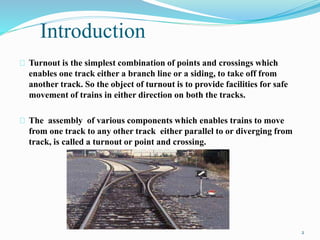
Turnout is the simplest combination of points and crossings which 
enables one track either a branch line or a siding, to take off from 
another track. So the object of turnout is to provide facilities for safe 
movement of trains in either direction on both the tracks. 
The assembly of various components which enables trains to move 
from one track to any other track either parallel to or diverging from 
track, is called a turnout or point and crossing. 
2
Turnout 
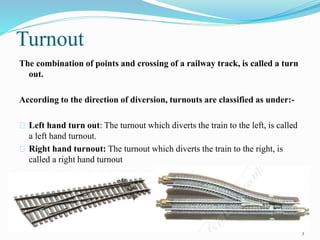
The combination of points and crossing of a railway track, is called a turn 
out. 
According to the direction of diversion, turnouts are classified as under:- 
Left hand turn out: The turnout which diverts the train to the left, is called 
a left hand turnout. 
Right hand turnout: The turnout which diverts the train to the right, is 
called a right hand turnout 
3
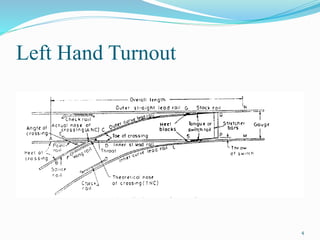
Left Hand Turnout 
4
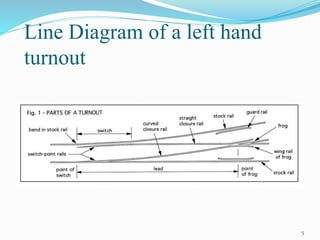
Line Diagram of a left hand 
turnout 
5
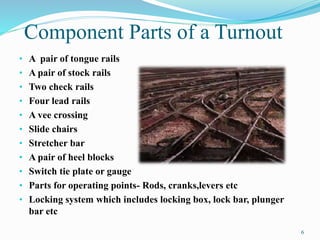
Component Parts of a Turnout 
• A pair of tongue rails 
• A pair of stock rails 
• Two check rails 
• Four lead rails 
• A vee crossing 
• Slide chairs 
• Stretcher bar 
• A pair of heel blocks 
• Switch tie plate or gauge 
• Parts for operating points- Rods, cranks,levers etc 
• Locking system which includes locking box, lock bar, plunger 
bar etc 
6
Important Terms Used 
• Facing Direction: If someone stands at toe of switch and looks 
towards the crossing, then the direction is called “Facing Direction” 
• Trailing Direction: If someone stands at the crossing and looks 
towards the switches then the direction is called “Trailing Direction” 
• Facing Points of Turnouts:When a train travels from the switch to 
the frog, the points are known as facing points of turnouts. 
• Trailing Points of Turnouts:When a train travels in the direction 
from the crossing to the switches, the points are known as trailing 
points or trailing turnouts. 
7
Turnout are basically consists of two main parts 
Points 
Crossings 
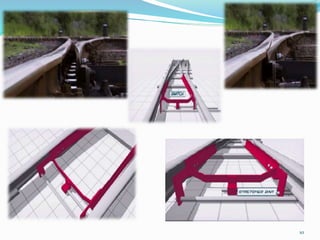
Components of Points 
Stock rail: The rails of the main line track against which tongue rails 
snugly fit, are called stock rail 
Tongue rail: The tapered rails whose thicker ends known as heel are fixed 
to the main track and thinner ends known as toe of the switch to obtain a 
snug fit with the respective stock rails, are called tongue rails, switch rails 
or point rails 
Switch: A stock rail and its respective tongue rails form a switch. A set 
switch is known as points which divert the trains from one track to another. 
8
Heel block: The block which connects the heel of the tongue rail to the 
stock rail, with a ordinary fish plate and bolts, is called the heel block. 
Sliding plate: The metal plates which are provided for supporting and 
sliding the tongue rail to obtain snug fit against the stock rail is called the 
sliding plates. 
Stretcher bar: Two or three bars which are used to connect the ends of the 
tongue rail at the toe to ensure the movement of the tongues through the 
same distance, are called the stretcher bar. 
Point rod: The rod which moves the points by operating a point leaver, is 
called the point rod. 
Throw of switch: The distance through the tongue moves laterally at the 
toe of the switch for movement of trains is known as throw of switch. 
9
10
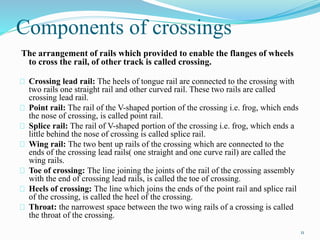
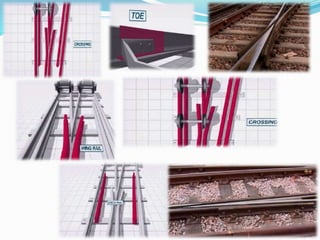
Components of crossings 
The arrangement of rails which provided to enable the flanges of wheels 
to cross the rail, of other track is called crossing. 
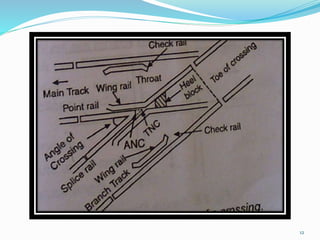
Crossing lead rail: The heels of tongue rail are connected to the crossing with 
two rails one straight rail and other curved rail. These two rails are called 
crossing lead rail. 
Point rail: The rail of the V-shaped portion of the crossing i.e. frog, which ends 
the nose of crossing, is called point rail. 
Splice rail: The rail of V-shaped portion of the crossing i.e. frog, which ends a 
little behind the nose of crossing is called splice rail. 
Wing rail: The two bent up rails of the crossing which are connected to the 
ends of the crossing lead rails( one straight and one curve rail) are called the 
wing rails. 
Toe of crossing: The line joining the joints of the rail of the crossing assembly 
with the end of crossing lead rails, is called the toe of crossing. 
Heels of crossing: The line which joins the ends of the point rail and splice rail 
of the crossing, is called the heel of the crossing. 
Throat: the narrowest space between the two wing rails of a crossing is called 
the throat of the crossing. 
11
12
13
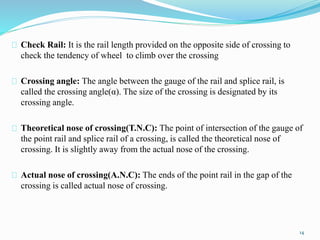
Check Rail: It is the rail length provided on the opposite side of crossing to 
check the tendency of wheel to climb over the crossing 
Crossing angle: The angle between the gauge of the rail and splice rail, is 
called the crossing angle(α). The size of the crossing is designated by its 
crossing angle. 
Theoretical nose of crossing(T.N.C): The point of intersection of the gauge of 
the point rail and splice rail of a crossing, is called the theoretical nose of 
crossing. It is slightly away from the actual nose of the crossing. 
Actual nose of crossing(A.N.C): The ends of the point rail in the gap of the 
crossing is called actual nose of crossing. 
14
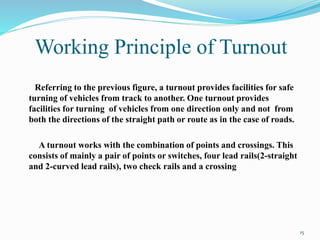
Working Principle of Turnout 
Referring to the previous figure, a turnout provides facilities for safe 
turning of vehicles from track to another. One turnout provides 
facilities for turning of vehicles from one direction only and not from 
both the directions of the straight path or route as in the case of roads. 
A turnout works with the combination of points and crossings. This 
consists of mainly a pair of points or switches, four lead rails(2-straight 
and 2-curved lead rails), two check rails and a crossing 
15
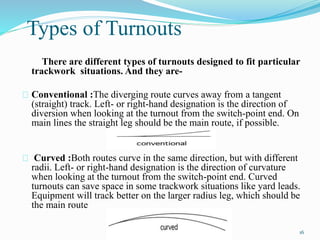
Types of Turnouts 
There are different types of turnouts designed to fit particular 
trackwork situations. And they are- 
Conventional :The diverging route curves away from a tangent 
(straight) track. Left- or right-hand designation is the direction of 
diversion when looking at the turnout from the switch-point end. On 
main lines the straight leg should be the main route, if possible. 
Curved :Both routes curve in the same direction, but with different 
radii. Left- or right-hand designation is the direction of curvature 
when looking at the turnout from the switch-point end. Curved 
turnouts can save space in some trackwork situations like yard leads. 
Equipment will track better on the larger radius leg, which should be 
the main route 
16
Conclusion 
In a developing country like India, the contribution of railway 
transport towards the economic growth is immense at other modes of 
transport ie roadways, airways ,inland waterways etc are not available 
at reasonable rates and in sizeable quantity to cope up with quantum of 
traffic. 
In order to move the traffic efficiently, it is felt that the speed of the rail 
transport shall be augmented. Turnout , an essential feature of the 
track structure for diversion of traffic from one road to another, poses 
at present a tricky problem in the context of achieving reasonably high 
speed over the turnout. 
Turnouts are an essential feature of trackwork but can be trouble 
makers if not done right 
Turnout points are hinged rails that move back and forth(left & right) 
and guide the train’s wheels throughout the turnout’s frog to either the 
straight leg of the turnout or through the curved leg of the turnout. 
17
Reference 
A text book of Railway Engineering-By S.C. Saxena and S.P. Arora 
www.wikipedia.com 
www.modelrectifier.com 
Transportation Engineering II: Railways-By Dr. Charisma Choudhury 
18
19

Left hand turnout

  • 1.
    Presented by- AnamikaDebbarma(DC2011BTE0127) 1
  • 2.
    Introduction Turnout isthe simplest combination of points and crossings which enables one track either a branch line or a siding, to take off from another track. So the object of turnout is to provide facilities for safe movement of trains in either direction on both the tracks. The assembly of various components which enables trains to move from one track to any other track either parallel to or diverging from track, is called a turnout or point and crossing. 2
  • 3.
    Turnout The combinationof points and crossing of a railway track, is called a turn out. According to the direction of diversion, turnouts are classified as under:- Left hand turn out: The turnout which diverts the train to the left, is called a left hand turnout. Right hand turnout: The turnout which diverts the train to the right, is called a right hand turnout 3
  • 4.
  • 5.
    Line Diagram ofa left hand turnout 5
  • 6.
    Component Parts ofa Turnout • A pair of tongue rails • A pair of stock rails • Two check rails • Four lead rails • A vee crossing • Slide chairs • Stretcher bar • A pair of heel blocks • Switch tie plate or gauge • Parts for operating points- Rods, cranks,levers etc • Locking system which includes locking box, lock bar, plunger bar etc 6
  • 7.
    Important Terms Used • Facing Direction: If someone stands at toe of switch and looks towards the crossing, then the direction is called “Facing Direction” • Trailing Direction: If someone stands at the crossing and looks towards the switches then the direction is called “Trailing Direction” • Facing Points of Turnouts:When a train travels from the switch to the frog, the points are known as facing points of turnouts. • Trailing Points of Turnouts:When a train travels in the direction from the crossing to the switches, the points are known as trailing points or trailing turnouts. 7
  • 8.
    Turnout are basicallyconsists of two main parts Points Crossings Components of Points Stock rail: The rails of the main line track against which tongue rails snugly fit, are called stock rail Tongue rail: The tapered rails whose thicker ends known as heel are fixed to the main track and thinner ends known as toe of the switch to obtain a snug fit with the respective stock rails, are called tongue rails, switch rails or point rails Switch: A stock rail and its respective tongue rails form a switch. A set switch is known as points which divert the trains from one track to another. 8
  • 9.
    Heel block: Theblock which connects the heel of the tongue rail to the stock rail, with a ordinary fish plate and bolts, is called the heel block. Sliding plate: The metal plates which are provided for supporting and sliding the tongue rail to obtain snug fit against the stock rail is called the sliding plates. Stretcher bar: Two or three bars which are used to connect the ends of the tongue rail at the toe to ensure the movement of the tongues through the same distance, are called the stretcher bar. Point rod: The rod which moves the points by operating a point leaver, is called the point rod. Throw of switch: The distance through the tongue moves laterally at the toe of the switch for movement of trains is known as throw of switch. 9
  • 10.
  • 11.
    Components of crossings The arrangement of rails which provided to enable the flanges of wheels to cross the rail, of other track is called crossing. Crossing lead rail: The heels of tongue rail are connected to the crossing with two rails one straight rail and other curved rail. These two rails are called crossing lead rail. Point rail: The rail of the V-shaped portion of the crossing i.e. frog, which ends the nose of crossing, is called point rail. Splice rail: The rail of V-shaped portion of the crossing i.e. frog, which ends a little behind the nose of crossing is called splice rail. Wing rail: The two bent up rails of the crossing which are connected to the ends of the crossing lead rails( one straight and one curve rail) are called the wing rails. Toe of crossing: The line joining the joints of the rail of the crossing assembly with the end of crossing lead rails, is called the toe of crossing. Heels of crossing: The line which joins the ends of the point rail and splice rail of the crossing, is called the heel of the crossing. Throat: the narrowest space between the two wing rails of a crossing is called the throat of the crossing. 11
  • 12.
  • 13.
  • 14.
    Check Rail: Itis the rail length provided on the opposite side of crossing to check the tendency of wheel to climb over the crossing Crossing angle: The angle between the gauge of the rail and splice rail, is called the crossing angle(α). The size of the crossing is designated by its crossing angle. Theoretical nose of crossing(T.N.C): The point of intersection of the gauge of the point rail and splice rail of a crossing, is called the theoretical nose of crossing. It is slightly away from the actual nose of the crossing. Actual nose of crossing(A.N.C): The ends of the point rail in the gap of the crossing is called actual nose of crossing. 14
  • 15.
    Working Principle ofTurnout Referring to the previous figure, a turnout provides facilities for safe turning of vehicles from track to another. One turnout provides facilities for turning of vehicles from one direction only and not from both the directions of the straight path or route as in the case of roads. A turnout works with the combination of points and crossings. This consists of mainly a pair of points or switches, four lead rails(2-straight and 2-curved lead rails), two check rails and a crossing 15
  • 16.
    Types of Turnouts There are different types of turnouts designed to fit particular trackwork situations. And they are- Conventional :The diverging route curves away from a tangent (straight) track. Left- or right-hand designation is the direction of diversion when looking at the turnout from the switch-point end. On main lines the straight leg should be the main route, if possible. Curved :Both routes curve in the same direction, but with different radii. Left- or right-hand designation is the direction of curvature when looking at the turnout from the switch-point end. Curved turnouts can save space in some trackwork situations like yard leads. Equipment will track better on the larger radius leg, which should be the main route 16
  • 17.
    Conclusion In adeveloping country like India, the contribution of railway transport towards the economic growth is immense at other modes of transport ie roadways, airways ,inland waterways etc are not available at reasonable rates and in sizeable quantity to cope up with quantum of traffic. In order to move the traffic efficiently, it is felt that the speed of the rail transport shall be augmented. Turnout , an essential feature of the track structure for diversion of traffic from one road to another, poses at present a tricky problem in the context of achieving reasonably high speed over the turnout. Turnouts are an essential feature of trackwork but can be trouble makers if not done right Turnout points are hinged rails that move back and forth(left & right) and guide the train’s wheels throughout the turnout’s frog to either the straight leg of the turnout or through the curved leg of the turnout. 17
  • 18.
    Reference A textbook of Railway Engineering-By S.C. Saxena and S.P. Arora www.wikipedia.com www.modelrectifier.com Transportation Engineering II: Railways-By Dr. Charisma Choudhury 18
  • 19.