

SOIL
Introduction
 From an engineering viewpoint, the
  ground beneath a site can conveniently
  be divided into the categories, based
  upon generalizations of its expected
  behaviour in construction works.
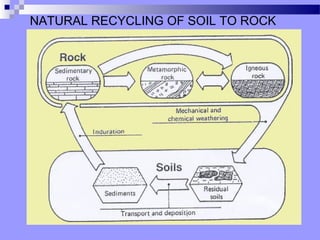
 Soil used to be rock, which was tuned
  into soil by weathering, chemical and
  mechanical forces.
 Nature recycles the soil to rock, that this
  takes millions of years.
NATURAL RECYCLING OF SOIL TO ROCK
HORIZONS

 Surface horizon is usually referred to as
  the O layer. It consists of loose organic
  matter such as fallen leaves and other
  biomass.
 Below is the A horizon, containing a
  mixture organic mineral materials and
  organics.
HORIZONS
 Next is E horizons, layer from which clays,
  iron and aluminum oxides have been lost
  by leaching process
 Below horizons E is B, which most of the
  iron, clays, and other leached materials
  have accumulated.
 After that is C horizons consisting of
  partially weather bedrock
 And last is R horizons of hard bedrock
SOIL

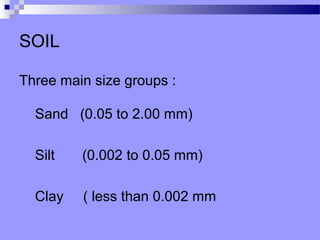
Three main size groups :

  Sand (0.05 to 2.00 mm)

  Silt   (0.002 to 0.05 mm)

  Clay   ( less than 0.002 mm
SOIL CHARACTERISTICS

 Color,
 Texture,
 Aggregation,
 Porosity,
 Ion content and
 pH
COLOR

 Soils come in a wide range of colors.
 Shades of brown, red, orange, yellow,
  gray and even blue or green.
 A dark color usually indicates the
  presence of organic matter.
TEXTURE
 A soil texture depends on its content of the
  three main mineral components of the soil,
  sand ,silt and clay.
 Very fine textured soils may be poorly
  drained.
 Medium texture and a        relatively even
  proportion of all particle sizes are most
  versatile
AGGREGATION
 Individual soil particles tend to be bound
  together into lager units referred to as
  aggregates or soil peds.
 Aggregation occurs as a result of complex
  chemical forces acting an small soil
  components in soil act as glue binding
  particles together.
POROSITY

 Part of the soil that is not solid is made up
  pores of various sizes and shapes
 Porosity greatly affects water movement
  and gas exchange.
ION CONTENT
   Particularly the clay, hold groupings of
    atoms known as ions.
   These ions carry a negative charge.
   Like magnets, these negative ions
    (anions) attract positive ions (cations)
pH
   Another important chemical measured is
    soil pH.

   Refers to the soil acidity or alkalinity.

   A greater concentration of hydrogen
    results in a lower pH, meaning greater
    acidity
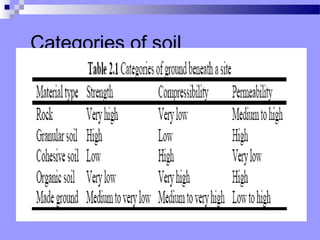
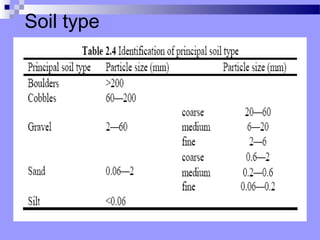
Categories of soil
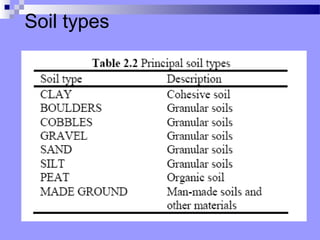
Soil types
Soil type
SOIL INVESTIGATIONS
Soil Investigation
Specifically related to the subsoil
beneath the site under investigation
and could be part of or separate from
the site investigation

A well designed soil investigation can
often lead to project cost savings in
the long term by allowing contractors
to foresee potential problems.
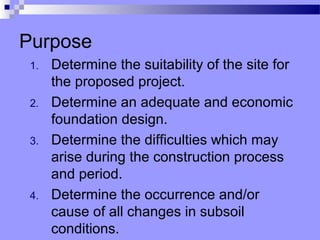
Purpose
 1.   Determine the suitability of the site for
      the proposed project.
 2.   Determine an adequate and economic
      foundation design.
 3.   Determine the difficulties which may
      arise during the construction process
      and period.
 4.   Determine the occurrence and/or
      cause of all changes in subsoil
      conditions.
Soil Samples
 1) Disturbed Soil Samples
  Soil samples obtained from boreholes
  and trial pits. The method of extraction
  disturbs the natural structure for visual
  grading, establishing the moisture
  content and some lab tests. Disturbed
  soil samples should be stored in
  labelled air tight jars.
Soil Samples
 2) Undisturbed Soil Samples

  Soil samples obtained using coring tools which
  preserve the natural structure and properties of
  the subsoil. The extracted undisturbed soil
  samples are labelled and laid in wooden boxes
  for dispatch to a lab for test. This method of
  obtaining soil samples is suitable for rock and
  clay sub-soils but difficulties can be
  experienced in trying to obtain undisturbed soil
  samples in other types of subsoil.
Soil Investigation Methods
      Method chosen will depend on several
      factors:

 1.   Size of contract;
 2.   Type of proposed foundation;
 3.   Type of sample required;
 4.   Type of subsoils which may be
      encountered.
Soil Investigation Methods
      As a general guide the most suitable
      methods in terms of investigation depth
      are:

 1.   Foundations up to 3.000d – trial pits;
 2.   Foundations up to 30.000d –
      borings;
 3.   Foundations over 30.000d – deep
      boring and in-situ examination from
      tunnels and/or deep pits.
Types Of Investigation

    Generally the following soil investigation
    techniques are employed for the majority of
    projects:

   Trial Pitting
   Dynamic Probe Testing
   Cable Percussive Boreholes
   Rotary Drilled Boreholes
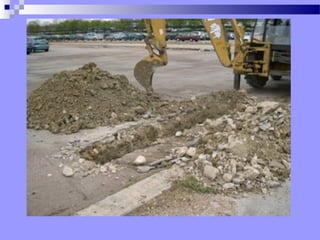
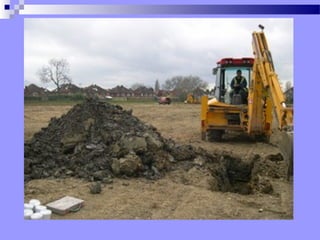
Trial Pitting
    Trial pitting can be carried out by a
     variety of methods from hand dug pits
     to machine excavated trenches.

    Trial pitting is generally carried out to a
     maximum depth of 4.5m with standard
     excavation plant and, depending on
     soil conditions, is generally suitable for
     most low rise developments.
Trial Pitting

   All trial pit investigations are supervised by
    experienced engineers with a thorough
    understanding of geology and soil
    mechanics.
Cable Percussive Boreholes

   Suitable for most projects, cable
    percussive boreholes are a common
    method of site investigation.

   Using a land rover towed rig or a specialist
    cut down rig suited to restricted access
    locations most sites can be investigated
Cable Percussive Boreholes

   In-situ testing techniques including
    Standard        Penetration     Testing,
    Permeability Testing, Borehole Vane
    Testing and Packer Testing can all be
    carried out in the boreholes in order to
    provide information for geotechnical
    design
Cable Percussive Boreholes


   Disturbed and undisturbed samples are
    retrieved from the boreholes for inspection
    and logging by engineers and subsequent
    testing in a laboratories.
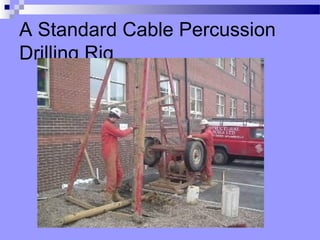
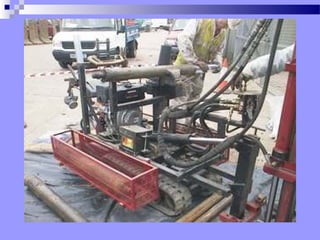
A Standard Cable Percussion
Drilling Rig
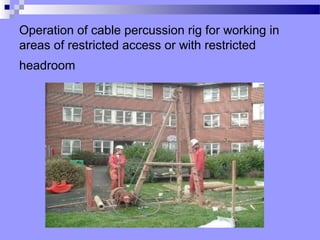
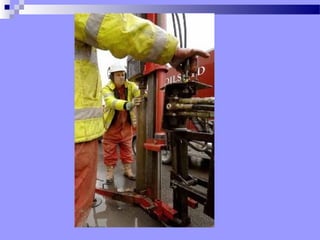
Operation of cable percussion rig for working in
areas of restricted access or with restricted
headroom
Rotary Drilled Boreholes
    Rotary    drilling techniques  are
     employed where boreholes are
     required into very dense gravel or
     bedrock.

    Samples of bedrock are recovered in
     seamless plastic tubes for subsequent
     logging by a suitably qualified
     engineer and for laboratory testing
Rotary Drilled Boreholes

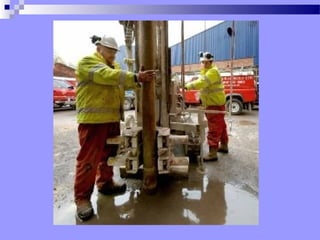
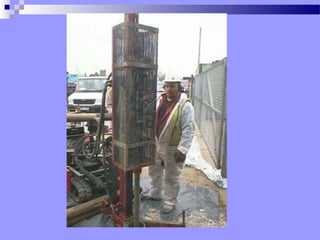
   Most of rotary coring work relies on the
    use of drilling rigs which can also obtain
    continuous samples of soils using
    dynamic sampling equipment.

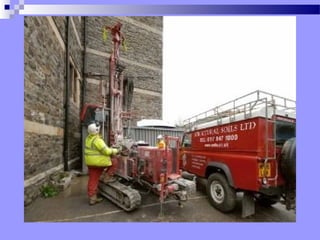
   The rigs are suitable for limited access
    works.
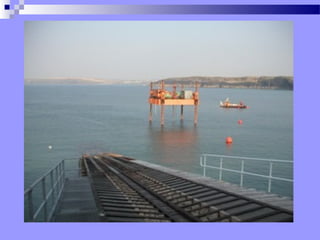
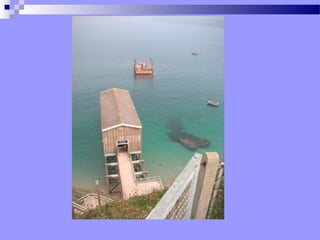
Rotary Drilling Techniques On A
Jackup Platform
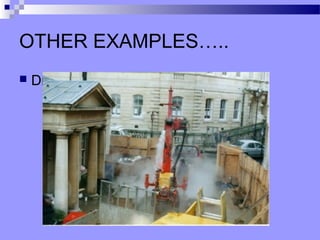
OTHER EXAMPLES…..
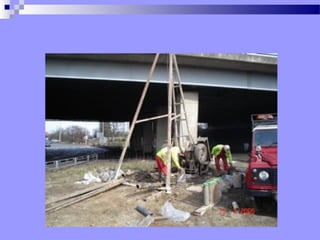
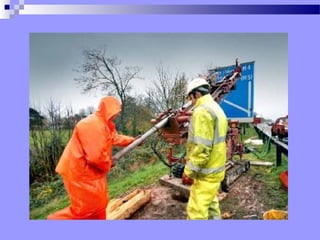
   Drilling in restricted areas…
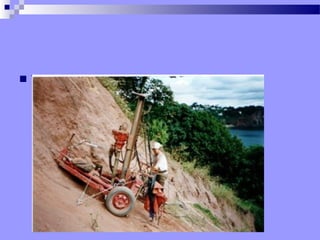
   Working on slopes….
It can be anywhere……

Soil investigation

  • 1.
  • 2.
    Introduction  From anengineering viewpoint, the ground beneath a site can conveniently be divided into the categories, based upon generalizations of its expected behaviour in construction works.  Soil used to be rock, which was tuned into soil by weathering, chemical and mechanical forces.  Nature recycles the soil to rock, that this takes millions of years.
  • 3.
  • 4.
    HORIZONS  Surface horizonis usually referred to as the O layer. It consists of loose organic matter such as fallen leaves and other biomass.  Below is the A horizon, containing a mixture organic mineral materials and organics.
  • 5.
    HORIZONS  Next isE horizons, layer from which clays, iron and aluminum oxides have been lost by leaching process  Below horizons E is B, which most of the iron, clays, and other leached materials have accumulated.  After that is C horizons consisting of partially weather bedrock  And last is R horizons of hard bedrock
  • 6.
    SOIL Three main sizegroups : Sand (0.05 to 2.00 mm) Silt (0.002 to 0.05 mm) Clay ( less than 0.002 mm
  • 7.
    SOIL CHARACTERISTICS  Color, Texture,  Aggregation,  Porosity,  Ion content and  pH
  • 8.
    COLOR  Soils comein a wide range of colors.  Shades of brown, red, orange, yellow, gray and even blue or green.  A dark color usually indicates the presence of organic matter.
  • 9.
    TEXTURE  A soiltexture depends on its content of the three main mineral components of the soil, sand ,silt and clay.  Very fine textured soils may be poorly drained.  Medium texture and a relatively even proportion of all particle sizes are most versatile
  • 10.
    AGGREGATION  Individual soilparticles tend to be bound together into lager units referred to as aggregates or soil peds.  Aggregation occurs as a result of complex chemical forces acting an small soil components in soil act as glue binding particles together.
  • 11.
    POROSITY  Part ofthe soil that is not solid is made up pores of various sizes and shapes  Porosity greatly affects water movement and gas exchange.
  • 12.
    ION CONTENT  Particularly the clay, hold groupings of atoms known as ions.  These ions carry a negative charge.  Like magnets, these negative ions (anions) attract positive ions (cations)
  • 13.
    pH  Another important chemical measured is soil pH.  Refers to the soil acidity or alkalinity.  A greater concentration of hydrogen results in a lower pH, meaning greater acidity
  • 14.
  • 15.
  • 16.
  • 17.
  • 18.
    Soil Investigation Specifically relatedto the subsoil beneath the site under investigation and could be part of or separate from the site investigation A well designed soil investigation can often lead to project cost savings in the long term by allowing contractors to foresee potential problems.
  • 19.
    Purpose 1. Determine the suitability of the site for the proposed project. 2. Determine an adequate and economic foundation design. 3. Determine the difficulties which may arise during the construction process and period. 4. Determine the occurrence and/or cause of all changes in subsoil conditions.
  • 20.
    Soil Samples 1)Disturbed Soil Samples Soil samples obtained from boreholes and trial pits. The method of extraction disturbs the natural structure for visual grading, establishing the moisture content and some lab tests. Disturbed soil samples should be stored in labelled air tight jars.
  • 21.
    Soil Samples 2)Undisturbed Soil Samples Soil samples obtained using coring tools which preserve the natural structure and properties of the subsoil. The extracted undisturbed soil samples are labelled and laid in wooden boxes for dispatch to a lab for test. This method of obtaining soil samples is suitable for rock and clay sub-soils but difficulties can be experienced in trying to obtain undisturbed soil samples in other types of subsoil.
  • 22.
    Soil Investigation Methods Method chosen will depend on several factors: 1. Size of contract; 2. Type of proposed foundation; 3. Type of sample required; 4. Type of subsoils which may be encountered.
  • 23.
    Soil Investigation Methods As a general guide the most suitable methods in terms of investigation depth are: 1. Foundations up to 3.000d – trial pits; 2. Foundations up to 30.000d – borings; 3. Foundations over 30.000d – deep boring and in-situ examination from tunnels and/or deep pits.
  • 24.
    Types Of Investigation Generally the following soil investigation techniques are employed for the majority of projects:  Trial Pitting  Dynamic Probe Testing  Cable Percussive Boreholes  Rotary Drilled Boreholes
  • 25.
    Trial Pitting  Trial pitting can be carried out by a variety of methods from hand dug pits to machine excavated trenches.  Trial pitting is generally carried out to a maximum depth of 4.5m with standard excavation plant and, depending on soil conditions, is generally suitable for most low rise developments.
  • 26.
    Trial Pitting  All trial pit investigations are supervised by experienced engineers with a thorough understanding of geology and soil mechanics.
  • 29.
    Cable Percussive Boreholes  Suitable for most projects, cable percussive boreholes are a common method of site investigation.  Using a land rover towed rig or a specialist cut down rig suited to restricted access locations most sites can be investigated
  • 30.
    Cable Percussive Boreholes  In-situ testing techniques including Standard Penetration Testing, Permeability Testing, Borehole Vane Testing and Packer Testing can all be carried out in the boreholes in order to provide information for geotechnical design
  • 31.
    Cable Percussive Boreholes  Disturbed and undisturbed samples are retrieved from the boreholes for inspection and logging by engineers and subsequent testing in a laboratories.
  • 32.
    A Standard CablePercussion Drilling Rig
  • 34.
    Operation of cablepercussion rig for working in areas of restricted access or with restricted headroom
  • 35.
    Rotary Drilled Boreholes  Rotary drilling techniques are employed where boreholes are required into very dense gravel or bedrock.  Samples of bedrock are recovered in seamless plastic tubes for subsequent logging by a suitably qualified engineer and for laboratory testing
  • 36.
    Rotary Drilled Boreholes  Most of rotary coring work relies on the use of drilling rigs which can also obtain continuous samples of soils using dynamic sampling equipment.  The rigs are suitable for limited access works.
  • 43.
    Rotary Drilling TechniquesOn A Jackup Platform
  • 46.
    OTHER EXAMPLES…..  Drilling in restricted areas…
  • 47.
    Working on slopes….
  • 48.
    It can beanywhere……