SOIL SAMPLING


MIDWEST LABORATORIES, INC. • 13611 B STREET • OMAHA, NE 68144 • 402-334-7770 • FAX 402-334-9121
Soil Sampling Methods
Properly collecting soil samples is the most important step in any nutrient/soil amendment management program. Soil
sampling should reflect tillage, past fertilizer/soil amendment placement, cropping patterns (and corresponding irrigation
requirements), soil type (including drainage and slope characteristics) and perhaps old field boundaries (such as old
feedlots, windrows, altered stream beds, etc.). Trends toward reduced and/or zero tillage and technology for variable
rate fertilization (VRF) have especially demanded that soil samples be taken more comprehensively and intensively for
more accurate fertilizer and soil amendment application. This brochure will discuss the many methods used for taking an
accurate soil sample using various methods and under several different types of tillage situations.
The most commonly used method for soil sampling would be based on soil types. Fields are split into sampling areas
that contain similar soils. Hillsides are kept separate from bottoms since the soil types will vary. Soil survey maps, if
applicable, can help organize the soil types throughout the sampling area. Samples will not necessarily need to be
collected for every soil type; however, similar soils should be kept together. Sampling maps can be kept to note the
locations of the cores for subsequent sampling.
The sampling area will be dependent on the soils and topography. Generally, an area of forty acres is considered the
maximum size. Smaller sampling areas may be needed if the soils are quite variable or a production problem is apparent.
Once the sampling area is determined, a sufficient number of cores should be taken to acquire a representative sample.
This is generally 10 to 20 cores. The depth of sample for surface soils would be 0 to 6 inches or as deep as the primary
tillage. Deeper samples to 24 or 36 inches can be taken for residual nitrate-nitrogen. These deep samples would be
kept separate from the surface samples and noted accordingly on the bag and submittal form.


Seasonal Effects on Soil Test Values                                        Crop Effects on Soil Test Values
There can be considerable seasonal influence on soil test values            Soil sampling events should be consistent as much as possible
and every effort to maintain consistency within season when                 as significant differences in total nutrient uptake between crops
taking soil tests should be made. The two analytes most affected            or crop specific nutrient inputs exist that can impact on soil test
by seasonal influences are potassium and pH.                                values. For instance, in the fall, exchangeable potassium will
                                                                            test lower following corn than following soybeans, due to larger
In the northern corn belt regions (Ohio, Indiana, Illinois,                 seasonal potassium uptake by corn during the growing season.
Wisconsin, Minnesota, Iowa, northern Missouri, Nebraska,                    Soil pH may be lower in the early fall following corn vs. following
northern Kansas and the Dakotas) on soils having medium to                  soybeans, due to nitrogen and/or sulfur inputs on the corn.
high clay contents, potassium soil test values have a tendency              Irrigation requirements vary between crops, leading to possible
to be higher during the winter months.                                      soil test variations following the irrigation season in the areas of
                                                                            nitrate-nitrogen, sulfate-sulfur, boron, soil pH, sodium,
Soil pH values can also vary appreciably over the year depending            carbonates, and electrical conductivity as a function of soluble
on nitrogen and sulfur inputs, amounts of rainfall or irrigation            salts. Effect of a given crop on seasonal nutrient uptake and
and soil buffering capacity (amount and types of clay and free              crop specific nutrient/irrigation requirements can help explain a
carbonates).                                                                great deal of year to year soil test variation.

Given that soil test values will vary between seasons, one                  Reduced Tillage, Ridge Tillage and Zero Tillage
approach as to when soil samples should be taken is during
those periods when the variations hit average values. These                 These tillage systems have been demonstrated to cause
periods are generally in the early fall (September-November)                significant layered, stratification of organic matter, pH and soil
and again in the late March-April time frames. In attempts to               nutrients (especially where subsurface banding of fertilizer is
ideally correlate soil test values to yield, tests should be taken to       not utilized). Reduced tillage, ridge tillage and zero tillage soil
coincide with a given crop’s critical nutrient demand period,               samples should include some samples that are split into 0"-3"
usually when nutrient uptake is at its fastest rate. Most generally,        and 3"-7" depth increments, to properly assess to what extent
however, the ideal time frame for taking soil samples should be             stratification is occurring in order to modify fertilizer/soil
based on ease of field access, so that differences in soil type,            amendment rates, timing and/or placement. When sampling
slope, drainage and cropping pattern can be most easily                     for ridge till, it is recommended that the sample is taken halfway
accounted for.                                                              down the ridge at a 45 º angle to the ridge.

Year to year variation of soil test values can be appreciable as            Soil Sampling in Fields Where Fertilizer Has Been
well, depending on the amount and timing of rainfall, and the
duration of freezing and thawing over the winter months.
                                                                            Banded
Considerable interpretive value can be obtained from soil tests             Where location of bands are known:
taken consecutively over 5-7 years to establish the extent of yearly
variability in attempts to better manage fertilizer and soil                (i) 30-inch band spacing: one in-the-band core for every twenty
amendment inputs for build-up, draw-down or maintenance                     between-the-band cores.
purposes.
                                                                        1
(ii) 15-inch band spacing: one in-the-band core for every eight               fig. 1. Schematic showing the layout of a square grid and
between-the-band cores.                                                                locations where soil cores would be collected.

Where location of the bands are unknown: at least 20 pairs of                                                                10' radius
cores to make one sample taken in a random pattern. The
second core of each pair is taken at a distance of 50% of the
band spacing from the first core, perpendicular to the band
direction.
                                                                                                                   •   A grid of equally spaced lines is
                                                                                                                       established.
Grid Soil Sampling
                                                                                                                   •   8 soil cores randomly collected within
                                                                                                                       a 10-ft. radius of the grid center.
Development of site-specific nutrient management via global
positioning systems (GPS) and variable rate fertilization (VRF)                                                    •   Cores composited as one soil
                                                                                                                       sample.
demands that soil sampling be intensively organized into a
systematic grid pattern.                                                                  Systematic Grid -Square Sampling Pattern
Grid soil samples should be taken at a specific point, either within
the grid cell or at intersection points between grid cells, consisting
of 8-10 cores per sample taken within a 10-foot radius (see figure
1). To more correctly represent soil test variability within a field
(especially for implementation of soil test mapping), the grid sample         fig. 2. Modification of a square grid where alternating rows of
points should be organized into a systematic grid-diamond pattern                      sample points are shifted one half thedistance from the
or a systematic unaligned grid pattern as shown in figures 2 and                       cell center and edge.
3. The grid-diamond pattern is accomplished by shifting the sample
points to the left or right of the grid cell center in alternating rows
perpendicular to the measurement pattern (established by counting
rows, using distance measuring devices, or GPS). The systematic
unaligned sampling pattern is best utilized via GPS, following this
procedure:

•   Divide the field into cells by means of a coarse grid. Square
    cells are the norm but not mandatory.

•   Superimpose a finer grid (reference grid) in each coarse cell.
    For example, if there are 5 rows and 5 columns in the coarse
    grid, you might choose to divide each coarse cell into 25 smaller                   Systematic Grid - Diamond Sampling Pattern
    cells.

•   Choose a corner of the coarse grid, say top left, and randomly
    select a reference cell—in this sample, one of the 25 refer-              fig 3. Schematic showing the layout of a systematic unaligned
    ence cells.                                                                        grid. The x, y coordinates were determined from a
                                                                                       random number table.
•   Move horizontally to the next coarse cell in the top row and
                                                                                                     2    4    2       5        3
    keep the X coordinate the same but randomly select a new Y
    coordinate.                                                                                 2


•   Repeat the process for all the coarse cells in the top row.                                 3


•   Return to the upper left corner and repeat the process down                                 5
    the first column of cells, this time keeping the Y coordinate the
    same, but changing the X coordinate in each successively                                    4
    lower coarse cell.
                                                                                                5
•   The remaining positions are determined by the X coordinate
    of the point in the left-hand square of its row and the Y coordi-                               Systematic Unaligned Grid
    nate of the point in the uppermost square of its column.

With this procedure a constant interval both along the rows and               rates should be grid point sampled on a 300 to 450-ft. grid (2.5 to
down the columns is maintained without alignment.                             5.0 acres). Fields that have previously tested less than high in
                                                                              nutrient levels or that have demonstrated response to added
The size of the grid cell sampling pattern should be based on                 fertilizer and also have received consistent crop removal
previous fertilizer response over a given field, and can be further           fertilization should be grid point sampled on a grid no larger than
adjusted with ongoing yield data from on-board combine yield                  200 ft. (1.5 acres). If a single rate of fertilizer is to be applied,
monitor systems. Fields that test high to very high in nutrient               then a larger grid cell pattern can be utilized (450-600 ft:5-10
levels and that have consistently received crop removal fertilization         acres), following a grid cell sampling pattern, as shown in fig. 4.


                                                                          2
fig. 4. Schematic showing layout of 318-ft cells and locations                                    NEMATODE SAMPLING
              where soil cores would be collected for a 125-acre field
              (total of 54 samples).
                                                                                                  Soybean Cyst Nematodes (SCN)
                                       318' grid
                                                                                                  The optimum time to sample for SCN is as close to soybean harvest
                                        318'
                                                                                                  as possible. The population will tend to fluctuate throughout the
                              }                                                                   season and can be affected by soil temperature, moisture, host
                                                         318'                                     suitability and over winter survival. SCN populations tend to be
                                                                                                  highest when host plants are almost mature to shortly after harvest.

                                              • The field is divided into square cells.           Samples should be taken 0 to 6 inches in depth and taken from
                                              • 5 soil cores collected within the cell.
                                                                                                  similar soil textures. Cores should be taken within two inches of
                                                                                                  the row. If the row is not identifiable, make use of zigzag pattern
                                              • Cores composited as one soil sample.
                                                                                                  throughout the intended field. Areas in the field where significant
                      Grid Cell Sampling Technique                                                stress has occurred should be sampled differently. The cores
                    Soil Test Values Represent an Area                                            should be taken between the affected plants and healthy plants.
                                                                                                  Severely stressed plants cannot support the higher populations.
Non-Grid Soil Sampling
While this method is less systematic and precise than grid                                        Parasitic Nematodes
sampling, reliable results can be obtained if sample points and/or
walk patterns are consistent between sampling events (utilizing                                   These nematodes are the microscopic organisms that are found
row counts, distance measuring devices, or GPS). The area                                         in soils that can feed on many types of plants. Seasonal fluctuations
represented by each sample should be no more than 20 acres                                        will occur. The populations and nematode activity will decrease
depending on soil type, slope, drainage, old field boundaries and                                 as root growth declines and soil temperatures cool between 60½ F
variation in cropping pattern. 15-25 cores per sample are                                         and raise above 85½ F. The optimum sampling time would be
recommended.                                                                                      when soil temperatures are between 60½ and 80½ F. Optimum
                                                                                                  moisture content should be 50-80% of field capacity. Samples
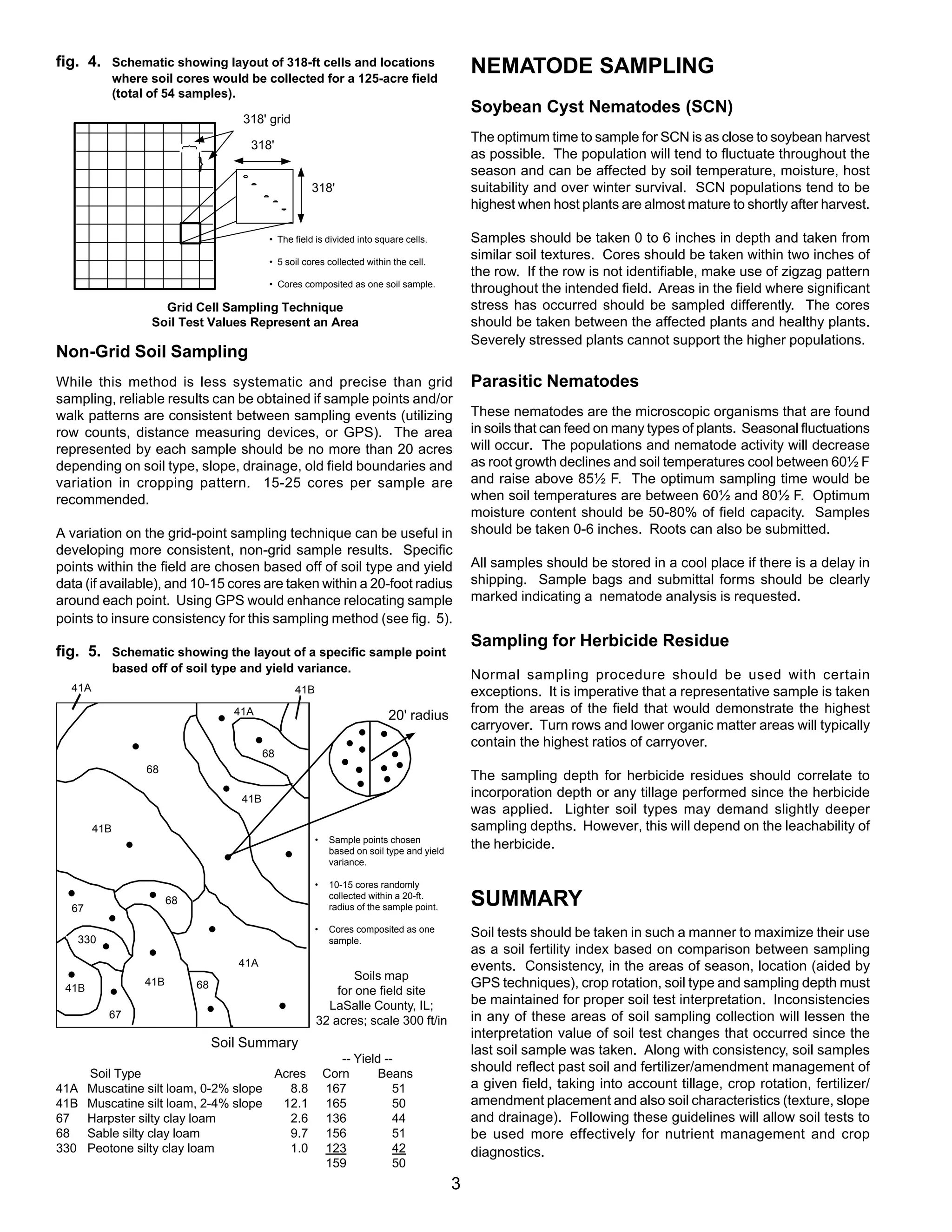
A variation on the grid-point sampling technique can be useful in                                 should be taken 0-6 inches. Roots can also be submitted.
developing more consistent, non-grid sample results. Specific
points within the field are chosen based off of soil type and yield                               All samples should be stored in a cool place if there is a delay in
data (if available), and 10-15 cores are taken within a 20-foot radius                            shipping. Sample bags and submittal forms should be clearly
around each point. Using GPS would enhance relocating sample                                      marked indicating a nematode analysis is requested.
points to insure consistency for this sampling method (see fig. 5).
                                                                                                  Sampling for Herbicide Residue
fig. 5. Schematic showing the layout of a specific sample point
              based off of soil type and yield variance.
                                                                                                  Normal sampling procedure should be used with certain
  41A                                               41B                                           exceptions. It is imperative that a representative sample is taken
                                      41A                                    20' radius           from the areas of the field that would demonstrate the highest
                                                                                                  carryover. Turn rows and lower organic matter areas will typically
                                                                                                  contain the highest ratios of carryover.
                                             68
                    68
                                                                                                  The sampling depth for herbicide residues should correlate to
                                       41B
                                                                                                  incorporation depth or any tillage performed since the herbicide
                                                                                                  was applied. Lighter soil types may demand slightly deeper
        41B                                                                                       sampling depths. However, this will depend on the leachability of
                                                          •    Sample points chosen
                                                               based on soil type and yield
                                                                                                  the herbicide.
                                                               variance.

                                                          •    10-15 cores randomly

  67
                         68                                    collected within a 20-ft.
                                                               radius of the sample point.        SUMMARY
                                                          •    Cores composited as one            Soil tests should be taken in such a manner to maximize their use
   330                                                         sample.
                                                                                                  as a soil fertility index based on comparison between sampling
                                      41A                                                         events. Consistency, in the areas of season, location (aided by
                                                                  Soils map
 41B
                   41B        68                                                                  GPS techniques), crop rotation, soil type and sampling depth must
                                                              for one field site
                                                            LaSalle County, IL;                   be maintained for proper soil test interpretation. Inconsistencies
          67                                                                                      in any of these areas of soil sampling collection will lessen the
                                                          32 acres; scale 300 ft/in
                                                                                                  interpretation value of soil test changes that occurred since the
                                   Soil Summary
                                                                                                  last soil sample was taken. Along with consistency, soil samples
                                                                 -- Yield --
    Soil Type                       Acres                     Corn       Beans
                                                                                                  should reflect past soil and fertilizer/amendment management of
41A Muscatine silt loam, 0-2% slope   8.8                     167           51                    a given field, taking into account tillage, crop rotation, fertilizer/
41B Muscatine silt loam, 2-4% slope  12.1                     165           50                    amendment placement and also soil characteristics (texture, slope
67 Harpster silty clay loam           2.6                     136           44                    and drainage). Following these guidelines will allow soil tests to
68 Sable silty clay loam              9.7                     156           51                    be used more effectively for nutrient management and crop
330 Peotone silty clay loam           1.0                     123           42                    diagnostics.
                                                              159           50
                                                                                              3

Soil Sampling

  • 1.
    SOIL SAMPLING MIDWEST LABORATORIES,INC. • 13611 B STREET • OMAHA, NE 68144 • 402-334-7770 • FAX 402-334-9121
  • 2.
    Soil Sampling Methods Properlycollecting soil samples is the most important step in any nutrient/soil amendment management program. Soil sampling should reflect tillage, past fertilizer/soil amendment placement, cropping patterns (and corresponding irrigation requirements), soil type (including drainage and slope characteristics) and perhaps old field boundaries (such as old feedlots, windrows, altered stream beds, etc.). Trends toward reduced and/or zero tillage and technology for variable rate fertilization (VRF) have especially demanded that soil samples be taken more comprehensively and intensively for more accurate fertilizer and soil amendment application. This brochure will discuss the many methods used for taking an accurate soil sample using various methods and under several different types of tillage situations. The most commonly used method for soil sampling would be based on soil types. Fields are split into sampling areas that contain similar soils. Hillsides are kept separate from bottoms since the soil types will vary. Soil survey maps, if applicable, can help organize the soil types throughout the sampling area. Samples will not necessarily need to be collected for every soil type; however, similar soils should be kept together. Sampling maps can be kept to note the locations of the cores for subsequent sampling. The sampling area will be dependent on the soils and topography. Generally, an area of forty acres is considered the maximum size. Smaller sampling areas may be needed if the soils are quite variable or a production problem is apparent. Once the sampling area is determined, a sufficient number of cores should be taken to acquire a representative sample. This is generally 10 to 20 cores. The depth of sample for surface soils would be 0 to 6 inches or as deep as the primary tillage. Deeper samples to 24 or 36 inches can be taken for residual nitrate-nitrogen. These deep samples would be kept separate from the surface samples and noted accordingly on the bag and submittal form. Seasonal Effects on Soil Test Values Crop Effects on Soil Test Values There can be considerable seasonal influence on soil test values Soil sampling events should be consistent as much as possible and every effort to maintain consistency within season when as significant differences in total nutrient uptake between crops taking soil tests should be made. The two analytes most affected or crop specific nutrient inputs exist that can impact on soil test by seasonal influences are potassium and pH. values. For instance, in the fall, exchangeable potassium will test lower following corn than following soybeans, due to larger In the northern corn belt regions (Ohio, Indiana, Illinois, seasonal potassium uptake by corn during the growing season. Wisconsin, Minnesota, Iowa, northern Missouri, Nebraska, Soil pH may be lower in the early fall following corn vs. following northern Kansas and the Dakotas) on soils having medium to soybeans, due to nitrogen and/or sulfur inputs on the corn. high clay contents, potassium soil test values have a tendency Irrigation requirements vary between crops, leading to possible to be higher during the winter months. soil test variations following the irrigation season in the areas of nitrate-nitrogen, sulfate-sulfur, boron, soil pH, sodium, Soil pH values can also vary appreciably over the year depending carbonates, and electrical conductivity as a function of soluble on nitrogen and sulfur inputs, amounts of rainfall or irrigation salts. Effect of a given crop on seasonal nutrient uptake and and soil buffering capacity (amount and types of clay and free crop specific nutrient/irrigation requirements can help explain a carbonates). great deal of year to year soil test variation. Given that soil test values will vary between seasons, one Reduced Tillage, Ridge Tillage and Zero Tillage approach as to when soil samples should be taken is during those periods when the variations hit average values. These These tillage systems have been demonstrated to cause periods are generally in the early fall (September-November) significant layered, stratification of organic matter, pH and soil and again in the late March-April time frames. In attempts to nutrients (especially where subsurface banding of fertilizer is ideally correlate soil test values to yield, tests should be taken to not utilized). Reduced tillage, ridge tillage and zero tillage soil coincide with a given crop’s critical nutrient demand period, samples should include some samples that are split into 0"-3" usually when nutrient uptake is at its fastest rate. Most generally, and 3"-7" depth increments, to properly assess to what extent however, the ideal time frame for taking soil samples should be stratification is occurring in order to modify fertilizer/soil based on ease of field access, so that differences in soil type, amendment rates, timing and/or placement. When sampling slope, drainage and cropping pattern can be most easily for ridge till, it is recommended that the sample is taken halfway accounted for. down the ridge at a 45 º angle to the ridge. Year to year variation of soil test values can be appreciable as Soil Sampling in Fields Where Fertilizer Has Been well, depending on the amount and timing of rainfall, and the duration of freezing and thawing over the winter months. Banded Considerable interpretive value can be obtained from soil tests Where location of bands are known: taken consecutively over 5-7 years to establish the extent of yearly variability in attempts to better manage fertilizer and soil (i) 30-inch band spacing: one in-the-band core for every twenty amendment inputs for build-up, draw-down or maintenance between-the-band cores. purposes. 1
  • 3.
    (ii) 15-inch bandspacing: one in-the-band core for every eight fig. 1. Schematic showing the layout of a square grid and between-the-band cores. locations where soil cores would be collected. Where location of the bands are unknown: at least 20 pairs of 10' radius cores to make one sample taken in a random pattern. The second core of each pair is taken at a distance of 50% of the band spacing from the first core, perpendicular to the band direction. • A grid of equally spaced lines is established. Grid Soil Sampling • 8 soil cores randomly collected within a 10-ft. radius of the grid center. Development of site-specific nutrient management via global positioning systems (GPS) and variable rate fertilization (VRF) • Cores composited as one soil sample. demands that soil sampling be intensively organized into a systematic grid pattern. Systematic Grid -Square Sampling Pattern Grid soil samples should be taken at a specific point, either within the grid cell or at intersection points between grid cells, consisting of 8-10 cores per sample taken within a 10-foot radius (see figure 1). To more correctly represent soil test variability within a field (especially for implementation of soil test mapping), the grid sample fig. 2. Modification of a square grid where alternating rows of points should be organized into a systematic grid-diamond pattern sample points are shifted one half thedistance from the or a systematic unaligned grid pattern as shown in figures 2 and cell center and edge. 3. The grid-diamond pattern is accomplished by shifting the sample points to the left or right of the grid cell center in alternating rows perpendicular to the measurement pattern (established by counting rows, using distance measuring devices, or GPS). The systematic unaligned sampling pattern is best utilized via GPS, following this procedure: • Divide the field into cells by means of a coarse grid. Square cells are the norm but not mandatory. • Superimpose a finer grid (reference grid) in each coarse cell. For example, if there are 5 rows and 5 columns in the coarse grid, you might choose to divide each coarse cell into 25 smaller Systematic Grid - Diamond Sampling Pattern cells. • Choose a corner of the coarse grid, say top left, and randomly select a reference cell—in this sample, one of the 25 refer- fig 3. Schematic showing the layout of a systematic unaligned ence cells. grid. The x, y coordinates were determined from a random number table. • Move horizontally to the next coarse cell in the top row and 2 4 2 5 3 keep the X coordinate the same but randomly select a new Y coordinate. 2 • Repeat the process for all the coarse cells in the top row. 3 • Return to the upper left corner and repeat the process down 5 the first column of cells, this time keeping the Y coordinate the same, but changing the X coordinate in each successively 4 lower coarse cell. 5 • The remaining positions are determined by the X coordinate of the point in the left-hand square of its row and the Y coordi- Systematic Unaligned Grid nate of the point in the uppermost square of its column. With this procedure a constant interval both along the rows and rates should be grid point sampled on a 300 to 450-ft. grid (2.5 to down the columns is maintained without alignment. 5.0 acres). Fields that have previously tested less than high in nutrient levels or that have demonstrated response to added The size of the grid cell sampling pattern should be based on fertilizer and also have received consistent crop removal previous fertilizer response over a given field, and can be further fertilization should be grid point sampled on a grid no larger than adjusted with ongoing yield data from on-board combine yield 200 ft. (1.5 acres). If a single rate of fertilizer is to be applied, monitor systems. Fields that test high to very high in nutrient then a larger grid cell pattern can be utilized (450-600 ft:5-10 levels and that have consistently received crop removal fertilization acres), following a grid cell sampling pattern, as shown in fig. 4. 2
  • 4.
    fig. 4. Schematicshowing layout of 318-ft cells and locations NEMATODE SAMPLING where soil cores would be collected for a 125-acre field (total of 54 samples). Soybean Cyst Nematodes (SCN) 318' grid The optimum time to sample for SCN is as close to soybean harvest 318' as possible. The population will tend to fluctuate throughout the } season and can be affected by soil temperature, moisture, host 318' suitability and over winter survival. SCN populations tend to be highest when host plants are almost mature to shortly after harvest. • The field is divided into square cells. Samples should be taken 0 to 6 inches in depth and taken from • 5 soil cores collected within the cell. similar soil textures. Cores should be taken within two inches of the row. If the row is not identifiable, make use of zigzag pattern • Cores composited as one soil sample. throughout the intended field. Areas in the field where significant Grid Cell Sampling Technique stress has occurred should be sampled differently. The cores Soil Test Values Represent an Area should be taken between the affected plants and healthy plants. Severely stressed plants cannot support the higher populations. Non-Grid Soil Sampling While this method is less systematic and precise than grid Parasitic Nematodes sampling, reliable results can be obtained if sample points and/or walk patterns are consistent between sampling events (utilizing These nematodes are the microscopic organisms that are found row counts, distance measuring devices, or GPS). The area in soils that can feed on many types of plants. Seasonal fluctuations represented by each sample should be no more than 20 acres will occur. The populations and nematode activity will decrease depending on soil type, slope, drainage, old field boundaries and as root growth declines and soil temperatures cool between 60½ F variation in cropping pattern. 15-25 cores per sample are and raise above 85½ F. The optimum sampling time would be recommended. when soil temperatures are between 60½ and 80½ F. Optimum moisture content should be 50-80% of field capacity. Samples A variation on the grid-point sampling technique can be useful in should be taken 0-6 inches. Roots can also be submitted. developing more consistent, non-grid sample results. Specific points within the field are chosen based off of soil type and yield All samples should be stored in a cool place if there is a delay in data (if available), and 10-15 cores are taken within a 20-foot radius shipping. Sample bags and submittal forms should be clearly around each point. Using GPS would enhance relocating sample marked indicating a nematode analysis is requested. points to insure consistency for this sampling method (see fig. 5). Sampling for Herbicide Residue fig. 5. Schematic showing the layout of a specific sample point based off of soil type and yield variance. Normal sampling procedure should be used with certain 41A 41B exceptions. It is imperative that a representative sample is taken 41A 20' radius from the areas of the field that would demonstrate the highest carryover. Turn rows and lower organic matter areas will typically contain the highest ratios of carryover. 68 68 The sampling depth for herbicide residues should correlate to 41B incorporation depth or any tillage performed since the herbicide was applied. Lighter soil types may demand slightly deeper 41B sampling depths. However, this will depend on the leachability of • Sample points chosen based on soil type and yield the herbicide. variance. • 10-15 cores randomly 67 68 collected within a 20-ft. radius of the sample point. SUMMARY • Cores composited as one Soil tests should be taken in such a manner to maximize their use 330 sample. as a soil fertility index based on comparison between sampling 41A events. Consistency, in the areas of season, location (aided by Soils map 41B 41B 68 GPS techniques), crop rotation, soil type and sampling depth must for one field site LaSalle County, IL; be maintained for proper soil test interpretation. Inconsistencies 67 in any of these areas of soil sampling collection will lessen the 32 acres; scale 300 ft/in interpretation value of soil test changes that occurred since the Soil Summary last soil sample was taken. Along with consistency, soil samples -- Yield -- Soil Type Acres Corn Beans should reflect past soil and fertilizer/amendment management of 41A Muscatine silt loam, 0-2% slope 8.8 167 51 a given field, taking into account tillage, crop rotation, fertilizer/ 41B Muscatine silt loam, 2-4% slope 12.1 165 50 amendment placement and also soil characteristics (texture, slope 67 Harpster silty clay loam 2.6 136 44 and drainage). Following these guidelines will allow soil tests to 68 Sable silty clay loam 9.7 156 51 be used more effectively for nutrient management and crop 330 Peotone silty clay loam 1.0 123 42 diagnostics. 159 50 3