PRESENTED BY
INDRANIL BANERJEE
ENROLLMENT NO-CEM18005
SUB:GEOTECHNICAL EXPLORATION AND TESTING(CE502)
DEPARTMENT OF CIVIL ENGINEERING
TEZPUR UNIVERSITY
CONTENTS
 INTRODUCTION
 USES SPT TEST
 USEFULL IN FINDING OUT
 INSTRUMENTS
 PROCEDURE
 CURRECTIONS
 USEFULLNESS AND LIMITATION OF SPT
 REFERENCE
INTRODUCTION
 The Standard Penetration test (SPT) is a common
in situ testing method used to determine the
geotechnical engineering properties of subsurface
soils. It is a simple and inexpensive test to estimate the
relative density of soils and approximate shear
strength parameters.
USES SPT TEST
These can be used for identification test like specific
gravity, grain size distribution, Atterberg limit,
compaction etc.
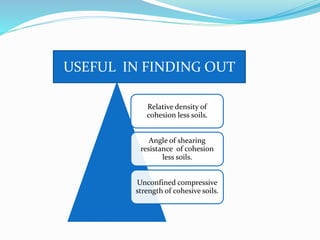
Relative density of
cohesion less soils.
Angle of shearing
resistance of cohesion
less soils.
Unconfined compressive
strength of cohesive soils.
USEFUL IN FINDING OUT
INSTRUMENTS
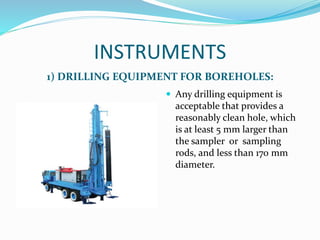
1) DRILLING EQUIPMENT FOR BOREHOLES:
 Any drilling equipment is
acceptable that provides a
reasonably clean hole, which
is at least 5 mm larger than
the sampler or sampling
rods, and less than 170 mm
diameter.
INSTRUMENTS
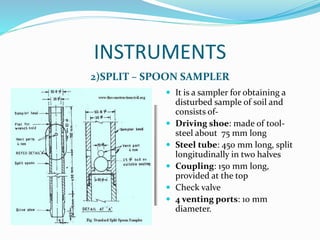
2)SPLIT – SPOON SAMPLER
 It is a sampler for obtaining a
disturbed sample of soil and
consists of-
 Driving shoe: made of tool-
steel about 75 mm long
 Steel tube: 450 mm long, split
longitudinally in two halves
 Coupling: 150 mm long,
provided at the top
 Check valve
 4 venting ports: 10 mm
diameter.
INSTRUMENTS
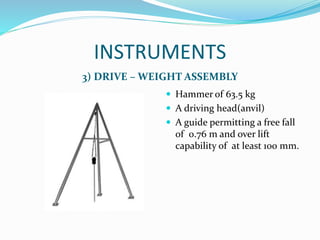
3) DRIVE – WEIGHT ASSEMBLY
 Hammer of 63.5 kg
 A driving head(anvil)
 A guide permitting a free fall
of 0.76 m and over lift
capability of at least 100 mm.
INSTRUMENTS
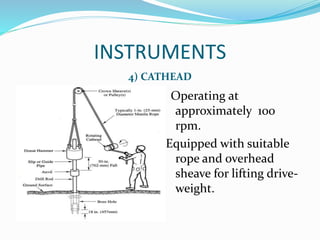
4) CATHEAD
Operating at
approximately 100
rpm.
Equipped with suitable
rope and overhead
sheave for lifting drive-
weight.
INSTRUMENTS
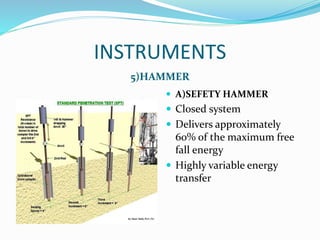
5)HAMMER
 A)SEFETY HAMMER
 Closed system
 Delivers approximately
60% of the maximum free
fall energy
 Highly variable energy
transfer
INSTRUMENTS
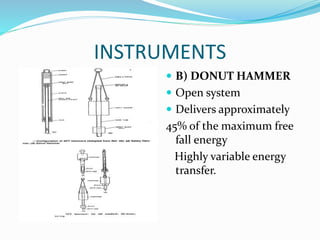
 B) DONUT HAMMER
 Open system
 Delivers approximately
45% of the maximum free
fall energy
Highly variable energy
transfer.
INSTRUMENTS
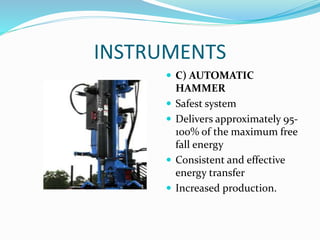
 C) AUTOMATIC
HAMMER
 Safest system
 Delivers approximately 95-
100% of the maximum free
fall energy
 Consistent and effective
energy transfer
 Increased production.
PROCEDURE
1)DRILLING OF BOREHOLE
 Drill the borehole to the desired sampling depth and clean
out all disturbed material.
 The equipment used shall provide a clean borehole, 100 to
150 mm in diameter, for insertion of the sampler to ensure
that the penetration test is performed on undisturbed soil.
 Casing shall be used when drilling in sand, soft clay or other
soils in which the sides of borehole are likely to cave in.
PROCEDURE
2) DRIVING THE CASING
 Where casing is used, it shall not be driven below the level at
which the test is made or soil sample is taken.
 In the case of cohesion less soils which cannot stand without
casing, the advancement of the casing pipe should be such that
it does not disturb the soil to be tested or sampled; the casing
shall preferably be advanced by slowly turning the casing
rather then by driving may alter the density of such deposits
immediately below the bottom of the borehole.
PROCEDURE
3) ASSEMBLING EQUIPMENT
 Attach the split-spoon sampler to the drill rod and lower
into the hole until it is sitting on the undisturbed material.
 Attach the drive weight assembly.
 Lift the 63.5 kg hammer approximately 0.76 m and allow it
to fall on the anvil delivering one seating blow.
 Mark the drill rod in 3 successive .15 m increments to
observe penetration.
PROCEDURE
4) PENETRATION TESTING
 Raise and drop the hammer 0.76 m successively by means of
the rope and cathead, using no more than two and one forth
wraps around the cathead.
 The hammer should be operated between 40 and 60 blows
per minute and should drop freely.
 Record the number of blows for each .15 m of the penetration.
 The first .15 m increment is the “seating” drive.
PROCEDURE
 The sum of the blows for second and third increment
of 0.15 m penetration is termed “penetration resistance
or N-value”.
 If the split spoon sampler is driven less then 45
cm(total), then the penetration resistance shall be for
the last 30 cm of penetration (if less than 30 cm is
penetrated, the logs should state the number of blows
and the depth penetrated).
 If the no. of blows for 15 cm drive exceeds 50, it is taken
as a refusal and the test is discontinued.
PROCEDURE
 Tests shall be made at every change in stratum or at
intervals of not more than 1-5 m whichever is less.
Tests may be made at lesser intervals if specified or
considered necessary.
 The intervals be increased to 3 m if in between vane
shear test is performed.
 The entire sampler may sometimes sink under its own
weight when very soft sub-soil stratum is encountered.
 Under such conditions, it may not be necessary to give
any blow to the split spoon sampler and SPT value
should be indicated as zero.
PROCEDURE
4)HANDLING SAMPLE
 Bring the sampler to the surface and open it. Remove any
obvious contamination from the ends or sides and drain excess
water. Carefully scrape or slice along one side to expose fresh
material and any stratification.
 Record the length, composition, color, stratification and
condition of sample.
 Remove sample and wrap it or seal in a plastic bag to retain
moisture. If the sample can be removed relatively intact, wrap it
in several layers of plastic and seal ends with tape.
CORRECTION
 No correction for cohesive soils.
 1)correction for overburden pressure
 2)correction for dilatancy
CORRECTOIN FOR OVERBURDEN PRESSURE
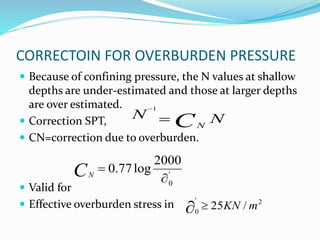
 Because of confining pressure, the N values at shallow
depths are under-estimated and those at larger depths
are over estimated.
 Correction SPT,
 CN=correction due to overburden.
 Valid for
 Effective overburden stress in
NN
CN

1
'
0
2000
log77.0

CN
2'
0
/25 mKN
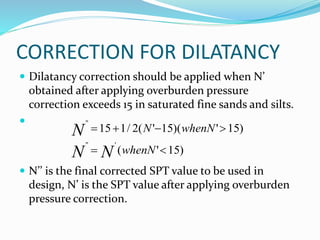
CORRECTION FOR DILATANCY
 Dilatancy correction should be applied when N’
obtained after applying overburden pressure
correction exceeds 15 in saturated fine sands and silts.

 N’’ is the final corrected SPT value to be used in
design, N’ is the SPT value after applying overburden
pressure correction.
)15'(
)15')(15'(2/115
'''
''


whenN
whenNN
NN
N
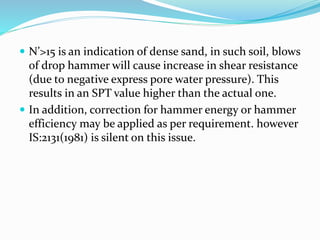
 N’>15 is an indication of dense sand, in such soil, blows
of drop hammer will cause increase in shear resistance
(due to negative express pore water pressure). This
results in an SPT value higher than the actual one.
 In addition, correction for hammer energy or hammer
efficiency may be applied as per requirement. however
IS:2131(1981) is silent on this issue.
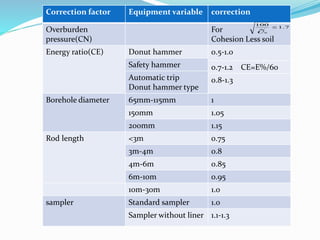
Correction factor Equipment variable correction
Overburden
pressure(CN)
For
Cohesion Less soil
Energy ratio(CE) Donut hammer 0.5-1.0
Safety hammer 0.7-1.2 CE=E%/60
Automatic trip
Donut hammer type
0.8-1.3
Borehole diameter 65mm-115mm 1
150mm 1.05
200mm 1.15
Rod length <3m 0.75
3m-4m 0.8
4m-6m 0.85
6m-10m 0.95
10m-30m 1.0
sampler Standard sampler 1.0
Sampler without liner 1.1-1.3
7.1
100
'
0


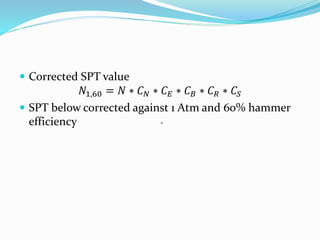
 Corrected SPT value
𝑁1,60 = 𝑁 ∗ 𝐶 𝑁 ∗ 𝐶 𝐸 ∗ 𝐶 𝐵 ∗ 𝐶 𝑅 ∗ 𝐶𝑆
 SPT below corrected against 1 Atm and 60% hammer
efficiency NN
EMPERICAL CORELATIONS WITH SPT VALUE
 SPT is not considered to be safe very precise and
reliable method of soil investigation. Despite of this
the N value gives useful information regarding the
compaction of cohesionless soil and consistency of
cohesive soil.
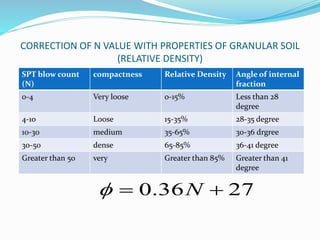
CORRECTION OF N VALUE WITH PROPERTIES OF GRANULAR SOIL
(RELATIVE DENSITY)
SPT blow count
(N)
compactness Relative Density Angle of internal
fraction
0-4 Very loose 0-15% Less than 28
degree
4-10 Loose 15-35% 28-35 degree
10-30 medium 35-65% 30-36 drgree
30-50 dense 65-85% 36-41 degree
Greater than 50 very Greater than 85% Greater than 41
degree
2736.0  N
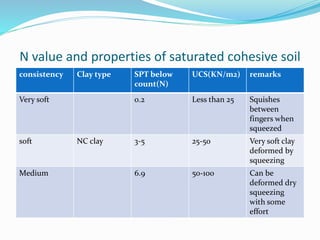
N value and properties of saturated cohesive soil
consistency Clay type SPT below
count(N)
UCS(KN/m2) remarks
Very soft 0.2 Less than 25 Squishes
between
fingers when
squeezed
soft NC clay 3-5 25-50 Very soft clay
deformed by
squeezing
Medium 6.9 50-100 Can be
deformed dry
squeezing
with some
effort
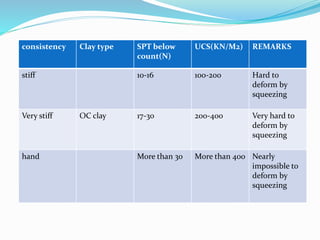
consistency Clay type SPT below
count(N)
UCS(KN/M2) REMARKS
stiff 10-16 100-200 Hard to
deform by
squeezing
Very stiff OC clay 17-30 200-400 Very hard to
deform by
squeezing
hand More than 30 More than 400 Nearly
impossible to
deform by
squeezing
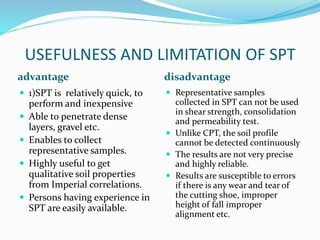
USEFULNESS AND LIMITATION OF SPT
advantage disadvantage
 1)SPT is relatively quick, to
perform and inexpensive
 Able to penetrate dense
layers, gravel etc.
 Enables to collect
representative samples.
 Highly useful to get
qualitative soil properties
from Imperial correlations.
 Persons having experience in
SPT are easily available.
 Representative samples
collected in SPT can not be used
in shear strength, consolidation
and permeability test.
 Unlike CPT, the soil profile
cannot be detected continuously
 The results are not very precise
and highly reliable.
 Results are susceptible to errors
if there is any wear and tear of
the cutting shoe, improper
height of fall improper
alignment etc.
REFERENCE
AS PER MY OWN KNOWLEDGE
THANK YOU

Standard Penetration Test

  • 1.
    PRESENTED BY INDRANIL BANERJEE ENROLLMENTNO-CEM18005 SUB:GEOTECHNICAL EXPLORATION AND TESTING(CE502) DEPARTMENT OF CIVIL ENGINEERING TEZPUR UNIVERSITY
  • 2.
    CONTENTS  INTRODUCTION  USESSPT TEST  USEFULL IN FINDING OUT  INSTRUMENTS  PROCEDURE  CURRECTIONS  USEFULLNESS AND LIMITATION OF SPT  REFERENCE
  • 3.
    INTRODUCTION  The StandardPenetration test (SPT) is a common in situ testing method used to determine the geotechnical engineering properties of subsurface soils. It is a simple and inexpensive test to estimate the relative density of soils and approximate shear strength parameters.
  • 4.
    USES SPT TEST Thesecan be used for identification test like specific gravity, grain size distribution, Atterberg limit, compaction etc.
  • 5.
    Relative density of cohesionless soils. Angle of shearing resistance of cohesion less soils. Unconfined compressive strength of cohesive soils. USEFUL IN FINDING OUT
  • 6.
    INSTRUMENTS 1) DRILLING EQUIPMENTFOR BOREHOLES:  Any drilling equipment is acceptable that provides a reasonably clean hole, which is at least 5 mm larger than the sampler or sampling rods, and less than 170 mm diameter.
  • 7.
    INSTRUMENTS 2)SPLIT – SPOONSAMPLER  It is a sampler for obtaining a disturbed sample of soil and consists of-  Driving shoe: made of tool- steel about 75 mm long  Steel tube: 450 mm long, split longitudinally in two halves  Coupling: 150 mm long, provided at the top  Check valve  4 venting ports: 10 mm diameter.
  • 8.
    INSTRUMENTS 3) DRIVE –WEIGHT ASSEMBLY  Hammer of 63.5 kg  A driving head(anvil)  A guide permitting a free fall of 0.76 m and over lift capability of at least 100 mm.
  • 9.
    INSTRUMENTS 4) CATHEAD Operating at approximately100 rpm. Equipped with suitable rope and overhead sheave for lifting drive- weight.
  • 10.
    INSTRUMENTS 5)HAMMER  A)SEFETY HAMMER Closed system  Delivers approximately 60% of the maximum free fall energy  Highly variable energy transfer
  • 11.
    INSTRUMENTS  B) DONUTHAMMER  Open system  Delivers approximately 45% of the maximum free fall energy Highly variable energy transfer.
  • 12.
    INSTRUMENTS  C) AUTOMATIC HAMMER Safest system  Delivers approximately 95- 100% of the maximum free fall energy  Consistent and effective energy transfer  Increased production.
  • 13.
    PROCEDURE 1)DRILLING OF BOREHOLE Drill the borehole to the desired sampling depth and clean out all disturbed material.  The equipment used shall provide a clean borehole, 100 to 150 mm in diameter, for insertion of the sampler to ensure that the penetration test is performed on undisturbed soil.  Casing shall be used when drilling in sand, soft clay or other soils in which the sides of borehole are likely to cave in.
  • 14.
    PROCEDURE 2) DRIVING THECASING  Where casing is used, it shall not be driven below the level at which the test is made or soil sample is taken.  In the case of cohesion less soils which cannot stand without casing, the advancement of the casing pipe should be such that it does not disturb the soil to be tested or sampled; the casing shall preferably be advanced by slowly turning the casing rather then by driving may alter the density of such deposits immediately below the bottom of the borehole.
  • 15.
    PROCEDURE 3) ASSEMBLING EQUIPMENT Attach the split-spoon sampler to the drill rod and lower into the hole until it is sitting on the undisturbed material.  Attach the drive weight assembly.  Lift the 63.5 kg hammer approximately 0.76 m and allow it to fall on the anvil delivering one seating blow.  Mark the drill rod in 3 successive .15 m increments to observe penetration.
  • 16.
    PROCEDURE 4) PENETRATION TESTING Raise and drop the hammer 0.76 m successively by means of the rope and cathead, using no more than two and one forth wraps around the cathead.  The hammer should be operated between 40 and 60 blows per minute and should drop freely.  Record the number of blows for each .15 m of the penetration.  The first .15 m increment is the “seating” drive.
  • 17.
    PROCEDURE  The sumof the blows for second and third increment of 0.15 m penetration is termed “penetration resistance or N-value”.  If the split spoon sampler is driven less then 45 cm(total), then the penetration resistance shall be for the last 30 cm of penetration (if less than 30 cm is penetrated, the logs should state the number of blows and the depth penetrated).  If the no. of blows for 15 cm drive exceeds 50, it is taken as a refusal and the test is discontinued.
  • 18.
    PROCEDURE  Tests shallbe made at every change in stratum or at intervals of not more than 1-5 m whichever is less. Tests may be made at lesser intervals if specified or considered necessary.  The intervals be increased to 3 m if in between vane shear test is performed.  The entire sampler may sometimes sink under its own weight when very soft sub-soil stratum is encountered.  Under such conditions, it may not be necessary to give any blow to the split spoon sampler and SPT value should be indicated as zero.
  • 19.
    PROCEDURE 4)HANDLING SAMPLE  Bringthe sampler to the surface and open it. Remove any obvious contamination from the ends or sides and drain excess water. Carefully scrape or slice along one side to expose fresh material and any stratification.  Record the length, composition, color, stratification and condition of sample.  Remove sample and wrap it or seal in a plastic bag to retain moisture. If the sample can be removed relatively intact, wrap it in several layers of plastic and seal ends with tape.
  • 20.
    CORRECTION  No correctionfor cohesive soils.  1)correction for overburden pressure  2)correction for dilatancy
  • 21.
    CORRECTOIN FOR OVERBURDENPRESSURE  Because of confining pressure, the N values at shallow depths are under-estimated and those at larger depths are over estimated.  Correction SPT,  CN=correction due to overburden.  Valid for  Effective overburden stress in NN CN  1 ' 0 2000 log77.0  CN 2' 0 /25 mKN
  • 22.
    CORRECTION FOR DILATANCY Dilatancy correction should be applied when N’ obtained after applying overburden pressure correction exceeds 15 in saturated fine sands and silts.   N’’ is the final corrected SPT value to be used in design, N’ is the SPT value after applying overburden pressure correction. )15'( )15')(15'(2/115 ''' ''   whenN whenNN NN N
  • 23.
     N’>15 isan indication of dense sand, in such soil, blows of drop hammer will cause increase in shear resistance (due to negative express pore water pressure). This results in an SPT value higher than the actual one.  In addition, correction for hammer energy or hammer efficiency may be applied as per requirement. however IS:2131(1981) is silent on this issue.
  • 24.
    Correction factor Equipmentvariable correction Overburden pressure(CN) For Cohesion Less soil Energy ratio(CE) Donut hammer 0.5-1.0 Safety hammer 0.7-1.2 CE=E%/60 Automatic trip Donut hammer type 0.8-1.3 Borehole diameter 65mm-115mm 1 150mm 1.05 200mm 1.15 Rod length <3m 0.75 3m-4m 0.8 4m-6m 0.85 6m-10m 0.95 10m-30m 1.0 sampler Standard sampler 1.0 Sampler without liner 1.1-1.3 7.1 100 ' 0  
  • 25.
     Corrected SPTvalue 𝑁1,60 = 𝑁 ∗ 𝐶 𝑁 ∗ 𝐶 𝐸 ∗ 𝐶 𝐵 ∗ 𝐶 𝑅 ∗ 𝐶𝑆  SPT below corrected against 1 Atm and 60% hammer efficiency NN
  • 26.
    EMPERICAL CORELATIONS WITHSPT VALUE  SPT is not considered to be safe very precise and reliable method of soil investigation. Despite of this the N value gives useful information regarding the compaction of cohesionless soil and consistency of cohesive soil.
  • 27.
    CORRECTION OF NVALUE WITH PROPERTIES OF GRANULAR SOIL (RELATIVE DENSITY) SPT blow count (N) compactness Relative Density Angle of internal fraction 0-4 Very loose 0-15% Less than 28 degree 4-10 Loose 15-35% 28-35 degree 10-30 medium 35-65% 30-36 drgree 30-50 dense 65-85% 36-41 degree Greater than 50 very Greater than 85% Greater than 41 degree 2736.0  N
  • 28.
    N value andproperties of saturated cohesive soil consistency Clay type SPT below count(N) UCS(KN/m2) remarks Very soft 0.2 Less than 25 Squishes between fingers when squeezed soft NC clay 3-5 25-50 Very soft clay deformed by squeezing Medium 6.9 50-100 Can be deformed dry squeezing with some effort
  • 29.
    consistency Clay typeSPT below count(N) UCS(KN/M2) REMARKS stiff 10-16 100-200 Hard to deform by squeezing Very stiff OC clay 17-30 200-400 Very hard to deform by squeezing hand More than 30 More than 400 Nearly impossible to deform by squeezing
  • 30.
    USEFULNESS AND LIMITATIONOF SPT advantage disadvantage  1)SPT is relatively quick, to perform and inexpensive  Able to penetrate dense layers, gravel etc.  Enables to collect representative samples.  Highly useful to get qualitative soil properties from Imperial correlations.  Persons having experience in SPT are easily available.  Representative samples collected in SPT can not be used in shear strength, consolidation and permeability test.  Unlike CPT, the soil profile cannot be detected continuously  The results are not very precise and highly reliable.  Results are susceptible to errors if there is any wear and tear of the cutting shoe, improper height of fall improper alignment etc.
  • 31.
    REFERENCE AS PER MYOWN KNOWLEDGE
  • 32.