SOIL SAMPLING TECHNIQUES AND ITS
IMPORTANTS
COURSE NAME : FOUNDATION ENGINEERING
COURSE CODE : 21BECE403
B.SARATH (22LBECE013)
R.SRI VIGNESH (22LBECE014)
R.BASKAR (22LBECE015)
N.DHAMOTHIRAN (22LBECE016)
S.GOWTHAM (22LBECE017)
A.SRINIVASAN (22LBECE018)
P.PARAMESHWARAN (22LBECE020)
SEMINAR 1
DEPARTMENT OF CIVIL ENGINEERING
Introduction
Benefits of soil sampling: Soil sampling is done for soil testing of a particular site
before the construction phase. It is done to check mainly two factors the load
bearing capacity and the settlement of soil.
CONTENTS
▶ Soil sampling
▶ Types of soil samples
▶ Types of samplers
▶ Sample disturbance
SOIL SAMPLING
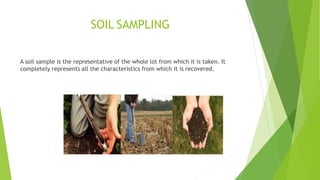
A soil sample is the representative of the whole lot from which it is taken. It
completely represents all the characteristics from which it is recovered.
Sampling Procedure
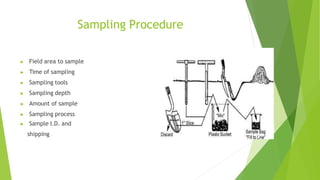
▶ Field area to sample
▶ Time of sampling
▶ Sampling tools
▶ Sampling depth
▶ Amount of sample
▶ Sampling process
▶ Sample I.D. and
shipping
Types of Soil Samples
▶ Disturbed Samples
▶ Undisturbed Samples
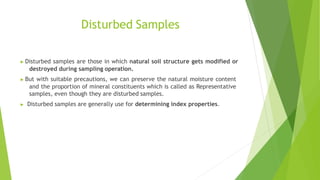
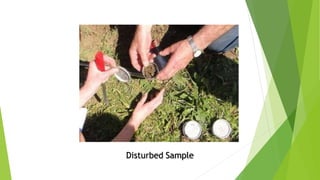
Disturbed Samples
▶ Disturbed samples are those in which natural soil structure gets modified or
destroyed during sampling operation.
▶ But with suitable precautions, we can preserve the natural moisture content
and the proportion of mineral constituents which is called as Representative
samples, even though they are disturbed samples.
▶ Disturbed samples are generally use for determining index properties.
Disturbed Sample
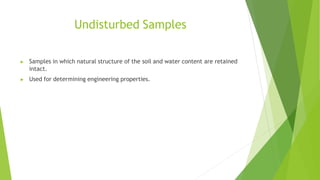
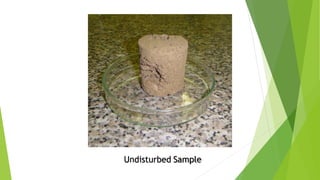
Undisturbed Samples
▶ Samples in which natural structure of the soil and water content are retained
intact.
▶ Used for determining engineering properties.
Undisturbed Sample
Types Of Samplers
The samplers classifies as thick wall or thin wall samplers depending up on the
ratio.
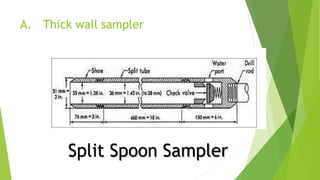
▶ Thick wall samplers are those having the area ratio greater than 10 to 25%.
Depending up to the mode of operation, they may be classified in the following
common types:
▶ Open drive,
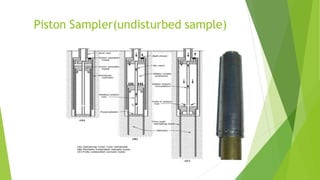
▶ Stationary piston, and
▶ Rotary
The open drives can be both thick and thin wall sampler.
The stationary piston and the rotary types are thin wall sampler.
Open Drive Sampler
▶ Thick wall sampler
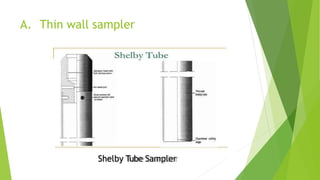
▶ Thin wall sampler
A. Thick wall sampler
Split Spoon Sampler
A. Thin wall sampler
Shelby Tube Sampler
Piston Sampler(undisturbed sample)
Rotary Sampler
These are the core barrel types having an outer tube provided with cutting teeth
and a removable thin wall liner inside. It is used for firm to hard cohesive soils.
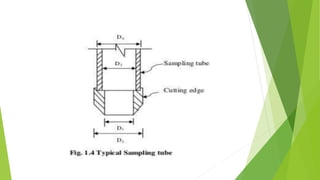
Sample Disturbance
▶ Depends upon design samplers and method of sampling.
▶ Design features governing the degree of disturbance.
a) Cutting edge
b) Inside wall friction
c) Non-return valve
The following ratios of the cutting edge and the sampler are shown:-
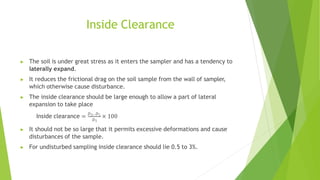
Inside Clearance
▶ The soil is under great stress as it enters the sampler and has a tendency to
laterally expand.
▶ It reduces the frictional drag on the soil sample from the wall of sampler,
which otherwise cause disturbance.
▶ The inside clearance should be large enough to allow a part of lateral
expansion to take place
Inside clearance = 𝐷3−𝐷1
× 100
𝐷1
▶ It should not be so large that it permits excessive deformations and cause
disturbances of the sample.
▶ For undisturbed sampling inside clearance should lie 0.5 to 3%.
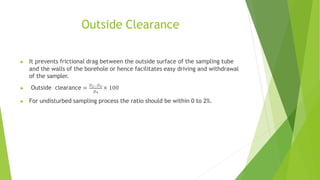
Outside Clearance
▶ It prevents frictional drag between the outside surface of the sampling tube
and the walls of the borehole or hence facilitates easy driving and withdrawal
of the sampler.
▶ Outside clearance = 𝐷2−𝐷4
× 100
𝐷4
▶ For undisturbed sampling process the ratio should be within 0 to 2%.
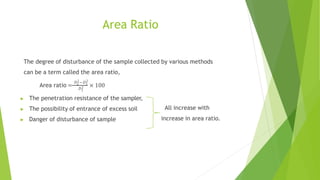
Area Ratio
The degree of disturbance of the sample collected by various methods
can be a term called the area ratio,
𝐷2−𝐷2
𝐷2
Area ratio = 2 1
× 100
1
▶ The penetration resistance of the sampler,
▶ The possibility of entrance of excess soil
▶ Danger of disturbance of sample
All increase with
increase in area ratio.
▶ The allowable area ratio intended for obtaining undisturbed samples depend up on
a) diameter,
b) design
c) method of operation of the sampler.
The area ratio should be preferably be less than 10%
▶ The greater area ratio can be tolerated when the sampler is provided with
a) A stationary piston
b) The cutting edge having very small angle of taper
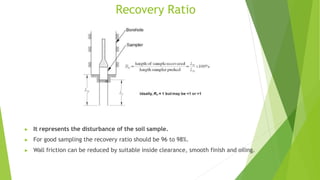
Recovery Ratio
▶ It represents the disturbance of the soil sample.
▶ For good sampling the recovery ratio should be 96 to 98%.
▶ Wall friction can be reduced by suitable inside clearance, smooth finish and oiling.
• Soil testing is primarily done to test the bearing capacity. The chemical and
physical composition of the soil is checked during this process. The soil must have
the ability to withstand the weight of the building.
• Quality of soil not only determines the bearing capacity but it ensures to
determine the structure stabilization, and its depends upon various factors such as
weather, climate change and for the past years the land was deployed for what
purpose and what was there previously.
• We’ve all heard about the importance of building a foundation on solid ground. But what
constitutes “solid” and how do you find out if soil is suitable for a construction project? Soil
needs to resist the weight of the building. If it doesn’t resist the weight of the building, the
building moves.
• There are many types of soil but not all are suitable for supporting a building. Some soils,
like clay, are great at supporting a building foundation because they are mostly inorganic
and don’t move readily.
• The length and depth of the pillar determined during the foundation depending upon the
quality of soil. The water level of the soil only can be determined from soil testing.
IMPORTANTS OF SOIL SAMPLING
• Soils that are full of organic matter will decompose over time and move, so they are not suitable for
supporting a foundation. Other soils like unconfined sand have poor bearing capacity because the
grains have lots of space between them and they may shift with time.
•
• Based on the soil testing reports quality of material can be decided.
•
• For example, if due to moisture the area is prone to corrosion then it is important to choose only
corrosion resistant TMT Bars for the construction.
•
• If soils are found to be inappropriate to support the building, they have to be removed before the
foundation is built. Sometimes the existing soil needs to be removed because it is contaminated, which
could be harmful to people. We just need to remove organic matter and replace it with an inorganic
substitute that is more stable, like gravel.
THANKS

foundation engineering.pptx

  • 1.
    SOIL SAMPLING TECHNIQUESAND ITS IMPORTANTS COURSE NAME : FOUNDATION ENGINEERING COURSE CODE : 21BECE403 B.SARATH (22LBECE013) R.SRI VIGNESH (22LBECE014) R.BASKAR (22LBECE015) N.DHAMOTHIRAN (22LBECE016) S.GOWTHAM (22LBECE017) A.SRINIVASAN (22LBECE018) P.PARAMESHWARAN (22LBECE020) SEMINAR 1 DEPARTMENT OF CIVIL ENGINEERING
  • 2.
    Introduction Benefits of soilsampling: Soil sampling is done for soil testing of a particular site before the construction phase. It is done to check mainly two factors the load bearing capacity and the settlement of soil. CONTENTS ▶ Soil sampling ▶ Types of soil samples ▶ Types of samplers ▶ Sample disturbance
  • 3.
    SOIL SAMPLING A soilsample is the representative of the whole lot from which it is taken. It completely represents all the characteristics from which it is recovered.
  • 4.
    Sampling Procedure ▶ Fieldarea to sample ▶ Time of sampling ▶ Sampling tools ▶ Sampling depth ▶ Amount of sample ▶ Sampling process ▶ Sample I.D. and shipping
  • 5.
    Types of SoilSamples ▶ Disturbed Samples ▶ Undisturbed Samples
  • 6.
    Disturbed Samples ▶ Disturbedsamples are those in which natural soil structure gets modified or destroyed during sampling operation. ▶ But with suitable precautions, we can preserve the natural moisture content and the proportion of mineral constituents which is called as Representative samples, even though they are disturbed samples. ▶ Disturbed samples are generally use for determining index properties.
  • 7.
  • 8.
    Undisturbed Samples ▶ Samplesin which natural structure of the soil and water content are retained intact. ▶ Used for determining engineering properties.
  • 9.
  • 10.
    Types Of Samplers Thesamplers classifies as thick wall or thin wall samplers depending up on the ratio. ▶ Thick wall samplers are those having the area ratio greater than 10 to 25%. Depending up to the mode of operation, they may be classified in the following common types: ▶ Open drive, ▶ Stationary piston, and ▶ Rotary The open drives can be both thick and thin wall sampler. The stationary piston and the rotary types are thin wall sampler.
  • 11.
    Open Drive Sampler ▶Thick wall sampler ▶ Thin wall sampler
  • 12.
    A. Thick wallsampler Split Spoon Sampler
  • 13.
    A. Thin wallsampler Shelby Tube Sampler
  • 14.
  • 15.
    Rotary Sampler These arethe core barrel types having an outer tube provided with cutting teeth and a removable thin wall liner inside. It is used for firm to hard cohesive soils.
  • 16.
    Sample Disturbance ▶ Dependsupon design samplers and method of sampling. ▶ Design features governing the degree of disturbance. a) Cutting edge b) Inside wall friction c) Non-return valve The following ratios of the cutting edge and the sampler are shown:-
  • 17.
    Inside Clearance ▶ Thesoil is under great stress as it enters the sampler and has a tendency to laterally expand. ▶ It reduces the frictional drag on the soil sample from the wall of sampler, which otherwise cause disturbance. ▶ The inside clearance should be large enough to allow a part of lateral expansion to take place Inside clearance = 𝐷3−𝐷1 × 100 𝐷1 ▶ It should not be so large that it permits excessive deformations and cause disturbances of the sample. ▶ For undisturbed sampling inside clearance should lie 0.5 to 3%.
  • 19.
    Outside Clearance ▶ Itprevents frictional drag between the outside surface of the sampling tube and the walls of the borehole or hence facilitates easy driving and withdrawal of the sampler. ▶ Outside clearance = 𝐷2−𝐷4 × 100 𝐷4 ▶ For undisturbed sampling process the ratio should be within 0 to 2%.
  • 20.
    Area Ratio The degreeof disturbance of the sample collected by various methods can be a term called the area ratio, 𝐷2−𝐷2 𝐷2 Area ratio = 2 1 × 100 1 ▶ The penetration resistance of the sampler, ▶ The possibility of entrance of excess soil ▶ Danger of disturbance of sample All increase with increase in area ratio.
  • 21.
    ▶ The allowablearea ratio intended for obtaining undisturbed samples depend up on a) diameter, b) design c) method of operation of the sampler. The area ratio should be preferably be less than 10% ▶ The greater area ratio can be tolerated when the sampler is provided with a) A stationary piston b) The cutting edge having very small angle of taper
  • 22.
    Recovery Ratio ▶ Itrepresents the disturbance of the soil sample. ▶ For good sampling the recovery ratio should be 96 to 98%. ▶ Wall friction can be reduced by suitable inside clearance, smooth finish and oiling.
  • 23.
    • Soil testingis primarily done to test the bearing capacity. The chemical and physical composition of the soil is checked during this process. The soil must have the ability to withstand the weight of the building. • Quality of soil not only determines the bearing capacity but it ensures to determine the structure stabilization, and its depends upon various factors such as weather, climate change and for the past years the land was deployed for what purpose and what was there previously. • We’ve all heard about the importance of building a foundation on solid ground. But what constitutes “solid” and how do you find out if soil is suitable for a construction project? Soil needs to resist the weight of the building. If it doesn’t resist the weight of the building, the building moves. • There are many types of soil but not all are suitable for supporting a building. Some soils, like clay, are great at supporting a building foundation because they are mostly inorganic and don’t move readily. • The length and depth of the pillar determined during the foundation depending upon the quality of soil. The water level of the soil only can be determined from soil testing. IMPORTANTS OF SOIL SAMPLING
  • 24.
    • Soils thatare full of organic matter will decompose over time and move, so they are not suitable for supporting a foundation. Other soils like unconfined sand have poor bearing capacity because the grains have lots of space between them and they may shift with time. • • Based on the soil testing reports quality of material can be decided. • • For example, if due to moisture the area is prone to corrosion then it is important to choose only corrosion resistant TMT Bars for the construction. • • If soils are found to be inappropriate to support the building, they have to be removed before the foundation is built. Sometimes the existing soil needs to be removed because it is contaminated, which could be harmful to people. We just need to remove organic matter and replace it with an inorganic substitute that is more stable, like gravel.
  • 25.