Section 2-9
Proving Lines Parallel
Essential Questions
• How do you recognize angle pairs that
occur with parallel lines?
• How do you prove that two lines are
parallel?
Postulates & Theorems
1. Converse of Corresponding Angles Postulate
Postulates & Theorems
1. Converse of Corresponding Angles Postulate
If two lines are cut by a transversal so that
corresponding angles are congruent, then the lines are
parallel.
Postulates & Theorems
2. Parallel Postulate
Postulates & Theorems
2. Parallel Postulate
If given a line and a point not on the line, then there
exists exactly one line through the point that is parallel
to the given line.
Postulates & Theorems
3. Alternate Exterior Angles Converse
Postulates & Theorems
3. Alternate Exterior Angles Converse
If two lines in a plane are cut by a transversal so that a
pair of alternate exterior angles is congruent, then the
two lines are parallel.
Postulates & Theorems
4. Consecutive Interior Angles Converse
Postulates & Theorems
4. Consecutive Interior Angles Converse
If two lines in a plane are cut by a transversal so that a
pair of consecutive interior angles is supplementary,
then the lines are parallel.
Postulates & Theorems
5. Alternate Interior Angles Converse
Postulates & Theorems
5. Alternate Interior Angles Converse
If two lines in a plane are cut by a transversal so that a
pair of alternate interior angles is congruent, then the
two lines are parallel.
Postulates & Theorems
6. Perpendicular Transversal Converse
Postulates & Theorems
6. Perpendicular Transversal Converse
In a plane, if two lines are perpendicular to the same
line, then they are parallel.
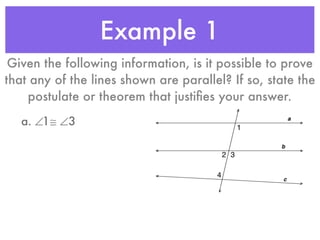
Example 1
Given the following information, is it possible to prove
that any of the lines shown are parallel? If so, state the
postulate or theorem that justifies your answer.
a. ∠1≅ ∠3
Example 1
Given the following information, is it possible to prove
that any of the lines shown are parallel? If so, state the
postulate or theorem that justifies your answer.
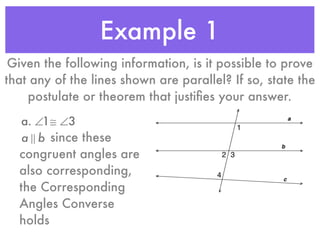
a. ∠1≅ ∠3
a ! b since these
congruent angles are
also corresponding,
the Corresponding
Angles Converse
holds
Example 1
Given the following information, is it possible to prove
that any of the lines shown are parallel? If so, state the
postulate or theorem that justifies your answer.
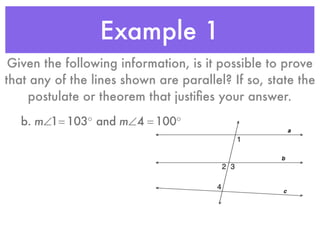
b. m∠1= 103° and m∠4 = 100°
Example 1
Given the following information, is it possible to prove
that any of the lines shown are parallel? If so, state the
postulate or theorem that justifies your answer.
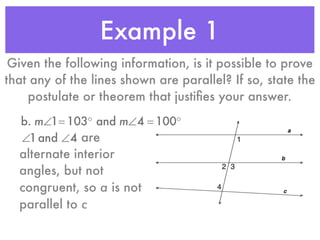
b. m∠1= 103° and m∠4 = 100°
are
alternate interior
angles, but not
congruent, so a is not
parallel to c
∠1and ∠4
Example 2
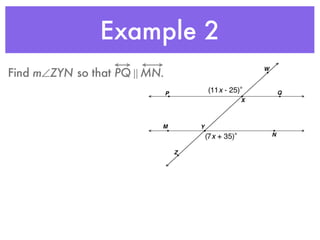
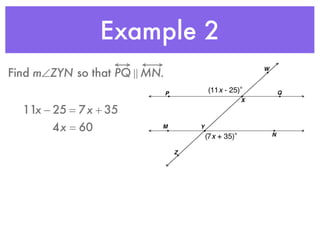
Find m∠ZYN so that PQ ! MN.
Example 2
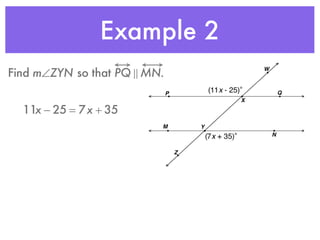
Find m∠ZYN so that PQ ! MN.
11x − 25 = 7x + 35
Example 2
Find m∠ZYN so that PQ ! MN.
11x − 25 = 7x + 35
4x = 60
Example 2
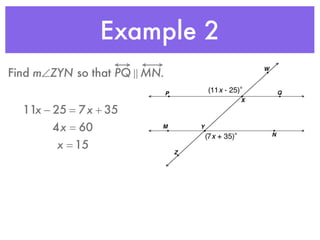
Find m∠ZYN so that PQ ! MN.
11x − 25 = 7x + 35
4x = 60
x = 15
Example 2
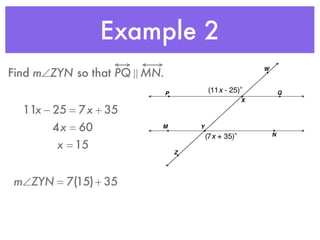
Find m∠ZYN so that PQ ! MN.
11x − 25 = 7x + 35
4x = 60
x = 15
m∠ZYN = 7(15)+ 35
Example 2
Find m∠ZYN so that PQ ! MN.
11x − 25 = 7x + 35
4x = 60
x = 15
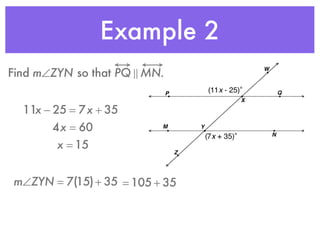
m∠ZYN = 7(15)+ 35 = 105 + 35
Example 2
Find m∠ZYN so that PQ ! MN.
11x − 25 = 7x + 35
4x = 60
x = 15
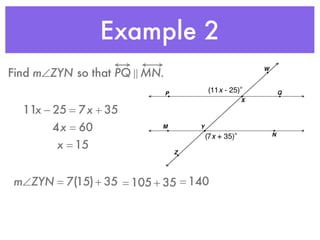
m∠ZYN = 7(15)+ 35 = 105 + 35 = 140
Example 2
Find m∠ZYN so that PQ ! MN.
11x − 25 = 7x + 35
4x = 60
x = 15
m∠ZYN = 7(15)+ 35 = 105 + 35 = 140
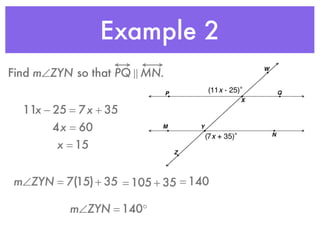
m∠ZYN = 140°

Geometry Section 2-9

  • 1.
  • 2.
    Essential Questions • Howdo you recognize angle pairs that occur with parallel lines? • How do you prove that two lines are parallel?
  • 3.
    Postulates & Theorems 1.Converse of Corresponding Angles Postulate
  • 4.
    Postulates & Theorems 1.Converse of Corresponding Angles Postulate If two lines are cut by a transversal so that corresponding angles are congruent, then the lines are parallel.
  • 5.
    Postulates & Theorems 2.Parallel Postulate
  • 6.
    Postulates & Theorems 2.Parallel Postulate If given a line and a point not on the line, then there exists exactly one line through the point that is parallel to the given line.
  • 7.
    Postulates & Theorems 3.Alternate Exterior Angles Converse
  • 8.
    Postulates & Theorems 3.Alternate Exterior Angles Converse If two lines in a plane are cut by a transversal so that a pair of alternate exterior angles is congruent, then the two lines are parallel.
  • 9.
    Postulates & Theorems 4.Consecutive Interior Angles Converse
  • 10.
    Postulates & Theorems 4.Consecutive Interior Angles Converse If two lines in a plane are cut by a transversal so that a pair of consecutive interior angles is supplementary, then the lines are parallel.
  • 11.
    Postulates & Theorems 5.Alternate Interior Angles Converse
  • 12.
    Postulates & Theorems 5.Alternate Interior Angles Converse If two lines in a plane are cut by a transversal so that a pair of alternate interior angles is congruent, then the two lines are parallel.
  • 13.
    Postulates & Theorems 6.Perpendicular Transversal Converse
  • 14.
    Postulates & Theorems 6.Perpendicular Transversal Converse In a plane, if two lines are perpendicular to the same line, then they are parallel.
  • 15.
    Example 1 Given thefollowing information, is it possible to prove that any of the lines shown are parallel? If so, state the postulate or theorem that justifies your answer. a. ∠1≅ ∠3
  • 16.
    Example 1 Given thefollowing information, is it possible to prove that any of the lines shown are parallel? If so, state the postulate or theorem that justifies your answer. a. ∠1≅ ∠3 a ! b since these congruent angles are also corresponding, the Corresponding Angles Converse holds
  • 17.
    Example 1 Given thefollowing information, is it possible to prove that any of the lines shown are parallel? If so, state the postulate or theorem that justifies your answer. b. m∠1= 103° and m∠4 = 100°
  • 18.
    Example 1 Given thefollowing information, is it possible to prove that any of the lines shown are parallel? If so, state the postulate or theorem that justifies your answer. b. m∠1= 103° and m∠4 = 100° are alternate interior angles, but not congruent, so a is not parallel to c ∠1and ∠4
  • 19.
    Example 2 Find m∠ZYNso that PQ ! MN.
  • 20.
    Example 2 Find m∠ZYNso that PQ ! MN. 11x − 25 = 7x + 35
  • 21.
    Example 2 Find m∠ZYNso that PQ ! MN. 11x − 25 = 7x + 35 4x = 60
  • 22.
    Example 2 Find m∠ZYNso that PQ ! MN. 11x − 25 = 7x + 35 4x = 60 x = 15
  • 23.
    Example 2 Find m∠ZYNso that PQ ! MN. 11x − 25 = 7x + 35 4x = 60 x = 15 m∠ZYN = 7(15)+ 35
  • 24.
    Example 2 Find m∠ZYNso that PQ ! MN. 11x − 25 = 7x + 35 4x = 60 x = 15 m∠ZYN = 7(15)+ 35 = 105 + 35
  • 25.
    Example 2 Find m∠ZYNso that PQ ! MN. 11x − 25 = 7x + 35 4x = 60 x = 15 m∠ZYN = 7(15)+ 35 = 105 + 35 = 140
  • 26.
    Example 2 Find m∠ZYNso that PQ ! MN. 11x − 25 = 7x + 35 4x = 60 x = 15 m∠ZYN = 7(15)+ 35 = 105 + 35 = 140 m∠ZYN = 140°