7.1 CONDITIONAL
AND BICONDITIONAL
STATEMENTS
BY: JAY BASILGO
MARC OVILLE
DANNAH PAQUIBOT
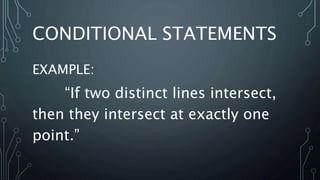
CONDITIONAL STATEMENTS
EXAMPLE:
“If two distinct lines intersect,
then they intersect at exactly one
point.”
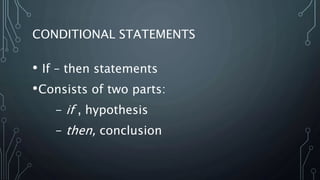
CONDITIONAL STATEMENTS
• If – then statements
•Consists of two parts:
- if , hypothesis
- then, conclusion
MORE EXAMPLES
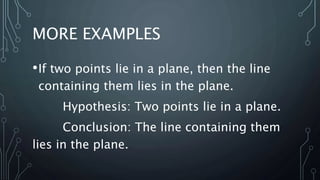
•If two points lie in a plane, then the line
containing them lies in the plane.
Hypothesis: Two points lie in a plane.
Conclusion: The line containing them
lies in the plane.
MORE EXAMPLES
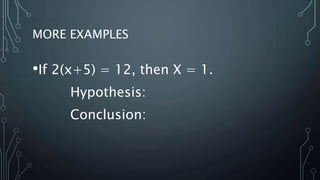
•If 2(x+5) = 12, then X = 1.
Hypothesis:
Conclusion:
MORE EXAMPLES
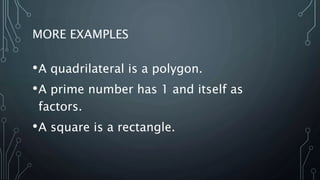
•A quadrilateral is a polygon.
•A prime number has 1 and itself as
factors.
•A square is a rectangle.
THE CONVERSE, INVERSE, AND
CONTRAPOSITIVE OF A CONDITIONAL
STATEMENT
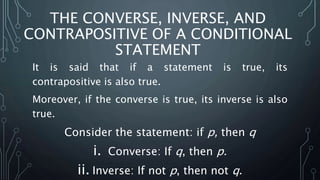
It is said that if a statement is true, its
contrapositive is also true.
Moreover, if the converse is true, its inverse is also
true.
Consider the statement: if p, then q
i. Converse: If q, then p.
ii. Inverse: If not p, then not q.
CONVERSE
•To write the converse of a conditional
statement, simply interchange the hypothesis
and the conclusion. That is, the then part
becomes the if part.
•Note that converse of a conditional statement is
not always a true statement.
EXAMPLE
•a. If m<A= 9, then m<A is a Rigth angle.
Converse: If m<A is a right angle, then m<A = 90
EXAMPLE
•B. The intersection of two distinct planes is a
line.
If-then: If two distinct planes intersect, then their
intersection is a line.
Converse: If the intersection of two figures is a line,
then the figure are two distinct planes.
INVERSE
•To write the inverse of a conditional
statement, simply negate both the
hypothesis and conclusion.
EXAMPLE
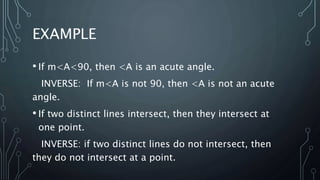
• If m<A<90, then <A is an acute angle.
INVERSE: If m<A is not 90, then <A is not an acute
angle.
• If two distinct lines intersect, then they intersect at
one point.
INVERSE: if two distinct lines do not intersect, then
they do not intersect at a point.
CONTRAPOSITIVE
•To form the contrapositive of a conditional
statement, first, get its inverse. Then,
interchange its hypothesis and conclusion.
EXAMPLE
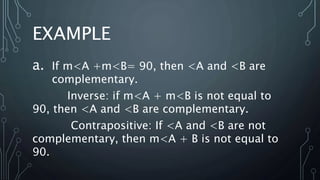
a. If m<A +m<B= 90, then <A and <B are
complementary.
Inverse: if m<A + m<B is not equal to
90, then <A and <B are complementary.
Contrapositive: If <A and <B are not
complementary, then m<A + B is not equal to
90.
BICONDITIONAL STATEMENT
•If a conditional statement and its converse are
both true. Then they can be joined together
into a single statement called biconditional
statement. Then this is done by using the
words if and only if.
EXAMPLE
a.If a+7= 12, then a = 5.
Conditional statement: if a+7 = 12,
then a = 5
Converse statement : If a = 5, then a +
7 = 12
*Both the conditional statement and its converse
are true statements. Hence, the biconditional statement

Conditional and biconditional statements

  • 1.
    7.1 CONDITIONAL AND BICONDITIONAL STATEMENTS BY:JAY BASILGO MARC OVILLE DANNAH PAQUIBOT
  • 2.
    CONDITIONAL STATEMENTS EXAMPLE: “If twodistinct lines intersect, then they intersect at exactly one point.”
  • 3.
    CONDITIONAL STATEMENTS • If– then statements •Consists of two parts: - if , hypothesis - then, conclusion
  • 4.
    MORE EXAMPLES •If twopoints lie in a plane, then the line containing them lies in the plane. Hypothesis: Two points lie in a plane. Conclusion: The line containing them lies in the plane.
  • 5.
    MORE EXAMPLES •If 2(x+5)= 12, then X = 1. Hypothesis: Conclusion:
  • 6.
    MORE EXAMPLES •A quadrilateralis a polygon. •A prime number has 1 and itself as factors. •A square is a rectangle.
  • 7.
    THE CONVERSE, INVERSE,AND CONTRAPOSITIVE OF A CONDITIONAL STATEMENT It is said that if a statement is true, its contrapositive is also true. Moreover, if the converse is true, its inverse is also true. Consider the statement: if p, then q i. Converse: If q, then p. ii. Inverse: If not p, then not q.
  • 8.
    CONVERSE •To write theconverse of a conditional statement, simply interchange the hypothesis and the conclusion. That is, the then part becomes the if part. •Note that converse of a conditional statement is not always a true statement.
  • 9.
    EXAMPLE •a. If m<A=9, then m<A is a Rigth angle. Converse: If m<A is a right angle, then m<A = 90
  • 10.
    EXAMPLE •B. The intersectionof two distinct planes is a line. If-then: If two distinct planes intersect, then their intersection is a line. Converse: If the intersection of two figures is a line, then the figure are two distinct planes.
  • 11.
    INVERSE •To write theinverse of a conditional statement, simply negate both the hypothesis and conclusion.
  • 12.
    EXAMPLE • If m<A<90,then <A is an acute angle. INVERSE: If m<A is not 90, then <A is not an acute angle. • If two distinct lines intersect, then they intersect at one point. INVERSE: if two distinct lines do not intersect, then they do not intersect at a point.
  • 13.
    CONTRAPOSITIVE •To form thecontrapositive of a conditional statement, first, get its inverse. Then, interchange its hypothesis and conclusion.
  • 14.
    EXAMPLE a. If m<A+m<B= 90, then <A and <B are complementary. Inverse: if m<A + m<B is not equal to 90, then <A and <B are complementary. Contrapositive: If <A and <B are not complementary, then m<A + B is not equal to 90.
  • 15.
    BICONDITIONAL STATEMENT •If aconditional statement and its converse are both true. Then they can be joined together into a single statement called biconditional statement. Then this is done by using the words if and only if.
  • 16.
    EXAMPLE a.If a+7= 12,then a = 5. Conditional statement: if a+7 = 12, then a = 5 Converse statement : If a = 5, then a + 7 = 12 *Both the conditional statement and its converse are true statements. Hence, the biconditional statement