SECTION 2-7
Parallel Lines and Transversals
ESSENTIAL
QUESTIONS
How do you identify the relationships between two lines or
two planes?
How do you name angle pairs formed by parallel lines and
transversals?
VOCABULARY
1. Transversal:
2. Interior Angles:
3. Exterior Angles:
4. Consecutive Interior Angles:
VOCABULARY
1. Transversal: A line that intersects two other coplanar lines at
two different points
2. Interior Angles:
3. Exterior Angles:
4. Consecutive Interior Angles:
VOCABULARY
1. Transversal: A line that intersects two other coplanar lines at
two different points
2. Interior Angles: Angles that are formed in the region between
two lines being intersected by a transversal
3. Exterior Angles:
4. Consecutive Interior Angles:
VOCABULARY
1. Transversal: A line that intersects two other coplanar lines at
two different points
2. Interior Angles: Angles that are formed in the region between
two lines being intersected by a transversal
3. Exterior Angles: Angles that are formed in the region outside of
the two lines being intersected by a transversal
4. Consecutive Interior Angles:
VOCABULARY
1. Transversal: A line that intersects two other coplanar lines at
two different points
2. Interior Angles: Angles that are formed in the region between
two lines being intersected by a transversal
3. Exterior Angles: Angles that are formed in the region outside of
the two lines being intersected by a transversal
4. Consecutive Interior Angles: Interior angles that are on the
same side of the transversal, thus being “next” to each other
VOCABULARY
5. Alternate Interior Angles:
6. Alternate Exterior Angles:
7. Corresponding Angles:
8. Parallel Lines:
VOCABULARY
5. Alternate Interior Angles: Nonadjacent interior angles that are
on opposite sides of the transversal
6. Alternate Exterior Angles:
7. Corresponding Angles:
8. Parallel Lines:
VOCABULARY
5. Alternate Interior Angles: Nonadjacent interior angles that are
on opposite sides of the transversal
6. Alternate Exterior Angles:
7. Corresponding Angles:
8. Parallel Lines:
Nonadjacent exterior angles that are
on opposite sides of the transversal
VOCABULARY
5. Alternate Interior Angles: Nonadjacent interior angles that are
on opposite sides of the transversal
6. Alternate Exterior Angles:
7. Corresponding Angles:
8. Parallel Lines:
Nonadjacent exterior angles that are
on opposite sides of the transversal
Angles that are on the same side of the
transversal and on the same side of the lines being intersected
by the transversal; these angles have the same position
VOCABULARY
5. Alternate Interior Angles: Nonadjacent interior angles that are
on opposite sides of the transversal
6. Alternate Exterior Angles:
7. Corresponding Angles:
8. Parallel Lines: Two or more lines in the same plane that do not
intersect
Nonadjacent exterior angles that are
on opposite sides of the transversal
Angles that are on the same side of the
transversal and on the same side of the lines being intersected
by the transversal; these angles have the same position
VOCABULARY
9. Skew Lines:
10. Parallel Planes:
VOCABULARY
9. Skew Lines: Two or more lines that are in different planes and
do not intersect
10. Parallel Planes:
VOCABULARY
9. Skew Lines: Two or more lines that are in different planes and
do not intersect
10. Parallel Planes: Two or more planes that do not intersect
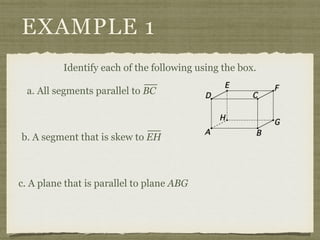
EXAMPLE 1
Identify each of the following using the box.
a. All segments parallel to BC
b. A segment that is skew to EH
c. A plane that is parallel to plane ABG
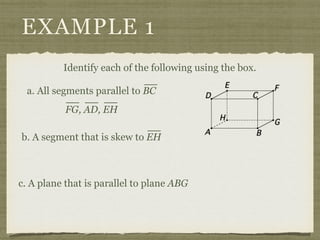
EXAMPLE 1
Identify each of the following using the box.
a. All segments parallel to BC
FG, AD, EH
b. A segment that is skew to EH
c. A plane that is parallel to plane ABG
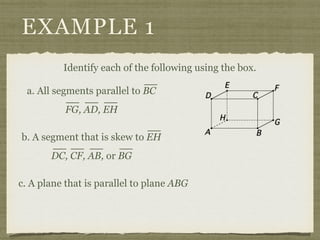
EXAMPLE 1
Identify each of the following using the box.
a. All segments parallel to BC
FG, AD, EH
b. A segment that is skew to EH
DC, CF, AB, or BG
c. A plane that is parallel to plane ABG
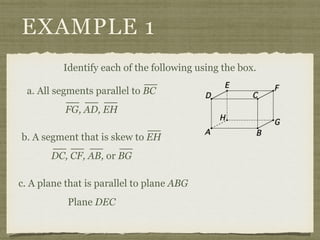
EXAMPLE 1
Identify each of the following using the box.
a. All segments parallel to BC
FG, AD, EH
b. A segment that is skew to EH
DC, CF, AB, or BG
c. A plane that is parallel to plane ABG
Plane DEC
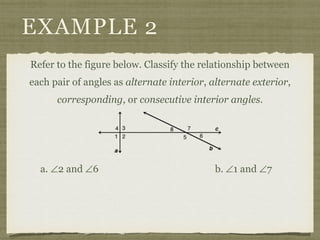
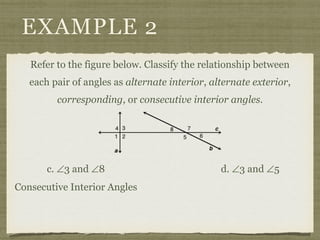
EXAMPLE 2
Refer to the figure below. Classify the relationship between
each pair of angles as alternate interior, alternate exterior,
corresponding, or consecutive interior angles.
a. ∠2 and ∠6 b. ∠1 and ∠7
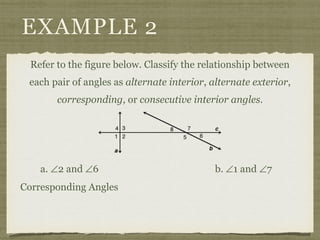
EXAMPLE 2
Refer to the figure below. Classify the relationship between
each pair of angles as alternate interior, alternate exterior,
corresponding, or consecutive interior angles.
a. ∠2 and ∠6 b. ∠1 and ∠7
Corresponding Angles
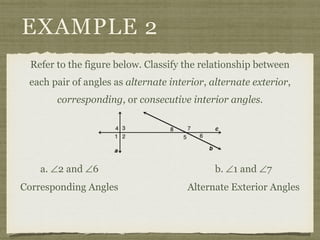
EXAMPLE 2
Refer to the figure below. Classify the relationship between
each pair of angles as alternate interior, alternate exterior,
corresponding, or consecutive interior angles.
a. ∠2 and ∠6 b. ∠1 and ∠7
Corresponding Angles Alternate Exterior Angles
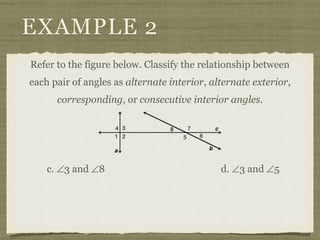
EXAMPLE 2
Refer to the figure below. Classify the relationship between
each pair of angles as alternate interior, alternate exterior,
corresponding, or consecutive interior angles.
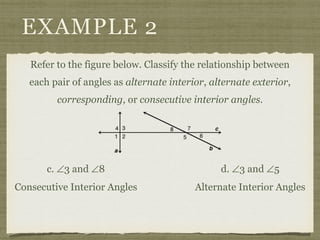
c. ∠3 and ∠8 d. ∠3 and ∠5
EXAMPLE 2
Refer to the figure below. Classify the relationship between
each pair of angles as alternate interior, alternate exterior,
corresponding, or consecutive interior angles.
c. ∠3 and ∠8 d. ∠3 and ∠5
Consecutive Interior Angles
EXAMPLE 2
Refer to the figure below. Classify the relationship between
each pair of angles as alternate interior, alternate exterior,
corresponding, or consecutive interior angles.
c. ∠3 and ∠8 d. ∠3 and ∠5
Consecutive Interior Angles Alternate Interior Angles
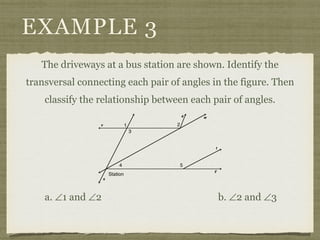
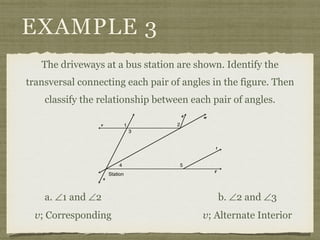
EXAMPLE 3
The driveways at a bus station are shown. Identify the
transversal connecting each pair of angles in the figure. Then
classify the relationship between each pair of angles.
a. ∠1 and ∠2 b. ∠2 and ∠3
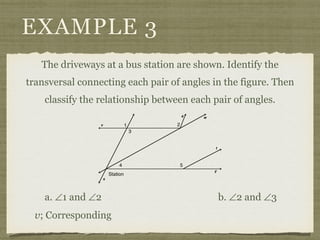
EXAMPLE 3
The driveways at a bus station are shown. Identify the
transversal connecting each pair of angles in the figure. Then
classify the relationship between each pair of angles.
a. ∠1 and ∠2 b. ∠2 and ∠3
v; Corresponding
EXAMPLE 3
The driveways at a bus station are shown. Identify the
transversal connecting each pair of angles in the figure. Then
classify the relationship between each pair of angles.
a. ∠1 and ∠2 b. ∠2 and ∠3
v; Corresponding v; Alternate Interior
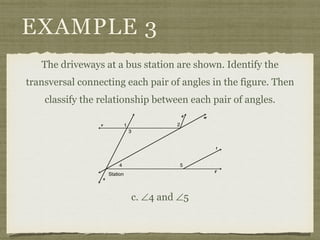
EXAMPLE 3
The driveways at a bus station are shown. Identify the
transversal connecting each pair of angles in the figure. Then
classify the relationship between each pair of angles.
c. ∠4 and ∠5
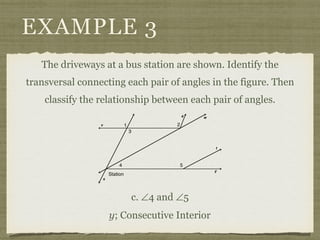
EXAMPLE 3
The driveways at a bus station are shown. Identify the
transversal connecting each pair of angles in the figure. Then
classify the relationship between each pair of angles.
c. ∠4 and ∠5
y; Consecutive Interior
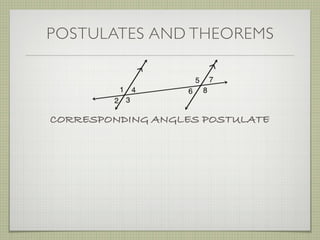
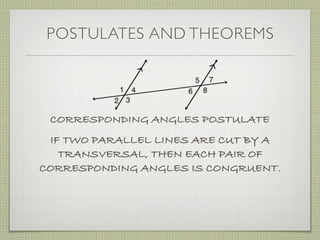
POSTULATES AND THEOREMS
CORRESPONDING ANGLES POSTULATE
POSTULATES AND THEOREMS
CORRESPONDING ANGLES POSTULATE
IF TWO PARALLEL LINES ARE CUT BY A
TRANSVERSAL, THEN EACH PAIR OF
CORRESPONDING ANGLES IS CONGRUENT.
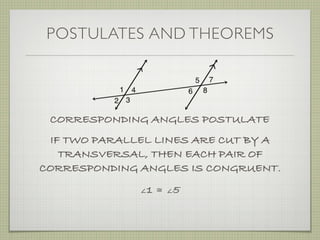
POSTULATES AND THEOREMS
CORRESPONDING ANGLES POSTULATE
IF TWO PARALLEL LINES ARE CUT BY A
TRANSVERSAL, THEN EACH PAIR OF
CORRESPONDING ANGLES IS CONGRUENT.
∠1 ≅ ∠5
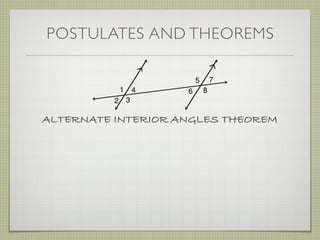
POSTULATES AND THEOREMS
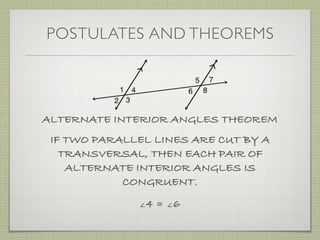
ALTERNATE INTERIOR ANGLES THEOREM
POSTULATES AND THEOREMS
ALTERNATE INTERIOR ANGLES THEOREM
IF TWO PARALLEL LINES ARE CUT BY A
TRANSVERSAL, THEN EACH PAIR OF
ALTERNATE INTERIOR ANGLES IS
CONGRUENT.
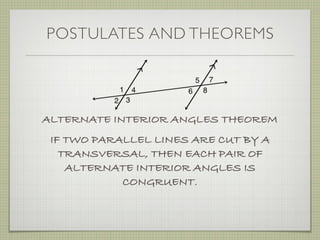
POSTULATES AND THEOREMS
ALTERNATE INTERIOR ANGLES THEOREM
IF TWO PARALLEL LINES ARE CUT BY A
TRANSVERSAL, THEN EACH PAIR OF
ALTERNATE INTERIOR ANGLES IS
CONGRUENT.
∠4 ≅ ∠6
POSTULATES AND THEOREMS
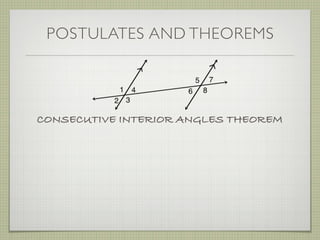
CONSECUTIVE INTERIOR ANGLES THEOREM
POSTULATES AND THEOREMS
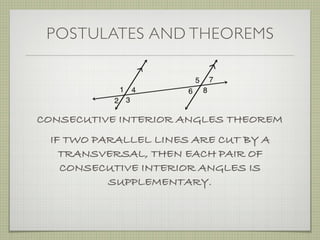
CONSECUTIVE INTERIOR ANGLES THEOREM
IF TWO PARALLEL LINES ARE CUT BY A
TRANSVERSAL, THEN EACH PAIR OF
CONSECUTIVE INTERIOR ANGLES IS
SUPPLEMENTARY.
POSTULATES AND THEOREMS
CONSECUTIVE INTERIOR ANGLES THEOREM
IF TWO PARALLEL LINES ARE CUT BY A
TRANSVERSAL, THEN EACH PAIR OF
CONSECUTIVE INTERIOR ANGLES IS
SUPPLEMENTARY.
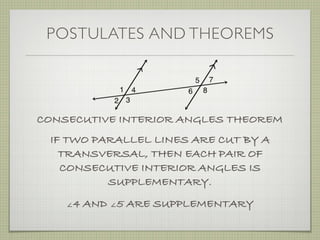
∠4 AND ∠5 ARE SUPPLEMENTARY
POSTULATES AND THEOREMS
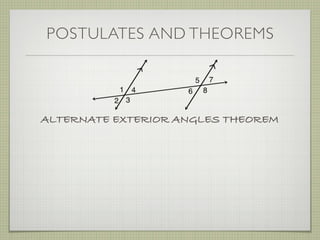
ALTERNATE EXTERIOR ANGLES THEOREM
POSTULATES AND THEOREMS
ALTERNATE EXTERIOR ANGLES THEOREM
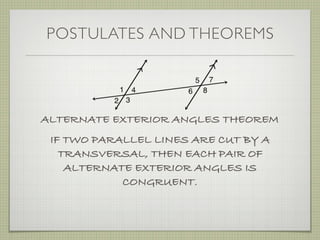
IF TWO PARALLEL LINES ARE CUT BY A
TRANSVERSAL, THEN EACH PAIR OF
ALTERNATE EXTERIOR ANGLES IS
CONGRUENT.
POSTULATES AND THEOREMS
ALTERNATE EXTERIOR ANGLES THEOREM
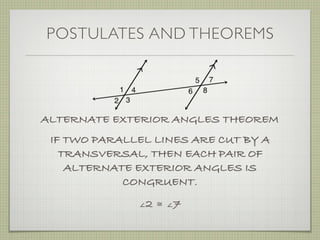
IF TWO PARALLEL LINES ARE CUT BY A
TRANSVERSAL, THEN EACH PAIR OF
ALTERNATE EXTERIOR ANGLES IS
CONGRUENT.
∠2 ≅ ∠7
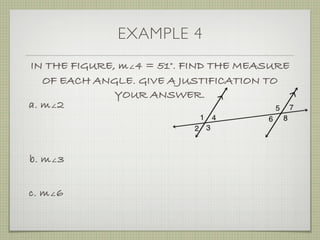
EXAMPLE 4
IN THE FIGURE, m∠4 = 51°. FIND THE MEASURE
OF EACH ANGLE. GIVE A JUSTIFICATION TO
YOUR ANSWER.
a. m∠2
b. m∠3
c. m∠6
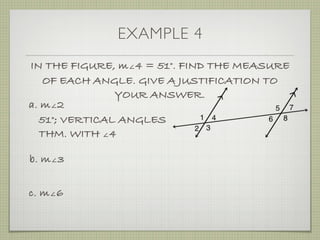
EXAMPLE 4
IN THE FIGURE, m∠4 = 51°. FIND THE MEASURE
OF EACH ANGLE. GIVE A JUSTIFICATION TO
YOUR ANSWER.
a. m∠2
51°; VERTICAL ANGLES
THM. WITH ∠4
b. m∠3
c. m∠6
EXAMPLE 4
IN THE FIGURE, m∠4 = 51°. FIND THE MEASURE
OF EACH ANGLE. GIVE A JUSTIFICATION TO
YOUR ANSWER.
a. m∠2
51°; VERTICAL ANGLES
THM. WITH ∠4
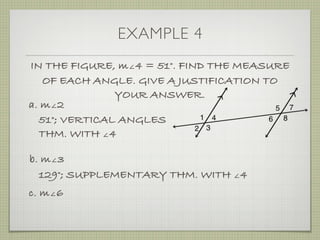
b. m∠3
129°; SUPPLEMENTARY THM. WITH ∠4
c. m∠6
EXAMPLE 4
IN THE FIGURE, m∠4 = 51°. FIND THE MEASURE
OF EACH ANGLE. GIVE A JUSTIFICATION TO
YOUR ANSWER.
a. m∠2
51°; VERTICAL ANGLES
THM. WITH ∠4
b. m∠3
129°; SUPPLEMENTARY THM. WITH ∠4
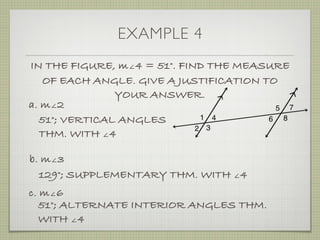
c. m∠6
51°; ALTERNATE INTERIOR ANGLES THM.
WITH ∠4
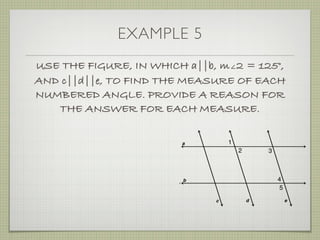
EXAMPLE 5
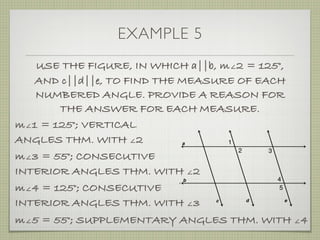
USE THE FIGURE, IN WHICH a||b, m∠2 = 125°,
AND c||d||e, TO FIND THE MEASURE OF EACH
NUMBERED ANGLE. PROVIDE A REASON FOR
THE ANSWER FOR EACH MEASURE.
EXAMPLE 5
USE THE FIGURE, IN WHICH a||b, m∠2 = 125°,
AND c||d||e, TO FIND THE MEASURE OF EACH
NUMBERED ANGLE. PROVIDE A REASON FOR
THE ANSWER FOR EACH MEASURE.
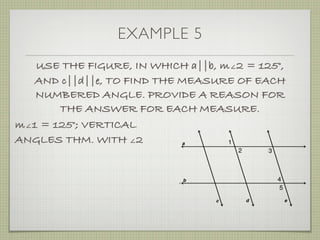
m∠1 = 125°; VERTICAL
ANGLES THM. WITH ∠2
EXAMPLE 5
USE THE FIGURE, IN WHICH a||b, m∠2 = 125°,
AND c||d||e, TO FIND THE MEASURE OF EACH
NUMBERED ANGLE. PROVIDE A REASON FOR
THE ANSWER FOR EACH MEASURE.
m∠1 = 125°; VERTICAL
ANGLES THM. WITH ∠2
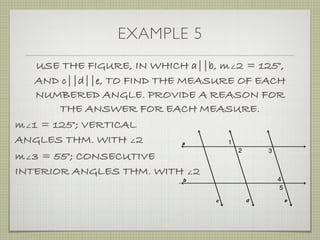
m∠3 = 55°; CONSECUTIVE
INTERIOR ANGLES THM. WITH ∠2
EXAMPLE 5
USE THE FIGURE, IN WHICH a||b, m∠2 = 125°,
AND c||d||e, TO FIND THE MEASURE OF EACH
NUMBERED ANGLE. PROVIDE A REASON FOR
THE ANSWER FOR EACH MEASURE.
m∠1 = 125°; VERTICAL
ANGLES THM. WITH ∠2
m∠3 = 55°; CONSECUTIVE
INTERIOR ANGLES THM. WITH ∠2
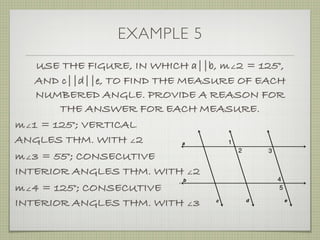
m∠4 = 125°; CONSECUTIVE
INTERIOR ANGLES THM. WITH ∠3
EXAMPLE 5
USE THE FIGURE, IN WHICH a||b, m∠2 = 125°,
AND c||d||e, TO FIND THE MEASURE OF EACH
NUMBERED ANGLE. PROVIDE A REASON FOR
THE ANSWER FOR EACH MEASURE.
m∠1 = 125°; VERTICAL
ANGLES THM. WITH ∠2
m∠3 = 55°; CONSECUTIVE
INTERIOR ANGLES THM. WITH ∠2
m∠4 = 125°; CONSECUTIVE
INTERIOR ANGLES THM. WITH ∠3
m∠5 = 55°; SUPPLEMENTARY ANGLES THM. WITH ∠4
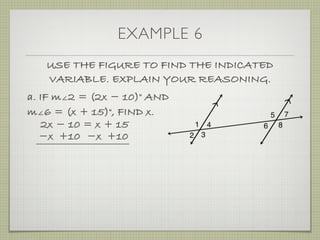
EXAMPLE 6
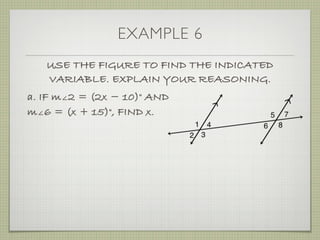
USE THE FIGURE TO FIND THE INDICATED
VARIABLE. EXPLAIN YOUR REASONING.
a. IF m∠2 = (2x ­ 10)° AND
m∠6 = (x + 15)°, FIND x.
EXAMPLE 6
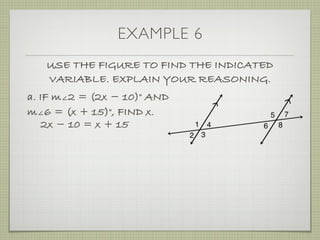
USE THE FIGURE TO FIND THE INDICATED
VARIABLE. EXPLAIN YOUR REASONING.
a. IF m∠2 = (2x ­ 10)° AND
m∠6 = (x + 15)°, FIND x.
2x ­ 10 = x + 15
EXAMPLE 6
USE THE FIGURE TO FIND THE INDICATED
VARIABLE. EXPLAIN YOUR REASONING.
a. IF m∠2 = (2x ­ 10)° AND
m∠6 = (x + 15)°, FIND x.
2x ­ 10 = x + 15
­x ­x
EXAMPLE 6
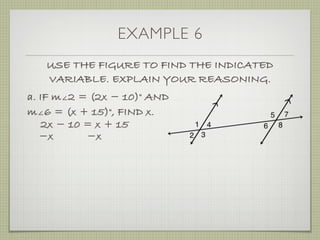
USE THE FIGURE TO FIND THE INDICATED
VARIABLE. EXPLAIN YOUR REASONING.
a. IF m∠2 = (2x ­ 10)° AND
m∠6 = (x + 15)°, FIND x.
2x ­ 10 = x + 15
­x ­x +10+10
EXAMPLE 6
USE THE FIGURE TO FIND THE INDICATED
VARIABLE. EXPLAIN YOUR REASONING.
a. IF m∠2 = (2x ­ 10)° AND
m∠6 = (x + 15)°, FIND x.
2x ­ 10 = x + 15
­x ­x +10+10
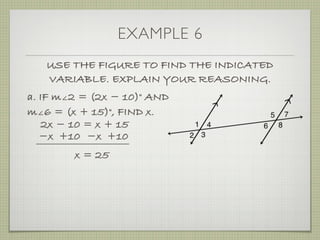
x = 25
EXAMPLE 6
USE THE FIGURE TO FIND THE INDICATED
VARIABLE. EXPLAIN YOUR REASONING.
a. IF m∠2 = (2x ­ 10)° AND
m∠6 = (x + 15)°, FIND x.
2x ­ 10 = x + 15
­x ­x +10+10
x = 25
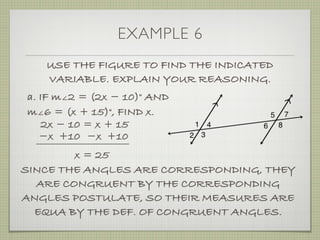
SINCE THE ANGLES ARE CORRESPONDING, THEY
ARE CONGRUENT BY THE CORRESPONDING
ANGLES POSTULATE, SO THEIR MEASURES ARE
EQUA BY THE DEF. OF CONGRUENT ANGLES.
EXAMPLE 6
USE THE FIGURE TO FIND THE INDICATED
VARIABLE. EXPLAIN YOUR REASONING.
b. IF m∠7 = [4(y ­ 25)]° AND
m∠1 = (4y)°, FIND y.
EXAMPLE 6
USE THE FIGURE TO FIND THE INDICATED
VARIABLE. EXPLAIN YOUR REASONING.
b. IF m∠7 = [4(y ­ 25)]° AND
m∠1 = (4y)°, FIND y.
4(y ­ 25) + 4y = 180
EXAMPLE 6
USE THE FIGURE TO FIND THE INDICATED
VARIABLE. EXPLAIN YOUR REASONING.
b. IF m∠7 = [4(y ­ 25)]° AND
m∠1 = (4y)°, FIND y.
4(y ­ 25) + 4y = 180
4y ­ 100 + 4y = 180
EXAMPLE 6
USE THE FIGURE TO FIND THE INDICATED
VARIABLE. EXPLAIN YOUR REASONING.
b. IF m∠7 = [4(y ­ 25)]° AND
m∠1 = (4y)°, FIND y.
4(y ­ 25) + 4y = 180
4y ­ 100 + 4y = 180
8y ­ 100 = 180
EXAMPLE 6
USE THE FIGURE TO FIND THE INDICATED
VARIABLE. EXPLAIN YOUR REASONING.
b. IF m∠7 = [4(y ­ 25)]° AND
m∠1 = (4y)°, FIND y.
4(y ­ 25) + 4y = 180
4y ­ 100 + 4y = 180
8y ­ 100 = 180
8y = 280
EXAMPLE 6
USE THE FIGURE TO FIND THE INDICATED
VARIABLE. EXPLAIN YOUR REASONING.
b. IF m∠7 = [4(y ­ 25)]° AND
m∠1 = (4y)°, FIND y.
4(y ­ 25) + 4y = 180
4y ­ 100 + 4y = 180
8y ­ 100 = 180
8y = 280
y = 35

Geometry Section 2-7

  • 1.
  • 2.
    ESSENTIAL QUESTIONS How do youidentify the relationships between two lines or two planes? How do you name angle pairs formed by parallel lines and transversals?
  • 3.
    VOCABULARY 1. Transversal: 2. InteriorAngles: 3. Exterior Angles: 4. Consecutive Interior Angles:
  • 4.
    VOCABULARY 1. Transversal: Aline that intersects two other coplanar lines at two different points 2. Interior Angles: 3. Exterior Angles: 4. Consecutive Interior Angles:
  • 5.
    VOCABULARY 1. Transversal: Aline that intersects two other coplanar lines at two different points 2. Interior Angles: Angles that are formed in the region between two lines being intersected by a transversal 3. Exterior Angles: 4. Consecutive Interior Angles:
  • 6.
    VOCABULARY 1. Transversal: Aline that intersects two other coplanar lines at two different points 2. Interior Angles: Angles that are formed in the region between two lines being intersected by a transversal 3. Exterior Angles: Angles that are formed in the region outside of the two lines being intersected by a transversal 4. Consecutive Interior Angles:
  • 7.
    VOCABULARY 1. Transversal: Aline that intersects two other coplanar lines at two different points 2. Interior Angles: Angles that are formed in the region between two lines being intersected by a transversal 3. Exterior Angles: Angles that are formed in the region outside of the two lines being intersected by a transversal 4. Consecutive Interior Angles: Interior angles that are on the same side of the transversal, thus being “next” to each other
  • 8.
    VOCABULARY 5. Alternate InteriorAngles: 6. Alternate Exterior Angles: 7. Corresponding Angles: 8. Parallel Lines:
  • 9.
    VOCABULARY 5. Alternate InteriorAngles: Nonadjacent interior angles that are on opposite sides of the transversal 6. Alternate Exterior Angles: 7. Corresponding Angles: 8. Parallel Lines:
  • 10.
    VOCABULARY 5. Alternate InteriorAngles: Nonadjacent interior angles that are on opposite sides of the transversal 6. Alternate Exterior Angles: 7. Corresponding Angles: 8. Parallel Lines: Nonadjacent exterior angles that are on opposite sides of the transversal
  • 11.
    VOCABULARY 5. Alternate InteriorAngles: Nonadjacent interior angles that are on opposite sides of the transversal 6. Alternate Exterior Angles: 7. Corresponding Angles: 8. Parallel Lines: Nonadjacent exterior angles that are on opposite sides of the transversal Angles that are on the same side of the transversal and on the same side of the lines being intersected by the transversal; these angles have the same position
  • 12.
    VOCABULARY 5. Alternate InteriorAngles: Nonadjacent interior angles that are on opposite sides of the transversal 6. Alternate Exterior Angles: 7. Corresponding Angles: 8. Parallel Lines: Two or more lines in the same plane that do not intersect Nonadjacent exterior angles that are on opposite sides of the transversal Angles that are on the same side of the transversal and on the same side of the lines being intersected by the transversal; these angles have the same position
  • 13.
  • 14.
    VOCABULARY 9. Skew Lines:Two or more lines that are in different planes and do not intersect 10. Parallel Planes:
  • 15.
    VOCABULARY 9. Skew Lines:Two or more lines that are in different planes and do not intersect 10. Parallel Planes: Two or more planes that do not intersect
  • 16.
    EXAMPLE 1 Identify eachof the following using the box. a. All segments parallel to BC b. A segment that is skew to EH c. A plane that is parallel to plane ABG
  • 17.
    EXAMPLE 1 Identify eachof the following using the box. a. All segments parallel to BC FG, AD, EH b. A segment that is skew to EH c. A plane that is parallel to plane ABG
  • 18.
    EXAMPLE 1 Identify eachof the following using the box. a. All segments parallel to BC FG, AD, EH b. A segment that is skew to EH DC, CF, AB, or BG c. A plane that is parallel to plane ABG
  • 19.
    EXAMPLE 1 Identify eachof the following using the box. a. All segments parallel to BC FG, AD, EH b. A segment that is skew to EH DC, CF, AB, or BG c. A plane that is parallel to plane ABG Plane DEC
  • 20.
    EXAMPLE 2 Refer tothe figure below. Classify the relationship between each pair of angles as alternate interior, alternate exterior, corresponding, or consecutive interior angles. a. ∠2 and ∠6 b. ∠1 and ∠7
  • 21.
    EXAMPLE 2 Refer tothe figure below. Classify the relationship between each pair of angles as alternate interior, alternate exterior, corresponding, or consecutive interior angles. a. ∠2 and ∠6 b. ∠1 and ∠7 Corresponding Angles
  • 22.
    EXAMPLE 2 Refer tothe figure below. Classify the relationship between each pair of angles as alternate interior, alternate exterior, corresponding, or consecutive interior angles. a. ∠2 and ∠6 b. ∠1 and ∠7 Corresponding Angles Alternate Exterior Angles
  • 23.
    EXAMPLE 2 Refer tothe figure below. Classify the relationship between each pair of angles as alternate interior, alternate exterior, corresponding, or consecutive interior angles. c. ∠3 and ∠8 d. ∠3 and ∠5
  • 24.
    EXAMPLE 2 Refer tothe figure below. Classify the relationship between each pair of angles as alternate interior, alternate exterior, corresponding, or consecutive interior angles. c. ∠3 and ∠8 d. ∠3 and ∠5 Consecutive Interior Angles
  • 25.
    EXAMPLE 2 Refer tothe figure below. Classify the relationship between each pair of angles as alternate interior, alternate exterior, corresponding, or consecutive interior angles. c. ∠3 and ∠8 d. ∠3 and ∠5 Consecutive Interior Angles Alternate Interior Angles
  • 26.
    EXAMPLE 3 The drivewaysat a bus station are shown. Identify the transversal connecting each pair of angles in the figure. Then classify the relationship between each pair of angles. a. ∠1 and ∠2 b. ∠2 and ∠3
  • 27.
    EXAMPLE 3 The drivewaysat a bus station are shown. Identify the transversal connecting each pair of angles in the figure. Then classify the relationship between each pair of angles. a. ∠1 and ∠2 b. ∠2 and ∠3 v; Corresponding
  • 28.
    EXAMPLE 3 The drivewaysat a bus station are shown. Identify the transversal connecting each pair of angles in the figure. Then classify the relationship between each pair of angles. a. ∠1 and ∠2 b. ∠2 and ∠3 v; Corresponding v; Alternate Interior
  • 29.
    EXAMPLE 3 The drivewaysat a bus station are shown. Identify the transversal connecting each pair of angles in the figure. Then classify the relationship between each pair of angles. c. ∠4 and ∠5
  • 30.
    EXAMPLE 3 The drivewaysat a bus station are shown. Identify the transversal connecting each pair of angles in the figure. Then classify the relationship between each pair of angles. c. ∠4 and ∠5 y; Consecutive Interior
  • 31.
  • 32.
    POSTULATES AND THEOREMS CORRESPONDINGANGLES POSTULATE IF TWO PARALLEL LINES ARE CUT BY A TRANSVERSAL, THEN EACH PAIR OF CORRESPONDING ANGLES IS CONGRUENT.
  • 33.
    POSTULATES AND THEOREMS CORRESPONDINGANGLES POSTULATE IF TWO PARALLEL LINES ARE CUT BY A TRANSVERSAL, THEN EACH PAIR OF CORRESPONDING ANGLES IS CONGRUENT. ∠1 ≅ ∠5
  • 34.
    POSTULATES AND THEOREMS ALTERNATEINTERIOR ANGLES THEOREM
  • 35.
    POSTULATES AND THEOREMS ALTERNATEINTERIOR ANGLES THEOREM IF TWO PARALLEL LINES ARE CUT BY A TRANSVERSAL, THEN EACH PAIR OF ALTERNATE INTERIOR ANGLES IS CONGRUENT.
  • 36.
    POSTULATES AND THEOREMS ALTERNATEINTERIOR ANGLES THEOREM IF TWO PARALLEL LINES ARE CUT BY A TRANSVERSAL, THEN EACH PAIR OF ALTERNATE INTERIOR ANGLES IS CONGRUENT. ∠4 ≅ ∠6
  • 37.
    POSTULATES AND THEOREMS CONSECUTIVEINTERIOR ANGLES THEOREM
  • 38.
    POSTULATES AND THEOREMS CONSECUTIVEINTERIOR ANGLES THEOREM IF TWO PARALLEL LINES ARE CUT BY A TRANSVERSAL, THEN EACH PAIR OF CONSECUTIVE INTERIOR ANGLES IS SUPPLEMENTARY.
  • 39.
    POSTULATES AND THEOREMS CONSECUTIVEINTERIOR ANGLES THEOREM IF TWO PARALLEL LINES ARE CUT BY A TRANSVERSAL, THEN EACH PAIR OF CONSECUTIVE INTERIOR ANGLES IS SUPPLEMENTARY. ∠4 AND ∠5 ARE SUPPLEMENTARY
  • 40.
    POSTULATES AND THEOREMS ALTERNATEEXTERIOR ANGLES THEOREM
  • 41.
    POSTULATES AND THEOREMS ALTERNATEEXTERIOR ANGLES THEOREM IF TWO PARALLEL LINES ARE CUT BY A TRANSVERSAL, THEN EACH PAIR OF ALTERNATE EXTERIOR ANGLES IS CONGRUENT.
  • 42.
    POSTULATES AND THEOREMS ALTERNATEEXTERIOR ANGLES THEOREM IF TWO PARALLEL LINES ARE CUT BY A TRANSVERSAL, THEN EACH PAIR OF ALTERNATE EXTERIOR ANGLES IS CONGRUENT. ∠2 ≅ ∠7
  • 43.
    EXAMPLE 4 IN THEFIGURE, m∠4 = 51°. FIND THE MEASURE OF EACH ANGLE. GIVE A JUSTIFICATION TO YOUR ANSWER. a. m∠2 b. m∠3 c. m∠6
  • 44.
    EXAMPLE 4 IN THEFIGURE, m∠4 = 51°. FIND THE MEASURE OF EACH ANGLE. GIVE A JUSTIFICATION TO YOUR ANSWER. a. m∠2 51°; VERTICAL ANGLES THM. WITH ∠4 b. m∠3 c. m∠6
  • 45.
    EXAMPLE 4 IN THEFIGURE, m∠4 = 51°. FIND THE MEASURE OF EACH ANGLE. GIVE A JUSTIFICATION TO YOUR ANSWER. a. m∠2 51°; VERTICAL ANGLES THM. WITH ∠4 b. m∠3 129°; SUPPLEMENTARY THM. WITH ∠4 c. m∠6
  • 46.
    EXAMPLE 4 IN THEFIGURE, m∠4 = 51°. FIND THE MEASURE OF EACH ANGLE. GIVE A JUSTIFICATION TO YOUR ANSWER. a. m∠2 51°; VERTICAL ANGLES THM. WITH ∠4 b. m∠3 129°; SUPPLEMENTARY THM. WITH ∠4 c. m∠6 51°; ALTERNATE INTERIOR ANGLES THM. WITH ∠4
  • 47.
    EXAMPLE 5 USE THEFIGURE, IN WHICH a||b, m∠2 = 125°, AND c||d||e, TO FIND THE MEASURE OF EACH NUMBERED ANGLE. PROVIDE A REASON FOR THE ANSWER FOR EACH MEASURE.
  • 48.
    EXAMPLE 5 USE THEFIGURE, IN WHICH a||b, m∠2 = 125°, AND c||d||e, TO FIND THE MEASURE OF EACH NUMBERED ANGLE. PROVIDE A REASON FOR THE ANSWER FOR EACH MEASURE. m∠1 = 125°; VERTICAL ANGLES THM. WITH ∠2
  • 49.
    EXAMPLE 5 USE THEFIGURE, IN WHICH a||b, m∠2 = 125°, AND c||d||e, TO FIND THE MEASURE OF EACH NUMBERED ANGLE. PROVIDE A REASON FOR THE ANSWER FOR EACH MEASURE. m∠1 = 125°; VERTICAL ANGLES THM. WITH ∠2 m∠3 = 55°; CONSECUTIVE INTERIOR ANGLES THM. WITH ∠2
  • 50.
    EXAMPLE 5 USE THEFIGURE, IN WHICH a||b, m∠2 = 125°, AND c||d||e, TO FIND THE MEASURE OF EACH NUMBERED ANGLE. PROVIDE A REASON FOR THE ANSWER FOR EACH MEASURE. m∠1 = 125°; VERTICAL ANGLES THM. WITH ∠2 m∠3 = 55°; CONSECUTIVE INTERIOR ANGLES THM. WITH ∠2 m∠4 = 125°; CONSECUTIVE INTERIOR ANGLES THM. WITH ∠3
  • 51.
    EXAMPLE 5 USE THEFIGURE, IN WHICH a||b, m∠2 = 125°, AND c||d||e, TO FIND THE MEASURE OF EACH NUMBERED ANGLE. PROVIDE A REASON FOR THE ANSWER FOR EACH MEASURE. m∠1 = 125°; VERTICAL ANGLES THM. WITH ∠2 m∠3 = 55°; CONSECUTIVE INTERIOR ANGLES THM. WITH ∠2 m∠4 = 125°; CONSECUTIVE INTERIOR ANGLES THM. WITH ∠3 m∠5 = 55°; SUPPLEMENTARY ANGLES THM. WITH ∠4
  • 52.
    EXAMPLE 6 USE THEFIGURE TO FIND THE INDICATED VARIABLE. EXPLAIN YOUR REASONING. a. IF m∠2 = (2x ­ 10)° AND m∠6 = (x + 15)°, FIND x.
  • 53.
    EXAMPLE 6 USE THEFIGURE TO FIND THE INDICATED VARIABLE. EXPLAIN YOUR REASONING. a. IF m∠2 = (2x ­ 10)° AND m∠6 = (x + 15)°, FIND x. 2x ­ 10 = x + 15
  • 54.
    EXAMPLE 6 USE THEFIGURE TO FIND THE INDICATED VARIABLE. EXPLAIN YOUR REASONING. a. IF m∠2 = (2x ­ 10)° AND m∠6 = (x + 15)°, FIND x. 2x ­ 10 = x + 15 ­x ­x
  • 55.
    EXAMPLE 6 USE THEFIGURE TO FIND THE INDICATED VARIABLE. EXPLAIN YOUR REASONING. a. IF m∠2 = (2x ­ 10)° AND m∠6 = (x + 15)°, FIND x. 2x ­ 10 = x + 15 ­x ­x +10+10
  • 56.
    EXAMPLE 6 USE THEFIGURE TO FIND THE INDICATED VARIABLE. EXPLAIN YOUR REASONING. a. IF m∠2 = (2x ­ 10)° AND m∠6 = (x + 15)°, FIND x. 2x ­ 10 = x + 15 ­x ­x +10+10 x = 25
  • 57.
    EXAMPLE 6 USE THEFIGURE TO FIND THE INDICATED VARIABLE. EXPLAIN YOUR REASONING. a. IF m∠2 = (2x ­ 10)° AND m∠6 = (x + 15)°, FIND x. 2x ­ 10 = x + 15 ­x ­x +10+10 x = 25 SINCE THE ANGLES ARE CORRESPONDING, THEY ARE CONGRUENT BY THE CORRESPONDING ANGLES POSTULATE, SO THEIR MEASURES ARE EQUA BY THE DEF. OF CONGRUENT ANGLES.
  • 58.
    EXAMPLE 6 USE THEFIGURE TO FIND THE INDICATED VARIABLE. EXPLAIN YOUR REASONING. b. IF m∠7 = [4(y ­ 25)]° AND m∠1 = (4y)°, FIND y.
  • 59.
    EXAMPLE 6 USE THEFIGURE TO FIND THE INDICATED VARIABLE. EXPLAIN YOUR REASONING. b. IF m∠7 = [4(y ­ 25)]° AND m∠1 = (4y)°, FIND y. 4(y ­ 25) + 4y = 180
  • 60.
    EXAMPLE 6 USE THEFIGURE TO FIND THE INDICATED VARIABLE. EXPLAIN YOUR REASONING. b. IF m∠7 = [4(y ­ 25)]° AND m∠1 = (4y)°, FIND y. 4(y ­ 25) + 4y = 180 4y ­ 100 + 4y = 180
  • 61.
    EXAMPLE 6 USE THEFIGURE TO FIND THE INDICATED VARIABLE. EXPLAIN YOUR REASONING. b. IF m∠7 = [4(y ­ 25)]° AND m∠1 = (4y)°, FIND y. 4(y ­ 25) + 4y = 180 4y ­ 100 + 4y = 180 8y ­ 100 = 180
  • 62.
    EXAMPLE 6 USE THEFIGURE TO FIND THE INDICATED VARIABLE. EXPLAIN YOUR REASONING. b. IF m∠7 = [4(y ­ 25)]° AND m∠1 = (4y)°, FIND y. 4(y ­ 25) + 4y = 180 4y ­ 100 + 4y = 180 8y ­ 100 = 180 8y = 280
  • 63.
    EXAMPLE 6 USE THEFIGURE TO FIND THE INDICATED VARIABLE. EXPLAIN YOUR REASONING. b. IF m∠7 = [4(y ­ 25)]° AND m∠1 = (4y)°, FIND y. 4(y ­ 25) + 4y = 180 4y ­ 100 + 4y = 180 8y ­ 100 = 180 8y = 280 y = 35