12th
CBSE SOLUTION_MATHS(SAT-1)_PAGE # 1
1. R = {(x, y) : x + 2y = 8}
x + 2y = 8
Put x = 2, 2 + 2y = 8, (2, 3)
y = 3
Put x = 4, 4 + 2  y = 8 (4, 2)
y = 2
Put x = 6, 6 + 2y = 8 (6, 1)
y = 1
 range if {1, 2, 3}
2. tan–1
x + tan–1
y =
4

if xy < 1
tan–1








xy1
yx
=
4

xy1
yx


= tan
4

x + y = 1 – xy
x + y + xy = 1
3. Given
A2
= A
7A – (I + A)3
= 7A – [I3
+ A3
+ 3I.A. (A + I)]
= 7A – [I + A. A + 3 I. A. A. + 3I. A.I.]
= 7A – I – A. –3A – 3A
= – I
4. 







wyx2
zyx
= 





50
41
x – y = – 1
2x – y = 0 x = 1
____________ y = 2
– x = – 1 Then x + y = 3
5. 





 42
7x3
= 





46
78
12x + 14 = 32 – 42
12x + 14 = – 10
12x = – 24
x = – 2
6. f(x) = 
x
0
dttsint
f’ (x) = [tsin t]0
x
= x sin x
12th
CBSE(SAT-1)
(SESSION : 2014)
SUBJECT : MATHS(xf.kr)
SOLUTION (gy)
12th
CBSE SOLUTION_MATHS(SAT-1)_PAGE # 2
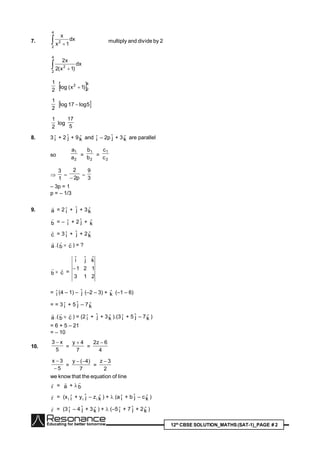
7.  
4
2
2
dx
1x
x
multiply and divide by 2
 
4
2
2
dx
)1x(2
x2
2
1
 4
2
2
)1x(log 
2
1
 5log17log 
2
1
log
5
17
8. 3 iˆ + 2 jˆ + 9kˆ and iˆ – 2p jˆ + 3kˆ are parallel
so
2
1
a
a
=
2
1
b
b
=
2
1
c
c

1
3

p2
2


3
9
– 3p = 1
p = – 1/3
9. a

= 2 iˆ + jˆ + 3kˆ
b

= – iˆ + 2 jˆ + kˆ
c

= 3 iˆ + jˆ + 2kˆ
a

.(b

 c

) = ?
b

 c

=
213
121
kˆjˆiˆ

= iˆ (4 – 1) – jˆ (–2 – 3) + kˆ (–1 – 6)
= = 3 iˆ + 5 jˆ – 7kˆ
a

.(b

 c

) = (2 iˆ + jˆ + 3kˆ ).(3 iˆ + 5 jˆ – 7kˆ )
= 6 + 5 – 21
= – 10
10.
5
x3 
=
7
4y 
=
4
6z2 
5
3x


=
7
)4(y 
=
2
3z 
we know that the equation of line
r

= a

+ b

r

= (x1 iˆ + y1 jˆ – z1 kˆ ) +  (a iˆ + b jˆ – ckˆ )
r

= (3 iˆ – 4 jˆ + 3kˆ ) +  (–5 iˆ + 7 jˆ + 2kˆ )
12th
CBSE SOLUTION_MATHS(SAT-1)_PAGE # 3
11. f : R  R, f(x) = x2
+ 2 , g : R  R, g(x) =
1x
x

, x  1
fog (x) = f [g(x)] gof (x) = g[f(x)]
fog(x) =
2
1x
x







+ 2 gof(x) =
1x
2x
2
2


fog(2) = 4 + 2 = 6 gof (–3) =
19
29


=
10
11
12. x = cos 2 ..(1)
= tan–1










2cos12cos1
2cos12cos1
= tan–1








sincos
sincos
= tan–1








tan1
tan1
= tan–1
tan 







0
4
=
4

– 
=
2

–
2
1
cos–1
x
OR
tan–1
4x
2x


+ tan–1
4x
2x


=
4

tan–1























4x
2x
4x
2x
1
4x
2x
4x
2x
=
4

)4x()16x(
)4x)(2x()4x)(2x(
22


= 1
x2
+ 2x – 8 + x2
– 2x – 8 = (x2
– 16) – (x2
– 4)
2x2
– 16 = – 16 + 4
2x2
= 4
x2
= 2
x =  2
13. Given
x3x8y8x10
x2x4y4x5
xxyx



= x3
12th
CBSE SOLUTION_MATHS(SAT-1)_PAGE # 4
L.H.S.
x3x8y8x10
x2x4y4x5
xxyx



x3x8x10
x2x4x5
xxx
+
x3x8y8
x2x4y4
xxy
take common elements
x3
3810
245
111
+ yx
388
244
111
Two coloumn are identical
c2
 c2
– c1
c3  c3
– c1
x3
7210
315
001


+ 0
x3
(7 – 6) = x3
14. x = ae
(sin – cos)
y = ae
(sin + cos)
if q =
4

d
dx
= ae
[cos + sin] + (sin – cos) ae

ae
(2 sin )
d
dy
ae
[cos – sin] + (sin + cos) ae

ae
(2 cos )
dx
dy
=


d
dx
d
dy
=




sin2
cos2
ae
ae
= cot
dx
dy
= cot
4
dx
dy








= cot
4

= 1
15. y = Peax
+ Qebx
show that
2
2
dx
yd
– (a + b)
dx
dy
+ aby = 0
dx
dy
= Paeax
+ Qbebx
12th
CBSE SOLUTION_MATHS(SAT-1)_PAGE # 5
2
2
dx
yd
= Pa2
eax
+ Qb2
ebx
L.H.S.
2
2
dx
yd
– (a + b)
dx
dy
+ aby
(Pa2
eax
+ Qb2
ebx
) – (a + b) (Paeax
+ Qbebx
) + aby = 0
Pa2
eax
+ Qb2
ebx
– Pa2
eax
– Qabebx
– Pabeax
– Qb2
ebx
+ aby = 0
– ab |Qebx
+ Peax
|+ aby
– aby + aby = 0
16. y = [x (x – 2)]2
dx
dy
= 2 (x (x – 2)) [(x -2) + x]
= 2[x2
– 2x] [2x – 2]
= 4[(x2
– 2x)(x – 1)]
for increasing faction
dx
dy
> 0
4 (x (x – 2) (x – 1)) > 0
x > 0 x > 2 x > 1
f(x) is increasing on
0 1 2
– + – +
(0, 1)  (2,  )
17. I = dx
xcos1
xsinx4
2



..(1)
we know that 
a
0
dx)x(f =  
a
0
dx)xa(f
I = dx
)x(cos1
)xsin()x(4
2




..(2)
by adding equation (1) and equation (2)
2I = dx
xcos1
xsin4
2




Let cos x = t
– sinx dx = dt when x = 0, t = 1
x = , t = – 1
2I = 



1
1
2
t1
)dt(4
2I = – 4 [tan–1
t]–1
+1
2I = – 4 [–
4

–
4

]
2I = 4p  4
2
= 22
I = 2
12th
CBSE SOLUTION_MATHS(SAT-1)_PAGE # 6
OR
 

dx
6x5x
2x
2
 

dx
6x5x
2)55x2(
2
1
2
2
1
 

dx
6x5x
5x2
2 –
2
1














22
2
2
1
2
5
x
1
dx
if x2
+ 5x + 6 = t
(2x + 5) dx = dt
2
1
 t
dt
–
2
1
log |(x + 5/2) + 22
)2/1()2/5x( 
2
1
2 t –
2
1
log | (x + 5/2) +
2
2
2
1
)2/5x( 





 + C
2
1
6x542
 –
2
1
log | (x + 5/2) + 6x5x2
 | + C
6x5x2
 –
2
1
log | (x + 5/2) + 6x5x2
 + C
18.
dx
dy
= 1 + x + y + xy
dx
dy
= 1 + x + y [1 + x]
dx
dy
= (1 +x) (1 + y)
y1
dy

= (1 + x) dx
intergrating both sides
  y1
dy
=   dx)x1(
log (1 + y) = x +
2
x2
+ C
Now put x = 1 and y = 0
log 1 = 1 +
2
1
+ C
0 =
2
3
+ C
C =
2
3
log (1 + y) = x +
2
x2
–
2
3
12th
CBSE SOLUTION_MATHS(SAT-1)_PAGE # 7
19. (1 + x2
)
dx
dy
+ y = etan–1x
dx
dy
+ 2
x1
y

= 2
xtan
x1
e
1


I.F. =  
dx
x1
1
2
e
= xtan 1
e

Solution of equation is given by
y.(I.F.) =  

2
xtan
x1
e
1
. (I.F.) dx
y. xtan 1
e

=
 




 
2
2
xtan
x1
e
1
.dx
put xtan 1
e

= t
2
xtan
x1
e
1


. dx = dt
y. xtan 1
e

=  dt.t
y. xtan 1
e

=
2
t2
+ C
y. xtan 1
e

=
2
)e( 2xtan 1
+ C
20. OA = 4 iˆ + 5 jˆ + kˆ
OB = – jˆ – kˆ
OC= 3 iˆ + 9 jˆ + 4kˆ
OD = – 4 iˆ + 4 jˆ + 4kˆ
Now these four points will be coplaner if
[AB AC AD] = 0 ...(1)
AB = (– jˆ –kˆ ) – (4 iˆ + 5 jˆ + kˆ )
AB = –4 iˆ – 6 jˆ – 2kˆ
AC = (3 iˆ +9 jˆ + 4kˆ ) – (4 iˆ + 5 jˆ + kˆ )
AC = – iˆ + 4 jˆ + 3kˆ
AD = – ( iˆ +4 jˆ + 4kˆ ) – (4 iˆ + 5 jˆ + kˆ )
AD = – 8 iˆ – jˆ + 3kˆ
by equation (1) [AB AC AD]
=
318
341
264



= – 4 (12 + 3) + 6 (– 3+ 24) – 2(1 + 32)
= – 60 + 126 – 66
= 0
So All four points are coplanar
12th
CBSE SOLUTION_MATHS(SAT-1)_PAGE # 8
21. Equation of straight line passing through (2, –1, 3) is
a
2x 
=
b
1y 
=
c
3z 
...(1)
lines (1) is perpendicular to two lines
 2a – 2b + c = 0
a + 2b + 2c = 0
24
a

=
14
b


=
24
c

6
a

=
3
b

=
6
c
 Equation of plane is
cartesian form
6
2x


=
3
1y


=
6
3z 
Vector form r

= (2 iˆ – jˆ + 3kˆ ) +  (–6 iˆ – 3 jˆ + 6kˆ )
22. P(success) = 3P(fails)
P(success) + P(fails) = 1
3P(fails) + P(fails) = 1
 P(fails) =
4
1
P(success) =
4
3
P(x  3) = P (x = 3) + P(x = 4) + P(x – 5)
= 5C3
3
4
3






2
4
1






+ 5C4
4
4
3






1
4
1






+ 5C5
5
4
3






= 10 
64
27

16
1
+ 5 
256
81

4
1
+
1024
243
=
1024
270
+
1024
405
+
1024
243
=
1024
918
=
512
459
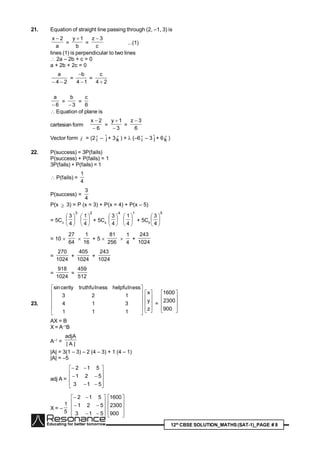
23.












111
314
123
esslnhelpfuesslntruthfuceritysin










z
y
x
=










900
2300
1600
AX = B
X = A–1
B
A–1
= |A|
adjA
|A| = 3(1 – 3) – 2 (4 – 3) + 1 (4 – 1)
|A| = –5
adj A =













513
521
512
X = –
5
1













513
521
512










900
2300
1600
12th
CBSE SOLUTION_MATHS(SAT-1)_PAGE # 9
= –
5
1













2000
1500
1000
=










400
300
200
X = 200 , Y = 300, Z = 400
24.
R
R
x
CA B
V
AC = 22
xR 
VC = VO + OC = R + x
V =
3
1
(AC)2
(VC)
V =
3
1
 (R2
– x2
) (R + x)
V =
3
1
 (R3
+ R2
x – x2
R – x3
)
dx
dv
=
3
1
 [R2
– 2Rx – 3x2
]
dx
dv
= 0
R2
– 2Rx - 3x2
= 0
(R – 3x) (R + x) = 0
x =
3
R
2
2
dx
vd
=
3
1
 (– 2R – 6x)
at x =
3
R
2
2
dx
vd
=
3
1
p [– 2R – 6 
3
R
] < 0
V is maximum
Altitude is VC = R +
3
R
=
3
R4
V =
3
1
(R2
– x2
) (R + x)
=
3
1
(R2
–
9
R2
) (R +
3
R
) =
81
R32 3

V =
27
8






 3
R
3
4
=
27
8
volume of sphere
12th
CBSE SOLUTION_MATHS(SAT-1)_PAGE # 10
25.   xsinxcos
dx
44
Divide by cos4
x
=  
dx
xtan1
xsec
4
4
=  
dx
xtan1
xsec.xsec
4
22
=  

dx
xtan1
xsec).xtan1(
4
22
Put tan x = t
sec2
xdx = dt
=  

dt
t1
t1
4
2
Divide by t2
=  

dt
t
1
t
t
1
1
2
2
2
= 








dt
)2(
t
1
t
t
1
1
2
2
2
let t –
t
1
= u
= 





 2
t
1
1 dt = du
=   22
)2(u
du
=
2
1
tan–1
2
u
+ C
=
2
1
tan–1





 
2
xcotxtan
+ C
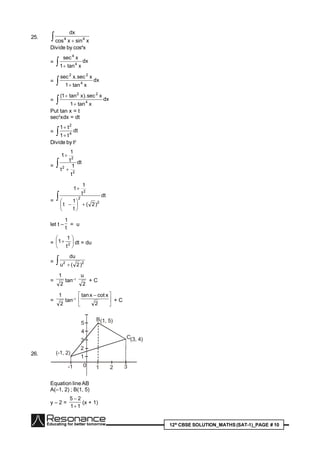
26.
1
2
3
4
5
-1 1 2 3
(-1, 2)
(1, 5)
(3, 4)
B
C
0
Equation lineAB
A(–1, 2) ; B(1, 5)
y – 2 =
11
25


(x + 1)
12th
CBSE SOLUTION_MATHS(SAT-1)_PAGE # 11
y – 2 =
2
3
(x + 1)
2y – 4 = 3x + 3
2y = 3x + 7
y =
2
7x3 
..(1)
equation line BC
B(1, 5) ; C(3, 4)
y – 5 =
13
54


(x – 1)
y – 5 =
2
1
(x – 1)
2y – 10 = –x + 1
y =
2
11x 
..(2)
equation of lineAC
A(–1, 2) ; C(3, 4)
y – 2 =
4
24 
(x +1)
4y – 8 = 2x + 2
y =
4
10x2 
=
2
5x 
area of ABC = 

1
1
dx
2
7x3
+ 

3
1
dx
2
11x
– 

3
1
dx
2
5x
=
2
1
1
1
2
x7
2
x3








 +
2
1
3
1
2
x
1
2
x










–
2
1
3
1
2
x5
2
x









=
2
1






























 11
2
1
33
2
9
7
2
3
7
2
3
–
2
1


















 5
2
1
15
2
9
=
2
1






 11
2
1
33
2
9
14 –
2
1
[4 + 20]
=
2
1
[32] –
2
1
[24]
= 16 – 12
= 4 square units
27. Equation of plane passing through the intersection of planes is
(x + y + z – 1) +  (2x + 3y + 4z – 5) = 0
x (1 + 2) + y (1 + 3) + z (1 + 4) – 1 – 5= 0 ... (1)
plane (1) is prep. to the plane
x – y + z = 0
 1 (1 + 2) – 1 (1 + 3) + 1 (1 + 4) = 0
1 + 2 – 1 – 3 + 1 + 4 = 0
3 + 1 = 0
 = –
3
1
12th
CBSE SOLUTION_MATHS(SAT-1)_PAGE # 12
So, equation of plane is
(x + y + z – 1) –
3
1
(2x + 3y + 4z – 5) = 0
3x + 3y + 3z – 3 – 2x – 3y – 4z + 5 = 0
x – z + 2 = 0
Distance of plane formation
=
11
|211|


=
2
2
= 2 unit
OR
Line
3
2x 
=
4
4y 
=
2
2z 
= l
x = 3 + 2
y = 4 – 4
z = 2 + 2
let the intersection point of line and plane is
(3 + 2, 4 – 4, 2 + 2)
Now this point will lies on plane x – 2y + z = 0
 (3 + 2) – 2 (4 – 4) + (2 + 2) = 0
3 + 2 – 8 + 8 + 2 + 2 = 0
– 3 + 12 = 0
– 3 = –12
 = 4
 point of intersection is : (14, 12, 10)
Distance between pont (2, 12, 5)
Distance = 222
)510()1212()214( 
= 250144 
= 169 = 13 unit
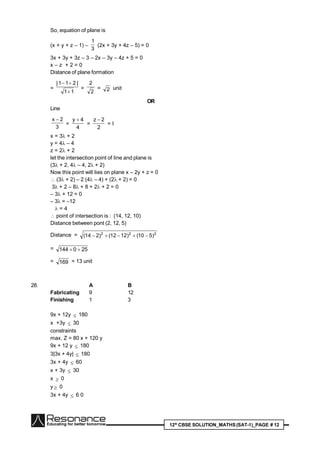
28. A B
Fabricating 9 12
Finishing 1 3
9x + 12y  180
x +3y  30
constraints
max. Z = 80 x + 120 y
9x + 12 y  180
3|3x + 4y|  180
3x + 4y  60
x + 3y  30
x  0
y  0
3x + 4y  6 0
12th
CBSE SOLUTION_MATHS(SAT-1)_PAGE # 13
x = 0 ; y = 15
y = 0 ; x = 20
(0, 15) (20, 0)
x + 3y  30
if x = 0 ; y = 10
y = 0 x = 30
(0, 10) (30, 0)
3x + 4y = 60 ..(1)
x + 3y = 30 ..(2)
equation (2) multiply by 3
3x + 4y = 60
3x + 9y = 90
___________
– 5y = – 30
y = 6 ..(3)
x + 18 = 30
x = 12 .. (4)
(12, 6) intersecting point
z = 30x + 120 y (0, 10), (12, 6), (20, 0)
If P1
(0, 10)
z = 1200
If Pz
(12, 6)
z = 80  12 + 120  6
= 960 + 720
= 1680
If P3
(20, 0)
z = 1600
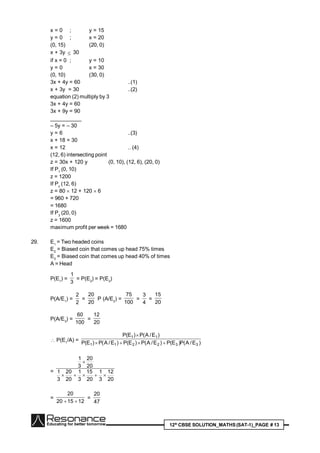
maximum profit per week = 1680
29. E1
= Two headed coins
E2
= Biased coin that comes up head 75% times
E3
= Biased coin that comes up head 40% of times
A = Head
P(E1
) =
3
1
= P(E2
) = P(E3
)
P(A/E1
) =
2
2
=
20
20
P (A/E2
) =
100
75
=
4
3
=
20
15
P(A/E3
) =
100
60
=
20
12
 P(E1
/A) = )E/A(P)E(P)E/A(P)E(P)E/A(P)E(P
)E/A(P)E(P
332211
11


=
20
12
3
1
20
15
3
1
20
20
3
1
20
20
3
1


=
121520
20

=
47
20
12th
CBSE SOLUTION_MATHS(SAT-1)_PAGE # 14
OR
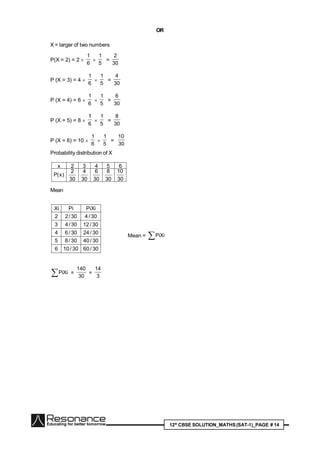
X = larger of two numbers
P(X = 2) = 2 
6
1

5
1
=
30
2
P (X = 3) = 4 
6
1

5
1
=
30
4
P (X = 4) = 6 
6
1

5
1
=
30
6
P (X = 5) = 8 
6
1

5
1
=
30
8
P (X = 6) = 10 
6
1

5
1
=
30
10
Probability distribution of X
30
10
30
8
30
6
30
4
30
2
)x(P
65432x
Mean
30/6030/106
30/4030/85
30/2430/64
30/1230/43
30/430/22
PiXiPiXi
Mean = PiXi
PiXi =
30
140
=
3
14

12 cbse-maths-2014-solution set 1

  • 1.
    12th CBSE SOLUTION_MATHS(SAT-1)_PAGE #1 1. R = {(x, y) : x + 2y = 8} x + 2y = 8 Put x = 2, 2 + 2y = 8, (2, 3) y = 3 Put x = 4, 4 + 2  y = 8 (4, 2) y = 2 Put x = 6, 6 + 2y = 8 (6, 1) y = 1  range if {1, 2, 3} 2. tan–1 x + tan–1 y = 4  if xy < 1 tan–1         xy1 yx = 4  xy1 yx   = tan 4  x + y = 1 – xy x + y + xy = 1 3. Given A2 = A 7A – (I + A)3 = 7A – [I3 + A3 + 3I.A. (A + I)] = 7A – [I + A. A + 3 I. A. A. + 3I. A.I.] = 7A – I – A. –3A – 3A = – I 4.         wyx2 zyx =       50 41 x – y = – 1 2x – y = 0 x = 1 ____________ y = 2 – x = – 1 Then x + y = 3 5.        42 7x3 =       46 78 12x + 14 = 32 – 42 12x + 14 = – 10 12x = – 24 x = – 2 6. f(x) =  x 0 dttsint f’ (x) = [tsin t]0 x = x sin x 12th CBSE(SAT-1) (SESSION : 2014) SUBJECT : MATHS(xf.kr) SOLUTION (gy)
  • 2.
    12th CBSE SOLUTION_MATHS(SAT-1)_PAGE #2 7.   4 2 2 dx 1x x multiply and divide by 2   4 2 2 dx )1x(2 x2 2 1  4 2 2 )1x(log  2 1  5log17log  2 1 log 5 17 8. 3 iˆ + 2 jˆ + 9kˆ and iˆ – 2p jˆ + 3kˆ are parallel so 2 1 a a = 2 1 b b = 2 1 c c  1 3  p2 2   3 9 – 3p = 1 p = – 1/3 9. a  = 2 iˆ + jˆ + 3kˆ b  = – iˆ + 2 jˆ + kˆ c  = 3 iˆ + jˆ + 2kˆ a  .(b   c  ) = ? b   c  = 213 121 kˆjˆiˆ  = iˆ (4 – 1) – jˆ (–2 – 3) + kˆ (–1 – 6) = = 3 iˆ + 5 jˆ – 7kˆ a  .(b   c  ) = (2 iˆ + jˆ + 3kˆ ).(3 iˆ + 5 jˆ – 7kˆ ) = 6 + 5 – 21 = – 10 10. 5 x3  = 7 4y  = 4 6z2  5 3x   = 7 )4(y  = 2 3z  we know that the equation of line r  = a  + b  r  = (x1 iˆ + y1 jˆ – z1 kˆ ) +  (a iˆ + b jˆ – ckˆ ) r  = (3 iˆ – 4 jˆ + 3kˆ ) +  (–5 iˆ + 7 jˆ + 2kˆ )
  • 3.
    12th CBSE SOLUTION_MATHS(SAT-1)_PAGE #3 11. f : R  R, f(x) = x2 + 2 , g : R  R, g(x) = 1x x  , x  1 fog (x) = f [g(x)] gof (x) = g[f(x)] fog(x) = 2 1x x        + 2 gof(x) = 1x 2x 2 2   fog(2) = 4 + 2 = 6 gof (–3) = 19 29   = 10 11 12. x = cos 2 ..(1) = tan–1           2cos12cos1 2cos12cos1 = tan–1         sincos sincos = tan–1         tan1 tan1 = tan–1 tan         0 4 = 4  –  = 2  – 2 1 cos–1 x OR tan–1 4x 2x   + tan–1 4x 2x   = 4  tan–1                        4x 2x 4x 2x 1 4x 2x 4x 2x = 4  )4x()16x( )4x)(2x()4x)(2x( 22   = 1 x2 + 2x – 8 + x2 – 2x – 8 = (x2 – 16) – (x2 – 4) 2x2 – 16 = – 16 + 4 2x2 = 4 x2 = 2 x =  2 13. Given x3x8y8x10 x2x4y4x5 xxyx    = x3
  • 4.
    12th CBSE SOLUTION_MATHS(SAT-1)_PAGE #4 L.H.S. x3x8y8x10 x2x4y4x5 xxyx    x3x8x10 x2x4x5 xxx + x3x8y8 x2x4y4 xxy take common elements x3 3810 245 111 + yx 388 244 111 Two coloumn are identical c2  c2 – c1 c3  c3 – c1 x3 7210 315 001   + 0 x3 (7 – 6) = x3 14. x = ae (sin – cos) y = ae (sin + cos) if q = 4  d dx = ae [cos + sin] + (sin – cos) ae  ae (2 sin ) d dy ae [cos – sin] + (sin + cos) ae  ae (2 cos ) dx dy =   d dx d dy =     sin2 cos2 ae ae = cot dx dy = cot 4 dx dy         = cot 4  = 1 15. y = Peax + Qebx show that 2 2 dx yd – (a + b) dx dy + aby = 0 dx dy = Paeax + Qbebx
  • 5.
    12th CBSE SOLUTION_MATHS(SAT-1)_PAGE #5 2 2 dx yd = Pa2 eax + Qb2 ebx L.H.S. 2 2 dx yd – (a + b) dx dy + aby (Pa2 eax + Qb2 ebx ) – (a + b) (Paeax + Qbebx ) + aby = 0 Pa2 eax + Qb2 ebx – Pa2 eax – Qabebx – Pabeax – Qb2 ebx + aby = 0 – ab |Qebx + Peax |+ aby – aby + aby = 0 16. y = [x (x – 2)]2 dx dy = 2 (x (x – 2)) [(x -2) + x] = 2[x2 – 2x] [2x – 2] = 4[(x2 – 2x)(x – 1)] for increasing faction dx dy > 0 4 (x (x – 2) (x – 1)) > 0 x > 0 x > 2 x > 1 f(x) is increasing on 0 1 2 – + – + (0, 1)  (2,  ) 17. I = dx xcos1 xsinx4 2    ..(1) we know that  a 0 dx)x(f =   a 0 dx)xa(f I = dx )x(cos1 )xsin()x(4 2     ..(2) by adding equation (1) and equation (2) 2I = dx xcos1 xsin4 2     Let cos x = t – sinx dx = dt when x = 0, t = 1 x = , t = – 1 2I =     1 1 2 t1 )dt(4 2I = – 4 [tan–1 t]–1 +1 2I = – 4 [– 4  – 4  ] 2I = 4p  4 2 = 22 I = 2
  • 6.
    12th CBSE SOLUTION_MATHS(SAT-1)_PAGE #6 OR    dx 6x5x 2x 2    dx 6x5x 2)55x2( 2 1 2 2 1    dx 6x5x 5x2 2 – 2 1               22 2 2 1 2 5 x 1 dx if x2 + 5x + 6 = t (2x + 5) dx = dt 2 1  t dt – 2 1 log |(x + 5/2) + 22 )2/1()2/5x(  2 1 2 t – 2 1 log | (x + 5/2) + 2 2 2 1 )2/5x(        + C 2 1 6x542  – 2 1 log | (x + 5/2) + 6x5x2  | + C 6x5x2  – 2 1 log | (x + 5/2) + 6x5x2  + C 18. dx dy = 1 + x + y + xy dx dy = 1 + x + y [1 + x] dx dy = (1 +x) (1 + y) y1 dy  = (1 + x) dx intergrating both sides   y1 dy =   dx)x1( log (1 + y) = x + 2 x2 + C Now put x = 1 and y = 0 log 1 = 1 + 2 1 + C 0 = 2 3 + C C = 2 3 log (1 + y) = x + 2 x2 – 2 3
  • 7.
    12th CBSE SOLUTION_MATHS(SAT-1)_PAGE #7 19. (1 + x2 ) dx dy + y = etan–1x dx dy + 2 x1 y  = 2 xtan x1 e 1   I.F. =   dx x1 1 2 e = xtan 1 e  Solution of equation is given by y.(I.F.) =    2 xtan x1 e 1 . (I.F.) dx y. xtan 1 e  =         2 2 xtan x1 e 1 .dx put xtan 1 e  = t 2 xtan x1 e 1   . dx = dt y. xtan 1 e  =  dt.t y. xtan 1 e  = 2 t2 + C y. xtan 1 e  = 2 )e( 2xtan 1 + C 20. OA = 4 iˆ + 5 jˆ + kˆ OB = – jˆ – kˆ OC= 3 iˆ + 9 jˆ + 4kˆ OD = – 4 iˆ + 4 jˆ + 4kˆ Now these four points will be coplaner if [AB AC AD] = 0 ...(1) AB = (– jˆ –kˆ ) – (4 iˆ + 5 jˆ + kˆ ) AB = –4 iˆ – 6 jˆ – 2kˆ AC = (3 iˆ +9 jˆ + 4kˆ ) – (4 iˆ + 5 jˆ + kˆ ) AC = – iˆ + 4 jˆ + 3kˆ AD = – ( iˆ +4 jˆ + 4kˆ ) – (4 iˆ + 5 jˆ + kˆ ) AD = – 8 iˆ – jˆ + 3kˆ by equation (1) [AB AC AD] = 318 341 264    = – 4 (12 + 3) + 6 (– 3+ 24) – 2(1 + 32) = – 60 + 126 – 66 = 0 So All four points are coplanar
  • 8.
    12th CBSE SOLUTION_MATHS(SAT-1)_PAGE #8 21. Equation of straight line passing through (2, –1, 3) is a 2x  = b 1y  = c 3z  ...(1) lines (1) is perpendicular to two lines  2a – 2b + c = 0 a + 2b + 2c = 0 24 a  = 14 b   = 24 c  6 a  = 3 b  = 6 c  Equation of plane is cartesian form 6 2x   = 3 1y   = 6 3z  Vector form r  = (2 iˆ – jˆ + 3kˆ ) +  (–6 iˆ – 3 jˆ + 6kˆ ) 22. P(success) = 3P(fails) P(success) + P(fails) = 1 3P(fails) + P(fails) = 1  P(fails) = 4 1 P(success) = 4 3 P(x  3) = P (x = 3) + P(x = 4) + P(x – 5) = 5C3 3 4 3       2 4 1       + 5C4 4 4 3       1 4 1       + 5C5 5 4 3       = 10  64 27  16 1 + 5  256 81  4 1 + 1024 243 = 1024 270 + 1024 405 + 1024 243 = 1024 918 = 512 459 23.             111 314 123 esslnhelpfuesslntruthfuceritysin           z y x =           900 2300 1600 AX = B X = A–1 B A–1 = |A| adjA |A| = 3(1 – 3) – 2 (4 – 3) + 1 (4 – 1) |A| = –5 adj A =              513 521 512 X = – 5 1              513 521 512           900 2300 1600
  • 9.
    12th CBSE SOLUTION_MATHS(SAT-1)_PAGE #9 = – 5 1              2000 1500 1000 =           400 300 200 X = 200 , Y = 300, Z = 400 24. R R x CA B V AC = 22 xR  VC = VO + OC = R + x V = 3 1 (AC)2 (VC) V = 3 1  (R2 – x2 ) (R + x) V = 3 1  (R3 + R2 x – x2 R – x3 ) dx dv = 3 1  [R2 – 2Rx – 3x2 ] dx dv = 0 R2 – 2Rx - 3x2 = 0 (R – 3x) (R + x) = 0 x = 3 R 2 2 dx vd = 3 1  (– 2R – 6x) at x = 3 R 2 2 dx vd = 3 1 p [– 2R – 6  3 R ] < 0 V is maximum Altitude is VC = R + 3 R = 3 R4 V = 3 1 (R2 – x2 ) (R + x) = 3 1 (R2 – 9 R2 ) (R + 3 R ) = 81 R32 3  V = 27 8        3 R 3 4 = 27 8 volume of sphere
  • 10.
    12th CBSE SOLUTION_MATHS(SAT-1)_PAGE #10 25.   xsinxcos dx 44 Divide by cos4 x =   dx xtan1 xsec 4 4 =   dx xtan1 xsec.xsec 4 22 =    dx xtan1 xsec).xtan1( 4 22 Put tan x = t sec2 xdx = dt =    dt t1 t1 4 2 Divide by t2 =    dt t 1 t t 1 1 2 2 2 =          dt )2( t 1 t t 1 1 2 2 2 let t – t 1 = u =        2 t 1 1 dt = du =   22 )2(u du = 2 1 tan–1 2 u + C = 2 1 tan–1        2 xcotxtan + C 26. 1 2 3 4 5 -1 1 2 3 (-1, 2) (1, 5) (3, 4) B C 0 Equation lineAB A(–1, 2) ; B(1, 5) y – 2 = 11 25   (x + 1)
  • 11.
    12th CBSE SOLUTION_MATHS(SAT-1)_PAGE #11 y – 2 = 2 3 (x + 1) 2y – 4 = 3x + 3 2y = 3x + 7 y = 2 7x3  ..(1) equation line BC B(1, 5) ; C(3, 4) y – 5 = 13 54   (x – 1) y – 5 = 2 1 (x – 1) 2y – 10 = –x + 1 y = 2 11x  ..(2) equation of lineAC A(–1, 2) ; C(3, 4) y – 2 = 4 24  (x +1) 4y – 8 = 2x + 2 y = 4 10x2  = 2 5x  area of ABC =   1 1 dx 2 7x3 +   3 1 dx 2 11x –   3 1 dx 2 5x = 2 1 1 1 2 x7 2 x3          + 2 1 3 1 2 x 1 2 x           – 2 1 3 1 2 x5 2 x          = 2 1                                11 2 1 33 2 9 7 2 3 7 2 3 – 2 1                    5 2 1 15 2 9 = 2 1        11 2 1 33 2 9 14 – 2 1 [4 + 20] = 2 1 [32] – 2 1 [24] = 16 – 12 = 4 square units 27. Equation of plane passing through the intersection of planes is (x + y + z – 1) +  (2x + 3y + 4z – 5) = 0 x (1 + 2) + y (1 + 3) + z (1 + 4) – 1 – 5= 0 ... (1) plane (1) is prep. to the plane x – y + z = 0  1 (1 + 2) – 1 (1 + 3) + 1 (1 + 4) = 0 1 + 2 – 1 – 3 + 1 + 4 = 0 3 + 1 = 0  = – 3 1
  • 12.
    12th CBSE SOLUTION_MATHS(SAT-1)_PAGE #12 So, equation of plane is (x + y + z – 1) – 3 1 (2x + 3y + 4z – 5) = 0 3x + 3y + 3z – 3 – 2x – 3y – 4z + 5 = 0 x – z + 2 = 0 Distance of plane formation = 11 |211|   = 2 2 = 2 unit OR Line 3 2x  = 4 4y  = 2 2z  = l x = 3 + 2 y = 4 – 4 z = 2 + 2 let the intersection point of line and plane is (3 + 2, 4 – 4, 2 + 2) Now this point will lies on plane x – 2y + z = 0  (3 + 2) – 2 (4 – 4) + (2 + 2) = 0 3 + 2 – 8 + 8 + 2 + 2 = 0 – 3 + 12 = 0 – 3 = –12  = 4  point of intersection is : (14, 12, 10) Distance between pont (2, 12, 5) Distance = 222 )510()1212()214(  = 250144  = 169 = 13 unit 28. A B Fabricating 9 12 Finishing 1 3 9x + 12y  180 x +3y  30 constraints max. Z = 80 x + 120 y 9x + 12 y  180 3|3x + 4y|  180 3x + 4y  60 x + 3y  30 x  0 y  0 3x + 4y  6 0
  • 13.
    12th CBSE SOLUTION_MATHS(SAT-1)_PAGE #13 x = 0 ; y = 15 y = 0 ; x = 20 (0, 15) (20, 0) x + 3y  30 if x = 0 ; y = 10 y = 0 x = 30 (0, 10) (30, 0) 3x + 4y = 60 ..(1) x + 3y = 30 ..(2) equation (2) multiply by 3 3x + 4y = 60 3x + 9y = 90 ___________ – 5y = – 30 y = 6 ..(3) x + 18 = 30 x = 12 .. (4) (12, 6) intersecting point z = 30x + 120 y (0, 10), (12, 6), (20, 0) If P1 (0, 10) z = 1200 If Pz (12, 6) z = 80  12 + 120  6 = 960 + 720 = 1680 If P3 (20, 0) z = 1600 maximum profit per week = 1680 29. E1 = Two headed coins E2 = Biased coin that comes up head 75% times E3 = Biased coin that comes up head 40% of times A = Head P(E1 ) = 3 1 = P(E2 ) = P(E3 ) P(A/E1 ) = 2 2 = 20 20 P (A/E2 ) = 100 75 = 4 3 = 20 15 P(A/E3 ) = 100 60 = 20 12  P(E1 /A) = )E/A(P)E(P)E/A(P)E(P)E/A(P)E(P )E/A(P)E(P 332211 11   = 20 12 3 1 20 15 3 1 20 20 3 1 20 20 3 1   = 121520 20  = 47 20
  • 14.
    12th CBSE SOLUTION_MATHS(SAT-1)_PAGE #14 OR X = larger of two numbers P(X = 2) = 2  6 1  5 1 = 30 2 P (X = 3) = 4  6 1  5 1 = 30 4 P (X = 4) = 6  6 1  5 1 = 30 6 P (X = 5) = 8  6 1  5 1 = 30 8 P (X = 6) = 10  6 1  5 1 = 30 10 Probability distribution of X 30 10 30 8 30 6 30 4 30 2 )x(P 65432x Mean 30/6030/106 30/4030/85 30/2430/64 30/1230/43 30/430/22 PiXiPiXi Mean = PiXi PiXi = 30 140 = 3 14