co-ordinate geometry presented by Gurpreet kaur T.G.T. MATHS KV Faridkot
Rene Descartes A French mathematician who discovered the co-ordinate geometry. He was the first man who unified Algebra and Geometry. According to him every point of the plane can be represented uniquely by two numbers
co-ordinate geometry It is that branch of geometry in which two numbers called  co-ordinates  , are used to locate the position of a point in a plane . It is also called as Cartesian-geometry
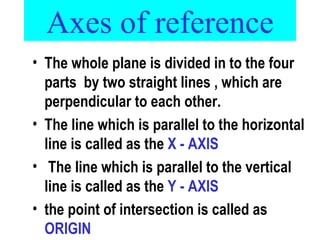
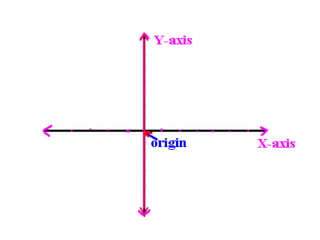
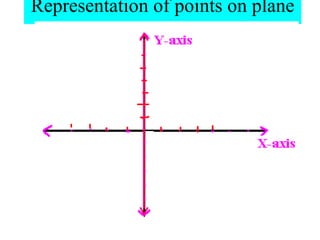
Axes of reference The whole plane is divided in to the four parts  by two straight lines , which are perpendicular to each other. The line which is parallel to the horizontal line is called as the  X - AXIS The line which is parallel to the vertical line is called as the  Y - AXIS the point of intersection is called as  ORIGIN
 
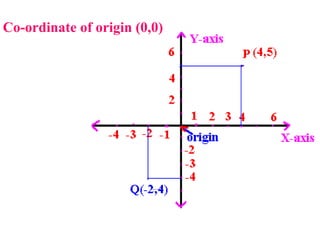
CO-ORDINATES OF A POINT X-CO-ORDINATE  - the distance of the point from the origin along X - axis is called  X-  co-ordinate (  abscissa ) Y-CO-ORDINATE  - the distance of the point from the origin along Y - axis is called  Y-  co-ordinate (  ordinate )
REPRESENTATION OF A POINT THE CO-ORDINATES OF A POINT IS ALWAYS REPRESENTED  BY ORDERED -PAIR (  ) FIRST PUT X-CO-ORDINATE THEN Y-CO-ORDINATE IN BRACKET ( X, Y )
Representation of points on plane
Co-ordinate of origin (0,0)
Distance formula To find out the distance between two points  in the plane
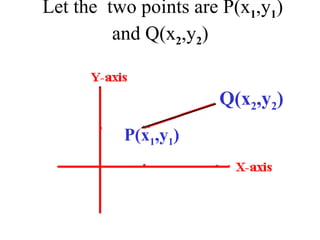
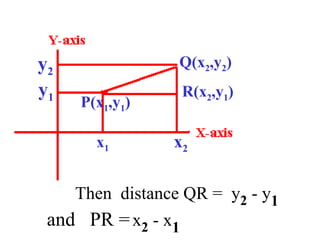
Let the  two points are P(x 1 ,y 1 ) and Q(x 2 ,y 2 )  P(x 1 ,y 1 ) Q(x 2 ,y 2 )
P(x 1 ,y 1 ) Q(x 2 ,y 2 ) x 1 x 2 y 2 y 1 R(x 2 ,y 1 ) Then  distance QR =  y 2  - y 1 and  PR =   x 2  - x 1
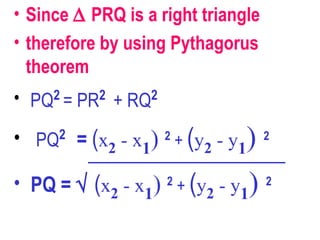
Since    PRQ is a right triangle therefore by using Pythagorus theorem PQ 2  = PR 2  + RQ 2   PQ 2   =   ( x 2  - x 1 )  2  +  ( y 2  - y 1 )  2 PQ =     ( x 2  - x 1 )  2  +  ( y 2  - y 1 )  2
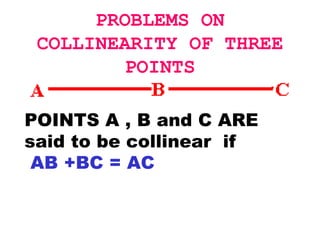
PROBLEMS   ON   COLLINEARITY   OF   THREE   POINTS POINTS A , B and C ARE said to be collinear  if  AB +BC = AC
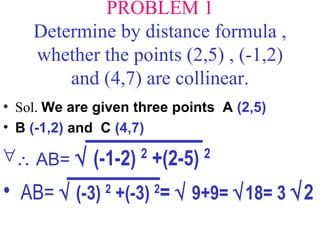
PROBLEM 1 Determine by distance formula , whether the points (2,5) , (-1,2) and (4,7) are collinear. Sol.  We are given three points  A  (2,5)   B  (-1,2)  and  C  (4,7)     AB=    (-1-2)  2  +(2-5)  2 AB=    (-3)  2  +(-3)  2 =    9+9=   18= 3   2
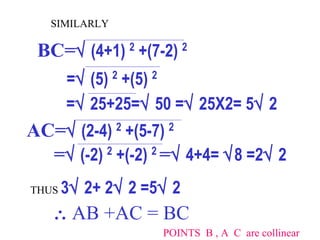
SIMILARLY  BC=   (4+1)  2  +(7-2)  2 =   (5)  2  +(5)  2 =   25+25=   50 =   25X2= 5   2 AC=   (2-4)  2  +(5-7)  2 =   (-2)  2  +(-2)  2  =   4+4=   8 =2   2  THUS  3   2+ 2   2 =5   2      AB +AC = BC POINTS  B , A  C  are collinear
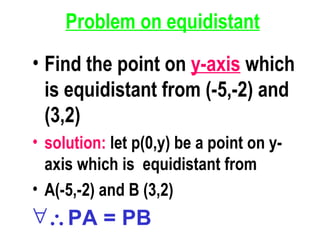
Problem on equidistant Find the point on  y-axis  which is equidistant from (-5,-2) and (3,2) solution:  let p(0,y) be a point on y-axis which is  equidistant from  A(-5,-2) and B (3,2)  PA = PB
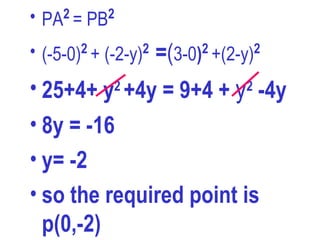
PA 2  = PB 2 (-5-0) 2  + (-2-y) 2  = ( 3-0 ) 2  +(2-y) 2 25+4+ y 2  +4y = 9+4 +  y 2  -4y 8y = -16 y= -2  so the required point is p(0,-2)
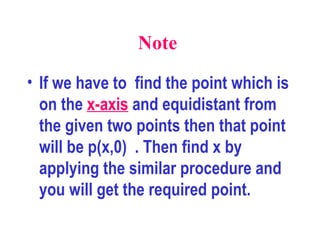
Note  If we have to  find the point which is on the  x-axis  and equidistant from the given two points then that point will be p(x,0)  . Then find x by applying the similar procedure and  you will get the required point.
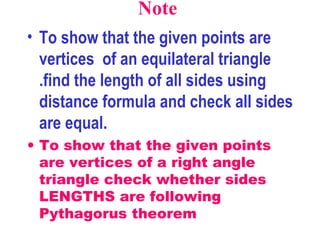
Note   To show that the given points are vertices  of an equilateral triangle .find the length of all sides using distance formula and check all sides are equal. To show that the given points are vertices of a right angle triangle check whether sides LENGTHS are following Pythagorus theorem
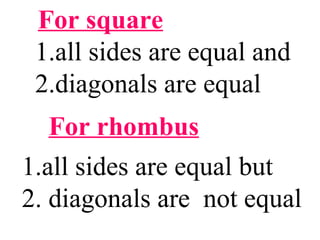
For square 1.all sides are equal and  2.diagonals are equal For rhombus 1.all sides are equal but 2. diagonals are  not equal
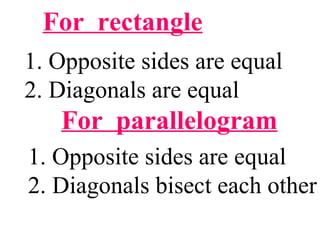
For  rectangle 1. Opposite sides are equal 2. Diagonals are equal For  parallelogram 1. Opposite sides are equal 2. Diagonals bisect each other
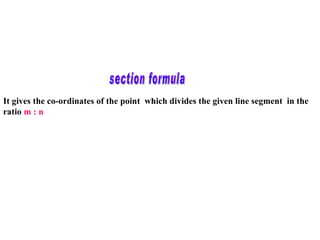
section formula It gives the co-ordinates of the point  which divides the given line segment  in the ratio   m : n
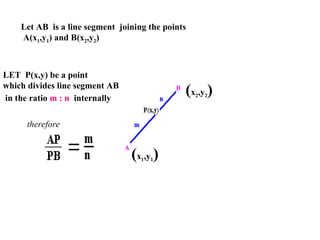
Let AB  is a line segment  joining the points A(x 1 ,y 1 ) and B(x 2 ,y 2 )  LET  P(x,y) be a point  which divides line segment AB  in the ratio   m : n  internally   therefore ( x 1 ,y 1 ) ( x 2 ,y 2 )
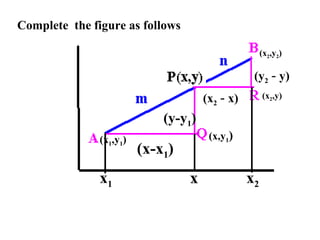
(x 1 ,y 1 ) (x 2 ,y 2 ) (x,y 1 ) (x-x 1 ) (x 2 ,y) (x 2   -  x) (y 2   -  y) (y-y 1 ) x 1 x x 2 Complete  the figure as follows
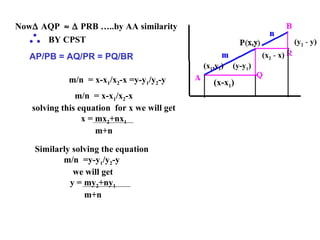
Now   AQP        PRB …..by AA similarity   AP/PB = AQ/PR = PQ/BR    BY CPST  m/n  = x-x 1 /x 2 -x =y-y 1 /y 2 -y m/n  = x-x 1 /x 2 -x solving this equation  for x we will get x = mx 2 +nx 1 m+n Similarly solving the equation  m/n  =y-y 1 /y 2 -y  we will get y = my 2 +ny 1 m+n (x 1 ,y 1 ) (x-x 1 ) (y-y 1 ) (y 2   -  y) (x 2   -  x)
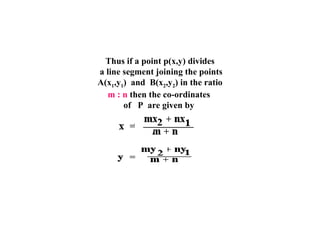
Thus if a point p(x,y) divides a line segment joining the points A(x 1 ,y 1 )  and  B(x 2 ,y 2 ) in the ratio  m : n  then the co-ordinates  of  P  are given by
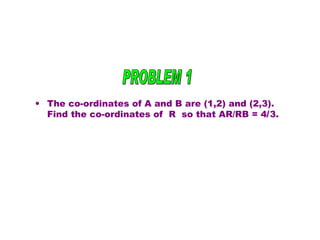
The co-ordinates of A and B are (1,2) and (2,3). Find the co-ordinates of  R  so that AR/RB = 4 / 3. PROBLEM 1
SOLUTION 1 Let co-ordinates of point R (X,Y) X = 4[2]+3[1] 4+3 X= {8+3]/7 = 11/7 Here  m=4 , n=3,  x 1 =1 , y 1 =2  x 2 = 2 ,  y 2  = 3 Y = 4[3]+3[2] 4+3 Y = [ 12+6]/7 = 18/7 Hence co-ordinates of R = (11/7 , 18/7)
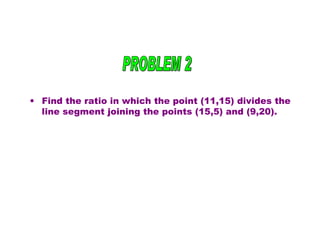
Find the ratio in which the point (11,15) divides the line segment joining the points (15,5) and (9,20). PROBLEM 2
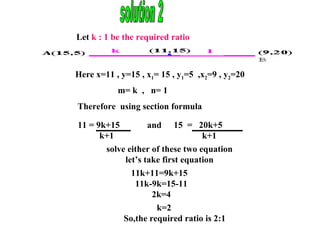
Let  k : 1 be the required ratio   Here x=11 , y=15 , x 1 = 15 , y 1 =5  ,x 2 =9 , y 2 =20 m= k  ,  n= 1 Therefore  using section formula 11 = 9k+15 k+1 and 15  =  20k+5 k+1 solve either of these two equation let’s take first equation solution 2 11k+11=9k+15 11k-9k=15-11 2k=4 k=2 So,the required ratio is 2:1
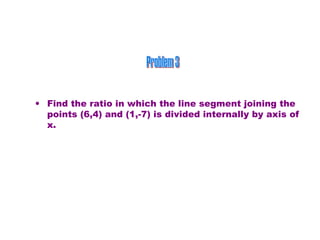
Find the ratio in which the line segment joining the points (6,4) and (1,-7) is divided internally by axis of x. Problem 3
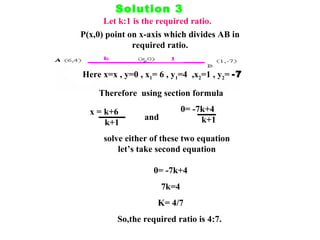
Solution 3 Let k:1 is the required ratio. P(x,0) point on x-axis which divides AB in required ratio. Here x=x , y=0 , x 1 = 6 , y 1 =4  ,x 2 =1 , y 2 =  -7 Therefore  using section formula x = k+6 k+1 and 0= -7k+4 k+1 solve either of these two equation let’s take second equation 0= -7k+4 7k=4 K= 4/7 So,the required ratio is 4:7.
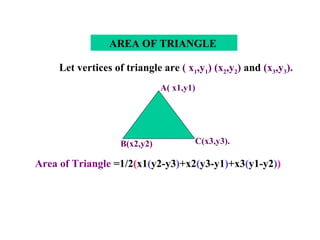
AREA OF TRIANGLE   Let vertices of triangle are  ( x 1 ,y 1 ) (x 2 ,y 2 )  and  (x 3 ,y 3 ). Area of Triangle  =1/2 ( x1 ( y2-y3 ) +x2 ( y3-y1 ) +x3 ( y1-y2 ) ) A( x1,y1) B(x2,y2) C(x3,y3).
PROBLEM 2 Find the area of triangle with vertices A(6,4) B(1,-7) C(2,3).
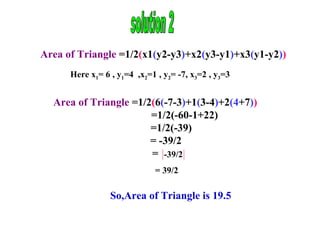
solution 2 Here x 1 = 6 , y 1 =4  ,x 2 =1 , y 2 = -7, x 3 =2 , y 3 =3 Area of Triangle  =1/2 ( x1 ( y2-y3 ) +x2 ( y3-y1 ) +x3 ( y1-y2 ) ) Area of Triangle  =1/2 ( 6 ( -7-3 ) +1 ( 3-4 ) +2 (4 +7 ) ) =1/2(-60-1+22) =1/2(-39) = -39/2 = -39/2 = 39/2 So,Area of Triangle is 19.5

Coordinategeometry1 1

  • 1.
    co-ordinate geometry presentedby Gurpreet kaur T.G.T. MATHS KV Faridkot
  • 2.
    Rene Descartes AFrench mathematician who discovered the co-ordinate geometry. He was the first man who unified Algebra and Geometry. According to him every point of the plane can be represented uniquely by two numbers
  • 3.
    co-ordinate geometry Itis that branch of geometry in which two numbers called co-ordinates , are used to locate the position of a point in a plane . It is also called as Cartesian-geometry
  • 4.
    Axes of referenceThe whole plane is divided in to the four parts by two straight lines , which are perpendicular to each other. The line which is parallel to the horizontal line is called as the X - AXIS The line which is parallel to the vertical line is called as the Y - AXIS the point of intersection is called as ORIGIN
  • 5.
  • 6.
    CO-ORDINATES OF APOINT X-CO-ORDINATE - the distance of the point from the origin along X - axis is called X- co-ordinate ( abscissa ) Y-CO-ORDINATE - the distance of the point from the origin along Y - axis is called Y- co-ordinate ( ordinate )
  • 7.
    REPRESENTATION OF APOINT THE CO-ORDINATES OF A POINT IS ALWAYS REPRESENTED BY ORDERED -PAIR ( ) FIRST PUT X-CO-ORDINATE THEN Y-CO-ORDINATE IN BRACKET ( X, Y )
  • 8.
  • 9.
  • 10.
    Distance formula Tofind out the distance between two points in the plane
  • 11.
    Let the two points are P(x 1 ,y 1 ) and Q(x 2 ,y 2 ) P(x 1 ,y 1 ) Q(x 2 ,y 2 )
  • 12.
    P(x 1 ,y1 ) Q(x 2 ,y 2 ) x 1 x 2 y 2 y 1 R(x 2 ,y 1 ) Then distance QR = y 2 - y 1 and PR = x 2 - x 1
  • 13.
    Since  PRQ is a right triangle therefore by using Pythagorus theorem PQ 2 = PR 2 + RQ 2 PQ 2 = ( x 2 - x 1 ) 2 + ( y 2 - y 1 ) 2 PQ =  ( x 2 - x 1 ) 2 + ( y 2 - y 1 ) 2
  • 14.
    PROBLEMS ON COLLINEARITY OF THREE POINTS POINTS A , B and C ARE said to be collinear if AB +BC = AC
  • 15.
    PROBLEM 1 Determineby distance formula , whether the points (2,5) , (-1,2) and (4,7) are collinear. Sol. We are given three points A (2,5) B (-1,2) and C (4,7)  AB=  (-1-2) 2 +(2-5) 2 AB=  (-3) 2 +(-3) 2 =  9+9=  18= 3  2
  • 16.
    SIMILARLY BC= (4+1) 2 +(7-2) 2 =  (5) 2 +(5) 2 =  25+25=  50 =  25X2= 5  2 AC=  (2-4) 2 +(5-7) 2 =  (-2) 2 +(-2) 2 =  4+4=  8 =2  2 THUS 3  2+ 2  2 =5  2  AB +AC = BC POINTS B , A C are collinear
  • 17.
    Problem on equidistantFind the point on y-axis which is equidistant from (-5,-2) and (3,2) solution: let p(0,y) be a point on y-axis which is equidistant from A(-5,-2) and B (3,2)  PA = PB
  • 18.
    PA 2 = PB 2 (-5-0) 2 + (-2-y) 2 = ( 3-0 ) 2 +(2-y) 2 25+4+ y 2 +4y = 9+4 + y 2 -4y 8y = -16 y= -2 so the required point is p(0,-2)
  • 19.
    Note Ifwe have to find the point which is on the x-axis and equidistant from the given two points then that point will be p(x,0) . Then find x by applying the similar procedure and you will get the required point.
  • 20.
    Note To show that the given points are vertices of an equilateral triangle .find the length of all sides using distance formula and check all sides are equal. To show that the given points are vertices of a right angle triangle check whether sides LENGTHS are following Pythagorus theorem
  • 21.
    For square 1.allsides are equal and 2.diagonals are equal For rhombus 1.all sides are equal but 2. diagonals are not equal
  • 22.
    For rectangle1. Opposite sides are equal 2. Diagonals are equal For parallelogram 1. Opposite sides are equal 2. Diagonals bisect each other
  • 23.
    section formula Itgives the co-ordinates of the point which divides the given line segment in the ratio m : n
  • 24.
    Let AB is a line segment joining the points A(x 1 ,y 1 ) and B(x 2 ,y 2 ) LET P(x,y) be a point which divides line segment AB in the ratio m : n internally therefore ( x 1 ,y 1 ) ( x 2 ,y 2 )
  • 25.
    (x 1 ,y1 ) (x 2 ,y 2 ) (x,y 1 ) (x-x 1 ) (x 2 ,y) (x 2 - x) (y 2 - y) (y-y 1 ) x 1 x x 2 Complete the figure as follows
  • 26.
    Now  AQP   PRB …..by AA similarity AP/PB = AQ/PR = PQ/BR  BY CPST m/n = x-x 1 /x 2 -x =y-y 1 /y 2 -y m/n = x-x 1 /x 2 -x solving this equation for x we will get x = mx 2 +nx 1 m+n Similarly solving the equation m/n =y-y 1 /y 2 -y we will get y = my 2 +ny 1 m+n (x 1 ,y 1 ) (x-x 1 ) (y-y 1 ) (y 2 - y) (x 2 - x)
  • 27.
    Thus if apoint p(x,y) divides a line segment joining the points A(x 1 ,y 1 ) and B(x 2 ,y 2 ) in the ratio m : n then the co-ordinates of P are given by
  • 28.
    The co-ordinates ofA and B are (1,2) and (2,3). Find the co-ordinates of R so that AR/RB = 4 / 3. PROBLEM 1
  • 29.
    SOLUTION 1 Letco-ordinates of point R (X,Y) X = 4[2]+3[1] 4+3 X= {8+3]/7 = 11/7 Here m=4 , n=3, x 1 =1 , y 1 =2 x 2 = 2 , y 2 = 3 Y = 4[3]+3[2] 4+3 Y = [ 12+6]/7 = 18/7 Hence co-ordinates of R = (11/7 , 18/7)
  • 30.
    Find the ratioin which the point (11,15) divides the line segment joining the points (15,5) and (9,20). PROBLEM 2
  • 31.
    Let k: 1 be the required ratio Here x=11 , y=15 , x 1 = 15 , y 1 =5 ,x 2 =9 , y 2 =20 m= k , n= 1 Therefore using section formula 11 = 9k+15 k+1 and 15 = 20k+5 k+1 solve either of these two equation let’s take first equation solution 2 11k+11=9k+15 11k-9k=15-11 2k=4 k=2 So,the required ratio is 2:1
  • 32.
    Find the ratioin which the line segment joining the points (6,4) and (1,-7) is divided internally by axis of x. Problem 3
  • 33.
    Solution 3 Letk:1 is the required ratio. P(x,0) point on x-axis which divides AB in required ratio. Here x=x , y=0 , x 1 = 6 , y 1 =4 ,x 2 =1 , y 2 = -7 Therefore using section formula x = k+6 k+1 and 0= -7k+4 k+1 solve either of these two equation let’s take second equation 0= -7k+4 7k=4 K= 4/7 So,the required ratio is 4:7.
  • 34.
    AREA OF TRIANGLE Let vertices of triangle are ( x 1 ,y 1 ) (x 2 ,y 2 ) and (x 3 ,y 3 ). Area of Triangle =1/2 ( x1 ( y2-y3 ) +x2 ( y3-y1 ) +x3 ( y1-y2 ) ) A( x1,y1) B(x2,y2) C(x3,y3).
  • 35.
    PROBLEM 2 Findthe area of triangle with vertices A(6,4) B(1,-7) C(2,3).
  • 36.
    solution 2 Herex 1 = 6 , y 1 =4 ,x 2 =1 , y 2 = -7, x 3 =2 , y 3 =3 Area of Triangle =1/2 ( x1 ( y2-y3 ) +x2 ( y3-y1 ) +x3 ( y1-y2 ) ) Area of Triangle =1/2 ( 6 ( -7-3 ) +1 ( 3-4 ) +2 (4 +7 ) ) =1/2(-60-1+22) =1/2(-39) = -39/2 = -39/2 = 39/2 So,Area of Triangle is 19.5