Genome Sequencing : Advanced
Dr Surabhi Johari
GENOME SEQUENCING
• Term “genome” was coined by H. Winkler in 1920
• A genome can be defined as the entire DNA content of each
nucleated cell in an organism
• Humans for example have a genome that is encoded on 46
chromosomes, organized into 23 pairs, out of which 44
chromosomes are autosomes and 2 are sex chromosomes
• Each genome contains all of the information needed to
build that organism and allow it to grow and develop 
Genome is a unique sequence of DNA
• It is over 3 billion letters long and is found in almost every
cell in the body
Steps in Genome Sequencing
• Break genome into smaller fragments
• Sequence those smaller pieces
• Place the sequences of the short fragments
together
Genome Sequencing Methods
• Two different methods used
• Hierarchical shotgun sequencing – useful for
sequencing genomes of higher vertebrates that
contain repetitive sequences
• 2) Whole genome shotgun sequencing – useful for
smaller genome .
• Factors that determine sequencing strategy are :- a)
Genome size b) Chromosomal structure c) Repeat
content and character d) Desired end product
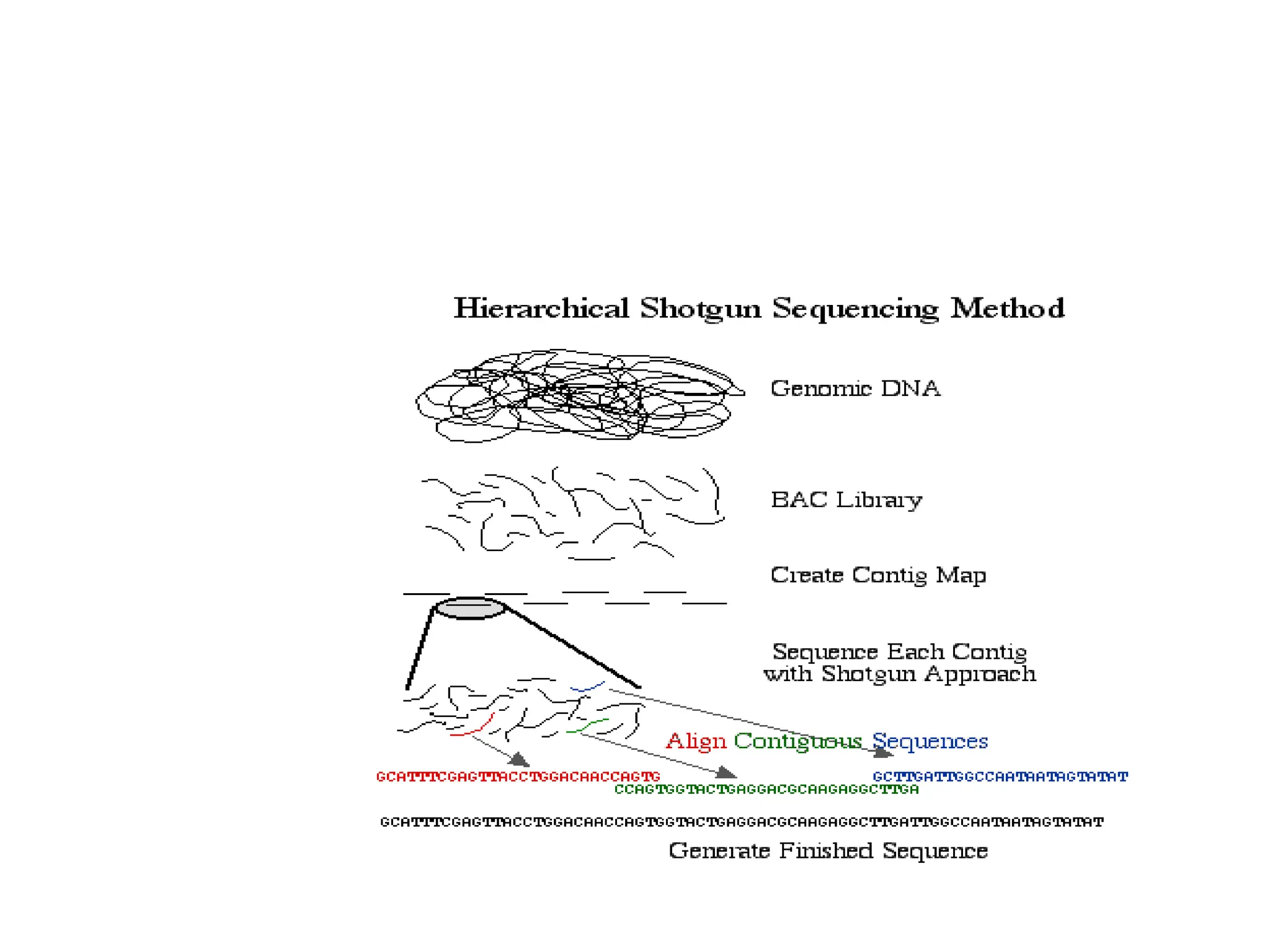
Hierarchical shotgun sequencing method.
• The method preferred by the HGP is the hierarchical shotgun sequencing method.
• Also known as - The Clone-by-clone strategy - The map-based method - map first,
sequence later - top-down sequencing . In clone based sequencing the first step is
mapping.
• One first constructs a map of the chromosome, making them at regular intervals of
about 100 kilo bases. Then known segments of marked chromosome are cloned in
plasmids.
• One special type of plasmid used for genome sequencing is BAC, which contain DNA
fragment of about 80-180 kb in E.Coli cells.
• The plasmid cells are then further broken into small, random, overlapping fragments of
0.5 to 1.0 kb.
• Finally automated sequencing machines determine the order of each nucleotide of the
small fragments.
• The National Human Genome Research Institute used clone based sequencing for the
human genome, for this they relied on computer scientists to assemble the final
sequence.
Whole genome shotgun sequencing
• Craig Venter and H. Smith developed “whole genome shotgun” sequencing and
sequenced the genome of bacteria H. Influenza and M. genitalicum .
• This approach maybe characterized into 4 steps :-
• 1) Library construction : the chromosome is isolated from the desired cells following the
methods of molecular biology and randomly fragments into small pieces using ultrasonic
waves. Then the fragments are purified and attached to the plasmid vector. Plasmids
with single insert are isolated. A library of plasmid clone is prepared transforming E. Coli
strains with plasmid lacked restriction enzymes.
• 2) Random sequencing : the DNA is purified from the plasmid. Thousands of DNA
fragments are sequenced using automated sequencer.
• 3) Fragment alignment and gap closure : by using special computer programmes, the
sequenced DNA fragments are clustered. Two fragments are joined together to form
large stretch of DNA
• 4) Proof reading : proof reading is done carefully so that any ambiguities could be
resolved. The sequence is also checked for frameshift mutation if so, the mutation is
corrected.
Hybrid shot gun sequencing
• In this, sequence reads are generated in both a
clone -by -clone and a whole genome fashion.
• A hybrid shotgun - sequencing strategy can, in
principle, capture the advantageous elements of
both clone -by - clone and whole -genome
approaches.
• For eg. The whole -genome shotgun
component provides the rapid insight about the
sequence of the entire genome.
Genome sequencing , proteomics , bioinformatics

Genome sequencing , proteomics , bioinformatics

  • 1.
    Genome Sequencing :Advanced Dr Surabhi Johari
  • 2.
    GENOME SEQUENCING • Term“genome” was coined by H. Winkler in 1920 • A genome can be defined as the entire DNA content of each nucleated cell in an organism • Humans for example have a genome that is encoded on 46 chromosomes, organized into 23 pairs, out of which 44 chromosomes are autosomes and 2 are sex chromosomes • Each genome contains all of the information needed to build that organism and allow it to grow and develop  Genome is a unique sequence of DNA • It is over 3 billion letters long and is found in almost every cell in the body
  • 3.
    Steps in GenomeSequencing • Break genome into smaller fragments • Sequence those smaller pieces • Place the sequences of the short fragments together
  • 4.
    Genome Sequencing Methods •Two different methods used • Hierarchical shotgun sequencing – useful for sequencing genomes of higher vertebrates that contain repetitive sequences • 2) Whole genome shotgun sequencing – useful for smaller genome . • Factors that determine sequencing strategy are :- a) Genome size b) Chromosomal structure c) Repeat content and character d) Desired end product
  • 5.
    Hierarchical shotgun sequencingmethod. • The method preferred by the HGP is the hierarchical shotgun sequencing method. • Also known as - The Clone-by-clone strategy - The map-based method - map first, sequence later - top-down sequencing . In clone based sequencing the first step is mapping. • One first constructs a map of the chromosome, making them at regular intervals of about 100 kilo bases. Then known segments of marked chromosome are cloned in plasmids. • One special type of plasmid used for genome sequencing is BAC, which contain DNA fragment of about 80-180 kb in E.Coli cells. • The plasmid cells are then further broken into small, random, overlapping fragments of 0.5 to 1.0 kb. • Finally automated sequencing machines determine the order of each nucleotide of the small fragments. • The National Human Genome Research Institute used clone based sequencing for the human genome, for this they relied on computer scientists to assemble the final sequence.
  • 6.
    Whole genome shotgunsequencing • Craig Venter and H. Smith developed “whole genome shotgun” sequencing and sequenced the genome of bacteria H. Influenza and M. genitalicum . • This approach maybe characterized into 4 steps :- • 1) Library construction : the chromosome is isolated from the desired cells following the methods of molecular biology and randomly fragments into small pieces using ultrasonic waves. Then the fragments are purified and attached to the plasmid vector. Plasmids with single insert are isolated. A library of plasmid clone is prepared transforming E. Coli strains with plasmid lacked restriction enzymes. • 2) Random sequencing : the DNA is purified from the plasmid. Thousands of DNA fragments are sequenced using automated sequencer. • 3) Fragment alignment and gap closure : by using special computer programmes, the sequenced DNA fragments are clustered. Two fragments are joined together to form large stretch of DNA • 4) Proof reading : proof reading is done carefully so that any ambiguities could be resolved. The sequence is also checked for frameshift mutation if so, the mutation is corrected.
  • 7.
    Hybrid shot gunsequencing • In this, sequence reads are generated in both a clone -by -clone and a whole genome fashion. • A hybrid shotgun - sequencing strategy can, in principle, capture the advantageous elements of both clone -by - clone and whole -genome approaches. • For eg. The whole -genome shotgun component provides the rapid insight about the sequence of the entire genome.