WOUND HEALING
BIO 134
Lecture on
WOUND
HEALING
Prof. MAI
Jose
What is
wound
healing?
 Wound healing is a complex and dynamic process
of replacing devitalized and missing cellular
structures and tissue layers.
 The human adult wound healing process can be
divided into 3 or 4 distinct phases.
 Earlier authors referred to 3 phases —
inflammatory, fibroblastic, and maturation.
Classification of Wounds
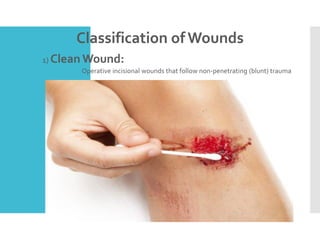
 1) Clean Wound:
 Operative incisional wounds that follow non-penetrating (blunt) trauma
 .
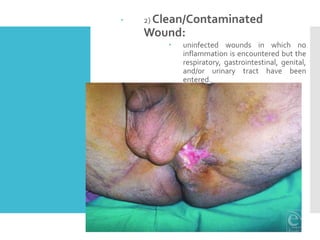
 2) Clean/Contaminated
Wound:
 uninfected wounds in which no
inflammation is encountered but the
respiratory, gastrointestinal, genital,
and/or urinary tract have been
entered.
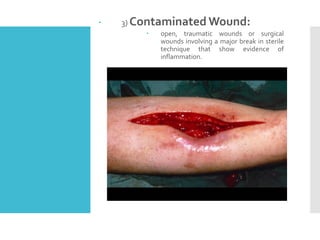
 3) Contaminated Wound:
 open, traumatic wounds or surgical
wounds involving a major break in sterile
technique that show evidence of
inflammation.
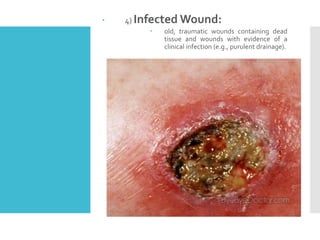
 4) Infected Wound:
 old, traumatic wounds containing dead
tissue and wounds with evidence of a
clinical infection (e.g., purulent drainage).
Classification of Wounds Closure
 Healing by Primary Intention:
 All Layers are closed. The incision that heals by first intention does so in a
minimum amount of time, with no separation of the wound edges, and
with minimal scar formation.
 Healing by Secondary Intention:
 Deep layers are closed but superficial layers are left to heal from the inside
out. Healing by second is appropriate in cases of infection, excessive
trauma, tissue loss, or imprecise approximation of tissue.
 Healing byTertiary Intention:
 Also referred to as delayed primary closure.
Wound Healing
 Inflammation occurs when the damaged endothelial cells release
cytokines that increase expression of integrands in circulating
lymphocytes.
 Histamine, serotonin, and kinins cause vessel contraction
(thromboxane), decrease in blood loss, and act as chemotactic factors
for neutrophils, the most abundant cells in the initial 24 hour period.
Wound
Healing
 Proliferative phase occurs next, after the
neutrophils have removed cellular debris and
release further cytokines acting as attracting agents
for macrophages.
 Fibroblasts now migrate into
the wound, and secrete
collagen type III.
 Angiogenesis occurs by 48
hours.
 The secretion of collagen,
macrophage remodeling and
secretion, and angiogenesis
continues for up to 3 weeks.
 The greatest increase in
wound strength occurs
during this phase.
Wound
Healing
 Maturation phase is the final phase and starts
from the 3rd week and continues for up to 9-12
months.
 This is where collagen III is converted to collagen
I, and the tensile strength continues to increase
up to 80% of normal tissue.
Risk
Factors for
Surgical
Wound
Infections
Patient-related factors:
 Age > 60, sex (female), weight (obesity)
 Presence of remote infections
 Underlying disease states
 Diabetes, Congestive heart failure (CHF)
 Liver disease, renal failure
 Duration of preoperative stay
hospitalization
 > 72 hours, ICU stay
 Immuno-suppression
Risk
Factors for
SWI
Surgery-related factors:
 Type of procedure, site of surgery, emergent
surgery
 Duration of surgery (>60- 120 min)
 Previous surgery
 Timing of antibiotic administration
 Placement of foreign body
 Hip/knee replacement, heart valve insertion,
 Hypotension, hypoxia, dehydration,
hypothermia
Antibiotic
Use
 Nose
S. aureus, pneumococcus,
meningococcus
 Skin
S. aureus, S. epidermidis
 Mouth/pharynx
Streptococci, Pneumococcus, E.coli,
bacteroides,
Urinary tract
E.coli, Proteus, Klebsiella, Enterobacter
Antibiotic
Use
 Colon
E. coli, Klebsiella, Enterobacter,
Bacteroides spp,
Biliary tract
E. coli, Klebsiella, Proteus, clostridia
 Vagina
Streptococci, staphylococci, E. coli,
Upper respiratory tract
Pneumococcus, H. influenzae
Hypertrophic
Scars and
Keloids
 The natural response to injury involves
several stages of wound healing,
migration of macrophages, neutrophils,
and fibroblasts and the release of
cytokines and collagen in an array to
promote wound healing and maturation.
 Hypertrophy and keloid formation are an
overactive response to the natural
process of wound healing.
Hypertrophic
Scars
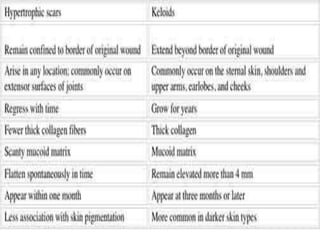
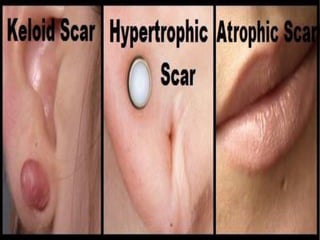
 These lesions are raised and thickened.
 This process does not extend beyond the
boundary of the incision/scar.
 This process is exacerbated by tension
lines on the area of surgery: incisions
over the knee and elbow have a higher
incidence of hypertrophic reaction.
Hypertrophic
Scars
 NOTE: hypertrophic scars and keloids are
indistinguishable by plain H&E staining.
 Treatment: nearly all hypertrophic scars
undergo a degree of spontaneous resolvement.
 If still present after six months, surgical excision
is indicated.
 Pressure applied early to a lesion is also of
benefit.
 Intractable lesions can be injected with
triamcinolone.
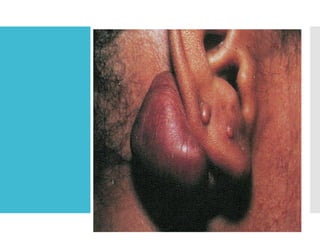
Keloids
 Raised and thickened. This process
extends beyond the boundary of the
incision.
 Continues weeks to months past the
initial insult.
 Higher incidence in AfricanAmericans.
 May have different incidences in
different parts of the same person;
 may not develop a keloid on the arm, yet
has a keloid after earring insertion.
Keloids
 NOTE: hypertrophic and keloids are
indistinguishable by plain H&E staining.
 Treatment: Pressure applied early may
decrease the extent of keloid formation.
 Injection of triamcinolone, or
corticosteroid injection may be helpful.
 Excision with intramarginal borders is
reserved for intractable keloids, and
used in conjunction with the above.
Burns
 Are divided by depth of injury.
Classically, and in some institutions the
burn is organized by “degree:’
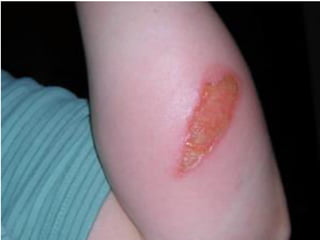
 First-degree: involve the epidermis and
demonstrates erythema and minor
microscopic changes. Pain is major
complaint. No scar is left. Healing is
complete in up to 10 days.
Burns
 Are divided by depth of injury.
Classically, and in some institutions the
burn is organized by “degree:’
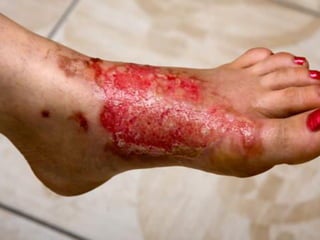
 Second-degree burns: involves all the
epidermis and part of the dermis.
Superficial second-degree burns are
characterized by blister formation while
deeper burns have a more reddish or
non-viable whitish appearance.
Burns
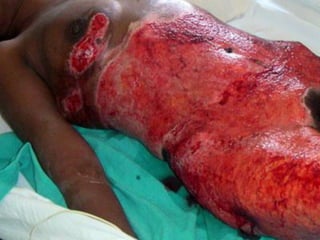
 Third-degree: these full thickness burns are
characteristically white, non-viable.
 They may demonstrate darkened brown or black
adipose tissue.
 Skin is non-sensate, and leathery.
 Muscle injury may also occur.
Pathology Bio 134 Wound Healing

Pathology Bio 134 Wound Healing

  • 1.
    WOUND HEALING BIO 134 Lectureon WOUND HEALING Prof. MAI Jose
  • 2.
    What is wound healing?  Woundhealing is a complex and dynamic process of replacing devitalized and missing cellular structures and tissue layers.  The human adult wound healing process can be divided into 3 or 4 distinct phases.  Earlier authors referred to 3 phases — inflammatory, fibroblastic, and maturation.
  • 4.
    Classification of Wounds 1) Clean Wound:  Operative incisional wounds that follow non-penetrating (blunt) trauma  .
  • 5.
     2) Clean/Contaminated Wound: uninfected wounds in which no inflammation is encountered but the respiratory, gastrointestinal, genital, and/or urinary tract have been entered.
  • 6.
     3) ContaminatedWound:  open, traumatic wounds or surgical wounds involving a major break in sterile technique that show evidence of inflammation.
  • 7.
     4) InfectedWound:  old, traumatic wounds containing dead tissue and wounds with evidence of a clinical infection (e.g., purulent drainage).
  • 8.
    Classification of WoundsClosure  Healing by Primary Intention:  All Layers are closed. The incision that heals by first intention does so in a minimum amount of time, with no separation of the wound edges, and with minimal scar formation.  Healing by Secondary Intention:  Deep layers are closed but superficial layers are left to heal from the inside out. Healing by second is appropriate in cases of infection, excessive trauma, tissue loss, or imprecise approximation of tissue.  Healing byTertiary Intention:  Also referred to as delayed primary closure.
  • 9.
    Wound Healing  Inflammationoccurs when the damaged endothelial cells release cytokines that increase expression of integrands in circulating lymphocytes.  Histamine, serotonin, and kinins cause vessel contraction (thromboxane), decrease in blood loss, and act as chemotactic factors for neutrophils, the most abundant cells in the initial 24 hour period.
  • 10.
    Wound Healing  Proliferative phaseoccurs next, after the neutrophils have removed cellular debris and release further cytokines acting as attracting agents for macrophages.  Fibroblasts now migrate into the wound, and secrete collagen type III.  Angiogenesis occurs by 48 hours.  The secretion of collagen, macrophage remodeling and secretion, and angiogenesis continues for up to 3 weeks.  The greatest increase in wound strength occurs during this phase.
  • 11.
    Wound Healing  Maturation phaseis the final phase and starts from the 3rd week and continues for up to 9-12 months.  This is where collagen III is converted to collagen I, and the tensile strength continues to increase up to 80% of normal tissue.
  • 12.
    Risk Factors for Surgical Wound Infections Patient-related factors: Age > 60, sex (female), weight (obesity)  Presence of remote infections  Underlying disease states  Diabetes, Congestive heart failure (CHF)  Liver disease, renal failure  Duration of preoperative stay hospitalization  > 72 hours, ICU stay  Immuno-suppression
  • 13.
    Risk Factors for SWI Surgery-related factors: Type of procedure, site of surgery, emergent surgery  Duration of surgery (>60- 120 min)  Previous surgery  Timing of antibiotic administration  Placement of foreign body  Hip/knee replacement, heart valve insertion,  Hypotension, hypoxia, dehydration, hypothermia
  • 14.
    Antibiotic Use  Nose S. aureus,pneumococcus, meningococcus  Skin S. aureus, S. epidermidis  Mouth/pharynx Streptococci, Pneumococcus, E.coli, bacteroides, Urinary tract E.coli, Proteus, Klebsiella, Enterobacter
  • 15.
    Antibiotic Use  Colon E. coli,Klebsiella, Enterobacter, Bacteroides spp, Biliary tract E. coli, Klebsiella, Proteus, clostridia  Vagina Streptococci, staphylococci, E. coli, Upper respiratory tract Pneumococcus, H. influenzae
  • 16.
    Hypertrophic Scars and Keloids  Thenatural response to injury involves several stages of wound healing, migration of macrophages, neutrophils, and fibroblasts and the release of cytokines and collagen in an array to promote wound healing and maturation.  Hypertrophy and keloid formation are an overactive response to the natural process of wound healing.
  • 19.
    Hypertrophic Scars  These lesionsare raised and thickened.  This process does not extend beyond the boundary of the incision/scar.  This process is exacerbated by tension lines on the area of surgery: incisions over the knee and elbow have a higher incidence of hypertrophic reaction.
  • 20.
    Hypertrophic Scars  NOTE: hypertrophicscars and keloids are indistinguishable by plain H&E staining.  Treatment: nearly all hypertrophic scars undergo a degree of spontaneous resolvement.  If still present after six months, surgical excision is indicated.  Pressure applied early to a lesion is also of benefit.  Intractable lesions can be injected with triamcinolone.
  • 21.
    Keloids  Raised andthickened. This process extends beyond the boundary of the incision.  Continues weeks to months past the initial insult.  Higher incidence in AfricanAmericans.  May have different incidences in different parts of the same person;  may not develop a keloid on the arm, yet has a keloid after earring insertion.
  • 23.
    Keloids  NOTE: hypertrophicand keloids are indistinguishable by plain H&E staining.  Treatment: Pressure applied early may decrease the extent of keloid formation.  Injection of triamcinolone, or corticosteroid injection may be helpful.  Excision with intramarginal borders is reserved for intractable keloids, and used in conjunction with the above.
  • 24.
    Burns  Are dividedby depth of injury. Classically, and in some institutions the burn is organized by “degree:’  First-degree: involve the epidermis and demonstrates erythema and minor microscopic changes. Pain is major complaint. No scar is left. Healing is complete in up to 10 days.
  • 26.
    Burns  Are dividedby depth of injury. Classically, and in some institutions the burn is organized by “degree:’  Second-degree burns: involves all the epidermis and part of the dermis. Superficial second-degree burns are characterized by blister formation while deeper burns have a more reddish or non-viable whitish appearance.
  • 28.
    Burns  Third-degree: thesefull thickness burns are characteristically white, non-viable.  They may demonstrate darkened brown or black adipose tissue.  Skin is non-sensate, and leathery.  Muscle injury may also occur.