Genetics 101:  Genetic differentiation in the age    of ecological restoration Susan J. Mazer Department of Ecology, Evolution & Marine Biology University of California, Santa Barbara [email_address]
Genetic concepts to be considered Rules of inheritance Genetic processes Consequences of mismatches between sources of material for restoration and  (a) the environment of the restoration site or  (b) the genotypes resident at the restoration site
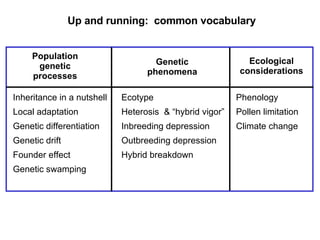
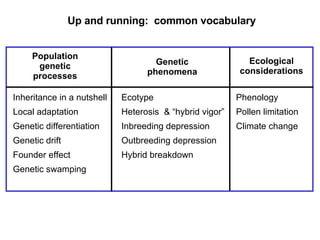
Up and running:  common vocabulary Population genetic processes Genetic phenomena Ecological considerations
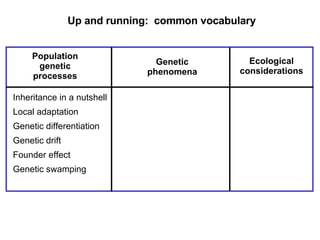
Up and running:  common vocabulary Inheritance in a nutshell Local adaptation  Genetic differentiation Genetic drift Founder effect Genetic swamping Population genetic processes Genetic phenomena Ecological considerations
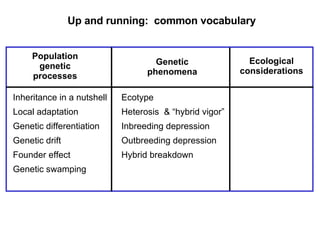
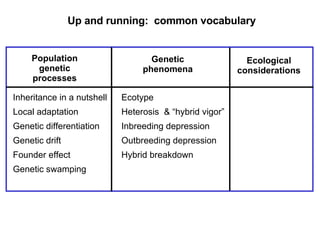
Up and running:  common vocabulary Inheritance in a nutshell Local adaptation  Genetic differentiation Genetic drift Founder effect Genetic swamping Ecotype  Heterosis  & “hybrid vigor” Inbreeding depression  Outbreeding depression Hybrid breakdown  Population genetic processes Genetic phenomena Ecological considerations
Up and running:  common vocabulary Inheritance in a nutshell Local adaptation  Genetic differentiation Genetic drift Founder effect Genetic swamping Ecotype  Heterosis  & “hybrid vigor” Inbreeding depression  Outbreeding depression Hybrid breakdown  Phenology Pollen limitation Climate change Population genetic processes Genetic phenomena Ecological considerations
Inheritance in a tiny nutshell Gene :  The sequence of DNA that determines the expression of a given trait.
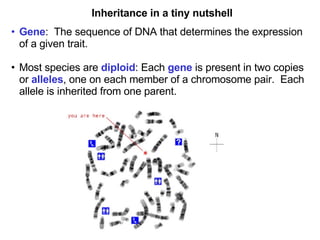
Inheritance in a tiny nutshell Gene :  The sequence of DNA that determines the expression of a given trait. Most species are  diploid : Each  gene  is present in two copies or  alleles , one on each member of a chromosome pair.  Each allele is inherited from one parent.
Inheritance in a tiny nutshell Gene :  The sequence of DNA that determines the expression of a given trait. Most species are  diploid : Each  gene  is present in two copies or  alleles , one on each member of a chromosome pair.  Each allele is inherited from one parent. One or more genes determine the appearance or performance of an individual for a given  trait  (e.g., drought tolerance, flower color, seed size, timing of flowering).
Inheritance in a tiny nutshell Gene :  The sequence of DNA that determines the expression of a given trait. Most species are  diploid : Each  gene  is present in two copies or  alleles , one on each member of a chromosome pair.  Each allele is inherited from one parent. One or more genes determine the appearance or performance of an individual for a given  trait  (e.g., drought tolerance, flower color, seed size, timing of flowering). When the two alleles of a gene are  identical , an individual is  homozygous  for this gene or trait.
Inheritance in a tiny nutshell Gene :  The sequence of DNA that determines the expression of a given trait. Most species are  diploid : Each  gene  is present in two copies or  alleles , one on each member of a chromosome pair.  Each allele is inherited from one parent. One or more genes determine the appearance or performance of an individual for a given  trait  (e.g., drought tolerance, flower color, seed size, timing of flowering). When the two alleles of a gene are  identical , an individual is  homozygous  for this gene or trait. When the two alleles of a gene  differ , the individual is  heterozygous  for this gene or trait.
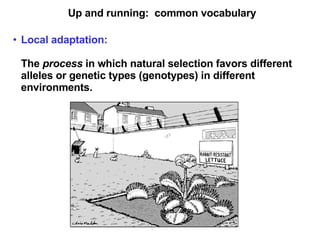
Up and running:  common vocabulary Local adaptation:   The  process  in which natural selection favors different alleles or genetic types (genotypes) in different environments.
Up and running:  common vocabulary Local adaptation:   The  process  in which natural selection favors different alleles or genetic types (genotypes) in different environments. Result : genetic differences between plant populations in locations that differ in attributes such as…   soil quality   climate (temperature, rainfall, date of first frost)   identity of pollinators    presence and composition of competing species   presence of predators   presence and identity of diseases
Up and running:  common vocabulary Genetic differentiation   The  process  and the  outcome  of genetic divergence among populations, resulting from natural selection.
Up and running:  common vocabulary Genetic differentiation   The  process  and the  outcome  of genetic divergence among populations, resulting from natural selection. Genetic differentiation among populations can also result from random processes such as genetic drift and founder effects.
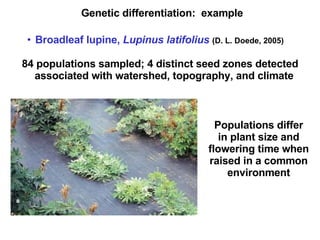
Genetic differentiation:  example Broadleaf lupine,  Lupinus latifolius  (D. L. Doede, 2005)  84 populations sampled; 4 distinct seed zones detected associated with watershed, topography, and climate Populations differ in plant size and flowering time when raised in a common environment
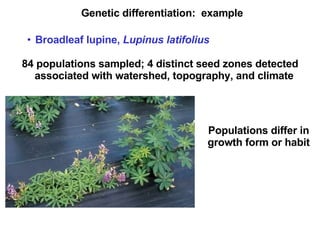
Genetic differentiation:  example Broadleaf lupine,  Lupinus latifolius   84 populations sampled; 4 distinct seed zones detected associated with watershed, topography, and climate Populations differ in growth form or habit
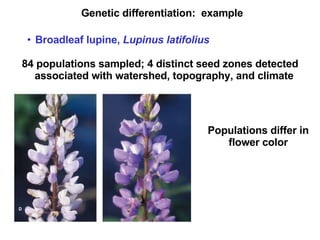
Genetic differentiation:  example Broadleaf lupine,  Lupinus latifolius   84 populations sampled; 4 distinct seed zones detected associated with watershed, topography, and climate Populations differ in flower color
Up and running:  common vocabulary Genetic drift Random fluctuations in the frequency of a specific gene in a small isolated population due to chance. The process by which gene frequencies change at random from generation to generation in small populations due to the chance sampling of different genes among the successful egg and sperm.
Up and running:  common vocabulary Genetic drift Random fluctuations in the frequency of a specific gene in a small isolated population due to chance. The process by which gene frequencies change at random from generation to generation in small populations due to the chance sampling of different genes among the successful egg and sperm. Over time, there is a net loss of heterozygosity and an increase in homozygosity until some alleles are lost forever…..
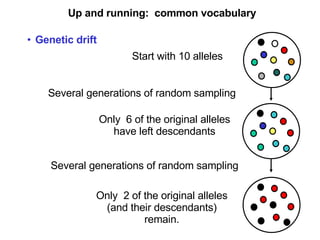
Up and running:  common vocabulary Genetic drift Start with 10 alleles Several generations of random sampling Only  6 of the original alleles have left descendants Several generations of random sampling Only  2 of the original alleles (and their descendants) remain.
Up and running:  common vocabulary Up and running:  common vocabulary Founder effect   Genetic drift observed in a population founded by a small, non-representative sample of a larger population. Rare alleles may become common by chance.
Up and running:  common vocabulary Founder effect   Genetic drift observed in a population founded by a small, non-representative sample of a larger population. Rare alleles may become common by chance.   Example:  A small group of seeds collected from a large population may contain genotypes that do not fully represent the population.  Small samples from large populations typically include less genetic variation than the original population.  This reduced genetic variation can limit the population’s ability to survive and to persist in a novel environment.
Founder effect:  example Hawaiian silverswords   Surviving populations of silverswords ( Argyroxiphium sandwicense and A. kaunense : Asteraceae) have experienced severe bottlenecks and are genetically depauperate.   A restored population of the Mauna Kea silversword,  A. sandwicense,  consists of 1500 individuals all derived from a two or three original parents.
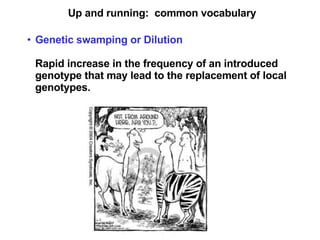
Up and running:  common vocabulary Genetic swamping or Dilution Rapid increase in the frequency of an introduced genotype that may lead to the replacement of local genotypes.
Up and running:  common vocabulary Genetic swamping or Dilution Rapid increase in the frequency of an introduced genotype that may lead to the replacement of local genotypes. Cause:   a short-term or long-term fitness advantage of the introduced genotype.
Up and running:  common vocabulary Genetic swamping or Dilution Rapid increase in the frequency of an introduced genotype that may lead to the replacement of local genotypes. Cause:   a short-term or long-term fitness advantage of the introduced genotype. Consequence:   a reduction in genetic variation relative to the initial mixture of resident and introduced genotypes.
Up and running:  common vocabulary Inheritance in a nutshell Local adaptation  Genetic differentiation Genetic drift Founder effect Genetic swamping Population genetic processes Genetic phenomena Ecological considerations Ecotype  Heterosis  & “hybrid vigor” Inbreeding depression  Outbreeding depression Hybrid breakdown
Up and running:  common vocabulary Ecotype:   The smallest subdivision of a species, consisting of populations adapted to a particular set of environmental conditions. These populations may be infertile when crossed with other ecotypes of the same species.
Up and running:  common vocabulary Ecotype:   The smallest subdivision of a species, consisting of populations adapted to a particular set of environmental conditions. These populations may be infertile when crossed with other ecotypes of the same species. In other words, ecotypes are genetically distinct populations within a species, resulting from adaptation to local environmental conditions.
Up and running:  common vocabulary Ecotype:   The smallest subdivision of a species, consisting of populations adapted to a particular set of environmental conditions. These populations may be infertile when crossed with other ecotypes of the same species. In other words, ecotypes are genetically distinct populations within a species, resulting from adaptation to local environmental conditions. G. Turesson. 1922.  The species and variety as ecological units.
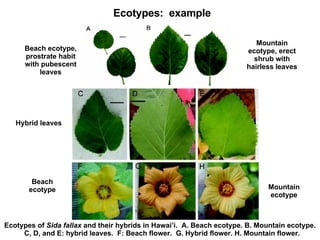
Ecotypes:  example Ecotypes of  Sida fallax  and their hybrids in Hawai’i.  A. Beach ecotype. B. Mountain ecotype. C, D, and E: hybrid leaves.  F: Beach flower.  G. Hybrid flower. H. Mountain flower.  Beach ecotype, prostrate habit with pubescent leaves Mountain ecotype, erect shrub with hairless leaves Beach ecotype Mountain ecotype Hybrid leaves
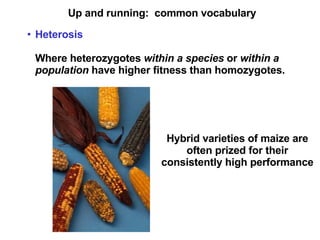
Up and running:  common vocabulary Heterosis   Where heterozygotes  within a species  or  within a population  have higher fitness than homozygotes. Hybrid varieties of maize are often prized for their consistently high performance
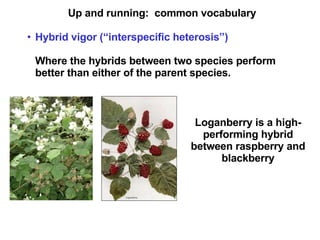
Up and running:  common vocabulary Hybrid vigor (“interspecific heterosis”)   Where the hybrids between two species perform better than either of the parent species. Loganberry is a high-performing hybrid between raspberry and blackberry
Up and running:  common vocabulary Heterosis and “hybrid vigor”   Where heterozygotes within a species or the hybrids between species have a higher fitness than either of their parents. Heterozygotes often grow better, are better able to survive, and/or are more fertile than the homozygotes.
Up and running:  common vocabulary Heterosis and “hybrid vigor”   Where heterozygotes within a species or the hybrids between species have a higher fitness than either of their parents. Heterozygotes often grow better, are better able to survive, and/or are more fertile than the homozygotes. This observation often causes people to think that mixing genotypes from two or more populations is always good.
Up and running:  common vocabulary Inbreeding depression Reduction in performance following mating between very closely related individuals of the same species.
Up and running:  common vocabulary Inbreeding depression Reduction in performance following mating between very closely related individuals of the same species. The union of gametes produced by very close relatives can generate offspring with high frequencies of (recessive) genetic diseases in homozygous form.
Up and running:  common vocabulary Inbreeding depression Reduction in performance following mating between very closely related individuals of the same species. The union of gametes produced by very close relatives can generate offspring with high frequencies of (recessive) genetic diseases in homozygous form. This observation often reinforces the assumption that mixing genotypes from multiple populations will improve the performance of the resulting population.
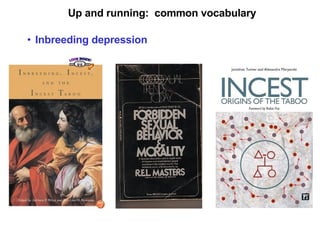
Up and running:  common vocabulary Inbreeding depression
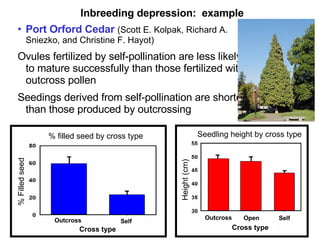
Inbreeding depression:  example Port Orford Cedar  (Scott E. Kolpak, Richard A. Sniezko, and Christine F. Hayot) Ovules fertilized by self-pollination are less likely to mature successfully than those fertilized with outcross pollen Seedings derived from self-pollination are shorter than those produced by outcrossing Cross type Cross type Outcross Outcross Self Self Open % filled seed by cross type Seedling height by cross type Height (cm) % Filled seed
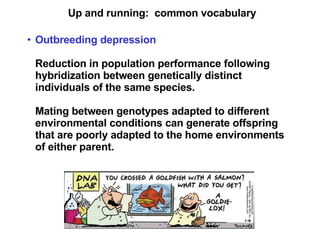
Up and running:  common vocabulary Outbreeding depression Reduction in population performance following hybridization between genetically distinct individuals of the same species. Mating between genotypes adapted to different environmental conditions can generate offspring that are poorly adapted to the home environments of either parent.
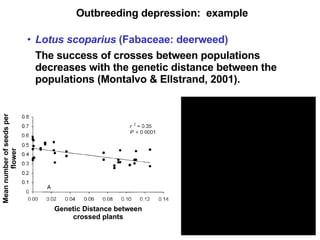
Outbreeding depression:  example Lotus scoparius  (Fabaceae: deerweed) The success of crosses between populations decreases with the genetic distance between the populations (Montalvo & Ellstrand, 2001). Genetic Distance between crossed plants Mean number of seeds per flower
Up and running:  common vocabulary Hybrid breakdown
Up and running:  common vocabulary Hybrid breakdown “ Classic” definition:  Where the first-generation hybrid offspring between two  species  are healthy, but subsequent generations resulting from the matings between these hybrids perform poorly.
Up and running:  common vocabulary Hybrid breakdown “ Classic” definition:  Where the first-generation hybrid offspring between two  species  are healthy, but subsequent generations resulting from the matings between these hybrids perform poorly. Updated definition:  Where the first-generation hybrid offspring between two  ecotypes or genotypes within a species  are healthy, but subsequent generations resulting from the matings between these hybrids are unhealthy and decrease in frequency.
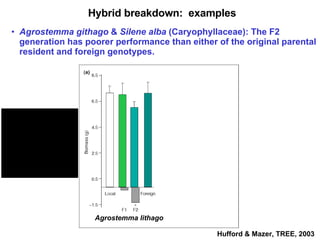
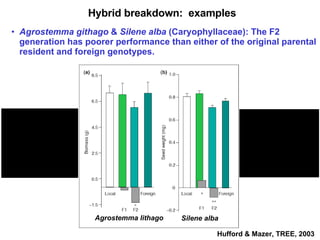
Hybrid breakdown:  examples Agrostemma githago  &  Silene alba  (Caryophyllaceae): The F2 generation has poorer performance than either of the original parental resident and foreign genotypes. Agrostemma lithago Silene alba Hufford & Mazer, TREE, 2003
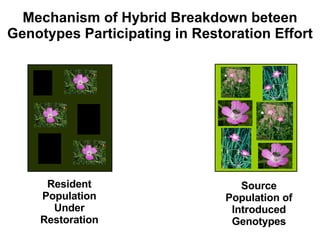
Mechanism of Hybrid Breakdown beteen Genotypes Participating in Restoration Effort Resident Population Under Restoration Source Population of Introduced Genotypes
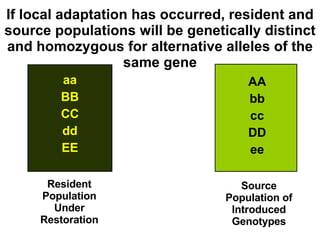
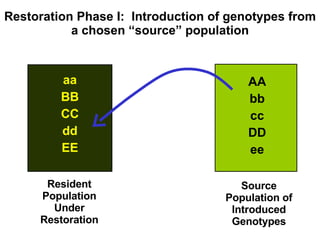
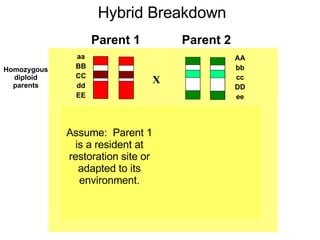
If local adaptation has occurred, resident and source populations will be genetically distinct and homozygous for alternative alleles of the same gene Resident Population Under Restoration Source Population of Introduced Genotypes aa BB CC dd EE AA bb cc DD ee
Restoration Phase I:  Introduction of genotypes from a chosen “source” population Resident Population Under Restoration Source Population of Introduced Genotypes aa BB CC dd EE AA bb cc DD ee
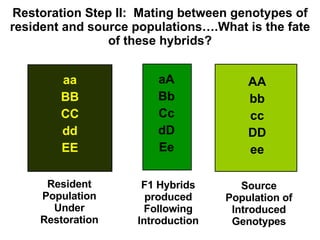
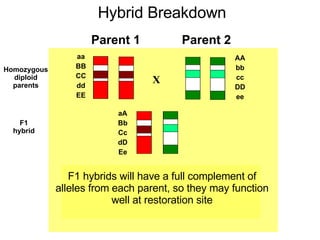
aa BB CC dd EE AA bb cc DD ee F1 Hybrids produced Following Introduction aA Bb Cc dD Ee Restoration Step II:  Mating between genotypes of resident and source populations….What is the fate of these hybrids? Resident Population Under Restoration Source Population of Introduced Genotypes
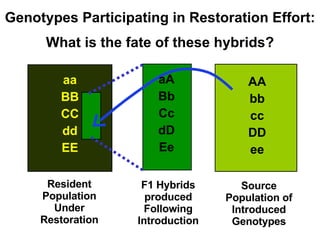
aa BB CC dd EE AA bb cc DD ee Genotypes Participating in Restoration Effort: What is the fate of these hybrids? F1 Hybrids produced Following Introduction aA Bb Cc dD Ee Resident Population Under Restoration Source Population of Introduced Genotypes
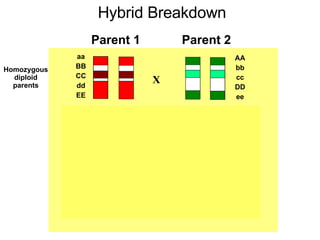
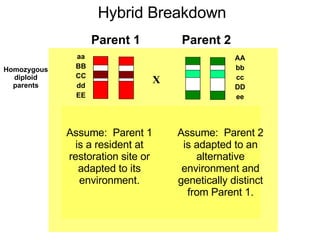
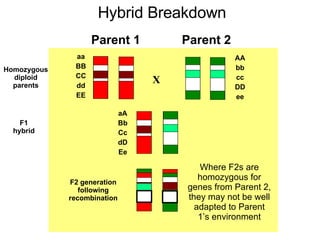
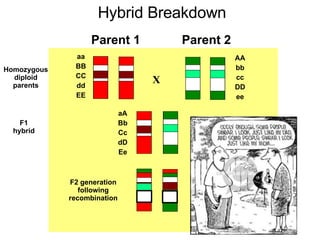
X aa BB CC dd EE AA bb cc DD ee aA Bb Cc dD Ee F2 generation following recombination Homozygous diploid parents Parent 2 Parent 1 Hybrid Breakdown
X aa BB CC dd EE AA bb cc DD ee aA Bb Cc dD Ee F2 generation following recombination Homozygous diploid parents Parent 2 Parent 1 Hybrid Breakdown Assume:  Parent 1 is a resident at restoration site or adapted to its environment.
X aa BB CC dd EE AA bb cc DD ee aA Bb Cc dD Ee F2 generation following recombination Homozygous diploid parents Parent 2 Parent 1 Hybrid Breakdown Assume:  Parent 1 is a resident at restoration site or adapted to its environment. Assume:  Parent 2 is adapted to an alternative environment and genetically distinct from Parent 1.
Parent 2 Parent 1 Hybrid Breakdown X aa BB CC dd EE AA bb cc DD ee aA Bb Cc dD Ee F1 hybrid F2 generation following recombination Homozygous diploid parents F1 hybrids will have a full complement of alleles from each parent, so they may function well at restoration site
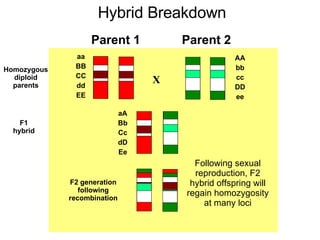
X aa BB CC dd EE AA bb cc DD ee aA Bb Cc dD Ee F1 hybrid F2 generation following recombination Homozygous diploid parents Parent 2 Parent 1 Following sexual reproduction, F2 hybrid offspring will regain homozygosity at many loci Hybrid Breakdown
X aa BB CC dd EE AA bb cc DD ee aA Bb Cc dD Ee F1 hybrid F2 generation following recombination Homozygous diploid parents Parent 2 Parent 1 Where F2s are homozygous for genes from Parent 2, they may not be well adapted to Parent 1’s environment Hybrid Breakdown
X aa BB CC dd EE AA bb cc DD ee aA Bb Cc dD Ee F1 hybrid F2 generation following recombination Homozygous diploid parents Parent 2 Parent 1 Hybrid Breakdown
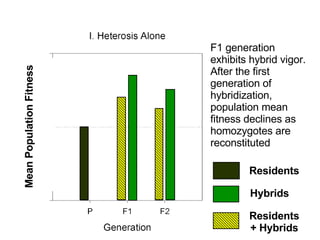
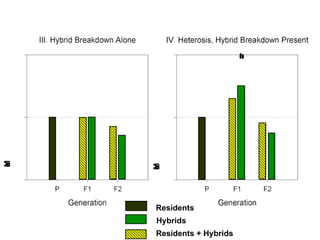
Possible Outcome of Hybridization between Resident and Introduced Genotypes F1 generation exhibits hybrid vigor.  After the first generation of hybridization, population mean fitness declines as homozygotes are reconstituted Mean Population Fitness Residents Hybrids Residents + Hybrids
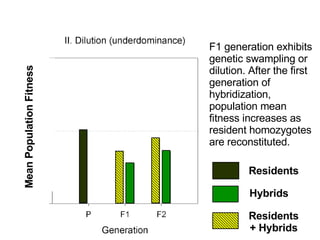
Possible Outcome of Hybridization between Resident and Introduced Genotypes F1 generation exhibits genetic swampling or dilution. After the first generation of hybridization, population mean fitness increases as resident homozygotes are reconstituted. Mean Population Fitness Residents Hybrids Residents + Hybrids
Mean Population Fitness Mean Population Fitness Possible Outcomes of Hybridization between Resident and Introduced Genotypes After 1st generation, population mean fitness declines as adaptive combinations are shuffled Magnitude of decline will depend on strength of  natural selection Residents Hybrids Residents + Hybrids
Up and running:  common vocabulary Inheritance in a nutshell Local adaptation  Genetic differentiation Genetic drift Founder effect Genetic swamping Population genetic processes Genetic phenomena Ecological considerations Ecotype  Heterosis  & “hybrid vigor” Inbreeding depression  Outbreeding depression Hybrid breakdown  Phenology Pollen limitation Climate change
Up and running:  common vocabulary Phenology The study of the timing of biological events
Up and running:  common vocabulary Phenology The study of the timing of biological events Includes critical events such as: The timing of germination, which often influences early seedling survivorship The timing of flowering, which determines the attraction of pollinators, the availability of mates, and reproductive success. The timing of seed ripening, which may determine the likelihood of seed dispersal by animals.
Up and running:  common vocabulary Phenology Yellow star thistle
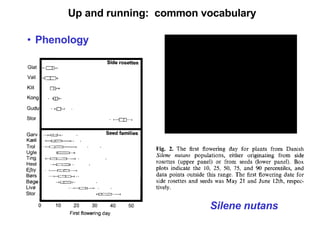
Up and running:  common vocabulary Phenology Silene nutans
Up and running:  common vocabulary Pollen limitation The phenomenon in which plants do not produce as many seeds as they are capable of, simply because they don’t receive enough pollen. Causes: Flowering too early or too late to attract pollinators Flowering too early or too late relative to other plants in the population
Short-term (more or less immediate) consequences: Long-term consequences:  Synthesis:  Consequences of inappropriate source selection
Short-term (more or less immediate) consequences: Genetic swamping or dilution  reduction in mean population performance Long-term consequences:  Synthesis:  Consequences of inappropriate source selection
Short-term (more or less immediate) consequences: Genetic swamping or dilution  reduction in mean population performance High mortality  reduced population size Long-term consequences:  Synthesis:  Consequences of inappropriate source selection
Short-term (more or less immediate) consequences: Genetic swamping or dilution  reduction in mean population performance High mortality  reduced population size Reduced genetic variation Long-term consequences:  Synthesis:  Consequences of inappropriate source selection
Short-term (more or less immediate) consequences: Genetic swamping or dilution  reduction in mean population performance High mortality  reduced population size Reduced genetic variation Long-term consequences:  Hybrid breakdown  poor performance of F2 and subsequent generations Synthesis:  Consequences of inappropriate source selection
Short-term (more or less immediate) consequences: Genetic swamping or dilution  reduction in mean population performance High mortality  reduced population size Reduced genetic variation Long-term consequences:  Hybrid breakdown  poor performance of F2 and subsequent generations Potential for phenological mismatch  Synthesis:  Consequences of inappropriate source selection
Short-term (more or less immediate) consequences: Genetic swamping or dilution  reduction in mean population performance High mortality  reduced population size Reduced genetic variation Long-term consequences:  Hybrid breakdown  poor performance of F2 and subsequent generations Potential for phenological mismatch  Potential failure to be pollinated Synthesis:  Consequences of inappropriate source selection
Short-term (more or less immediate) consequences: Genetic swamping or dilution  reduction in mean population performance High mortality  reduced population size Reduced genetic variation Long-term consequences:  Hybrid breakdown  poor performance of F2 and subsequent generations Potential for phenological mismatch  Potential failure to be pollinated Pollen-stigma incompatibilities Synthesis:  Consequences of inappropriate source selection
Short-term (more or less immediate) consequences: Genetic swamping or dilution  reduction in mean population performance High mortality  reduced population size Reduced genetic variation Long-term consequences:  Hybrid breakdown  poor performance of F2 and subsequent generations Potential for phenological mismatch  Potential failure to be pollinated Pollen-stigma incompatibilities Inability to adapt to climate change (due to limited genetic variation). Synthesis:  Consequences of inappropriate source selection
 
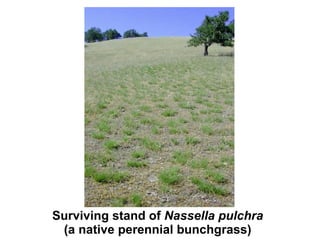
Surviving stand of  Nassella pulchra  (a native perennial bunchgrass)
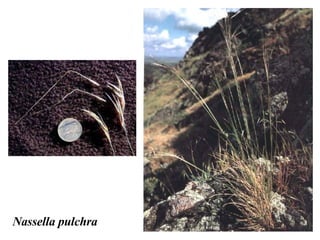
Nassella pulchra
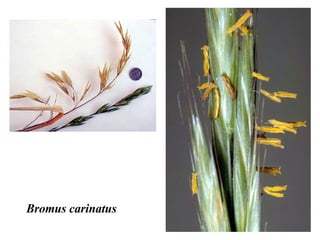
Bromus carinatus
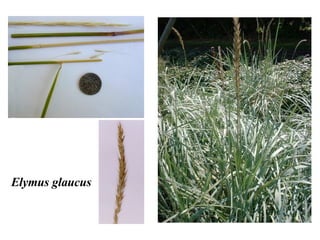
Elymus glaucus
Genetics 101:  Genetic differentiation in the age    of ecological restoration Susan J. Mazer Department of Ecology, Evolution & Marine Biology University of California, Santa Barbara [email_address]

Genetics 101: Genetic Differentiation in the Age of Ecological Restoration

  • 1.
    Genetics 101: Genetic differentiation in the age of ecological restoration Susan J. Mazer Department of Ecology, Evolution & Marine Biology University of California, Santa Barbara [email_address]
  • 2.
    Genetics 101: Genetic differentiation in the age of ecological restoration Susan J. Mazer Department of Ecology, Evolution & Marine Biology University of California, Santa Barbara [email_address]
  • 3.
    Genetic concepts tobe considered Rules of inheritance Genetic processes Consequences of mismatches between sources of material for restoration and (a) the environment of the restoration site or (b) the genotypes resident at the restoration site
  • 4.
    Up and running: common vocabulary Population genetic processes Genetic phenomena Ecological considerations
  • 5.
    Up and running: common vocabulary Inheritance in a nutshell Local adaptation Genetic differentiation Genetic drift Founder effect Genetic swamping Population genetic processes Genetic phenomena Ecological considerations
  • 6.
    Up and running: common vocabulary Inheritance in a nutshell Local adaptation Genetic differentiation Genetic drift Founder effect Genetic swamping Ecotype Heterosis & “hybrid vigor” Inbreeding depression Outbreeding depression Hybrid breakdown Population genetic processes Genetic phenomena Ecological considerations
  • 7.
    Up and running: common vocabulary Inheritance in a nutshell Local adaptation Genetic differentiation Genetic drift Founder effect Genetic swamping Ecotype Heterosis & “hybrid vigor” Inbreeding depression Outbreeding depression Hybrid breakdown Phenology Pollen limitation Climate change Population genetic processes Genetic phenomena Ecological considerations
  • 8.
    Inheritance in atiny nutshell Gene : The sequence of DNA that determines the expression of a given trait.
  • 9.
    Inheritance in atiny nutshell Gene : The sequence of DNA that determines the expression of a given trait. Most species are diploid : Each gene is present in two copies or alleles , one on each member of a chromosome pair. Each allele is inherited from one parent.
  • 10.
    Inheritance in atiny nutshell Gene : The sequence of DNA that determines the expression of a given trait. Most species are diploid : Each gene is present in two copies or alleles , one on each member of a chromosome pair. Each allele is inherited from one parent. One or more genes determine the appearance or performance of an individual for a given trait (e.g., drought tolerance, flower color, seed size, timing of flowering).
  • 11.
    Inheritance in atiny nutshell Gene : The sequence of DNA that determines the expression of a given trait. Most species are diploid : Each gene is present in two copies or alleles , one on each member of a chromosome pair. Each allele is inherited from one parent. One or more genes determine the appearance or performance of an individual for a given trait (e.g., drought tolerance, flower color, seed size, timing of flowering). When the two alleles of a gene are identical , an individual is homozygous for this gene or trait.
  • 12.
    Inheritance in atiny nutshell Gene : The sequence of DNA that determines the expression of a given trait. Most species are diploid : Each gene is present in two copies or alleles , one on each member of a chromosome pair. Each allele is inherited from one parent. One or more genes determine the appearance or performance of an individual for a given trait (e.g., drought tolerance, flower color, seed size, timing of flowering). When the two alleles of a gene are identical , an individual is homozygous for this gene or trait. When the two alleles of a gene differ , the individual is heterozygous for this gene or trait.
  • 13.
    Up and running: common vocabulary Local adaptation: The process in which natural selection favors different alleles or genetic types (genotypes) in different environments.
  • 14.
    Up and running: common vocabulary Local adaptation: The process in which natural selection favors different alleles or genetic types (genotypes) in different environments.
  • 15.
    Up and running: common vocabulary Local adaptation: The process in which natural selection favors different alleles or genetic types (genotypes) in different environments. Result : genetic differences between plant populations in locations that differ in attributes such as… soil quality climate (temperature, rainfall, date of first frost) identity of pollinators presence and composition of competing species presence of predators presence and identity of diseases
  • 16.
    Up and running: common vocabulary Genetic differentiation The process and the outcome of genetic divergence among populations, resulting from natural selection.
  • 17.
    Up and running: common vocabulary Genetic differentiation The process and the outcome of genetic divergence among populations, resulting from natural selection. Genetic differentiation among populations can also result from random processes such as genetic drift and founder effects.
  • 18.
    Genetic differentiation: example Broadleaf lupine, Lupinus latifolius (D. L. Doede, 2005) 84 populations sampled; 4 distinct seed zones detected associated with watershed, topography, and climate Populations differ in plant size and flowering time when raised in a common environment
  • 19.
    Genetic differentiation: example Broadleaf lupine, Lupinus latifolius 84 populations sampled; 4 distinct seed zones detected associated with watershed, topography, and climate Populations differ in growth form or habit
  • 20.
    Genetic differentiation: example Broadleaf lupine, Lupinus latifolius 84 populations sampled; 4 distinct seed zones detected associated with watershed, topography, and climate Populations differ in flower color
  • 21.
    Up and running: common vocabulary Genetic drift Random fluctuations in the frequency of a specific gene in a small isolated population due to chance. The process by which gene frequencies change at random from generation to generation in small populations due to the chance sampling of different genes among the successful egg and sperm.
  • 22.
    Up and running: common vocabulary Genetic drift Random fluctuations in the frequency of a specific gene in a small isolated population due to chance. The process by which gene frequencies change at random from generation to generation in small populations due to the chance sampling of different genes among the successful egg and sperm. Over time, there is a net loss of heterozygosity and an increase in homozygosity until some alleles are lost forever…..
  • 23.
    Up and running: common vocabulary Genetic drift Start with 10 alleles Several generations of random sampling Only 6 of the original alleles have left descendants Several generations of random sampling Only 2 of the original alleles (and their descendants) remain.
  • 24.
    Up and running: common vocabulary Up and running: common vocabulary Founder effect   Genetic drift observed in a population founded by a small, non-representative sample of a larger population. Rare alleles may become common by chance.
  • 25.
    Up and running: common vocabulary Founder effect   Genetic drift observed in a population founded by a small, non-representative sample of a larger population. Rare alleles may become common by chance. Example: A small group of seeds collected from a large population may contain genotypes that do not fully represent the population. Small samples from large populations typically include less genetic variation than the original population. This reduced genetic variation can limit the population’s ability to survive and to persist in a novel environment.
  • 26.
    Founder effect: example Hawaiian silverswords   Surviving populations of silverswords ( Argyroxiphium sandwicense and A. kaunense : Asteraceae) have experienced severe bottlenecks and are genetically depauperate. A restored population of the Mauna Kea silversword, A. sandwicense, consists of 1500 individuals all derived from a two or three original parents.
  • 27.
    Up and running: common vocabulary Genetic swamping or Dilution Rapid increase in the frequency of an introduced genotype that may lead to the replacement of local genotypes.
  • 28.
    Up and running: common vocabulary Genetic swamping or Dilution Rapid increase in the frequency of an introduced genotype that may lead to the replacement of local genotypes. Cause: a short-term or long-term fitness advantage of the introduced genotype.
  • 29.
    Up and running: common vocabulary Genetic swamping or Dilution Rapid increase in the frequency of an introduced genotype that may lead to the replacement of local genotypes. Cause: a short-term or long-term fitness advantage of the introduced genotype. Consequence: a reduction in genetic variation relative to the initial mixture of resident and introduced genotypes.
  • 30.
    Up and running: common vocabulary Inheritance in a nutshell Local adaptation Genetic differentiation Genetic drift Founder effect Genetic swamping Population genetic processes Genetic phenomena Ecological considerations Ecotype Heterosis & “hybrid vigor” Inbreeding depression Outbreeding depression Hybrid breakdown
  • 31.
    Up and running: common vocabulary Ecotype: The smallest subdivision of a species, consisting of populations adapted to a particular set of environmental conditions. These populations may be infertile when crossed with other ecotypes of the same species.
  • 32.
    Up and running: common vocabulary Ecotype: The smallest subdivision of a species, consisting of populations adapted to a particular set of environmental conditions. These populations may be infertile when crossed with other ecotypes of the same species. In other words, ecotypes are genetically distinct populations within a species, resulting from adaptation to local environmental conditions.
  • 33.
    Up and running: common vocabulary Ecotype: The smallest subdivision of a species, consisting of populations adapted to a particular set of environmental conditions. These populations may be infertile when crossed with other ecotypes of the same species. In other words, ecotypes are genetically distinct populations within a species, resulting from adaptation to local environmental conditions. G. Turesson. 1922. The species and variety as ecological units.
  • 34.
    Ecotypes: exampleEcotypes of Sida fallax and their hybrids in Hawai’i. A. Beach ecotype. B. Mountain ecotype. C, D, and E: hybrid leaves. F: Beach flower. G. Hybrid flower. H. Mountain flower. Beach ecotype, prostrate habit with pubescent leaves Mountain ecotype, erect shrub with hairless leaves Beach ecotype Mountain ecotype Hybrid leaves
  • 35.
    Up and running: common vocabulary Heterosis   Where heterozygotes within a species or within a population have higher fitness than homozygotes. Hybrid varieties of maize are often prized for their consistently high performance
  • 36.
    Up and running: common vocabulary Hybrid vigor (“interspecific heterosis”)   Where the hybrids between two species perform better than either of the parent species. Loganberry is a high-performing hybrid between raspberry and blackberry
  • 37.
    Up and running: common vocabulary Heterosis and “hybrid vigor”   Where heterozygotes within a species or the hybrids between species have a higher fitness than either of their parents. Heterozygotes often grow better, are better able to survive, and/or are more fertile than the homozygotes.
  • 38.
    Up and running: common vocabulary Heterosis and “hybrid vigor”   Where heterozygotes within a species or the hybrids between species have a higher fitness than either of their parents. Heterozygotes often grow better, are better able to survive, and/or are more fertile than the homozygotes. This observation often causes people to think that mixing genotypes from two or more populations is always good.
  • 39.
    Up and running: common vocabulary Inbreeding depression Reduction in performance following mating between very closely related individuals of the same species.
  • 40.
    Up and running: common vocabulary Inbreeding depression Reduction in performance following mating between very closely related individuals of the same species. The union of gametes produced by very close relatives can generate offspring with high frequencies of (recessive) genetic diseases in homozygous form.
  • 41.
    Up and running: common vocabulary Inbreeding depression Reduction in performance following mating between very closely related individuals of the same species. The union of gametes produced by very close relatives can generate offspring with high frequencies of (recessive) genetic diseases in homozygous form. This observation often reinforces the assumption that mixing genotypes from multiple populations will improve the performance of the resulting population.
  • 42.
    Up and running: common vocabulary Inbreeding depression
  • 43.
    Inbreeding depression: example Port Orford Cedar (Scott E. Kolpak, Richard A. Sniezko, and Christine F. Hayot) Ovules fertilized by self-pollination are less likely to mature successfully than those fertilized with outcross pollen Seedings derived from self-pollination are shorter than those produced by outcrossing Cross type Cross type Outcross Outcross Self Self Open % filled seed by cross type Seedling height by cross type Height (cm) % Filled seed
  • 44.
    Up and running: common vocabulary Outbreeding depression Reduction in population performance following hybridization between genetically distinct individuals of the same species. Mating between genotypes adapted to different environmental conditions can generate offspring that are poorly adapted to the home environments of either parent.
  • 45.
    Up and running: common vocabulary Outbreeding depression Reduction in population performance following hybridization between genetically distinct individuals of the same species. Mating between genotypes adapted to different environmental conditions can generate offspring that are poorly adapted to the home environments of either parent.
  • 46.
    Outbreeding depression: example Lotus scoparius (Fabaceae: deerweed) The success of crosses between populations decreases with the genetic distance between the populations (Montalvo & Ellstrand, 2001). Genetic Distance between crossed plants Mean number of seeds per flower
  • 47.
    Up and running: common vocabulary Hybrid breakdown
  • 48.
    Up and running: common vocabulary Hybrid breakdown
  • 49.
    Up and running: common vocabulary Hybrid breakdown
  • 50.
    Up and running: common vocabulary Hybrid breakdown “ Classic” definition: Where the first-generation hybrid offspring between two species are healthy, but subsequent generations resulting from the matings between these hybrids perform poorly.
  • 51.
    Up and running: common vocabulary Hybrid breakdown “ Classic” definition: Where the first-generation hybrid offspring between two species are healthy, but subsequent generations resulting from the matings between these hybrids perform poorly. Updated definition: Where the first-generation hybrid offspring between two ecotypes or genotypes within a species are healthy, but subsequent generations resulting from the matings between these hybrids are unhealthy and decrease in frequency.
  • 52.
    Hybrid breakdown: examples Agrostemma githago & Silene alba (Caryophyllaceae): The F2 generation has poorer performance than either of the original parental resident and foreign genotypes. Agrostemma lithago Silene alba Hufford & Mazer, TREE, 2003
  • 53.
    Hybrid breakdown: examples Agrostemma githago & Silene alba (Caryophyllaceae): The F2 generation has poorer performance than either of the original parental resident and foreign genotypes. Agrostemma lithago Silene alba Hufford & Mazer, TREE, 2003
  • 54.
    Mechanism of HybridBreakdown beteen Genotypes Participating in Restoration Effort Resident Population Under Restoration Source Population of Introduced Genotypes
  • 55.
    If local adaptationhas occurred, resident and source populations will be genetically distinct and homozygous for alternative alleles of the same gene Resident Population Under Restoration Source Population of Introduced Genotypes aa BB CC dd EE AA bb cc DD ee
  • 56.
    Restoration Phase I: Introduction of genotypes from a chosen “source” population Resident Population Under Restoration Source Population of Introduced Genotypes aa BB CC dd EE AA bb cc DD ee
  • 57.
    aa BB CCdd EE AA bb cc DD ee F1 Hybrids produced Following Introduction aA Bb Cc dD Ee Restoration Step II: Mating between genotypes of resident and source populations….What is the fate of these hybrids? Resident Population Under Restoration Source Population of Introduced Genotypes
  • 58.
    aa BB CCdd EE AA bb cc DD ee Genotypes Participating in Restoration Effort: What is the fate of these hybrids? F1 Hybrids produced Following Introduction aA Bb Cc dD Ee Resident Population Under Restoration Source Population of Introduced Genotypes
  • 59.
    X aa BBCC dd EE AA bb cc DD ee aA Bb Cc dD Ee F2 generation following recombination Homozygous diploid parents Parent 2 Parent 1 Hybrid Breakdown
  • 60.
    X aa BBCC dd EE AA bb cc DD ee aA Bb Cc dD Ee F2 generation following recombination Homozygous diploid parents Parent 2 Parent 1 Hybrid Breakdown Assume: Parent 1 is a resident at restoration site or adapted to its environment.
  • 61.
    X aa BBCC dd EE AA bb cc DD ee aA Bb Cc dD Ee F2 generation following recombination Homozygous diploid parents Parent 2 Parent 1 Hybrid Breakdown Assume: Parent 1 is a resident at restoration site or adapted to its environment. Assume: Parent 2 is adapted to an alternative environment and genetically distinct from Parent 1.
  • 62.
    Parent 2 Parent1 Hybrid Breakdown X aa BB CC dd EE AA bb cc DD ee aA Bb Cc dD Ee F1 hybrid F2 generation following recombination Homozygous diploid parents F1 hybrids will have a full complement of alleles from each parent, so they may function well at restoration site
  • 63.
    X aa BBCC dd EE AA bb cc DD ee aA Bb Cc dD Ee F1 hybrid F2 generation following recombination Homozygous diploid parents Parent 2 Parent 1 Following sexual reproduction, F2 hybrid offspring will regain homozygosity at many loci Hybrid Breakdown
  • 64.
    X aa BBCC dd EE AA bb cc DD ee aA Bb Cc dD Ee F1 hybrid F2 generation following recombination Homozygous diploid parents Parent 2 Parent 1 Where F2s are homozygous for genes from Parent 2, they may not be well adapted to Parent 1’s environment Hybrid Breakdown
  • 65.
    X aa BBCC dd EE AA bb cc DD ee aA Bb Cc dD Ee F1 hybrid F2 generation following recombination Homozygous diploid parents Parent 2 Parent 1 Hybrid Breakdown
  • 66.
    Possible Outcome ofHybridization between Resident and Introduced Genotypes F1 generation exhibits hybrid vigor. After the first generation of hybridization, population mean fitness declines as homozygotes are reconstituted Mean Population Fitness Residents Hybrids Residents + Hybrids
  • 67.
    Possible Outcome ofHybridization between Resident and Introduced Genotypes F1 generation exhibits genetic swampling or dilution. After the first generation of hybridization, population mean fitness increases as resident homozygotes are reconstituted. Mean Population Fitness Residents Hybrids Residents + Hybrids
  • 68.
    Mean Population FitnessMean Population Fitness Possible Outcomes of Hybridization between Resident and Introduced Genotypes After 1st generation, population mean fitness declines as adaptive combinations are shuffled Magnitude of decline will depend on strength of natural selection Residents Hybrids Residents + Hybrids
  • 69.
    Up and running: common vocabulary Inheritance in a nutshell Local adaptation Genetic differentiation Genetic drift Founder effect Genetic swamping Population genetic processes Genetic phenomena Ecological considerations Ecotype Heterosis & “hybrid vigor” Inbreeding depression Outbreeding depression Hybrid breakdown Phenology Pollen limitation Climate change
  • 70.
    Up and running: common vocabulary Phenology The study of the timing of biological events
  • 71.
    Up and running: common vocabulary Phenology The study of the timing of biological events Includes critical events such as: The timing of germination, which often influences early seedling survivorship The timing of flowering, which determines the attraction of pollinators, the availability of mates, and reproductive success. The timing of seed ripening, which may determine the likelihood of seed dispersal by animals.
  • 72.
    Up and running: common vocabulary Phenology Yellow star thistle
  • 73.
    Up and running: common vocabulary Phenology Silene nutans
  • 74.
    Up and running: common vocabulary Pollen limitation The phenomenon in which plants do not produce as many seeds as they are capable of, simply because they don’t receive enough pollen. Causes: Flowering too early or too late to attract pollinators Flowering too early or too late relative to other plants in the population
  • 75.
    Short-term (more orless immediate) consequences: Long-term consequences: Synthesis: Consequences of inappropriate source selection
  • 76.
    Short-term (more orless immediate) consequences: Genetic swamping or dilution reduction in mean population performance Long-term consequences: Synthesis: Consequences of inappropriate source selection
  • 77.
    Short-term (more orless immediate) consequences: Genetic swamping or dilution reduction in mean population performance High mortality reduced population size Long-term consequences: Synthesis: Consequences of inappropriate source selection
  • 78.
    Short-term (more orless immediate) consequences: Genetic swamping or dilution reduction in mean population performance High mortality reduced population size Reduced genetic variation Long-term consequences: Synthesis: Consequences of inappropriate source selection
  • 79.
    Short-term (more orless immediate) consequences: Genetic swamping or dilution reduction in mean population performance High mortality reduced population size Reduced genetic variation Long-term consequences: Hybrid breakdown poor performance of F2 and subsequent generations Synthesis: Consequences of inappropriate source selection
  • 80.
    Short-term (more orless immediate) consequences: Genetic swamping or dilution reduction in mean population performance High mortality reduced population size Reduced genetic variation Long-term consequences: Hybrid breakdown poor performance of F2 and subsequent generations Potential for phenological mismatch Synthesis: Consequences of inappropriate source selection
  • 81.
    Short-term (more orless immediate) consequences: Genetic swamping or dilution reduction in mean population performance High mortality reduced population size Reduced genetic variation Long-term consequences: Hybrid breakdown poor performance of F2 and subsequent generations Potential for phenological mismatch Potential failure to be pollinated Synthesis: Consequences of inappropriate source selection
  • 82.
    Short-term (more orless immediate) consequences: Genetic swamping or dilution reduction in mean population performance High mortality reduced population size Reduced genetic variation Long-term consequences: Hybrid breakdown poor performance of F2 and subsequent generations Potential for phenological mismatch Potential failure to be pollinated Pollen-stigma incompatibilities Synthesis: Consequences of inappropriate source selection
  • 83.
    Short-term (more orless immediate) consequences: Genetic swamping or dilution reduction in mean population performance High mortality reduced population size Reduced genetic variation Long-term consequences: Hybrid breakdown poor performance of F2 and subsequent generations Potential for phenological mismatch Potential failure to be pollinated Pollen-stigma incompatibilities Inability to adapt to climate change (due to limited genetic variation). Synthesis: Consequences of inappropriate source selection
  • 84.
  • 85.
    Surviving stand of Nassella pulchra (a native perennial bunchgrass)
  • 86.
  • 87.
  • 88.
  • 89.
    Genetics 101: Genetic differentiation in the age of ecological restoration Susan J. Mazer Department of Ecology, Evolution & Marine Biology University of California, Santa Barbara [email_address]

Editor's Notes

  • #2 The third project I’ll mention is a collaboration with my post-doc Kristina Hufford, who was awarded a 3-year National Parks Foundation fellowship to support her work on this project. We’re examining the results of local adaptation at a metapopulation scale.