GENE INTERACTIONS
Dr Saji Mariam George
Associate Professor (Retired)
Assumption College Autonomous
Changanacherry
GENE INTERACTIONS
• According to Gregor Johann Mendel, (the Father of Genetics)
each character is controlled by a pair of factors(now called genes,
Johannsen 1909). A gene has alternative forms having different
phenotypic effects called alleles ; of the two alleles of a gene ,
one allele is completely dominant over the other (recessive) .
Due to this the heterozygote has the dominant phenotype.
• But later discoveries proved that there are several exceptions to
Mendelian patterns of inheritance. Investigations by various
scientists on the inheritance of several traits have shown
deviations from the typical Mendelian ratios.
• Certain characters are controlled by two or more factors or genes
and they interact with each other. Such gene interactions
produce new phenotypes which may not have dominant –
recessive relationships as observed by Mendel in Garden pea
(Pisum sativum).
• William Bateson and R. C. Punnett proposed ‘Factor
Hypothesis’ to explain genic interaction. Factor Hypothesis
states that certain characters are controlled by the
interaction of two or more factors (genes).
• Gene interaction may occur between the two alleles of a
single gene. This type of intragenic interaction is known as
allelic gene interaction. Similarly, genic interaction can also
occur between genes located in the same chromosome or
different chromosomes. This type of intergenic interaction is
known as non-allelic gene interactions.
TYPES OF GENE INTERACTIONS
1. Allelic Gene interactions
• Gene interaction that occur between the two alleles of a single gene.
Complete dominance, incomplete dominance and co-dominance are
examples of allelic interactions.
a) Complete Dominance
• One allele of a pair of alleles (of a gene) when brought together in a
hybrid, completely dominates the other allele and get expressed in
the F1 (dominant allele) while the other allele remains hidden
(recessive allele).
• In complete dominance, the F2 phenotypic ratio in a monohybrid
cross is 3 : 1(3 Dominant phenotype: 1 Recessive phenotype) and in a
dihybrid cross is 9: 3 : 3: 1 (9 Dominant phenotype – Parentals : 3
Recombinants: 3 Recombinants : 1 Recessive phenotype – Parental ).
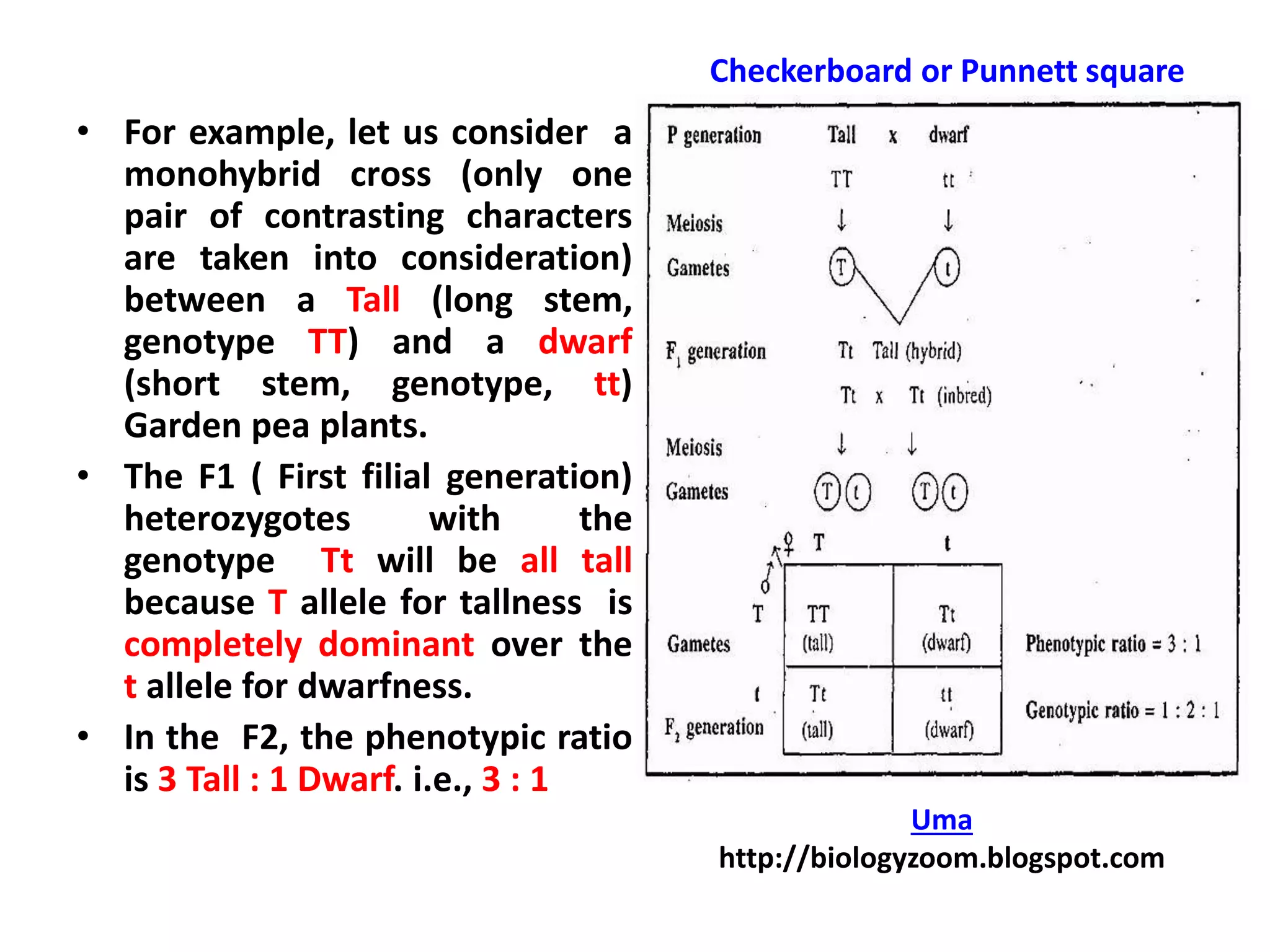
• For example, let us consider a
monohybrid cross (only one
pair of contrasting characters
are taken into consideration)
between a Tall (long stem,
genotype TT) and a dwarf
(short stem, genotype, tt)
Garden pea plants.
• The F1 ( First filial generation)
heterozygotes with the
genotype Tt will be all tall
because T allele for tallness is
completely dominant over the
t allele for dwarfness.
• In the F2, the phenotypic ratio
is 3 Tall : 1 Dwarf. i.e., 3 : 1
Uma
http://biologyzoom.blogspot.com
Checkerboard or Punnett square
• Similarly, in a dihybrid cross (two
pairs of contrasting characters are
taken into consideration) between
a pure breeding tall garden pea
plant with violet flowers with
genotype TTVV and a dwarf one
with white flowers with the
genotype ttvv (Tall completely
dominant over dwarf and violet
flower colour completely
dominant over white ), all the F1
hybrids with the genotype TtVv
will be Tall Violet (Long stem,
violet flowers).
• In the F2, the phenotypic ratio will
be 9/16 Tall Violet (Dominant
phenotype , Parentals ) : 3/16 Tall
White (Recombinants) : 3/16
Dwarf Violet (Recombinants) :
1/16 Dwarf White (Recessive
phenotype, Parental).
i.e, 9: 3 : 3 : 1 Harprit
https://www.sarthaks.com
Checkerboard or Punnett square
• In humans, there are many traits that show complete
dominant - recessive relationships. For example, dark hair is
dominant over blonde or red hair, widow's peak ( having a
V-shaped hairline) over a straight hairline, detached
earlobes over attached earlobes, right-handedness over
left-handedness etc.
• Ability to roll the tongue, baldness, drooping eyelids,
freckles, cleft chin, dimples, brachydactyly (malformed
hands with shortened fingers) etc. are also examples of
dominant traits in man.
b) Incomplete Dominance
(Partial dominance or Semi-dominance)
• A pattern of inheritance of a trait where one allele is
incompletely dominant over the other allele. There is no
complete dominant – recessive relationship between a pair
of alleles with the result that the dominant allele in the
heterozygous condition has reduced expression. Both the
alleles express partially. Hence the F1 hybrids resemble
neither parent and are intermediate between them.
Therefore, incomplete dominance is also known as Partial
dominance or Semi-dominance.
• Incomplete dominance was reported for the first time by
Carl Correns (one of the scientists who re-discovered the
Mendel's works in Pisum sativum) in the flower colour in
four-o' clock plant, Mirabilis jalapa. Another example is
flower colour in Snapdragon (Antirrhinum majus).
Incomplete Dominance in
4’O clock plant (Mirabilis jalapa) & Snapdragon
(Antirrhinum majus)
• In the 4’O clock plant, Mirabilis jalapa, and also in Snapdragon,
Antirrhinum majus, it was found that when plants with red
flowers (RR) were crossed with those having white flowers (rr),
the hybrid F1 (Rr) plants have pink flowers.
• This is because , the allele R for red flower colour is incompletely
dominant over the allele r for white flower colour.
• Hence the F1 hybrids with the genotype Rr have an intermediate
phenotype, pink flower colour .
• When the F1 plants with pink flowers were self pollinated or
crossed among themselves (F1 x F1) to produce the F2, the
flowers were produced in a 1 Red (RR) : 2 Pink (Rr): 1 White (rr)
ratio .
• Thus in incomplete dominance, both the phenotypic (in the
above examples, 1 Red : 2 Pink: 1 white) and the genotypic (1RR :
2 Rr : 1 rr) ratios are the same. i.e., 1 : 2 : 1
Incomplete Dominance in 4’O clock plant (Mirabilis jalapa) &
Snapdragon (Antirrhinum majus)
Checkerboard or Punnett square
https://www.bankofbiology.com
¼ Red (RR) : 2/4 Pink(Rr) : ¼ White(rr)
F2 phenotypic ratio - 1 Red : 2 Pink: 1 white i.e., 1 : 2 : 1
F2 genotypic ratio - 1RR : 2 Rr : 1 rr i.e., 1 : 2 : 1
4’O clock plant (Mirabilis jalapa)-Incomplete
Dominance
RR
Red
rr
White
Rr
Pink
x
Snapdragon, Antirrhinum majus - Incomplete
Dominance
RR
Red
rr
White
Rr
Pink
x
c) Co-dominance
• In Co-dominance , there is independence of allele function.
Neither allele is dominant or even partially dominant over
the other.
• In co-dominance, both the alleles of a pair of genes express
themselves in the F1 heterozygotes. That is, there is
simultaneous expression of both the alleles in the
heterozygous condition.
• Co-dominant alleles are represented by superscripts on the
symbol for the gene.
Codominance: Examples
i) MN blood group system in man
• The M allele is LM and the N allele is LN (the letter L - a
tribute to Karl Landsteiner , the discoverer of blood -
typing).
• In MN blood group system, the homozygotes for the M
allele , LM LM produce only the M antigen and blood type is
M group and the homozygotes for the N allele , LNLN
produce only the N antigen and the blood type is N group.
But the heterozygotes for these two alleles LMLN produce
both kinds of antigens M and N and the blood type is MN
group. This is because the alleles M and N are co-dominant
and contribute equally to the phenotype of the
heterozygote.
ii) AB blood group of man
• In ABO blood group system , the gene responsible for the
production of A and B antigens is denoted by the letter I ( I -
stands for isoagglutinogen, another term for antigen). There
are three different alleles such as IA, IB and IO or i (Multiple
alleles). The IA allele produces A antigen , IB allele produces B
antigen and IO or i allele does not produce any antigen and it is
recessive to both IA and IB alleles.
• The genotypes IAIA (homozygote)and IAIO or IA i(heterozygote)
produce A antigen and hence the blood group is A.
• The genotypes IBIB (homozygote) and IBIO or IBi (heterozygote)
produce B antigen and hence the blood group is B.
• In ABO blood group system, the IA and IB alleles are
co-dominant and they are expressed equally in the IAIB
heterozygotes and produce both A and B antigens. Hence the
blood group is AB.
https://mysciencesquad.weebly.com
iii) Roan coat colour of shorthorn breed of cattle
• In Shorthorn breed of cattle, the genotype CRCR produces red
coat colour and the genotype CWCW produces white coat
colour.
• When a red shorthorn bull is crossed with a white shorthorn
cow, the progeny has roan coat colour.
• In the roan coat, red and white hairs occur in definite patches
but no hair has intermediate colour of red and white.
• This is because the alleles CR and CW are co-dominant and
expresses equally in the heterozygote , CRCW .
Coat colour of Shorthorn breed of cattle : Co-dominance
CRCR
Red Shorthorn Bull
CWCW
White Shorthorn Cow
X
CRCW
Roan Shorthorn Calf
(Red and white hairs occur in definite patches, no hair has intermediate colour of red and
white).
2. Non-allelic Gene interactions
• This include interactions that occur between genes
located in the same chromosome or different
chromosomes.
• Inheritance of some traits are governed by two
independently assorting genes.
• Different combinations of alleles of these two genes may
result in different phenotypes.
i) Simple Interaction:
Inheritance of Comb Pattern in Poultry
• Bateson and Punnet (1905 -
1908) observed that each
variety of poultry possesses a
characteristic type of comb - a
fleshy appendage on the
head . Combs helps chicken to
regulate body temperature.
Moreover, large, bright comb
in roosters attract the hens.
• The size, shape and colour of
the combs vary based on the
age, sex, and breed of the
chicken.
© David Faure, InThinking www.biology-inthinking.co.uk
https://www.wvssearland.com
• The shape of the comb in poultry is determined by two different ,
independently assorting genes R and P.
• The gene, R alone (in the absence of dominant P allele for Pea
comb, i.e, in presence of the recessive alleles pp) produces rose
comb. Hence the genotype of the rose combed fowl may be RRpp
or Rrpp.
• The Rose comb is found in different breeds of chicken –
Wyandottes, Dominiques, Hamburgs, Red Caps, Sebrights etc.
There are also ‘Rose Comb’ breeds of Leghorns, Black and White
Minorcas, Rhode Island Reds and Rhode Island Whites.
• Rose comb is fleshy, solid, broad, almost flat on top, ending in a
pointed spike. The front two-thirds of this comb is covered in
small, round bumps. The shape of the rose comb may vary.
Phenotypic variability in Rose comb in Chicken
• The gene P alone (in the absence of dominant R allele for
Rose comb, i.e., in presence of the recessive alleles, rr)
produces Pea comb. Hence the genotype of the Pea
combed fowl may be rrPP or rrPp.
• The pea comb is a medium-size comb. It has three ridges
running lengthwise from the top of the beak to the top of
the head, with the middle ridge a bit higher than the others.
• Pea comb is found in different breeds like
Brahmas, Araucanas, Ameraucanas, Aseels, Buckeyes,
Cornish, Sumatras and Shamo.
Phenotypic variability in Pea comb in Chicken
• The combination of the recessive alleles of the genes for
Rose and Pea combs , rrpp produces the Single comb.
• Most common type of comb .
• Single comb is attached to the chicken's head in a straight
line from the beginning of the beak to the back of the head,
thin, smooth and soft. It has 5-6 ridges called points. The
comb is much larger and thicker in roosters than in hens.
• Single combs are rigidly upright, but in some breeds, the
comb will flop over to hang on one side of the chicken's
head.
• Single combs are found in breeds like Leghorns, Rhode Island
Red, Minorcas, Faverolles, Barnevelders and Avam cemani.
Phenotypic variability in Single comb in Chicken
• Crosses between Rose-combed and Single – combed fowls
showed that Rose comb is dominant over Single comb and
they segregated in a 3: 1 ratio (3 Rose combed : 1 Single
combed) in the F2.
• In crosses between Pea –combed and Single-combed fowls,
Pea comb is dominant over Single comb and they also
segregated in a 3: 1 ratio (3 Pea combed : 1 Single combed) in
the F2.
• But when a Rose-combed fowl was crossed with a Pea -
combed one, the F1 hybrid showed a new comb, the Walnut
- looks like half of a Walnut .
Phenotypic variability in Walnut comb in Chicken
• When the F1
Walnut -
combed
fowls were
interbred (F1
x F1), the F2
phenotypic
ratio was 9
Walnut
combed : 3
Rose combed
: 3 Pea
combed : 1
single
combed.
i.e., 9: 3 : 3 : 1
https://qforquestions.com
Cross between a Rose combed fowl and Pea
combed fowl - Punnett square
• The F2 phenotypic ratio in the above cross is same as that of
the typical dihybrid F2 phenotypic ratio 9:3:3:1, but differ
from it in the following respects.
 The F1 progeny had a new comb type , Walnut which do
not resemble with that of the parent’s combs. (i.e., Rose
comb and Pea comb). Walnut comb is due to an interaction
between two independently assorting dominant genes, R
and P.
 Another new one, Single comb(rrpp), appeared in the F2.
ii) Epistasis
• Epistasis involves intergenic suppression.
• In epistasis (Gr, = stand above ) two independent, non-allelic
genes affecting the same character interact in such a way
that one gene masks or suppresses the effect of the other
gene.
• The gene that suppresses the effect of the other gene is
known as the epistatic gene and the gene whose expression
is suppressed is known as hypostatic gene.
• Epistasis can be of two types viz. dominant epistasis and
recessive epistasis.
Dominant Epistasis (12 : 3 : 1)
• When a dominant gene inhibits the expression of another
non-allelic dominant gene, it is known as dominant epistasis.
In other words, when the epistatic gene is a dominant gene,
the epistasis is known as dominant epistasis.
• Due to dominant epistasis, the dihybrid F2 phenotypic ratio,
9 : 3 : 3 : 1 is modified into a 12 : 3 : 1 ratio.
e. g. Fruit colour in Summer squash (Cucurbita pepo).
Fruit colour in Summer squash (Cucurbita pepo)
• In Summer squash , the yellow
fruit colour (Y) is dominant over
green (y). Another dominant gene
W produces white fruit colour and
is epistatic to the gene Y. When W
allele is present, the fruit colour
will be always white irrespective
of the presence of other colour
genes Y or y. In the absence of W,
the fruit colour will be yellow in
the presence of the dominant
allele Y and green if Y is absent.
• Thus the genotypes of pure
breeding green fruited plant will
be wwyy, yellow fruited plant will
be wwYY and white fruited plant
will be WWYY or WWyy.
© 2020, West Coast Seeds
Summer squash (Cucurbita pepo)
• When a white fruited
variety of Summer
squash with the genotype
WWYY is crossed with a
green fruited variety
with the genotype wwyy
, the F1 hybrid has the
genotype WwYy. The
fruit colour of the F1
hybrid will be white
because, the dominant
allele W is epistatic to
the dominant allele Y.
https://www.entrancei.com
• F1 hybrid has the genotype WwYy – White fruited
• Interbreeding F1 to produce the F2 generation (F1 x F1 )
WwYy x WwYy
Gametes WY, Wy, wY, wy WY, Wy, wY, wy
https://www.entrancei.com
• Out of the 16 combinations, 12 carry at least one W allele,
and will, therefore, be white fruited; 3 carry at least one Y
allele, but no W allele and will, therefore, be yellow fruited
and 1 carries neither W allele nor Y allele and will be green
fruited.
• Here the first two classes of the typical dihybrid F2
phenotypic ratio, 9 : 3 : 3 : 1 are phenotypically similar . i.e.,
9/16 and 3/16 . Thus the typical dihybrid F2 phenotypic ratio
9 : 3 : 3 : 1 is modified into a 12 : 3 : 1 ratio.
Recessive Epistasis (9 : 3 : 4)
• In recessive epistasis, the
recessive alleles of one gene
mask the phenotypic
expression of another
dominant gene.
Example : Coat colour in Mice
• The inheritance of coat colour
in mice was studied by W. E.
Castle.
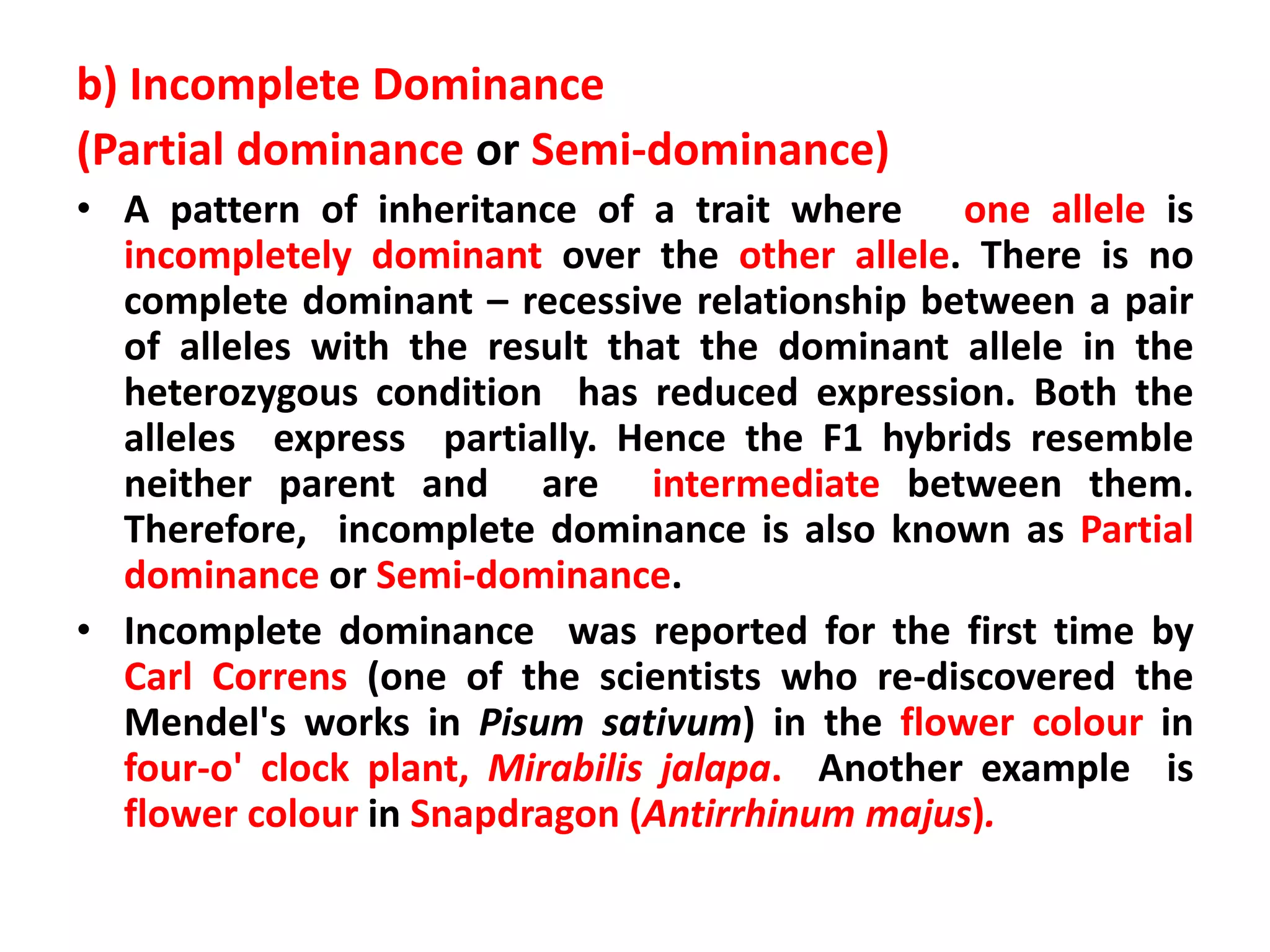
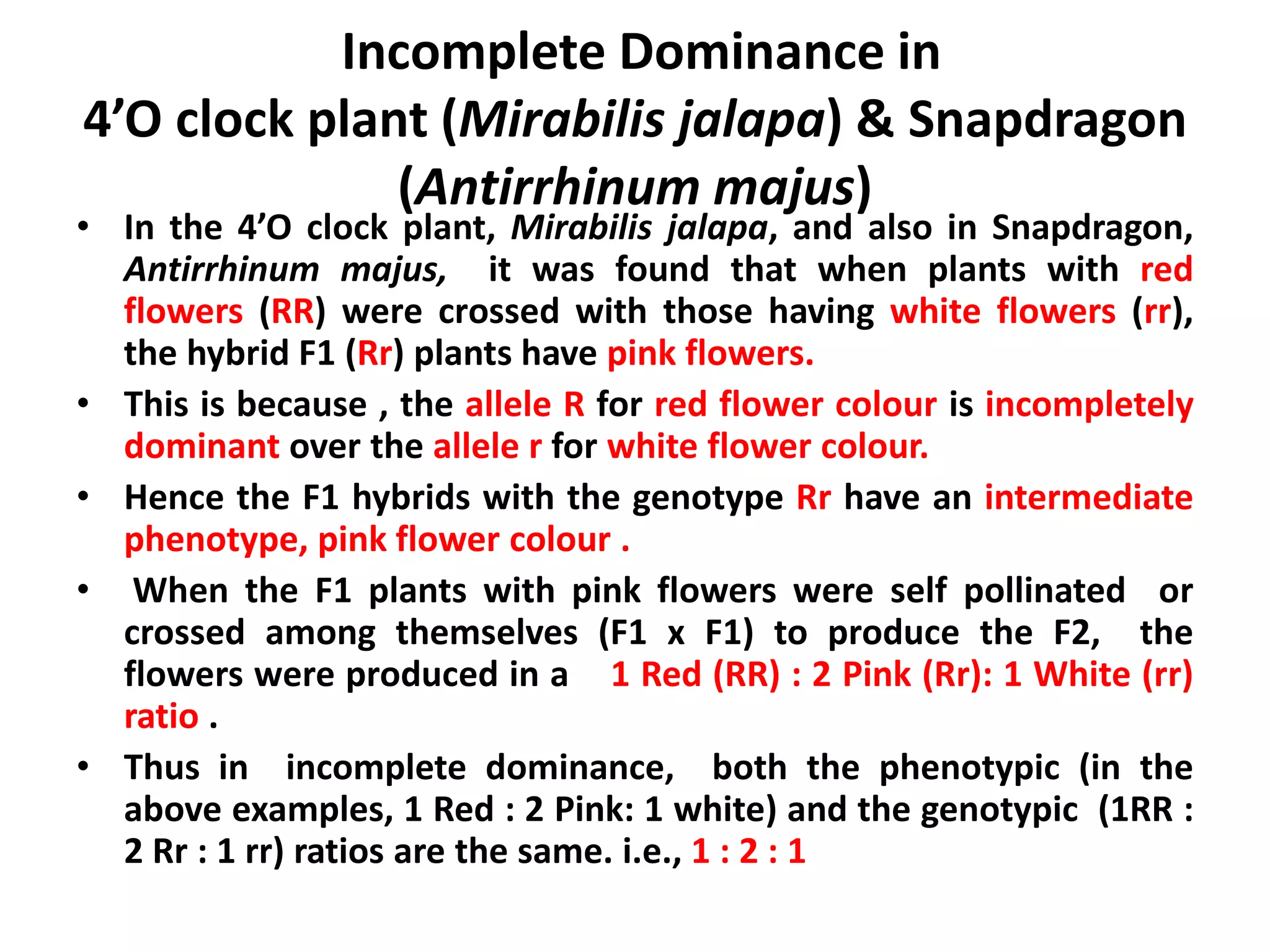
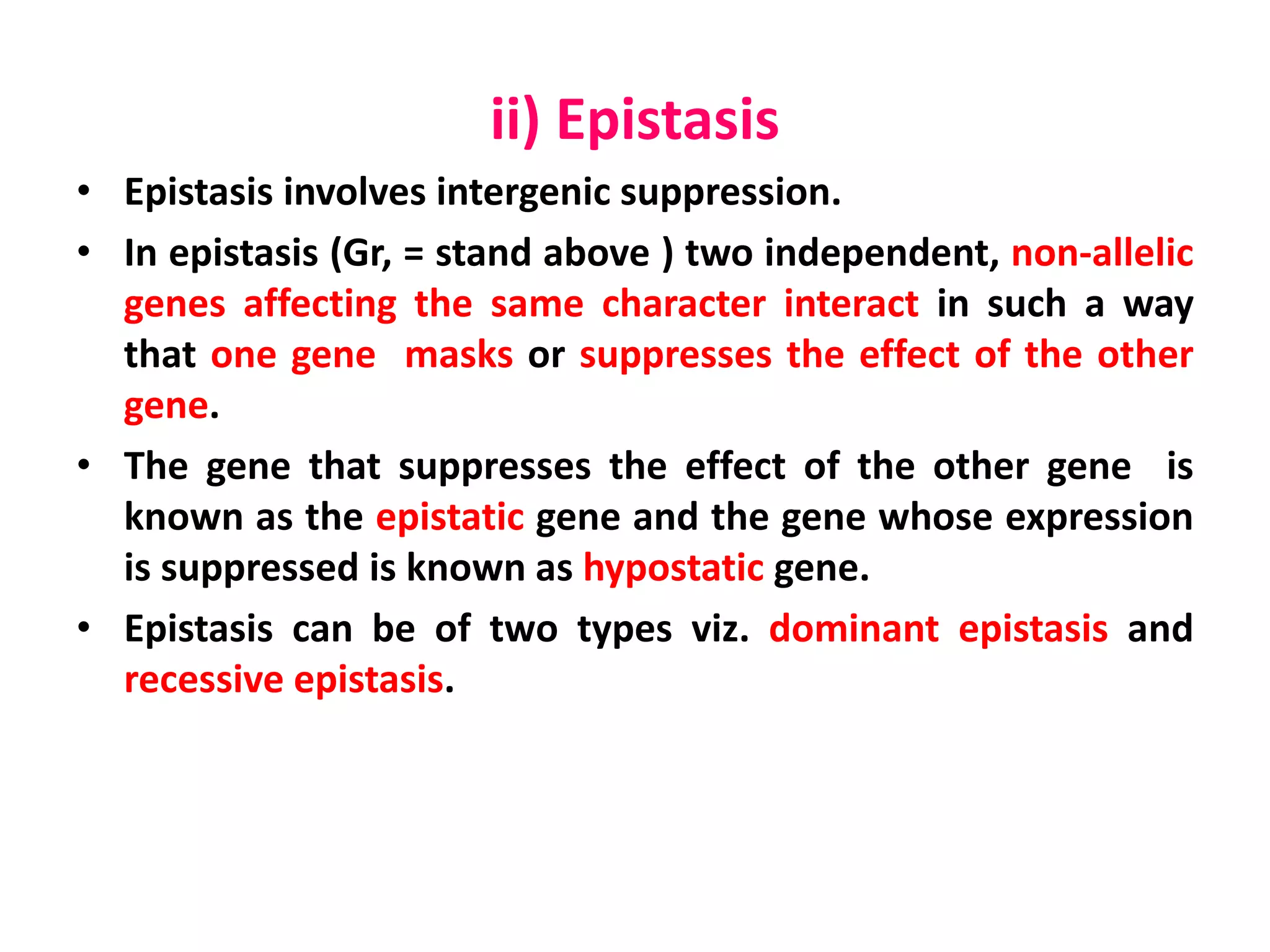
• The common house mouse
has different coat colours
such as agouti, black and
albino(lack pigments - white
coat colour and pink eyes).
Agouti
Black
Albino
Images: http://www.informatics.jax.org , imagesu.net
• The coat colour in mice is controlled by two dominant genes, C and
A.
• Dominant gene C alone produces black coat colour (Genotypes
CC aa or Cc aa).
• The agouti coat colour is controlled by the dominant gene A
and its expression is suppressed by a pair of recessive alleles cc.
Thus the recessive alleles cc is epistatic to the dominant gene A for
agouti coat colour (Agouti coat colour – wild gray . This colour is due
to the presence of two pigments in the fur. The individual hairs are
for the most part black with a narrow yellow band near the tip).
• The dominant gene A for agouti is thus hypostatic to the recessive
alleles cc. Thus mice with the genotypes ccAA and ccAa are unable
to develop agouti coat colour and they will be albinos.
• Agouti colour is dominant to black and albino.
• Black is dominant to albino and recessive to agouti.
• Albino always breed true and is recessive to any colour ( to both
agouti and black).
• When a homozygous black mouse (CCaa) was crossed with a
homozygous albino mouse (ccAA) , the F1 were agouti
(CcAa).
Parents : Black mouse x Albino mouse
Genotype: CCaa ccAA
Gametes : Ca cA
The gametes on fusion, produced CcAa – F1 – All agouti
because, the dominant allele A for agouti coat colour
expressed in the absence of the epistatic recessive alleles
cc.
Interbreeding of F1 produces the F2 generation (F1 x F1 )
Agouti x Agouti
CcAa CcAa
Gametes CA , Ca, cA , ca CA, Ca, cA, ca
F2: F1 x F1 Agouti (CcAa) x Agouti (CcAa)
Punnett square
https://www.entrancei.com
• When the F1 agoutis
were interbred (F1 x F1),
the F2 progeny
consisted of 9/16 Agouti
: 3/16 black : 4/16
Albino. i.e., 9 : 3 : 4
ratio, which is a
modification of the
dihybrid F2 phenotypic
ratio, 9 : 3 : 3 : 1, where
the last two phenotypic
classes are combined.
Coat colour in F2 :
9/16 Agouti : 3/16 Black : 4/16 Albino
Image: doi: https://doi.org/10.1371/journal.pone.0090570.g003
https://journals.plos.org
• In the cross between Black (CCaa) and Albino (ccAA) mice, two
independent genes have interacted in the production of the Agouti
coat colour.
• One dominant gene, C (CC in homozygous condition or Cc in
heterozygous condition) produces its effect whether or not the
second dominant gene A is present (AA - in homozygous condition
or Aa - in heterozygous condition).
• But the second dominant gene, A can produce its effect only in the
presence of the first, C. Hence these genes, C and A can be called as
supplementary genes (Supplementary gene interaction ). When the
second dominant gene A is present along with the first gene C, it
changes the effect of the first gene (the genotypes CCAA, CCAa,
CcAA, CcAa) - hence a new phenotype, Agouti coat colour is
produced.
• When the second gene A is alone (i.e. in the absence of the
dominant C, the genotypes ccAA, ccAa), it cannot express itself,
because the recessive alleles cc is epistatic to the dominant gene A
and produce albinos.
iii) Complementary Gene Interaction (9 : 7 Ratio)
• In Complementary gene interaction, two dominant genes
which are located in different loci and affecting the same
character, when present together, interact and produce a
new phenotype of the trait. Each dominant gene control a
step essential for the production of a particular end product
which is responsible for the new phenotype. Thus, the
interaction of these dominant genes is said to be
complementary.
• As a result of complementary gene interaction, the dihybrid
F2 phenotypic ratio , 9 : 3 : 3 : 1 is modified into a 9 : 7 ratio.
e.g. Purple Flower colour in Sweet Pea (Lathyrus odoratus).
Purple Flower colour in Sweet Pea
(Lathyrus odoratus)
• Bateson and Punnett(1906) had investigated the flower colour
in Sweet pea. They had crossed two pure breeding white
flowered Sweet pea plants.
• All the F1 hybrid plants were purple flowered.
Sweet Pea (Lathyrus odoratus)
Illustrations Credit : Muriel Wheldale - in the William Bateson’s publication ,
Mendel’s Principles of Heredity, in 1909.
https://agardenthroughtime.files.wordpress.com
• F1 hybrids on selfing produced the F2 generation. Bateson
and Punnett had counted a total of 382 purple-flowered
plants and 269 white-flowered plants in the F2. The ratio of
purple flowers to white flowers was thus 9.4 : 6.6, or
approximately 9:7.
• Here, the last three phenotypic classes of dihybrid F2
phenotypic ratio, 9:3: 3: 1 were combined → 9 : 7 ratio.
• In Sweet pea, the purple colour of flowers is due to the
pigment Anthocyanin. Its synthesis involves two biochemical
reactions. The end product of the first reaction form the
substrate for the other reaction. Each reaction is catalyzed
by an enzyme which is produced by the genes C and P. Thus
the synthesis of the pigment anthocyanin is dependent on
two non-allelic dominant genes C and P.
• Gene C produces an enzyme that catalyses the formation of
a colourless chromogen which is required for the synthesis
of the pigment Anthocyanin.
• The gene P controls the production of an enzyme which
catalyses the transformation of the colourless chromogen
into the anthocyanin pigment. Thus the action of the
dominant genes C and P are complementary.
• If either step is nonfunctional,
then, no production of the purple
Anthocyanin pigment and the
affected Sweet pea plant will
produce only white flowers.
• When the genes are in recessive
condition, there is no synthesis of
the anthocyanin pigment - The
recessive gene, cc can not produce
the colourless chromogen. So
plants with genotypes ccPP and
ccPp will produce white flowers.
Similarly , the recessive gene, pp
can not produce the enzyme that
catalyse the conversion of the
colourless chromogen into
coloured anthocyanin. So, plants
with the genotype CCpp and Ccpp
also will produce white flowers.
• The plant with genotype in
double recessive condition, ccpp
will also produce only white
flowers. © https://www.nature.com
Cross between two white flowered Sweet pea
(Lathyrus odoratus)
https://www.entrancei.com
F1 Purple flowered Sweet Pea(CcPp) on Selfing → F2
Punnett Square
https://www.entrancei.com
In the F2, 9/16 Purple flowered : 7/16 White flowered
• If a plant possesses at least one allele each of the two
dominant genes C and P, it will produce purple flowers. If
any one of the dominant alleles is absent, no anthocyanin
pigment is produced and the flowers will be white.
• The F2 phenotypic ratio is 9 Purple : 7 White . i.e., 9 : 7.
THANK YOU

GENE INTERACTIONS SMG

  • 1.
    GENE INTERACTIONS Dr SajiMariam George Associate Professor (Retired) Assumption College Autonomous Changanacherry
  • 2.
    GENE INTERACTIONS • Accordingto Gregor Johann Mendel, (the Father of Genetics) each character is controlled by a pair of factors(now called genes, Johannsen 1909). A gene has alternative forms having different phenotypic effects called alleles ; of the two alleles of a gene , one allele is completely dominant over the other (recessive) . Due to this the heterozygote has the dominant phenotype. • But later discoveries proved that there are several exceptions to Mendelian patterns of inheritance. Investigations by various scientists on the inheritance of several traits have shown deviations from the typical Mendelian ratios. • Certain characters are controlled by two or more factors or genes and they interact with each other. Such gene interactions produce new phenotypes which may not have dominant – recessive relationships as observed by Mendel in Garden pea (Pisum sativum).
  • 3.
    • William Batesonand R. C. Punnett proposed ‘Factor Hypothesis’ to explain genic interaction. Factor Hypothesis states that certain characters are controlled by the interaction of two or more factors (genes). • Gene interaction may occur between the two alleles of a single gene. This type of intragenic interaction is known as allelic gene interaction. Similarly, genic interaction can also occur between genes located in the same chromosome or different chromosomes. This type of intergenic interaction is known as non-allelic gene interactions.
  • 4.
    TYPES OF GENEINTERACTIONS 1. Allelic Gene interactions • Gene interaction that occur between the two alleles of a single gene. Complete dominance, incomplete dominance and co-dominance are examples of allelic interactions. a) Complete Dominance • One allele of a pair of alleles (of a gene) when brought together in a hybrid, completely dominates the other allele and get expressed in the F1 (dominant allele) while the other allele remains hidden (recessive allele). • In complete dominance, the F2 phenotypic ratio in a monohybrid cross is 3 : 1(3 Dominant phenotype: 1 Recessive phenotype) and in a dihybrid cross is 9: 3 : 3: 1 (9 Dominant phenotype – Parentals : 3 Recombinants: 3 Recombinants : 1 Recessive phenotype – Parental ).
  • 5.
    • For example,let us consider a monohybrid cross (only one pair of contrasting characters are taken into consideration) between a Tall (long stem, genotype TT) and a dwarf (short stem, genotype, tt) Garden pea plants. • The F1 ( First filial generation) heterozygotes with the genotype Tt will be all tall because T allele for tallness is completely dominant over the t allele for dwarfness. • In the F2, the phenotypic ratio is 3 Tall : 1 Dwarf. i.e., 3 : 1 Uma http://biologyzoom.blogspot.com Checkerboard or Punnett square
  • 6.
    • Similarly, ina dihybrid cross (two pairs of contrasting characters are taken into consideration) between a pure breeding tall garden pea plant with violet flowers with genotype TTVV and a dwarf one with white flowers with the genotype ttvv (Tall completely dominant over dwarf and violet flower colour completely dominant over white ), all the F1 hybrids with the genotype TtVv will be Tall Violet (Long stem, violet flowers). • In the F2, the phenotypic ratio will be 9/16 Tall Violet (Dominant phenotype , Parentals ) : 3/16 Tall White (Recombinants) : 3/16 Dwarf Violet (Recombinants) : 1/16 Dwarf White (Recessive phenotype, Parental). i.e, 9: 3 : 3 : 1 Harprit https://www.sarthaks.com Checkerboard or Punnett square
  • 7.
    • In humans,there are many traits that show complete dominant - recessive relationships. For example, dark hair is dominant over blonde or red hair, widow's peak ( having a V-shaped hairline) over a straight hairline, detached earlobes over attached earlobes, right-handedness over left-handedness etc. • Ability to roll the tongue, baldness, drooping eyelids, freckles, cleft chin, dimples, brachydactyly (malformed hands with shortened fingers) etc. are also examples of dominant traits in man.
  • 8.
    b) Incomplete Dominance (Partialdominance or Semi-dominance) • A pattern of inheritance of a trait where one allele is incompletely dominant over the other allele. There is no complete dominant – recessive relationship between a pair of alleles with the result that the dominant allele in the heterozygous condition has reduced expression. Both the alleles express partially. Hence the F1 hybrids resemble neither parent and are intermediate between them. Therefore, incomplete dominance is also known as Partial dominance or Semi-dominance. • Incomplete dominance was reported for the first time by Carl Correns (one of the scientists who re-discovered the Mendel's works in Pisum sativum) in the flower colour in four-o' clock plant, Mirabilis jalapa. Another example is flower colour in Snapdragon (Antirrhinum majus).
  • 9.
    Incomplete Dominance in 4’Oclock plant (Mirabilis jalapa) & Snapdragon (Antirrhinum majus) • In the 4’O clock plant, Mirabilis jalapa, and also in Snapdragon, Antirrhinum majus, it was found that when plants with red flowers (RR) were crossed with those having white flowers (rr), the hybrid F1 (Rr) plants have pink flowers. • This is because , the allele R for red flower colour is incompletely dominant over the allele r for white flower colour. • Hence the F1 hybrids with the genotype Rr have an intermediate phenotype, pink flower colour . • When the F1 plants with pink flowers were self pollinated or crossed among themselves (F1 x F1) to produce the F2, the flowers were produced in a 1 Red (RR) : 2 Pink (Rr): 1 White (rr) ratio . • Thus in incomplete dominance, both the phenotypic (in the above examples, 1 Red : 2 Pink: 1 white) and the genotypic (1RR : 2 Rr : 1 rr) ratios are the same. i.e., 1 : 2 : 1
  • 10.
    Incomplete Dominance in4’O clock plant (Mirabilis jalapa) & Snapdragon (Antirrhinum majus) Checkerboard or Punnett square https://www.bankofbiology.com ¼ Red (RR) : 2/4 Pink(Rr) : ¼ White(rr) F2 phenotypic ratio - 1 Red : 2 Pink: 1 white i.e., 1 : 2 : 1 F2 genotypic ratio - 1RR : 2 Rr : 1 rr i.e., 1 : 2 : 1
  • 11.
    4’O clock plant(Mirabilis jalapa)-Incomplete Dominance RR Red rr White Rr Pink x
  • 12.
    Snapdragon, Antirrhinum majus- Incomplete Dominance RR Red rr White Rr Pink x
  • 13.
    c) Co-dominance • InCo-dominance , there is independence of allele function. Neither allele is dominant or even partially dominant over the other. • In co-dominance, both the alleles of a pair of genes express themselves in the F1 heterozygotes. That is, there is simultaneous expression of both the alleles in the heterozygous condition. • Co-dominant alleles are represented by superscripts on the symbol for the gene.
  • 14.
    Codominance: Examples i) MNblood group system in man • The M allele is LM and the N allele is LN (the letter L - a tribute to Karl Landsteiner , the discoverer of blood - typing). • In MN blood group system, the homozygotes for the M allele , LM LM produce only the M antigen and blood type is M group and the homozygotes for the N allele , LNLN produce only the N antigen and the blood type is N group. But the heterozygotes for these two alleles LMLN produce both kinds of antigens M and N and the blood type is MN group. This is because the alleles M and N are co-dominant and contribute equally to the phenotype of the heterozygote.
  • 15.
    ii) AB bloodgroup of man • In ABO blood group system , the gene responsible for the production of A and B antigens is denoted by the letter I ( I - stands for isoagglutinogen, another term for antigen). There are three different alleles such as IA, IB and IO or i (Multiple alleles). The IA allele produces A antigen , IB allele produces B antigen and IO or i allele does not produce any antigen and it is recessive to both IA and IB alleles. • The genotypes IAIA (homozygote)and IAIO or IA i(heterozygote) produce A antigen and hence the blood group is A. • The genotypes IBIB (homozygote) and IBIO or IBi (heterozygote) produce B antigen and hence the blood group is B. • In ABO blood group system, the IA and IB alleles are co-dominant and they are expressed equally in the IAIB heterozygotes and produce both A and B antigens. Hence the blood group is AB.
  • 16.
  • 17.
    iii) Roan coatcolour of shorthorn breed of cattle • In Shorthorn breed of cattle, the genotype CRCR produces red coat colour and the genotype CWCW produces white coat colour. • When a red shorthorn bull is crossed with a white shorthorn cow, the progeny has roan coat colour. • In the roan coat, red and white hairs occur in definite patches but no hair has intermediate colour of red and white. • This is because the alleles CR and CW are co-dominant and expresses equally in the heterozygote , CRCW .
  • 18.
    Coat colour ofShorthorn breed of cattle : Co-dominance CRCR Red Shorthorn Bull CWCW White Shorthorn Cow X CRCW Roan Shorthorn Calf (Red and white hairs occur in definite patches, no hair has intermediate colour of red and white).
  • 19.
    2. Non-allelic Geneinteractions • This include interactions that occur between genes located in the same chromosome or different chromosomes. • Inheritance of some traits are governed by two independently assorting genes. • Different combinations of alleles of these two genes may result in different phenotypes.
  • 20.
    i) Simple Interaction: Inheritanceof Comb Pattern in Poultry • Bateson and Punnet (1905 - 1908) observed that each variety of poultry possesses a characteristic type of comb - a fleshy appendage on the head . Combs helps chicken to regulate body temperature. Moreover, large, bright comb in roosters attract the hens. • The size, shape and colour of the combs vary based on the age, sex, and breed of the chicken. © David Faure, InThinking www.biology-inthinking.co.uk https://www.wvssearland.com
  • 21.
    • The shapeof the comb in poultry is determined by two different , independently assorting genes R and P. • The gene, R alone (in the absence of dominant P allele for Pea comb, i.e, in presence of the recessive alleles pp) produces rose comb. Hence the genotype of the rose combed fowl may be RRpp or Rrpp. • The Rose comb is found in different breeds of chicken – Wyandottes, Dominiques, Hamburgs, Red Caps, Sebrights etc. There are also ‘Rose Comb’ breeds of Leghorns, Black and White Minorcas, Rhode Island Reds and Rhode Island Whites. • Rose comb is fleshy, solid, broad, almost flat on top, ending in a pointed spike. The front two-thirds of this comb is covered in small, round bumps. The shape of the rose comb may vary.
  • 22.
    Phenotypic variability inRose comb in Chicken
  • 23.
    • The geneP alone (in the absence of dominant R allele for Rose comb, i.e., in presence of the recessive alleles, rr) produces Pea comb. Hence the genotype of the Pea combed fowl may be rrPP or rrPp. • The pea comb is a medium-size comb. It has three ridges running lengthwise from the top of the beak to the top of the head, with the middle ridge a bit higher than the others. • Pea comb is found in different breeds like Brahmas, Araucanas, Ameraucanas, Aseels, Buckeyes, Cornish, Sumatras and Shamo.
  • 24.
    Phenotypic variability inPea comb in Chicken
  • 25.
    • The combinationof the recessive alleles of the genes for Rose and Pea combs , rrpp produces the Single comb. • Most common type of comb . • Single comb is attached to the chicken's head in a straight line from the beginning of the beak to the back of the head, thin, smooth and soft. It has 5-6 ridges called points. The comb is much larger and thicker in roosters than in hens. • Single combs are rigidly upright, but in some breeds, the comb will flop over to hang on one side of the chicken's head. • Single combs are found in breeds like Leghorns, Rhode Island Red, Minorcas, Faverolles, Barnevelders and Avam cemani.
  • 26.
    Phenotypic variability inSingle comb in Chicken
  • 27.
    • Crosses betweenRose-combed and Single – combed fowls showed that Rose comb is dominant over Single comb and they segregated in a 3: 1 ratio (3 Rose combed : 1 Single combed) in the F2. • In crosses between Pea –combed and Single-combed fowls, Pea comb is dominant over Single comb and they also segregated in a 3: 1 ratio (3 Pea combed : 1 Single combed) in the F2. • But when a Rose-combed fowl was crossed with a Pea - combed one, the F1 hybrid showed a new comb, the Walnut - looks like half of a Walnut .
  • 28.
    Phenotypic variability inWalnut comb in Chicken
  • 29.
    • When theF1 Walnut - combed fowls were interbred (F1 x F1), the F2 phenotypic ratio was 9 Walnut combed : 3 Rose combed : 3 Pea combed : 1 single combed. i.e., 9: 3 : 3 : 1 https://qforquestions.com Cross between a Rose combed fowl and Pea combed fowl - Punnett square
  • 30.
    • The F2phenotypic ratio in the above cross is same as that of the typical dihybrid F2 phenotypic ratio 9:3:3:1, but differ from it in the following respects.  The F1 progeny had a new comb type , Walnut which do not resemble with that of the parent’s combs. (i.e., Rose comb and Pea comb). Walnut comb is due to an interaction between two independently assorting dominant genes, R and P.  Another new one, Single comb(rrpp), appeared in the F2.
  • 31.
    ii) Epistasis • Epistasisinvolves intergenic suppression. • In epistasis (Gr, = stand above ) two independent, non-allelic genes affecting the same character interact in such a way that one gene masks or suppresses the effect of the other gene. • The gene that suppresses the effect of the other gene is known as the epistatic gene and the gene whose expression is suppressed is known as hypostatic gene. • Epistasis can be of two types viz. dominant epistasis and recessive epistasis.
  • 32.
    Dominant Epistasis (12: 3 : 1) • When a dominant gene inhibits the expression of another non-allelic dominant gene, it is known as dominant epistasis. In other words, when the epistatic gene is a dominant gene, the epistasis is known as dominant epistasis. • Due to dominant epistasis, the dihybrid F2 phenotypic ratio, 9 : 3 : 3 : 1 is modified into a 12 : 3 : 1 ratio. e. g. Fruit colour in Summer squash (Cucurbita pepo).
  • 33.
    Fruit colour inSummer squash (Cucurbita pepo) • In Summer squash , the yellow fruit colour (Y) is dominant over green (y). Another dominant gene W produces white fruit colour and is epistatic to the gene Y. When W allele is present, the fruit colour will be always white irrespective of the presence of other colour genes Y or y. In the absence of W, the fruit colour will be yellow in the presence of the dominant allele Y and green if Y is absent. • Thus the genotypes of pure breeding green fruited plant will be wwyy, yellow fruited plant will be wwYY and white fruited plant will be WWYY or WWyy. © 2020, West Coast Seeds Summer squash (Cucurbita pepo)
  • 34.
    • When awhite fruited variety of Summer squash with the genotype WWYY is crossed with a green fruited variety with the genotype wwyy , the F1 hybrid has the genotype WwYy. The fruit colour of the F1 hybrid will be white because, the dominant allele W is epistatic to the dominant allele Y. https://www.entrancei.com
  • 35.
    • F1 hybridhas the genotype WwYy – White fruited • Interbreeding F1 to produce the F2 generation (F1 x F1 ) WwYy x WwYy Gametes WY, Wy, wY, wy WY, Wy, wY, wy https://www.entrancei.com
  • 36.
    • Out ofthe 16 combinations, 12 carry at least one W allele, and will, therefore, be white fruited; 3 carry at least one Y allele, but no W allele and will, therefore, be yellow fruited and 1 carries neither W allele nor Y allele and will be green fruited. • Here the first two classes of the typical dihybrid F2 phenotypic ratio, 9 : 3 : 3 : 1 are phenotypically similar . i.e., 9/16 and 3/16 . Thus the typical dihybrid F2 phenotypic ratio 9 : 3 : 3 : 1 is modified into a 12 : 3 : 1 ratio.
  • 37.
    Recessive Epistasis (9: 3 : 4) • In recessive epistasis, the recessive alleles of one gene mask the phenotypic expression of another dominant gene. Example : Coat colour in Mice • The inheritance of coat colour in mice was studied by W. E. Castle. • The common house mouse has different coat colours such as agouti, black and albino(lack pigments - white coat colour and pink eyes). Agouti Black Albino Images: http://www.informatics.jax.org , imagesu.net
  • 38.
    • The coatcolour in mice is controlled by two dominant genes, C and A. • Dominant gene C alone produces black coat colour (Genotypes CC aa or Cc aa). • The agouti coat colour is controlled by the dominant gene A and its expression is suppressed by a pair of recessive alleles cc. Thus the recessive alleles cc is epistatic to the dominant gene A for agouti coat colour (Agouti coat colour – wild gray . This colour is due to the presence of two pigments in the fur. The individual hairs are for the most part black with a narrow yellow band near the tip). • The dominant gene A for agouti is thus hypostatic to the recessive alleles cc. Thus mice with the genotypes ccAA and ccAa are unable to develop agouti coat colour and they will be albinos. • Agouti colour is dominant to black and albino. • Black is dominant to albino and recessive to agouti. • Albino always breed true and is recessive to any colour ( to both agouti and black).
  • 39.
    • When ahomozygous black mouse (CCaa) was crossed with a homozygous albino mouse (ccAA) , the F1 were agouti (CcAa). Parents : Black mouse x Albino mouse Genotype: CCaa ccAA Gametes : Ca cA The gametes on fusion, produced CcAa – F1 – All agouti because, the dominant allele A for agouti coat colour expressed in the absence of the epistatic recessive alleles cc. Interbreeding of F1 produces the F2 generation (F1 x F1 ) Agouti x Agouti CcAa CcAa Gametes CA , Ca, cA , ca CA, Ca, cA, ca
  • 40.
    F2: F1 xF1 Agouti (CcAa) x Agouti (CcAa) Punnett square https://www.entrancei.com
  • 41.
    • When theF1 agoutis were interbred (F1 x F1), the F2 progeny consisted of 9/16 Agouti : 3/16 black : 4/16 Albino. i.e., 9 : 3 : 4 ratio, which is a modification of the dihybrid F2 phenotypic ratio, 9 : 3 : 3 : 1, where the last two phenotypic classes are combined. Coat colour in F2 : 9/16 Agouti : 3/16 Black : 4/16 Albino Image: doi: https://doi.org/10.1371/journal.pone.0090570.g003 https://journals.plos.org
  • 42.
    • In thecross between Black (CCaa) and Albino (ccAA) mice, two independent genes have interacted in the production of the Agouti coat colour. • One dominant gene, C (CC in homozygous condition or Cc in heterozygous condition) produces its effect whether or not the second dominant gene A is present (AA - in homozygous condition or Aa - in heterozygous condition). • But the second dominant gene, A can produce its effect only in the presence of the first, C. Hence these genes, C and A can be called as supplementary genes (Supplementary gene interaction ). When the second dominant gene A is present along with the first gene C, it changes the effect of the first gene (the genotypes CCAA, CCAa, CcAA, CcAa) - hence a new phenotype, Agouti coat colour is produced. • When the second gene A is alone (i.e. in the absence of the dominant C, the genotypes ccAA, ccAa), it cannot express itself, because the recessive alleles cc is epistatic to the dominant gene A and produce albinos.
  • 43.
    iii) Complementary GeneInteraction (9 : 7 Ratio) • In Complementary gene interaction, two dominant genes which are located in different loci and affecting the same character, when present together, interact and produce a new phenotype of the trait. Each dominant gene control a step essential for the production of a particular end product which is responsible for the new phenotype. Thus, the interaction of these dominant genes is said to be complementary. • As a result of complementary gene interaction, the dihybrid F2 phenotypic ratio , 9 : 3 : 3 : 1 is modified into a 9 : 7 ratio. e.g. Purple Flower colour in Sweet Pea (Lathyrus odoratus).
  • 44.
    Purple Flower colourin Sweet Pea (Lathyrus odoratus) • Bateson and Punnett(1906) had investigated the flower colour in Sweet pea. They had crossed two pure breeding white flowered Sweet pea plants. • All the F1 hybrid plants were purple flowered. Sweet Pea (Lathyrus odoratus) Illustrations Credit : Muriel Wheldale - in the William Bateson’s publication , Mendel’s Principles of Heredity, in 1909. https://agardenthroughtime.files.wordpress.com
  • 45.
    • F1 hybridson selfing produced the F2 generation. Bateson and Punnett had counted a total of 382 purple-flowered plants and 269 white-flowered plants in the F2. The ratio of purple flowers to white flowers was thus 9.4 : 6.6, or approximately 9:7. • Here, the last three phenotypic classes of dihybrid F2 phenotypic ratio, 9:3: 3: 1 were combined → 9 : 7 ratio.
  • 46.
    • In Sweetpea, the purple colour of flowers is due to the pigment Anthocyanin. Its synthesis involves two biochemical reactions. The end product of the first reaction form the substrate for the other reaction. Each reaction is catalyzed by an enzyme which is produced by the genes C and P. Thus the synthesis of the pigment anthocyanin is dependent on two non-allelic dominant genes C and P. • Gene C produces an enzyme that catalyses the formation of a colourless chromogen which is required for the synthesis of the pigment Anthocyanin. • The gene P controls the production of an enzyme which catalyses the transformation of the colourless chromogen into the anthocyanin pigment. Thus the action of the dominant genes C and P are complementary.
  • 47.
    • If eitherstep is nonfunctional, then, no production of the purple Anthocyanin pigment and the affected Sweet pea plant will produce only white flowers. • When the genes are in recessive condition, there is no synthesis of the anthocyanin pigment - The recessive gene, cc can not produce the colourless chromogen. So plants with genotypes ccPP and ccPp will produce white flowers. Similarly , the recessive gene, pp can not produce the enzyme that catalyse the conversion of the colourless chromogen into coloured anthocyanin. So, plants with the genotype CCpp and Ccpp also will produce white flowers. • The plant with genotype in double recessive condition, ccpp will also produce only white flowers. © https://www.nature.com
  • 48.
    Cross between twowhite flowered Sweet pea (Lathyrus odoratus) https://www.entrancei.com
  • 49.
    F1 Purple floweredSweet Pea(CcPp) on Selfing → F2 Punnett Square https://www.entrancei.com In the F2, 9/16 Purple flowered : 7/16 White flowered
  • 50.
    • If aplant possesses at least one allele each of the two dominant genes C and P, it will produce purple flowers. If any one of the dominant alleles is absent, no anthocyanin pigment is produced and the flowers will be white. • The F2 phenotypic ratio is 9 Purple : 7 White . i.e., 9 : 7.
  • 51.