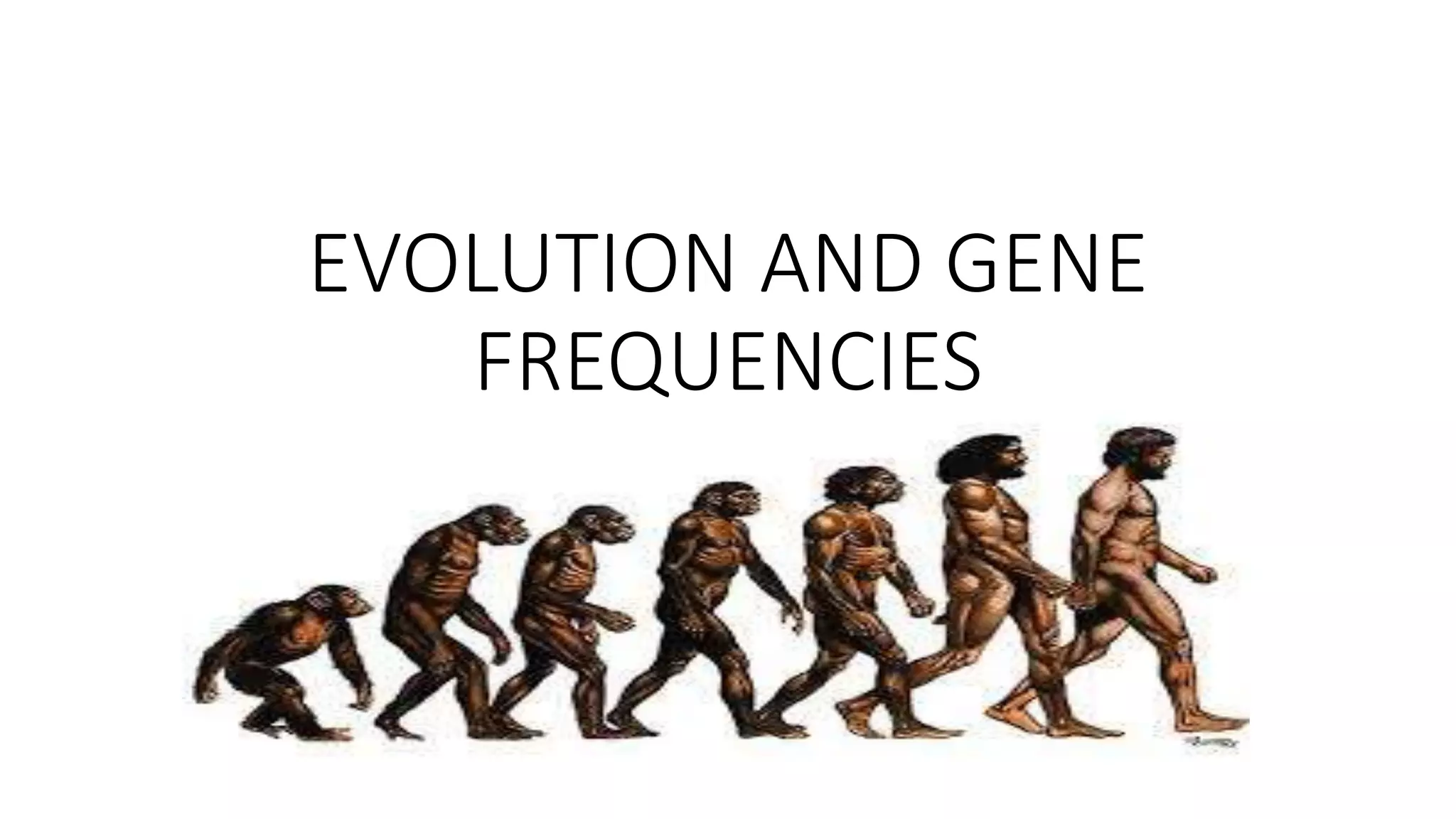
EVOLUTION AND GENE
FREQUENCIES
EVOLUTION
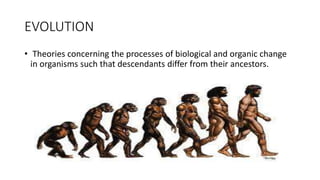
• Theories concerning the processes of biological and organic change
in organisms such that descendants differ from their ancestors.
POPULATION AND GENE FLOW
• Individuals do not evolve.
• Evolution requires that genetic changes are passed from one
generation to another within larger group called population.
Population
• are groups of individuals of the same species that occupy given area
at the same time and share a unique set of genes.
• Varying expression of genes at each locus are called alleles.
GENE POOL
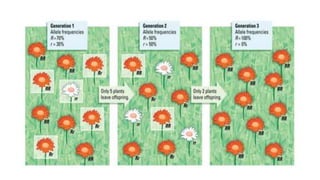
• The sum of all alleles for all traits in a sexually reproducing population
is a pool of hereditary resources for the entire population and is
called gene pool.
• When generation of a population undergo sexual reproduction, there
is a constant shuffling of alleles.
THE HARDY- WEINBERGE THEOREM
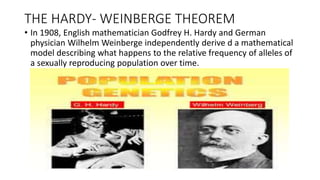
• In 1908, English mathematician Godfrey H. Hardy and German
physician Wilhelm Weinberge independently derive d a mathematical
model describing what happens to the relative frequency of alleles of
a sexually reproducing population over time.
Hardy-Weinberg theorem
• states that the mixing of alleles at meiosis and their subsequent
recombination do not alter the relative frequencies of the alleles in
the future generations, if certain assumptions are met. Stated
another way, if certain assumptions are met, evolution will not occur
because the relative allelic frequencies will not change from
generation to generation, even though the specific mixes of alleles in
individuals may vary.
The assumption of the Hardy-Weinberg
theorem are as follows:
• 1. The population size must be large.
• 2. Sexual reproduction within the population must be random.
• 3. Individuals cannot migrate into, or out of, the population.
• 4. Mutation must not occur.
• These assumptions must be met if allelic frequencies are not
changing---that is, if evolution is not occurring.
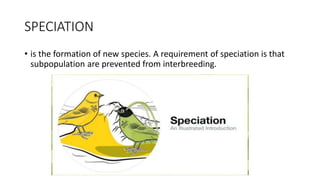
EVOLUTIONARY MECHANISMS
• Evolution is simply a result of some individuals in a population
surviving and being more effective at reproducing than others in the
population, leading to changes in a relative allelic frequencies.
POPULATION SIZE, GENETIC DRIFT, AND
NEUTRAL EVOLUTION
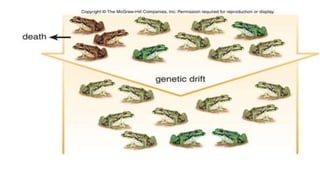
• Chance often plays an important role in the perpetuation of genes in
a population, and the smaller the population, the most significant
change may be.
• In small population, inbreeding is also common. Genetic drift and
inbreeding are likely to reduce genetic variation within a, population.
FOUNDER EFFECT
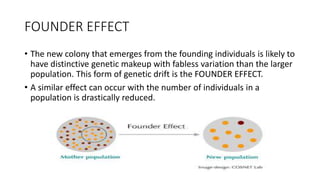
• The new colony that emerges from the founding individuals is likely to
have distinctive genetic makeup with fabless variation than the larger
population. This form of genetic drift is the FOUNDER EFFECT.
• A similar effect can occur with the number of individuals in a
population is drastically reduced.
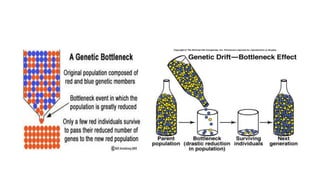
BOTTLENECK EFFECT
• Their depleted populations have reduced genetic diversity to the
point that even if population size is restored, they will have only a
remnant of the original gene pool. This form of genetic drift is called
the bottleneck population effect.
• The traditional interpretation is that decreases in genetic diversity
make populations less likely to withstand environmental stress and
more susceptible to extinction. That is, with a high genetic diversity is
more likely to have some individuals with a combination of genes that
allows them to withstand environmental changes.
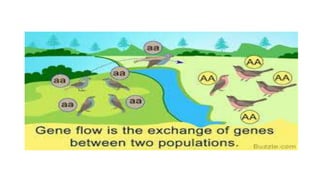
GENE FLOW
• The Hardy-Weinberg theorem assumes that no individuals enter a
population from the outside and that no individuals leave a
population.
• Immigration or emigration upsets the Hardy-Weinberg equilibrium,
resulting in changes in allelic frequency (evolution). Changes in
relative allelic frequency from the migration of individuals are gene
flow.
• The absence of gene flow can make change in the populations
population less likely.
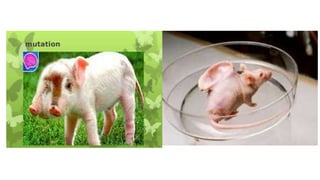
MUTATION
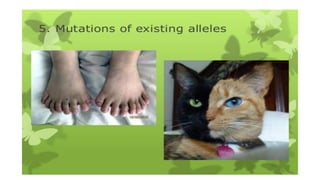
• Mutations are changes in the structure of genes and chromosomes.
• Mutations counters the loss of genetic materials from nature
selection to genetic drift, and it increases the likelihood that
variations will be present that allow some individuals to survive
future environmental shocks.
• Mutation pressure is the measure of the tendency for gene
frequencies to change through mutations.
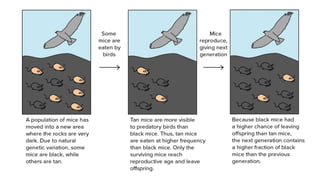
NATURAL SELECTION REEXAMINED
• natural selection occurs whenever some phenotypes are more
successful at leaving offspring than other phenotype.
• The tendency for natural selection to occur -and upset Hardy-
Weinberg equilibrium- is selection pressure. Although natural
selection is simple in principle, it is diverse in operation.
MODES OF SELECTION
• For certain traits, many populations have a range of phenotypes,
characterize by a bell-shape curve that shows that phenotypic
extremes are less common than the intermediate phenotypes.
• Natural selection may affect a range of phenotypes in 3 ways:
• Directional selection
• Disruption selection
- produces distinct subpopulation.
• Stabilizing selection
- When both phenotypic extremes are deleterious, a third form of
natural selection-stabilizing selection- narrows the phenotypic range.
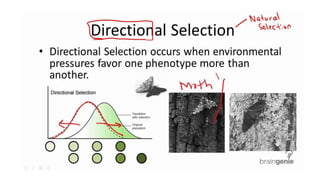
Directional selection
• occurs when one phenotypic extreme are at a disadvantage
compared to all other individuals in the population.
• In response to this selection, the deleterious gene(s) decreases in
frequency, and all other genes increase in frequency.
• Directional selection may occur when a mutation gives arise to a new
gene, or when the environment changes to select against an existing
phenotype.
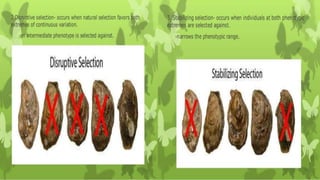
• Disruption selection
- produces distinct subpopulation.
• Stabilizing selection
- When both phenotypic extremes
are deleterious, a third form of
natural selection-stabilizing
selection- narrows the phenotypic
range.
NEUTRALIST/SELECTIONIST CONTROVERSY
• Both natural selection and neutral evolution occur, but they may not
be equally important in all circumstances.
BALANCE POLYMORPHISM AND
HETEROZYGOTE SUPERIORITY
• polymorphism occur in a population when two or more distinct form
exist without a range of phenotypes between them.
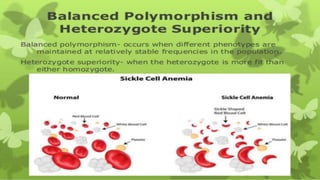
• Balance polymorphism Occurs when different phenotypes are
maintained at relatively stable frequencies in the population and may
resemble a popular in which disruptive selection operates.
• In the heterozygous state, the quantities normal and sickled-cells are
roughly equal. Sickle cell heterozygous occur in some African
populations with a frequency as high as 0.4.
• Sickle-cells heterozygotes are less susceptible to malarial infections of
infected, they experience less severe symptoms than do homozygotes
without sickle-cells.
• The homozygotes, who usually no symptoms of anemia, are more
likely to survive than either homozygotes.
• This system is also an example of heterozygote superiority--when the
heterozygotes is more fit than either homozygote.
• Heterozygote superiority can lead no balanced polymorphism
because perpetuation of the alleles in the heterozygous condition
maintains both alleles at a higher frequency that would be expected if
natural selection acted only on the homozygous phenotypes.
SPECIES AND SPECIATION
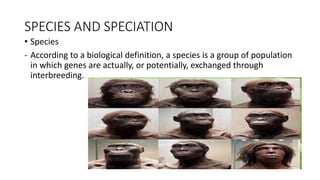
• Species
- According to a biological definition, a species is a group of population
in which genes are actually, or potentially, exchanged through
interbreeding.
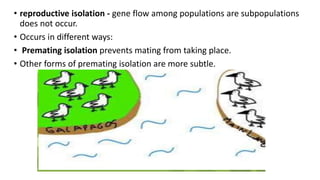
SPECIATION
• is the formation of new species. A requirement of speciation is that
subpopulation are prevented from interbreeding.
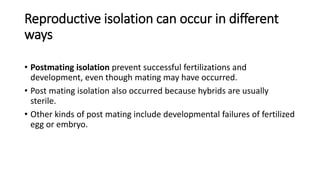
• reproductive isolation - gene flow among populations are subpopulations
does not occur.
• Occurs in different ways:
• Premating isolation prevents mating from taking place.
• Other forms of premating isolation are more subtle.
Reproductive isolation can occur in different
ways
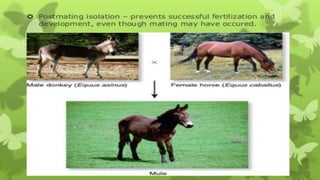
• Postmating isolation prevent successful fertilizations and
development, even though mating may have occurred.
• Post mating isolation also occurred because hybrids are usually
sterile.
• Other kinds of post mating include developmental failures of fertilized
egg or embryo.
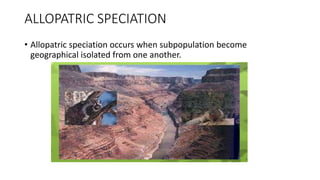
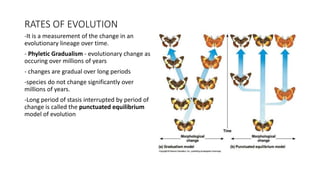
ALLOPATRIC SPECIATION
• Allopatric speciation occurs when subpopulation become
geographical isolated from one another.
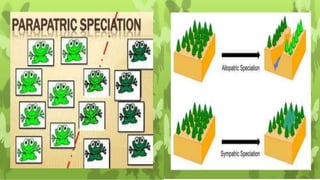
PARAPATRIC SPECIATION
• Another form of speciation, called parapatric speciation occurs in
small, local population, called demes.
• Parapatric speciation is therefore considered of less importance in the
evolution of animal groups than allopatric speciation.
SYMPATRIC SPECIATION
• Occurs within a single population.
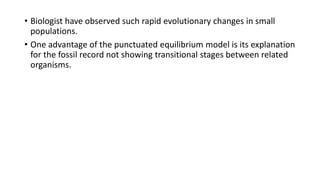
RATES OF EVOLUTION
-It is a measurement of the change in an
evolutionary lineage over time.
- Phyletic Gradualism - evolutionary change as
occuring over millions of years
- changes are gradual over long periods
-species do not change significantly over
millions of years.
-Long period of stasis interrupted by period of
change is called the punctuated equilibrium
model of evolution
• Biologist have observed such rapid evolutionary changes in small
populations.
• One advantage of the punctuated equilibrium model is its explanation
for the fossil record not showing transitional stages between related
organisms.
MOLECULAR EVOLUTION
• Molecular evolutionist investigates evolutionary relationships among
organisms by studying DNA and proteins.
GENE DUPLICATION
• Most mutation are selected against.
• Gene duplication, the accidental duplication of a gene on a
chromosome, is one way that extra genetic material can arise.
• Vertebrate hemoglobin and myoglobin are believed to have arisen
from a common ancestral molecule.
• Hemoglobin carries oxygen in red blood cells, and myoglobin is an
oxygen of storage molecule in muscle.
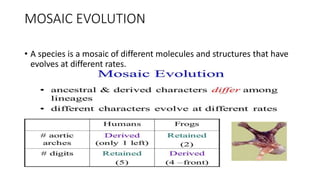
MOSAIC EVOLUTION
• A species is a mosaic of different molecules and structures that have
evolves at different rates.
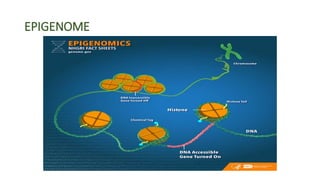
EPIGENOME
What is the epigenome?
• The epigenome is a multitude of chemical compounds that can tell
the genome what to do.
• The epigenome is made up of chemical compounds and proteins that
can attach to DNA and direct such actions as turning genes on or off,
controlling the production of proteins in particular cells.
What does the epigenome do?
• A human being has trillions of cells, specialized for different functions
in muscles, bones and the brain, and each of these cells carries
essentially the same genome in its nucleus.
• The epigenome controls many of these changes to the genome.
What makes up the epigenome?
• The epigenome is the set of chemical modifications to the DNA and
DNA-associated proteins in the cell, which alter gene expression, and
are heritable.
• The first type of mark, called DNA methylation, directly affects the
DNA in a genome.
• The second kind of mark, called histone modification, affects DNA
indirectly.
Is the epigenome inherited?
• The genome is passed from parents to their offspring and from cells,
when they divide, to their next generation.
• When cells divide, often much of the epigenome is passed on to the
next generation of cells, helping the cells remain specialized.
What is imprinting?
• The human genome contains two copies of every gene-one copy
inherited from the mother and one from the father. . For a small
number of genes, only the copy from the mother gets switched on;
for others, only the copy from the father is turned on.
• Some diseases are caused by abnormal imprinting.
Include:
- Beckwith-Wiedemann syndrome
- increased risk of cancer
- Prader-Willi syndrome
- Angelman syndrome
Evolution and gene frequencies my report

Evolution and gene frequencies my report

  • 1.
  • 2.
    EVOLUTION • Theories concerningthe processes of biological and organic change in organisms such that descendants differ from their ancestors.
  • 3.
    POPULATION AND GENEFLOW • Individuals do not evolve. • Evolution requires that genetic changes are passed from one generation to another within larger group called population.
  • 4.
    Population • are groupsof individuals of the same species that occupy given area at the same time and share a unique set of genes. • Varying expression of genes at each locus are called alleles.
  • 5.
    GENE POOL • Thesum of all alleles for all traits in a sexually reproducing population is a pool of hereditary resources for the entire population and is called gene pool. • When generation of a population undergo sexual reproduction, there is a constant shuffling of alleles.
  • 12.
    THE HARDY- WEINBERGETHEOREM • In 1908, English mathematician Godfrey H. Hardy and German physician Wilhelm Weinberge independently derive d a mathematical model describing what happens to the relative frequency of alleles of a sexually reproducing population over time.
  • 13.
    Hardy-Weinberg theorem • statesthat the mixing of alleles at meiosis and their subsequent recombination do not alter the relative frequencies of the alleles in the future generations, if certain assumptions are met. Stated another way, if certain assumptions are met, evolution will not occur because the relative allelic frequencies will not change from generation to generation, even though the specific mixes of alleles in individuals may vary.
  • 14.
    The assumption ofthe Hardy-Weinberg theorem are as follows: • 1. The population size must be large. • 2. Sexual reproduction within the population must be random. • 3. Individuals cannot migrate into, or out of, the population. • 4. Mutation must not occur. • These assumptions must be met if allelic frequencies are not changing---that is, if evolution is not occurring.
  • 15.
    EVOLUTIONARY MECHANISMS • Evolutionis simply a result of some individuals in a population surviving and being more effective at reproducing than others in the population, leading to changes in a relative allelic frequencies.
  • 16.
    POPULATION SIZE, GENETICDRIFT, AND NEUTRAL EVOLUTION • Chance often plays an important role in the perpetuation of genes in a population, and the smaller the population, the most significant change may be. • In small population, inbreeding is also common. Genetic drift and inbreeding are likely to reduce genetic variation within a, population.
  • 18.
    FOUNDER EFFECT • Thenew colony that emerges from the founding individuals is likely to have distinctive genetic makeup with fabless variation than the larger population. This form of genetic drift is the FOUNDER EFFECT. • A similar effect can occur with the number of individuals in a population is drastically reduced.
  • 19.
    BOTTLENECK EFFECT • Theirdepleted populations have reduced genetic diversity to the point that even if population size is restored, they will have only a remnant of the original gene pool. This form of genetic drift is called the bottleneck population effect. • The traditional interpretation is that decreases in genetic diversity make populations less likely to withstand environmental stress and more susceptible to extinction. That is, with a high genetic diversity is more likely to have some individuals with a combination of genes that allows them to withstand environmental changes.
  • 21.
    GENE FLOW • TheHardy-Weinberg theorem assumes that no individuals enter a population from the outside and that no individuals leave a population. • Immigration or emigration upsets the Hardy-Weinberg equilibrium, resulting in changes in allelic frequency (evolution). Changes in relative allelic frequency from the migration of individuals are gene flow. • The absence of gene flow can make change in the populations population less likely.
  • 23.
    MUTATION • Mutations arechanges in the structure of genes and chromosomes. • Mutations counters the loss of genetic materials from nature selection to genetic drift, and it increases the likelihood that variations will be present that allow some individuals to survive future environmental shocks. • Mutation pressure is the measure of the tendency for gene frequencies to change through mutations.
  • 25.
    NATURAL SELECTION REEXAMINED •natural selection occurs whenever some phenotypes are more successful at leaving offspring than other phenotype. • The tendency for natural selection to occur -and upset Hardy- Weinberg equilibrium- is selection pressure. Although natural selection is simple in principle, it is diverse in operation.
  • 27.
    MODES OF SELECTION •For certain traits, many populations have a range of phenotypes, characterize by a bell-shape curve that shows that phenotypic extremes are less common than the intermediate phenotypes. • Natural selection may affect a range of phenotypes in 3 ways: • Directional selection • Disruption selection - produces distinct subpopulation. • Stabilizing selection - When both phenotypic extremes are deleterious, a third form of natural selection-stabilizing selection- narrows the phenotypic range.
  • 28.
    Directional selection • occurswhen one phenotypic extreme are at a disadvantage compared to all other individuals in the population. • In response to this selection, the deleterious gene(s) decreases in frequency, and all other genes increase in frequency. • Directional selection may occur when a mutation gives arise to a new gene, or when the environment changes to select against an existing phenotype.
  • 30.
    • Disruption selection -produces distinct subpopulation. • Stabilizing selection - When both phenotypic extremes are deleterious, a third form of natural selection-stabilizing selection- narrows the phenotypic range.
  • 31.
    NEUTRALIST/SELECTIONIST CONTROVERSY • Bothnatural selection and neutral evolution occur, but they may not be equally important in all circumstances.
  • 32.
    BALANCE POLYMORPHISM AND HETEROZYGOTESUPERIORITY • polymorphism occur in a population when two or more distinct form exist without a range of phenotypes between them. • Balance polymorphism Occurs when different phenotypes are maintained at relatively stable frequencies in the population and may resemble a popular in which disruptive selection operates. • In the heterozygous state, the quantities normal and sickled-cells are roughly equal. Sickle cell heterozygous occur in some African populations with a frequency as high as 0.4.
  • 33.
    • Sickle-cells heterozygotesare less susceptible to malarial infections of infected, they experience less severe symptoms than do homozygotes without sickle-cells. • The homozygotes, who usually no symptoms of anemia, are more likely to survive than either homozygotes. • This system is also an example of heterozygote superiority--when the heterozygotes is more fit than either homozygote. • Heterozygote superiority can lead no balanced polymorphism because perpetuation of the alleles in the heterozygous condition maintains both alleles at a higher frequency that would be expected if natural selection acted only on the homozygous phenotypes.
  • 34.
    SPECIES AND SPECIATION •Species - According to a biological definition, a species is a group of population in which genes are actually, or potentially, exchanged through interbreeding.
  • 35.
    SPECIATION • is theformation of new species. A requirement of speciation is that subpopulation are prevented from interbreeding.
  • 36.
    • reproductive isolation- gene flow among populations are subpopulations does not occur. • Occurs in different ways: • Premating isolation prevents mating from taking place. • Other forms of premating isolation are more subtle.
  • 37.
    Reproductive isolation canoccur in different ways • Postmating isolation prevent successful fertilizations and development, even though mating may have occurred. • Post mating isolation also occurred because hybrids are usually sterile. • Other kinds of post mating include developmental failures of fertilized egg or embryo.
  • 39.
    ALLOPATRIC SPECIATION • Allopatricspeciation occurs when subpopulation become geographical isolated from one another.
  • 40.
    PARAPATRIC SPECIATION • Anotherform of speciation, called parapatric speciation occurs in small, local population, called demes. • Parapatric speciation is therefore considered of less importance in the evolution of animal groups than allopatric speciation. SYMPATRIC SPECIATION • Occurs within a single population.
  • 42.
    RATES OF EVOLUTION -Itis a measurement of the change in an evolutionary lineage over time. - Phyletic Gradualism - evolutionary change as occuring over millions of years - changes are gradual over long periods -species do not change significantly over millions of years. -Long period of stasis interrupted by period of change is called the punctuated equilibrium model of evolution
  • 43.
    • Biologist haveobserved such rapid evolutionary changes in small populations. • One advantage of the punctuated equilibrium model is its explanation for the fossil record not showing transitional stages between related organisms.
  • 44.
    MOLECULAR EVOLUTION • Molecularevolutionist investigates evolutionary relationships among organisms by studying DNA and proteins.
  • 45.
    GENE DUPLICATION • Mostmutation are selected against. • Gene duplication, the accidental duplication of a gene on a chromosome, is one way that extra genetic material can arise. • Vertebrate hemoglobin and myoglobin are believed to have arisen from a common ancestral molecule. • Hemoglobin carries oxygen in red blood cells, and myoglobin is an oxygen of storage molecule in muscle.
  • 46.
    MOSAIC EVOLUTION • Aspecies is a mosaic of different molecules and structures that have evolves at different rates.
  • 47.
  • 48.
    What is theepigenome? • The epigenome is a multitude of chemical compounds that can tell the genome what to do. • The epigenome is made up of chemical compounds and proteins that can attach to DNA and direct such actions as turning genes on or off, controlling the production of proteins in particular cells.
  • 49.
    What does theepigenome do? • A human being has trillions of cells, specialized for different functions in muscles, bones and the brain, and each of these cells carries essentially the same genome in its nucleus. • The epigenome controls many of these changes to the genome.
  • 50.
    What makes upthe epigenome? • The epigenome is the set of chemical modifications to the DNA and DNA-associated proteins in the cell, which alter gene expression, and are heritable. • The first type of mark, called DNA methylation, directly affects the DNA in a genome. • The second kind of mark, called histone modification, affects DNA indirectly.
  • 51.
    Is the epigenomeinherited? • The genome is passed from parents to their offspring and from cells, when they divide, to their next generation. • When cells divide, often much of the epigenome is passed on to the next generation of cells, helping the cells remain specialized.
  • 52.
    What is imprinting? •The human genome contains two copies of every gene-one copy inherited from the mother and one from the father. . For a small number of genes, only the copy from the mother gets switched on; for others, only the copy from the father is turned on. • Some diseases are caused by abnormal imprinting. Include: - Beckwith-Wiedemann syndrome - increased risk of cancer - Prader-Willi syndrome - Angelman syndrome