Nucleic Acids
RNA and Transcription
  The Genetic Code
  Protein Synthesis
      Mutations


                        1
Types of RNA
• Messenger RNA (mRNA)
 Carries genetic information for protein
 synthesis from DNA in nucleus to the
 ribosomes
• Transfer RNA (tRNA)
 Small molecules of 20 types that recognize
 and transfer amino acids for protein synthesis
• Ribosomal RNA (rRNA)
 Makes up 2/3 of ribosomes (1/3 protein) where
 protein synthesis takes place
                                            2
Transcription
• Genetic information contained
  in nucleus
• One strand of DNA is copied
• Complementary bases build mRNA
      DNA(1 strand)          mRNA
• In mRNA uracil (U) complements A (DNA)
• New mRNA moves out of nucleus to
  ribosomes in cytoplasm
                                           3
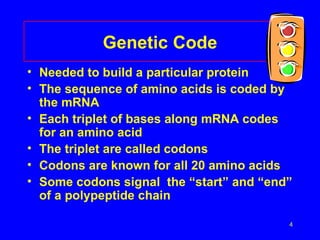
Genetic Code
• Needed to build a particular protein
• The sequence of amino acids is coded by
  the mRNA
• Each triplet of bases along mRNA codes
  for an amino acid
• The triplet are called codons
• Codons are known for all 20 amino acids
• Some codons signal the “start” and “end”
  of a polypeptide chain

                                         4
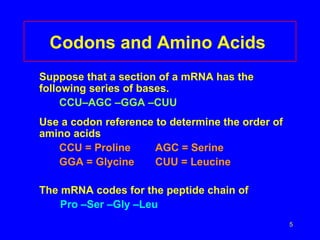
Codons and Amino Acids
Suppose that a section of a mRNA has the
following series of bases.
     CCU–AGC –GGA –CUU
Use a codon reference to determine the order of
amino acids
   CCU = Proline      AGC = Serine
   GGA = Glycine      CUU = Leucine

The mRNA codes for the peptide chain of
    Pro –Ser –Gly –Leu
                                                  5
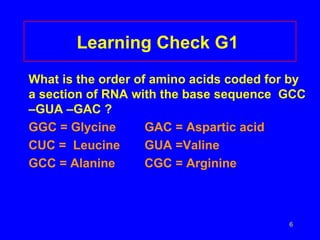
Learning Check G1
What is the order of amino acids coded for by
a section of RNA with the base sequence GCC
–GUA –GAC ?
GGC = Glycine       GAC = Aspartic acid
CUC = Leucine       GUA =Valine
GCC = Alanine       CGC = Arginine


                                          6
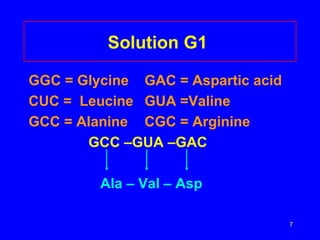
Solution G1

GGC = Glycine GAC = Aspartic acid
CUC = Leucine GUA =Valine
GCC = Alanine CGC = Arginine
       GCC –GUA –GAC

         Ala – Val – Asp

                                    7
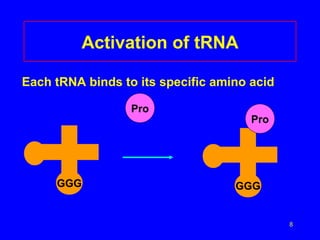
Activation of tRNA

Each tRNA binds to its specific amino acid

                  Pro
                                      Pro


     GGG                           GGG


                                             8
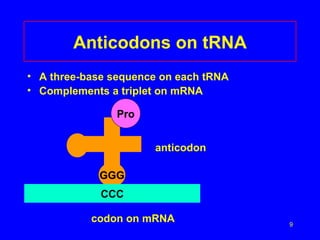
Anticodons on tRNA
• A three-base sequence on each tRNA
• Complements a triplet on mRNA

                Pro


                      anticodon

            GGG
             CCC

           codon on mRNA               9
Initiation and Elongation
• mRNA attaches to a ribosome
• tRNA with anticodon UAC binds to first codon
  (AUG) to initiate synthesis
• The second codon picks up a tRNA with the
  proper anticodon.
• A peptide bond forms between the amino
  acids at the first and second codons.
• The first tRNA detaches and the ribosome
  shifts to the next codon on the mRNA
                                            10
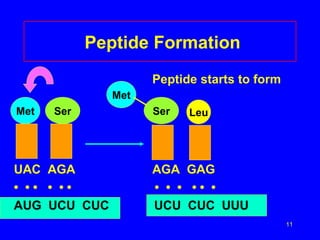
Peptide Formation
                     Peptide starts to form
               Met
Met   Ser            Ser   Leu


UAC AGA              AGA GAG
• •• • ••            • • • •• •
AUG UCU CUC          UCU CUC UUU
                                              11
Termination
• Protein grows as tRNAs bring amino acids to
  the codons on the mRNA
• When all amino acids for a protein are linked
  the next codon is “stop”
• There is no tRNA for the “stop” codon
• Protein synthesis ends
• Protein released from ribosome


                                             12
Learning Check G2
     Match the following processes in protein
     synthesis with the statements:
     (1) Activation     (2) Initiation
     (3) Elongation     (4) Termination
A.   Ribosome moves along mRNA to add new amino
     acids to a growing peptide chain
B.   Completed peptide chain released
C.   A tRNA attaches to its specific amino acid
D.   tRNA binds to the AUG codon of the mRNA on
     the ribosome                               13
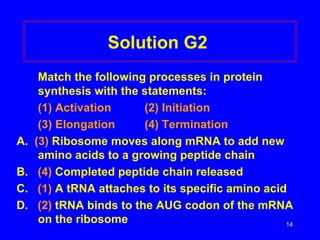
Solution G2
      Match the following processes in protein
      synthesis with the statements:
      (1) Activation      (2) Initiation
      (3) Elongation      (4) Termination
A.   (3) Ribosome moves along mRNA to add new
      amino acids to a growing peptide chain
B.    (4) Completed peptide chain released
C.    (1) A tRNA attaches to its specific amino acid
D.    (2) tRNA binds to the AUG codon of the mRNA
      on the ribosome                               14
Learning Check G3
The following section of DNA is used to build
a mRNA for a protein.
   GAA-CCC-TTT
A. What is the corresponding base sequence
   on mRNA?
B. What are the anticodons for the tRNAs?
C. What is the amino acid order in the
   peptide?
                                           15
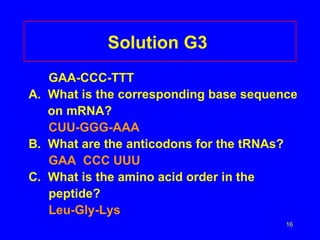
Solution G3
   GAA-CCC-TTT
A. What is the corresponding base sequence
   on mRNA?
   CUU-GGG-AAA
B. What are the anticodons for the tRNAs?
   GAA CCC UUU
C. What is the amino acid order in the
   peptide?
   Leu-Gly-Lys
                                        16
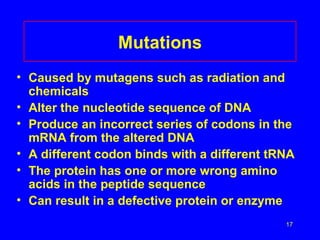
Mutations
• Caused by mutagens such as radiation and
  chemicals
• Alter the nucleotide sequence of DNA
• Produce an incorrect series of codons in the
  mRNA from the altered DNA
• A different codon binds with a different tRNA
• The protein has one or more wrong amino
  acids in the peptide sequence
• Can result in a defective protein or enzyme
                                             17
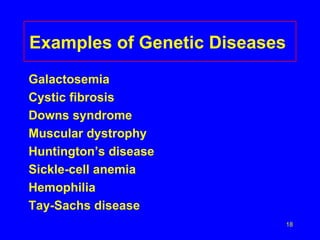
Examples of Genetic Diseases
Galactosemia
Cystic fibrosis
Downs syndrome
Muscular dystrophy
Huntington’s disease
Sickle-cell anemia
Hemophilia
Tay-Sachs disease
                               18

Genetic code

  • 1.
    Nucleic Acids RNA andTranscription The Genetic Code Protein Synthesis Mutations 1
  • 2.
    Types of RNA •Messenger RNA (mRNA) Carries genetic information for protein synthesis from DNA in nucleus to the ribosomes • Transfer RNA (tRNA) Small molecules of 20 types that recognize and transfer amino acids for protein synthesis • Ribosomal RNA (rRNA) Makes up 2/3 of ribosomes (1/3 protein) where protein synthesis takes place 2
  • 3.
    Transcription • Genetic informationcontained in nucleus • One strand of DNA is copied • Complementary bases build mRNA DNA(1 strand) mRNA • In mRNA uracil (U) complements A (DNA) • New mRNA moves out of nucleus to ribosomes in cytoplasm 3
  • 4.
    Genetic Code • Neededto build a particular protein • The sequence of amino acids is coded by the mRNA • Each triplet of bases along mRNA codes for an amino acid • The triplet are called codons • Codons are known for all 20 amino acids • Some codons signal the “start” and “end” of a polypeptide chain 4
  • 5.
    Codons and AminoAcids Suppose that a section of a mRNA has the following series of bases. CCU–AGC –GGA –CUU Use a codon reference to determine the order of amino acids CCU = Proline AGC = Serine GGA = Glycine CUU = Leucine The mRNA codes for the peptide chain of Pro –Ser –Gly –Leu 5
  • 6.
    Learning Check G1 Whatis the order of amino acids coded for by a section of RNA with the base sequence GCC –GUA –GAC ? GGC = Glycine GAC = Aspartic acid CUC = Leucine GUA =Valine GCC = Alanine CGC = Arginine 6
  • 7.
    Solution G1 GGC =Glycine GAC = Aspartic acid CUC = Leucine GUA =Valine GCC = Alanine CGC = Arginine GCC –GUA –GAC Ala – Val – Asp 7
  • 8.
    Activation of tRNA EachtRNA binds to its specific amino acid Pro Pro GGG GGG 8
  • 9.
    Anticodons on tRNA •A three-base sequence on each tRNA • Complements a triplet on mRNA Pro anticodon GGG CCC codon on mRNA 9
  • 10.
    Initiation and Elongation •mRNA attaches to a ribosome • tRNA with anticodon UAC binds to first codon (AUG) to initiate synthesis • The second codon picks up a tRNA with the proper anticodon. • A peptide bond forms between the amino acids at the first and second codons. • The first tRNA detaches and the ribosome shifts to the next codon on the mRNA 10
  • 11.
    Peptide Formation Peptide starts to form Met Met Ser Ser Leu UAC AGA AGA GAG • •• • •• • • • •• • AUG UCU CUC UCU CUC UUU 11
  • 12.
    Termination • Protein growsas tRNAs bring amino acids to the codons on the mRNA • When all amino acids for a protein are linked the next codon is “stop” • There is no tRNA for the “stop” codon • Protein synthesis ends • Protein released from ribosome 12
  • 13.
    Learning Check G2 Match the following processes in protein synthesis with the statements: (1) Activation (2) Initiation (3) Elongation (4) Termination A. Ribosome moves along mRNA to add new amino acids to a growing peptide chain B. Completed peptide chain released C. A tRNA attaches to its specific amino acid D. tRNA binds to the AUG codon of the mRNA on the ribosome 13
  • 14.
    Solution G2 Match the following processes in protein synthesis with the statements: (1) Activation (2) Initiation (3) Elongation (4) Termination A. (3) Ribosome moves along mRNA to add new amino acids to a growing peptide chain B. (4) Completed peptide chain released C. (1) A tRNA attaches to its specific amino acid D. (2) tRNA binds to the AUG codon of the mRNA on the ribosome 14
  • 15.
    Learning Check G3 Thefollowing section of DNA is used to build a mRNA for a protein. GAA-CCC-TTT A. What is the corresponding base sequence on mRNA? B. What are the anticodons for the tRNAs? C. What is the amino acid order in the peptide? 15
  • 16.
    Solution G3 GAA-CCC-TTT A. What is the corresponding base sequence on mRNA? CUU-GGG-AAA B. What are the anticodons for the tRNAs? GAA CCC UUU C. What is the amino acid order in the peptide? Leu-Gly-Lys 16
  • 17.
    Mutations • Caused bymutagens such as radiation and chemicals • Alter the nucleotide sequence of DNA • Produce an incorrect series of codons in the mRNA from the altered DNA • A different codon binds with a different tRNA • The protein has one or more wrong amino acids in the peptide sequence • Can result in a defective protein or enzyme 17
  • 18.
    Examples of GeneticDiseases Galactosemia Cystic fibrosis Downs syndrome Muscular dystrophy Huntington’s disease Sickle-cell anemia Hemophilia Tay-Sachs disease 18