THE TRIGEMINAL NERVE
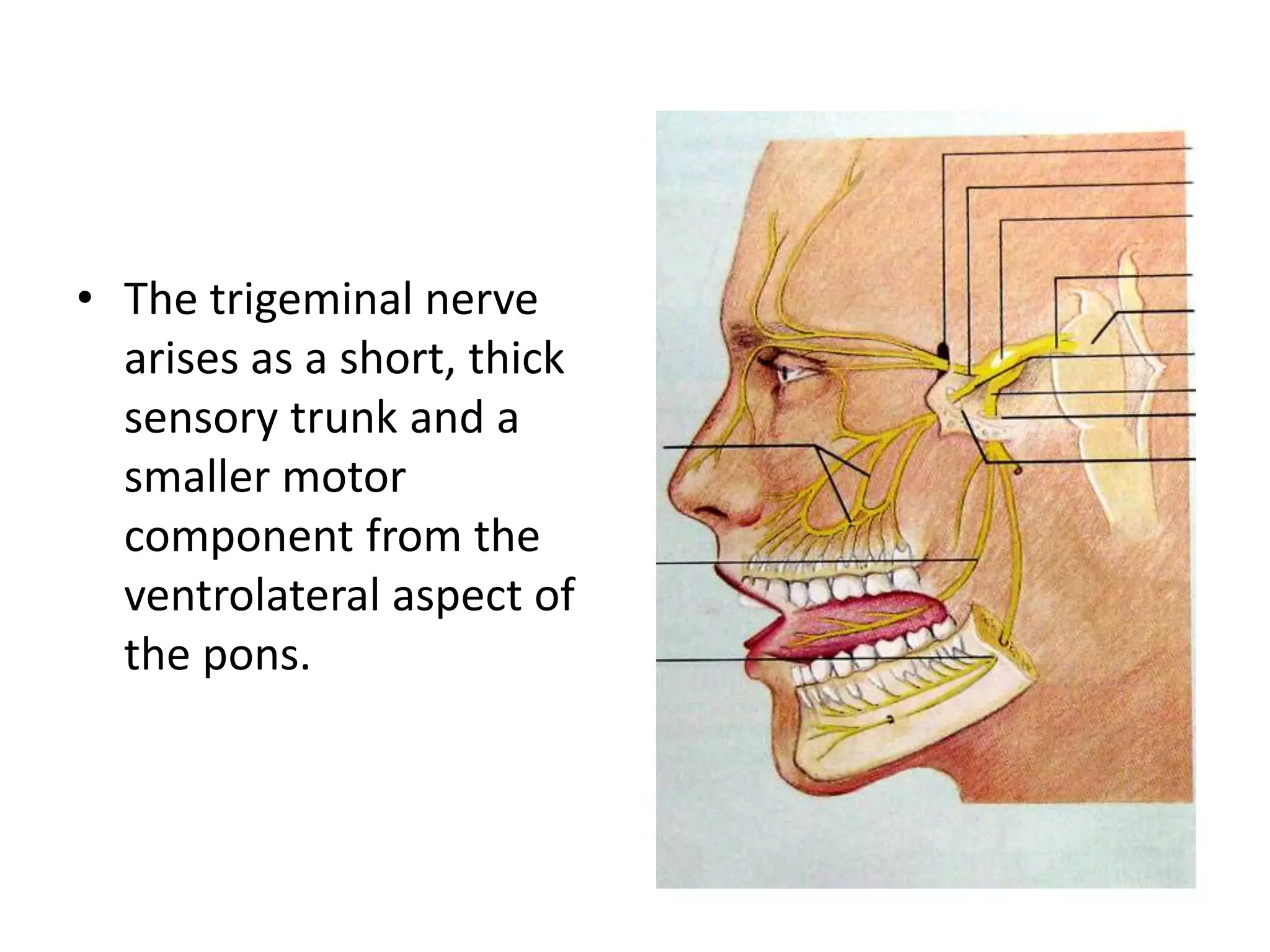
• The trigeminal nerve
arises as a short, thick
sensory trunk and a
smaller motor
component from the
ventrolateral aspect of
the pons.
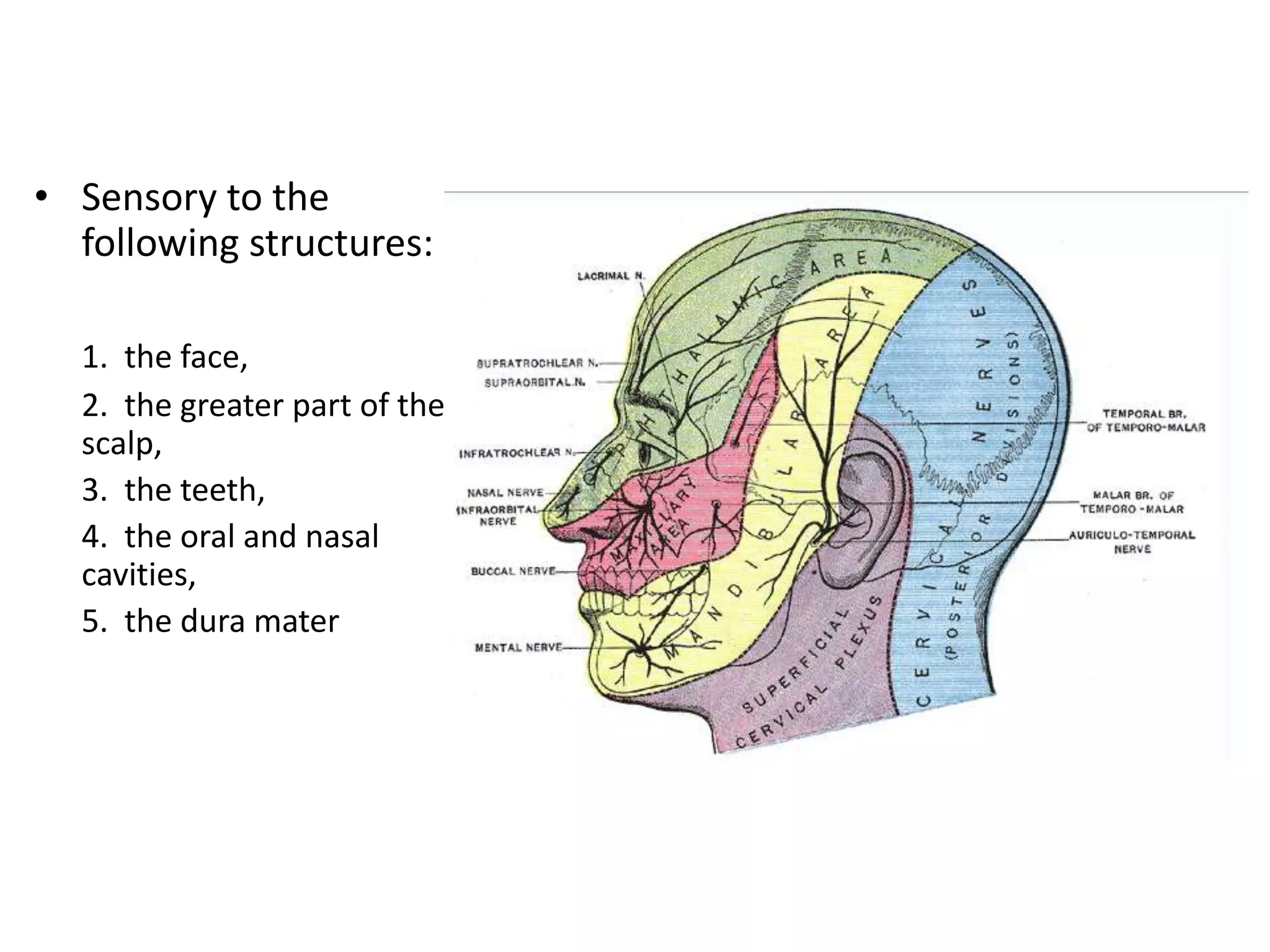
• Sensory to the
following structures:
1. the face,
2. the greater part of the
scalp,
3. the teeth,
4. the oral and nasal
cavities,
5. the dura mater
Motor to the following
structures:
1. the masticatory
muscles,
2. the anterior belly of
the digastric,
3. tensor tympani,
4. tensor veli palatini,
5. and the mylohyoid.
ROUTE OF THE TRIGEMINAL NERVE
• The nerve passes anteriorly
over the petrous temporal
ridge into a tunnel of dura
mater (trigeminal or
Meckel’s cave) within the
middle cranial fossa. Within
the cave, the nerve flattens
out as the large trigeminal
(semilunar) ganglion
• And this, in turn, gives rise
to three divisions:
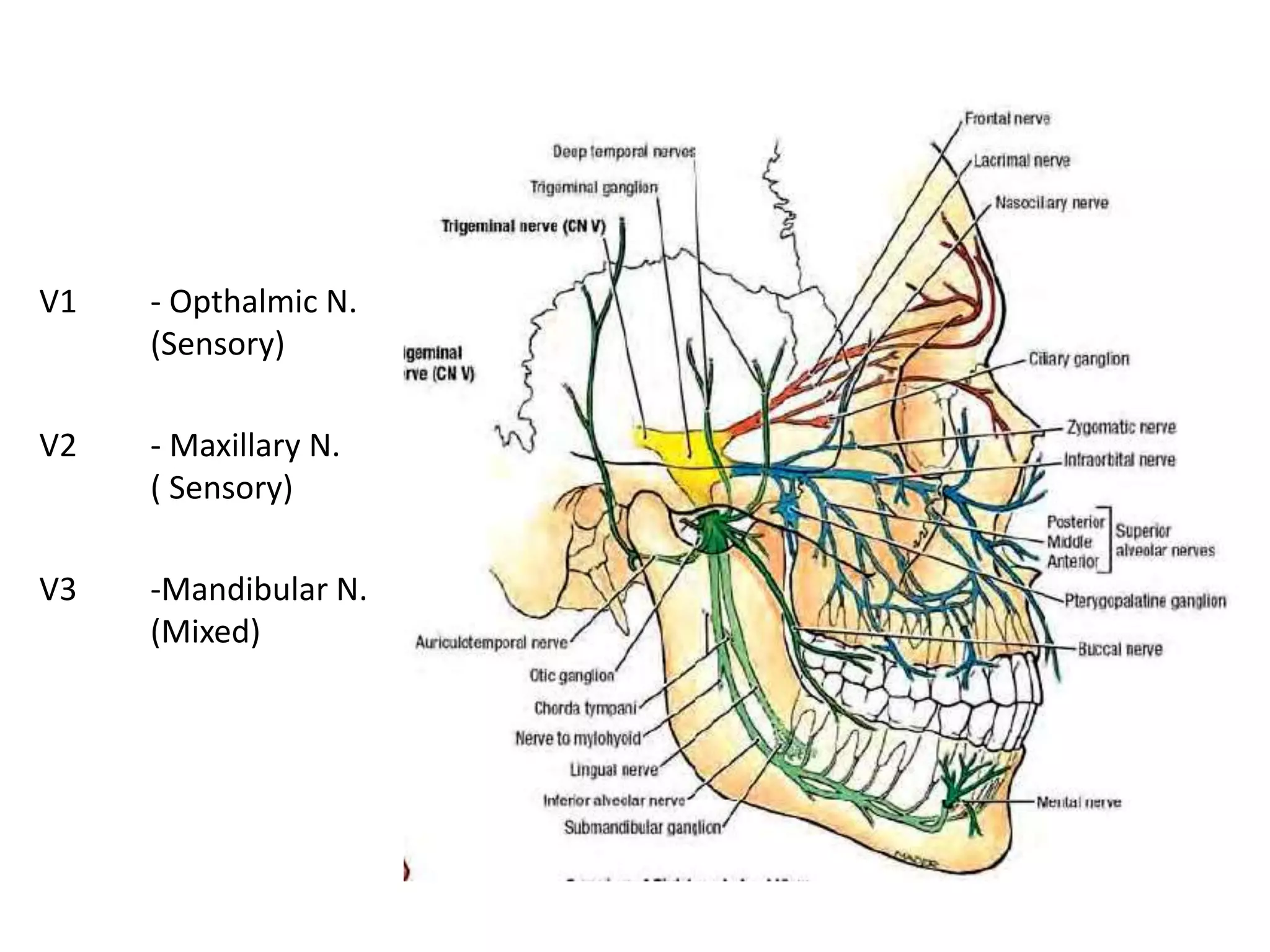
V1 - Opthalmic N.
(Sensory)
V2 - Maxillary N.
( Sensory)
V3 -Mandibular N.
(Mixed)
THE OPHTHALMIC NERVE
• The superior and the smallest of the trigeminal
division, and is wholly sensory. It supplies the
following:
1. the eyeball,
2. the lacrimal gland and
conjunctiva,
3. part of the nasal mucosa,
4. the skin of the nose,
eyelids, forehead and
part of the scalp.
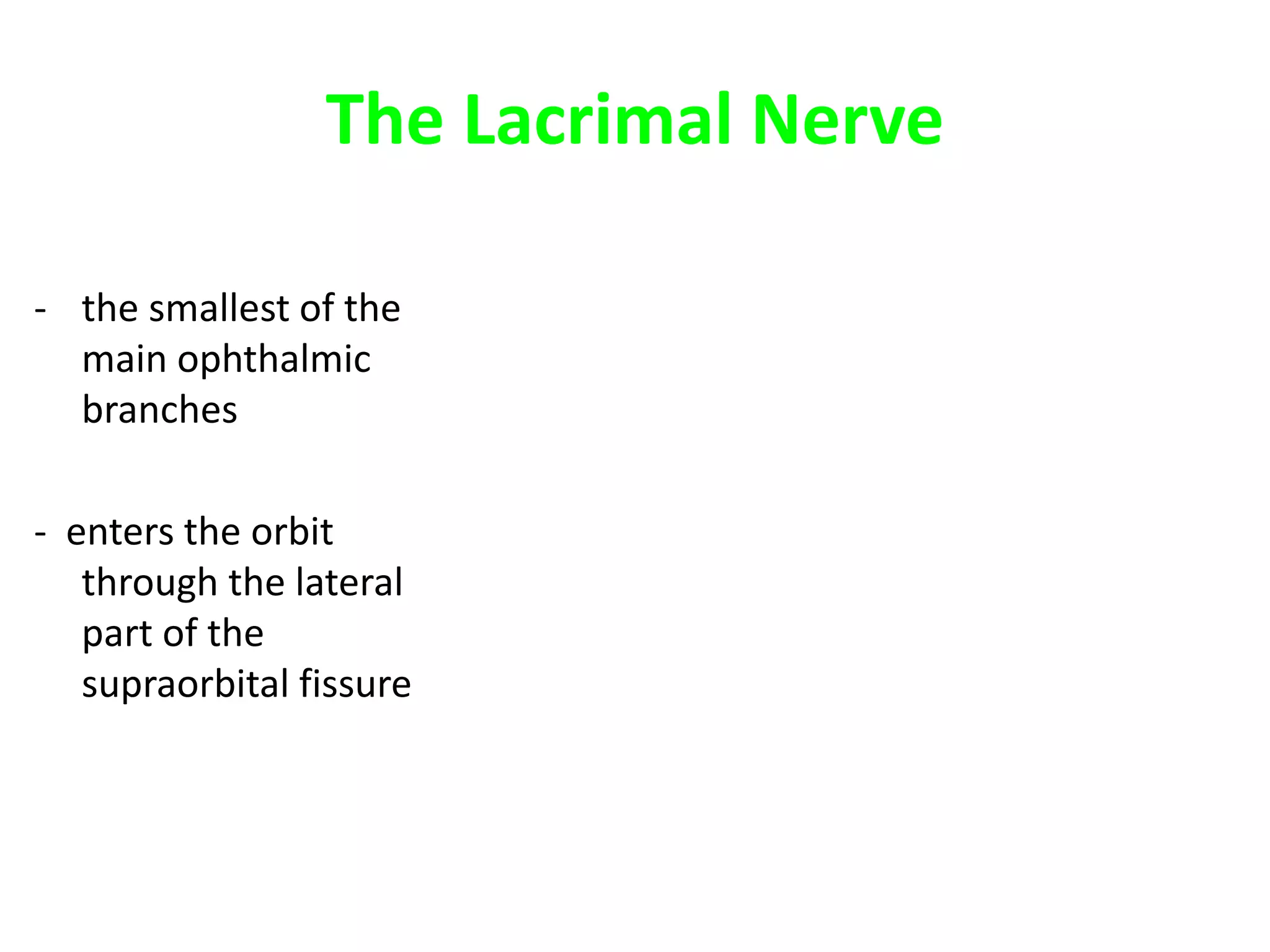
Passes thru the supraorbital fissure and divides
into three branches:
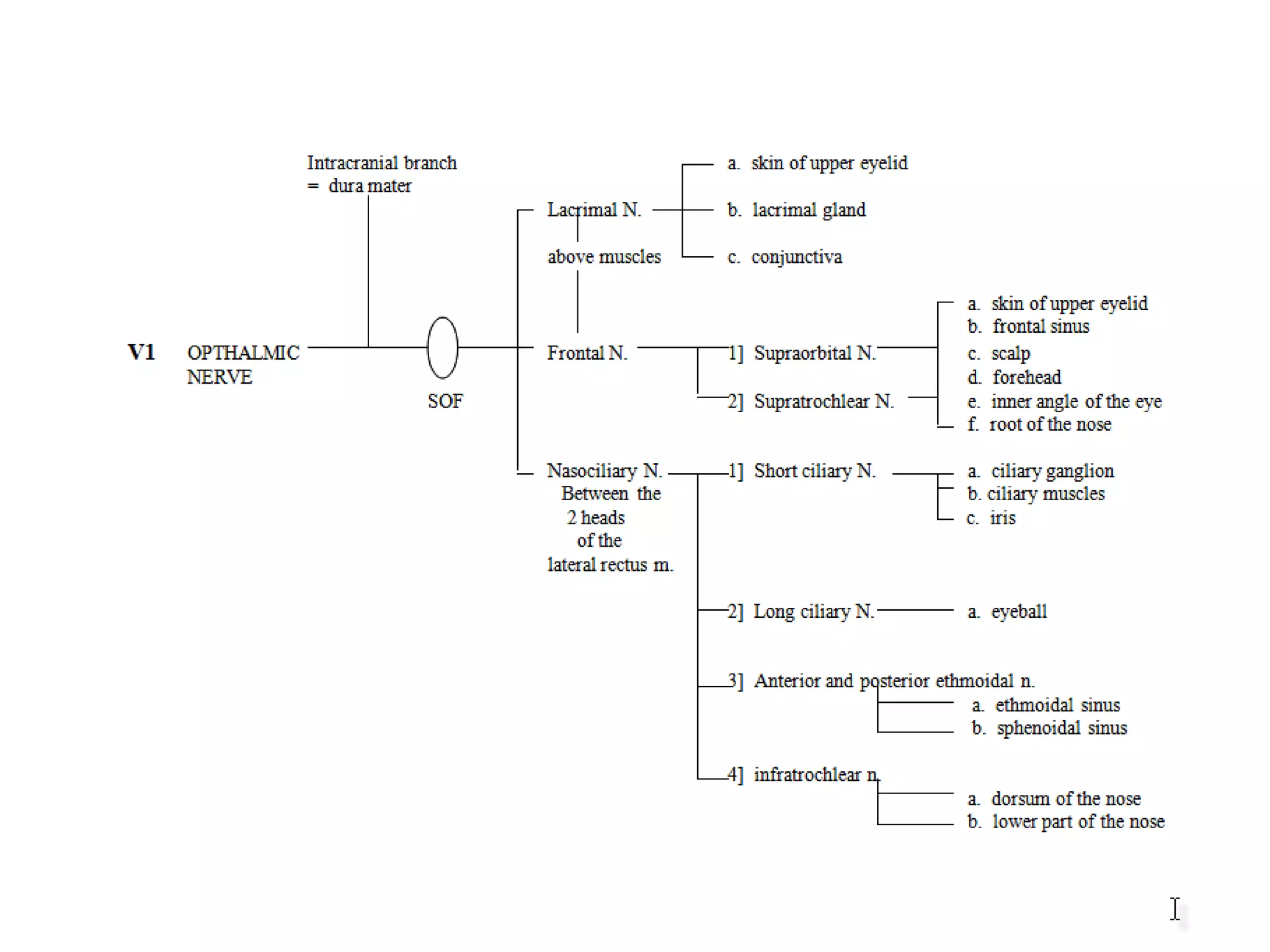
1. Lacrimal n.
2. Frontal n.
3. Nasociliary n.
The Lacrimal Nerve
- the smallest of the
main ophthalmic
branches
- enters the orbit
through the lateral
part of the
supraorbital fissure
The Frontal Nerve
- the largest of the
ophthalmic division
- enters the orbit by the
supraorbital fissure
- has 2 branches:
a. Supraorbital N.
b. Supratrochlear N.
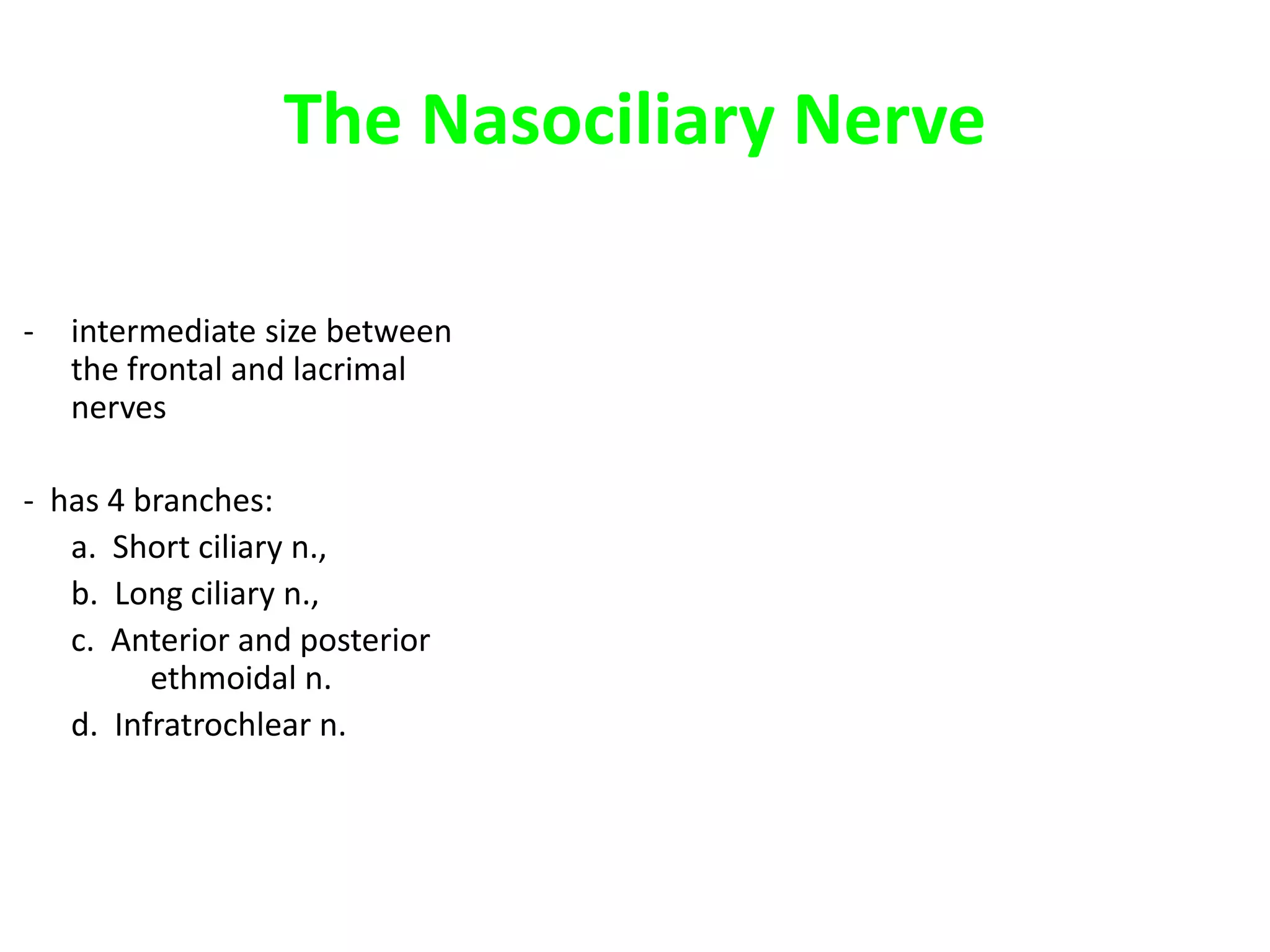
The Nasociliary Nerve
- intermediate size between
the frontal and lacrimal
nerves
- has 4 branches:
a. Short ciliary n.,
b. Long ciliary n.,
c. Anterior and posterior
ethmoidal n.
d. Infratrochlear n.
THE MAXILLARY NERVE
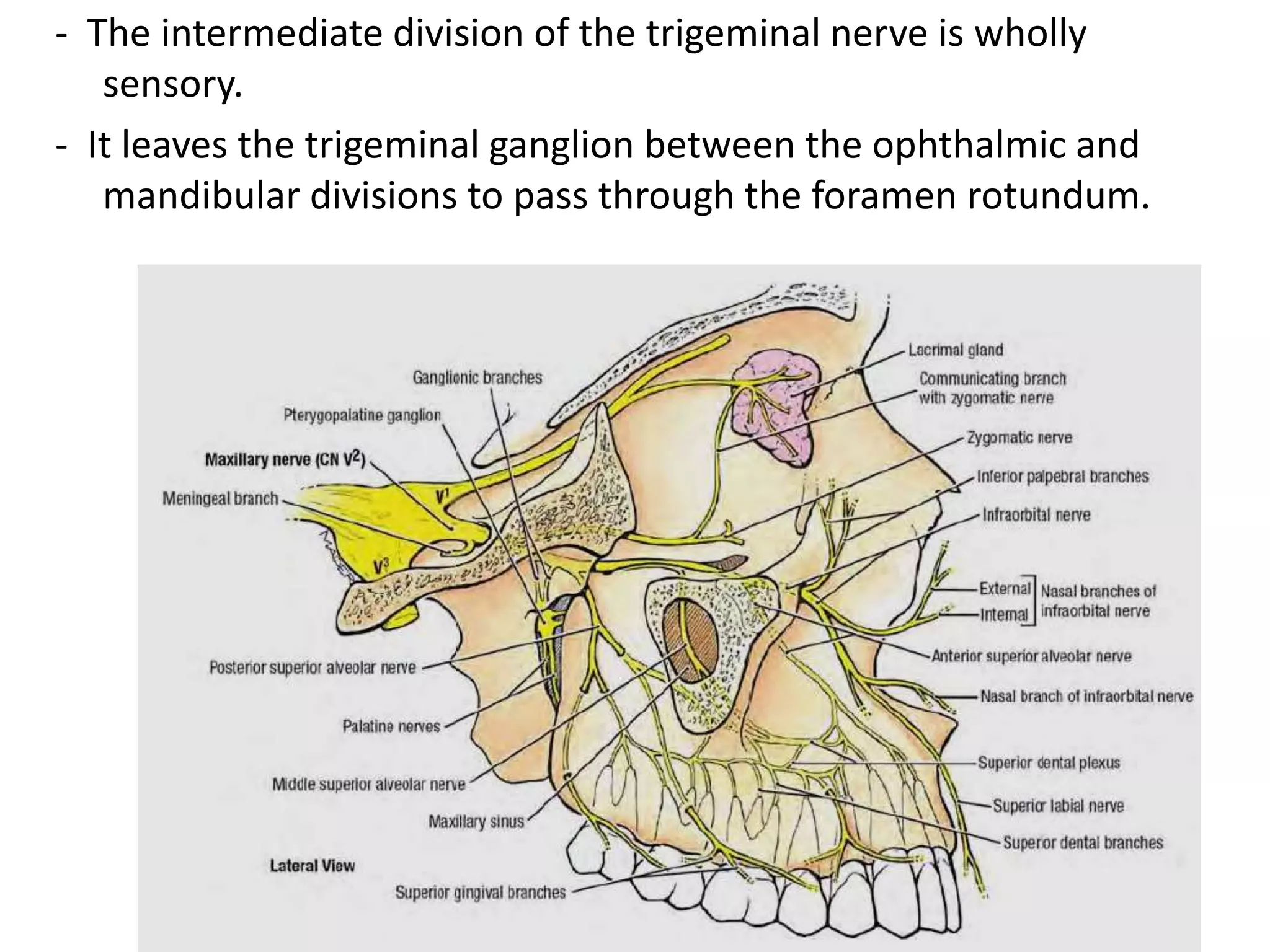
- The intermediate division of the trigeminal nerve is wholly
sensory.
- It leaves the trigeminal ganglion between the ophthalmic and
mandibular divisions to pass through the foramen rotundum.
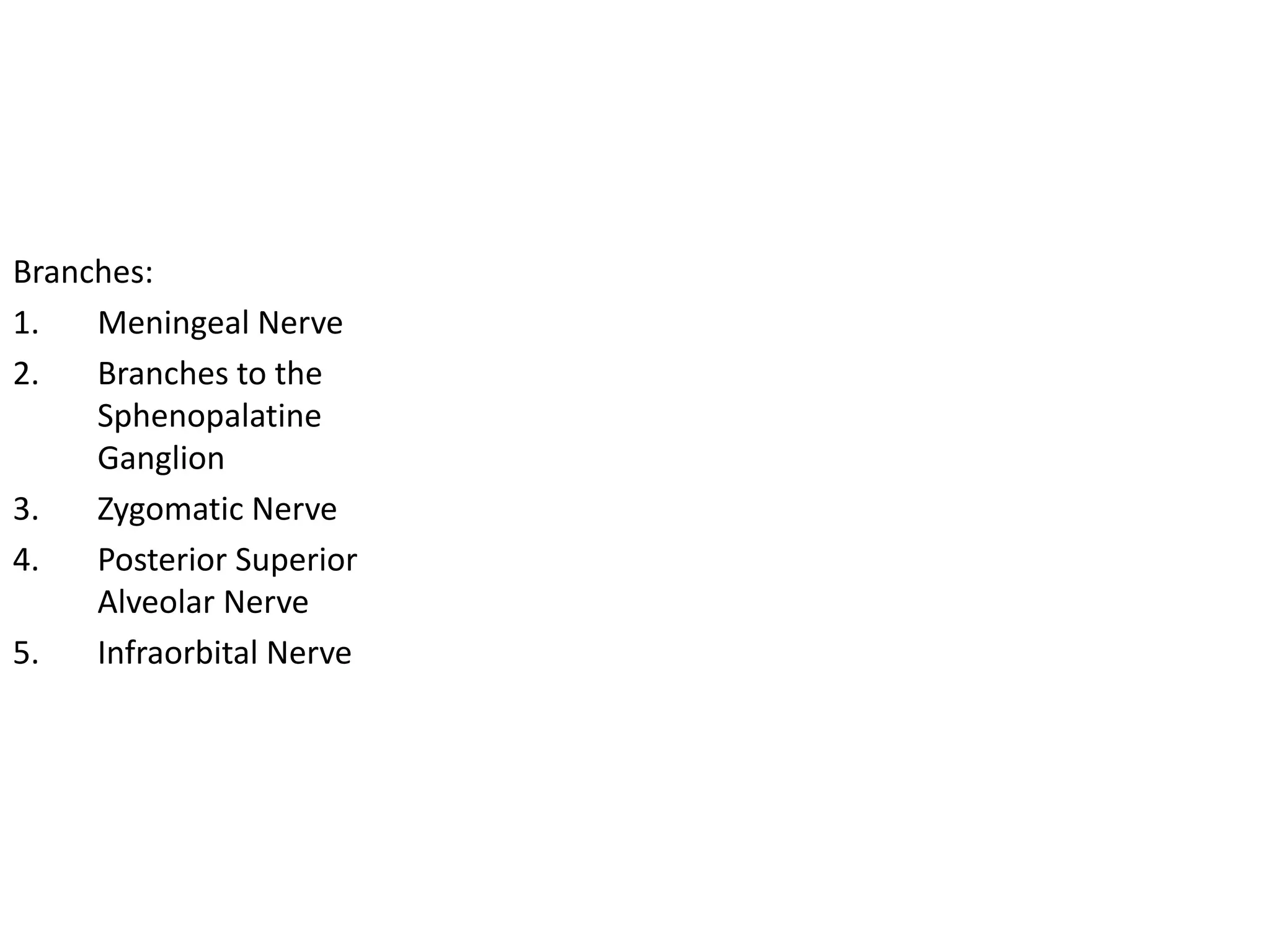
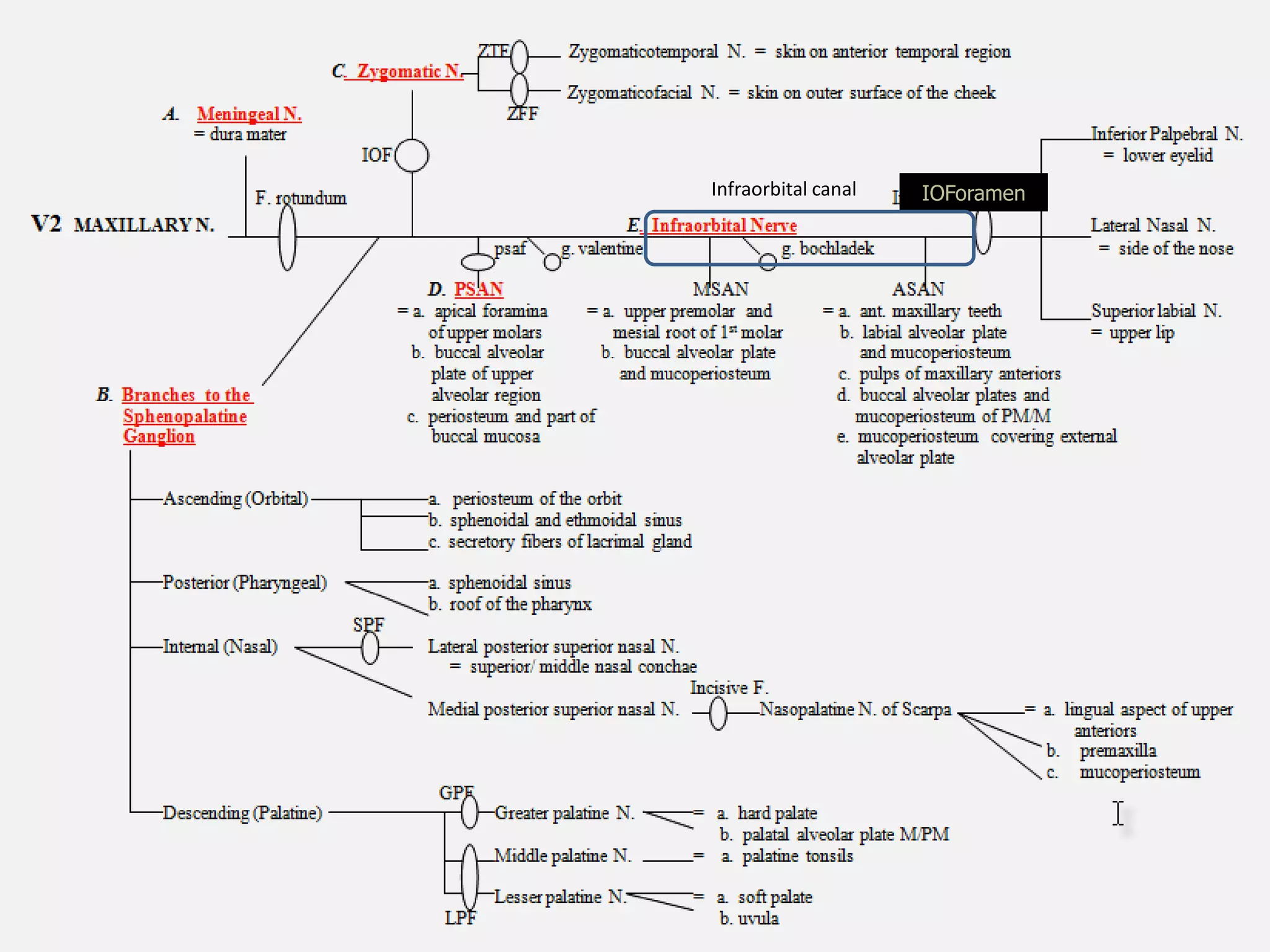
Branches:
1. Meningeal Nerve
2. Branches to the
Sphenopalatine
Ganglion
3. Zygomatic Nerve
4. Posterior Superior
Alveolar Nerve
5. Infraorbital Nerve
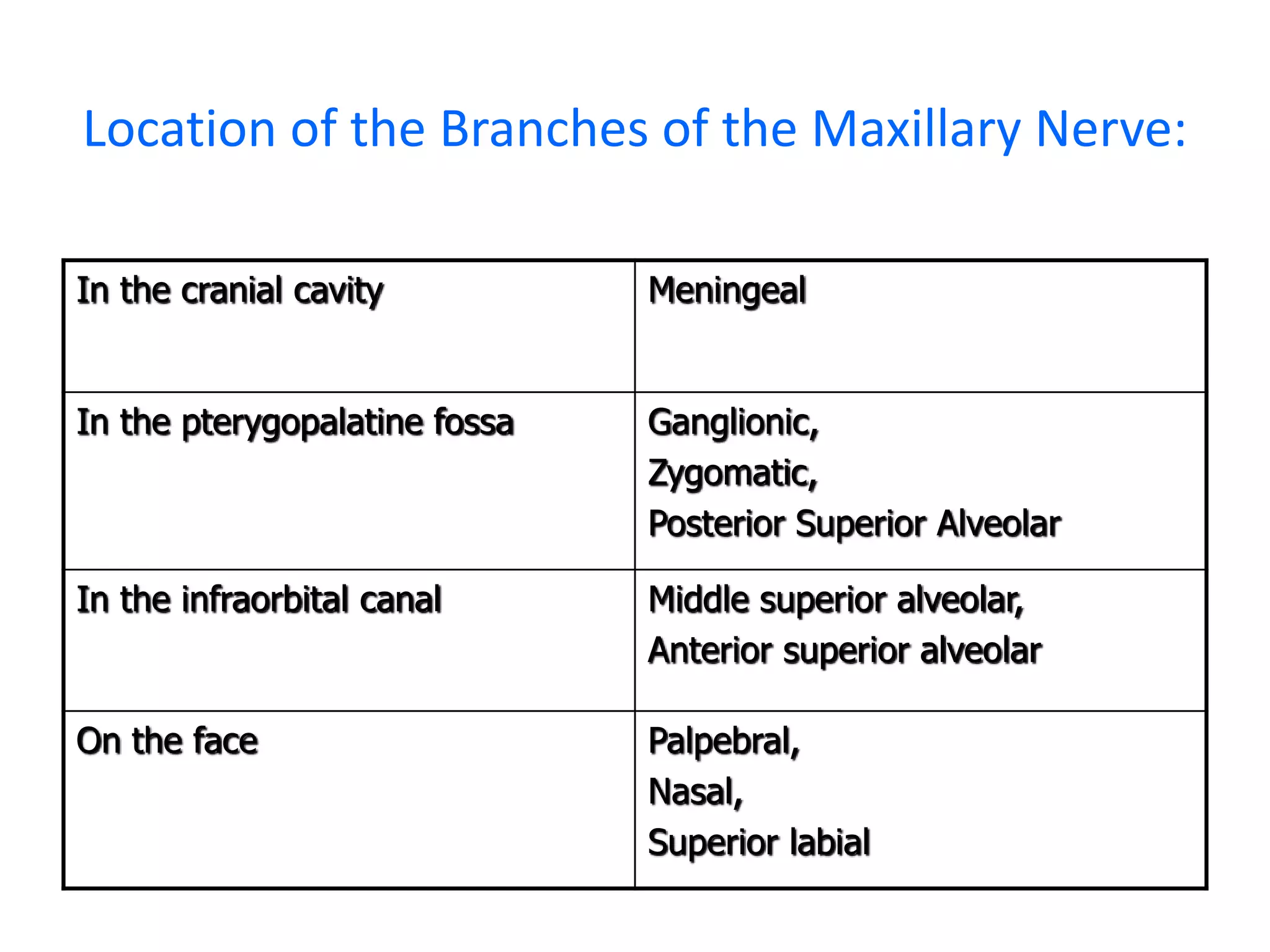
Location of the Branches of the Maxillary Nerve:
In the cranial cavity Meningeal
In the pterygopalatine fossa Ganglionic,
Zygomatic,
Posterior Superior Alveolar
In the infraorbital canal Middle superior alveolar,
Anterior superior alveolar
On the face Palpebral,
Nasal,
Superior labial
IOForamenInfraorbital canal
THE MANDIBULAR NERVE
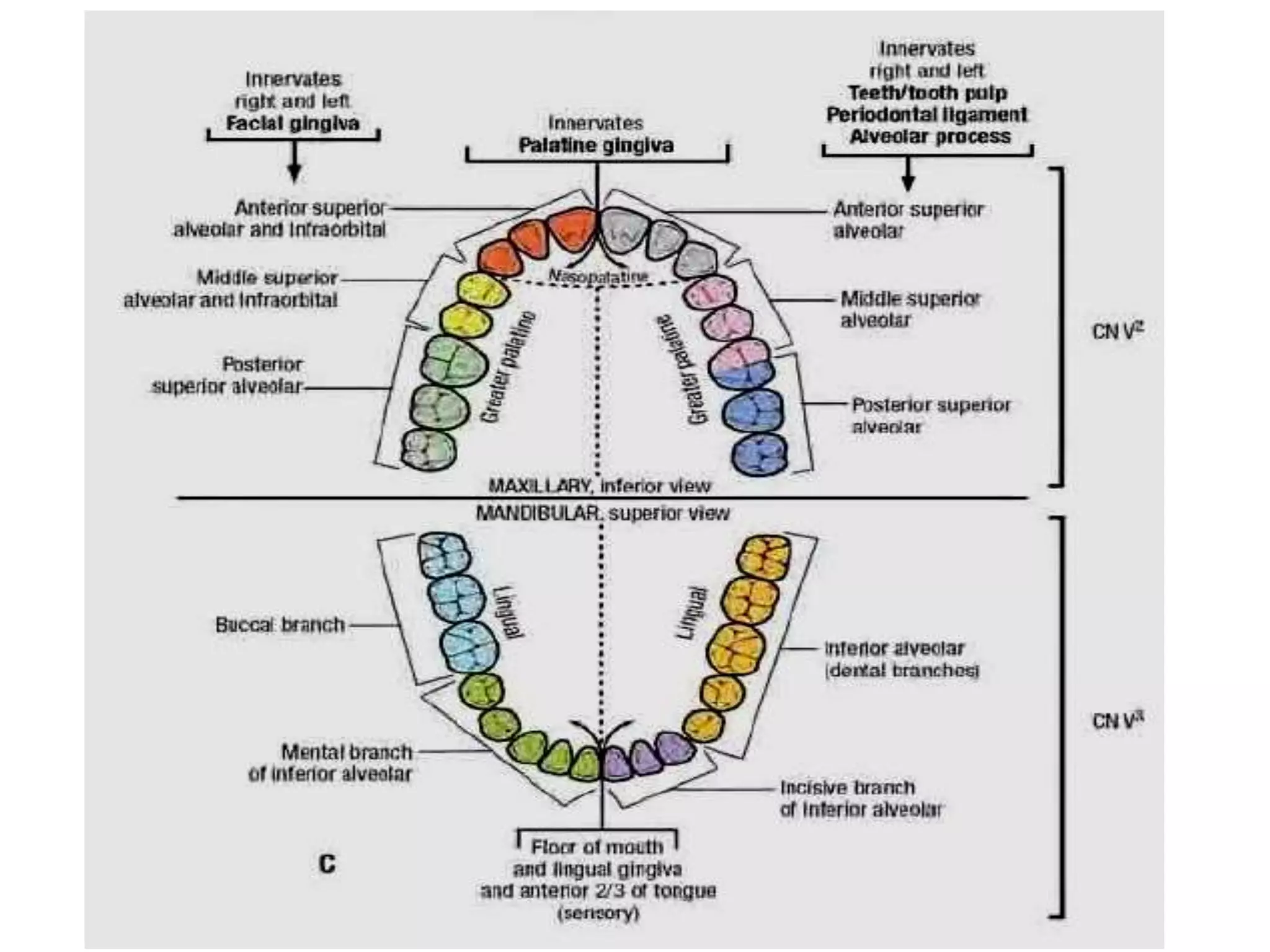
• The largest trigeminal division, and is both sensory and
motor,exits the skull through the foramen ovale.
• It supplies the following structures:
a. the teeth and the gums of the mandible,
b. The skin in the temporal region,
c. Part of the auricle including the external meatus and
tympanum,
d. The lower lip,
e. The lower part of the face ,
f. The muscles of mastication,
g. The mucosa of the anterior 2/3s of the tongue,
h. And the mucosa of the floor of the mouth
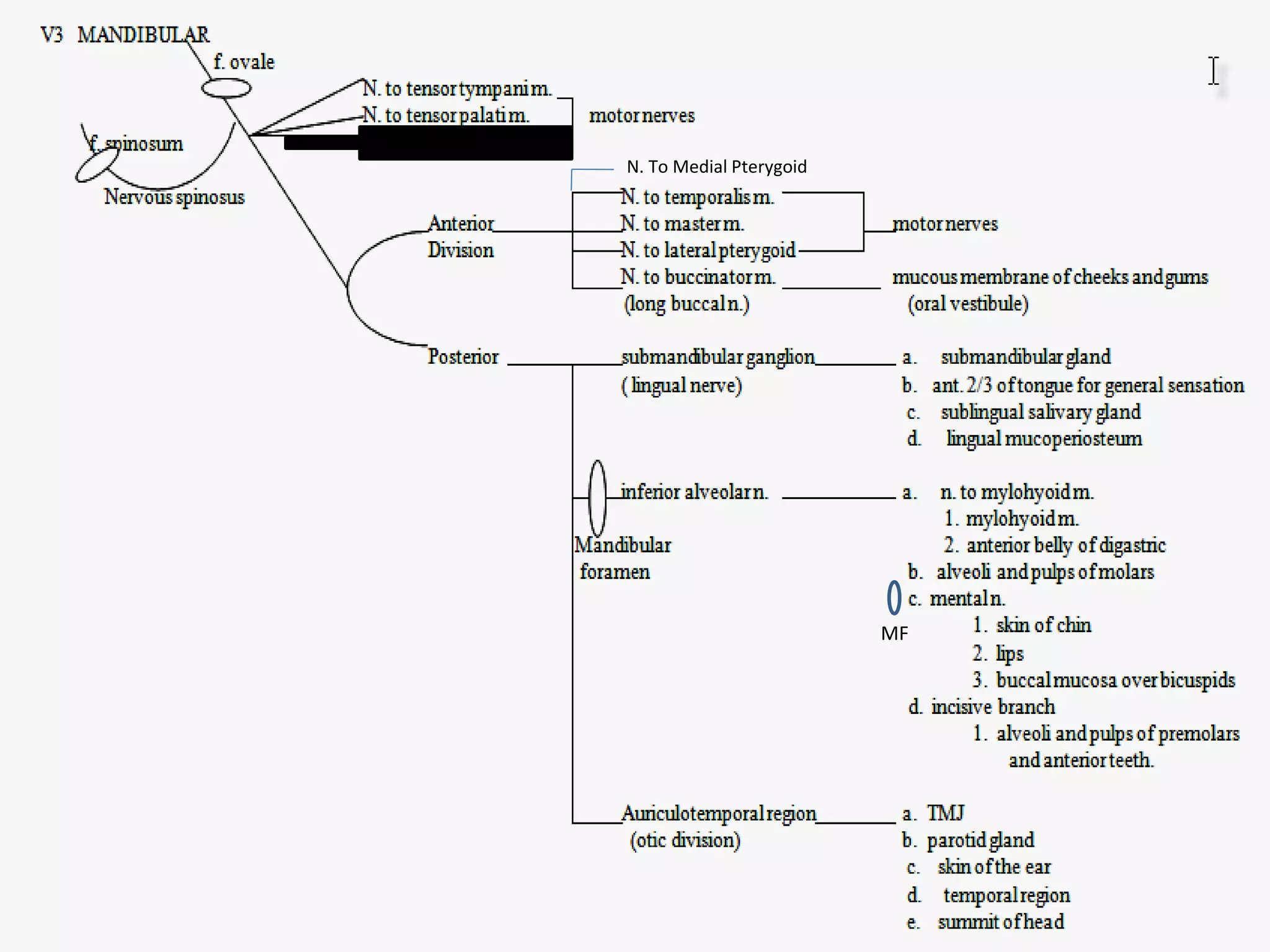
MF
N. To Medial Pterygoid
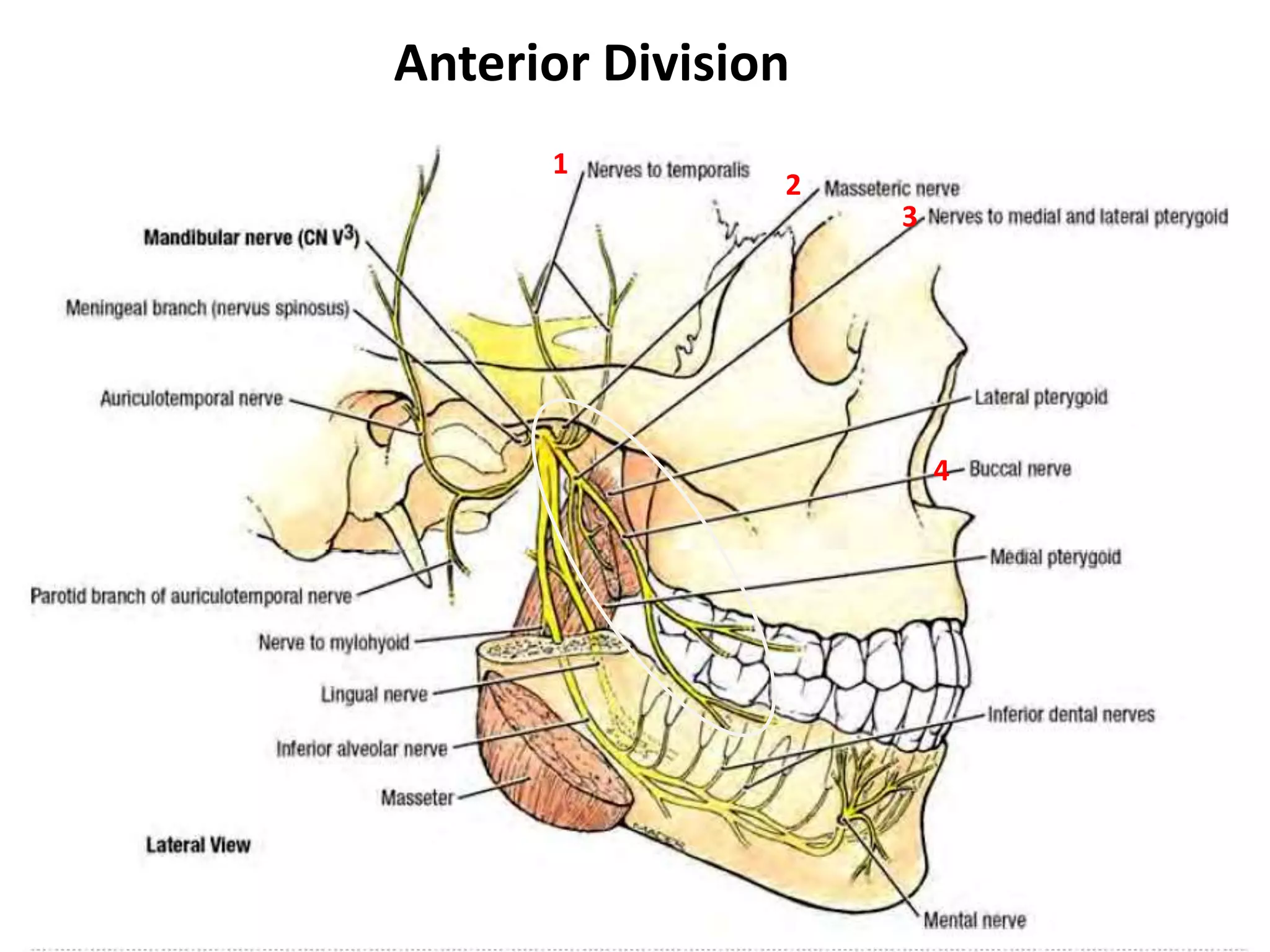
Anterior Division
1
4
3
2
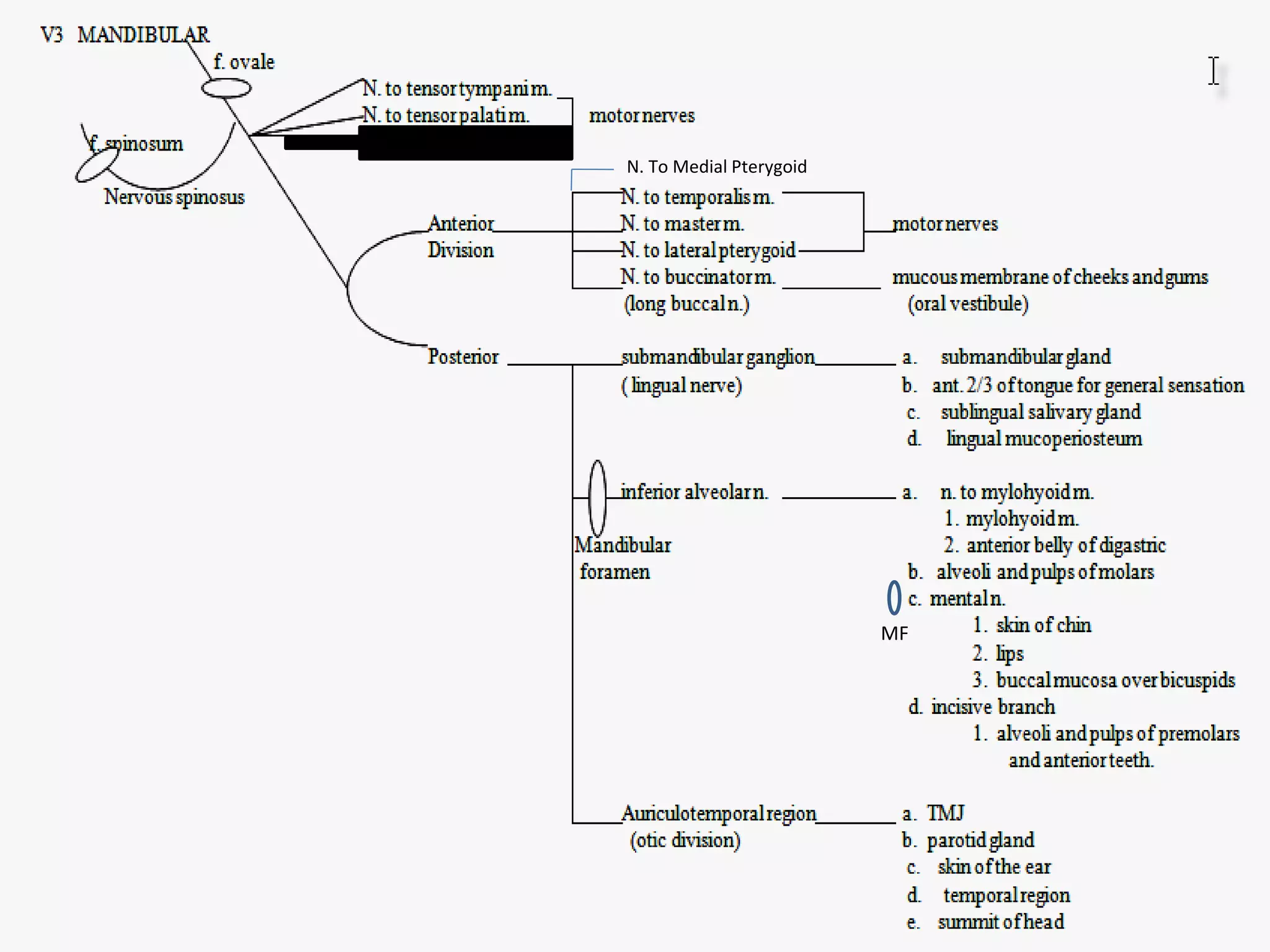
MF
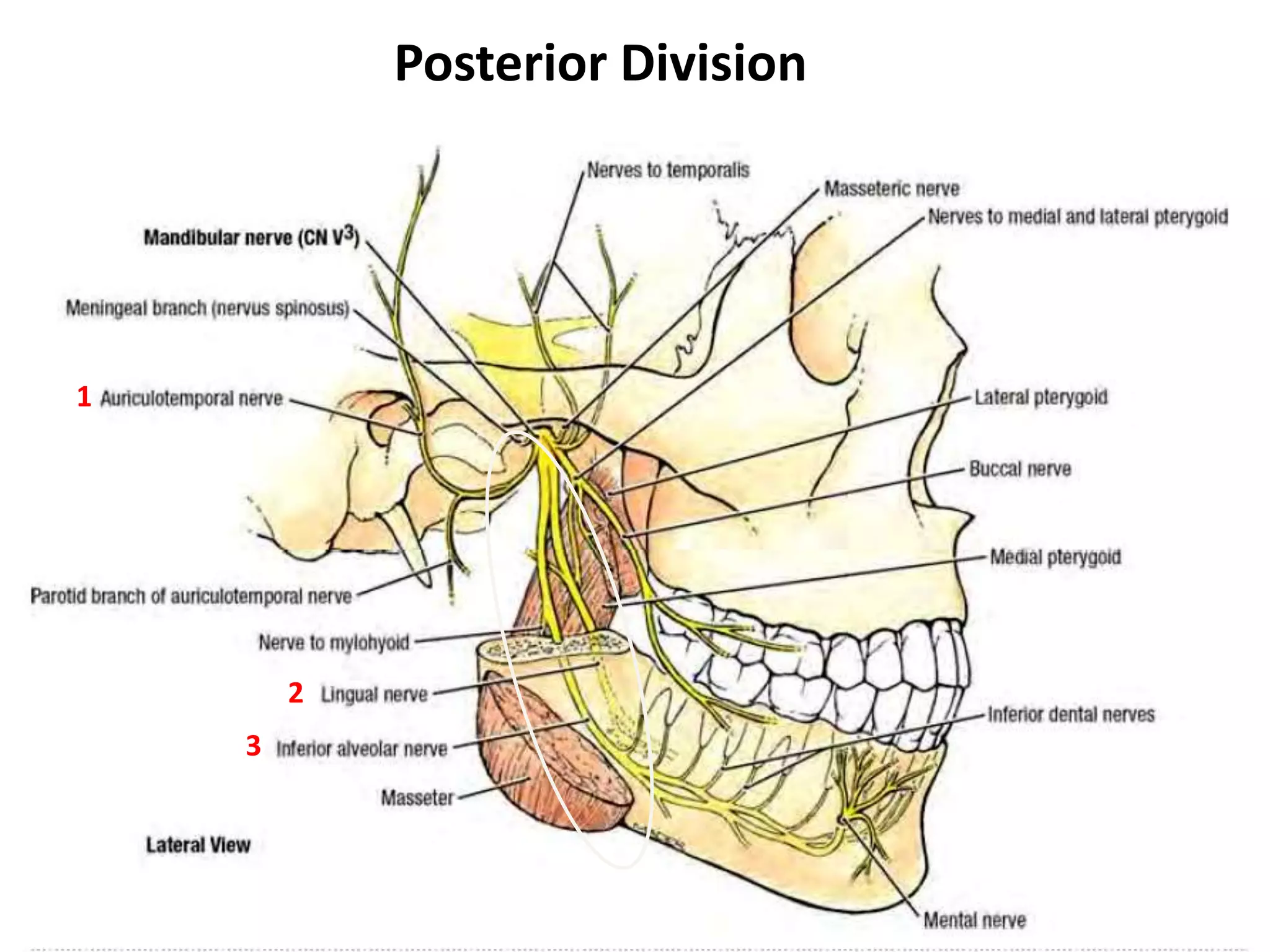
N. To Medial Pterygoid
Posterior Division
1
3
2
Injection Techniques
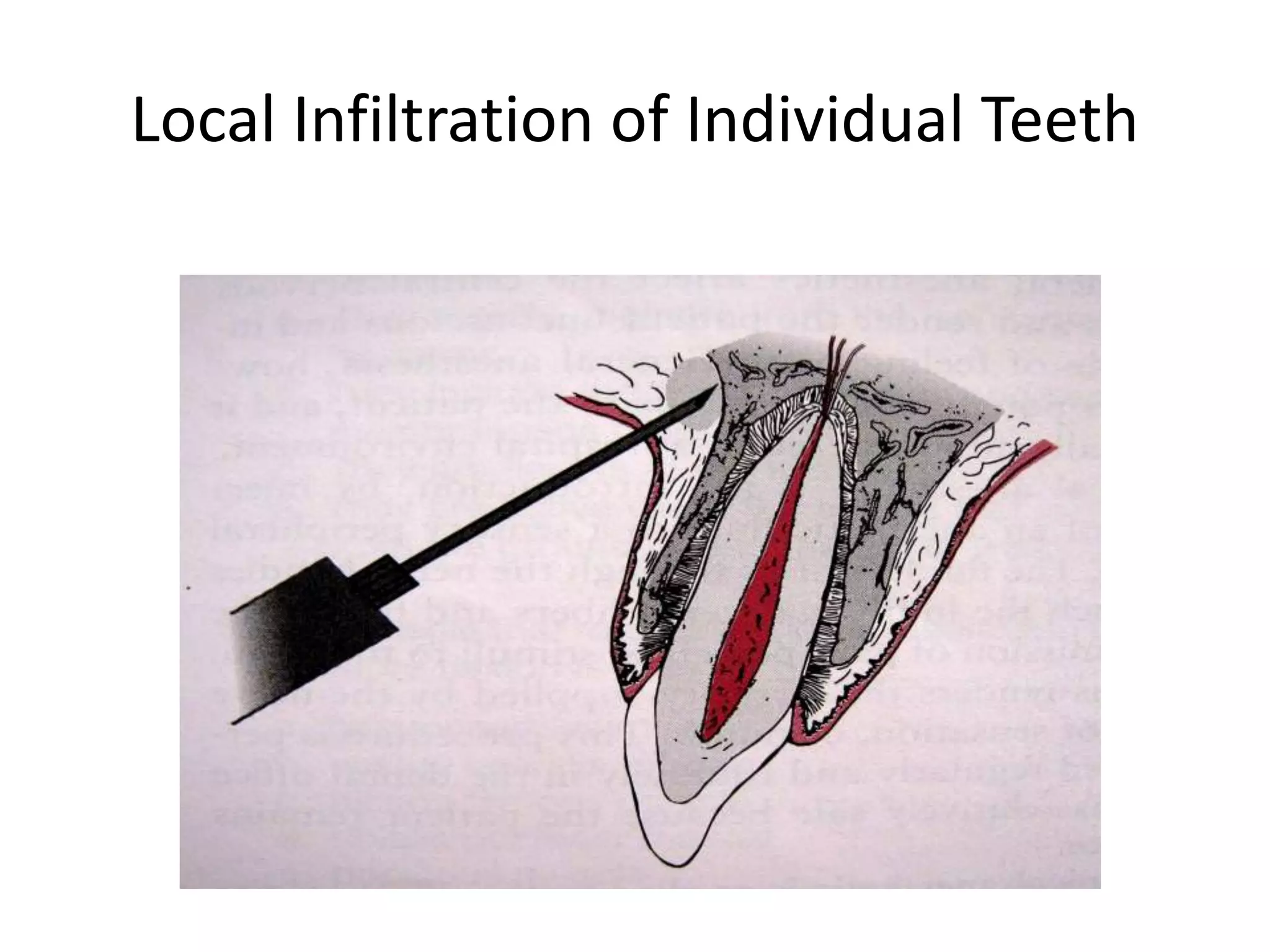
Local Infiltration
Local Infiltration of Individual Teeth
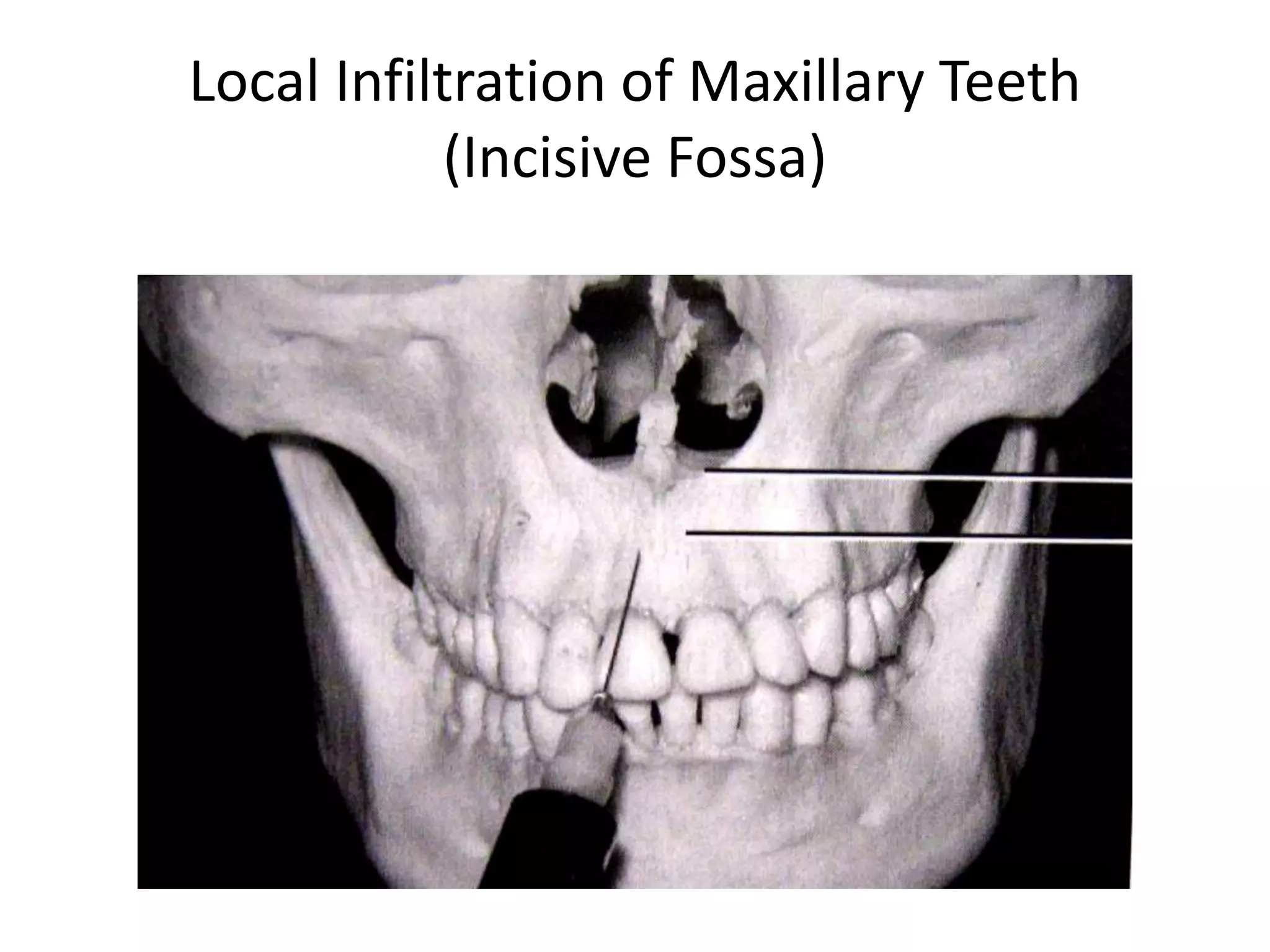
Local Infiltration of Maxillary Teeth
(Incisive Fossa)
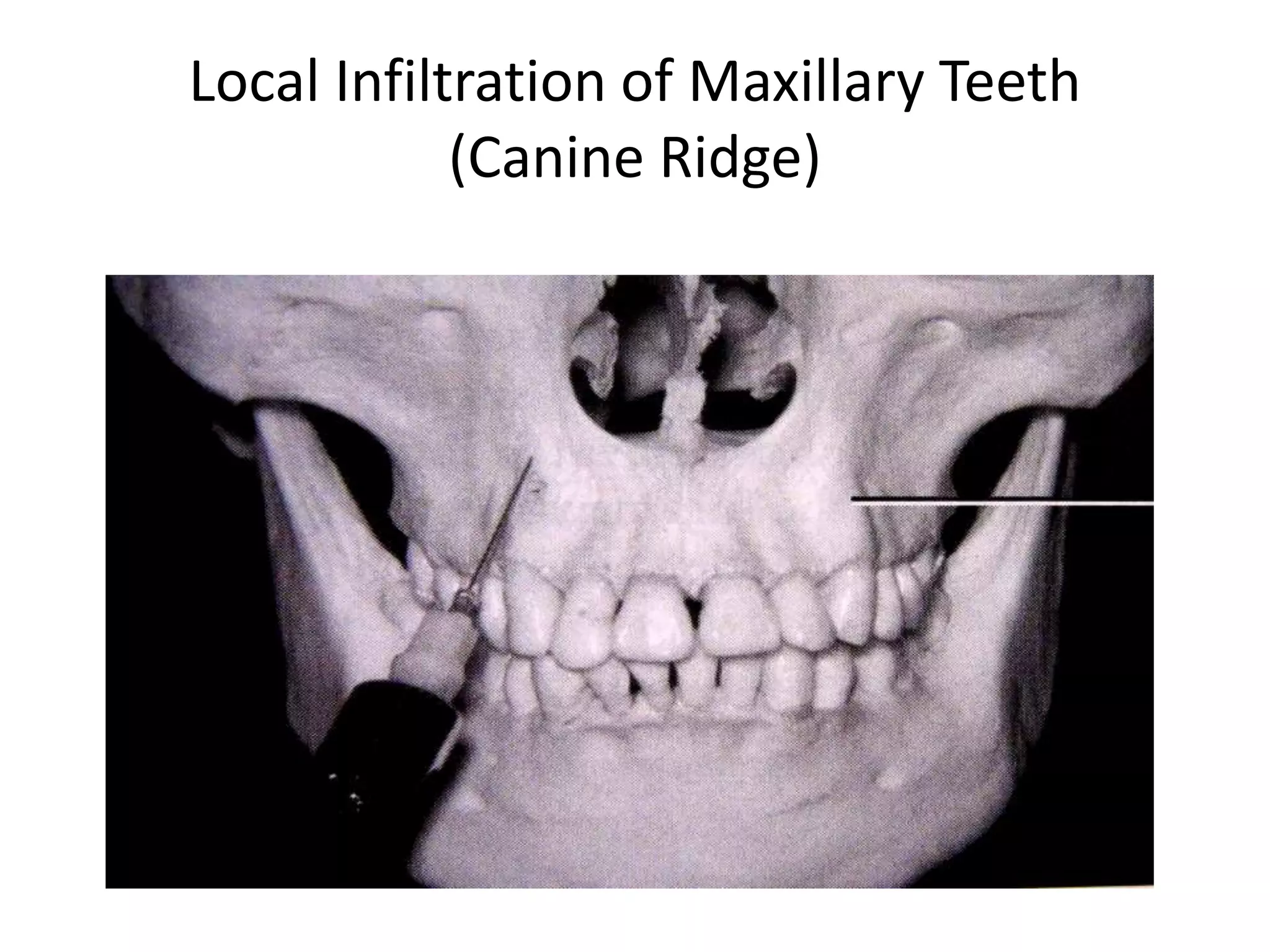
Local Infiltration of Maxillary Teeth
(Canine Ridge)
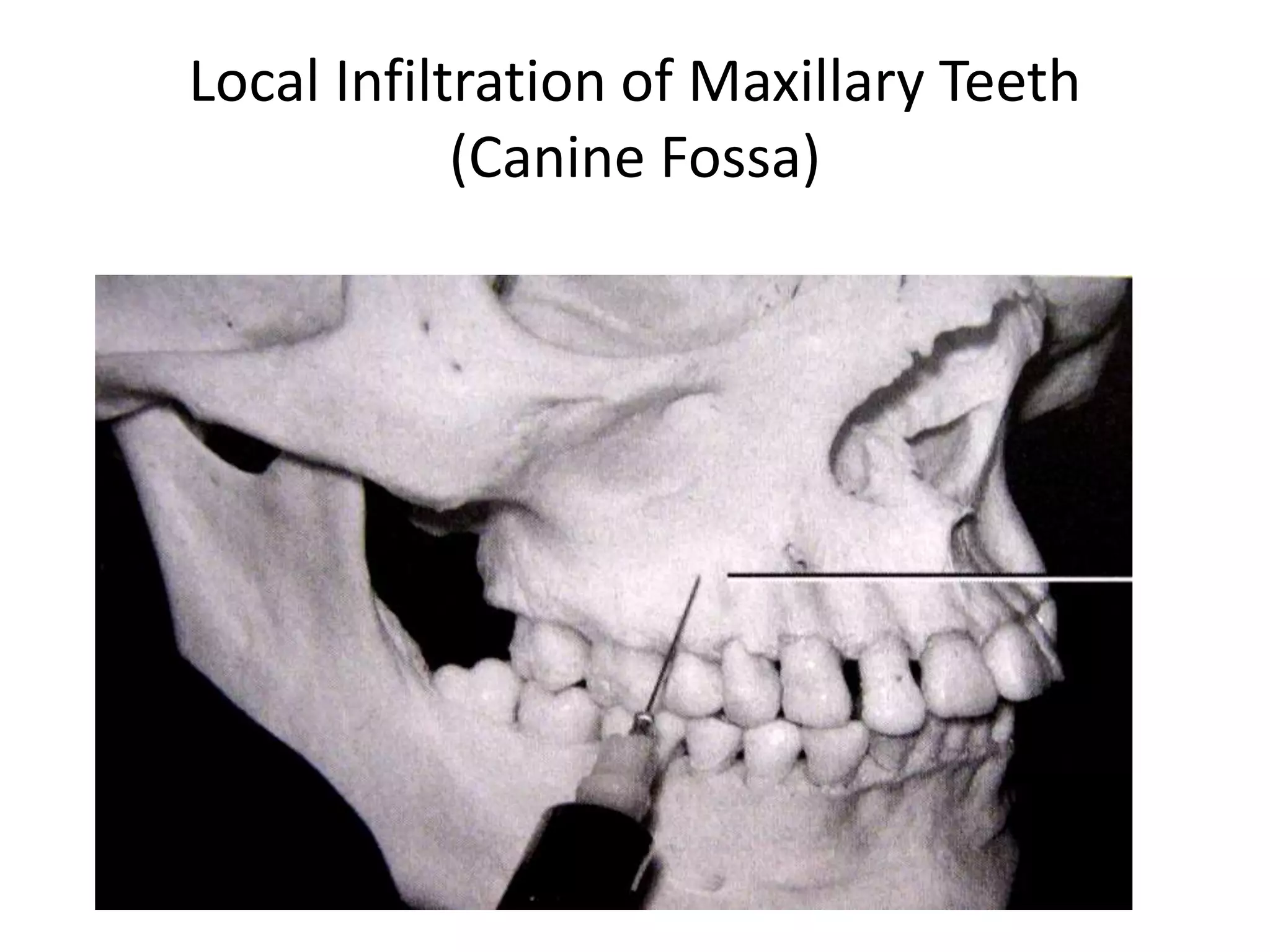
Local Infiltration of Maxillary Teeth
(Canine Fossa)
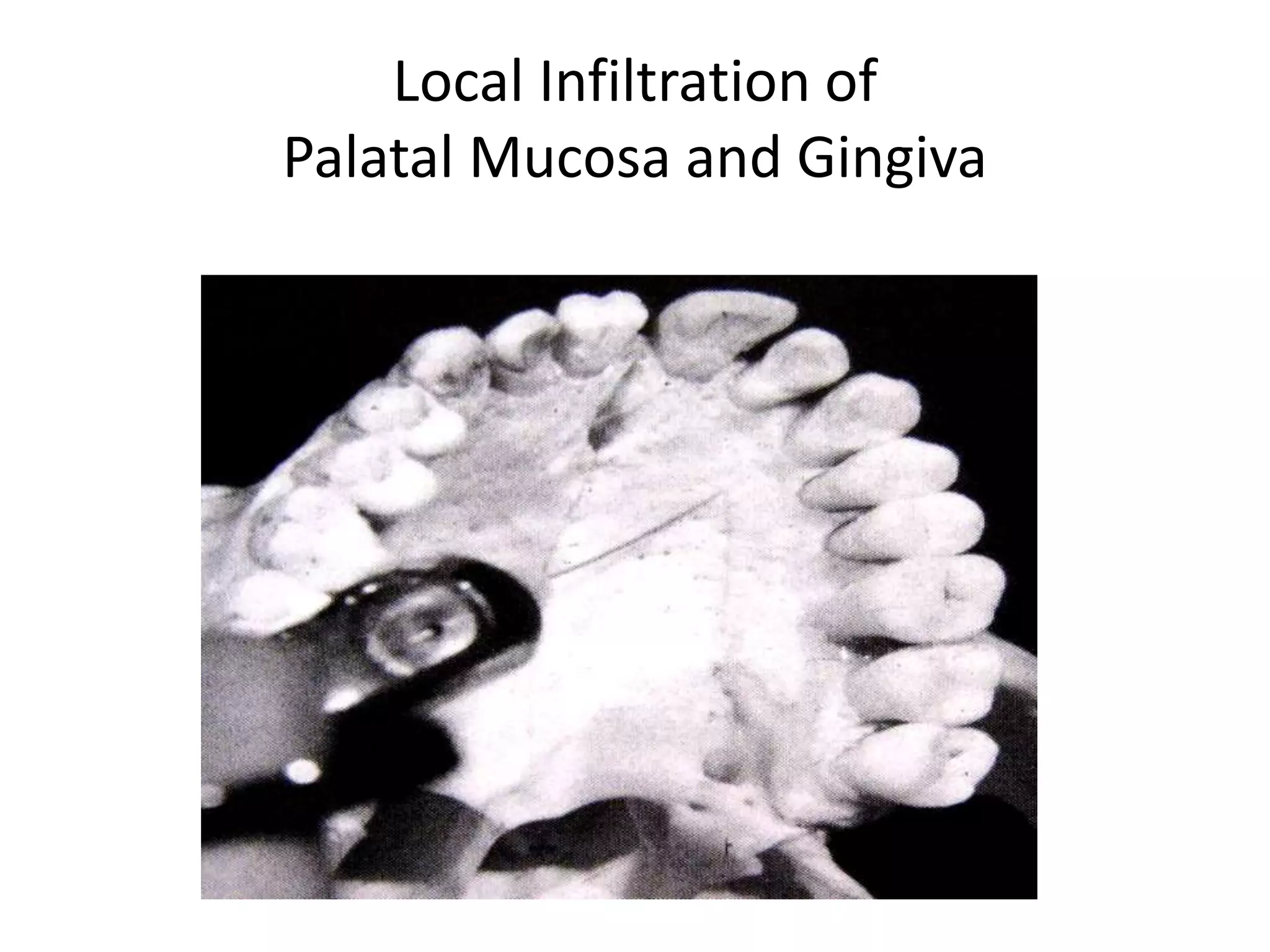
Local Infiltration of
Palatal Mucosa and Gingiva
Nerve Blocks
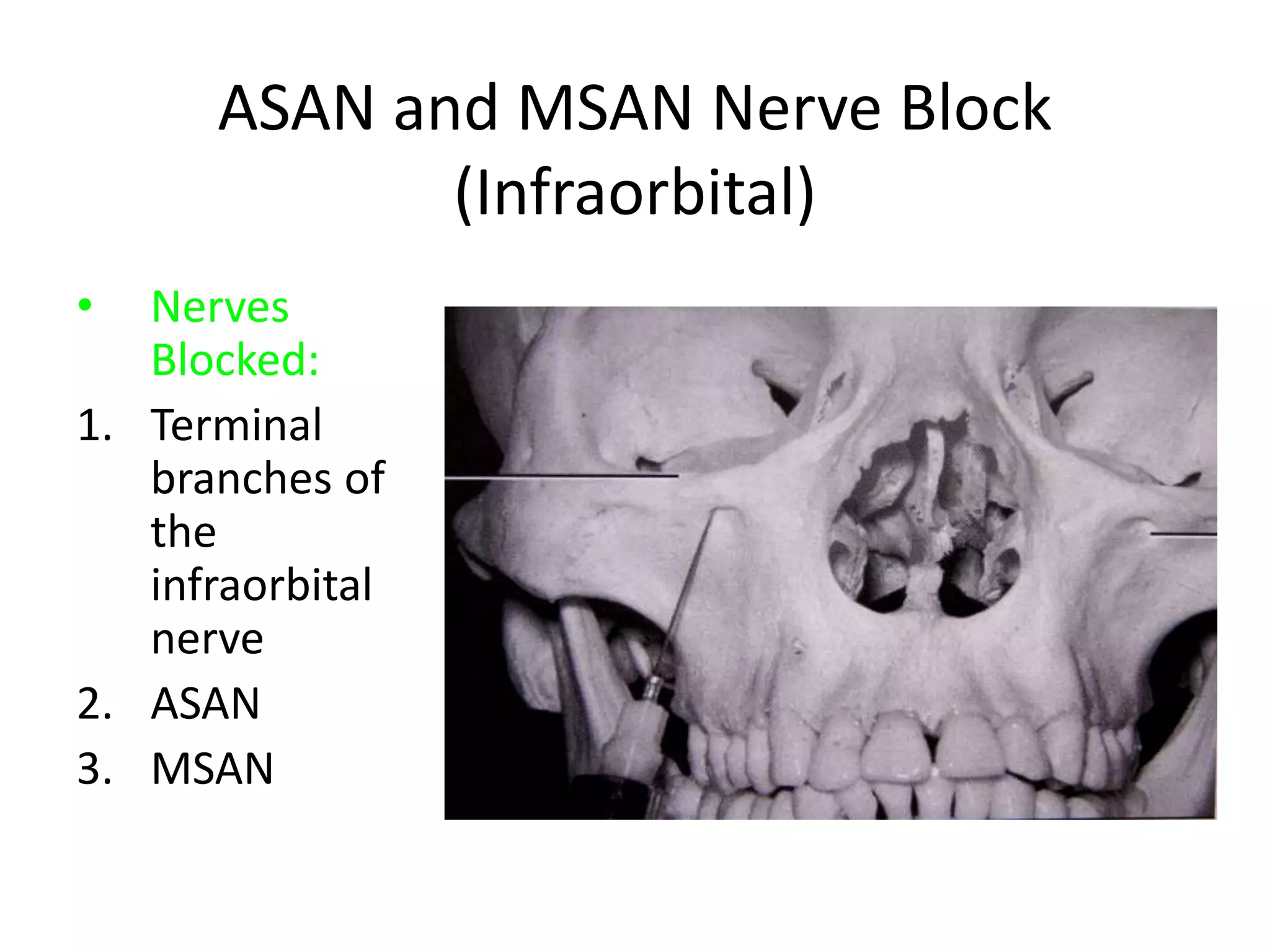
ASAN and MSAN Nerve Block
(Infraorbital)
• Nerves
Blocked:
1. Terminal
branches of
the
infraorbital
nerve
2. ASAN
3. MSAN
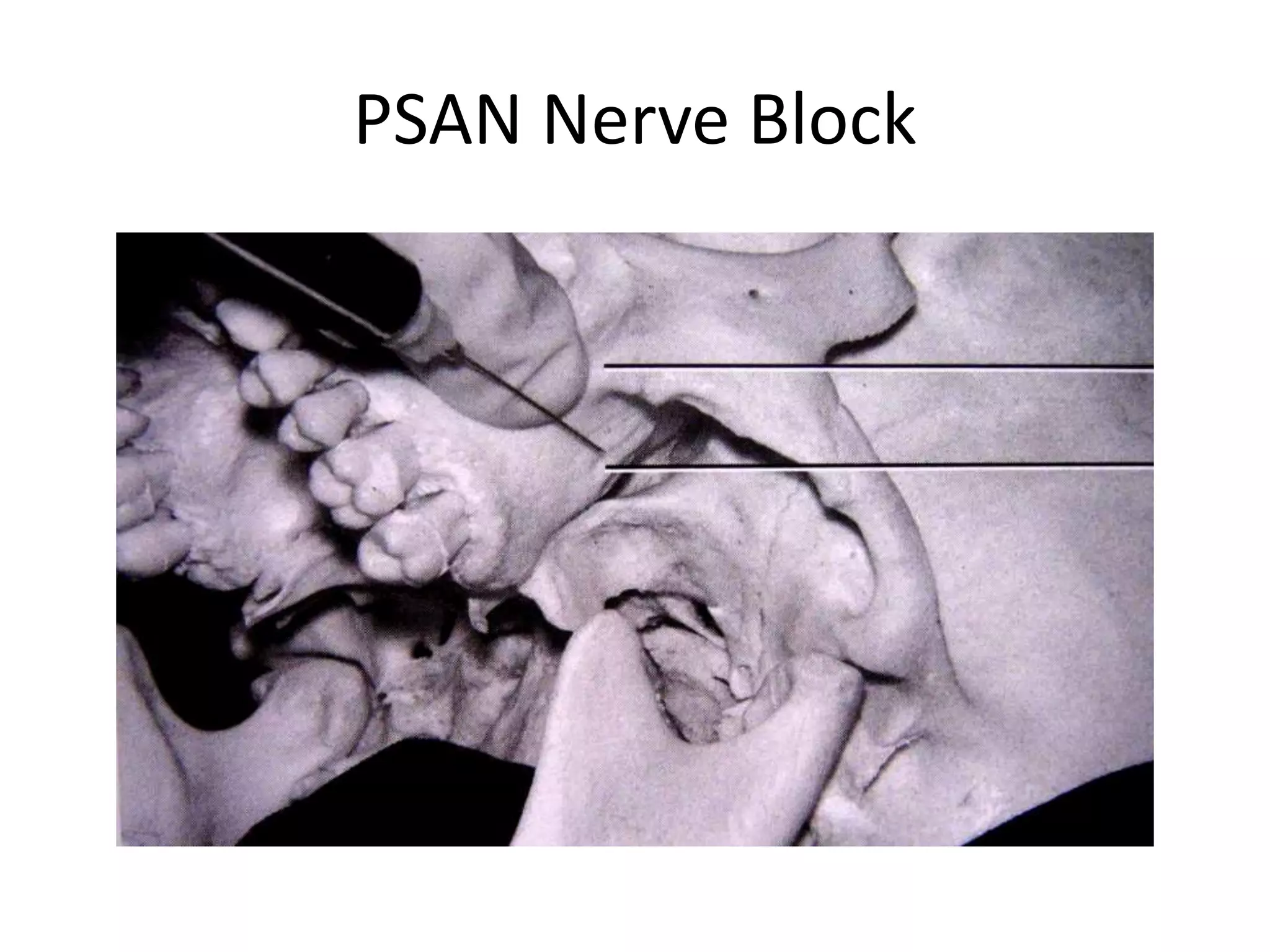
PSAN Nerve Block
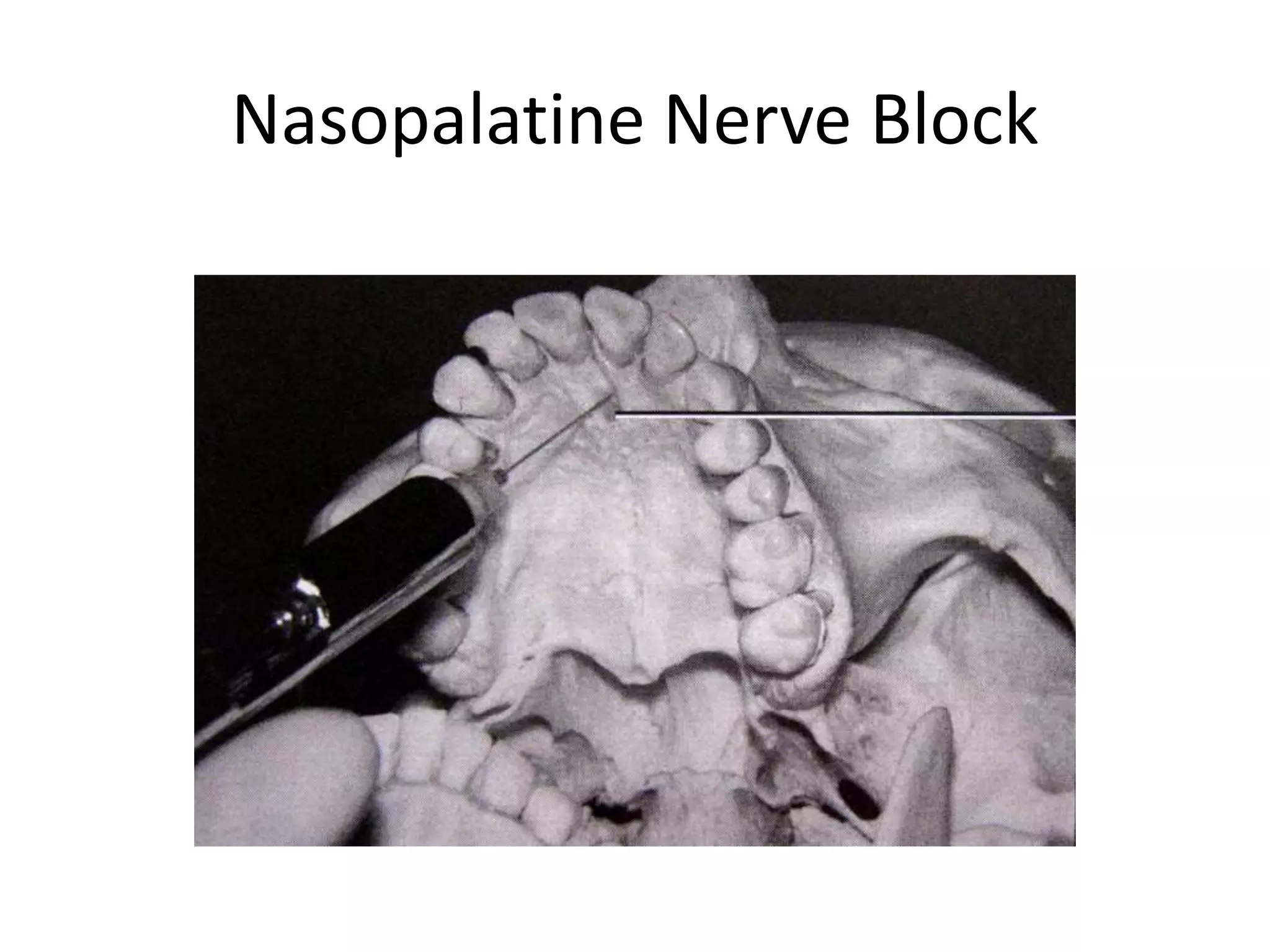
Nasopalatine Nerve Block
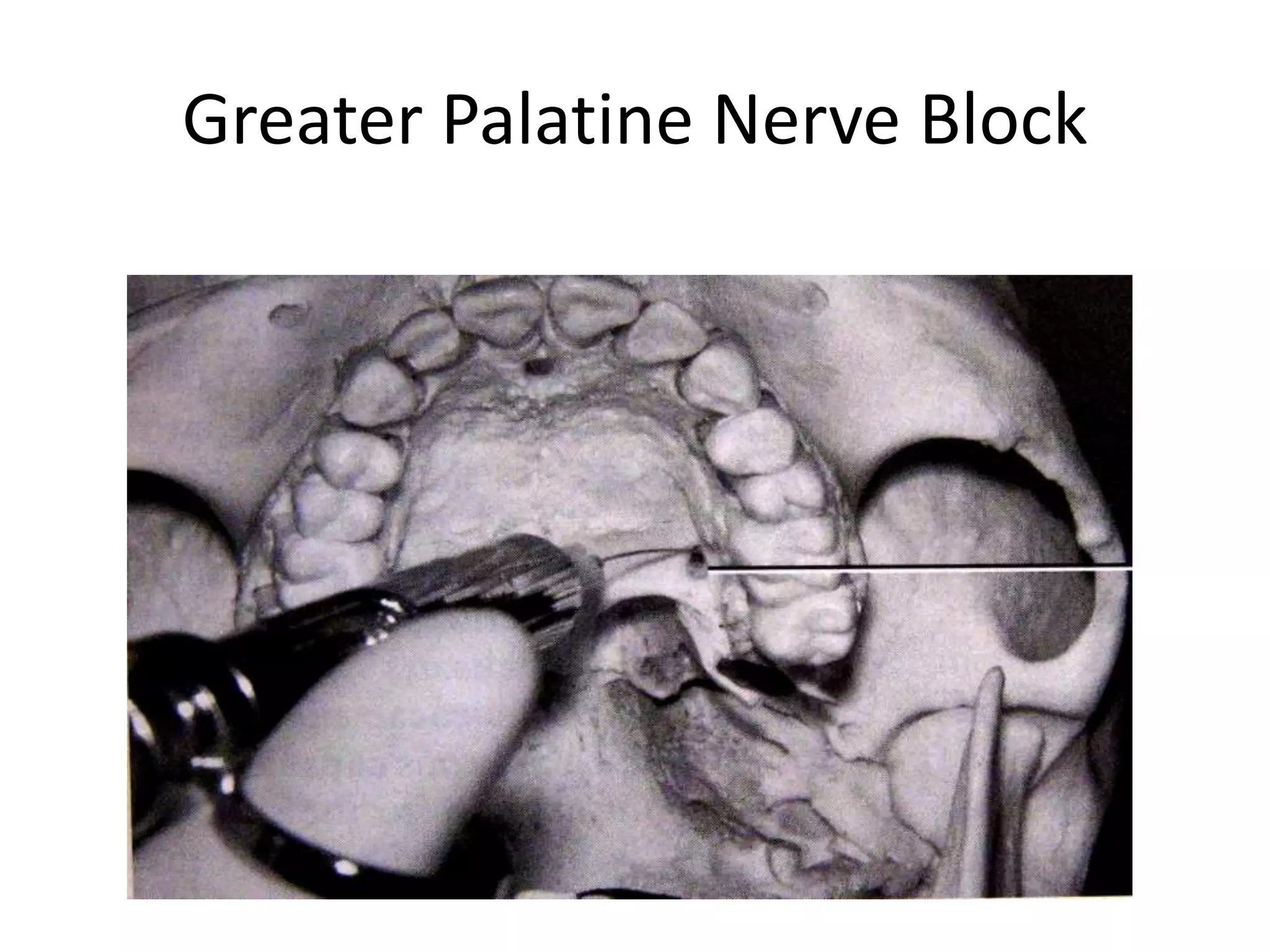
Greater Palatine Nerve Block
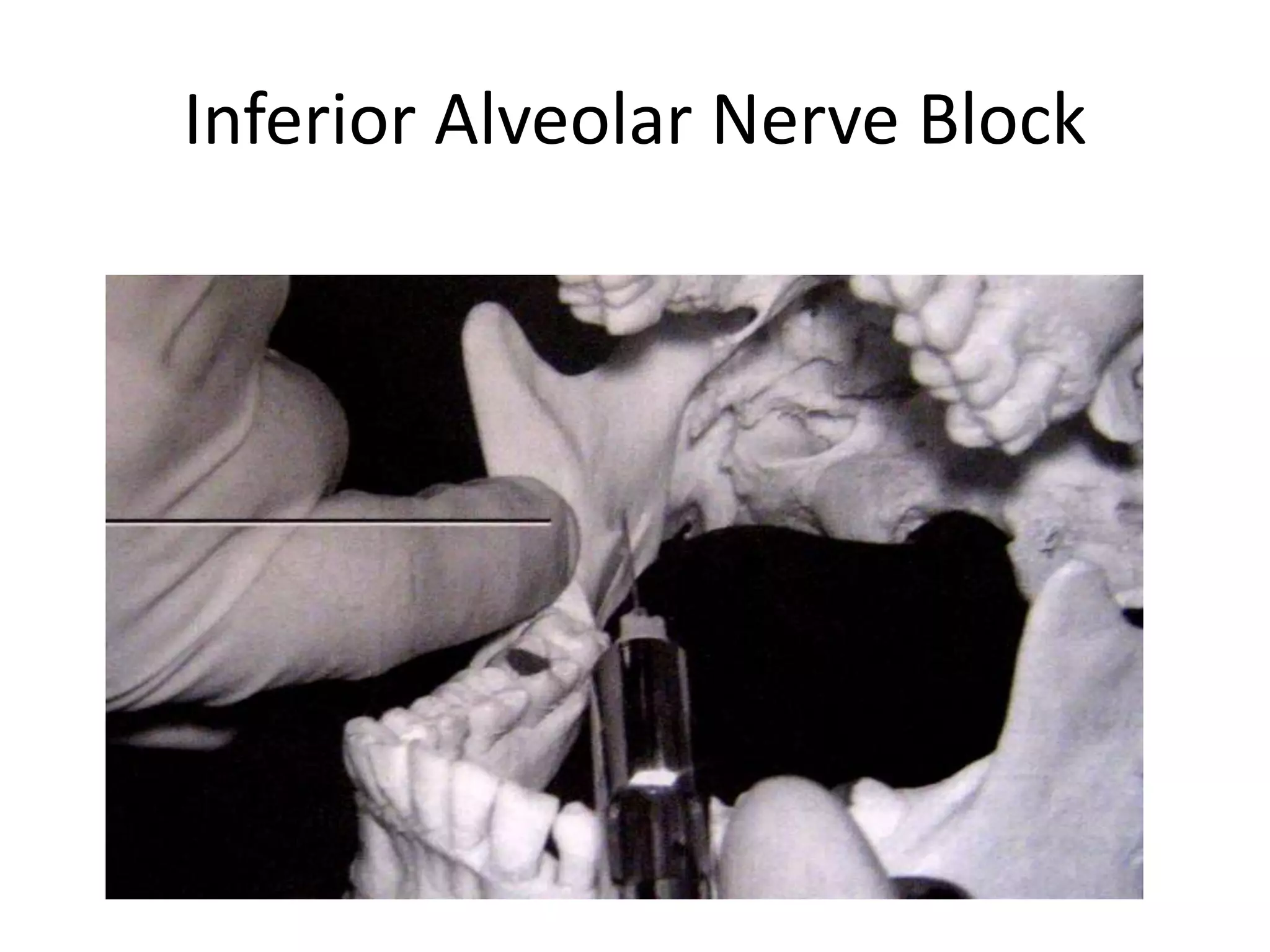
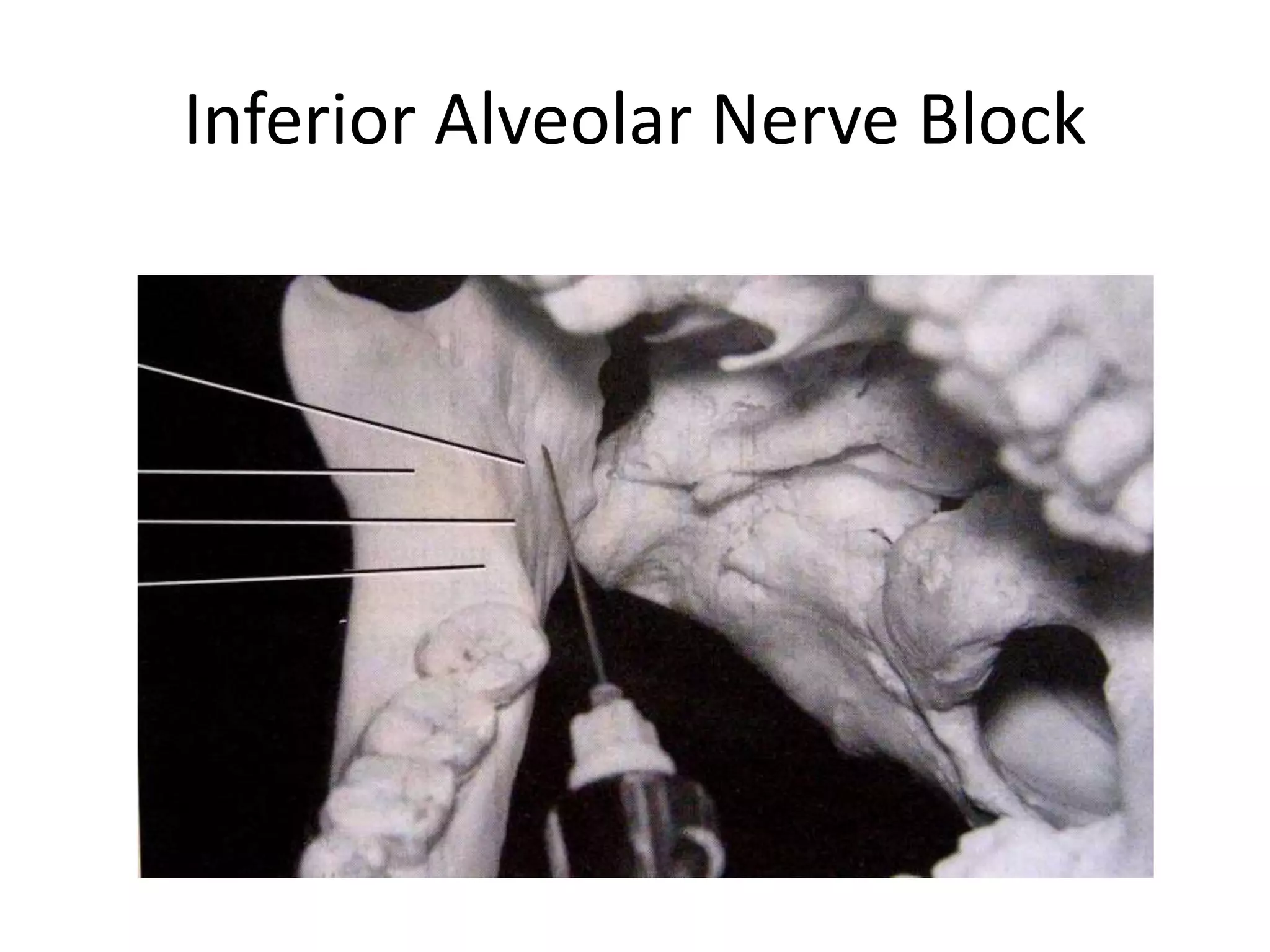
Inferior Alveolar Nerve Block
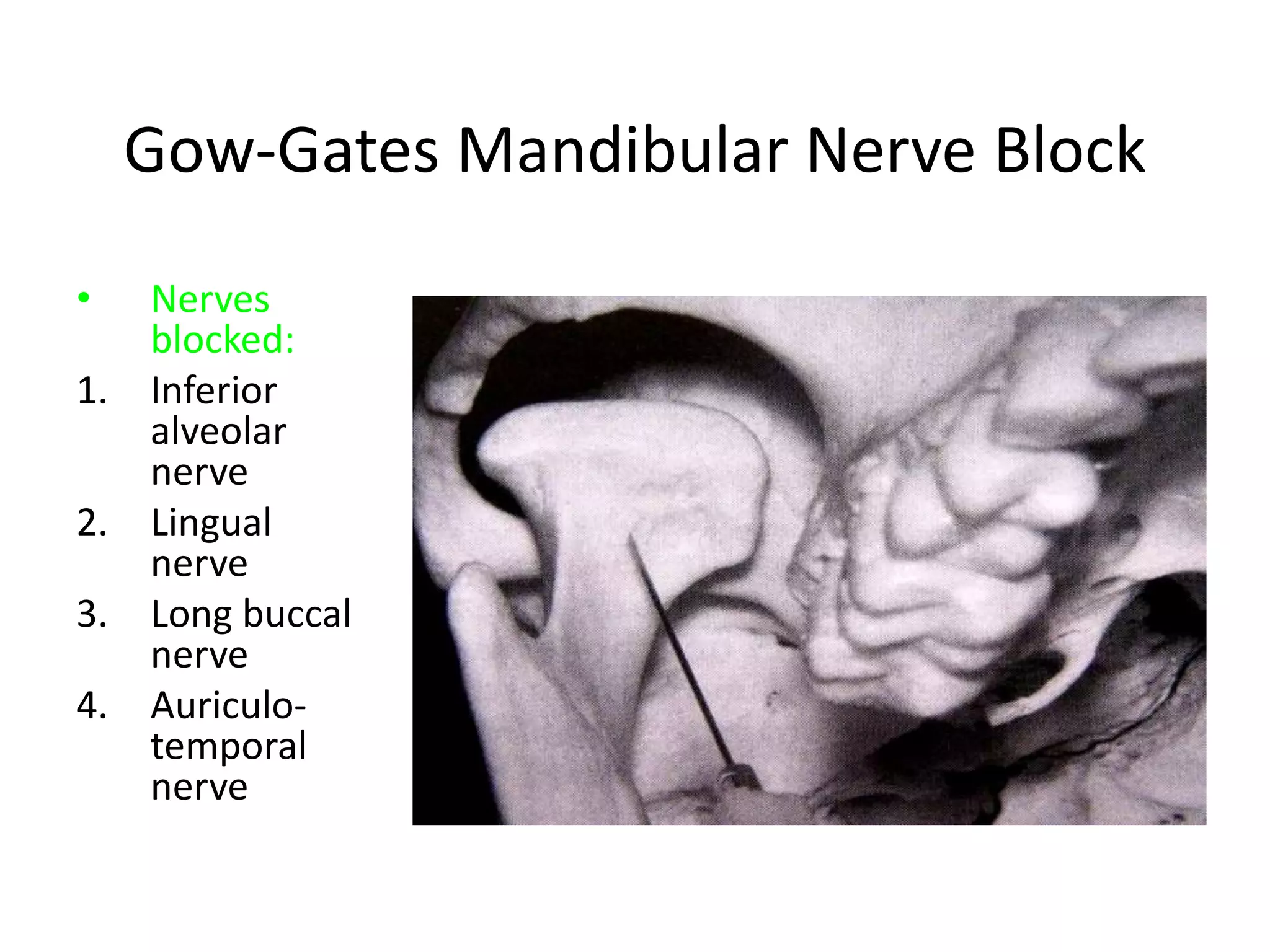
Gow-Gates Mandibular Nerve Block
• Nerves
blocked:
1. Inferior
alveolar
nerve
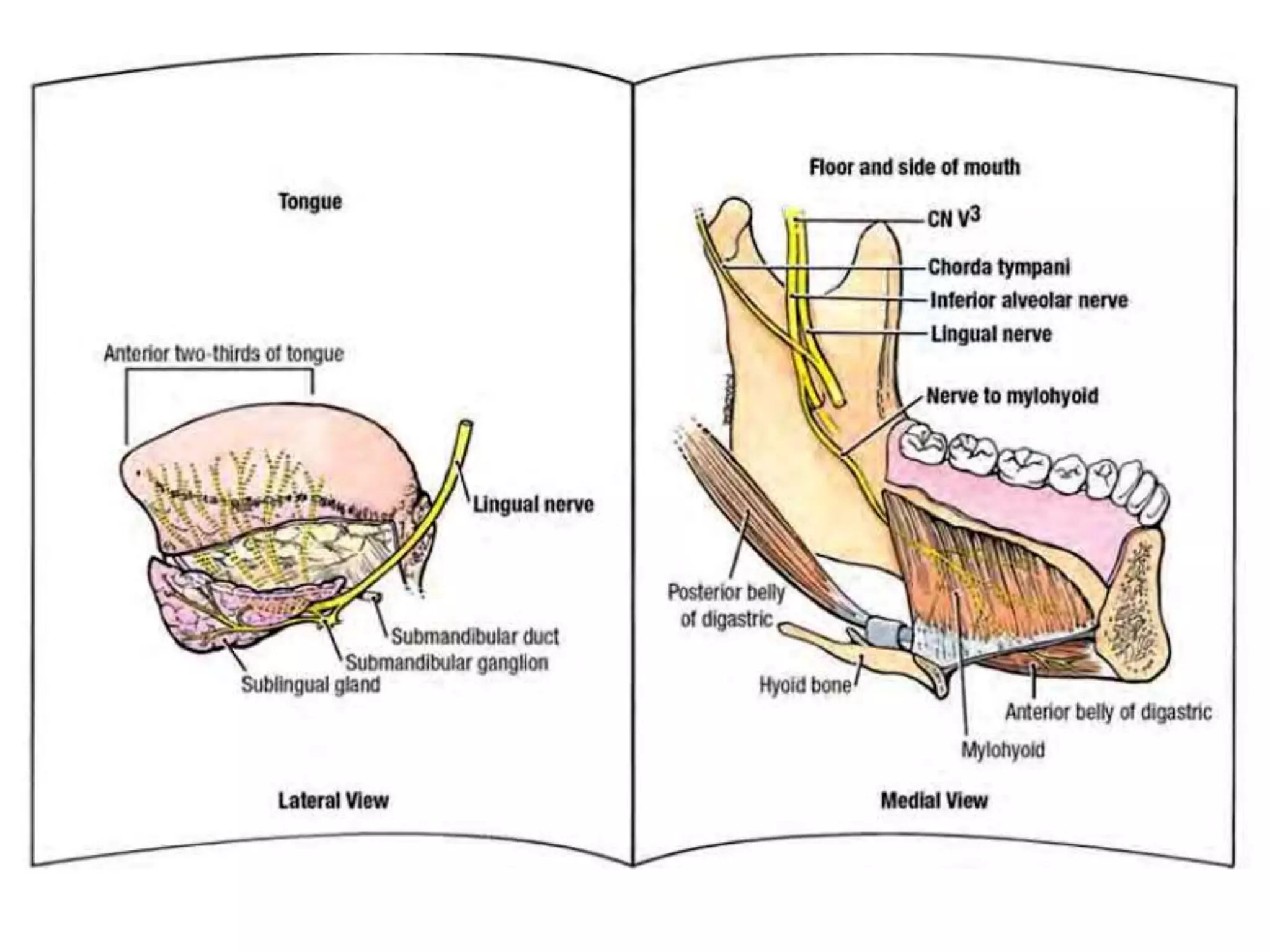
2. Lingual
nerve
3. Long buccal
nerve
4. Auriculo-
temporal
nerve
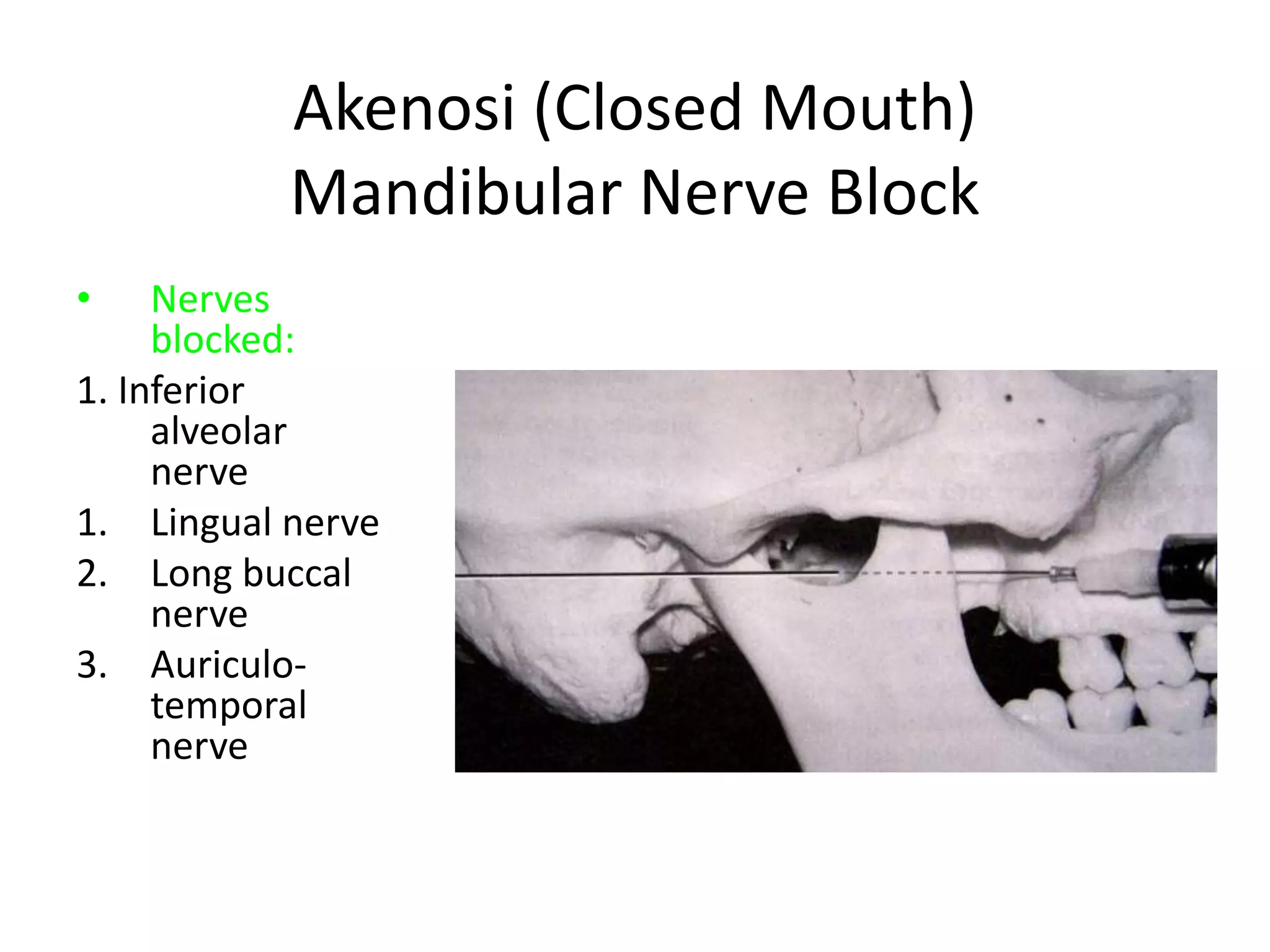
Akenosi (Closed Mouth)
Mandibular Nerve Block
• Nerves
blocked:
1. Inferior
alveolar
nerve
1. Lingual nerve
2. Long buccal
nerve
3. Auriculo-
temporal
nerve
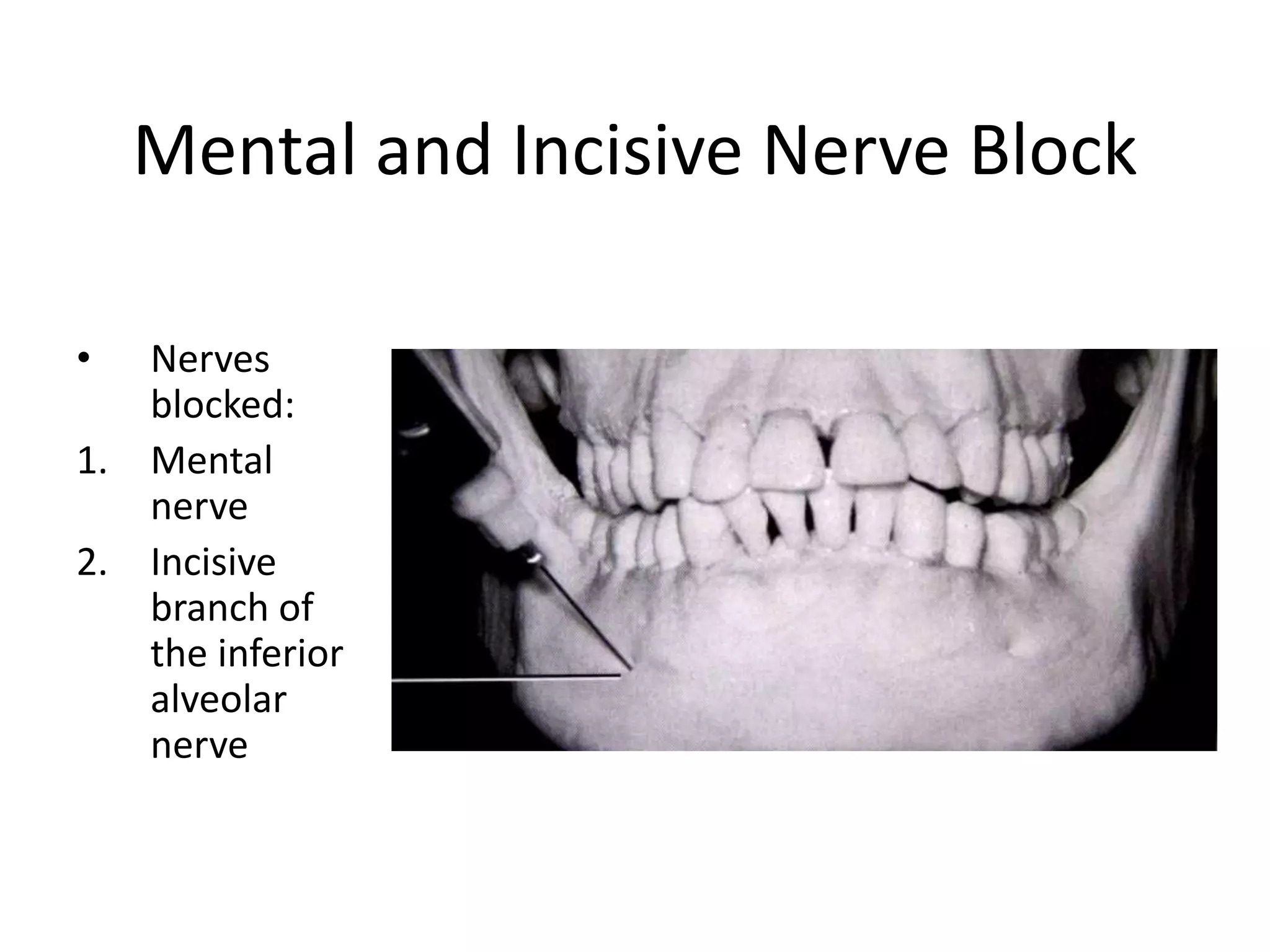
Mental and Incisive Nerve Block
• Nerves
blocked:
1. Mental
nerve
2. Incisive
branch of
the inferior
alveolar
nerve
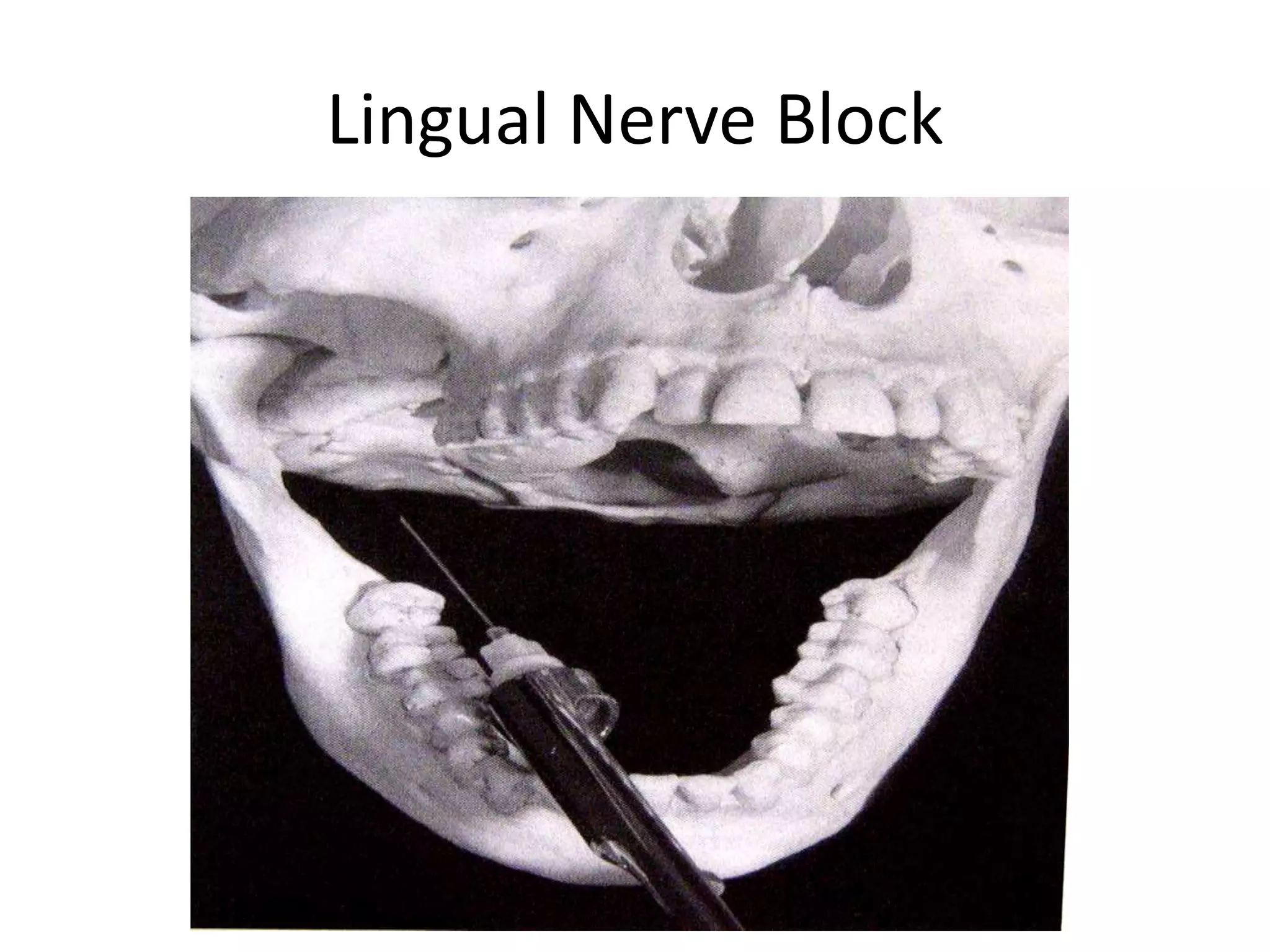
Lingual Nerve Block
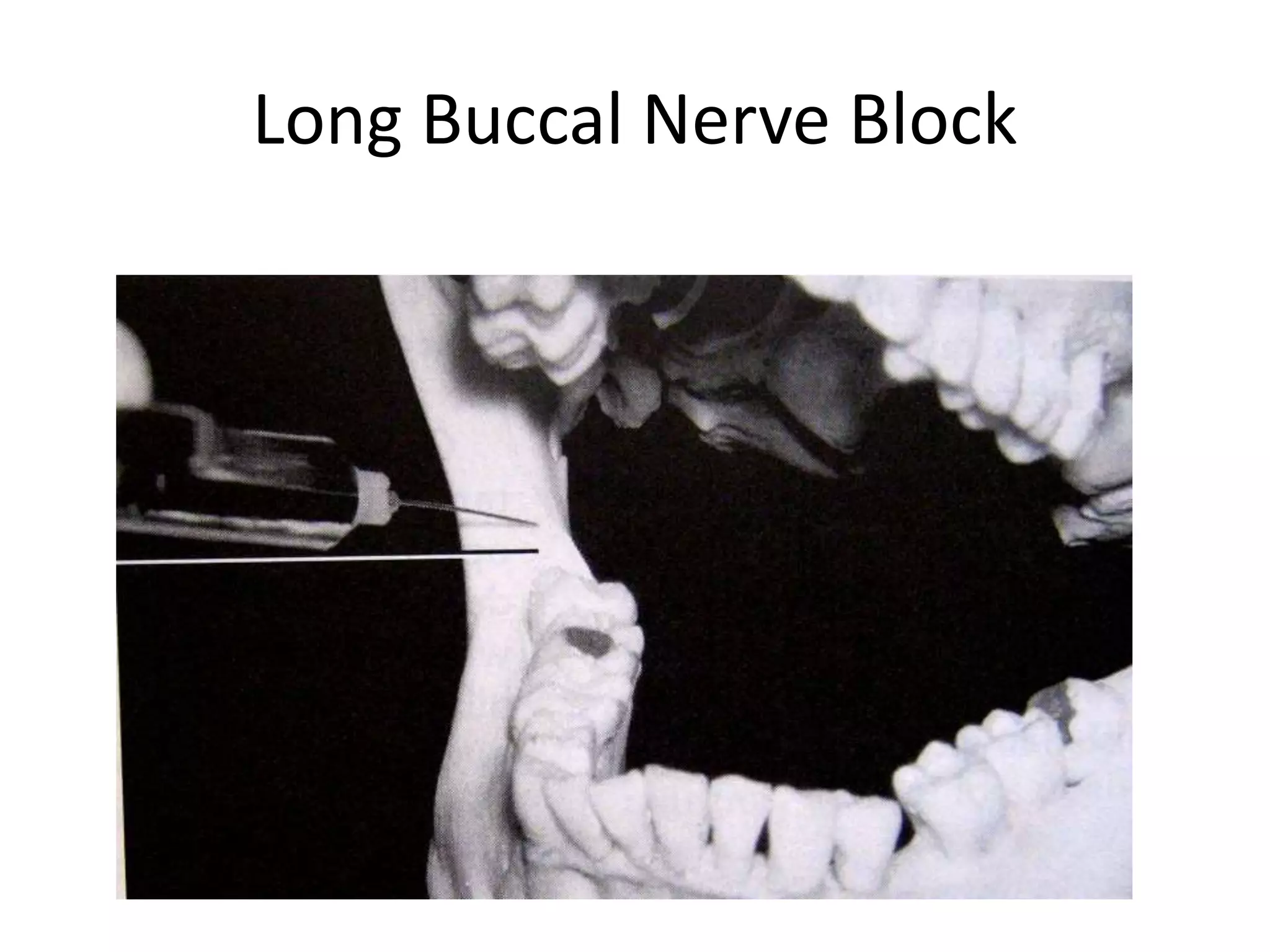
Long Buccal Nerve Block

Trigeminal n.