Norma Basalis Interna
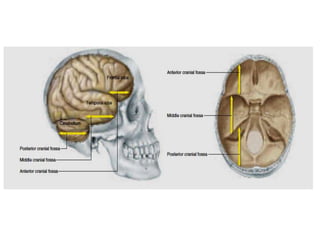
THE ANTERIOR CRANIAL FOSSA
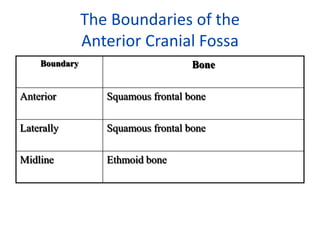
The Boundaries of the
               Anterior Cranial Fossa
    Boundary                        Bone

Anterior          Squamous frontal bone

Laterally         Squamous frontal bone

Midline           Ethmoid bone
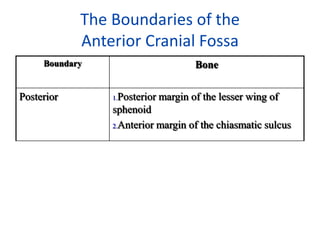
The Boundaries of the
            Anterior Cranial Fossa
     Boundary                      Bone


Posterior       1.Posterior margin of the lesser wing of
                sphenoid
                2.Anterior margin of the chiasmatic sulcus
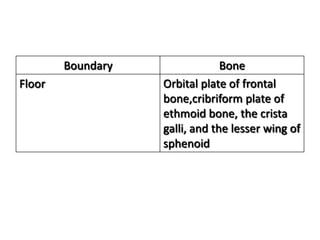
Boundary                Bone
Floor              Orbital plate of frontal
                   bone,cribriform plate of
                   ethmoid bone, the crista
                   galli, and the lesser wing of
                   sphenoid
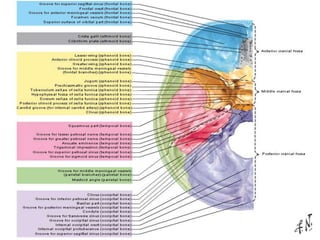
Special Features of the
             Anterior Cranial Fossa
1.   Frontal crest
2.   Foramen cecum
3.   Ethmoidal notch
4.   Crista galli
5.   Cribriform plate of ethmoid bone
6.   Jugum of sphenoid bone
7.   Anterior and posterior ethmoidal foramina
8.   Grooves for anterior meningeal vessels
Frontal crest

 - A ridge arising at the termination of the
 sagittal sulcus on the cerebral surface of
 the frontal bone and ending at the foramen
 cecum.

  - for anterior attachment of the falx
  cerebri
Foramen cecum

 - foramen varies in size in different
 subjects, and is frequently impervious;
 when open, it transmits a vein from the
 nose to the superior sagittal sinus.
Ethmoidal notch

 - separates the two orbital plates; it is
 quadrilateral, and filled, in the articulated
 skull, by the cribriform plate of the
 ethmoid.
Crista galli

- vertical plate of bone projecting upward
  along the midline from the cribriform
  plate. It is continuous below with the bony
  nasal septum and anchors the anterior end
  of the falx cerebri.
• Cribriform plate of ethmoid
  bone
 - is that horizontal part of the ethmoid
 bone between the midline and the
 frontoethmoidal suture. It is
 thin, perforated with many small holes and
 easily fractured. It forms the roof of the
 nasal cavity on each side.
Jugum of sphenoid bone

• a plane surface on the sphenoid bone, in
  front of the sella turcica, connecting the
  two lesser wings, and forming part of the
  anterior cranial fossa.
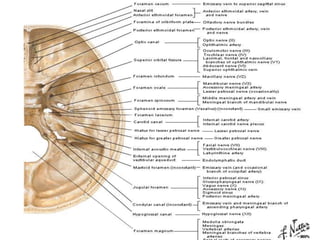
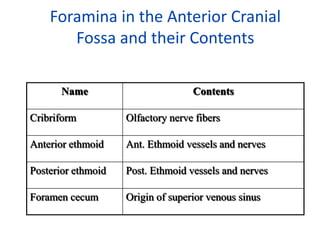
Foramina in the Anterior Cranial
       Fossa and their Contents

       Name                        Contents

Cribriform          Olfactory nerve fibers

Anterior ethmoid    Ant. Ethmoid vessels and nerves

Posterior ethmoid   Post. Ethmoid vessels and nerves

Foramen cecum       Origin of superior venous sinus
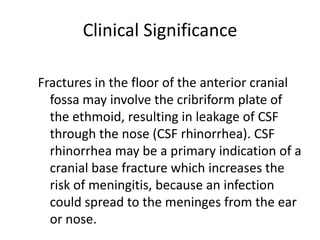
Clinical Significance

Fractures in the floor of the anterior cranial
  fossa may involve the cribriform plate of
  the ethmoid, resulting in leakage of CSF
  through the nose (CSF rhinorrhea). CSF
  rhinorrhea may be a primary indication of a
  cranial base fracture which increases the
  risk of meningitis, because an infection
  could spread to the meninges from the ear
  or nose.
THE MIDDLE CRANIAL FOSSA
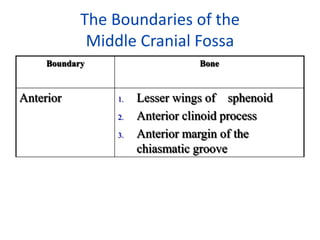
The Boundaries of the
             Middle Cranial Fossa
     Boundary                   Bone


Anterior        1.   Lesser wings of sphenoid
                2.   Anterior clinoid process
                3.   Anterior margin of the
                     chiasmatic groove
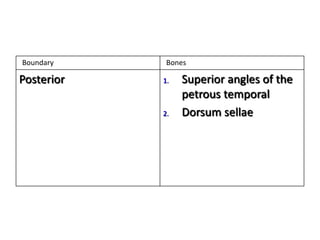
Boundary     Bones

Posterior   1.   Superior angles of the
                 petrous temporal
            2.   Dorsum sellae
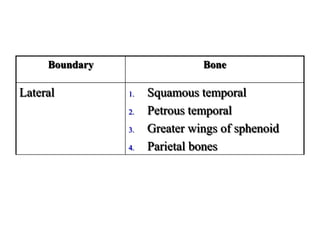
Boundary                  Bone

Lateral         1.   Squamous temporal
                2.   Petrous temporal
                3.   Greater wings of sphenoid
                4.   Parietal bones
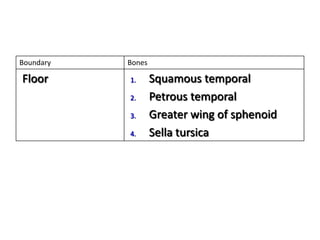
Boundary   Bones

Floor      1.      Squamous temporal
           2.      Petrous temporal
           3.      Greater wing of sphenoid
           4.      Sella tursica
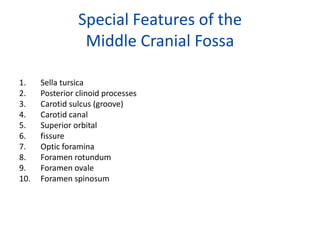
Special Features of the
                 Middle Cranial Fossa

1.    Sella tursica
2.    Posterior clinoid processes
3.    Carotid sulcus (groove)
4.    Carotid canal
5.    Superior orbital
6.    fissure
7.    Optic foramina
8.    Foramen rotundum
9.    Foramen ovale
10.   Foramen spinosum
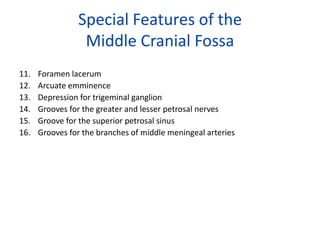
Special Features of the
                 Middle Cranial Fossa
11.   Foramen lacerum
12.   Arcuate emminence
13.   Depression for trigeminal ganglion
14.   Grooves for the greater and lesser petrosal nerves
15.   Groove for the superior petrosal sinus
16.   Grooves for the branches of middle meningeal arteries
Sella tursica

• A saddlelike prominence on the upper
  surface of the sphenoid bone of the skull,
  situated in the middle cranial fossa and
  dividing it into two halves.
• a depression on the upper surface of the
  sphenoid bone, lodging the pituitary gland.
Posterior clinoid processes
  Posterior angle of the dorsum sellae which
  deepen the sella turcica, and give attachment to
  the tentorium cerebelli.
Carotid sulcus (groove)
it lodges the internal carotid artery and the
     cavernous sinus.
Carotid canal
  is the large circular aperture On the interior
  surface of the temporal bone, behind the rough
  surface of the apex
Superior orbital fissure
  lies between the lesser and greater wings
  of the sphenoid bone. Through it pass
  the branches of the ophthalmic division of
  the trigeminal (V1), the oculomotor (III),
  trochlear (IV), and abducens (VI) nerves,
  and the superior ophthalmic vein.
Optic foramina
  the optic nerve and ophthalmic artery (with
  accompanying sympathetis nerve fibres) into
  the orbital cavity.
Foramen rotundum
  lies in the floor of the middle cranial fossa
  at the junction of the body and greater
  wing of the sphenoid. It transmits the
  maxillary division of the trigeminal nerve
  (V2) from the cranial cavity into the
  pterygopalatine fossa.
Foramen ovale
  is a large oval opening in the posterior part of
  the greater wing of the sphenoid, half-way
  across the floor of the middle cranial fossa. It
  transmits the mandibular division of the
  trigeminal nerve (V3) from the cranial cavity
  into the infratemporal fossa, along with the
  lesser petrosal branch of the glossopharyngeal
  nerve (IX).
Foramen spinosum
• small round hole in the greater wing of the
  sphenoid just posterolateral to the foramen
  ovale. The middle meningeal branch of the
  maxillary artery passes upward through the
  foramen into the middle cranial fossa,
  accompanied by its postganglionic
  sympathetic nerve plexus and the nervus
  spinosus, a recurrent meningeal branch of the
  mandibular division of the trigeminal nerve.
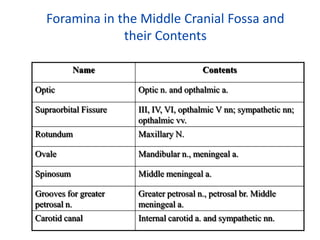
Foramina in the Middle Cranial Fossa and
                their Contents

           Name                          Contents

Optic                  Optic n. and opthalmic a.

Supraorbital Fissure   III, IV, VI, opthalmic V nn; sympathetic nn;
                       opthalmic vv.
Rotundum               Maxillary N.

Ovale                  Mandibular n., meningeal a.

Spinosum               Middle meningeal a.

Grooves for greater    Greater petrosal n., petrosal br. Middle
petrosal n.            meningeal a.
Carotid canal          Internal carotid a. and sympathetic nn.
THE POSTERIOR CRANIAL FOSSA
The Boundaries of the
            Posterior Cranial Fossa
     Boundary                    Bone


Anterior         1.   Dorsum sellae
                 2.   Basal occipital
                 3.   Crest of petrous temporal
Lateral             Parietal bone
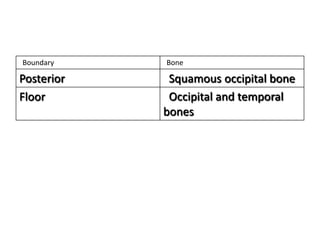
Boundary    Bone

Posterior    Squamous occipital bone
Floor        Occipital and temporal
            bones
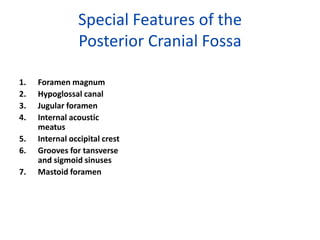
Special Features of the
                Posterior Cranial Fossa

1.   Foramen magnum
2.   Hypoglossal canal
3.   Jugular foramen
4.   Internal acoustic
     meatus
5.   Internal occipital crest
6.   Grooves for tansverse
     and sigmoid sinuses
7.   Mastoid foramen
Foramen magnum
the large slightly oval opening in the center of
  the floor of the posterior cranial fossa. The
  brain stem becomes continuous with the
  spinal cord through the foramen, while the
  spinal accessory nerves (XI) pass upward
  from cervical cord segments into the cranial
  cavity.
Hypoglossal canal

• pass anterolaterally through the occipital bone
  immediately above the occipital
  condyles. They transmit the hypoglossal (XII)
  nerves.
Jugular foramen
• a large, irregular widening of the petrooccipital
  suture below the internal auditory meatus. The
  sigmoid and inferior petrosal dural venous sinuses
  pass through the foramen to join the internal
  jugular vein in the jugular fossa. The
  glossopharyngeal (IX), vagus (X), and spinal
  accessory (XI) nerves also exit the posterior
  cranial fossa via the jugular foramen
Internal acoustic meatus
(also internal acoustic meatus, internal
    auditory canal, and internal acoustic
    canal) is a canal in the petrous part of the
    temporal bone of the skull that carries
    nerves from inside the cranium towards
    the middle and inner ear compartments
    namely cranial nerve VII and cranial nerve
    VIII.
Internal occipital crest
  gives attachment to the falx cerebelli
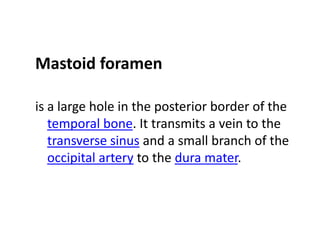
Mastoid foramen

is a large hole in the posterior border of the
   temporal bone. It transmits a vein to the
   transverse sinus and a small branch of the
   occipital artery to the dura mater.
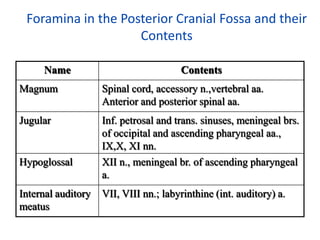
Foramina in the Posterior Cranial Fossa and their
                    Contents

     Name                              Contents
Magnum              Spinal cord, accessory n.,vertebral aa.
                    Anterior and posterior spinal aa.
Jugular             Inf. petrosal and trans. sinuses, meningeal brs.
                    of occipital and ascending pharyngeal aa.,
                    IX,X, XI nn.
Hypoglossal         XII n., meningeal br. of ascending pharyngeal
                    a.
Internal auditory   VII, VIII nn.; labyrinthine (int. auditory) a.
meatus
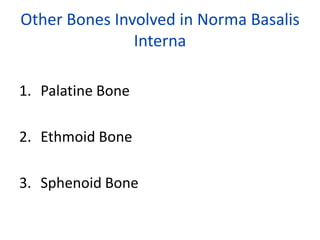
Other Bones Involved in Norma Basalis
               Interna

1. Palatine Bone

2. Ethmoid Bone

3. Sphenoid Bone
THE PALATINE BONE
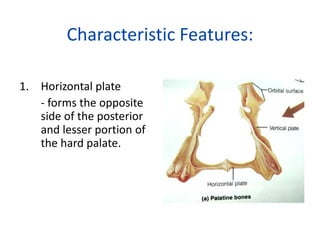
• A pair of L-shaped bones, presenting
  two main parts that are at right angles
  with each other
Characteristic Features:

1. Horizontal plate
   - forms the opposite
   side of the posterior
   and lesser portion of
   the hard palate.
2. Perpendicular part
   - The longer process
     found immediately
     in front of the
     medial pterygoid
     plate of sphenoid;
     it forms the lateral
     wall of the nasal
     cavity.
Characteristic Features of the Palatine
                 Bone
3.   Pyramidal process
     - is directed backwards
     and laterally from the
     junction of the horizontal
     and perpendicular plates.

4.   Orbital and sphenoidal
     recesses
     - two irregular
     projections that stand up
     from the upper end of the
     perpendicular plate.
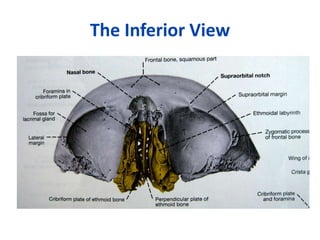
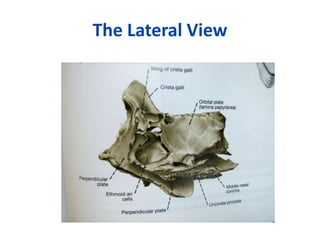
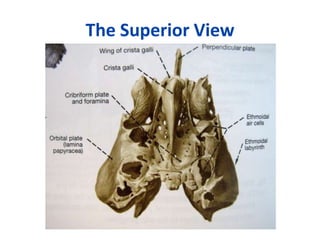
THE ETHMOID BONE
• Is irregular in shape, inserted into a notch
  between the orbital plates of the frontal
  bone, in front of the sphenoid bone. It
  forms part of the nasal, cranial, and orbital
  cavities.
Characteristic Features

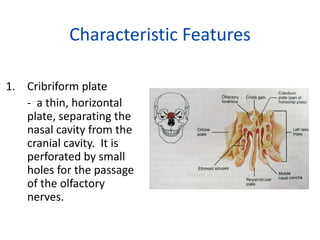
1. Cribriform plate
   - a thin, horizontal
   plate, separating the
   nasal cavity from the
   cranial cavity. It is
   perforated by small
   holes for the passage
   of the olfactory
   nerves.
2. Perpendicular plate
   - is an irregular pentagonal plate of bone
   forming the upper anterior part of the bony
   nasal septum.
   - extends upward as the crista galli which
   serves for the attachment of the falx cerebri.
3. Ethmoidal labyrinth
   - are found on each side of the
   perpendicular plate and contain air sinuses –
   the anterior, middle, and posterior
   ethmoidal paranasal sinuses.
The Inferior View
The Lateral View
The Superior View
THE SPHENOID BONE
Is found anterior to the occipital bone, between
   the two temporal bones at the base of the
   skull.
CHARACTERISTIC FEATURES OF THE SPHENOID
BONE
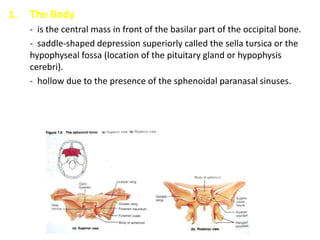
1.   The Body
     - is the central mass in front of the basilar part of the occipital bone.
     - saddle-shaped depression superiorly called the sella tursica or the
     hypophyseal fossa (location of the pituitary gland or hypophysis
     cerebri).
     - hollow due to the presence of the sphenoidal paranasal sinuses.
2. Greater wings
   - form the floor of the middle cranial fossa and the
   side of the skull. It is the location of the “ r o s”
   foramens.
3. Lesser wings
   - are flattened, triangular plates whose roots
   surround the optic foramen.
4. Pterygoid processes
   - is made up of the lateral and medial laminae
   enclosing the pterygoid fossa. Superior to the
   medial pterygoid is the scaphoid fossa while inferior
   to it is the pterygoid hamulus.

Norma basalis interna

  • 1.
  • 5.
  • 6.
    The Boundaries ofthe Anterior Cranial Fossa Boundary Bone Anterior Squamous frontal bone Laterally Squamous frontal bone Midline Ethmoid bone
  • 7.
    The Boundaries ofthe Anterior Cranial Fossa Boundary Bone Posterior 1.Posterior margin of the lesser wing of sphenoid 2.Anterior margin of the chiasmatic sulcus
  • 8.
    Boundary Bone Floor Orbital plate of frontal bone,cribriform plate of ethmoid bone, the crista galli, and the lesser wing of sphenoid
  • 9.
    Special Features ofthe Anterior Cranial Fossa 1. Frontal crest 2. Foramen cecum 3. Ethmoidal notch 4. Crista galli 5. Cribriform plate of ethmoid bone 6. Jugum of sphenoid bone 7. Anterior and posterior ethmoidal foramina 8. Grooves for anterior meningeal vessels
  • 10.
    Frontal crest -A ridge arising at the termination of the sagittal sulcus on the cerebral surface of the frontal bone and ending at the foramen cecum. - for anterior attachment of the falx cerebri
  • 11.
    Foramen cecum -foramen varies in size in different subjects, and is frequently impervious; when open, it transmits a vein from the nose to the superior sagittal sinus.
  • 12.
    Ethmoidal notch -separates the two orbital plates; it is quadrilateral, and filled, in the articulated skull, by the cribriform plate of the ethmoid.
  • 13.
    Crista galli - verticalplate of bone projecting upward along the midline from the cribriform plate. It is continuous below with the bony nasal septum and anchors the anterior end of the falx cerebri.
  • 14.
    • Cribriform plateof ethmoid bone - is that horizontal part of the ethmoid bone between the midline and the frontoethmoidal suture. It is thin, perforated with many small holes and easily fractured. It forms the roof of the nasal cavity on each side.
  • 15.
    Jugum of sphenoidbone • a plane surface on the sphenoid bone, in front of the sella turcica, connecting the two lesser wings, and forming part of the anterior cranial fossa.
  • 16.
    Foramina in theAnterior Cranial Fossa and their Contents Name Contents Cribriform Olfactory nerve fibers Anterior ethmoid Ant. Ethmoid vessels and nerves Posterior ethmoid Post. Ethmoid vessels and nerves Foramen cecum Origin of superior venous sinus
  • 17.
    Clinical Significance Fractures inthe floor of the anterior cranial fossa may involve the cribriform plate of the ethmoid, resulting in leakage of CSF through the nose (CSF rhinorrhea). CSF rhinorrhea may be a primary indication of a cranial base fracture which increases the risk of meningitis, because an infection could spread to the meninges from the ear or nose.
  • 18.
  • 19.
    The Boundaries ofthe Middle Cranial Fossa Boundary Bone Anterior 1. Lesser wings of sphenoid 2. Anterior clinoid process 3. Anterior margin of the chiasmatic groove
  • 20.
    Boundary Bones Posterior 1. Superior angles of the petrous temporal 2. Dorsum sellae
  • 21.
    Boundary Bone Lateral 1. Squamous temporal 2. Petrous temporal 3. Greater wings of sphenoid 4. Parietal bones
  • 22.
    Boundary Bones Floor 1. Squamous temporal 2. Petrous temporal 3. Greater wing of sphenoid 4. Sella tursica
  • 23.
    Special Features ofthe Middle Cranial Fossa 1. Sella tursica 2. Posterior clinoid processes 3. Carotid sulcus (groove) 4. Carotid canal 5. Superior orbital 6. fissure 7. Optic foramina 8. Foramen rotundum 9. Foramen ovale 10. Foramen spinosum
  • 24.
    Special Features ofthe Middle Cranial Fossa 11. Foramen lacerum 12. Arcuate emminence 13. Depression for trigeminal ganglion 14. Grooves for the greater and lesser petrosal nerves 15. Groove for the superior petrosal sinus 16. Grooves for the branches of middle meningeal arteries
  • 25.
    Sella tursica • Asaddlelike prominence on the upper surface of the sphenoid bone of the skull, situated in the middle cranial fossa and dividing it into two halves. • a depression on the upper surface of the sphenoid bone, lodging the pituitary gland.
  • 26.
    Posterior clinoid processes Posterior angle of the dorsum sellae which deepen the sella turcica, and give attachment to the tentorium cerebelli.
  • 27.
    Carotid sulcus (groove) itlodges the internal carotid artery and the cavernous sinus.
  • 28.
    Carotid canal is the large circular aperture On the interior surface of the temporal bone, behind the rough surface of the apex
  • 29.
    Superior orbital fissure lies between the lesser and greater wings of the sphenoid bone. Through it pass the branches of the ophthalmic division of the trigeminal (V1), the oculomotor (III), trochlear (IV), and abducens (VI) nerves, and the superior ophthalmic vein.
  • 30.
    Optic foramina the optic nerve and ophthalmic artery (with accompanying sympathetis nerve fibres) into the orbital cavity.
  • 31.
    Foramen rotundum lies in the floor of the middle cranial fossa at the junction of the body and greater wing of the sphenoid. It transmits the maxillary division of the trigeminal nerve (V2) from the cranial cavity into the pterygopalatine fossa.
  • 32.
    Foramen ovale is a large oval opening in the posterior part of the greater wing of the sphenoid, half-way across the floor of the middle cranial fossa. It transmits the mandibular division of the trigeminal nerve (V3) from the cranial cavity into the infratemporal fossa, along with the lesser petrosal branch of the glossopharyngeal nerve (IX).
  • 33.
    Foramen spinosum • smallround hole in the greater wing of the sphenoid just posterolateral to the foramen ovale. The middle meningeal branch of the maxillary artery passes upward through the foramen into the middle cranial fossa, accompanied by its postganglionic sympathetic nerve plexus and the nervus spinosus, a recurrent meningeal branch of the mandibular division of the trigeminal nerve.
  • 34.
    Foramina in theMiddle Cranial Fossa and their Contents Name Contents Optic Optic n. and opthalmic a. Supraorbital Fissure III, IV, VI, opthalmic V nn; sympathetic nn; opthalmic vv. Rotundum Maxillary N. Ovale Mandibular n., meningeal a. Spinosum Middle meningeal a. Grooves for greater Greater petrosal n., petrosal br. Middle petrosal n. meningeal a. Carotid canal Internal carotid a. and sympathetic nn.
  • 35.
  • 36.
    The Boundaries ofthe Posterior Cranial Fossa Boundary Bone Anterior 1. Dorsum sellae 2. Basal occipital 3. Crest of petrous temporal Lateral Parietal bone
  • 37.
    Boundary Bone Posterior Squamous occipital bone Floor Occipital and temporal bones
  • 38.
    Special Features ofthe Posterior Cranial Fossa 1. Foramen magnum 2. Hypoglossal canal 3. Jugular foramen 4. Internal acoustic meatus 5. Internal occipital crest 6. Grooves for tansverse and sigmoid sinuses 7. Mastoid foramen
  • 39.
    Foramen magnum the largeslightly oval opening in the center of the floor of the posterior cranial fossa. The brain stem becomes continuous with the spinal cord through the foramen, while the spinal accessory nerves (XI) pass upward from cervical cord segments into the cranial cavity.
  • 40.
    Hypoglossal canal • passanterolaterally through the occipital bone immediately above the occipital condyles. They transmit the hypoglossal (XII) nerves.
  • 41.
    Jugular foramen • alarge, irregular widening of the petrooccipital suture below the internal auditory meatus. The sigmoid and inferior petrosal dural venous sinuses pass through the foramen to join the internal jugular vein in the jugular fossa. The glossopharyngeal (IX), vagus (X), and spinal accessory (XI) nerves also exit the posterior cranial fossa via the jugular foramen
  • 42.
    Internal acoustic meatus (alsointernal acoustic meatus, internal auditory canal, and internal acoustic canal) is a canal in the petrous part of the temporal bone of the skull that carries nerves from inside the cranium towards the middle and inner ear compartments namely cranial nerve VII and cranial nerve VIII.
  • 43.
    Internal occipital crest gives attachment to the falx cerebelli
  • 44.
    Mastoid foramen is alarge hole in the posterior border of the temporal bone. It transmits a vein to the transverse sinus and a small branch of the occipital artery to the dura mater.
  • 45.
    Foramina in thePosterior Cranial Fossa and their Contents Name Contents Magnum Spinal cord, accessory n.,vertebral aa. Anterior and posterior spinal aa. Jugular Inf. petrosal and trans. sinuses, meningeal brs. of occipital and ascending pharyngeal aa., IX,X, XI nn. Hypoglossal XII n., meningeal br. of ascending pharyngeal a. Internal auditory VII, VIII nn.; labyrinthine (int. auditory) a. meatus
  • 46.
    Other Bones Involvedin Norma Basalis Interna 1. Palatine Bone 2. Ethmoid Bone 3. Sphenoid Bone
  • 47.
  • 48.
    • A pairof L-shaped bones, presenting two main parts that are at right angles with each other
  • 49.
    Characteristic Features: 1. Horizontalplate - forms the opposite side of the posterior and lesser portion of the hard palate.
  • 50.
    2. Perpendicular part - The longer process found immediately in front of the medial pterygoid plate of sphenoid; it forms the lateral wall of the nasal cavity.
  • 51.
    Characteristic Features ofthe Palatine Bone 3. Pyramidal process - is directed backwards and laterally from the junction of the horizontal and perpendicular plates. 4. Orbital and sphenoidal recesses - two irregular projections that stand up from the upper end of the perpendicular plate.
  • 52.
  • 53.
    • Is irregularin shape, inserted into a notch between the orbital plates of the frontal bone, in front of the sphenoid bone. It forms part of the nasal, cranial, and orbital cavities.
  • 54.
    Characteristic Features 1. Cribriformplate - a thin, horizontal plate, separating the nasal cavity from the cranial cavity. It is perforated by small holes for the passage of the olfactory nerves.
  • 55.
    2. Perpendicular plate - is an irregular pentagonal plate of bone forming the upper anterior part of the bony nasal septum. - extends upward as the crista galli which serves for the attachment of the falx cerebri.
  • 56.
    3. Ethmoidal labyrinth - are found on each side of the perpendicular plate and contain air sinuses – the anterior, middle, and posterior ethmoidal paranasal sinuses.
  • 57.
  • 58.
  • 59.
  • 60.
  • 61.
    Is found anteriorto the occipital bone, between the two temporal bones at the base of the skull.
  • 62.
    CHARACTERISTIC FEATURES OFTHE SPHENOID BONE
  • 63.
    1. The Body - is the central mass in front of the basilar part of the occipital bone. - saddle-shaped depression superiorly called the sella tursica or the hypophyseal fossa (location of the pituitary gland or hypophysis cerebri). - hollow due to the presence of the sphenoidal paranasal sinuses.
  • 64.
    2. Greater wings - form the floor of the middle cranial fossa and the side of the skull. It is the location of the “ r o s” foramens.
  • 65.
    3. Lesser wings - are flattened, triangular plates whose roots surround the optic foramen.
  • 66.
    4. Pterygoid processes - is made up of the lateral and medial laminae enclosing the pterygoid fossa. Superior to the medial pterygoid is the scaphoid fossa while inferior to it is the pterygoid hamulus.