GENETIC CODE
Jigar V. Patel
Lecturer
Department of Zoology
Government Science Collage, Vankal
Ta. Mangrol, Di. Surat-394430
Email. pateljigar1818@gmail.com
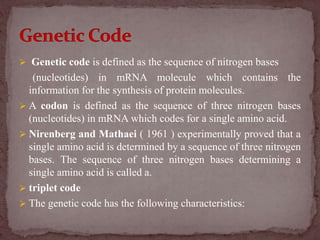
 Genetic code is defined as the sequence of nitrogen bases
(nucleotides) in mRNA molecule which contains the
information for the synthesis of protein molecules.
 A codon is defined as the sequence of three nitrogen bases
(nucleotides) in mRNA which codes for a single amino acid.
 Nirenberg and Mathaei ( 1961 ) experimentally proved that a
single amino acid is determined by a sequence of three nitrogen
bases. The sequence of three nitrogen bases determining a
single amino acid is called a.
 triplet code
 The genetic code has the following characteristics:
1. Triplet
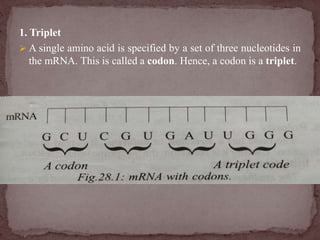
 A single amino acid is specified by a set of three nucleotides in
the mRNA. This is called a codon. Hence, a codon is a triplet.
2. Universal
 Genetic code is universal in nature. One type of code
determines the same amino acid in all organisms including
viruses, bacteria, plants and animals.
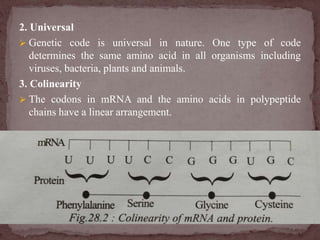
3. Colinearity
 The codons in mRNA and the amino acids in polypeptide
chains have a linear arrangement.
4. Commaless
 There is no comma or punctuation between the adjacent
Codons. That is, each codon is immediately followed by the
next codon without any spaces in between.
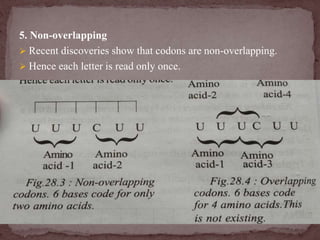
5. Non-overlapping
 Recent discoveries show that codons are non-overlapping.
 Hence each letter is read only once.
6. Polarity
 The code has a direction or polarity. It is read in only one
direction. Usually it is read from the S(5prime) end of mRNA.
7. Initiation Codon
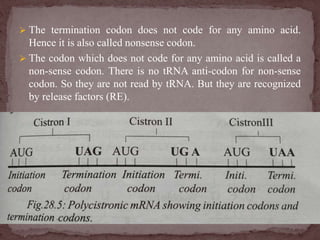
 The synthesis o/a polypeptide chain is initiated by a codon
called initiation codon. It is located in the beginning of a
cistron (gene). The initiation codon is constant in most cases. It
is AUG and it codes for the amino acid methionine.
8. Termination Codon
 The synthesis o/a polypeptide chain is completed by a codon
called termination codon. It is located at the end of a cistron.
The termination codon may be UAA, UGA or UAG.
 The termination codon does not code for any amino acid.
Hence it is also called nonsense codon.
 The codon which does not code for any amino acid is called a
non-sense codon. There is no tRNA anti-codon for non-sense
codon. So they are not read by tRNA. But they are recognized
by release factors (RE).
9. Codons and Anticodons
 The codons of mRNA can base pair with complementary
codons of tRNA. The codon of tRNA is called anti-codon. In
base pairing, the base A pairs with U and G with C.
 The codon in the mRNA is read from the 5/(5 prime end). So
the codon AUG, may be .written as 5/ AUG 3. The
corresponding anti-codon in the tRNA may be written as 5/
UAC Y. This means that the first base will be at the 5/ end in
both codon and anti-codon.
10. Degeneracy
 A single amino acid may be specified by many codons. This is
called degeneracy. Such codons are called degenerate codons.
For example, phenylalanine has two codons such as UUU and
CUC. Alanine has four codons such as GCU, GCC, GCA and
GCG.
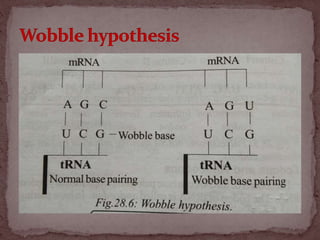
11. Wobble Hypothesis
 Wobble hypothesis was proposed by Crick in 1965. It explains
the property of anti-codons. According to this hypothesis. The
base can pair with the complementary base and also with a
non-complementary base. The first two bases of anti-codon in
the tRNA are specific in recognizing the codon in the mRNA
and the third base of anti-codon is less specific in recognizing
that codon. This non-specific third base is called wobble base.
The unusual base pairing of the wobble base is called wobble
pairing.
 For example, the anti-codon UCG of serine tRNA recognize
the codon A GC in the mRNA. Here the third base G of tRNA
pairs with C of mRNA. G-C pairing is the normal base pairing.
The anti-codon can also pair with another codon CCU. Here
the third base G of tRNA pairs with U of mRNA. The G-U is
an unusual pairing and it is called wobble base-pairing.
 Wobbliness of the third base helps the tRNA to carry more than
one amino acid.
ThankYou
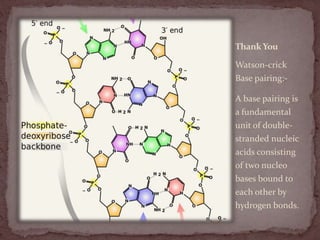
Watson-crick
Base pairing:-
A base pairing is
a fundamental
unit of double-
stranded nucleic
acids consisting
of two nucleo
bases bound to
each other by
hydrogen bonds.

Genetic code - Charateristics

  • 1.
    GENETIC CODE Jigar V.Patel Lecturer Department of Zoology Government Science Collage, Vankal Ta. Mangrol, Di. Surat-394430 Email. pateljigar1818@gmail.com
  • 2.
     Genetic codeis defined as the sequence of nitrogen bases (nucleotides) in mRNA molecule which contains the information for the synthesis of protein molecules.  A codon is defined as the sequence of three nitrogen bases (nucleotides) in mRNA which codes for a single amino acid.  Nirenberg and Mathaei ( 1961 ) experimentally proved that a single amino acid is determined by a sequence of three nitrogen bases. The sequence of three nitrogen bases determining a single amino acid is called a.  triplet code  The genetic code has the following characteristics:
  • 3.
    1. Triplet  Asingle amino acid is specified by a set of three nucleotides in the mRNA. This is called a codon. Hence, a codon is a triplet.
  • 4.
    2. Universal  Geneticcode is universal in nature. One type of code determines the same amino acid in all organisms including viruses, bacteria, plants and animals. 3. Colinearity  The codons in mRNA and the amino acids in polypeptide chains have a linear arrangement.
  • 5.
    4. Commaless  Thereis no comma or punctuation between the adjacent Codons. That is, each codon is immediately followed by the next codon without any spaces in between.
  • 6.
    5. Non-overlapping  Recentdiscoveries show that codons are non-overlapping.  Hence each letter is read only once.
  • 7.
    6. Polarity  Thecode has a direction or polarity. It is read in only one direction. Usually it is read from the S(5prime) end of mRNA. 7. Initiation Codon  The synthesis o/a polypeptide chain is initiated by a codon called initiation codon. It is located in the beginning of a cistron (gene). The initiation codon is constant in most cases. It is AUG and it codes for the amino acid methionine. 8. Termination Codon  The synthesis o/a polypeptide chain is completed by a codon called termination codon. It is located at the end of a cistron. The termination codon may be UAA, UGA or UAG.
  • 8.
     The terminationcodon does not code for any amino acid. Hence it is also called nonsense codon.  The codon which does not code for any amino acid is called a non-sense codon. There is no tRNA anti-codon for non-sense codon. So they are not read by tRNA. But they are recognized by release factors (RE).
  • 9.
    9. Codons andAnticodons  The codons of mRNA can base pair with complementary codons of tRNA. The codon of tRNA is called anti-codon. In base pairing, the base A pairs with U and G with C.  The codon in the mRNA is read from the 5/(5 prime end). So the codon AUG, may be .written as 5/ AUG 3. The corresponding anti-codon in the tRNA may be written as 5/ UAC Y. This means that the first base will be at the 5/ end in both codon and anti-codon. 10. Degeneracy  A single amino acid may be specified by many codons. This is called degeneracy. Such codons are called degenerate codons. For example, phenylalanine has two codons such as UUU and CUC. Alanine has four codons such as GCU, GCC, GCA and GCG.
  • 10.
    11. Wobble Hypothesis Wobble hypothesis was proposed by Crick in 1965. It explains the property of anti-codons. According to this hypothesis. The base can pair with the complementary base and also with a non-complementary base. The first two bases of anti-codon in the tRNA are specific in recognizing the codon in the mRNA and the third base of anti-codon is less specific in recognizing that codon. This non-specific third base is called wobble base. The unusual base pairing of the wobble base is called wobble pairing.
  • 11.
     For example,the anti-codon UCG of serine tRNA recognize the codon A GC in the mRNA. Here the third base G of tRNA pairs with C of mRNA. G-C pairing is the normal base pairing. The anti-codon can also pair with another codon CCU. Here the third base G of tRNA pairs with U of mRNA. The G-U is an unusual pairing and it is called wobble base-pairing.  Wobbliness of the third base helps the tRNA to carry more than one amino acid.
  • 13.
    ThankYou Watson-crick Base pairing:- A basepairing is a fundamental unit of double- stranded nucleic acids consisting of two nucleo bases bound to each other by hydrogen bonds.