PROTEINPROTEIN
SYNTHESISSYNTHESIS
1
DNADNA
ANDAND
GENESGENES
2
DNADNA
• DNA contains genes,
sequences of nucleotide
bases
• These Genes code for
polypeptides (proteins)
• Proteins are used to build
cells and do much of the
work inside cells 3
GENES & PROTEINSGENES & PROTEINS
Proteins are made of
amino acids linked
together by peptide
bonds
20 different amino acids
exist
4
AMINO ACIDAMINO ACID
STRUCTURESTRUCTURE
5
POLYPEPTIDESPOLYPEPTIDES
•Amino acid
chains are
called
polypeptides
6
DNA BEGINS THEDNA BEGINS THE
PROCESSPROCESS
• DNA is found inside the nucleus
• Proteins, however, are made in the cytoplasm of cells by
organelles called ribosomes
• Ribosomes may be free in the cytosol or attached to the
surface of rough ER
7
STARTING WITH DNASTARTING WITH DNA
• DNA ‘s codeDNA ‘s code must bemust be copiedcopied
and taken to the cytosoland taken to the cytosol
• In the cytoplasm, thisIn the cytoplasm, this codecode
must be readmust be read soso amino acidsamino acids
can be assembled to makecan be assembled to make
polypeptides (proteins)polypeptides (proteins)
• This process is calledThis process is called
PROTEIN SYNTHESISPROTEIN SYNTHESIS
8
RNARNA
9
ROLES OF RNA AND
DNA
•DNA is the MASTER
PLAN
•RNA is the BLUEPRINT
of the Master Plan
10
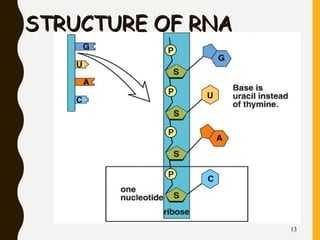
RNA DIFFERS FROM DNARNA DIFFERS FROM DNA
• RNA has a sugarRNA has a sugar riboseribose
DNA has a sugarDNA has a sugar deoxyribosedeoxyribose
11
OTHER DIFFERENCESOTHER DIFFERENCES
• RNA contains the baseRNA contains the base
uracil (Uuracil (U))
DNA hasDNA has thymine (T)thymine (T)
• RNA molecule isRNA molecule is single-single-
strandedstranded
DNA isDNA is double-strandeddouble-stranded
12
DNA
STRUCTURE OF RNASTRUCTURE OF RNA
13
THREE TYPES OF RNATHREE TYPES OF RNA
• Messenger RNA (mRNA)Messenger RNA (mRNA) copies DNA’s code & carriescopies DNA’s code & carries
the genetic information to the ribosomesthe genetic information to the ribosomes
• Ribosomal RNA (rRNA)Ribosomal RNA (rRNA), along with protein, makes up, along with protein, makes up
the ribosomesthe ribosomes
• Transfer RNA (tRNA)Transfer RNA (tRNA) transfers amino acids to thetransfers amino acids to the
ribosomes where proteins are synthesizedribosomes where proteins are synthesized
14
.
MESSENGER RNA
• Long Straight chain
of Nucleotides
• Made in the Nucleus
• Copies DNA & leaves
through nuclear pores
• Contains the Nitrogen
Bases A, G, C, U ( no
T )
15
MESSENGER RNA (MRNA)MESSENGER RNA (MRNA)
• Carries the information for aCarries the information for a specific proteinspecific protein
• Made up ofMade up of 500 to 1000 nucleotides long500 to 1000 nucleotides long
• Sequence of 3 bases calledSequence of 3 bases called codoncodon
• AUGAUG – methionine or– methionine or start codonstart codon
• UAA, UAG, or UGAUAA, UAG, or UGA –– stop codonsstop codons
16
RIBOSOMAL RNA (RRNA)RIBOSOMAL RNA (RRNA)
• rRNA is a singlerRNA is a single
strandstrand 100 to 3000100 to 3000
nucleotidesnucleotides longlong
• GlobularGlobular in shapein shape
• Made inside theMade inside the
nucleusnucleus of a cellof a cell
• Associates withAssociates with
proteins to formproteins to form
ribosomesribosomes
• Site ofSite of proteinprotein
SynthesisSynthesis
17
THE GENETIC CODE
• A codon designates an amino acid
• An amino acid may have more than one codon
• There are 20 amino acids, but 64 possible codons
• Some codons tell the ribosome to stop translating
18
THE GENETIC CODE
19
•Use the
code by
reading from
the center to
the outside
•Example:
AUG codes
for
Methionine
NAME THE AMINO
ACIDS
•GGG?
•UCA?
•CAU?
•GCA?
•AAA?
20
REMEMBER THEREMEMBER THE
COMPLEMENTARY BASESCOMPLEMENTARY BASES
On DNA:
A-T
C-G
On RNA:
A-U
C-G
21
TRANSFER RNA (TRNA)TRANSFER RNA (TRNA)
• Clover-leaf shape
• Single stranded molecule with attachment site at one end
for an amino acid
• Opposite end has three nucleotide bases called the
anticodon
22
TRANSFER RNATRANSFER RNA
23
amino acidamino acid
attachment siteattachment site
U A C
anticodonanticodon
CODONS AND
ANTICODONS
• The 3 bases of an
anticodon are
complementary to the
3 bases of a codon
• Example: Codon ACU
Anticodon UGA
24
UGA
ACU
TRANSCRIPTIONTRANSCRIPTION
ANDAND
TRANSLATIONTRANSLATION
25
PATHWAY TO MAKINGPATHWAY TO MAKING
A PROTEINA PROTEIN
DNADNA
mRNAmRNA
tRNA (ribosomes)tRNA (ribosomes)
ProteinProtein
26
PROTEINPROTEIN
SYNTHESISSYNTHESIS The production or synthesis of
polypeptide chains (proteins)
 Two phases:
Transcription & Translation
 mRNA must be processed
before it leaves the nucleus of
eukaryotic cells
27
DNADNA →→ RNARNA →→ PROTEINPROTEIN
28
Nuclear
membrane
TranscriptionTranscription
RNA ProcessingRNA Processing
TranslationTranslation
DNA
Pre-mRNA
mRNA
Ribosome
Protein
EukaryoticEukaryotic
CellCell
TRANSCRIPTIONTRANSCRIPTION
•The process of copying the
sequence of one strand of
DNA, the template strand
•mRNA copies the template
strand
•Requires the enzyme RNA
Polymerase
29
TEMPLATE STRAND
30
QUESTION:QUESTION:
What would be theWhat would be the
complementary RNA strandcomplementary RNA strand
for the following DNAfor the following DNA
sequence?sequence?
DNA 5’-DNA 5’-GCGTATGGCGTATG-3’-3’
31
ANSWER:ANSWER:
•DNA 5’-GCGTATG-3’DNA 5’-GCGTATG-3’
•RNA 3’-CGCAUAC-5’RNA 3’-CGCAUAC-5’
32
TRANSCRIPTIONTRANSCRIPTION
• During transcription, RNA polymerase binds to DNA and
separates the DNA strands
• RNA Polymerase then uses one strand of DNA as a
template to assemble nucleotides into RNA
33
TRANSCRIPTIONTRANSCRIPTION
• Promoters are regions on DNA that show where
RNA Polymerase must bind to begin the
Transcription of RNA
• Called the TATA box
• Specific base sequences act as signals to stop
• Called the termination signal
34
RNA POLYMERASERNA POLYMERASE
35
MRNA PROCESSINGMRNA PROCESSING
• After the DNA is
transcribed into RNA,
editing must be done to the
nucleotide chain to make the
RNA functional
• Introns, non-functional
segments of DNA are
snipped out of the chain
36
MRNA EDITINGMRNA EDITING
• Exons, segments of DNA that code for proteins, are then rejoined by the enzyme
ligase
• A guanine triphosphate cap is added to the 5” end of the newly copied mRNA
• A poly A tail is added to the 3’ end of the RNA
• The newly processed mRNA can then leave the nucleus
37
38CAP
TailNew Transcript
Result of TranscriptionResult of Transcription
MRNA TRANSCRIPT
39
•mRNA leaves the nucleus
through its pores and goes to
the ribosomes
TRANSLATIONTRANSLATION
•Translation is the process of
decoding the mRNA into a
polypeptide chain
•Ribosomes read mRNA three
bases or 1 codon at a time and
construct the proteins
40
41
TranscriptionTranscription
TranslationTranslation
RIBOSOMESRIBOSOMES
•Made of a large and small
subunit
•Composed of rRNA (40%)
and proteins (60%)
•Have two sites for tRNA
attachment --- P and A
42
STEP 1- INITIATIONSTEP 1- INITIATION
• mRNA transcript start
codon AUG attaches to the
small ribosomal subunit
• Small subunit attaches to
large ribosomal subunit
43
mRNA transcript
RIBOSOMESRIBOSOMES
44
P
Site
A
Site
Large
subunit
Small
subunit
mRNAmRNA
A U G C U A C U U C G
STEP 2 -
ELONGATION• As ribosome moves, two tRNA with
their amino acids move into site A and
P of the ribosome
• Peptide bonds join the amino acids
45
INITIATIONINITIATION
46
mRNAmRNA
A U G C U A C U U C G
2-tRNA
G
aa2
A U
A
1-tRNA
U A C
aa1
anticodon
hydrogen
bonds codon
47
mRNAmRNA
A U G C U A C U U C G
1-tRNA 2-tRNA
U A C G
aa1 aa2
A U
A
anticodon
hydrogen
bonds codon
peptide bond
3-tRNA
G A A
aa3
ElongationElongation
48
mRNAmRNA
A U G C U A C U U C G
1-tRNA
2-tRNA
U A C
G
aa1
aa2
A U
A
peptide bond
3-tRNA
G A A
aa3
Ribosomes move over one codon
(leaves)
49
mRNAmRNA
A U G C U A C U U C G
2-tRNA
G
aa1
aa2
A U
A
peptide bonds
3-tRNA
G A A
aa3
4-tRNA
G C U
aa4
A C U
50
mRNAmRNA
A U G C U A C U U C G
2-tRNA
G
aa1
aa2
A U
A
peptide bonds
3-tRNA
G A A
aa3
4-tRNA
G C U
aa4
A C U
(leaves)
Ribosomes move over one codon
51
mRNAmRNA
G C U A C U U C G
aa1
aa2
A
peptide bonds
3-tRNA
G A A
aa3
4-tRNA
G C U
aa4
A C U
U G A
5-tRNA
aa5
52
mRNAmRNA
G C U A C U U C G
aa1
aa2
A
peptide bonds
3-tRNA
G A A
aa3
4-tRNA
G C U
aa4
A C U
U G A
5-tRNA
aa5
Ribosomes move over one codon
53
mRNAmRNA
A C A U G U
aa1
aa2
U
primaryprimary
structurestructure
of a proteinof a protein
aa3
200-tRNA
aa4
U A G
aa5
C U
aa200
aa199
terminatorterminator
or stopor stop
codoncodon
TerminationTermination
END PRODUCT –THEEND PRODUCT –THE
PROTEIN!PROTEIN!• The end products of protein synthesis is a primary
structure of a protein
• A sequence of amino acid bonded together by
peptide bonds
54
aa1
aa2 aa3 aa4
aa5
aa200
aa199
MESSENGER RNAMESSENGER RNA
(MRNA)(MRNA)
55
methionine glycine serine isoleucine glycine alanine stop
codon
proteinprotein
A U G G G C U C C A U C G G C G C A U A AmRNAmRNA
start
codon
Primary structure of a proteinPrimary structure of a protein
aa1 aa2 aa3 aa4 aa5 aa6
peptide bonds
codon 2 codon 3 codon 4 codon 5 codon 6 codon 7codon 1

Central Dogma of DNA ANDRES

  • 1.
  • 2.
  • 3.
    DNADNA • DNA containsgenes, sequences of nucleotide bases • These Genes code for polypeptides (proteins) • Proteins are used to build cells and do much of the work inside cells 3
  • 4.
    GENES & PROTEINSGENES& PROTEINS Proteins are made of amino acids linked together by peptide bonds 20 different amino acids exist 4
  • 5.
  • 6.
  • 7.
    DNA BEGINS THEDNABEGINS THE PROCESSPROCESS • DNA is found inside the nucleus • Proteins, however, are made in the cytoplasm of cells by organelles called ribosomes • Ribosomes may be free in the cytosol or attached to the surface of rough ER 7
  • 8.
    STARTING WITH DNASTARTINGWITH DNA • DNA ‘s codeDNA ‘s code must bemust be copiedcopied and taken to the cytosoland taken to the cytosol • In the cytoplasm, thisIn the cytoplasm, this codecode must be readmust be read soso amino acidsamino acids can be assembled to makecan be assembled to make polypeptides (proteins)polypeptides (proteins) • This process is calledThis process is called PROTEIN SYNTHESISPROTEIN SYNTHESIS 8
  • 9.
  • 10.
    ROLES OF RNAAND DNA •DNA is the MASTER PLAN •RNA is the BLUEPRINT of the Master Plan 10
  • 11.
    RNA DIFFERS FROMDNARNA DIFFERS FROM DNA • RNA has a sugarRNA has a sugar riboseribose DNA has a sugarDNA has a sugar deoxyribosedeoxyribose 11
  • 12.
    OTHER DIFFERENCESOTHER DIFFERENCES •RNA contains the baseRNA contains the base uracil (Uuracil (U)) DNA hasDNA has thymine (T)thymine (T) • RNA molecule isRNA molecule is single-single- strandedstranded DNA isDNA is double-strandeddouble-stranded 12 DNA
  • 13.
  • 14.
    THREE TYPES OFRNATHREE TYPES OF RNA • Messenger RNA (mRNA)Messenger RNA (mRNA) copies DNA’s code & carriescopies DNA’s code & carries the genetic information to the ribosomesthe genetic information to the ribosomes • Ribosomal RNA (rRNA)Ribosomal RNA (rRNA), along with protein, makes up, along with protein, makes up the ribosomesthe ribosomes • Transfer RNA (tRNA)Transfer RNA (tRNA) transfers amino acids to thetransfers amino acids to the ribosomes where proteins are synthesizedribosomes where proteins are synthesized 14 .
  • 15.
    MESSENGER RNA • LongStraight chain of Nucleotides • Made in the Nucleus • Copies DNA & leaves through nuclear pores • Contains the Nitrogen Bases A, G, C, U ( no T ) 15
  • 16.
    MESSENGER RNA (MRNA)MESSENGERRNA (MRNA) • Carries the information for aCarries the information for a specific proteinspecific protein • Made up ofMade up of 500 to 1000 nucleotides long500 to 1000 nucleotides long • Sequence of 3 bases calledSequence of 3 bases called codoncodon • AUGAUG – methionine or– methionine or start codonstart codon • UAA, UAG, or UGAUAA, UAG, or UGA –– stop codonsstop codons 16
  • 17.
    RIBOSOMAL RNA (RRNA)RIBOSOMALRNA (RRNA) • rRNA is a singlerRNA is a single strandstrand 100 to 3000100 to 3000 nucleotidesnucleotides longlong • GlobularGlobular in shapein shape • Made inside theMade inside the nucleusnucleus of a cellof a cell • Associates withAssociates with proteins to formproteins to form ribosomesribosomes • Site ofSite of proteinprotein SynthesisSynthesis 17
  • 18.
    THE GENETIC CODE •A codon designates an amino acid • An amino acid may have more than one codon • There are 20 amino acids, but 64 possible codons • Some codons tell the ribosome to stop translating 18
  • 19.
    THE GENETIC CODE 19 •Usethe code by reading from the center to the outside •Example: AUG codes for Methionine
  • 20.
  • 21.
    REMEMBER THEREMEMBER THE COMPLEMENTARYBASESCOMPLEMENTARY BASES On DNA: A-T C-G On RNA: A-U C-G 21
  • 22.
    TRANSFER RNA (TRNA)TRANSFERRNA (TRNA) • Clover-leaf shape • Single stranded molecule with attachment site at one end for an amino acid • Opposite end has three nucleotide bases called the anticodon 22
  • 23.
    TRANSFER RNATRANSFER RNA 23 aminoacidamino acid attachment siteattachment site U A C anticodonanticodon
  • 24.
    CODONS AND ANTICODONS • The3 bases of an anticodon are complementary to the 3 bases of a codon • Example: Codon ACU Anticodon UGA 24 UGA ACU
  • 25.
  • 26.
    PATHWAY TO MAKINGPATHWAYTO MAKING A PROTEINA PROTEIN DNADNA mRNAmRNA tRNA (ribosomes)tRNA (ribosomes) ProteinProtein 26
  • 27.
    PROTEINPROTEIN SYNTHESISSYNTHESIS The productionor synthesis of polypeptide chains (proteins)  Two phases: Transcription & Translation  mRNA must be processed before it leaves the nucleus of eukaryotic cells 27
  • 28.
    DNADNA →→ RNARNA→→ PROTEINPROTEIN 28 Nuclear membrane TranscriptionTranscription RNA ProcessingRNA Processing TranslationTranslation DNA Pre-mRNA mRNA Ribosome Protein EukaryoticEukaryotic CellCell
  • 29.
    TRANSCRIPTIONTRANSCRIPTION •The process ofcopying the sequence of one strand of DNA, the template strand •mRNA copies the template strand •Requires the enzyme RNA Polymerase 29
  • 30.
  • 31.
    QUESTION:QUESTION: What would betheWhat would be the complementary RNA strandcomplementary RNA strand for the following DNAfor the following DNA sequence?sequence? DNA 5’-DNA 5’-GCGTATGGCGTATG-3’-3’ 31
  • 32.
  • 33.
    TRANSCRIPTIONTRANSCRIPTION • During transcription,RNA polymerase binds to DNA and separates the DNA strands • RNA Polymerase then uses one strand of DNA as a template to assemble nucleotides into RNA 33
  • 34.
    TRANSCRIPTIONTRANSCRIPTION • Promoters areregions on DNA that show where RNA Polymerase must bind to begin the Transcription of RNA • Called the TATA box • Specific base sequences act as signals to stop • Called the termination signal 34
  • 35.
  • 36.
    MRNA PROCESSINGMRNA PROCESSING •After the DNA is transcribed into RNA, editing must be done to the nucleotide chain to make the RNA functional • Introns, non-functional segments of DNA are snipped out of the chain 36
  • 37.
    MRNA EDITINGMRNA EDITING •Exons, segments of DNA that code for proteins, are then rejoined by the enzyme ligase • A guanine triphosphate cap is added to the 5” end of the newly copied mRNA • A poly A tail is added to the 3’ end of the RNA • The newly processed mRNA can then leave the nucleus 37
  • 38.
    38CAP TailNew Transcript Result ofTranscriptionResult of Transcription
  • 39.
    MRNA TRANSCRIPT 39 •mRNA leavesthe nucleus through its pores and goes to the ribosomes
  • 40.
    TRANSLATIONTRANSLATION •Translation is theprocess of decoding the mRNA into a polypeptide chain •Ribosomes read mRNA three bases or 1 codon at a time and construct the proteins 40
  • 41.
  • 42.
    RIBOSOMESRIBOSOMES •Made of alarge and small subunit •Composed of rRNA (40%) and proteins (60%) •Have two sites for tRNA attachment --- P and A 42
  • 43.
    STEP 1- INITIATIONSTEP1- INITIATION • mRNA transcript start codon AUG attaches to the small ribosomal subunit • Small subunit attaches to large ribosomal subunit 43 mRNA transcript
  • 44.
  • 45.
    STEP 2 - ELONGATION•As ribosome moves, two tRNA with their amino acids move into site A and P of the ribosome • Peptide bonds join the amino acids 45
  • 46.
    INITIATIONINITIATION 46 mRNAmRNA A U GC U A C U U C G 2-tRNA G aa2 A U A 1-tRNA U A C aa1 anticodon hydrogen bonds codon
  • 47.
    47 mRNAmRNA A U GC U A C U U C G 1-tRNA 2-tRNA U A C G aa1 aa2 A U A anticodon hydrogen bonds codon peptide bond 3-tRNA G A A aa3 ElongationElongation
  • 48.
    48 mRNAmRNA A U GC U A C U U C G 1-tRNA 2-tRNA U A C G aa1 aa2 A U A peptide bond 3-tRNA G A A aa3 Ribosomes move over one codon (leaves)
  • 49.
    49 mRNAmRNA A U GC U A C U U C G 2-tRNA G aa1 aa2 A U A peptide bonds 3-tRNA G A A aa3 4-tRNA G C U aa4 A C U
  • 50.
    50 mRNAmRNA A U GC U A C U U C G 2-tRNA G aa1 aa2 A U A peptide bonds 3-tRNA G A A aa3 4-tRNA G C U aa4 A C U (leaves) Ribosomes move over one codon
  • 51.
    51 mRNAmRNA G C UA C U U C G aa1 aa2 A peptide bonds 3-tRNA G A A aa3 4-tRNA G C U aa4 A C U U G A 5-tRNA aa5
  • 52.
    52 mRNAmRNA G C UA C U U C G aa1 aa2 A peptide bonds 3-tRNA G A A aa3 4-tRNA G C U aa4 A C U U G A 5-tRNA aa5 Ribosomes move over one codon
  • 53.
    53 mRNAmRNA A C AU G U aa1 aa2 U primaryprimary structurestructure of a proteinof a protein aa3 200-tRNA aa4 U A G aa5 C U aa200 aa199 terminatorterminator or stopor stop codoncodon TerminationTermination
  • 54.
    END PRODUCT –THEENDPRODUCT –THE PROTEIN!PROTEIN!• The end products of protein synthesis is a primary structure of a protein • A sequence of amino acid bonded together by peptide bonds 54 aa1 aa2 aa3 aa4 aa5 aa200 aa199
  • 55.
    MESSENGER RNAMESSENGER RNA (MRNA)(MRNA) 55 methionineglycine serine isoleucine glycine alanine stop codon proteinprotein A U G G G C U C C A U C G G C G C A U A AmRNAmRNA start codon Primary structure of a proteinPrimary structure of a protein aa1 aa2 aa3 aa4 aa5 aa6 peptide bonds codon 2 codon 3 codon 4 codon 5 codon 6 codon 7codon 1

Editor's Notes

  • #14 Like DNA, RNA is a polymer of nucleotides. In an RNA nucleotide, the sugar ribose is attached to a phosphate molecule and to a base, either G, U, A, or C. Notice that in RNA, the base uracil replaces thymine as one of the pyrimidine bases. RNA is single-stranded, whereas DNA is double-stranded.
  • #42 Transcription occurs when DNA acts as a template for mRNA synthesis. Translation occurs when the sequence of the mRNA codons determines the sequence of amino acids in a protein.