The Oral Cavity
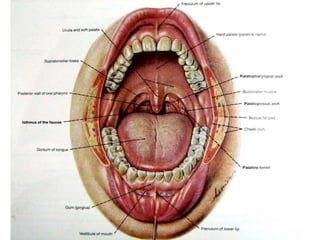
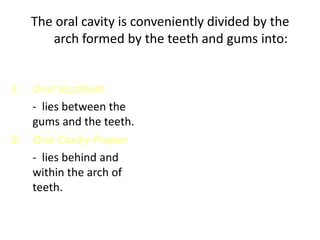
The oral cavity is conveniently divided by the
      arch formed by the teeth and gums into:


1. Oral Vestibule
   - lies between the
   gums and the teeth.
2. Oral Cavity Proper
   - lies behind and
   within the arch of
   teeth.
THE ORAL VESTIBULE
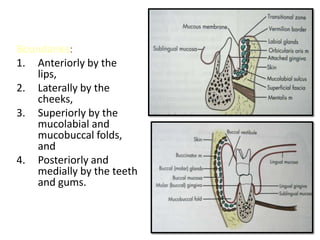
Boundaries:
1. Anteriorly by the
   lips,
2. Laterally by the
   cheeks,
3. Superiorly by the
   mucolabial and
   mucobuccal folds,
   and
4. Posteriorly and
   medially by the teeth
   and gums.
THE ORAL CAVITY PROPER
Boundaries:
1.   Anteriorly and
     laterally by the teeth
     and gums,
2.   Superiorly by the
     palate (hard and
     soft),
3.   Inferiorly by the
     tongue and the floor
     of the mouth, and
4.   Posteriorly by the
     opening into the
     pharynx.
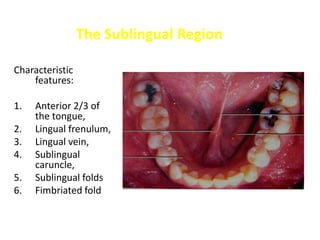
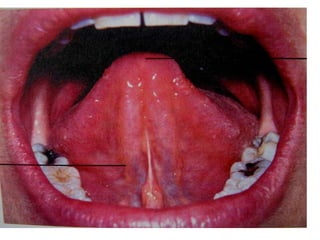
The Sublingual Region

Characteristic
    features:

1.   Anterior 2/3 of
     the tongue,
2.   Lingual frenulum,
3.   Lingual vein,
4.   Sublingual
     caruncle,
5.   Sublingual folds
6.   Fimbriated fold
Gums and Gingivae
- consist of dense vascular fibrous tissue which
  is covered by mucous membrane and is
  attached to the alveolar margins of the jaw.

- they are continuous with the mucosa of the
  oral vestibule externally and the palate or the
  floor of the mouth internally.
Hard and Soft Palate

The palate forms the superior wall or the roof of
  the oral cavity proper. It is composed of the
  hard palate which has an osseous base, and
  behind, a soft palate composed of fibrous
  tissue.
THE HARD PALATE
- Covered by mucoperiosteum and forms a
partition between the oral and nasal cavities.

- mucoperiosteum is thin in the middle but thicker
at the sides due to the presence of numerous
glands

- formed by the palatine process of the maxilla
and the horizontal plate of the palatine bone.
Characteristic Features:
1.   Median raphe is a
     longitudinal ridge
     extending from the
     uvula to the incisive
     papilla.

2.   Incisive papilla is a
     small projection of the
     mucosa indicating the
     location of the incisive
     foramen and the
     anterior limit of the
     median raphe.
3.   Transverse palatine
     process or palatine rugae
     are about six distinct
     elevation crossing the
     anterior part of the hard
     palate.

4.   Fovea palatine are small
     inconstant pits on the
     posterior margin of the
     hard palate on either
     side of the median
     raphe.
THE SOFT PALATE
Is the posterior movable portion of the palate,
   extending from one side of the pharynx to the
   other, and attached to the posterior border of
   the hard palate.
Characteristic Features:
1.   Uvula is the median conical
     projection marked by
     median raphe.

2.   Palatine arches are free
     margins of the soft palate
     and splitting into two parts
     as they approach the lateral
     wall.
         a. Palatoglossal arch or
     anterior pillar of fauces or
     anterior palatine arch
     encloses the palatoglossus
     muscle.
         b. Palatapharyngeal arch
     or posterior pillar of fauces
     or posterior palatine arch
     encloses the
     palatopharyngeus muscle.
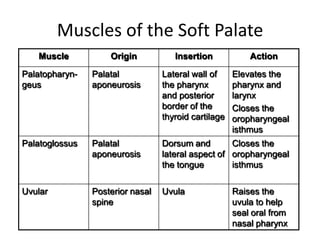
Muscles of the Soft Palate
   Muscle           Origin           Insertion            Action

Palatopharyn-   Palatal           Lateral wall of     Elevates the
geus            aponeurosis       the pharynx         pharynx and
                                  and posterior       larynx
                                  border of the       Closes the
                                  thyroid cartilage   oropharyngeal
                                                      isthmus
Palatoglossus   Palatal           Dorsum and        Closes the
                aponeurosis       lateral aspect of oropharyngeal
                                  the tongue        isthmus

Uvular          Posterior nasal   Uvula               Raises the
                spine                                 uvula to help
                                                      seal oral from
                                                      nasal pharynx
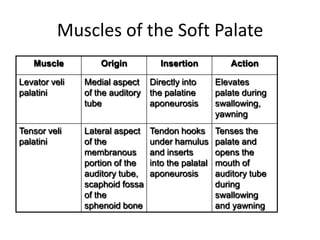
Muscles of the Soft Palate
   Muscle          Origin          Insertion           Action

Levator veli   Medial aspect     Directly into      Elevates
palatini       of the auditory   the palatine       palate during
               tube              aponeurosis        swallowing,
                                                    yawning
Tensor veli    Lateral aspect    Tendon hooks       Tenses the
palatini       of the            under hamulus      palate and
               membranous        and inserts        opens the
               portion of the    into the palatal   mouth of
               auditory tube,    aponeurosis        auditory tube
               scaphoid fossa                       during
               of the                               swallowing
               sphenoid bone                        and yawning
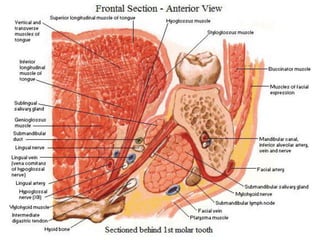
THE TONGUE
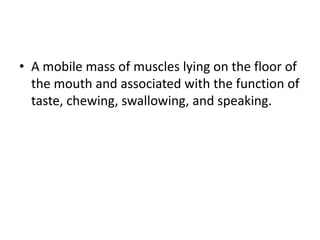
• A mobile mass of muscles lying on the floor of
  the mouth and associated with the function of
  taste, chewing, swallowing, and speaking.
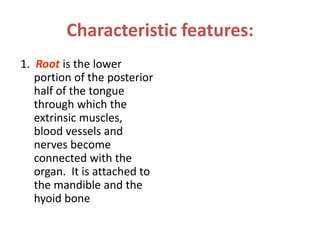
Characteristic features:
1. Root is the lower
   portion of the posterior
   half of the tongue
   through which the
   extrinsic muscles,
   blood vessels and
   nerves become
   connected with the
   organ. It is attached to
   the mandible and the
   hyoid bone
2.   Body anterior part of the
     tongue, made up of
     interlacing skeletal
     muscles.
3.   Margins are the lateral
     portion of the tongue,
     free and blunt, in relation
     to the gums and teeth.
4.   Tip or apex is the pointed
     and free anterior end.
5.   Inferior surface is seen
     when the tongue is
     turned upwards.
6.   Dorsum linguae is slightly
     convex antero-posteriorly,
     divided into 2 parts by a V-
     shaped groove – the SULCUS
     TERMINALIS or LINEA
     TERMINALIS.
     Parts:
     a. Palatine part is visible
     when the mouth is opened,
     covered by papillae.
     b. Median sulcus is a faint
     groove separating the
     palatine part into
     symmetrical parts.
     c. Foramen caecum is a
     small pit at the apex of the
     sulcus terminalis.
     d. Pharyngeal part is the
     posterior 2/3s of the tongue
     which contains serous glands
     and nodules of lymphoid
     tissue – LINGUAL FOLLICLES.
     e. Glosso-epiglottic fold is
     the reflection of the mucous
     membrane of the tongue on
     to the epiglottis producing
     elevation.
THE LINGUAL PAPILLAE
1. Vallate or circumvallate papillae are the largest,
   numbering from 7-12, and are arranged in front of
   the sulcus terminalis.
2. Fungiform papillae are fewer in number and are
   limited to the tip and margins of the tongue.
3. Filiform papillae are the smallest and the most
   numerous, scattered all over the anterior 2/3 of
   the dorsum of the tongue.
The Taste Buds
- are receptor organs for the special
sensation of taste. They are pale oval bodies
most of which are located surrounding the
vallate papillae; a few are found on the
fungiform and foliate papillae. A few taste
buds are scattered through the epithelium of
the oral surface of the soft palate, the
posterior wall of the pharynx, and the
epiglottis.
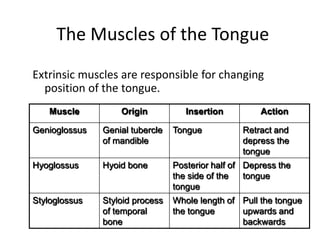
The Muscles of the Tongue
Extrinsic muscles are responsible for changing
  position of the tongue.
    Muscle         Origin           Insertion         Action

Genioglossus   Genial tubercle   Tongue           Retract and
               of mandible                        depress the
                                                  tongue
Hyoglossus     Hyoid bone        Posterior half of Depress the
                                 the side of the   tongue
                                 tongue
Styloglossus   Styloid process   Whole length of Pull the tongue
               of temporal       the tongue      upwards and
               bone                              backwards
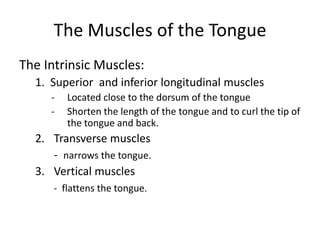
The Muscles of the Tongue
The Intrinsic Muscles:
  1. Superior and inferior longitudinal muscles
     -   Located close to the dorsum of the tongue
     -   Shorten the length of the tongue and to curl the tip of
         the tongue and back.
  2. Transverse muscles
     - narrows the tongue.
  3. Vertical muscles
      - flattens the tongue.
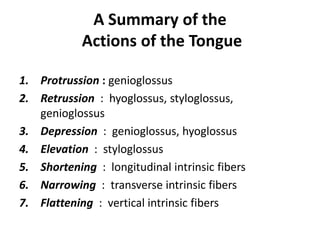
A Summary of the
            Actions of the Tongue

1. Protrussion : genioglossus
2. Retrussion : hyoglossus, styloglossus,
   genioglossus
3. Depression : genioglossus, hyoglossus
4. Elevation : styloglossus
5. Shortening : longitudinal intrinsic fibers
6. Narrowing : transverse intrinsic fibers
7. Flattening : vertical intrinsic fibers
CLINICAL NOTES
Paralyzed Tongue
a fractured mandible may damage the
hypoglossal nerve to pull the tongue to the
same side. General anesthesia results in
looseness, or flaccidity, of muscles. A
paralyzed or flaccid tongue tends to fall back
into the airway, causing suffocation, unless a
patent airway is maintained.
Tongue Tie

A large lingual frenulum can limit the
  mobility of the tongue and interfere with
  speech. The condition is easily repaired
  by cutting the frenulum (lingual
  frenectomy).
The Salivary Glands and
Accessory Glands of the Oral
           Cavity
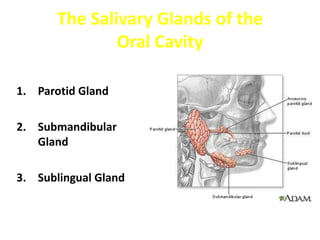
The Salivary Glands of the
               Oral Cavity

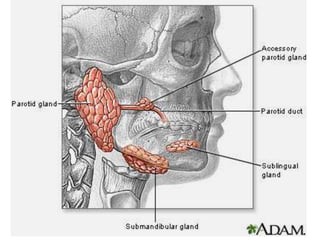
1. Parotid Gland

2. Submandibular
   Gland

3. Sublingual Gland
The Parotid Gland
The Parotid Gland
The parotid gland is one of
  the three major salivary
  glands that produce and
  secrete saliva for the
  oral cavity.

weight: about 14 to 28 g.

color :yellowish in the
      fresh state

composition: serous
  secreting units
Location and Relations
                  of the Parotid Gland
A.   Anterior surface: lies
     against the posterior
     border of the ramus of
     the mandible

B.   Posterior surface: on
     the external auditory
     meatus and
     sternocleidomastoid
     muscle
B.   Superficial surface:
     lobulated, covered by
     skin, fascia, lymph
     nodes, and facial
     branches of the great
     auricular nerve.

C.   Deep surface: styloid
     process and its
     muscles as well as
     under the mastoid and
     sternocleidomastoid
     muscles.
Capsule of the Parotid Gland
-The gland is wrapped in a fibrous capsule, which is
    continuous with the deep investing fascia of the
    neck.
-The stylomandibular ligament is an anterior thickening
    of the capsule, which runs from the styloid process
    to the angle of the mandible. –
-It separates the parotid gland from the infratemporal
    fossa anteriorly and separates the parotid gland
    from the submandibular gland inferiorly and
    anteriorly.
The Parotid Duct
From the rostral border of
   the gland, crosses
   masseter muscle, turns
   inward to pierce the fat
   pad of the cheek and
   then the buccinator
   muscle, to open into
   the mouth opposite
   the second maxillary
   molar. Approximately 5
   cm. long.
CLINICAL CONSIDERATIONS
1. A viral inflammation of the parotid gland
   (mumps) causes it to swell, resulting to pain
   on movement of the jaw.
2. Abcesses or cysts of the gland may result in
   pressure to the facial nerve
3. Stones or calculi in the duct can block it,
   causing painful swelling of the gland.
The Submandibular Gland
Type:
It is a mixed serous and mucous secreting
   gland.

Location:
It is found partly in the submandibular fossa
   below the mylohyoid muscle and partly in
   the floor of the mouth.
Duct:
The submandibular duct (Wharton’s) arises from
  the medial surface of the gland and
  accompanies it under the mlohyoid muscle; it
  passes diagonally across the medial aspect of
  the sublingual gland and adheres to it. It opens
  at the sublingual papillae (sublingual caruncle)
  beside the base of the lingual frenulum.
The Sublingual Gland
The smallest of the three major salivary glands
  and rests upon the mylohyoid muscle in the
  sublingual fossa close to the symphysis. It is
  primarily a mucous secreting gland.
Location:
  The gland, indicated by the subligual fold is
  found between the alveolus and the anterior
  part of the tongue.

Ducts:
  The gland has many lesser sublingual ducts
  (Rivini’s) that opens separately at the floor of
  the mouth and a greater sublingual duct
  (Bartholin’s) that opens on the sublingual
  caruncle together with the Wharton’s duct.
The Accessory Glands
Beside the main salivary glands, many others
exists: some in the tongue, others around and
in the palatine tonsil between its crypts, with
the large number in the soft palate, the
posterior part of the hard palate, the lips and
the cheeks. These are similar in structure to
larger salivary glands and are mainly mucous
type.

The oral cavity

  • 1.
  • 3.
    The oral cavityis conveniently divided by the arch formed by the teeth and gums into: 1. Oral Vestibule - lies between the gums and the teeth. 2. Oral Cavity Proper - lies behind and within the arch of teeth.
  • 4.
  • 5.
    Boundaries: 1. Anteriorly bythe lips, 2. Laterally by the cheeks, 3. Superiorly by the mucolabial and mucobuccal folds, and 4. Posteriorly and medially by the teeth and gums.
  • 6.
  • 7.
    Boundaries: 1. Anteriorly and laterally by the teeth and gums, 2. Superiorly by the palate (hard and soft), 3. Inferiorly by the tongue and the floor of the mouth, and 4. Posteriorly by the opening into the pharynx.
  • 8.
    The Sublingual Region Characteristic features: 1. Anterior 2/3 of the tongue, 2. Lingual frenulum, 3. Lingual vein, 4. Sublingual caruncle, 5. Sublingual folds 6. Fimbriated fold
  • 10.
    Gums and Gingivae -consist of dense vascular fibrous tissue which is covered by mucous membrane and is attached to the alveolar margins of the jaw. - they are continuous with the mucosa of the oral vestibule externally and the palate or the floor of the mouth internally.
  • 11.
    Hard and SoftPalate The palate forms the superior wall or the roof of the oral cavity proper. It is composed of the hard palate which has an osseous base, and behind, a soft palate composed of fibrous tissue.
  • 12.
  • 13.
    - Covered bymucoperiosteum and forms a partition between the oral and nasal cavities. - mucoperiosteum is thin in the middle but thicker at the sides due to the presence of numerous glands - formed by the palatine process of the maxilla and the horizontal plate of the palatine bone.
  • 14.
    Characteristic Features: 1. Median raphe is a longitudinal ridge extending from the uvula to the incisive papilla. 2. Incisive papilla is a small projection of the mucosa indicating the location of the incisive foramen and the anterior limit of the median raphe.
  • 15.
    3. Transverse palatine process or palatine rugae are about six distinct elevation crossing the anterior part of the hard palate. 4. Fovea palatine are small inconstant pits on the posterior margin of the hard palate on either side of the median raphe.
  • 16.
  • 17.
    Is the posteriormovable portion of the palate, extending from one side of the pharynx to the other, and attached to the posterior border of the hard palate.
  • 18.
    Characteristic Features: 1. Uvula is the median conical projection marked by median raphe. 2. Palatine arches are free margins of the soft palate and splitting into two parts as they approach the lateral wall. a. Palatoglossal arch or anterior pillar of fauces or anterior palatine arch encloses the palatoglossus muscle. b. Palatapharyngeal arch or posterior pillar of fauces or posterior palatine arch encloses the palatopharyngeus muscle.
  • 19.
    Muscles of theSoft Palate Muscle Origin Insertion Action Palatopharyn- Palatal Lateral wall of Elevates the geus aponeurosis the pharynx pharynx and and posterior larynx border of the Closes the thyroid cartilage oropharyngeal isthmus Palatoglossus Palatal Dorsum and Closes the aponeurosis lateral aspect of oropharyngeal the tongue isthmus Uvular Posterior nasal Uvula Raises the spine uvula to help seal oral from nasal pharynx
  • 20.
    Muscles of theSoft Palate Muscle Origin Insertion Action Levator veli Medial aspect Directly into Elevates palatini of the auditory the palatine palate during tube aponeurosis swallowing, yawning Tensor veli Lateral aspect Tendon hooks Tenses the palatini of the under hamulus palate and membranous and inserts opens the portion of the into the palatal mouth of auditory tube, aponeurosis auditory tube scaphoid fossa during of the swallowing sphenoid bone and yawning
  • 21.
  • 22.
    • A mobilemass of muscles lying on the floor of the mouth and associated with the function of taste, chewing, swallowing, and speaking.
  • 23.
    Characteristic features: 1. Rootis the lower portion of the posterior half of the tongue through which the extrinsic muscles, blood vessels and nerves become connected with the organ. It is attached to the mandible and the hyoid bone
  • 24.
    2. Body anterior part of the tongue, made up of interlacing skeletal muscles. 3. Margins are the lateral portion of the tongue, free and blunt, in relation to the gums and teeth. 4. Tip or apex is the pointed and free anterior end. 5. Inferior surface is seen when the tongue is turned upwards.
  • 25.
    6. Dorsum linguae is slightly convex antero-posteriorly, divided into 2 parts by a V- shaped groove – the SULCUS TERMINALIS or LINEA TERMINALIS. Parts: a. Palatine part is visible when the mouth is opened, covered by papillae. b. Median sulcus is a faint groove separating the palatine part into symmetrical parts. c. Foramen caecum is a small pit at the apex of the sulcus terminalis. d. Pharyngeal part is the posterior 2/3s of the tongue which contains serous glands and nodules of lymphoid tissue – LINGUAL FOLLICLES. e. Glosso-epiglottic fold is the reflection of the mucous membrane of the tongue on to the epiglottis producing elevation.
  • 26.
  • 27.
    1. Vallate orcircumvallate papillae are the largest, numbering from 7-12, and are arranged in front of the sulcus terminalis. 2. Fungiform papillae are fewer in number and are limited to the tip and margins of the tongue. 3. Filiform papillae are the smallest and the most numerous, scattered all over the anterior 2/3 of the dorsum of the tongue.
  • 28.
    The Taste Buds -are receptor organs for the special sensation of taste. They are pale oval bodies most of which are located surrounding the vallate papillae; a few are found on the fungiform and foliate papillae. A few taste buds are scattered through the epithelium of the oral surface of the soft palate, the posterior wall of the pharynx, and the epiglottis.
  • 29.
    The Muscles ofthe Tongue Extrinsic muscles are responsible for changing position of the tongue. Muscle Origin Insertion Action Genioglossus Genial tubercle Tongue Retract and of mandible depress the tongue Hyoglossus Hyoid bone Posterior half of Depress the the side of the tongue tongue Styloglossus Styloid process Whole length of Pull the tongue of temporal the tongue upwards and bone backwards
  • 30.
    The Muscles ofthe Tongue The Intrinsic Muscles: 1. Superior and inferior longitudinal muscles - Located close to the dorsum of the tongue - Shorten the length of the tongue and to curl the tip of the tongue and back. 2. Transverse muscles - narrows the tongue. 3. Vertical muscles - flattens the tongue.
  • 33.
    A Summary ofthe Actions of the Tongue 1. Protrussion : genioglossus 2. Retrussion : hyoglossus, styloglossus, genioglossus 3. Depression : genioglossus, hyoglossus 4. Elevation : styloglossus 5. Shortening : longitudinal intrinsic fibers 6. Narrowing : transverse intrinsic fibers 7. Flattening : vertical intrinsic fibers
  • 34.
  • 35.
    Paralyzed Tongue a fracturedmandible may damage the hypoglossal nerve to pull the tongue to the same side. General anesthesia results in looseness, or flaccidity, of muscles. A paralyzed or flaccid tongue tends to fall back into the airway, causing suffocation, unless a patent airway is maintained.
  • 36.
    Tongue Tie A largelingual frenulum can limit the mobility of the tongue and interfere with speech. The condition is easily repaired by cutting the frenulum (lingual frenectomy).
  • 37.
    The Salivary Glandsand Accessory Glands of the Oral Cavity
  • 39.
    The Salivary Glandsof the Oral Cavity 1. Parotid Gland 2. Submandibular Gland 3. Sublingual Gland
  • 40.
  • 41.
    The Parotid Gland Theparotid gland is one of the three major salivary glands that produce and secrete saliva for the oral cavity. weight: about 14 to 28 g. color :yellowish in the fresh state composition: serous secreting units
  • 42.
    Location and Relations of the Parotid Gland A. Anterior surface: lies against the posterior border of the ramus of the mandible B. Posterior surface: on the external auditory meatus and sternocleidomastoid muscle
  • 43.
    B. Superficial surface: lobulated, covered by skin, fascia, lymph nodes, and facial branches of the great auricular nerve. C. Deep surface: styloid process and its muscles as well as under the mastoid and sternocleidomastoid muscles.
  • 44.
    Capsule of theParotid Gland -The gland is wrapped in a fibrous capsule, which is continuous with the deep investing fascia of the neck. -The stylomandibular ligament is an anterior thickening of the capsule, which runs from the styloid process to the angle of the mandible. – -It separates the parotid gland from the infratemporal fossa anteriorly and separates the parotid gland from the submandibular gland inferiorly and anteriorly.
  • 45.
    The Parotid Duct Fromthe rostral border of the gland, crosses masseter muscle, turns inward to pierce the fat pad of the cheek and then the buccinator muscle, to open into the mouth opposite the second maxillary molar. Approximately 5 cm. long.
  • 46.
  • 47.
    1. A viralinflammation of the parotid gland (mumps) causes it to swell, resulting to pain on movement of the jaw. 2. Abcesses or cysts of the gland may result in pressure to the facial nerve 3. Stones or calculi in the duct can block it, causing painful swelling of the gland.
  • 48.
  • 49.
    Type: It is amixed serous and mucous secreting gland. Location: It is found partly in the submandibular fossa below the mylohyoid muscle and partly in the floor of the mouth.
  • 50.
    Duct: The submandibular duct(Wharton’s) arises from the medial surface of the gland and accompanies it under the mlohyoid muscle; it passes diagonally across the medial aspect of the sublingual gland and adheres to it. It opens at the sublingual papillae (sublingual caruncle) beside the base of the lingual frenulum.
  • 51.
  • 52.
    The smallest ofthe three major salivary glands and rests upon the mylohyoid muscle in the sublingual fossa close to the symphysis. It is primarily a mucous secreting gland.
  • 53.
    Location: Thegland, indicated by the subligual fold is found between the alveolus and the anterior part of the tongue. Ducts: The gland has many lesser sublingual ducts (Rivini’s) that opens separately at the floor of the mouth and a greater sublingual duct (Bartholin’s) that opens on the sublingual caruncle together with the Wharton’s duct.
  • 54.
  • 55.
    The Accessory Glands Besidethe main salivary glands, many others exists: some in the tongue, others around and in the palatine tonsil between its crypts, with the large number in the soft palate, the posterior part of the hard palate, the lips and the cheeks. These are similar in structure to larger salivary glands and are mainly mucous type.