PROKARYOTIC GENE REGULATION
Transcription regulation  is common   mechanism in prokaryotes Negative Regulation  = repressor  binds to regulatory site to block  transcription of active gene Positive Regulation  = Activator  binds to regulatory site to  stimulate transcription; gene is  off in absence of activator
TRANSCRIPTIONAL CONTROL OF GENE EXPRESSION IN PROKARYOTES The two well studied main mechanisms of transcriptional control of gene expression are: 1. The operons : genes involved in a metabolic pathway are regrouped into a gene cluster controlled by common regulatory sequences and proteins. The expression of these genes are then rapid and synchronized. The operon model was developed by François Jacob and Jacques Monod (1961). 2. The cascades of gene expression : Under some environmental conditions, expression of a first set of genes can be “switch on”, and one or more of the products of this first gene set will “switch on” a second gene set. This event could be repeated many times to mobilize wider gene sets to achieve a special metabolic pathway .
 
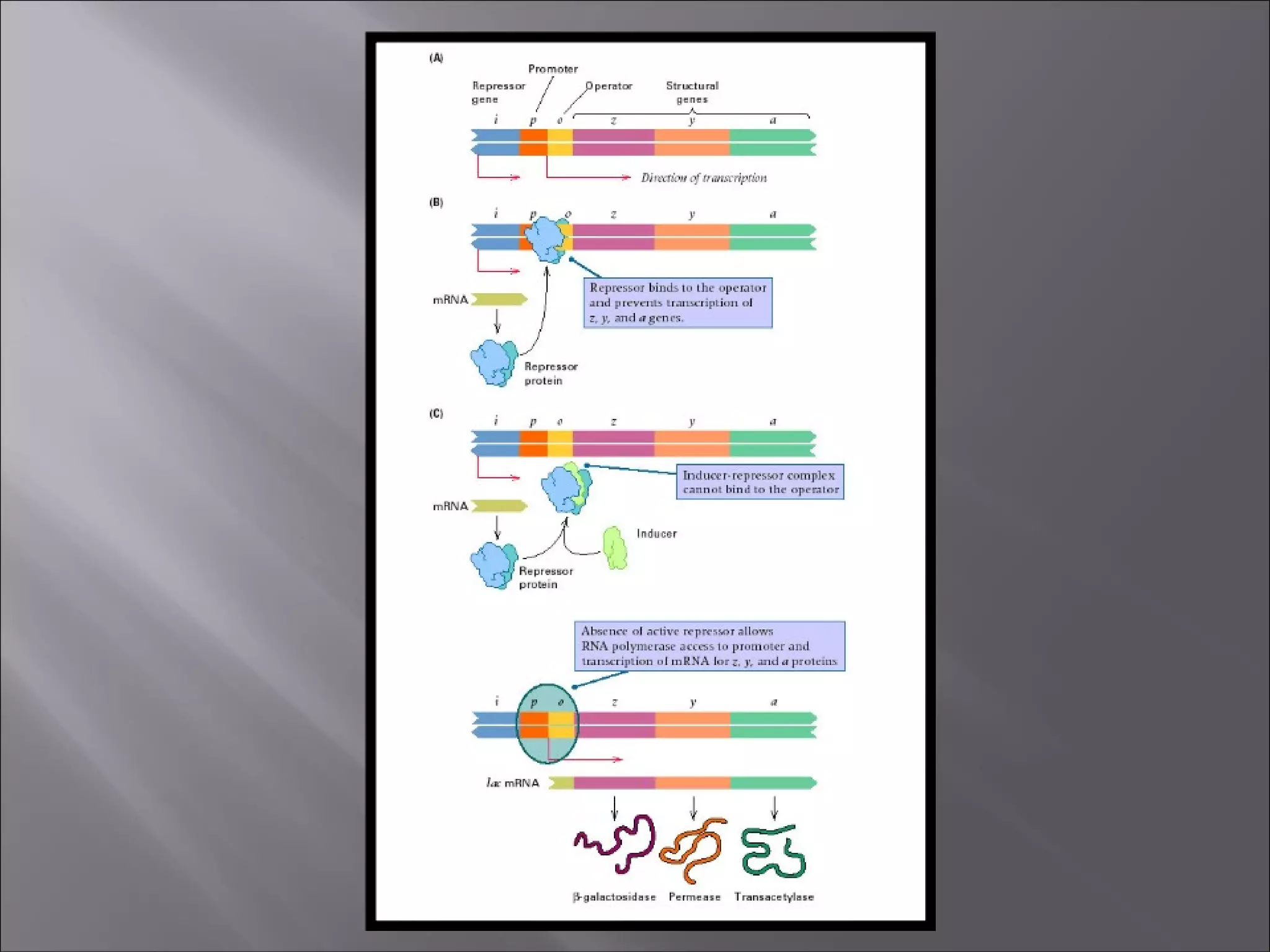
The  operon  consists of  several structural genes  required for lactose  metabolism under the control  of a single regulatory domain  =  coordinate regulation   Repressor binding site =  operator  Site for transcriptional  activation =  promoter
 
Inducible  operon is activated by small molecule  inducers ; mode of regulation in degradative  (catabolic)  pathways Repressible  operon is shut off by small molecule  co-repressors ; mode of regulation in biosynthetic  (anabolic)  pathways
Negative regulation : repressor protein blocks transcription: Inducible :  inducer  antagonizes repressor to allow transcription  initiation Repressible :  aporepessor   combines with  co-repressor  to form  functional repressor
 
Positive Regulation : transcription occurs only if promoter is activated by transcriptional activator Negative regulation is more common in  prokaryotes Positive regulation is more common in  eukaryotes Autoregulation : protein regulates its own transcription
 
Lactose degradation is  regulated by the  lactose  (lac) operon The first regulatory mutations discovered affect lactose metabolism Structural proteins of the lac operon:  B-  galactosidase  required for lactose metabolism and  lactose permease  required for lactose entry
Lac operon gene expression can be  inducible  or  constitutive The  repressor  is expressed  constitutively  (continuously) from the i gene and binds to the operator to block transcription  The operon is  inducible  since lactose binds and inactivates the repressor to permit transcription initiation
Lactose operator  is essential site for repression  Operator mutations are  cis-dominant  because only genes on the same genetic unit are affected Lactose promoter  is essential site for transcription Lac operon contains linked structural genes and regulatory sites
Lactose operon is also subject to positive regulation Positive regulation of the lac operon involves  cAMP-CRP  ( cyclic AMP receptor protein) which binds to the promoter to activate transcription by RNA polymerase cAMP-CRP  complex regulates the activity of the lac operon
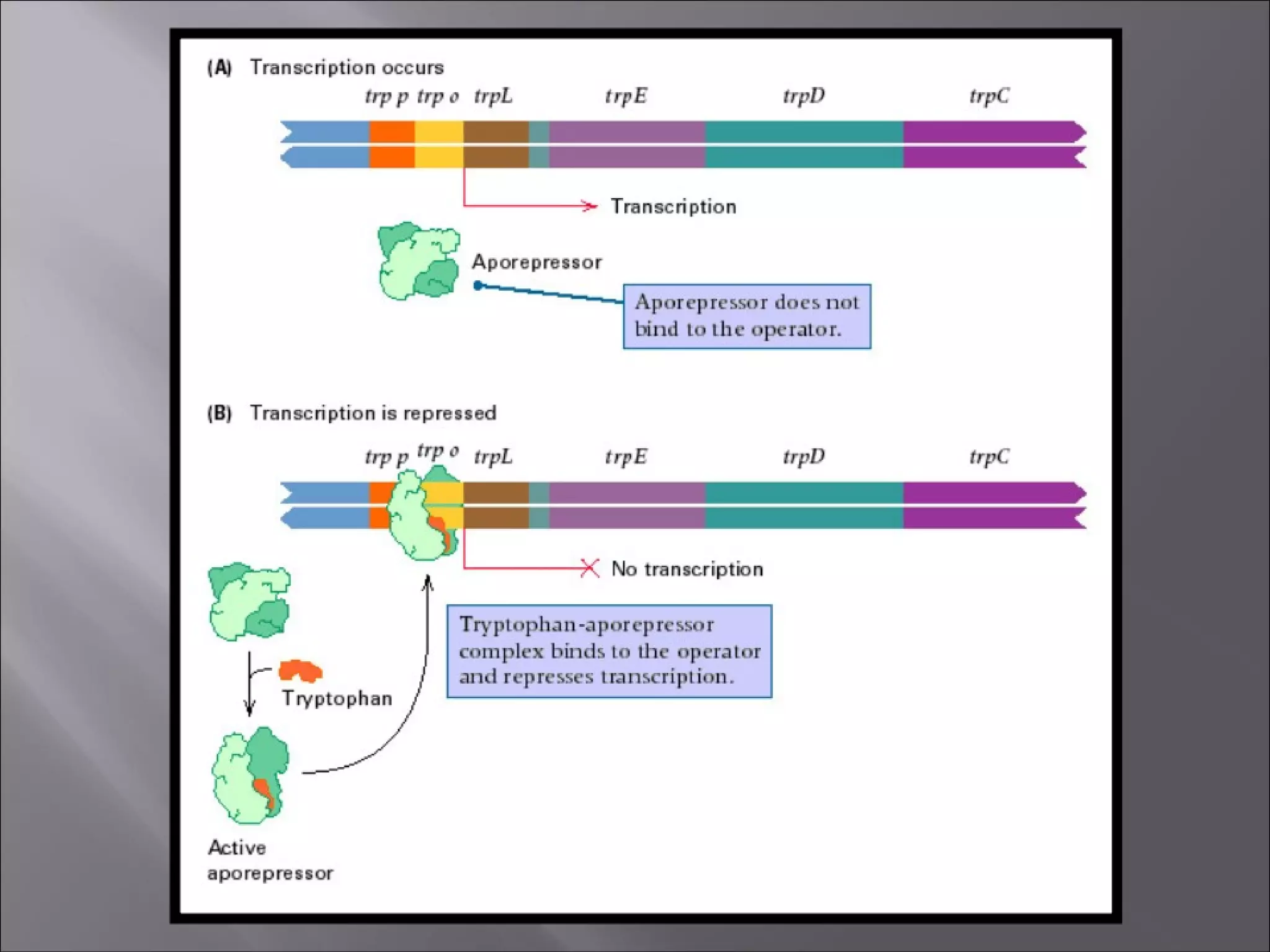
The  trp operon  contains the structural genes which encode enzymes required for the synthesis of the amino acid  tryptophan The  trp operon  is transcriptionally active unless tryptophan is present The trp operon is an example of a  repressible system  regulated by a  negative feedback loop
 
The  trp operon  is shut off when tryptophan binds to inactive  aporepressor  Tryptophan-repressor complex  binds to operator to block transcription when tryptophan levels are high If tryptophan levels fall trp-repressor complex dissociates from operator
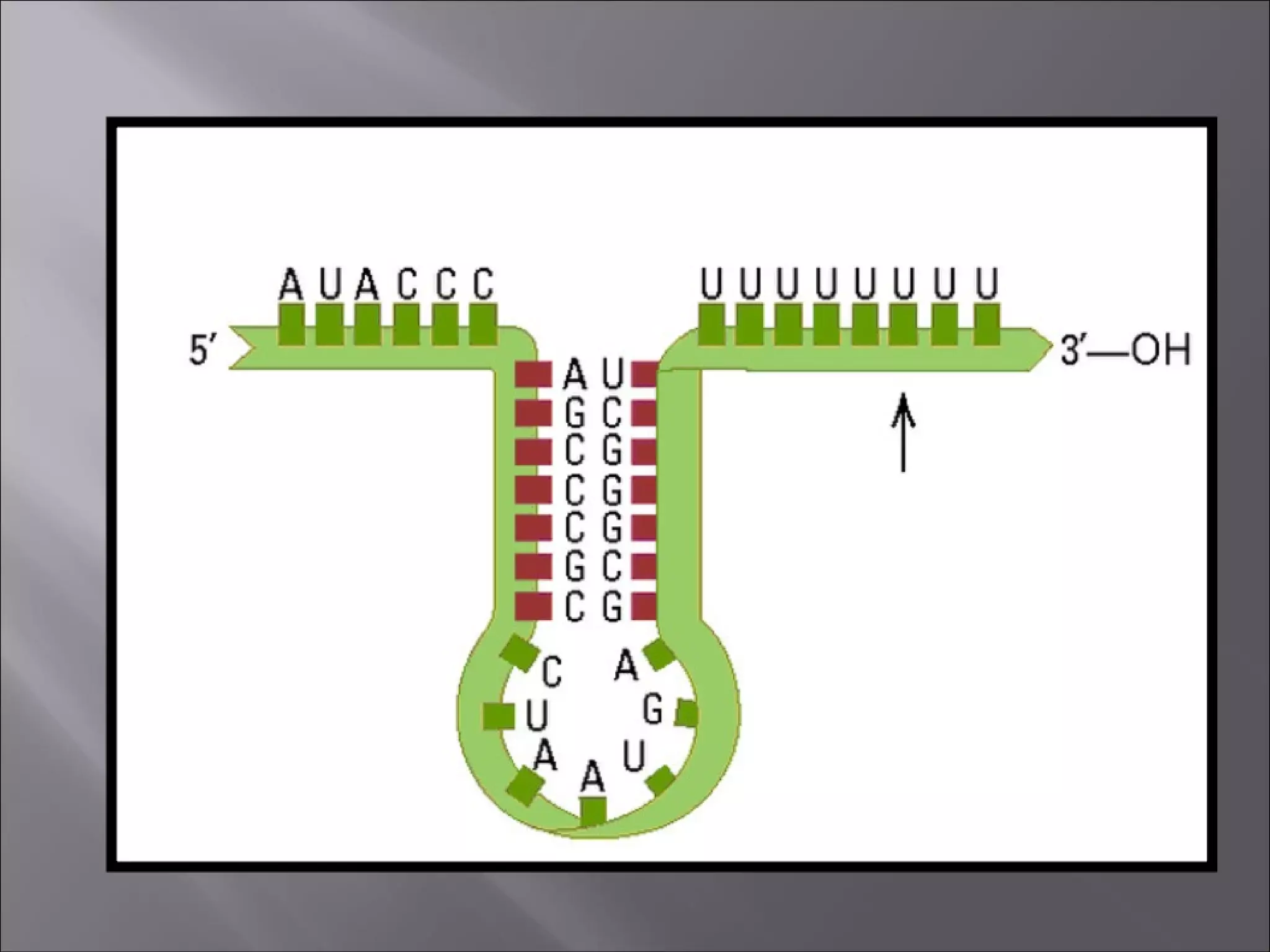
Attenuation  is a very sensitive form of translational regulation of the trp operon The  trp attenuator  sequence consists of 5’ base sequence in mRNA which is  complementary  and  can base pair to form  a stem and loop  structure
 
Attenuation  results in the  premature   termination  of mRNA synthesis due to  stem and loop  formation in the 5’ region of mRNA If  tRNA-trp  is present , synthesis of the leader peptide results in pairing of mRNA which blocks the action  of RNA  polymerase
 
At low concentrations of tRNA-trp, the ribosome stalls, and the mRNA opens so that transcription continues Attenuation permits the cell to respond to tryptophan levels by expressing the genes needed for its synthesis when needed
 

Prokaryotic gene regulation

  • 1.
  • 2.
    Transcription regulation is common mechanism in prokaryotes Negative Regulation = repressor binds to regulatory site to block transcription of active gene Positive Regulation = Activator binds to regulatory site to stimulate transcription; gene is off in absence of activator
  • 3.
    TRANSCRIPTIONAL CONTROL OFGENE EXPRESSION IN PROKARYOTES The two well studied main mechanisms of transcriptional control of gene expression are: 1. The operons : genes involved in a metabolic pathway are regrouped into a gene cluster controlled by common regulatory sequences and proteins. The expression of these genes are then rapid and synchronized. The operon model was developed by François Jacob and Jacques Monod (1961). 2. The cascades of gene expression : Under some environmental conditions, expression of a first set of genes can be “switch on”, and one or more of the products of this first gene set will “switch on” a second gene set. This event could be repeated many times to mobilize wider gene sets to achieve a special metabolic pathway .
  • 4.
  • 5.
    The operon consists of several structural genes required for lactose metabolism under the control of a single regulatory domain = coordinate regulation Repressor binding site = operator Site for transcriptional activation = promoter
  • 6.
  • 7.
    Inducible operonis activated by small molecule inducers ; mode of regulation in degradative (catabolic) pathways Repressible operon is shut off by small molecule co-repressors ; mode of regulation in biosynthetic (anabolic) pathways
  • 8.
    Negative regulation :repressor protein blocks transcription: Inducible : inducer antagonizes repressor to allow transcription initiation Repressible : aporepessor combines with co-repressor to form functional repressor
  • 9.
  • 10.
    Positive Regulation :transcription occurs only if promoter is activated by transcriptional activator Negative regulation is more common in prokaryotes Positive regulation is more common in eukaryotes Autoregulation : protein regulates its own transcription
  • 11.
  • 12.
    Lactose degradation is regulated by the lactose (lac) operon The first regulatory mutations discovered affect lactose metabolism Structural proteins of the lac operon: B- galactosidase required for lactose metabolism and lactose permease required for lactose entry
  • 13.
    Lac operon geneexpression can be inducible or constitutive The repressor is expressed constitutively (continuously) from the i gene and binds to the operator to block transcription The operon is inducible since lactose binds and inactivates the repressor to permit transcription initiation
  • 14.
    Lactose operator is essential site for repression Operator mutations are cis-dominant because only genes on the same genetic unit are affected Lactose promoter is essential site for transcription Lac operon contains linked structural genes and regulatory sites
  • 15.
    Lactose operon isalso subject to positive regulation Positive regulation of the lac operon involves cAMP-CRP ( cyclic AMP receptor protein) which binds to the promoter to activate transcription by RNA polymerase cAMP-CRP complex regulates the activity of the lac operon
  • 16.
    The trpoperon contains the structural genes which encode enzymes required for the synthesis of the amino acid tryptophan The trp operon is transcriptionally active unless tryptophan is present The trp operon is an example of a repressible system regulated by a negative feedback loop
  • 17.
  • 18.
    The trpoperon is shut off when tryptophan binds to inactive aporepressor Tryptophan-repressor complex binds to operator to block transcription when tryptophan levels are high If tryptophan levels fall trp-repressor complex dissociates from operator
  • 19.
    Attenuation isa very sensitive form of translational regulation of the trp operon The trp attenuator sequence consists of 5’ base sequence in mRNA which is complementary and can base pair to form a stem and loop structure
  • 20.
  • 21.
    Attenuation resultsin the premature termination of mRNA synthesis due to stem and loop formation in the 5’ region of mRNA If tRNA-trp is present , synthesis of the leader peptide results in pairing of mRNA which blocks the action of RNA polymerase
  • 22.
  • 23.
    At low concentrationsof tRNA-trp, the ribosome stalls, and the mRNA opens so that transcription continues Attenuation permits the cell to respond to tryptophan levels by expressing the genes needed for its synthesis when needed
  • 24.