
Topic :Genetic
code
By,
Pillai Aswathy viswanath
PG 1 Botany
St. thomas college
kozhencherry
Introduction
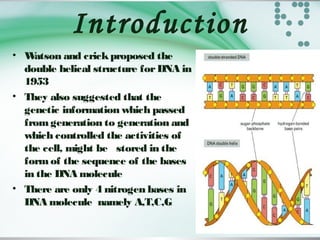
• Watson and crickproposed the
double helical structure forDNA in
1953
• They also suggested that the
genetic information which passed
from generation to generation and
which controlled the activities of
the cell, might be stored in the
form of the sequence of the bases
in the DNA molecule
• There are only 4 nitrogen bases in
DNA molecule namely A,T,C,G
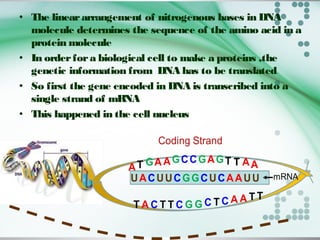
• The lineararrangement of nitrogenous bases in DNA
molecule determines the sequence of the amino acid in a
protein molecule
• In orderfora biological cell to make a proteins ,the
genetic information from DNA has to be translated
• So first the gene encoded in DNA is transcribed into a
single strand of mRNA
• This happened in the cell nucleus
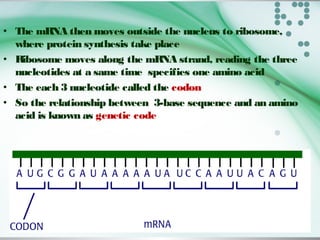
• The mRNA then moves outside the nucleus to ribosome,
where protein synthesis take place
• Ribosome moves along the mRNA strand, reading the three
nucleotides at a same time specifies one amino acid
• The each 3 nucleotide called the codon
• So the relationship between 3-base sequence and an amino
acid is known as genetic code
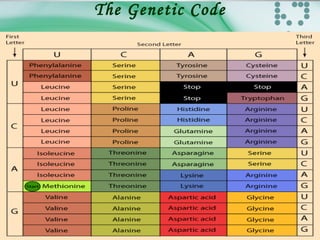
The Genetic Code
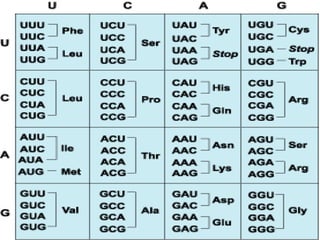
• There are 64 possible combination of 3 nucleotides
sequences
• Out of 64 ; 61 of these code for20 amino acid including
the initiation codon methionine
• Initiation codon is AUG, which initiates protein
synthesis
• The other3 are called stop codons
• UAG (ambercodon), UAA (ochre codon) and UGA (opal
codon),
• Termination codon , which code forno amino acid but
instead cause protein synthesis to terminate.
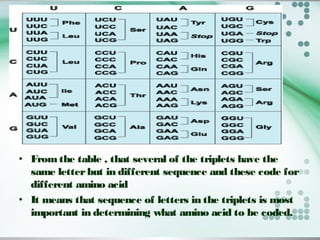
• Fromthe table , that several of the triplets have the
same letterbut in different sequence and these code for
different amino acid
• It means that sequence of letters in the triplets is most
important in determining what amino acid to be coded.
Important features of the genetic
codes
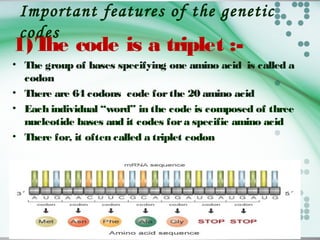
1)The code is a triplet :-
• The group of bases specifying one amino acid is called a
codon
• There are 64 codons code forthe 20 amino acid
• Each individual “word” in the code is composed of three
nucleotide bases and it codes fora specific amino acid
• There for, it often called a triplet codon
Proof forthe triplet
codeCrick-Brennerexperiment: 
• An elegant and important experiment performed in 1961
by Francis Crick and Sydney Brenner.
• The experiment proved that the genetic code was a
triplet code
• Each codon must contain 3 letters and also the
sequence of 3 bases specify one amino acid
• The effect of inserting ordeleting particularnumbers of
bases in a coding sequence was examined
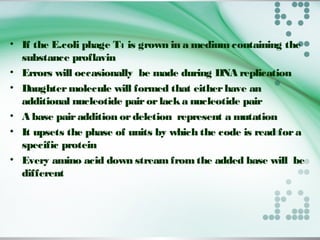
• If the E.coli phage T4 is grown in a medium containing the
substance proflavin
• Errors will occasionally be made during DNA replication
• Daughtermolecule will formed that eitherhave an
additional nucleotide pairorlacka nucleotide pair
• A base pairaddition ordeletion represent a mutation
• It upsets the phase of units by which the code is read fora
specific protein
• Every amino acid down streamfromthe added base will be
different
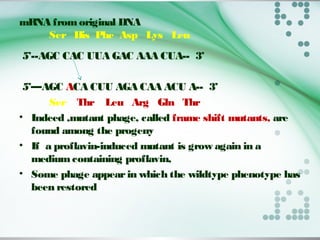
mRNA fromoriginal DNA
Ser His Phe Asp Lys Leu
5’--AGC CAC UUA GAC AAA CUA-- 3’
5’—AGC ACA CUU AGA CAA ACU A-- 3’
Ser Thr Leu Arg Gln Thr
• Indeed ,mutant phage, called frame shift mutants, are
found among the progeny
• If a proflavin-induced mutant is grow again in a
mediumcontaining proflavin,
• Some phage appearin which the wildtype phenotype has
been restored
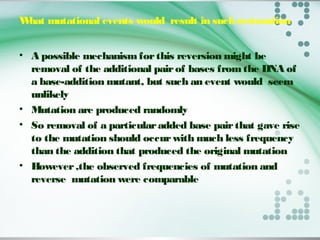
What mutational events would result in such restoration
• A possible mechanismforthis reversion might be
removal of the additional pairof bases fromthe DNA of
a base-addition mutant, but such an event would seem
unlikely
• Mutation are produced randomly
• So removal of a particularadded base pairthat gave rise
to the mutation should occurwith much less frequency
than the addition that produced the original mutation
• However,the observed frequencies of mutation and
reverse mutation were comparable
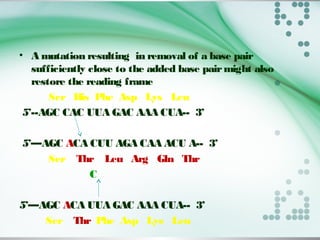
• A mutation resulting in removal of a base pair
sufficiently close to the added base pairmight also
restore the reading frame
Ser His Phe Asp Lys Leu
5’--AGC CAC UUA GAC AAA CUA-- 3’
5’—AGC ACA CUU AGA CAA ACU A-- 3’
Ser Thr Leu Arg Gln Thr
C
5’—AGC ACA UUA GAC AAA CUA-- 3’
Ser Thr Phe Asp Lys Leu
• In certain cases might result in production of a
biological functional protein
• Even though the amino acid sequences of the original
wild type and the one formed by a mutation plus a
reverse mutation were not identical
• This proved in the study of a collection of proflavin-
induced mutants in the gene called rIIB of Ecoli phage
T4
• If the 2 phage strains each carrying a different mutation
in the same gene are crossed
• Some wild type phage progeny arise by genetic
recombination
• However, when 2 randomly selected proflavin induced
mutants were crossed
• Wild type phage progeny did not always arise
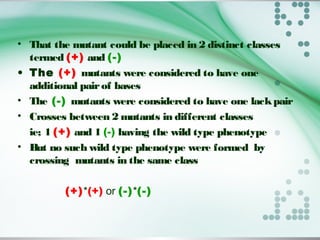
• That the mutant could be placed in 2 distinct classes
termed (+) and (-)
• The (+) mutants were considered to have one
additional pairof bases
• The (-) mutants were considered to have one lackpair
• Crosses between 2 mutants in different classes
ie; 1 (+) and 1 (-) having the wild type phenotype
• But no such wild type phenotype were formed by
crossing mutants in the same class
(+)*(+) or (-)*(-)
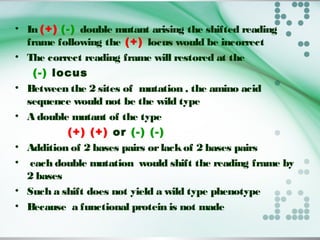
• In (+) (-) double mutant arising the shifted reading
frame following the (+) locus would be incorrect
• The correct reading frame will restored at the
(-) locus
• Between the 2 sites of mutation , the amino acid
sequence would not be the wild type
• A double mutant of the type
(+) (+) or (-) (-)
• Addition of 2 bases pairs orlackof 2 bases pairs
• each double mutation would shift the reading frame by
2 bases
• Such a shift does not yield a wild type phenotype
• Because a functional protein is not made
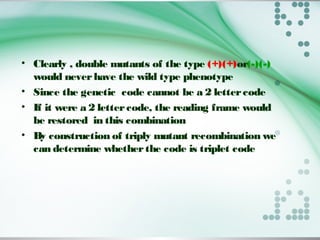
• Clearly , double mutants of the type (+)(+)or(-)(-)
would neverhave the wild type phenotype
• Since the genetic code cannot be a 2 lettercode
• If it were a 2 lettercode, the reading frame would
be restored in this combination
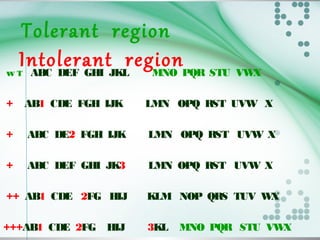
• By construction of triply mutant recombination we
can determine whetherthe code is triplet code
Tolerant region
Intolerant regionw T ABC DEF GHI JKL MNO PQR STU VWX
+ AB1 CDE FGH IJK LMN OPQ RST UVW X
+ ABC DE2 FGH IJK LMN OPQ RST UVW X
+ ABC DEF GHI JK3 LMN OPQ RST UVW X
++ AB1 CDE 2FG HIJ KLM NOP QRS TUV WX
+++AB1 CDE 2FG HIJ 3KL MNO PQR STU VWX
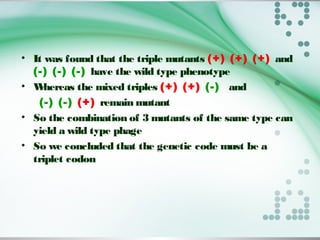
• It was found that the triple mutants (+) (+) (+) and
(-) (-) (-) have the wild type phenotype
• Whereas the mixed triples (+) (+) (-) and
(-) (-) (+) remain mutant
• So the combination of 3 mutants of the same type can
yield a wild type phage
• So we concluded that the genetic code must be a
triplet codon
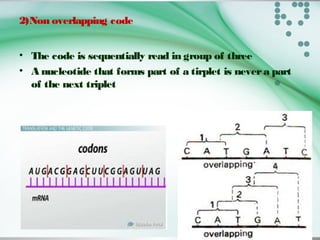
2)Non overlapping code
• The code is sequentially read in group of three
• A nucleotide that forms part of a tirplet is nevera part
of the next triplet
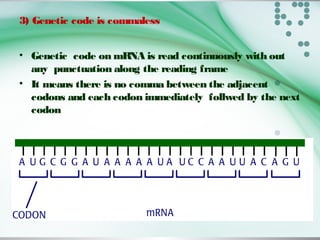
3) Genetic code is commaless
• Genetic code on mRNA is read continuously with out
any punctuation along the reading frame
• It means there is no comma between the adjacent
codons and each codon immediately follwed by the next
codon
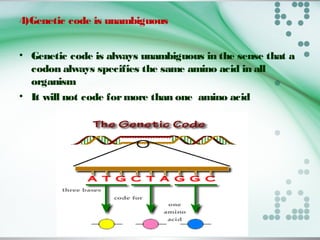
4)Genetic code is unambiguous
• Genetic code is always unambiguous in the sense that a
codon always specifies the same amino acid in all
organism
• It will not code formore than one amino acid
5)Genetic code is degenerate
• Therare 64 possible codons foronly 20 amino acid that
are found in proteins
• It was concluded that in most cases a single amino acid
code for2 to several different codons
• This multiple systemof coding is known as degenerate
genetic code
• Except formethionine and tryptophan which have only
one codon each
• All otheramino acid have 2 ormore codons
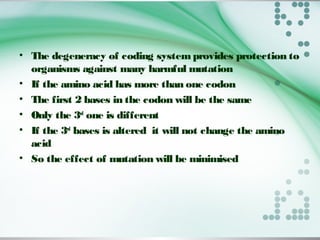
• The degeneracy of coding systemprovides protection to
organisms against many harmful mutation
• If the amino acid has more than one codon
• The first 2 bases in the codon will be the same
• Only the 3rd
one is different
• If the 3rd
bases is altered it will not change the amino
acid
• So the effect of mutation will be minimised
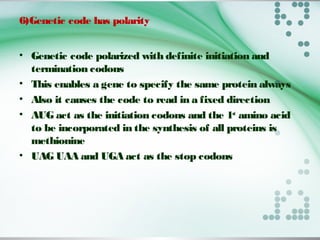
6)Genetic code has polarity
• Genetic code polarized with definite initiation and
termination codons
• This enables a gene to specify the same protein always
• Also it causes the code to read in a fixed direction
• AUG act as the initiation codons and the 1st
amino acid
to be incorporated in the synthesis of all proteins is
methionine
• UAG UAA and UGA act as the stop codons
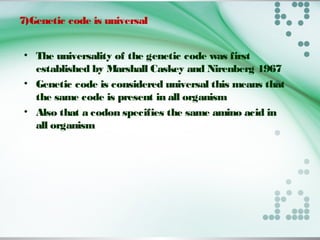
7)Genetic code is universal
• The universality of the genetic code was first
established by Marshall Caskey and Nirenberg 1967
• Genetic code is considered universal this means that
the same code is present in all organism
• Also that a codon specifies the same amino acid in
all organism
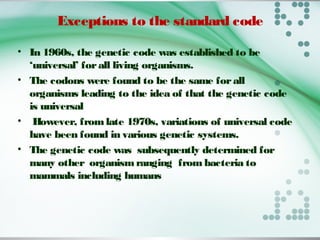
Exceptions to the standard code
• In 1960s, the genetic code was established to be
‘universal’ forall living organisms.
• The codons were found to be the same forall
organisms leading to the idea of that the genetic code
is universal
• However, fromlate 1970s, variations of universal code
have been found in various genetic systems.
• The genetic code was subsequently determined for
many other organismranging from bacteria to
mammals including humans
• Afterit was established any subsequent changes in
the code would prove to be lethal
• If one codon changed then all similarcodons in the
entire organisms genome would have to change
simultaneously
• In fact a few rare exceptions to the universal code
must be found
• Most of the exceptions are found in mitochondrial
genome
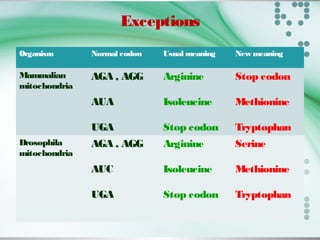
Exceptions
Organism Normal codon Usual meaning New meaning
Mammalian
mitochondria
AGA , AGG
AUA
UGA
Arginine
Isoleucine
Stop codon
Stop codon
Methionine
Tryptophan
Drosophila
mitochondria
AGA , AGG
AUC
UGA
Arginine
Isoleucine
Stop codon
Serine
Methionine
Tryptophan
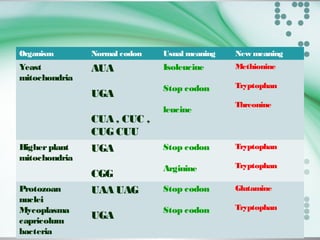
Organism Normal codon Usual meaning New meaning
Yeast
mitochondria
AUA
UGA
CUA , CUC ,
CUG CUU
Isoleucine
Stop codon
leucine
Methionine
Tryptophan
Threonine
Higher plant
mitochondria
UGA
CGG
Stop codon
Arginine
Tryptophan
Tryptophan
Protozoan
nuclei
Mycoplasma
capricolum
bacteria
UAA UAG
UGA
Stop codon
Stop codon
Glutamine
Tryptophan
Reference
• Veerbala rastogi (2008).fundamental of molecular
biology .published by Ane books India
• Daniel L.Hartl,David Freifelder,Leon A.
Snyder(1987).Basic Genetics.Jones and Bartlett
Publishers
• http://www.answers.com/topic/genetic-code#ixzz36hBojiS2
• Griffiths, Anthony J.F., Jeffrey H. Miller, David T. Suzuki,
Richard C. Lewontin, and William M. Gelbart. 1993. An
Introduction to Genetic Analysis 5th ed. W.H.
Freeman and Company.
• Gupta P.K(2007).genetics classical to modern
Rastogi publications.
G.c -p.aswathy viswanath

G.c -p.aswathy viswanath

  • 1.
    Topic :Genetic code By, Pillai Aswathyviswanath PG 1 Botany St. thomas college kozhencherry
  • 2.
    Introduction • Watson andcrickproposed the double helical structure forDNA in 1953 • They also suggested that the genetic information which passed from generation to generation and which controlled the activities of the cell, might be stored in the form of the sequence of the bases in the DNA molecule • There are only 4 nitrogen bases in DNA molecule namely A,T,C,G
  • 3.
    • The lineararrangementof nitrogenous bases in DNA molecule determines the sequence of the amino acid in a protein molecule • In orderfora biological cell to make a proteins ,the genetic information from DNA has to be translated • So first the gene encoded in DNA is transcribed into a single strand of mRNA • This happened in the cell nucleus
  • 4.
    • The mRNAthen moves outside the nucleus to ribosome, where protein synthesis take place • Ribosome moves along the mRNA strand, reading the three nucleotides at a same time specifies one amino acid • The each 3 nucleotide called the codon • So the relationship between 3-base sequence and an amino acid is known as genetic code
  • 5.
  • 6.
    • There are64 possible combination of 3 nucleotides sequences • Out of 64 ; 61 of these code for20 amino acid including the initiation codon methionine • Initiation codon is AUG, which initiates protein synthesis • The other3 are called stop codons • UAG (ambercodon), UAA (ochre codon) and UGA (opal codon), • Termination codon , which code forno amino acid but instead cause protein synthesis to terminate.
  • 7.
    • Fromthe table, that several of the triplets have the same letterbut in different sequence and these code for different amino acid • It means that sequence of letters in the triplets is most important in determining what amino acid to be coded.
  • 8.
    Important features ofthe genetic codes 1)The code is a triplet :- • The group of bases specifying one amino acid is called a codon • There are 64 codons code forthe 20 amino acid • Each individual “word” in the code is composed of three nucleotide bases and it codes fora specific amino acid • There for, it often called a triplet codon
  • 9.
    Proof forthe triplet codeCrick-Brennerexperiment:  •An elegant and important experiment performed in 1961 by Francis Crick and Sydney Brenner. • The experiment proved that the genetic code was a triplet code • Each codon must contain 3 letters and also the sequence of 3 bases specify one amino acid • The effect of inserting ordeleting particularnumbers of bases in a coding sequence was examined
  • 10.
    • If theE.coli phage T4 is grown in a medium containing the substance proflavin • Errors will occasionally be made during DNA replication • Daughtermolecule will formed that eitherhave an additional nucleotide pairorlacka nucleotide pair • A base pairaddition ordeletion represent a mutation • It upsets the phase of units by which the code is read fora specific protein • Every amino acid down streamfromthe added base will be different
  • 11.
    mRNA fromoriginal DNA SerHis Phe Asp Lys Leu 5’--AGC CAC UUA GAC AAA CUA-- 3’ 5’—AGC ACA CUU AGA CAA ACU A-- 3’ Ser Thr Leu Arg Gln Thr • Indeed ,mutant phage, called frame shift mutants, are found among the progeny • If a proflavin-induced mutant is grow again in a mediumcontaining proflavin, • Some phage appearin which the wildtype phenotype has been restored
  • 12.
    What mutational eventswould result in such restoration • A possible mechanismforthis reversion might be removal of the additional pairof bases fromthe DNA of a base-addition mutant, but such an event would seem unlikely • Mutation are produced randomly • So removal of a particularadded base pairthat gave rise to the mutation should occurwith much less frequency than the addition that produced the original mutation • However,the observed frequencies of mutation and reverse mutation were comparable
  • 13.
    • A mutationresulting in removal of a base pair sufficiently close to the added base pairmight also restore the reading frame Ser His Phe Asp Lys Leu 5’--AGC CAC UUA GAC AAA CUA-- 3’ 5’—AGC ACA CUU AGA CAA ACU A-- 3’ Ser Thr Leu Arg Gln Thr C 5’—AGC ACA UUA GAC AAA CUA-- 3’ Ser Thr Phe Asp Lys Leu
  • 14.
    • In certaincases might result in production of a biological functional protein • Even though the amino acid sequences of the original wild type and the one formed by a mutation plus a reverse mutation were not identical • This proved in the study of a collection of proflavin- induced mutants in the gene called rIIB of Ecoli phage T4
  • 15.
    • If the2 phage strains each carrying a different mutation in the same gene are crossed • Some wild type phage progeny arise by genetic recombination • However, when 2 randomly selected proflavin induced mutants were crossed • Wild type phage progeny did not always arise
  • 16.
    • That themutant could be placed in 2 distinct classes termed (+) and (-) • The (+) mutants were considered to have one additional pairof bases • The (-) mutants were considered to have one lackpair • Crosses between 2 mutants in different classes ie; 1 (+) and 1 (-) having the wild type phenotype • But no such wild type phenotype were formed by crossing mutants in the same class (+)*(+) or (-)*(-)
  • 17.
    • In (+)(-) double mutant arising the shifted reading frame following the (+) locus would be incorrect • The correct reading frame will restored at the (-) locus • Between the 2 sites of mutation , the amino acid sequence would not be the wild type • A double mutant of the type (+) (+) or (-) (-) • Addition of 2 bases pairs orlackof 2 bases pairs • each double mutation would shift the reading frame by 2 bases • Such a shift does not yield a wild type phenotype • Because a functional protein is not made
  • 18.
    • Clearly ,double mutants of the type (+)(+)or(-)(-) would neverhave the wild type phenotype • Since the genetic code cannot be a 2 lettercode • If it were a 2 lettercode, the reading frame would be restored in this combination • By construction of triply mutant recombination we can determine whetherthe code is triplet code
  • 19.
    Tolerant region Intolerant regionwT ABC DEF GHI JKL MNO PQR STU VWX + AB1 CDE FGH IJK LMN OPQ RST UVW X + ABC DE2 FGH IJK LMN OPQ RST UVW X + ABC DEF GHI JK3 LMN OPQ RST UVW X ++ AB1 CDE 2FG HIJ KLM NOP QRS TUV WX +++AB1 CDE 2FG HIJ 3KL MNO PQR STU VWX
  • 20.
    • It wasfound that the triple mutants (+) (+) (+) and (-) (-) (-) have the wild type phenotype • Whereas the mixed triples (+) (+) (-) and (-) (-) (+) remain mutant • So the combination of 3 mutants of the same type can yield a wild type phage • So we concluded that the genetic code must be a triplet codon
  • 21.
    2)Non overlapping code •The code is sequentially read in group of three • A nucleotide that forms part of a tirplet is nevera part of the next triplet
  • 22.
    3) Genetic codeis commaless • Genetic code on mRNA is read continuously with out any punctuation along the reading frame • It means there is no comma between the adjacent codons and each codon immediately follwed by the next codon
  • 23.
    4)Genetic code isunambiguous • Genetic code is always unambiguous in the sense that a codon always specifies the same amino acid in all organism • It will not code formore than one amino acid
  • 24.
    5)Genetic code isdegenerate • Therare 64 possible codons foronly 20 amino acid that are found in proteins • It was concluded that in most cases a single amino acid code for2 to several different codons • This multiple systemof coding is known as degenerate genetic code • Except formethionine and tryptophan which have only one codon each • All otheramino acid have 2 ormore codons
  • 25.
    • The degeneracyof coding systemprovides protection to organisms against many harmful mutation • If the amino acid has more than one codon • The first 2 bases in the codon will be the same • Only the 3rd one is different • If the 3rd bases is altered it will not change the amino acid • So the effect of mutation will be minimised
  • 27.
    6)Genetic code haspolarity • Genetic code polarized with definite initiation and termination codons • This enables a gene to specify the same protein always • Also it causes the code to read in a fixed direction • AUG act as the initiation codons and the 1st amino acid to be incorporated in the synthesis of all proteins is methionine • UAG UAA and UGA act as the stop codons
  • 28.
    7)Genetic code isuniversal • The universality of the genetic code was first established by Marshall Caskey and Nirenberg 1967 • Genetic code is considered universal this means that the same code is present in all organism • Also that a codon specifies the same amino acid in all organism
  • 29.
    Exceptions to thestandard code • In 1960s, the genetic code was established to be ‘universal’ forall living organisms. • The codons were found to be the same forall organisms leading to the idea of that the genetic code is universal • However, fromlate 1970s, variations of universal code have been found in various genetic systems. • The genetic code was subsequently determined for many other organismranging from bacteria to mammals including humans
  • 30.
    • Afterit wasestablished any subsequent changes in the code would prove to be lethal • If one codon changed then all similarcodons in the entire organisms genome would have to change simultaneously • In fact a few rare exceptions to the universal code must be found • Most of the exceptions are found in mitochondrial genome
  • 31.
    Exceptions Organism Normal codonUsual meaning New meaning Mammalian mitochondria AGA , AGG AUA UGA Arginine Isoleucine Stop codon Stop codon Methionine Tryptophan Drosophila mitochondria AGA , AGG AUC UGA Arginine Isoleucine Stop codon Serine Methionine Tryptophan
  • 32.
    Organism Normal codonUsual meaning New meaning Yeast mitochondria AUA UGA CUA , CUC , CUG CUU Isoleucine Stop codon leucine Methionine Tryptophan Threonine Higher plant mitochondria UGA CGG Stop codon Arginine Tryptophan Tryptophan Protozoan nuclei Mycoplasma capricolum bacteria UAA UAG UGA Stop codon Stop codon Glutamine Tryptophan
  • 33.
    Reference • Veerbala rastogi(2008).fundamental of molecular biology .published by Ane books India • Daniel L.Hartl,David Freifelder,Leon A. Snyder(1987).Basic Genetics.Jones and Bartlett Publishers • http://www.answers.com/topic/genetic-code#ixzz36hBojiS2 • Griffiths, Anthony J.F., Jeffrey H. Miller, David T. Suzuki, Richard C. Lewontin, and William M. Gelbart. 1993. An Introduction to Genetic Analysis 5th ed. W.H. Freeman and Company. • Gupta P.K(2007).genetics classical to modern Rastogi publications.