-PRIYA
           SRIVASTAVA
04/27/12    090105801   1
INTRODUCTION
 Fuzzy logic has rapidly become one of the most
  successful of today's technologies for developing
  sophisticated control systems. The reason for which is
  very simple.
 Fuzzy logic addresses such applications perfectly as it
  resembles human decision making with an ability to
  generate precise solutions from certain or
  approximate information.
 It fills an important gap in engineering design
  methods left vacant by purely mathematical
  approaches (e.g. linear control design), and purely
  logic-based approaches (e.g. expert systems) in
  system design.
04/27/12                                                2
 While other approaches require accurate equations to
  model real-world behaviors, fuzzy design can
  accommodate the ambiguities of real-world human
  language and logic.
 It provides both an intuitive method for describing
  systems in human terms and automates the
  conversion of those system specifications into
  effective models.


    04/27/12                                             3
CHRONICLE:-
 Lotfi A. Zadeh, a professor of UC Berkeley in
  California, soon to be known as the founder of fuzzy
  logic observed that conventional computer logic was
  incapable of manipulating data representing subjective
  or vague human ideas such as "an atractive person" .
 Fuzzy logic, hence was designed to allow computers
  to determine the distinctions among data with shades
  of gray, similar to the process of human reasoning.
 This theory proposed making the membership
  function (or the values False and True) operate over
  the range of real numbers [0.0, 1.0]. Fuzzy logic was
  now introduced to the world.

04/27/12                                               4
t d o yo u m e a n b y  f u z z y
   Fuzzy logic is a superset of Boolean logic that has
      been extended to handle the concept of partial truth-
      truth values between "completely true" and
      "completely false".
      The essential characteristics of fuzzy logicare as
      follows:-
   In fuzzy logic, exact reasoning is viewed as a limiting
      case of approximate reasoning.
   In fuzzy logic everything is a matter of degree.
   Any logical system can be fuzzified
   In fuzzy logic, knowledge is interpreted as a collection
      of elastic or, equivalently , fuzzy constraint on a
      collection of variables
   The third statement hence, define Boolean logic as a
      subset of Fuzzy logic.
  04/27/12                                                   5
F uzzy S e ts

 A paradigm is a set of rules and regulations which
  defines boundaries and tells us what to do to be
  successful in solving problems within these
  boundaries.
 For example the use of transistors instead of vacuum
  tubes is a paradigm shift - likewise the development of
  Fuzzy Set Theory from conventional bivalent set
  theory is a paradigm shift.
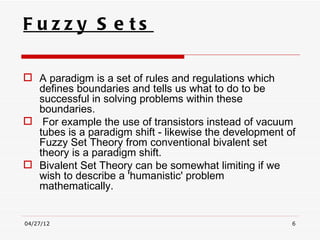
 Bivalent Set Theory can be somewhat limiting if we
  wish to describe a 'humanistic' problem
  mathematically.


04/27/12                                                6
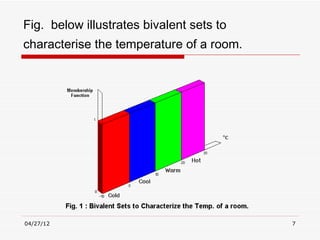
Fig. below illustrates bivalent sets to
characterise the temperature of a room.


04/27/12                                  7
F u z z y S e t O p e r a t io n s .

 U n io n
     The membership function of the Union of two fuzzy sets A
      and B with membership functions  and   respectively is
      defined as the maximum of the two individual membership
      functions. This is called the maximum criterion.


04/27/12                                                         8
W h a t d o e s it o f f e r ?

 The first applications of fuzzy theory were primarily
     industrial, such as process control for cement kilns.
 Since then, the applications of Fuzzy Logic technology
     have virtually exploded, affecting things we use
     everyday.
     Take for example, the fuzzy washing machine .
 A load of clothes in it and press start, and the
     machine begins to churn, automatically choosing the
     best cycle. The fuzzy microwave, Place chili,
     potatoes, or etc in a fuzzy microwave and push single
     button, and it cooks for the right time at the proper
     temperature.
 The fuzzy car, maneuvers itself by following simple
     verbal instructions from its driver. It can even stop
     itself when there is an obstacle immediately ahead 9
04/27/12
     using sensors.
H o w d o f u z z y s e t s d if f e r
f r o m c la s s ic a l s e t s ?
 In classical set theory we assume that all sets rare
  well-defined (or crisp), that is given any object in our
  universe we can always say that object either is or is
  not the member of a particular set.
                CLASSICAL SETS
                The set of people that can run a mile in 4 minutes or
                 less.
                The set of children under age seven that weigh more
                 than 1oo pounds.
                FUZZY SETS
                The set of fast runners.
                The set of overweight children.

04/27/12                                                                 10
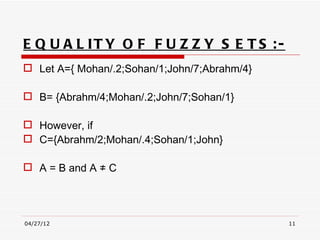
E Q U A L IT Y O F F U Z Z Y S E T S :-
 Let A={ Mohan/.2;Sohan/1;John/7;Abrahm/4}

 B= {Abrahm/4;Mohan/.2;John/7;Sohan/1}

 However, if
 C={Abrahm/2;Mohan/.4;Sohan/1;John}

 A = B and A ≠ C


04/27/12                                      11
F U Z Z Y C O N TR O L :-

 Fuzzy control, which directly uses fuzzy rules is the
  most important application in fuzzy theory.
 Using a procedure originated by Ebrahim Mamdani in
  the late 70s, three steps are taken to create a fuzzy
  controlled machine:
 1)Fuzzification(Using membership functions to
  graphically describe a situation)

  2)Rule evaluation(Application of fuzzy rules) 

  3)Defuzzification(Obtaining the crisp or actual results) 

04/27/12                                                 12
WH Y F U Z Z Y C O N TR O L ?
 Fuzzy Logic is a technique to embody human like
  thinking into a control system.
 A fuzzy controller is designed to emulate human
  deductive thinking, that is, the process people use to
  infer conclusions from what they know.
 Traditional control approach requires formal modeling
  of the physical reality.


04/27/12                                               13
 A f u z z y c o n t r o l s y s t e m  can also be
  described as based on fuzzy logic—a mathematical
   system that analyzes analog input values in terms of 
  logical variables that take on continuous values
  between 0 and 1, in contrast to classical or digital
   logic, which operates on discrete values of either 1 or
  0 (true or false respectively).


04/27/12                                                14
 Fuzzy logic is widely used in machine control.

 The term itself inspires a certain skepticism, sounding
  equivalent to "half-baked logic" or "bogus logic", but
  the "fuzzy" part does not refer to a lack of rigour in the
  method, rather to the fact that the logic involved can
  deal with fuzzy concepts—concepts that cannot be
  expressed as "true" or "false" but rather as "partially
  true".


04/27/12                                                  15
 Although genetic algorithms and neural networks can
  perform just as well as fuzzy logic in many cases,
 fuzzy logic has the advantage that the solution to the
  problem can be cast in terms that human operators
  can understand,
 so that their experience can be used in the design of
  the controller. This makes it easier to mechanize tasks
  that are already successfully performed by humans.


04/27/12                                               16
L IT T L E M O R E O N F U Z Z Y
C O N T R O L :-
 Fuzzy controllers are very simple conceptually.
  They consist of an input stage, a processing
  stage, and an output stage.
 The input stage maps sensor or other inputs,
  such as switches, thumbwheels, and so on, to the
  appropriate membership functions and truth
  values.
 The processing stage invokes each appropriate
  rule and generates a result for each, then
  combines the results of the rules. Finally, the
  output stage converts the combined result back
  into a specific control output value.
04/27/12                                        17
H o w f a r c a n f u z z y lo g ic
go???

  It can appear almost anyplace where computers and
     modern control theory are overly precise as well as in
     tasks requiring delicate human intuition and
     experience-based knowledge. What does the future
     hold?
 Computers that understand and respond to normal
     human language.
      Machines that write interesting novels and
     screenplays in a selected style , such as
     Hemingway's.
  Molecule-sized soldiers of health that will roam the
     blood-stream, killing cancer cells and slowing the
04/27/12                                                   18
     aging process.
 Hence, it can be seen that with the enormous
  research currently being done in Japan and many
  other countries whose eyes have opened, the future
  of fuzzy logic is undetermined. There is no limit to
  where it can go. 
  The future is bright. The future is fuzzy.


04/27/12                                                 19
04/27/12   20

Fuzzy logic ppt

  • 1.
    -PRIYA SRIVASTAVA 04/27/12 090105801 1
  • 2.
    INTRODUCTION  Fuzzy logichas rapidly become one of the most successful of today's technologies for developing sophisticated control systems. The reason for which is very simple.  Fuzzy logic addresses such applications perfectly as it resembles human decision making with an ability to generate precise solutions from certain or approximate information.  It fills an important gap in engineering design methods left vacant by purely mathematical approaches (e.g. linear control design), and purely logic-based approaches (e.g. expert systems) in system design. 04/27/12 2
  • 3.
     While otherapproaches require accurate equations to model real-world behaviors, fuzzy design can accommodate the ambiguities of real-world human language and logic.  It provides both an intuitive method for describing systems in human terms and automates the conversion of those system specifications into effective models. 04/27/12 3
  • 4.
    CHRONICLE:-  Lotfi A.Zadeh, a professor of UC Berkeley in California, soon to be known as the founder of fuzzy logic observed that conventional computer logic was incapable of manipulating data representing subjective or vague human ideas such as "an atractive person" .  Fuzzy logic, hence was designed to allow computers to determine the distinctions among data with shades of gray, similar to the process of human reasoning.  This theory proposed making the membership function (or the values False and True) operate over the range of real numbers [0.0, 1.0]. Fuzzy logic was now introduced to the world. 04/27/12 4
  • 5.
    t d oyo u m e a n b y  f u z z y  Fuzzy logic is a superset of Boolean logic that has been extended to handle the concept of partial truth- truth values between "completely true" and "completely false". The essential characteristics of fuzzy logicare as follows:-  In fuzzy logic, exact reasoning is viewed as a limiting case of approximate reasoning.  In fuzzy logic everything is a matter of degree.  Any logical system can be fuzzified  In fuzzy logic, knowledge is interpreted as a collection of elastic or, equivalently , fuzzy constraint on a collection of variables  The third statement hence, define Boolean logic as a subset of Fuzzy logic. 04/27/12 5
  • 6.
    F uzzy Se ts  A paradigm is a set of rules and regulations which defines boundaries and tells us what to do to be successful in solving problems within these boundaries.  For example the use of transistors instead of vacuum tubes is a paradigm shift - likewise the development of Fuzzy Set Theory from conventional bivalent set theory is a paradigm shift.  Bivalent Set Theory can be somewhat limiting if we wish to describe a 'humanistic' problem mathematically. 04/27/12 6
  • 7.
    Fig. below illustratesbivalent sets to characterise the temperature of a room. 04/27/12 7
  • 8.
    F u zz y S e t O p e r a t io n s .  U n io n  The membership function of the Union of two fuzzy sets A and B with membership functions  and   respectively is defined as the maximum of the two individual membership functions. This is called the maximum criterion. 04/27/12 8
  • 9.
    W h at d o e s it o f f e r ?  The first applications of fuzzy theory were primarily industrial, such as process control for cement kilns.  Since then, the applications of Fuzzy Logic technology have virtually exploded, affecting things we use everyday. Take for example, the fuzzy washing machine .  A load of clothes in it and press start, and the machine begins to churn, automatically choosing the best cycle. The fuzzy microwave, Place chili, potatoes, or etc in a fuzzy microwave and push single button, and it cooks for the right time at the proper temperature.  The fuzzy car, maneuvers itself by following simple verbal instructions from its driver. It can even stop itself when there is an obstacle immediately ahead 9 04/27/12 using sensors.
  • 10.
    H o wd o f u z z y s e t s d if f e r f r o m c la s s ic a l s e t s ?  In classical set theory we assume that all sets rare well-defined (or crisp), that is given any object in our universe we can always say that object either is or is not the member of a particular set.  CLASSICAL SETS  The set of people that can run a mile in 4 minutes or less.  The set of children under age seven that weigh more than 1oo pounds.  FUZZY SETS  The set of fast runners.  The set of overweight children. 04/27/12 10
  • 11.
    E Q UA L IT Y O F F U Z Z Y S E T S :-  Let A={ Mohan/.2;Sohan/1;John/7;Abrahm/4}  B= {Abrahm/4;Mohan/.2;John/7;Sohan/1}  However, if  C={Abrahm/2;Mohan/.4;Sohan/1;John}  A = B and A ≠ C 04/27/12 11
  • 12.
    F U ZZ Y C O N TR O L :-  Fuzzy control, which directly uses fuzzy rules is the most important application in fuzzy theory.  Using a procedure originated by Ebrahim Mamdani in the late 70s, three steps are taken to create a fuzzy controlled machine:  1)Fuzzification(Using membership functions to graphically describe a situation)  2)Rule evaluation(Application of fuzzy rules)   3)Defuzzification(Obtaining the crisp or actual results)  04/27/12 12
  • 13.
    WH Y FU Z Z Y C O N TR O L ?  Fuzzy Logic is a technique to embody human like thinking into a control system.  A fuzzy controller is designed to emulate human deductive thinking, that is, the process people use to infer conclusions from what they know.  Traditional control approach requires formal modeling of the physical reality. 04/27/12 13
  • 14.
     A f uz z y c o n t r o l s y s t e m  can also be described as based on fuzzy logic—a mathematical  system that analyzes analog input values in terms of  logical variables that take on continuous values between 0 and 1, in contrast to classical or digital  logic, which operates on discrete values of either 1 or 0 (true or false respectively). 04/27/12 14
  • 15.
     Fuzzy logicis widely used in machine control.  The term itself inspires a certain skepticism, sounding equivalent to "half-baked logic" or "bogus logic", but the "fuzzy" part does not refer to a lack of rigour in the method, rather to the fact that the logic involved can deal with fuzzy concepts—concepts that cannot be expressed as "true" or "false" but rather as "partially true". 04/27/12 15
  • 16.
     Although geneticalgorithms and neural networks can perform just as well as fuzzy logic in many cases,  fuzzy logic has the advantage that the solution to the problem can be cast in terms that human operators can understand,  so that their experience can be used in the design of the controller. This makes it easier to mechanize tasks that are already successfully performed by humans. 04/27/12 16
  • 17.
    L IT TL E M O R E O N F U Z Z Y C O N T R O L :-  Fuzzy controllers are very simple conceptually. They consist of an input stage, a processing stage, and an output stage.  The input stage maps sensor or other inputs, such as switches, thumbwheels, and so on, to the appropriate membership functions and truth values.  The processing stage invokes each appropriate rule and generates a result for each, then combines the results of the rules. Finally, the output stage converts the combined result back into a specific control output value. 04/27/12 17
  • 18.
    H o wf a r c a n f u z z y lo g ic go???   It can appear almost anyplace where computers and modern control theory are overly precise as well as in tasks requiring delicate human intuition and experience-based knowledge. What does the future hold?  Computers that understand and respond to normal human language. Machines that write interesting novels and screenplays in a selected style , such as Hemingway's.   Molecule-sized soldiers of health that will roam the blood-stream, killing cancer cells and slowing the 04/27/12 18 aging process.
  • 19.
     Hence, itcan be seen that with the enormous research currently being done in Japan and many other countries whose eyes have opened, the future of fuzzy logic is undetermined. There is no limit to where it can go.  The future is bright. The future is fuzzy. 04/27/12 19
  • 20.