FUZZY LOGIC…….. 
NISHANT C. NAIK
•OUTLINE….. 
HISTORY….. 
INTRODUCTION…. 
APPLICATIONS……. 
REFERENCES…. 
1 
2 
3 
4 
5 
FUZZY SETS, LINGUISTIC VARIABLES, MEMBERSHIP FUNCTIONS, 
FUZZY LOGIC, FUZZY CONTROL….
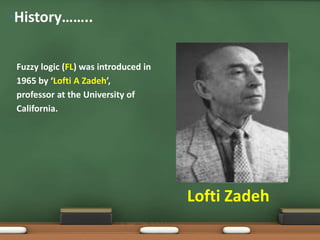
Fuzzy logic (FL) was introduced in 
1965 by ‘Lofti A Zadeh’, 
professor at the University of 
California. 
An accent, click to edit the text 
inside. 
Lofti Zadeh 
•History…….. 
An accent, click to edit the text 
inside.
•History……..(cont…) 
• Zadeh developed fuzzy logic as a way of processing data. 
Instead of requiring a data element to be either a member or 
non-member of a set, he introduced the idea of partial set 
membership. 
• In 1974 Mamdani and Assilian used fuzzy logic to regulate a 
steam engine. 
• In 1985 researchers at Bell laboratories developed the first fuzzy 
logic chip. 
• In 1987 The first subway system was built which worked with a 
fuzzy logic-based automatic train operation control system in 
Japan. It was a big success and resulted in a fuzzy boom
•SINCE THEN – TODAY AND BEYOND 
• Today, almost every intelligent machine has fuzzy logic 
technology inside it. But fuzzy logic doesn't only help boast 
machine IQs. It also plays an important role in numerous other 
fields of applications, including Water Resources Management, 
GIS and lots more. …………………………..
•INTRODUCTION…. 
What is Fuzzy Logic? 
• Fuzzy logic is the way the human brain works, and 
we can mimic this in machines so they will 
perform somewhat like humans…
•INTRODUCTION….(cont….) 
• Humans say things like "If it is sunny and warm today, I 
will drive fast" 
• Linguistic variables: 
• Temp: {freezing, cool, warm, hot} 
• Cloud Cover: {overcast, partly cloudy, sunny} 
• Speed: {slow, fast}
•Defining Fuzzy Sets 
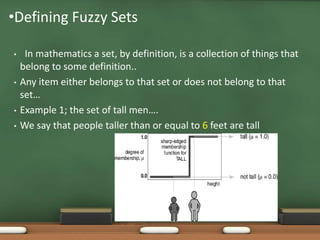
• In mathematics a set, by definition, is a collection of things that 
belong to some definition.. 
• Any item either belongs to that set or does not belong to that 
set… 
• Example 1; the set of tall men…. 
• We say that people taller than or equal to 6 feet are tall
•Fuzzy Sets……(cont….) 
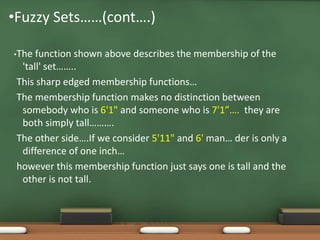
•The function shown above describes the membership of the 
'tall' set…….. 
This sharp edged membership functions… 
The membership function makes no distinction between 
somebody who is 6'1" and someone who is 7'1”…. they are 
both simply tall………. 
The other side….If we consider 5'11" and 6' man… der is only a 
difference of one inch… 
however this membership function just says one is tall and the 
other is not tall.
•Fuzzy Sets……(cont….) 
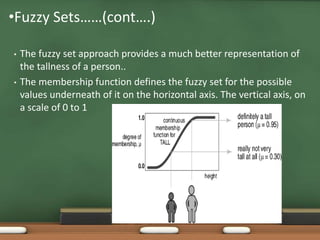
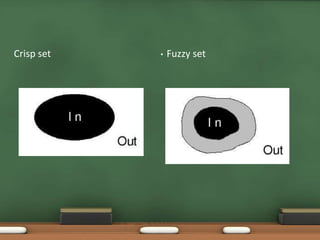
• The fuzzy set approach provides a much better representation of 
the tallness of a person.. 
• The membership function defines the fuzzy set for the possible 
values underneath of it on the horizontal axis. The vertical axis, on 
a scale of 0 to 1
Crisp set • Fuzzy set
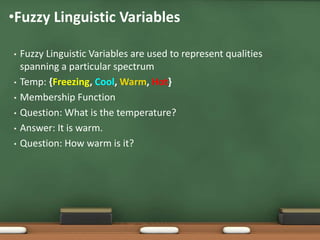
•Fuzzy Linguistic Variables 
• Fuzzy Linguistic Variables are used to represent qualities 
spanning a particular spectrum 
• Temp: {Freezing, Cool, Warm, Hot} 
• Membership Function 
• Question: What is the temperature? 
• Answer: It is warm. 
• Question: How warm is it?
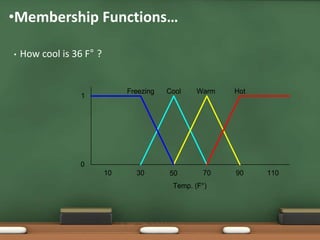
•Membership Functions… 
• How cool is 36 F° ? 
Freezing Cool Warm Hot 
10 30 50 70 90 110 
Temp. (F°) 
1 
0
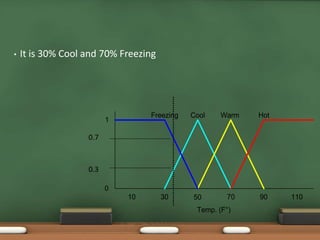
• It is 30% Cool and 70% Freezing 
Freezing Cool Warm Hot 
10 30 50 70 90 110 
Temp. (F°) 
1 
0 
0.7 
0.3
•FUZZY LOGIC… 
•Fuzzy Conjunction,  
•Fuzzy Disjunction,  
•Operate on degrees of membership in 
fuzzy sets
•FUZZY LOGIC…(cont..) 
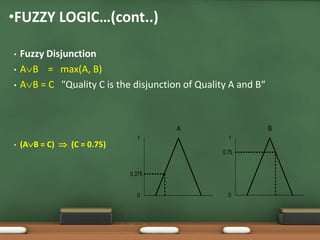
• Fuzzy Disjunction 
• AB = max(A, B) 
• AB = C "Quality C is the disjunction of Quality A and B“ 
• (AB = C)  (C = 0.75) 
1 
0.375 
0 
A 
1 
0.75 
0 
B
•FUZZY LOGIC…(CONT….) 
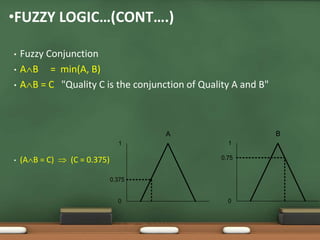
• Fuzzy Conjunction 
• AB = min(A, B) 
• AB = C "Quality C is the conjunction of Quality A and B" 
• (AB = C)  (C = 0.375) 
1 
0.375 
0 
A 
1 
0.75 
0 
B
•Example: Fuzzy Conjunction 
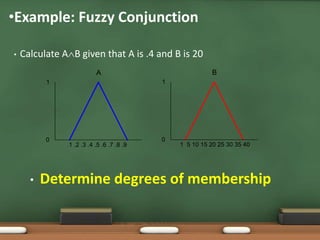
• Calculate AB given that A is .4 and B is 20 
1 
0 
A 
1 
0 
B 
.1 .2 .3 .4 .5 .6 .7 .8 .9 1 5 10 15 20 25 30 35 40 
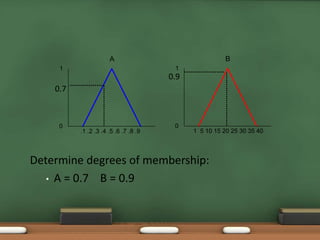
• Determine degrees of membership
1 
0 
A 
1 
Determine degrees of membership: 
• A = 0.7 B = 0.9 
0 
B 
.1 .2 .3 .4 .5 .6 .7 .8 .9 1 5 10 15 20 25 30 35 40 
0.7 
0.9
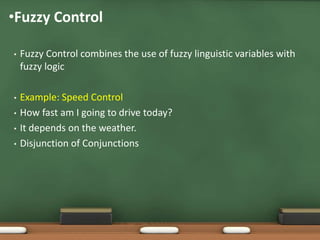
•Fuzzy Control 
• Fuzzy Control combines the use of fuzzy linguistic variables with 
fuzzy logic 
• Example: Speed Control 
• How fast am I going to drive today? 
• It depends on the weather. 
• Disjunction of Conjunctions
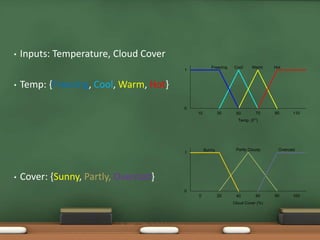
• Inputs: Temperature, Cloud Cover 
• Temp: {Freezing, Cool, Warm, Hot} 
• Cover: {Sunny, Partly, Overcast} 
Freezing Cool Warm Hot 
10 30 50 70 90 110 
Temp. (F°) 
1 
0 
Sunny Partly Cloudy Overcast 
0 20 40 60 80 100 
Cloud Cover (%) 
1 
0
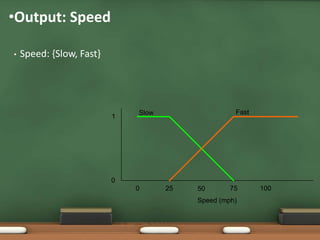
•Output: Speed 
• Speed: {Slow, Fast} 
Slow Fast 
0 25 50 75 100 
Speed (mph) 
1 
0
• Rules 
• If it's Sunny and Warm, drive Fast 
Sunny(Cover)Warm(Temp) Fast(Speed) 
• If it's Cloudy and Cool, drive Slow 
Cloudy(Cover)Cool(Temp) Slow(Speed) 
• Driving Speed is the combination of output of these rules... 
• How fast will I go if it is 65 F° and 25 % Cloud Cover ?
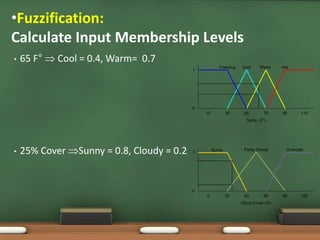
•Fuzzification: 
Calculate Input Membership Levels 
• 65 F°  Cool = 0.4, Warm= 0.7 
• 25% Cover Sunny = 0.8, Cloudy = 0.2 
Freezing Cool Warm Hot 
10 30 50 70 90 110 
Temp. (F°) 
1 
0 
Sunny Partly Cloudy Overcast 
0 20 40 60 80 100 
Cloud Cover (%) 
1 
0
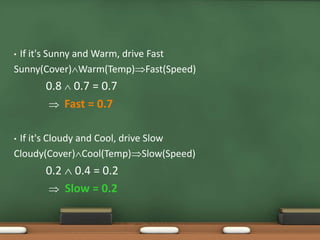
• If it's Sunny and Warm, drive Fast 
Sunny(Cover)Warm(Temp)Fast(Speed) 
0.8  0.7 = 0.7 
 Fast = 0.7 
• If it's Cloudy and Cool, drive Slow 
Cloudy(Cover)Cool(Temp)Slow(Speed) 
0.2  0.4 = 0.2 
 Slow = 0.2
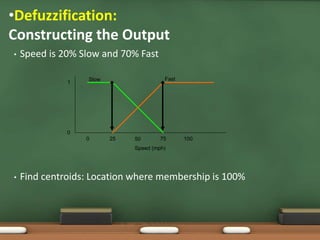
•Defuzzification: 
Constructing the Output 
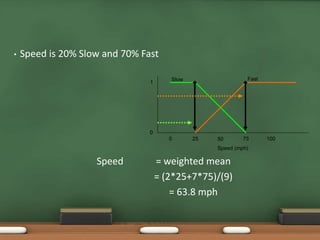
• Speed is 20% Slow and 70% Fast 
Slow Fast 
0 25 50 75 100 
Speed (mph) 
1 
0 
• Find centroids: Location where membership is 100%
• Speed is 20% Slow and 70% Fast 
Slow Fast 
0 25 50 75 100 
Speed (mph) 
1 
Speed = weighted mean 
= (2*25+7*75)/(9) 
= 63.8 mph 
0
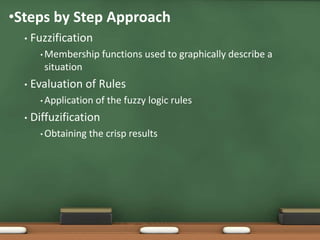
•Steps by Step Approach 
• Fuzzification 
•Membership functions used to graphically describe a 
situation 
• Evaluation of Rules 
• Application of the fuzzy logic rules 
• Diffuzification 
•Obtaining the crisp results
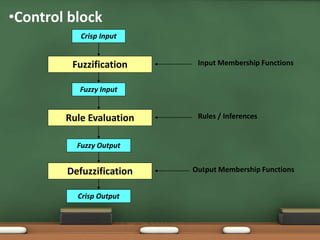
•Control block 
Crisp Input 
Fuzzification 
Fuzzy Input 
Rule Evaluation 
Fuzzy Output 
Defuzzification 
Crisp Output 
Input Membership Functions 
Rules / Inferences 
Output Membership Functions
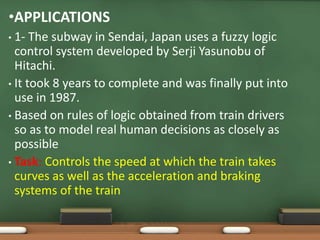
•APPLICATIONS 
• 1- The subway in Sendai, Japan uses a fuzzy logic 
control system developed by Serji Yasunobu of 
Hitachi. 
• It took 8 years to complete and was finally put into 
use in 1987. 
• Based on rules of logic obtained from train drivers 
so as to model real human decisions as closely as 
possible 
• Task: Controls the speed at which the train takes 
curves as well as the acceleration and braking 
systems of the train
• Has model of the motor and break to predict the 
next state of speed, stopping point, and running 
time input variables 
• Controller selects the best action based on the 
predicted states. 
• The results of the fuzzy logic controller for the 
Sendai subway are excellent!! 
• The train movement is smoother than most other 
trains 
• Even the skilled human operators who sometimes 
run the train cannot beat the automated system in 
terms of smoothness or accuracy of stopping
•AUTOMATED AUTOMOBILES 
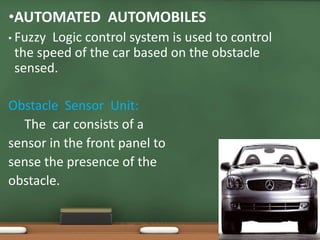
• Fuzzy Logic control system is used to control 
the speed of the car based on the obstacle 
sensed. 
Obstacle Sensor Unit: 
The car consists of a 
sensor in the front panel to 
sense the presence of the 
obstacle.
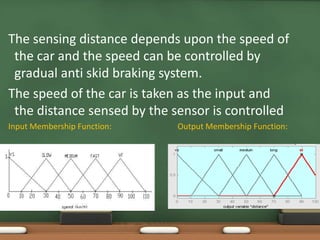
The sensing distance depends upon the speed of 
the car and the speed can be controlled by 
gradual anti skid braking system. 
The speed of the car is taken as the input and 
the distance sensed by the sensor is controlled 
Input Membership Function: Output Membership Function:
Human Decision Making(Volkswagen 
Direct-Shift Gearbox) 
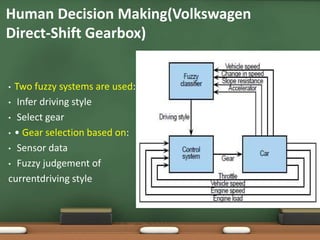
• Two fuzzy systems are used: 
• Infer driving style 
• Select gear 
• • Gear selection based on: 
• Sensor data 
• Fuzzy judgement of 
currentdriving style
Current Uses of Fuzzy Logic 
• Nuclear Fusion 
•Water Treatment Systems 
•Washing Machines 
• Dryers 
• Microwave Ovens 
• Still and Video Cameras - Auto focus, Exposure 
and Anti-Shake 
• AC 
• IMAGE processing
REFERENCES 
[1] Daniel Mcneil and Paul 
Freiberger " Fuzzy Logic" 
[2]http://www.quadralay.com/ 
www/Fuzzy/FAQ/FAQ00.html 
[3]http://www.fll.uni.linz.ac.af/ 
pdhome.html 
[4] http://soft.amcac.ac.jp/index-e. 
html
THANK YOU

Fuzzy logic 2014

  • 1.
  • 2.
    •OUTLINE….. HISTORY….. INTRODUCTION…. APPLICATIONS……. REFERENCES…. 1 2 3 4 5 FUZZY SETS, LINGUISTIC VARIABLES, MEMBERSHIP FUNCTIONS, FUZZY LOGIC, FUZZY CONTROL….
  • 3.
    Fuzzy logic (FL)was introduced in 1965 by ‘Lofti A Zadeh’, professor at the University of California. An accent, click to edit the text inside. Lofti Zadeh •History…….. An accent, click to edit the text inside.
  • 4.
    •History……..(cont…) • Zadehdeveloped fuzzy logic as a way of processing data. Instead of requiring a data element to be either a member or non-member of a set, he introduced the idea of partial set membership. • In 1974 Mamdani and Assilian used fuzzy logic to regulate a steam engine. • In 1985 researchers at Bell laboratories developed the first fuzzy logic chip. • In 1987 The first subway system was built which worked with a fuzzy logic-based automatic train operation control system in Japan. It was a big success and resulted in a fuzzy boom
  • 5.
    •SINCE THEN –TODAY AND BEYOND • Today, almost every intelligent machine has fuzzy logic technology inside it. But fuzzy logic doesn't only help boast machine IQs. It also plays an important role in numerous other fields of applications, including Water Resources Management, GIS and lots more. …………………………..
  • 6.
    •INTRODUCTION…. What isFuzzy Logic? • Fuzzy logic is the way the human brain works, and we can mimic this in machines so they will perform somewhat like humans…
  • 7.
    •INTRODUCTION….(cont….) • Humanssay things like "If it is sunny and warm today, I will drive fast" • Linguistic variables: • Temp: {freezing, cool, warm, hot} • Cloud Cover: {overcast, partly cloudy, sunny} • Speed: {slow, fast}
  • 8.
    •Defining Fuzzy Sets • In mathematics a set, by definition, is a collection of things that belong to some definition.. • Any item either belongs to that set or does not belong to that set… • Example 1; the set of tall men…. • We say that people taller than or equal to 6 feet are tall
  • 9.
    •Fuzzy Sets……(cont….) •Thefunction shown above describes the membership of the 'tall' set…….. This sharp edged membership functions… The membership function makes no distinction between somebody who is 6'1" and someone who is 7'1”…. they are both simply tall………. The other side….If we consider 5'11" and 6' man… der is only a difference of one inch… however this membership function just says one is tall and the other is not tall.
  • 10.
    •Fuzzy Sets……(cont….) •The fuzzy set approach provides a much better representation of the tallness of a person.. • The membership function defines the fuzzy set for the possible values underneath of it on the horizontal axis. The vertical axis, on a scale of 0 to 1
  • 11.
    Crisp set •Fuzzy set
  • 12.
    •Fuzzy Linguistic Variables • Fuzzy Linguistic Variables are used to represent qualities spanning a particular spectrum • Temp: {Freezing, Cool, Warm, Hot} • Membership Function • Question: What is the temperature? • Answer: It is warm. • Question: How warm is it?
  • 13.
    •Membership Functions… •How cool is 36 F° ? Freezing Cool Warm Hot 10 30 50 70 90 110 Temp. (F°) 1 0
  • 14.
    • It is30% Cool and 70% Freezing Freezing Cool Warm Hot 10 30 50 70 90 110 Temp. (F°) 1 0 0.7 0.3
  • 15.
    •FUZZY LOGIC… •FuzzyConjunction,  •Fuzzy Disjunction,  •Operate on degrees of membership in fuzzy sets
  • 16.
    •FUZZY LOGIC…(cont..) •Fuzzy Disjunction • AB = max(A, B) • AB = C "Quality C is the disjunction of Quality A and B“ • (AB = C)  (C = 0.75) 1 0.375 0 A 1 0.75 0 B
  • 17.
    •FUZZY LOGIC…(CONT….) •Fuzzy Conjunction • AB = min(A, B) • AB = C "Quality C is the conjunction of Quality A and B" • (AB = C)  (C = 0.375) 1 0.375 0 A 1 0.75 0 B
  • 18.
    •Example: Fuzzy Conjunction • Calculate AB given that A is .4 and B is 20 1 0 A 1 0 B .1 .2 .3 .4 .5 .6 .7 .8 .9 1 5 10 15 20 25 30 35 40 • Determine degrees of membership
  • 19.
    1 0 A 1 Determine degrees of membership: • A = 0.7 B = 0.9 0 B .1 .2 .3 .4 .5 .6 .7 .8 .9 1 5 10 15 20 25 30 35 40 0.7 0.9
  • 20.
    •Fuzzy Control •Fuzzy Control combines the use of fuzzy linguistic variables with fuzzy logic • Example: Speed Control • How fast am I going to drive today? • It depends on the weather. • Disjunction of Conjunctions
  • 21.
    • Inputs: Temperature,Cloud Cover • Temp: {Freezing, Cool, Warm, Hot} • Cover: {Sunny, Partly, Overcast} Freezing Cool Warm Hot 10 30 50 70 90 110 Temp. (F°) 1 0 Sunny Partly Cloudy Overcast 0 20 40 60 80 100 Cloud Cover (%) 1 0
  • 22.
    •Output: Speed •Speed: {Slow, Fast} Slow Fast 0 25 50 75 100 Speed (mph) 1 0
  • 23.
    • Rules •If it's Sunny and Warm, drive Fast Sunny(Cover)Warm(Temp) Fast(Speed) • If it's Cloudy and Cool, drive Slow Cloudy(Cover)Cool(Temp) Slow(Speed) • Driving Speed is the combination of output of these rules... • How fast will I go if it is 65 F° and 25 % Cloud Cover ?
  • 24.
    •Fuzzification: Calculate InputMembership Levels • 65 F°  Cool = 0.4, Warm= 0.7 • 25% Cover Sunny = 0.8, Cloudy = 0.2 Freezing Cool Warm Hot 10 30 50 70 90 110 Temp. (F°) 1 0 Sunny Partly Cloudy Overcast 0 20 40 60 80 100 Cloud Cover (%) 1 0
  • 25.
    • If it'sSunny and Warm, drive Fast Sunny(Cover)Warm(Temp)Fast(Speed) 0.8  0.7 = 0.7  Fast = 0.7 • If it's Cloudy and Cool, drive Slow Cloudy(Cover)Cool(Temp)Slow(Speed) 0.2  0.4 = 0.2  Slow = 0.2
  • 26.
    •Defuzzification: Constructing theOutput • Speed is 20% Slow and 70% Fast Slow Fast 0 25 50 75 100 Speed (mph) 1 0 • Find centroids: Location where membership is 100%
  • 27.
    • Speed is20% Slow and 70% Fast Slow Fast 0 25 50 75 100 Speed (mph) 1 Speed = weighted mean = (2*25+7*75)/(9) = 63.8 mph 0
  • 28.
    •Steps by StepApproach • Fuzzification •Membership functions used to graphically describe a situation • Evaluation of Rules • Application of the fuzzy logic rules • Diffuzification •Obtaining the crisp results
  • 29.
    •Control block CrispInput Fuzzification Fuzzy Input Rule Evaluation Fuzzy Output Defuzzification Crisp Output Input Membership Functions Rules / Inferences Output Membership Functions
  • 30.
    •APPLICATIONS • 1-The subway in Sendai, Japan uses a fuzzy logic control system developed by Serji Yasunobu of Hitachi. • It took 8 years to complete and was finally put into use in 1987. • Based on rules of logic obtained from train drivers so as to model real human decisions as closely as possible • Task: Controls the speed at which the train takes curves as well as the acceleration and braking systems of the train
  • 31.
    • Has modelof the motor and break to predict the next state of speed, stopping point, and running time input variables • Controller selects the best action based on the predicted states. • The results of the fuzzy logic controller for the Sendai subway are excellent!! • The train movement is smoother than most other trains • Even the skilled human operators who sometimes run the train cannot beat the automated system in terms of smoothness or accuracy of stopping
  • 32.
    •AUTOMATED AUTOMOBILES •Fuzzy Logic control system is used to control the speed of the car based on the obstacle sensed. Obstacle Sensor Unit: The car consists of a sensor in the front panel to sense the presence of the obstacle.
  • 33.
    The sensing distancedepends upon the speed of the car and the speed can be controlled by gradual anti skid braking system. The speed of the car is taken as the input and the distance sensed by the sensor is controlled Input Membership Function: Output Membership Function:
  • 34.
    Human Decision Making(Volkswagen Direct-Shift Gearbox) • Two fuzzy systems are used: • Infer driving style • Select gear • • Gear selection based on: • Sensor data • Fuzzy judgement of currentdriving style
  • 35.
    Current Uses ofFuzzy Logic • Nuclear Fusion •Water Treatment Systems •Washing Machines • Dryers • Microwave Ovens • Still and Video Cameras - Auto focus, Exposure and Anti-Shake • AC • IMAGE processing
  • 36.
    REFERENCES [1] DanielMcneil and Paul Freiberger " Fuzzy Logic" [2]http://www.quadralay.com/ www/Fuzzy/FAQ/FAQ00.html [3]http://www.fll.uni.linz.ac.af/ pdhome.html [4] http://soft.amcac.ac.jp/index-e. html
  • 37.