Neuro-Fuzzy Systems
       (NFS)


               Presented by Sagar Ahire
Neuro-Fuzzy System
         =
 Neural Network
         +
   Fuzzy System
Fuzzy Logic
• A form of logic that deals with approximate
  reasoning
• Created to model human reasoning processes
• Uses variables with truth values between 0
  and 1
Characteristics of Fuzzy Logic
• Everything is a matter of degree
• Knowledge is interpreted as a collection of
  fuzzy constraints on a collection of variables
• Inference is viewed as the process of
  propagation of these constraints
• Any logic system can be fuzzified
Neural Network
• Simplified Mathematical model of brain-like
  systems
• Functions like a massively parallel distributed
  computation network
• Is not programmed, but is trained
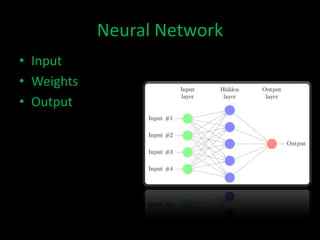
Neural Network
• Input
• Weights
• Output
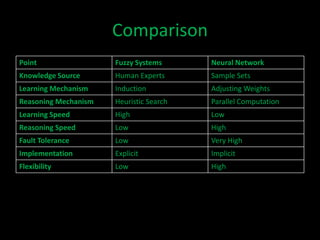
Comparison
Point                 Fuzzy Systems      Neural Network
Knowledge Source      Human Experts      Sample Sets
Learning Mechanism    Induction          Adjusting Weights
Reasoning Mechanism   Heuristic Search   Parallel Computation
Learning Speed        High               Low
Reasoning Speed       Low                High
Fault Tolerance       Low                Very High
Implementation        Explicit           Implicit
Flexibility           Low                High
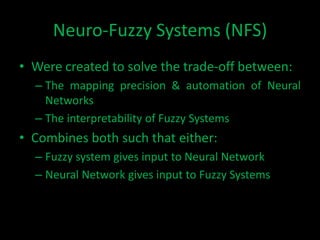
Neuro-Fuzzy Systems (NFS)
• Were created to solve the trade-off between:
  – The mapping precision & automation of Neural
    Networks
  – The interpretability of Fuzzy Systems
• Combines both such that either:
  – Fuzzy system gives input to Neural Network
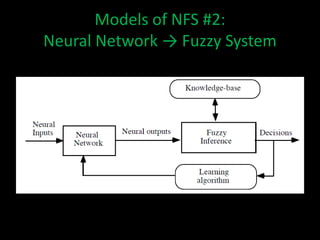
  – Neural Network gives input to Fuzzy Systems
Steps in Development of NFS
• Development of Fuzzy Neural Models
  [Neurons]
• Development of synaptic connection models
  which incorporate fuzziness into Neural
  Network [Weights]
• Development of Learning Algorithms [Method
  of adjusting weights]
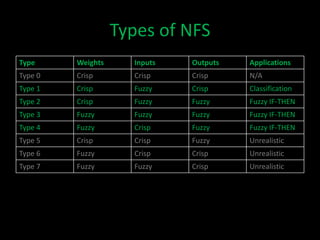
Types of NFS
Type     Weights     Inputs   Outputs   Applications
Type 0   Crisp       Crisp    Crisp     N/A
Type 1   Crisp       Fuzzy    Crisp     Classification
Type 2   Crisp       Fuzzy    Fuzzy     Fuzzy IF-THEN
Type 3   Fuzzy       Fuzzy    Fuzzy     Fuzzy IF-THEN
Type 4   Fuzzy       Crisp    Fuzzy     Fuzzy IF-THEN
Type 5   Crisp       Crisp    Fuzzy     Unrealistic
Type 6   Fuzzy       Crisp    Crisp     Unrealistic
Type 7   Fuzzy       Fuzzy    Crisp     Unrealistic
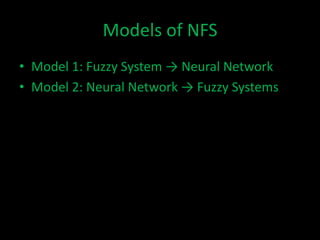
Models of NFS
• Model 1: Fuzzy System → Neural Network
• Model 2: Neural Network → Fuzzy Systems
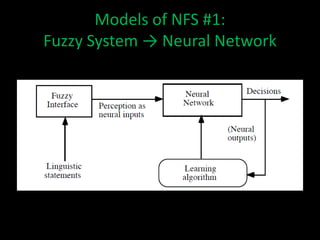
Models of NFS #1:
Fuzzy System → Neural Network
Models of NFS #2:
Neural Network → Fuzzy System
Applications of NFS
• Measuring opacity/transparency of water in
  washing machine – Hitachi, Japan
• Improving the rating of convertible bonds –
  Nikko Securities, Japan
• Adjusting exposure in photocopy machines –
  Sanyo, Japan
• Electric fan that rotates towards the user –
  Sanyo, Japan

Neuro-fuzzy systems

  • 1.
    Neuro-Fuzzy Systems (NFS) Presented by Sagar Ahire
  • 2.
    Neuro-Fuzzy System = Neural Network + Fuzzy System
  • 3.
    Fuzzy Logic • Aform of logic that deals with approximate reasoning • Created to model human reasoning processes • Uses variables with truth values between 0 and 1
  • 4.
    Characteristics of FuzzyLogic • Everything is a matter of degree • Knowledge is interpreted as a collection of fuzzy constraints on a collection of variables • Inference is viewed as the process of propagation of these constraints • Any logic system can be fuzzified
  • 5.
    Neural Network • SimplifiedMathematical model of brain-like systems • Functions like a massively parallel distributed computation network • Is not programmed, but is trained
  • 6.
    Neural Network • Input •Weights • Output
  • 7.
    Comparison Point Fuzzy Systems Neural Network Knowledge Source Human Experts Sample Sets Learning Mechanism Induction Adjusting Weights Reasoning Mechanism Heuristic Search Parallel Computation Learning Speed High Low Reasoning Speed Low High Fault Tolerance Low Very High Implementation Explicit Implicit Flexibility Low High
  • 8.
    Neuro-Fuzzy Systems (NFS) •Were created to solve the trade-off between: – The mapping precision & automation of Neural Networks – The interpretability of Fuzzy Systems • Combines both such that either: – Fuzzy system gives input to Neural Network – Neural Network gives input to Fuzzy Systems
  • 9.
    Steps in Developmentof NFS • Development of Fuzzy Neural Models [Neurons] • Development of synaptic connection models which incorporate fuzziness into Neural Network [Weights] • Development of Learning Algorithms [Method of adjusting weights]
  • 10.
    Types of NFS Type Weights Inputs Outputs Applications Type 0 Crisp Crisp Crisp N/A Type 1 Crisp Fuzzy Crisp Classification Type 2 Crisp Fuzzy Fuzzy Fuzzy IF-THEN Type 3 Fuzzy Fuzzy Fuzzy Fuzzy IF-THEN Type 4 Fuzzy Crisp Fuzzy Fuzzy IF-THEN Type 5 Crisp Crisp Fuzzy Unrealistic Type 6 Fuzzy Crisp Crisp Unrealistic Type 7 Fuzzy Fuzzy Crisp Unrealistic
  • 11.
    Models of NFS •Model 1: Fuzzy System → Neural Network • Model 2: Neural Network → Fuzzy Systems
  • 12.
    Models of NFS#1: Fuzzy System → Neural Network
  • 13.
    Models of NFS#2: Neural Network → Fuzzy System
  • 14.
    Applications of NFS •Measuring opacity/transparency of water in washing machine – Hitachi, Japan • Improving the rating of convertible bonds – Nikko Securities, Japan • Adjusting exposure in photocopy machines – Sanyo, Japan • Electric fan that rotates towards the user – Sanyo, Japan

Editor's Notes

  • #9 - Automatically extract fuzzy rules from numerical data