Rushdi Shams, Dept of CSE, KUET, Bangladesh 1
Knowledge RepresentationKnowledge Representation
First Order LogicFirst Order Logic
Artificial IntelligenceArtificial Intelligence
Version 2.0Version 2.0
There are 10 types of people in this world- who understand binaryThere are 10 types of people in this world- who understand binary
and who do not understand binaryand who do not understand binary
Rushdi Shams, Dept of CSE, KUET, Bangladesh 2
Introduction
Propositional logic is declarative
Propositional logic allows partial/disjunctive/negated
information
(unlike most data structures and databases)
Meaning in propositional logic is context-independent
(unlike natural language, where meaning depends on context)
Propositional logic has very limited expressive power
(unlike natural language)
E.g., cannot say “if any student sits an exam they either pass or
fail”.
Propositional logic is compositional
(meaning of B ^ P is derived from meaning of B and of P)
Rushdi Shams, Dept of CSE, KUET, Bangladesh 3
Introduction
You see that we can convert the sentences into
propositional logic but it is difficult
Thus, we will use the foundation of propositional
logic and build a more expressive logic
Rushdi Shams, Dept of CSE, KUET, Bangladesh 4
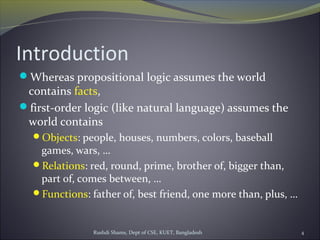
Introduction
Whereas propositional logic assumes the world
contains facts,
first-order logic (like natural language) assumes the
world contains
Objects: people, houses, numbers, colors, baseball
games, wars, …
Relations: red, round, prime, brother of, bigger than,
part of, comes between, …
Functions: father of, best friend, one more than, plus, …
Rushdi Shams, Dept of CSE, KUET, Bangladesh 5
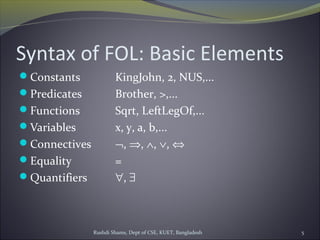
Syntax of FOL: Basic Elements
Constants KingJohn, 2, NUS,...
Predicates Brother, >,...
Functions Sqrt, LeftLegOf,...
Variables x, y, a, b,...
Connectives ¬, ⇒, ∧, ∨, ⇔
Equality =
Quantifiers ∀, ∃
Rushdi Shams, Dept of CSE, KUET, Bangladesh 6
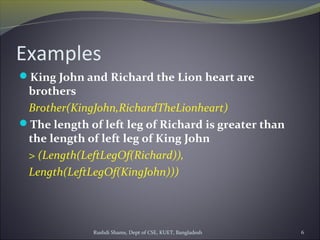
Examples
King John and Richard the Lion heart are
brothers
Brother(KingJohn,RichardTheLionheart)
The length of left leg of Richard is greater than
the length of left leg of King John
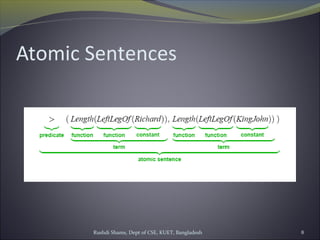
> (Length(LeftLegOf(Richard)),
Length(LeftLegOf(KingJohn)))
Rushdi Shams, Dept of CSE, KUET, Bangladesh 7
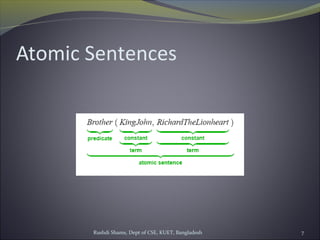
Atomic Sentences
Rushdi Shams, Dept of CSE, KUET, Bangladesh 8
Atomic Sentences
Rushdi Shams, Dept of CSE, KUET, Bangladesh 9
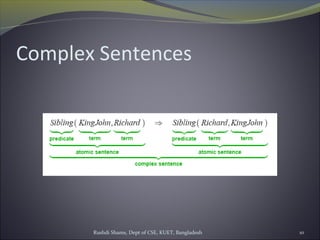
Complex Sentences
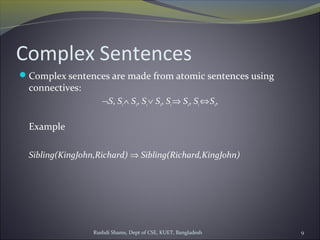
Complex sentences are made from atomic sentences using
connectives:
¬S, S1∧ S2, S1∨ S2, S1⇒ S2, S1⇔S2,
Example
Sibling(KingJohn,Richard) ⇒ Sibling(Richard,KingJohn)
Rushdi Shams, Dept of CSE, KUET, Bangladesh 10
Complex Sentences
Rushdi Shams, Dept of CSE, KUET, Bangladesh 11
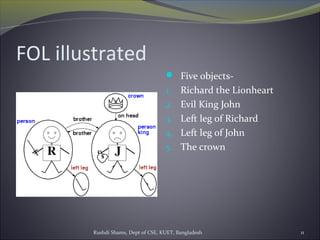
FOL illustrated
 Five objects-
1. Richard the Lionheart
2. Evil King John
3. Left leg of Richard
4. Left leg of John
5. The crown
Rushdi Shams, Dept of CSE, KUET, Bangladesh 12
FOL illustrated
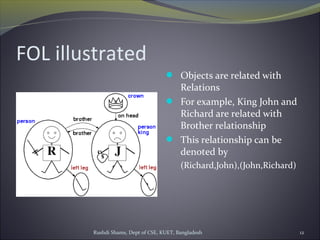
 Objects are related with
Relations
 For example, King John and
Richard are related with
Brother relationship
 This relationship can be
denoted by
(Richard,John),(John,Richard)
Rushdi Shams, Dept of CSE, KUET, Bangladesh 13
FOL illustrated
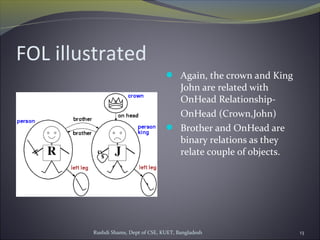
 Again, the crown and King
John are related with
OnHead Relationship-
OnHead (Crown,John)
 Brother and OnHead are
binary relations as they
relate couple of objects.
Rushdi Shams, Dept of CSE, KUET, Bangladesh 14
FOL illustrated
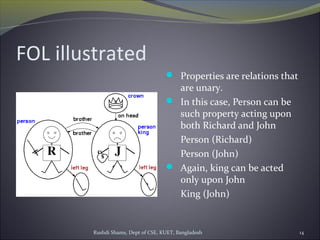
 Properties are relations that
are unary.
 In this case, Person can be
such property acting upon
both Richard and John
Person (Richard)
Person (John)
 Again, king can be acted
only upon John
King (John)
Rushdi Shams, Dept of CSE, KUET, Bangladesh 15
FOL illustrated
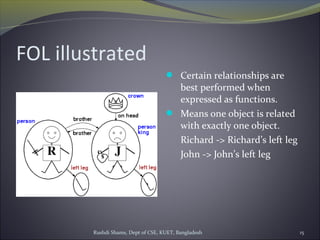
 Certain relationships are
best performed when
expressed as functions.
 Means one object is related
with exactly one object.
Richard -> Richard’s left leg
John -> John’s left leg
Rushdi Shams, Dept of CSE, KUET, Bangladesh 16
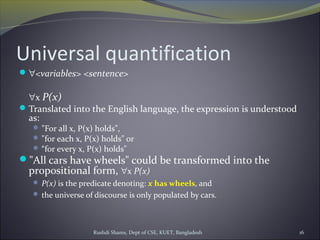
Universal quantification
∀<variables> <sentence>
∀x P(x)
Translated into the English language, the expression is understood
as:
 "For all x, P(x) holds",
 "for each x, P(x) holds" or
 “for every x, P(x) holds"
"All cars have wheels" could be transformed into the
propositional form, ∀x P(x)
 P(x) is the predicate denoting: x has wheels, and
 the universe of discourse is only populated by cars.
Rushdi Shams, Dept of CSE, KUET, Bangladesh 17
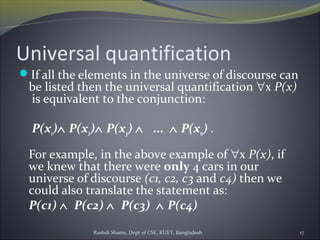
Universal quantification
If all the elements in the universe of discourse can
be listed then the universal quantification ∀x P(x)
is equivalent to the conjunction:
P(x1)∧ P(x2)∧ P(x3) ∧   ...  ∧ P(xn) .
For example, in the above example of ∀x P(x), if
we knew that there were only 4 cars in our
universe of discourse (c1, c2, c3 and c4) then we
could also translate the statement as:
P(c1) ∧  P(c2) ∧  P(c3)  ∧ P(c4)
Rushdi Shams, Dept of CSE, KUET, Bangladesh 18
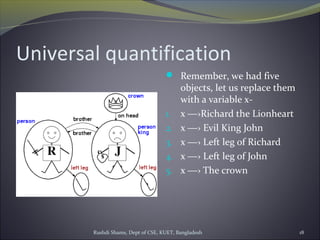
Universal quantification
 Remember, we had five
objects, let us replace them
with a variable x-
1. x ―›Richard the Lionheart
2. x ―› Evil King John
3. x ―› Left leg of Richard
4. x ―› Left leg of John
5. x ―› The crown
Rushdi Shams, Dept of CSE, KUET, Bangladesh 19
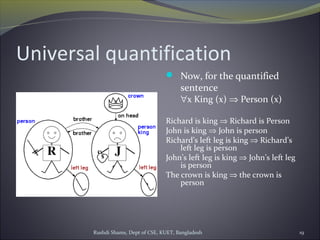
Universal quantification
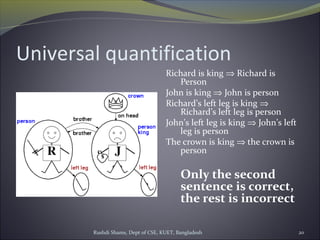
 Now, for the quantified
sentence
∀x King (x) ⇒ Person (x)
Richard is king ⇒ Richard is Person
John is king ⇒ John is person
Richard’s left leg is king ⇒ Richard’s
left leg is person
John’s left leg is king ⇒ John’s left leg
is person
The crown is king ⇒ the crown is
person
Rushdi Shams, Dept of CSE, KUET, Bangladesh 20
Universal quantification
Richard is king ⇒ Richard is
Person
John is king ⇒ John is person
Richard’s left leg is king ⇒
Richard’s left leg is person
John’s left leg is king ⇒ John’s left
leg is person
The crown is king ⇒ the crown is
person
Only the second 
sentence is correct, 
the rest is incorrect
Rushdi Shams, Dept of CSE, KUET, Bangladesh 21
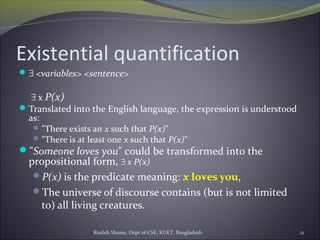
Existential quantification
∃ <variables> <sentence>
∃ x P(x)
Translated into the English language, the expression is understood
as:
"There exists an x such that P(x)"
"There is at least one x such that P(x)"
"Someone loves you" could be transformed into the
propositional form, ∃ x P(x)
P(x) is the predicate meaning: x loves you,
The universe of discourse contains (but is not limited
to) all living creatures.
Rushdi Shams, Dept of CSE, KUET, Bangladesh 22
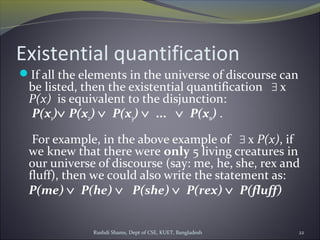
Existential quantification
If all the elements in the universe of discourse can
be listed, then the existential quantification ∃ x
P(x) is equivalent to the disjunction:
P(x1)∨ P(x2) ∨  P(x3) ∨  ...   ∨  P(xn) .
For example, in the above example of ∃ x P(x), if
we knew that there were only 5 living creatures in
our universe of discourse (say: me, he, she, rex and
fluff), then we could also write the statement as:
P(me) ∨  P(he) ∨   P(she) ∨  P(rex) ∨  P(fluff)
Order of application of quantifiers
When more than one variables are quantified in a wff
such as   ∃ y  ∀ x P( x, y ), they are applied from the
inside, that is, the one closest to the atomic formula is
applied first.
Thus  ∃ y  ∀ x P( x, y ) reads ∃ y  [∀ x P( x, y )], and
we say "there exists a y such that for every x, P( x, 
y ) holds" or "for some y, P( x, y ) holds for every x".
Rushdi Shams, Dept of CSE, KUET, Bangladesh 23
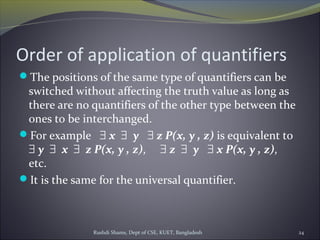
Order of application of quantifiers
The positions of the same type of quantifiers can be
switched without affecting the truth value as long as
there are no quantifiers of the other type between the
ones to be interchanged.
For example   ∃ x  ∃  y   ∃ z P(x, y , z) is equivalent to  
∃ y  ∃  x  ∃  z P(x, y , z),   ∃ z  ∃  y   ∃ x P(x, y , z),
etc.
It is the same for the universal quantifier.
Rushdi Shams, Dept of CSE, KUET, Bangladesh 24
Order of application of quantifiers
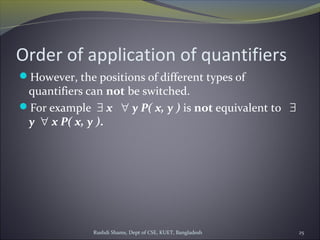
However, the positions of different types of
quantifiers can not be switched.
For example ∃ x   ∀ y P( x, y ) is not equivalent to   ∃
y  ∀ x P( x, y ).
Rushdi Shams, Dept of CSE, KUET, Bangladesh 25
Rushdi Shams, Dept of CSE, KUET, Bangladesh 26
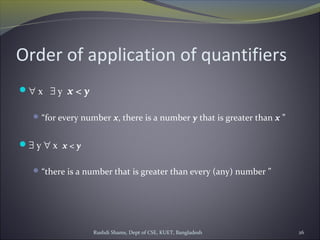
Order of application of quantifiers
∀ x ∃ y x < y
“for every number x, there is a number y that is greater than x ”
∃ y ∀ x x < y
“there is a number that is greater than every (any) number ”
Rushdi Shams, Dept of CSE, KUET, Bangladesh 27
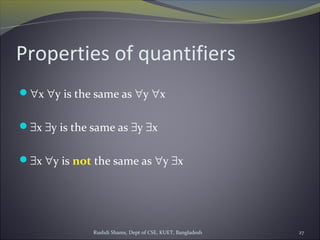
Properties of quantifiers
∀x ∀y is the same as ∀y ∀x
∃x ∃y is the same as ∃y ∃x
∃x ∀y is not the same as ∀y ∃x
Rushdi Shams, Dept of CSE, KUET, Bangladesh 28
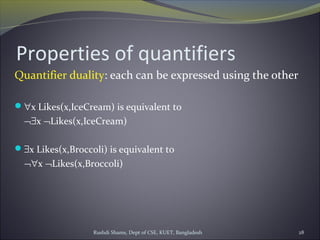
Properties of quantifiers
Quantifier duality: each can be expressed using the other
∀x Likes(x,IceCream) is equivalent to
¬∃x ¬Likes(x,IceCream)
∃x Likes(x,Broccoli) is equivalent to
¬∀x ¬Likes(x,Broccoli)
Rushdi Shams, Dept of CSE, KUET, Bangladesh 29
Properties of quantifiers
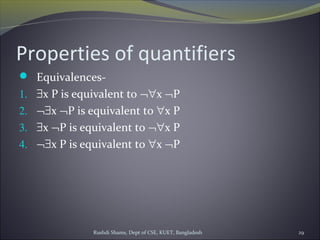
 Equivalences-
1. ∃x P is equivalent to ¬∀x ¬P
2. ¬∃x ¬P is equivalent to ∀x P
3. ∃x ¬P is equivalent to ¬∀x P
4. ¬∃x P is equivalent to ∀x ¬P
Rushdi Shams, Dept of CSE, KUET, Bangladesh 30
Rushdi Shams, Dept of CSE, KUET, Bangladesh 31
Example knowledge base
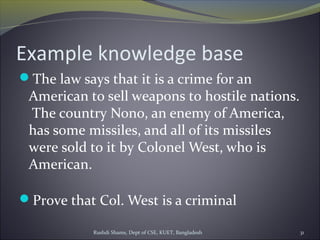
The law says that it is a crime for an
American to sell weapons to hostile nations.
The country Nono, an enemy of America,
has some missiles, and all of its missiles
were sold to it by Colonel West, who is
American.
Prove that Col. West is a criminal
Rushdi Shams, Dept of CSE, KUET, Bangladesh 32
Example knowledge base
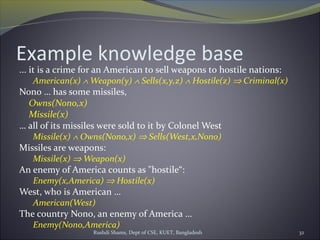
... it is a crime for an American to sell weapons to hostile nations:
American(x) ∧ Weapon(y) ∧ Sells(x,y,z) ∧ Hostile(z) ⇒ Criminal(x)
Nono … has some missiles,
Owns(Nono,x)
Missile(x)
… all of its missiles were sold to it by Colonel West
Missile(x) ∧ Owns(Nono,x) ⇒ Sells(West,x,Nono)
Missiles are weapons:
Missile(x) ⇒ Weapon(x)
An enemy of America counts as "hostile“:
Enemy(x,America) ⇒ Hostile(x)
West, who is American …
American(West)
The country Nono, an enemy of America …
Enemy(Nono,America)
Rushdi Shams, Dept of CSE, KUET, Bangladesh 33
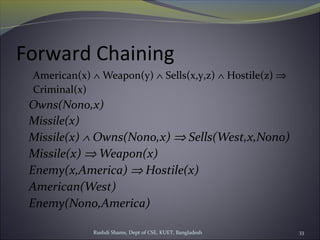
Forward Chaining
American(x) ∧ Weapon(y) ∧ Sells(x,y,z) ∧ Hostile(z) ⇒
Criminal(x)
Owns(Nono,x)
Missile(x)
Missile(x) ∧ Owns(Nono,x) ⇒ Sells(West,x,Nono)
Missile(x) ⇒ Weapon(x)
Enemy(x,America) ⇒ Hostile(x)
American(West)
Enemy(Nono,America)
Rushdi Shams, Dept of CSE, KUET, Bangladesh 34
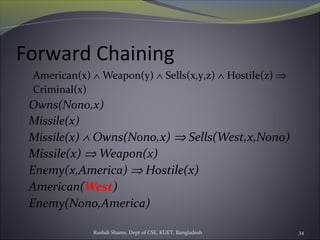
Forward Chaining
American(x) ∧ Weapon(y) ∧ Sells(x,y,z) ∧ Hostile(z) ⇒
Criminal(x)
Owns(Nono,x)
Missile(x)
Missile(x) ∧ Owns(Nono,x) ⇒ Sells(West,x,Nono)
Missile(x) ⇒ Weapon(x)
Enemy(x,America) ⇒ Hostile(x)
American(West)
Enemy(Nono,America)
Rushdi Shams, Dept of CSE, KUET, Bangladesh 35
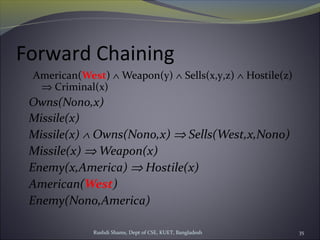
Forward Chaining
American(West) ∧ Weapon(y) ∧ Sells(x,y,z) ∧ Hostile(z)
⇒ Criminal(x)
Owns(Nono,x)
Missile(x)
Missile(x) ∧ Owns(Nono,x) ⇒ Sells(West,x,Nono)
Missile(x) ⇒ Weapon(x)
Enemy(x,America) ⇒ Hostile(x)
American(West)
Enemy(Nono,America)
Rushdi Shams, Dept of CSE, KUET, Bangladesh 36
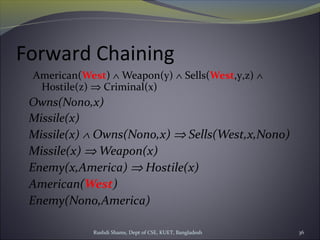
Forward Chaining
American(West) ∧ Weapon(y) ∧ Sells(West,y,z) ∧
Hostile(z) ⇒ Criminal(x)
Owns(Nono,x)
Missile(x)
Missile(x) ∧ Owns(Nono,x) ⇒ Sells(West,x,Nono)
Missile(x) ⇒ Weapon(x)
Enemy(x,America) ⇒ Hostile(x)
American(West)
Enemy(Nono,America)
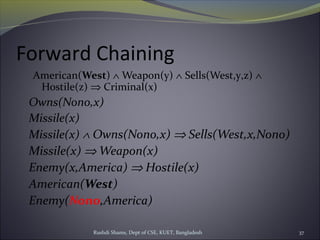
Rushdi Shams, Dept of CSE, KUET, Bangladesh 37
Forward Chaining
American(West) ∧ Weapon(y) ∧ Sells(West,y,z) ∧
Hostile(z) ⇒ Criminal(x)
Owns(Nono,x)
Missile(x)
Missile(x) ∧ Owns(Nono,x) ⇒ Sells(West,x,Nono)
Missile(x) ⇒ Weapon(x)
Enemy(x,America) ⇒ Hostile(x)
American(West)
Enemy(Nono,America)
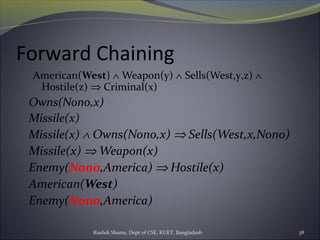
Rushdi Shams, Dept of CSE, KUET, Bangladesh 38
Forward Chaining
American(West) ∧ Weapon(y) ∧ Sells(West,y,z) ∧
Hostile(z) ⇒ Criminal(x)
Owns(Nono,x)
Missile(x)
Missile(x) ∧ Owns(Nono,x) ⇒ Sells(West,x,Nono)
Missile(x) ⇒ Weapon(x)
Enemy(Nono,America) ⇒ Hostile(x)
American(West)
Enemy(Nono,America)
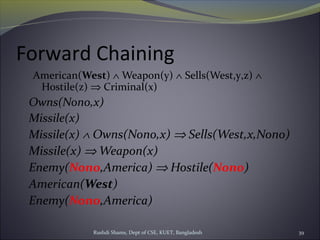
Rushdi Shams, Dept of CSE, KUET, Bangladesh 39
Forward Chaining
American(West) ∧ Weapon(y) ∧ Sells(West,y,z) ∧
Hostile(z) ⇒ Criminal(x)
Owns(Nono,x)
Missile(x)
Missile(x) ∧ Owns(Nono,x) ⇒ Sells(West,x,Nono)
Missile(x) ⇒ Weapon(x)
Enemy(Nono,America) ⇒ Hostile(Nono)
American(West)
Enemy(Nono,America)
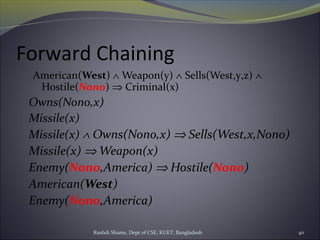
Rushdi Shams, Dept of CSE, KUET, Bangladesh 40
Forward Chaining
American(West) ∧ Weapon(y) ∧ Sells(West,y,z) ∧
Hostile(Nono) ⇒ Criminal(x)
Owns(Nono,x)
Missile(x)
Missile(x) ∧ Owns(Nono,x) ⇒ Sells(West,x,Nono)
Missile(x) ⇒ Weapon(x)
Enemy(Nono,America) ⇒ Hostile(Nono)
American(West)
Enemy(Nono,America)
Rushdi Shams, Dept of CSE, KUET, Bangladesh 41
Backward Chaining
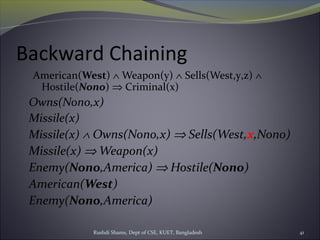
American(West) ∧ Weapon(y) ∧ Sells(West,y,z) ∧
Hostile(Nono) ⇒ Criminal(x)
Owns(Nono,x)
Missile(x)
Missile(x) ∧ Owns(Nono,x) ⇒ Sells(West,x,Nono)
Missile(x) ⇒ Weapon(x)
Enemy(Nono,America) ⇒ Hostile(Nono)
American(West)
Enemy(Nono,America)
Rushdi Shams, Dept of CSE, KUET, Bangladesh 42
Backward Chaining
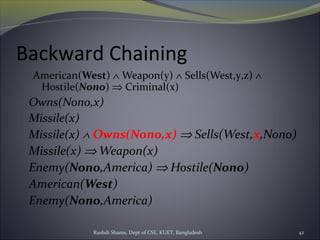
American(West) ∧ Weapon(y) ∧ Sells(West,y,z) ∧
Hostile(Nono) ⇒ Criminal(x)
Owns(Nono,x)
Missile(x)
Missile(x) ∧ Owns(Nono,x) ⇒ Sells(West,x,Nono)
Missile(x) ⇒ Weapon(x)
Enemy(Nono,America) ⇒ Hostile(Nono)
American(West)
Enemy(Nono,America)
Rushdi Shams, Dept of CSE, KUET, Bangladesh 43
Backward Chaining
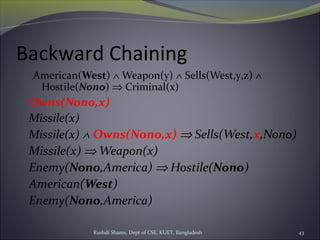
American(West) ∧ Weapon(y) ∧ Sells(West,y,z) ∧
Hostile(Nono) ⇒ Criminal(x)
Owns(Nono,x)
Missile(x)
Missile(x) ∧ Owns(Nono,x) ⇒ Sells(West,x,Nono)
Missile(x) ⇒ Weapon(x)
Enemy(Nono,America) ⇒ Hostile(Nono)
American(West)
Enemy(Nono,America)
Rushdi Shams, Dept of CSE, KUET, Bangladesh 44
Backward Chaining
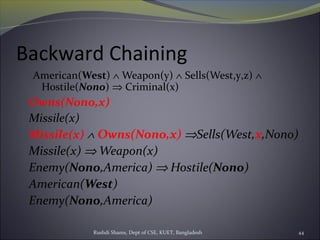
American(West) ∧ Weapon(y) ∧ Sells(West,y,z) ∧
Hostile(Nono) ⇒ Criminal(x)
Owns(Nono,x)
Missile(x)
Missile(x) ∧ Owns(Nono,x) ⇒Sells(West,x,Nono)
Missile(x) ⇒ Weapon(x)
Enemy(Nono,America) ⇒ Hostile(Nono)
American(West)
Enemy(Nono,America)
Rushdi Shams, Dept of CSE, KUET, Bangladesh 45
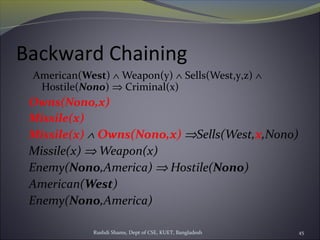
Backward Chaining
American(West) ∧ Weapon(y) ∧ Sells(West,y,z) ∧
Hostile(Nono) ⇒ Criminal(x)
Owns(Nono,x)
Missile(x)
Missile(x) ∧ Owns(Nono,x) ⇒Sells(West,x,Nono)
Missile(x) ⇒ Weapon(x)
Enemy(Nono,America) ⇒ Hostile(Nono)
American(West)
Enemy(Nono,America)
Rushdi Shams, Dept of CSE, KUET, Bangladesh 46
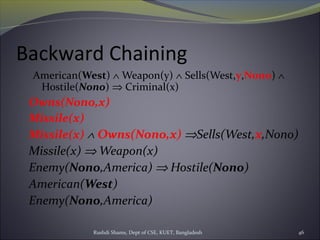
Backward Chaining
American(West) ∧ Weapon(y) ∧ Sells(West,y,Nono) ∧
Hostile(Nono) ⇒ Criminal(x)
Owns(Nono,x)
Missile(x)
Missile(x) ∧ Owns(Nono,x) ⇒Sells(West,x,Nono)
Missile(x) ⇒ Weapon(x)
Enemy(Nono,America) ⇒ Hostile(Nono)
American(West)
Enemy(Nono,America)
Rushdi Shams, Dept of CSE, KUET, Bangladesh 47
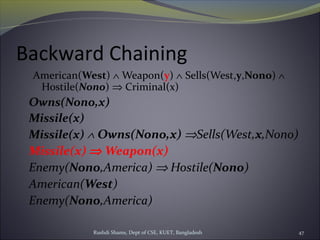
Backward Chaining
American(West) ∧ Weapon(y) ∧ Sells(West,y,Nono) ∧
Hostile(Nono) ⇒ Criminal(x)
Owns(Nono,x)
Missile(x)
Missile(x) ∧ Owns(Nono,x) ⇒Sells(West,x,Nono)
Missile(x) ⇒ Weapon(x)
Enemy(Nono,America) ⇒ Hostile(Nono)
American(West)
Enemy(Nono,America)
Rushdi Shams, Dept of CSE, KUET, Bangladesh 48
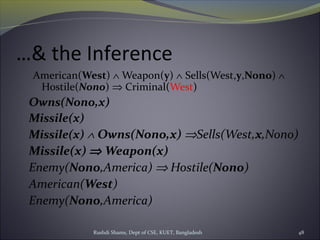
…& the Inference
American(West) ∧ Weapon(y) ∧ Sells(West,y,Nono) ∧
Hostile(Nono) ⇒ Criminal(West)
Owns(Nono,x)
Missile(x)
Missile(x) ∧ Owns(Nono,x) ⇒Sells(West,x,Nono)
Missile(x) ⇒ Weapon(x)
Enemy(Nono,America) ⇒ Hostile(Nono)
American(West)
Enemy(Nono,America)
Rushdi Shams, Dept of CSE, KUET, Bangladesh 49
References
Artificial Intelligence: A Modern Approach (2nd
Edition)
by Russell and Norvig Chapter 8
http://www.cs.odu.edu/~toida/nerzic/content/logic/pred_

First order logic

  • 1.
    Rushdi Shams, Deptof CSE, KUET, Bangladesh 1 Knowledge RepresentationKnowledge Representation First Order LogicFirst Order Logic Artificial IntelligenceArtificial Intelligence Version 2.0Version 2.0 There are 10 types of people in this world- who understand binaryThere are 10 types of people in this world- who understand binary and who do not understand binaryand who do not understand binary
  • 2.
    Rushdi Shams, Deptof CSE, KUET, Bangladesh 2 Introduction Propositional logic is declarative Propositional logic allows partial/disjunctive/negated information (unlike most data structures and databases) Meaning in propositional logic is context-independent (unlike natural language, where meaning depends on context) Propositional logic has very limited expressive power (unlike natural language) E.g., cannot say “if any student sits an exam they either pass or fail”. Propositional logic is compositional (meaning of B ^ P is derived from meaning of B and of P)
  • 3.
    Rushdi Shams, Deptof CSE, KUET, Bangladesh 3 Introduction You see that we can convert the sentences into propositional logic but it is difficult Thus, we will use the foundation of propositional logic and build a more expressive logic
  • 4.
    Rushdi Shams, Deptof CSE, KUET, Bangladesh 4 Introduction Whereas propositional logic assumes the world contains facts, first-order logic (like natural language) assumes the world contains Objects: people, houses, numbers, colors, baseball games, wars, … Relations: red, round, prime, brother of, bigger than, part of, comes between, … Functions: father of, best friend, one more than, plus, …
  • 5.
    Rushdi Shams, Deptof CSE, KUET, Bangladesh 5 Syntax of FOL: Basic Elements Constants KingJohn, 2, NUS,... Predicates Brother, >,... Functions Sqrt, LeftLegOf,... Variables x, y, a, b,... Connectives ¬, ⇒, ∧, ∨, ⇔ Equality = Quantifiers ∀, ∃
  • 6.
    Rushdi Shams, Deptof CSE, KUET, Bangladesh 6 Examples King John and Richard the Lion heart are brothers Brother(KingJohn,RichardTheLionheart) The length of left leg of Richard is greater than the length of left leg of King John > (Length(LeftLegOf(Richard)), Length(LeftLegOf(KingJohn)))
  • 7.
    Rushdi Shams, Deptof CSE, KUET, Bangladesh 7 Atomic Sentences
  • 8.
    Rushdi Shams, Deptof CSE, KUET, Bangladesh 8 Atomic Sentences
  • 9.
    Rushdi Shams, Deptof CSE, KUET, Bangladesh 9 Complex Sentences Complex sentences are made from atomic sentences using connectives: ¬S, S1∧ S2, S1∨ S2, S1⇒ S2, S1⇔S2, Example Sibling(KingJohn,Richard) ⇒ Sibling(Richard,KingJohn)
  • 10.
    Rushdi Shams, Deptof CSE, KUET, Bangladesh 10 Complex Sentences
  • 11.
    Rushdi Shams, Deptof CSE, KUET, Bangladesh 11 FOL illustrated  Five objects- 1. Richard the Lionheart 2. Evil King John 3. Left leg of Richard 4. Left leg of John 5. The crown
  • 12.
    Rushdi Shams, Deptof CSE, KUET, Bangladesh 12 FOL illustrated  Objects are related with Relations  For example, King John and Richard are related with Brother relationship  This relationship can be denoted by (Richard,John),(John,Richard)
  • 13.
    Rushdi Shams, Deptof CSE, KUET, Bangladesh 13 FOL illustrated  Again, the crown and King John are related with OnHead Relationship- OnHead (Crown,John)  Brother and OnHead are binary relations as they relate couple of objects.
  • 14.
    Rushdi Shams, Deptof CSE, KUET, Bangladesh 14 FOL illustrated  Properties are relations that are unary.  In this case, Person can be such property acting upon both Richard and John Person (Richard) Person (John)  Again, king can be acted only upon John King (John)
  • 15.
    Rushdi Shams, Deptof CSE, KUET, Bangladesh 15 FOL illustrated  Certain relationships are best performed when expressed as functions.  Means one object is related with exactly one object. Richard -> Richard’s left leg John -> John’s left leg
  • 16.
    Rushdi Shams, Deptof CSE, KUET, Bangladesh 16 Universal quantification ∀<variables> <sentence> ∀x P(x) Translated into the English language, the expression is understood as:  "For all x, P(x) holds",  "for each x, P(x) holds" or  “for every x, P(x) holds" "All cars have wheels" could be transformed into the propositional form, ∀x P(x)  P(x) is the predicate denoting: x has wheels, and  the universe of discourse is only populated by cars.
  • 17.
    Rushdi Shams, Deptof CSE, KUET, Bangladesh 17 Universal quantification If all the elements in the universe of discourse can be listed then the universal quantification ∀x P(x) is equivalent to the conjunction: P(x1)∧ P(x2)∧ P(x3) ∧   ...  ∧ P(xn) . For example, in the above example of ∀x P(x), if we knew that there were only 4 cars in our universe of discourse (c1, c2, c3 and c4) then we could also translate the statement as: P(c1) ∧  P(c2) ∧  P(c3)  ∧ P(c4)
  • 18.
    Rushdi Shams, Deptof CSE, KUET, Bangladesh 18 Universal quantification  Remember, we had five objects, let us replace them with a variable x- 1. x ―›Richard the Lionheart 2. x ―› Evil King John 3. x ―› Left leg of Richard 4. x ―› Left leg of John 5. x ―› The crown
  • 19.
    Rushdi Shams, Deptof CSE, KUET, Bangladesh 19 Universal quantification  Now, for the quantified sentence ∀x King (x) ⇒ Person (x) Richard is king ⇒ Richard is Person John is king ⇒ John is person Richard’s left leg is king ⇒ Richard’s left leg is person John’s left leg is king ⇒ John’s left leg is person The crown is king ⇒ the crown is person
  • 20.
    Rushdi Shams, Deptof CSE, KUET, Bangladesh 20 Universal quantification Richard is king ⇒ Richard is Person John is king ⇒ John is person Richard’s left leg is king ⇒ Richard’s left leg is person John’s left leg is king ⇒ John’s left leg is person The crown is king ⇒ the crown is person Only the second  sentence is correct,  the rest is incorrect
  • 21.
    Rushdi Shams, Deptof CSE, KUET, Bangladesh 21 Existential quantification ∃ <variables> <sentence> ∃ x P(x) Translated into the English language, the expression is understood as: "There exists an x such that P(x)" "There is at least one x such that P(x)" "Someone loves you" could be transformed into the propositional form, ∃ x P(x) P(x) is the predicate meaning: x loves you, The universe of discourse contains (but is not limited to) all living creatures.
  • 22.
    Rushdi Shams, Deptof CSE, KUET, Bangladesh 22 Existential quantification If all the elements in the universe of discourse can be listed, then the existential quantification ∃ x P(x) is equivalent to the disjunction: P(x1)∨ P(x2) ∨  P(x3) ∨  ...   ∨  P(xn) . For example, in the above example of ∃ x P(x), if we knew that there were only 5 living creatures in our universe of discourse (say: me, he, she, rex and fluff), then we could also write the statement as: P(me) ∨  P(he) ∨   P(she) ∨  P(rex) ∨  P(fluff)
  • 23.
    Order of applicationof quantifiers When more than one variables are quantified in a wff such as   ∃ y  ∀ x P( x, y ), they are applied from the inside, that is, the one closest to the atomic formula is applied first. Thus  ∃ y  ∀ x P( x, y ) reads ∃ y  [∀ x P( x, y )], and we say "there exists a y such that for every x, P( x,  y ) holds" or "for some y, P( x, y ) holds for every x". Rushdi Shams, Dept of CSE, KUET, Bangladesh 23
  • 24.
    Order of applicationof quantifiers The positions of the same type of quantifiers can be switched without affecting the truth value as long as there are no quantifiers of the other type between the ones to be interchanged. For example   ∃ x  ∃  y   ∃ z P(x, y , z) is equivalent to   ∃ y  ∃  x  ∃  z P(x, y , z),   ∃ z  ∃  y   ∃ x P(x, y , z), etc. It is the same for the universal quantifier. Rushdi Shams, Dept of CSE, KUET, Bangladesh 24
  • 25.
    Order of applicationof quantifiers However, the positions of different types of quantifiers can not be switched. For example ∃ x   ∀ y P( x, y ) is not equivalent to   ∃ y  ∀ x P( x, y ). Rushdi Shams, Dept of CSE, KUET, Bangladesh 25
  • 26.
    Rushdi Shams, Deptof CSE, KUET, Bangladesh 26 Order of application of quantifiers ∀ x ∃ y x < y “for every number x, there is a number y that is greater than x ” ∃ y ∀ x x < y “there is a number that is greater than every (any) number ”
  • 27.
    Rushdi Shams, Deptof CSE, KUET, Bangladesh 27 Properties of quantifiers ∀x ∀y is the same as ∀y ∀x ∃x ∃y is the same as ∃y ∃x ∃x ∀y is not the same as ∀y ∃x
  • 28.
    Rushdi Shams, Deptof CSE, KUET, Bangladesh 28 Properties of quantifiers Quantifier duality: each can be expressed using the other ∀x Likes(x,IceCream) is equivalent to ¬∃x ¬Likes(x,IceCream) ∃x Likes(x,Broccoli) is equivalent to ¬∀x ¬Likes(x,Broccoli)
  • 29.
    Rushdi Shams, Deptof CSE, KUET, Bangladesh 29 Properties of quantifiers  Equivalences- 1. ∃x P is equivalent to ¬∀x ¬P 2. ¬∃x ¬P is equivalent to ∀x P 3. ∃x ¬P is equivalent to ¬∀x P 4. ¬∃x P is equivalent to ∀x ¬P
  • 30.
    Rushdi Shams, Deptof CSE, KUET, Bangladesh 30
  • 31.
    Rushdi Shams, Deptof CSE, KUET, Bangladesh 31 Example knowledge base The law says that it is a crime for an American to sell weapons to hostile nations. The country Nono, an enemy of America, has some missiles, and all of its missiles were sold to it by Colonel West, who is American. Prove that Col. West is a criminal
  • 32.
    Rushdi Shams, Deptof CSE, KUET, Bangladesh 32 Example knowledge base ... it is a crime for an American to sell weapons to hostile nations: American(x) ∧ Weapon(y) ∧ Sells(x,y,z) ∧ Hostile(z) ⇒ Criminal(x) Nono … has some missiles, Owns(Nono,x) Missile(x) … all of its missiles were sold to it by Colonel West Missile(x) ∧ Owns(Nono,x) ⇒ Sells(West,x,Nono) Missiles are weapons: Missile(x) ⇒ Weapon(x) An enemy of America counts as "hostile“: Enemy(x,America) ⇒ Hostile(x) West, who is American … American(West) The country Nono, an enemy of America … Enemy(Nono,America)
  • 33.
    Rushdi Shams, Deptof CSE, KUET, Bangladesh 33 Forward Chaining American(x) ∧ Weapon(y) ∧ Sells(x,y,z) ∧ Hostile(z) ⇒ Criminal(x) Owns(Nono,x) Missile(x) Missile(x) ∧ Owns(Nono,x) ⇒ Sells(West,x,Nono) Missile(x) ⇒ Weapon(x) Enemy(x,America) ⇒ Hostile(x) American(West) Enemy(Nono,America)
  • 34.
    Rushdi Shams, Deptof CSE, KUET, Bangladesh 34 Forward Chaining American(x) ∧ Weapon(y) ∧ Sells(x,y,z) ∧ Hostile(z) ⇒ Criminal(x) Owns(Nono,x) Missile(x) Missile(x) ∧ Owns(Nono,x) ⇒ Sells(West,x,Nono) Missile(x) ⇒ Weapon(x) Enemy(x,America) ⇒ Hostile(x) American(West) Enemy(Nono,America)
  • 35.
    Rushdi Shams, Deptof CSE, KUET, Bangladesh 35 Forward Chaining American(West) ∧ Weapon(y) ∧ Sells(x,y,z) ∧ Hostile(z) ⇒ Criminal(x) Owns(Nono,x) Missile(x) Missile(x) ∧ Owns(Nono,x) ⇒ Sells(West,x,Nono) Missile(x) ⇒ Weapon(x) Enemy(x,America) ⇒ Hostile(x) American(West) Enemy(Nono,America)
  • 36.
    Rushdi Shams, Deptof CSE, KUET, Bangladesh 36 Forward Chaining American(West) ∧ Weapon(y) ∧ Sells(West,y,z) ∧ Hostile(z) ⇒ Criminal(x) Owns(Nono,x) Missile(x) Missile(x) ∧ Owns(Nono,x) ⇒ Sells(West,x,Nono) Missile(x) ⇒ Weapon(x) Enemy(x,America) ⇒ Hostile(x) American(West) Enemy(Nono,America)
  • 37.
    Rushdi Shams, Deptof CSE, KUET, Bangladesh 37 Forward Chaining American(West) ∧ Weapon(y) ∧ Sells(West,y,z) ∧ Hostile(z) ⇒ Criminal(x) Owns(Nono,x) Missile(x) Missile(x) ∧ Owns(Nono,x) ⇒ Sells(West,x,Nono) Missile(x) ⇒ Weapon(x) Enemy(x,America) ⇒ Hostile(x) American(West) Enemy(Nono,America)
  • 38.
    Rushdi Shams, Deptof CSE, KUET, Bangladesh 38 Forward Chaining American(West) ∧ Weapon(y) ∧ Sells(West,y,z) ∧ Hostile(z) ⇒ Criminal(x) Owns(Nono,x) Missile(x) Missile(x) ∧ Owns(Nono,x) ⇒ Sells(West,x,Nono) Missile(x) ⇒ Weapon(x) Enemy(Nono,America) ⇒ Hostile(x) American(West) Enemy(Nono,America)
  • 39.
    Rushdi Shams, Deptof CSE, KUET, Bangladesh 39 Forward Chaining American(West) ∧ Weapon(y) ∧ Sells(West,y,z) ∧ Hostile(z) ⇒ Criminal(x) Owns(Nono,x) Missile(x) Missile(x) ∧ Owns(Nono,x) ⇒ Sells(West,x,Nono) Missile(x) ⇒ Weapon(x) Enemy(Nono,America) ⇒ Hostile(Nono) American(West) Enemy(Nono,America)
  • 40.
    Rushdi Shams, Deptof CSE, KUET, Bangladesh 40 Forward Chaining American(West) ∧ Weapon(y) ∧ Sells(West,y,z) ∧ Hostile(Nono) ⇒ Criminal(x) Owns(Nono,x) Missile(x) Missile(x) ∧ Owns(Nono,x) ⇒ Sells(West,x,Nono) Missile(x) ⇒ Weapon(x) Enemy(Nono,America) ⇒ Hostile(Nono) American(West) Enemy(Nono,America)
  • 41.
    Rushdi Shams, Deptof CSE, KUET, Bangladesh 41 Backward Chaining American(West) ∧ Weapon(y) ∧ Sells(West,y,z) ∧ Hostile(Nono) ⇒ Criminal(x) Owns(Nono,x) Missile(x) Missile(x) ∧ Owns(Nono,x) ⇒ Sells(West,x,Nono) Missile(x) ⇒ Weapon(x) Enemy(Nono,America) ⇒ Hostile(Nono) American(West) Enemy(Nono,America)
  • 42.
    Rushdi Shams, Deptof CSE, KUET, Bangladesh 42 Backward Chaining American(West) ∧ Weapon(y) ∧ Sells(West,y,z) ∧ Hostile(Nono) ⇒ Criminal(x) Owns(Nono,x) Missile(x) Missile(x) ∧ Owns(Nono,x) ⇒ Sells(West,x,Nono) Missile(x) ⇒ Weapon(x) Enemy(Nono,America) ⇒ Hostile(Nono) American(West) Enemy(Nono,America)
  • 43.
    Rushdi Shams, Deptof CSE, KUET, Bangladesh 43 Backward Chaining American(West) ∧ Weapon(y) ∧ Sells(West,y,z) ∧ Hostile(Nono) ⇒ Criminal(x) Owns(Nono,x) Missile(x) Missile(x) ∧ Owns(Nono,x) ⇒ Sells(West,x,Nono) Missile(x) ⇒ Weapon(x) Enemy(Nono,America) ⇒ Hostile(Nono) American(West) Enemy(Nono,America)
  • 44.
    Rushdi Shams, Deptof CSE, KUET, Bangladesh 44 Backward Chaining American(West) ∧ Weapon(y) ∧ Sells(West,y,z) ∧ Hostile(Nono) ⇒ Criminal(x) Owns(Nono,x) Missile(x) Missile(x) ∧ Owns(Nono,x) ⇒Sells(West,x,Nono) Missile(x) ⇒ Weapon(x) Enemy(Nono,America) ⇒ Hostile(Nono) American(West) Enemy(Nono,America)
  • 45.
    Rushdi Shams, Deptof CSE, KUET, Bangladesh 45 Backward Chaining American(West) ∧ Weapon(y) ∧ Sells(West,y,z) ∧ Hostile(Nono) ⇒ Criminal(x) Owns(Nono,x) Missile(x) Missile(x) ∧ Owns(Nono,x) ⇒Sells(West,x,Nono) Missile(x) ⇒ Weapon(x) Enemy(Nono,America) ⇒ Hostile(Nono) American(West) Enemy(Nono,America)
  • 46.
    Rushdi Shams, Deptof CSE, KUET, Bangladesh 46 Backward Chaining American(West) ∧ Weapon(y) ∧ Sells(West,y,Nono) ∧ Hostile(Nono) ⇒ Criminal(x) Owns(Nono,x) Missile(x) Missile(x) ∧ Owns(Nono,x) ⇒Sells(West,x,Nono) Missile(x) ⇒ Weapon(x) Enemy(Nono,America) ⇒ Hostile(Nono) American(West) Enemy(Nono,America)
  • 47.
    Rushdi Shams, Deptof CSE, KUET, Bangladesh 47 Backward Chaining American(West) ∧ Weapon(y) ∧ Sells(West,y,Nono) ∧ Hostile(Nono) ⇒ Criminal(x) Owns(Nono,x) Missile(x) Missile(x) ∧ Owns(Nono,x) ⇒Sells(West,x,Nono) Missile(x) ⇒ Weapon(x) Enemy(Nono,America) ⇒ Hostile(Nono) American(West) Enemy(Nono,America)
  • 48.
    Rushdi Shams, Deptof CSE, KUET, Bangladesh 48 …& the Inference American(West) ∧ Weapon(y) ∧ Sells(West,y,Nono) ∧ Hostile(Nono) ⇒ Criminal(West) Owns(Nono,x) Missile(x) Missile(x) ∧ Owns(Nono,x) ⇒Sells(West,x,Nono) Missile(x) ⇒ Weapon(x) Enemy(Nono,America) ⇒ Hostile(Nono) American(West) Enemy(Nono,America)
  • 49.
    Rushdi Shams, Deptof CSE, KUET, Bangladesh 49 References Artificial Intelligence: A Modern Approach (2nd Edition) by Russell and Norvig Chapter 8 http://www.cs.odu.edu/~toida/nerzic/content/logic/pred_